INTRODUCTION
Since the early 1990s, many sub-Saharan African countries have embarked on renewed decentralisation measures that devolve fiscal, administrative and political power from the centre to sub-national governments. An integral part of the measures is intergovernmental fiscal relations reform, involving expenditure and revenue assignment, intergovernmental fiscal transfers and sub-national borrowing. Recent writings indicate that reforms have neither brought real autonomy for sub-national governments to decide on levels of expenditure, revenue and borrowing, nor reduced their dependence on central government transfers (Helmsing Reference Helmsing2005; Smoke Reference Smoke2003; Wunsch Reference Wunsch2001). Given the disappointing outcomes, there have been extensive deliberations on the desirability of intergovernmental fiscal relations reforms and their management. There are two different views. The first questions the relevance of decentralisation models for assignment of functions and finance; it warns about the potential fallacy of basing policy prescriptions for developing countries on a theory inspired by observation of fiscal affairs in highly developed countries, and exposes the danger of mechanical application of traditional theories of public finance (Brueckner Reference Brueckner2000; Prud'homme Reference Prud'homme1995; Smoke Reference Smoke1994). The second maintains that, if properly applied, conventional theories of fiscal decentralisation can help; it argues that failure in design and implementation of the reforms is due to weakness and/or absence of institutional arrangements, such as a legal framework, political and administrative institutions, local capacity, civil society and multi-party elections (Litvack et al. Reference Litvack, Ahmed and Bird1998; McLure Reference McLure1995; Tanzi Reference Tanzi2001).
This article takes the view that there exist bottlenecks created by institutions that govern or impact upon the implementation of decentralisation reforms. Of these, it considers only one element within political institutions: intra-party relationships or the relationship between the central and regional ruling parties in Ethiopia.
The literature, especially in the Western world, describes various forms of intra-party relations in a decentralised setting. The United States has two highly decentralised political parties, while Canada has a federal government controlled by nationally based parties and regional governments controlled by provincial parties without a national base (Ordeshook & Shvetsova Reference Ordeshook and Shvetsova1997; Riker Reference Riker1964). In Germany, national party conventions are controlled by Länder organisations. The old Soviet Union, however, had a heavily centralised party structure that undermined the autonomy of the nationality-based union republics (ibid.). There seems to be an understanding that sub-national governments' autonomy and capacity to run their affairs and genuinely represent their interests at the central level are strengthened when sub-national governments are run by parties that operate independently of the party in power at the centre (Aalen Reference Aalen2002a; Assefa Reference Assefa and Turton2006).
Nonetheless, the issue of intra-party relationships and their impact on intergovernmental fiscal relations is not given due attention by authors, especially in Ethiopia, who analyse the impacts of political institutions on decentralisation reforms. Aalen (Reference Aalen2006) examines the extent to which the EPRDF's centralised party structure holds a firm grip on political affairs in the country and undermines the devolution of power to ethnic groups in the country. Similarly, Alem (Reference Alem2003: 28) argues that in Ethiopia ‘there is a mismatch between the liberal-democratic political-pluralist elements of the Constitution and the political praxis of the dominant party; it is wedded to the modus operandi of democratic centralism, inhibiting effective decentralisation and democratisation’. A recent book (Turton Reference Turton2006) provides comprehensive accounts of the political aspects of decentralisation in Ethiopia. Merera (Reference Merera and Turton2006), in this book, argues the need for national consensus on the modalities of democratic governance for successful democratic decentralisation in Ethiopia. Assefa (Reference Assefa and Turton2006: 158) also contends that ‘the gap between constitutionally proclaimed principles of federalism and political process is a serious concern’ in the Ethiopian federal arrangement. Studies on fiscal decentralisation in Ethiopia (Eshetu Reference Eshetu and Eshetu1994; World Bank 2000, 2004) discuss the issue of vertical and horizontal imbalances without linking it to the political process. A World Bank study (2003) also measures Ethiopia's progress in decentralisation along with 29 other African countries, the indicators it uses being number of elected sub-national tiers, existence of direct elections for local governments, turnout and fairness of elections and so forth. This article, however, attempts to link the actual political power constellation under decentralisation with intergovernmental fiscal relations.
Ethiopia's decentralisation policy, elaborated in the 1991 transitional charter and the 1995 constitution, was created by the current ruling party (EPRDF – Ethiopian Peoples' Revolutionary Democratic Front) to devolve fiscal, political and administrative power to the ethnically organised regional governments. Unlike previous, heavily centralised Ethiopian regimes, the EPRDF introduced an ethnically based decentralised federal arrangement, and officially allowed different political parties to compete and participate at both central and regional government levels. Nonetheless, the past decade has seen increased central control over revenue and expenditure assignments, and an increasing regional dependence on central transfers. On the political front, the EPRDF controls all the regional state governments in the Ethiopian federation, either directly through its member parties or indirectly through affiliate parties. The relationship between the central and regional parties is between patron and clients. This article argues that Ethiopia's flawed decentralisation, reflected by increased central dominance over expenditure and revenue assignment, lack of regionally diverse expenditure policies and programmes, revenue collection patterns, and dependence on central government, is best explained by the clientelistic relationship between the central and regional political parties.
From the nine regional states in Ethiopia, Amhara, Benshangul-Gumuz and Tigray were selected as case studies.Footnote 1 Expenditure assignments in health, education and agriculture were considered. Qualitative and quantitative data were collected at the centre and in the three regions from reliable sources and through interviews with political and bureaucratic officials and experts.Footnote 2 Prior to reading any analysis of this data, the concept of clientelism needs to be made clear, as does the way the legal framework assigns fiscal responsibilities. The link between clientelism and Ethiopia's intergovernmental fiscal relations reform is analysed and discussed in the last two sections.
THE CONCEPT OF CLIENTELISM
Following Lemarchand (Reference Lemarchand1972: 69), clientelism can be viewed as a more or less personalised relationship between actors or sets of actors commanding unequal wealth, status or influence, based on conditional loyalties and involving exchange transactions. The concept has two main variants: traditional and modern. The former has four sub-divisions: patrimonial (king–chief), feudal (noble–serf), mercantile (trader–customer) and saintly (religious leader–follower) (ibid.). The modern form includes the complex types of relationships between different actors in modern political institutions: the bureaucracy and political party system (Scott Reference Scott1972). Different authors have explained the relationships among political parties in many developing countries using clientelism. These include Scott (Reference Scott1972) on southeast Asia, Lemarchand (Reference Lemarchand1972) on tropical Africa, and Smith (Reference Smith2003) and Clapham (Reference Clapham1985) on politics in third world countries generally. Scott (ibid.: 92) notes ‘If we are to grasp … why political parties seem more like ad hoc assemblage of notables together with their entourages than arenas in which established interests are aggregated, we must rely heavily on patron-client analysis.’ Focusing on ethnic coalition and member parties, the main features of patron-client relationship are summarised as follows:
● The relationship is based on strong inequality and power differences. The central party structure controls economic, political and technical resources; it defines the organisation of the state structure and is co-extensive with its field of operation.
● The relation is not necessarily dyadic and unidirectional, but may involve a network of reciprocities. The transactions vary substantially and include material benefits, status, protection and authority, which are exchanged for personal loyalty and obedience.
● The strength of the relationship depends upon the distributive capacity at the central level. Exceedingly lopsided distributions of resources can bring dissatisfaction, revolt or ethnic strife. But as long as this exchange process is seen as mutually satisfying by the central and regional political leaders, the system retains its homeostatic qualities.
● Clientelism and ethnicity have overlapping memberships, where some individuals stick to the ethnic sub-structure, and others act as intermediary links between the ethnic group and the higher reaches of the clientelistic pyramid. The relationship will not always exclude maintenance of traditional clientelistic ties or ethnic solidarity.
● Elections, with or without violence, provide conditions for the emergence of a dominant coalition party at the centre, often sharing the characteristics of a political machine. Voting support by ethnic parties is a mechanism to meet demands for goods and services for constituencies.
● Conflicts among patrons are not ideological, but are disagreements over control of state resources, authority to influence key positions in the party and government structure, and the ability to gain enough followers to win office.
This article focuses on three important elements of clientelism: (a) the strong inequality and power differences between the central and regional political parties that sustain vertical imbalance, upward accountability and central government domination; (b) the central government's (patron's) desire to avoid lopsided distribution of resources among regional governments (clients) and to forbid diversity between them; and (c) the traditional clientelism that is maintained through unofficial patronage networks. Such clientelistic relationships undermine the devolution of de facto power to regional governments, limiting their ability to prioritise expenditure, mobilise resources or genuinely participate in setting national policies. The clientelistic relation invalidates the classic arguments for decentralisation, which include productive efficiency (local governments would produce the same goods at lower costs than central government), allocative efficiency (local governments would better match supply of public services with constituent preferences than central government) (Musgrave Reference Musgrave and Musgrave1989; Oates Reference Oates1972; Tiebout Reference Tiebout1956), constraining the power of central government, fostering competition between, and autonomy of, lower level governments, and a closer nexus between expenditure decisions and their beneficiaries, and sub-national governments' accountability and popular participation (Litvack et al. Reference Litvack, Ahmed and Bird1998; Olowu & Wunsch Reference Olowu and Wunsch2004; Smoke Reference Smoke1994; Tanzi Reference Tanzi2001).
ETHIOPIA'S DECENTRALISATION FRAMEWORK
After overthrowing the Derg regime in May 1991, the EPRDF leadership officially declared a decentralised ethnic-federal system. It justified the system as a mechanism to resolve the perennial struggle for state power and resources between the ethnic political elites, and to accommodate the distinctiveness of the various ethnic groups in terms of geographical features, economic activity, social and cultural values and political history. Externally, international donors, who insisted on establishing democratic and decentralised forms of government as preconditions for aid, reinforced the reform.
The decentralisation frameworkFootnote 3 provides separate legislative, judicial and executive powers to the centre and regional governments. The centre formulates and implements overall national socio-economic development plans/programmes, and sets standards and basic policy criteria. It is responsible for tasks that have a nationwide character (defence, foreign affairs, financial and monetary policy, air and sea transport, trunk roads, postal and telecommunication undertakings). Regions have formal power to enact state constitutions; formulate and implement their respective socio-economic development policies, strategies and plans; establish state administration that best advances self-government; and independently bear all financial expenditures necessary to carry out their responsibilities.
On revenue assignment, the centre has power to administer and collect taxes from foreign trade, personal income, profit, sales, national lotteries and chance-winning prizes, and to generate income from air, train and marine transport, rental of houses and properties, licence fees and service charges. The regions, within their respective jurisdictions, have the power to administer and collect taxes on personal income, rural land use, agricultural income, profit, sales and inland water transport, and to generate income from rental of property, licence fees, service charges, and royalties from small-scale mining. Both levels share proceeds from taxes on profits and personal income, sales from joint enterprises, and royalties from large-scale mining, petroleum and gas operations.
Intergovernmental fiscal transfers, in the form of ‘unconditional’ or ‘block’ grants, are transmitted from central to regional governments to promote balanced regional economic development and control positive externalities. In Ethiopia, actual fiscal transfer started in 1993/4 on an ad hoc basis, but the formula-based grant system has been in place since 1995/6. Different factors in the formula (mainly population, level of development and revenue generation) have been in use with changing weights at different times. Moreover, regions have the right to borrow from domestic sources, although the centre has the power to determine the terms and conditions.
THE IMPACT OF CLIENTELISTIC INTRA-PARTY RELATIONSHIPS ON INTERGOVERNMENTAL FISCAL RELATIONS
The formal decentralisation framework was intended to establish autonomous, accountable and responsive regional governments that would develop and implement their policies on provision of public goods, and finance these by mobilising sufficient own resources. The intentions follow the theoretical propositions of decentralisation. In Ethiopia, a closer look at the last decade's fiscal performance shows that the reform lagged far behind expectations.
Clientelism sustains upward accountability, central domination and regional fiscal dependence
Decentralisation, especially devolution, aims to create sub-national governments that are accountable to their constituencies. This accountability should enhance popular control over what sub-national governments do or leave undone, better matches provision of public services with local needs and aspirations, and enhances mobilisation of local resources. Once clientelism comes into play, this downward accountability is limited by upward accountability: the sub-national governments' responsiveness and loyalty to the central party. Creating and sustaining upward accountability through a patron–client relationship allows the central political leadership to dominate political power and resources throughout the society by positioning loyal clients at sub-national levels. These loyal political leaders benefit, because they have access to rewarding positions in the sub-national government structure. In Ethiopia, the interaction between the central ruling party (EPRDF), and regional ruling (member and affiliate) parties manifests an intra-party relationship characterised by clientelism, as shown by the following analysis of the emergence of parties, the unequal relationship in terms of power and resources, and the exchange and party disciplinary mechanisms.
EPRDF and the four regional member parties
Formed in 1989, the EPRDF was an insurgent group that controlled Ethiopia's state power and resources after the fall of the Derg in 1991. Since then, it has become a dominant party and an umbrella political organisation for the four regional ethnic political parties, which claim to represent the four large regions of the country, holding 86·41% of the population: Amhara (25·6%), Oromo (35·3%), Southern Nations, Nationalities and Peoples (19·8%), Tigray (5·8%). These regional ethnic parties are the Amhara National Democratic Movement (ANDM), the Oromo People's Democratic Organisation (OPDO), the Southern Ethiopian Peoples' Democratic Movement (SEPDM), and the Tigray People's Liberation Front (TPLF).
There are two explanations for the origin of the EPRDF. The first claims that two political groupings, the TPLF and the Ethiopian Peoples' Democratic Movement (EPDM), which forged an alliance to oust the Derg from power, initially formed the party (EPRDF 2001). The second argues that the origin of the EPRDF goes back to the control of Tigray by the TPLF during the war against the Derg in 1989; the leaders of the TPLF, who had realised that an economically viable independent state of Tigray was impossible, organised the EPRDF to build a coalition and extend the armed movements to the entire country (Pausewang et al. Reference Pausewang, Tronvoll and Aalen2002; Young Reference Young1998). The latter explanation, which argues that the TPLF established the EPRDF for political expediency, is plausible considering the power relations between the TPLF and the other parties, and the way the parties were formed.
Militant Tigrayan students, who fought the Derg through an ethnically based movement, established the TPLF in 1975. Based in the peasantry, the TPLF maintained an armed struggle for 14 years, gaining control of the Tigray region in 1989. Since then, with a dominant role within the EPRDF, it has ruled the Tigray regional state. The TPLF organised the ANDM or EPDM in 1980 from members of a faction of the Ethiopian People's Revolutionary Party (EPRP), one of the prominent class-based political movements that emerged in 1972 to challenge the imperial regime; the Derg had crushed its urban armed struggle in 1977, and the TPLF partially crippled its rural movement in 1978. OPDO was organised by the TPLF in 1989. The first members were prisoners of war and Oromo members of the EPDM, and OPDO has ruled the Oromo regional state since 1991. SEPDM was also organised by the TPLF in 1994, including members from the 23 ethnic political groups in the southern part of the country. The original members of these groups were prisoners of war captured by the TPLF during the armed struggle against the Derg. These were trained and organised by the TPLF, and were positioned to mobilise and lead their ethnic communities after the fall of the Derg. Since 1994, SEPDM has ruled the Southern Nations, Nationalities and Peoples' regional governments.
Having formed and organised the member parties, the TPLF took a dominant role in the leadership of the EPRDF, although it formally stated that the four regional parties had equal status (EPRDF 2001). ‘In spite of the nominally coalition structure of the EPRDF, from the beginning the TPLF provided the leadership, ideological direction and majority of the fighters of the movements’ (Young Reference Young1998: 193). The domination of the TPLF within the EPRDF becomes apparent in light of the following:
● Since its formation, the EPRDF has been led by the TPLF leader, who was president during the Transition Period (1991–95) and has been Prime Minister since 1995. In September 2006, he was elected to lead both TPLF and EPRDF for the coming two or more years.Footnote 4
● Until the 2001 fracture, TPLF veterans managed and administered the EPRDF office. Among the nine members who led the office, seven were from TPLF and two from ANDM. OPDO and SEPDM were not involved in top leadership at all.
● TPLF enjoys remarkably greater economic power than the other parties. The parapartals (ruling political party owned and managed businesses) are engaged in manufacturing and service industries. Although there is no public information regarding the nature, capital, operation and management of the parapartals, unofficial sources estimate that TPLF has more than 50 business organisations with capital of over birr 3·5 billion (roughly €320 million). ANDM has five businesses and an estimated capital of birr 350 million (€32 million); OPDO has seven businesses and an estimated capital of birr 150 million (€14 million); and SEPDM has only one organisation with estimated capital of birr 12 million (€1·1 million) (Anonymous 2003; Bogale Reference Bogalle2004). The TPLF is a dominant economic power, owning and managing parapartals in agriculture, trade, cement production, textiles and garments, livestock and leather, mining and exploration, transportation, engineering, construction, consultancy and the finance sector (see Vaughan & Tronvoll Reference Vaughan and Tronvoll2003:77).
● Top political leaders of TPLF have a de facto mandate to select and appoint individuals for regional party leadership positions.
EPRDF and the five regional affiliate parties
While the EPDRF's four member parties control the four largest regions, its affiliate parties rule the remaining five regions (9·1% of Ethiopia's population). The EPRDF guides, facilitates and controls the establishment and operation of these five parties: the Afar National Democratic Movement (ANDM), Somali People's Democratic Party (SPDP), Harari National League (HNL), Benshangul-Gumuz Peoples' Democratic Unity Front (BGPDUF), and Gambella Peoples' Democratic Party (GPDP). The way the central party controls the Benshangul-Gumuz region can be seen as indicative of its operations in the other regions.
Benshangul-Gumuz region includes more than 11 ethnic groups, but only five are indigenous to the region: Berta (26·7%), Gumuz (23·4%), Shinasha (7%), Mao (0·6%), and Komo (0·2%). The remaining 42·1% of the population are settlers or outsiders. In this region, there were two armed resistance groups against the Derg regime, operating in the Ethio-Sudanese border zone in the late 1980s under the guidance and with the military support of the OLF (Oromo Liberation Front) and the TPLF. Since 1991, the Benshangul-Gumuz regional political leadership has experienced frequent changes:
● After the fall of the Derg in 1991, the TPLF/EPRDF organised the two resistance groups into one party, the Berta People's Liberation Movement (BPLM), and mandated it to rule the region.
● In 1993, the TPLF/EPRDF reorganised an additional three ethnic political groups, representing the native ethnic groups of the region: the Gumuz People's Democratic Movement (GPLM), the Boru-Shinasha People's Democratic Movement (BSPDM), and the Mao/Komo People's Democratic Movement (MKPDM).
● In 1994, the TPLF/EPRDF reorganised these four ethnic parties into two major political parties: the Benshangul and North Western Ethiopian People's Democratic Unity Party (BNWEPDUP) and the Benshangul and Western Ethiopian People's Democratic Party (BWEPDP). The pretext for having only two parties was to reduce the ethnic fracture in the region.
● In 1995 these two parties and independent candidates ran for election, and the presidency of the regional government was assigned to the Gumuz. Subsequently, an armed struggle broke out between the Gumuz and Berta ethnic parties, as they could not agree on the distribution of positions in the region's government structure. The Berta, who claim to have a larger population and to have made a larger contribution to the fight against the Derg regime, resisted the appointment of the regional presidency from a minority ethnic group.
● In 1996, the TPLF/EPRDF intervened and held a ‘Peace and Democracy Conference’,Footnote 5 and merged the political parties into one party, the Benshangul-Gumuz Democratic Unity Front (BGDUF). The TPLF selected 250 loyal political cadres for a three-month political training course on the EPRDF's political programme and on party internal working procedures. The TPLF also provided the newly established party with a duplicate of the ANDM political programme.
In the ensuing period, the feud between the ethnic political elites of the region continued. The EPRDF has provided momentary solutions through arbitration, divide-and-rule techniques, imprisoning and demoting those suspected of inciting disturbances, and assigning central political cadres to monitor and direct regional political developments.
The political party system in Benshangul-Gumuz region thus reveals two features. First, the EPRDF continuously leads and follows up the development of affiliate parties through direct intervention in regional political affairs, and appoints the top regional leaders, albeit from among the indigenous groups. Second, the root cause of political conflict between the different ethnic elites is control over the regional state structure, which is the major provider of finance and political resources. This is corroborated by Vaughan and Tronvoll (Reference Vaughan and Tronvoll2003: 134), who identify five mechanisms by which the central ruling party influences the five emerging regions, namely: (a) direct membership of elected EPRDF representatives on regional state councils; (b) attaching key EPRDF political advisors to the regional executives; (c) providing a wide range of seminars and training for party officials and bureaucrats to disseminate and streamline the EPRDF's ‘way of thinking’; (d) disciplining regional party members and removing ‘unwanted members’ from their political positions; and (e) intervening through federal forces (armed and security) to assume direct control when regions fail to maintain stability.
This intra-party relationship shows how the EPRDF has dominated Ethiopia's political landscape through member and affiliate parties. Regional ruling parties do not evolve through regional political processes but are TPLF/EPRDF organised, reorganised and guided (see also Clapham Reference Clapham and Wiseman1995: 130). This state of affairs has led to member and affiliate parties within the EPRDF and the Ethiopian government structure having unequal status. The TPLF has the upper hand in both structures, controls state power and resources, and also has considerable economic power. Evidence of the patron-client relationship does not stop there, however, given that:
● The TPLF/EPRDF controls the central resources and maintains the clientelistic relation through subsidies. The yearly subsidies from the central treasury (excluding loan and assistance) keep afloat the administrative machinery of the regional governments. The patron makes sure that the regional governments' expenditures, especially salaries, are fully covered. If the annual grant cannot cover the recurrent expenditure, it releases additional funds. For instance, the centre financed the 1997/8 salary increment (cost of living adjustment) of civil servants throughout the country, for which the regions were formally responsible. Moreover, the centre makes sure that regions have the impression that there is even distribution of the official grants.
● The TPLF/EPRDF provides protection to loyal regional party leaders. Proclamation No. 359/2003 reinforced the prime minister's power to deploy the federal police or federal defence force to counter deteriorating security situations in regions, to set up a provisional administration or to suspend the regional council and executive organ, if they endangered the constitutional order of the country. Since the proclamation did not define ‘endangering constitutional order’, this evidently gives the premier full power to protect loyal regional clients from contending but less trusted ethnic political elites.
● Loyalty and obedience to the central leadership have been critical assets of regional leaders. A dyadic clientelism was evidenced when a top political leader from ANDM supported the prime minister during the 2001 TPLF crisis, and was promoted from his presidency of Amhara regional state to deputy prime minister of the country. Other regional political leaders, especially from Oromia and Southern region, who were not loyal during the crisis, were ousted from power and one of them was imprisoned for alleged corruption. Regional political leaders can only stay in power if they are loyal to the central political leadership. A case in point is the Benshangul-Gumuz regional government president, who has been in power for 15 years irrespective of the power struggle among the regional ethnic political elites (see Derege Reference Derege and Turton2006 for Gambella regional state).
● The TPLF/EPRDF also expects electoral support from clients. To acquire maximum votes, regional political leaders extend patronage through pyramidal clientelism. The central political leader channels funds for social services and agricultural extension programmes to regions, so that they can use them to garner support from the local population. Peasants who vote for the opposition candidates have no access to medical services, agricultural input credits and seeds, and are sometimes evicted from their farms (Aalen Reference Aalen and 2002b; McCann Reference McCann and Pausewang2002).
In addition to these classic features, Ethiopia's clientelism has additional dimensions, including the party evaluation system and democratic centralism (ANDM 2001; EPRDF 2001).
The party evaluation system is a mechanism by which clientelism is maintained between the EPRDF and regional (member and affiliate) parties. The evaluation process follows the chain of party structure: central – regional – zonal – woreda (district) – kebelle (neighbourhood) – community level party cell. Both party and government officials are subject to evaluation. Under normal procedures, the system involves evaluating the implementation of party strategies and EPRDF's five-year development programmes. There are also irregular evaluation sessions that are arranged when reports from party intelligence sources disclose ‘wrongdoings’ by politicians and office holders. A closer look at the ruling party documents indicates that guidelines on evaluation fit a popular management concept: no one shall set plans without reviewing past performance. While informants, especially political cadres,Footnote 6 value evaluation as helpful to instil loyalty and commitment to party lines, demonstrate self-education, encourage openness, reduce corruption, increase motivation and performance, and ‘clear the dead-wood’, the EPRDF's evaluation system is castigating. The party programme states that members who entertain different views from the party line cannot continue as party members; any act opposing EPRDF party programmes and policies results in expulsion from party membership. Some informants (civil servants and some political officials)Footnote 7 feel that the system enhances central political leaders’ domination, kills regional incentives to innovate and be flexible, discourages challenge to the status quo, and makes lower-level politicians and office holders insecure. The common folklore describes this state as: ‘being an office holder of the EPRDF is like sleeping on a branch of a tree’. Nonetheless, the contradiction in the evaluation system is that politicians and officials who display ‘anti-democratic acts’ or sub-standard performance are tolerated because of their allegiance to the top political leadership.
The principles of democratic centralism also govern the clientelistic relationship between the EPRDF and regional member and affiliate parties. The EPRDF party programme (ibid.) states that lower organs are obliged to implement, unquestioned, decisions from higher bodies which have the right to cancel, amend and change decisions made by lower bodies. Party members have the right and obligation to discuss the agendas presented freely, to oppose, support and provide critical comments. However, members have no right to mobilise others against decisions passed by the central political leadership. Members cannot lobby on issues of interest or attempt to gather support from formal discussion forums, and attempts to create factions or any other grouping in an open or hidden manner would be major disciplinary breaches.
The intra-party relationship between the central and regional ruling parties shows both classic and new features of patron–client mechanisms. These mechanisms have made regional governments responsive and loyal to the central party (upward accountability); and invalidated the regions' power to attend to the demands and aspirations of their constituents, and match these with available resources.
Quantitative indicators show that the clientelistic relations led to high and sustained regional dependency on central subsidy as well as to central government domination of expenditure and revenue assignments. For example:
High and sustained regional dependency on central subsidy:
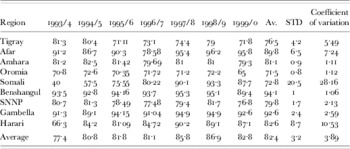
based on seven years of data, Table 1 calculates the degree of regional dependency; it shows regions' weak capacity to finance expenditures from their own sources. Dividing a region's own revenue by its total expenditure and subtracting this from 100% provides the percentage. The percentage decreases as regions cover more of their expenditure from their own revenue and become less dependent on subsidies from central government.
Regional government's degree of dependency (%)

Source: own calculation from regional budget data of various years.
Total average dependency grew from 77·4% in 1993/4 to 82·2% in 1999/2000. The standard deviation and co-efficient of variation for each region show little variation, with sustained dependency of all regions across time, indicating a lack of divergence in the regions' capacity to cover their expenditure from their own sources since the start of the decentralisation reform. Even in Somali Region, which shows less dependency at the beginning because of political instability in the area during the earlier period and absence of well-established regional administration, it tends to increase over the years.
Increased central control over overall public expenditure and revenue:
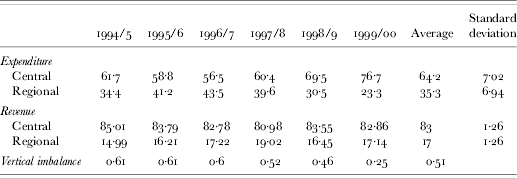
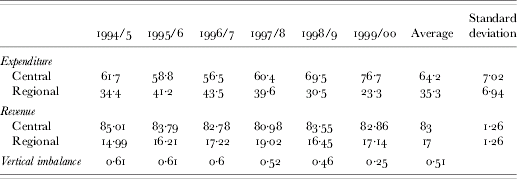
whilst the figures are aggregate and cannot discriminate intra-sectoral allocation, there are imbalances of economic and political power because the centre has the major share of overall public expenditure and revenue (Table 2). The centre controls more than 80% of aggregate revenue and more than 60% of expenditure, and the standard deviation shows little change during the seven-year period. The figures for the last two years indicate an increased central governmental share of expenditure. High vertical imbalance indices (regional expenditure over regional revenue) reflect regional incapacity to cover expenditure from their own revenue. The last two years' indices are low because of regional governments' lesser share of expenditure. Whilst this is a common phenomenon in many federal countries, Ethiopia's vertical imbalance (averaging 0·51) is relatively high by the standards of some federal countries. World Bank (2000:25) indices give this for Argentina as 0·03 (1995); Australia 0·24 (1996); Germany 0·15 (1996); India 0·28 (1995); Mexico 0·36 (1994); and South Africa 0·88 (1995).Footnote 8
Percentage share of expenditure and revenue
Source: own calculation from several years' central and regional budget data.
Growing trends of central control over social sector public expenditures:
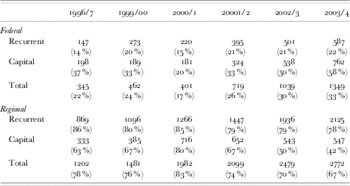
formally, the responsibility for educational expenditures is split between the centre (tertiary education and overall policy matters), and regions (pre-primary, primary, secondary, adult, teacher training, some junior colleges). Accordingly, regions are expected to shoulder the higher expenditure share. Table 3 shows that the regional shares of public expenditure in education are decreasing. The decreasing share of regions' capital expenditure also indicates that their decision-making power on capital projects is diminishing.
Centre–region share of budgeted educational expenditure (million birr)

Source: World Bank 2004.
The above countrywide indicators reveal that clientelism, which is mainly manifested by the unequal power relationship between the central and regional governments, has sustained both central governmental control over the share of total expenditure and revenue, and continuous regional government dependency on central transfers. This state of affairs also reveals that the clientelistic intra-party relationship has undermined the decentralisation reform, because it is not creating regional governments that are autonomous, accountable and responsive to their respective constituencies. Rather, decentralisation under clientelism effectively sustains upward accountability of regional governments to the central political leadership. This is maintained through patron–client relationships and by recruiting loyal political elites at the sub-national level who are subservient to the central leadership.
Clientelism leads to sustained similarities in intergovernmental fiscal relations among sub-national governments
In principle, decentralisation is expected to constrain central government intervention by empowering sub-national governments to develop and implement specific policies on expenditure needs and priorities, mobilise and administer their own revenues, and supplement their financial resources through central subsidies and borrowing from local banks. These intentions are also the main pillars of Ethiopia's decentralisation reform. Such decentralised arrangements should lead to horizontal imbalance or fiscal inequality among sub-national governments, because of differences in resource endowment and decentralisation-induced competition between sub-national governments. This imbalance should increase the ability of relatively well-off sub-national governments to raise more revenue and provide more or better public services than the poorer ones. Clientelism, however, subjects regional patrons to one-size-fits-all policies in expenditure and revenue assignment, and limits the possibilities for competition, experimentation and innovation between regional governments. Reducing fiscal inequality among regional governments has a political value as it provides the central political leadership (the patron) with the opportunity to promote the impression, for regional political elites and other observers, that its treatment of all regional governments is fair and balanced. Thus, the regional political leaders (the clients) can easily be convinced that they are given equal treatment or that there is an absence of lopsided distribution.
In Ethiopia, decentralisation not only maintains the horizontal imbalances that existed at the beginning of the decentralisation process, but also limits the ability of regional governments to increase their fiscal capacity. The field data collected from the centre and three case regions in 2003 and 2004 provides the following evidence.
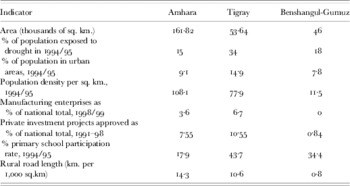
The three case study regions have socio-economic variations. Amhara, followed by Tigray, has the largest population, area and crude density. Urbanisation is highest in Tigray, followed by Amhara. Benshangul-Gumuz is least urbanised and has poorly developed economic infrastructures (telephone, postal services, electricity, access to roads, potable water, TV, etc.). Differences in farming systems, land fertility and degree of rural poverty are also prevalent. Land degradation is high in Amhara and Tigray compared to Benshangul-Gumuz. Tigray and Amhara have sedentary populations who follow a livestock–cereal subsistence farming system and use archaic oxen-ploughing farming techniques. Benshangul-Gumuz has a fertile rangeland, although the local people are semi-pastoralists who follow hoe-farming agricultural techniques.
These relative differences justify the need for decentralisation, but the following paragraphs show the extent to which the centre dominates the implementation of expenditure and revenue assignment, intergovernmental transfers, and borrowing. They indicate the extent to which regional political leaders (clients) are subjected to one-size-fits-all policies, and required to adhere to the directives given by the centre (patron) (see Table 4).
Expenditure and revenue assignments
The three EPRDF Development, Peace and Democracy midterm plans (1995/6 to 1999/2000; 2000/1 to 2004/5; 2002/3 to 2004/5) provide specific guidelines on expenditure assignments to all regions. The process of formulating these plans involved three main steps. First, the EPRDF executive committee members dominated by a few TPLF veterans and their advisors initiate major policy issues and develop detailed draft programmes. Second, the EPRDF central committee members, who are leaders of the EPRDF regional member parties, discuss proposed activities and targets and accept the same with minor adjustments. The central committee usually accepts ideas coming from a few top political leaders as absolute and unquestionable. Third, the centre passes the midterm plans to regions for elaboration and implementation.
The three regions had midterm plans with labels similar to the federal programmes, except the prefixes in the titles to indicate the name of the region to which the documents belong. In Tigray and Amhara regions, the development of the midterm plans follows similar processes. Regional top political leaders, who are involved in the discussions on EPRDF's proposed plans at the centre, carry the accepted documents to their respective regions for further discussion among regional political leaders, bureau heads and handpicked experts. Then, the regional executive body adopts the central directives and issues similar guidelines to the regional sector offices and the lower tiers of government. Unlike the Tigray and Amhara regional governments, advisors sent from the centre give direction and approval on the formulation of Benshangul-Gumuz medium-term plans.
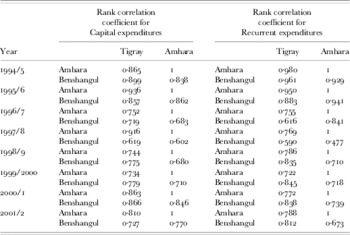
A closer look at regional expenditure prioritising (midterm and annual plans and budgets) in the three regions shows that this replicates the EPRDF midterm plans. Priorities in the agricultural sector follow activities and guidelines specified in national agricultural extension package programmes and the ‘white papers’ on rural development.Footnote 9 Expenditure assignments in education and health sectors in the regions strictly follow sector policies developed during the Transitional Government, and the National Education and Health Sector Development Programmes (ESDP and HSDP). These programmes, which have a 20-year span (1997–2016), are the bases for regional decisions on expenditure priorities in both sectors. The three regions' decision-making power when developing their respective regional ESDP and HSDP is slight, as they simply follow the national ESDP and HSDP, which specify expenditure goals, targets and indicators through two documents known as the PAP (Programme Action Plan) and PIM (Programme Implementation Manual). These indicate programme contents, financial requirements, budgetary and expenditure indicators, performance indicators, implementation guidelines (on governance, financial and procurement management, construction, rehabilitation and upgrading, distance between health posts and schools), and monitoring and evaluation procedures. In short, the top-down midterm plans and sector programmes are one-size-fits-all policies and directives, which give regional governments little discretion for setting their own expenditure priorities. The types of detailed activities indicated in the three regional midterm plans have marginal differences. Based on actual regional capital and recurrent expenditure data (1995–2002), the Spearman rank correlation coefficientFootnote 10 indices reveal lack of diversity in the pattern of intersectoral allocation of resources within the three regions (see Table 5).

Correlation indices

Source: own calculation from the annual regional budget data.
Whilst the measurement has some limitations as it is based on aggregate sectoral data, it shows no wide-ranging differences between regional governments in prioritising items of expenditure under capital and recurrent expenditure. The indices of correlation coefficient are all significant at the 0·01 level (2 tailed tests) and 0·05 levels (2 tailed tests). The latter is the correlation coefficient between Benshangul and Amhara for the recurrent expenditure in 1997/8.
Analysing the implementation of revenue assignment has its foundation in the process of decision-making on revenue bases and rates, administration and collection of revenue, and data on actual annual revenue collection. Regions have the formal power to levy and collect taxes on revenue sources reserved for them. The past decade witnessed the introduction of new taxes (value added tax, turnover tax, and taxes on bank deposits, rental income and capital gains), tax systems (the presumptive tax system and the withholding tax system), and various proclamations on tax rate amendments. The process of decision-making is similar in all cases: proposals are sent from the Prime Minister's Office to be read by the Speaker of the House to the House of Peoples' Representatives. The document is then referred to either the Legal or Economic Committee of the House for further analysis. After some time, the committee presents the original document again to the House for approval. Regional governments' direct participation in decision-making is minimal, even though they have to implement these decisions. In the past decade, all regions have ratified only one proclamation on the Rural Land Use Fee and Agricultural Activities Income Tax. Regions developed this proclamation under the instruction of the central government and based on the template designed by the Federal Ministry of Finance.
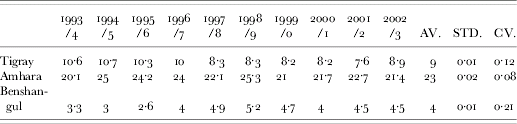
Own tax revenue collection from 1994/5–2001/2 in the three regional governments is similar, as the primary source of own revenue for the three regional governments is employee income tax. This was the leading source of revenue in all three regions, at 30% for Amhara, 29% for Tigray and 59% for Benshangul-Gumuz. Moreover, as Table 6 shows, in all cases regional annual revenue collection per capita is small.
Own tax revenue per capita (Eth. birr)

Source: own calculation from the annual regional budget data of various years.
Table 6 shows that revenue collection per capita averages birr 5 for Benshangul (€0·45), birr 8 for Amhara (€0·73) and birr 19 (€1·73) for Tigray. This has made regions heavily dependent on federal subsidies and contrasts with the received wisdom, that when sub-national units are responsible for a significant proportion of their overall resources, they act in a fiscally responsible manner. Some of the causes for poor revenue collection are:
● The central government's control over high revenue-yielding tax bases and its dominance over regions' decision-making power on revenue rates, bases and tax administration. The central government controls 83% of the total revenue in the country. As indicated in Table 2, the standard deviation (1·26) and co-efficient of variation (0·015), show sustained central government control over revenue sources.
● The central and regional political leadership have put no concerted effort into mobilising revenues. A closer look at the three EPRDF five-year development plans shows that the issue of revenue collection has not been given enough attention. There are no studies on revenue potential at the central and region level. A cynical informant from Amhara Region (an official of the region's Revenue Department, Bahirdar, January 2004) commented, ‘The issue of revenue is not a big concern at both levels of governments, since the centre is sure to secure funds from donors and the regions expect from the centre too.’ Only after 2002 was some effort made to overhaul the country's revenue administration system.
● Regional governments have little incentive to mobilise revenue from their constituencies. In addition to the central directives, the yearly annual transfer formulas do not encourage regions to put more effort into raising revenue; the weight attached to revenue raising effort in the transfer formula has been decreasing. In 1994/5 it was 20%, in 1995/6 and 1996/7 it was 33·3%, from 1997/8–1999/0 it was 15%; from 2000/1–2002/3 it was 11%, and in 2003/4 it went down to 7·3%. Moreover, at least until 2001, the revenue incentive factor built into the budget subsidy formula does not create a direct incentive for regions to generate own revenue. Rather it provided a disincentive for revenue effort because of the budget-offset system, which reduced regions' own revenue from the central transfer and penalised regions for raising more revenue (World Bank 2000).
Centre–region transfers
The analysis of the implementation of centre–region fiscal transfers considers the process of decision-making on transfer pool and transfer formulas as well as data on yearly subsidies. Determination of the distribution pool is ad hoc and follows annual budgeting processes. Usually, the federal Ministry of Finance and Economic Development (MOFED), in consultation with the Office of the Prime Minister, develops technical proposals for the distribution pool and submits these for approval to a committee of the Council of Ministers chaired by the prime minister. The decision at this stage is final. Subsequently, formal approval of the distribution pool passes through two additional levels: first to the full session of the Council of Ministers and then to the House of Peoples' Representatives. These bodies have never altered decisions on the distribution pool; regional governments have never been involved in the decision-making process or informed appropriately on such issues that determine their yearly subsidy.
Transfer formulae (indicators and weights) have been decided using two systems. Ad hoc transfer was in operation during the initial years, and formula-based allocation has been in use for the last decade. During the first three-year period (1993–95), there was little debate on the issue of fiscal transfer in the Transitional Council. Since 1995/6 and the establishment of the two houses of Parliament (House of Federation and House of Peoples' Representatives), the decision-making process has followed these procedures: (a) the Office of the Prime Minister instructs MOFED to develop the formula (the indicators and weights); (b) the Council of Ministers gives initial approval; (c) the House of Federation debates and approves the same; and (d) the House of Peoples' Representatives endorses it along with the approval of the annual national budget. During the past decade, there have been frequent changes in the formula and there were intense debates between members of the House of Federation and MOFED on inclusion and/or exclusion of indicators and sub-indicators, on weights assigned, and the accuracy and reliability of the information base. Whilst members' articulation of their regional demands has been encouraging, none of the changes accommodated their inputs. Thus, there were few differences in the yearly share of each regional government subsidy.
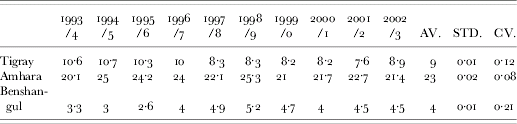
Table 7 shows that the formula based transfer (1996–2003) does not differ from the ad hoc approach (1993–95), as the standard deviation and the coefficient of variation is not very high. It reflects that the amount of yearly allocation to regions is determined using an incremental approach, and the central top political leaders decide along with the yearly distribution pools. Apparently, as earlier indicated, the main concern in the decision-making process is keeping afloat regional administrative machinery by covering recurrent expenditure, especially salary costs. Detailed analysis of sub-national borrowing is unavailable. Whilst regions have formally the power to borrow from domestic sources, no region has reportedly made such a request. Actually, instructed by the centre, regions once used their annual budget as collateral for providing farmers with credit facilities.
Regional percentage share of subsidy out of the distribution pool
Source: own calculation from the annual central government transfer data.
The above discussion shows that there is lack of divergence in fiscal performance between regional governments. The realities are not congruent with the country's formal pronouncements and assumptions of the theories of decentralisation. The above findings demonstrate that regional governments are neither autonomous nor accountable to their constituencies. The centre does not allow them to articulate and address regional interests; rather, they are required to implement central directives. As Assefa (Reference Assefa and Turton2006: 157) notes:
The central committee of the ruling coalition generates specific plans of action often through the chairman himself, which then form the basis of the EPRDF's five-year plan, to be implemented through out the country … Consequently, the constitutional right of the states to formulate and implement plans and policies is severely diminished by the fact that the state governments follow centrally designed policies and plans.
A study on Gambella provides parallel evidence. Derege (Reference Derege and Turton2006: 224) points out that:
Ever since the establishment of GPNRS (Gambella Peoples National Regional State), the federal government has been active in the political process. The overriding motive for its involvement, however, has been to ensure political control, rather than to facilitate the evolution of a political community that articulates a regional interest.
Maintaining traditional clientelism
Traditional clientelism refers to a situation where a dominant party within an ethnic coalition party provides favourable conditions or channels funds to its allies or a particular regional ethnic group in the country. In many cases, the central dominant party does not employ the formal mechanisms, indulge in outright traditional clientelism, or favour one ethnic group or its constituency while excluding others. As indicated under ‘features of clientelism’, the patron avoids lopsided distribution of resources. The Ethiopian case demonstrates that the TPLF, which controls the central political leadership of the EPRDF, has not officially given preferential treatment for Tigray region in terms of the formal expenditure assignment, revenue assignment or yearly subsidy transfers. The political leadership is apparently aware that such outright measures may incite conflict and resentment between the central political leadership (patron) and the loyal regional party leaders (clients). As pointed out above, the central political leadership is keen to maintain the horizontal imbalance as well as the similarities that existed at the beginning of the decentralisation process. The TPLF is also cautious that favouring Tigray openly would potentially lead to ethnic war or be exploited by opposition political elites to mobilise their constituencies against the regime.
Nonetheless, traditional clientelism between the TPLF and its constituency is maintained through different and unofficial patronage networks, including the parapartals, off-budget funds and non-transparent central government infrastructure allocations to regions. Revealing patronage systems through reliable and complete data is not possible, since such systems are secretive and may incite ethnic conflict. However, the following mechanisms indicate the new forms of TPLF patronage networks in Ethiopia.
The first such mechanism is the TPLF-owned large businesses. These are managed under a giant umbrella organisation, EFFORT (Endowment Fund for Rehabilitation of Tigray), and party-owned non-government organisations which are managed by the TDA (Tigray Development Association), the Dedebit micro credit and REST (Relief Society of Tigray). EFFORT manages the large manufacturing and service organisations operating in Tigray region, which are disguised as ‘endowment funds’, or party-owned businesses. As earlier indicated, the TPLF owns business enterprises that have an authorised capital of over birr 3·5 billion (€320 million). The major ones include Mesebo Building Materials Manufacturing SC, Almeda Textiles Manufacturing SC, Sur Construction Co., Trans Ethiopia SC, Addis Pharmaceutical Production SC, Sheba Tannery Factory and Mesfin Engineering. The TPLF claims that these organisations were formed by investing the capital contributed from the Tigray people during the struggle against the Derg. These parapartals appear to have preferential access to the central government's capital and other economic opportunities (Abbink Reference Abbink2006). An anonymous report (2003) indicates that by 2003, loans taken by these organisations from the three government-owned banks (Commercial Bank, Development Bank and Construction Bank) amounted to birr 1·5 billion for Mesebo, birr 800 million for Sheba, birr 1·2 billion for Almeda, birr 1·3 billion for Mesfin Engineering, birr 400 million for Addis Pharmacy, and birr 1·2 billion for Trans Ethiopia (roughly birr 6·2 billion or €563 million). These party-owned organisations headed by prominent party members are patronage mechanisms. As their manufacturing premises are located in Tigray region, they generate gainful employment and improve the life of some members of the ethnic group.
The Amhara regional ruling party, ANDM, has similar party businesses and NGOs, managed by its top party officials. The scale of operation of ANDM organisations is, however, small. They include Ambassel Trading House, Dashen Brewery, Zeleke Agricultural Mechanisation, Blue Nile Transport and others, and their estimated capital is birr 350 million (€32 million). Their access to government capital is also limited. The above anonymous report indicates that only Ambassel Trading House has taken a loan (birr 500 million or €45 million) from the government-owned banks. Benshangul-Gumuz has nothing at all except one microfinance institution.
The second is patronage through off-budget funding, which manifests itself through arbitrary and biased patterns of assignment of donor-funded projects to regions. Although difficult to document, the number of bilateral NGOs working in the three regions varies in size, mode of operation and the amount of funds they make available to the regions. Some studies, however, indicate the existence of such disparities. For example, the European Union (2001) partially confirms this disparity, stating that ‘off-budget donor and NGO expenditure is very important in Tigray, representing in 1998/9 and 1999/0 more than the regional Government's capital expenditure’. The study shows that the estimated off-budget donors and NGOs contribution for Tigray for four years (1997/8–2000/1) was birr 407·13 million (€37 million) (ibid.). A related study in Benshangul-Gumuz indicated that off-budget donor funding for five years (1996/7–2000/1) was only birr 70·34 million (€6·4 million) (ADB 2001). Regions also lack information on agreements made between donors and the central government, and the way donors select specific regions. Informants (officials in Bureau of Finance and Economic Development, Assosa, August 2003) from Benshangul-Gumuz state admit that the central political leadership influences donors' selection of regions. They pointed out that in Tigray, NGOs including Irish Aid, GTZ and Italian Aid, and in Amhara, SIDA and other international NGOs, contributed a good sum of money to regional economic development, whereas Benshangul-Gumuz has only a few financially weak NGOs.
The third is the non-transparent distribution of centrally funded service provisions such as transport, communication and energy infrastructures. No official and easy accessible documents are available that clarify the annual amount of central government financed infrastructure in the different regions. Such issues are ‘holy cows’, as they are openly discussed neither in parliament nor in public. At the 55th regular session of the House of Federation (Addis Ababa, June 1997), a member of parliament asked bluntly: why was the central government channelling more funds to build the infrastructure of Tigray? The premier's response was simply: ‘for individuals who consider a given ethnic group as an enemy, justice and equality is a bitter pill to swallow’. It is an open secret in Ethiopia that the EPRDF channelled a larger amount of central government funding to Tigray than to the other regions, under the pretext of reconstructing the war-affected region.
These are the new patronage mechanisms employed by the TPLF. As the system is secretive, it is difficult to document the impact of the new patronage network in Ethiopia on regional economic differentials, or to show which particular groups in Tigray society have benefited. Further study is required to measure the wealth/income gap between regional governments in Ethiopia and beneficiaries in Tigray. Nonetheless, some studies (EEA 2000/1: 126) reveal that compared to the two case regions, Tigray increased its share of both value added and employment in the manufacturing sector five-fold between 1995/6 and 1998/9, a leap mainly explained by the activities of party-owned manufacturing and service organisations operating in the region. Moreover, as is common in clientelistic regime settings, it is likely that the regional political and business elite who are loyal to the TPLF central political leadership are the main beneficiaries of the new patronage network.
* * *
The above discussion reveals that a clientelistic intra-party relationship in Ethiopia has undermined the virtues of decentralisation (allocative and production efficiencies, accountability, responsiveness, etc.). The unequal relationship, the exchange transactions, the party discipline and evaluation mechanism sustain central government dominance over sub-national governments in expenditure and revenue assignment. Whilst the case study regions have relative variation in their socio-economic conditions, they have been subjected to one-size-fits-all policies developed by the central political leadership. This has led to the lack of marked differences between regional governments in expenditure planning and revenue mobilisation, dependence on central government subsidy, and sub-national borrowing. The TPLF makes sure that both the regional political leaders and the populace have the feeling that there is no special treatment for any region, especially for Tigray, as far as formal or documented fiscal performances are concerned. However, new patronage or unofficial mechanisms for maintaining traditional clientelism exist. Regional political leaders cannot raise issues concerning the new patronage mechanisms as this would endanger their political position. In short, in Ethiopia, decentralisation has failed due to the clientelistic relations between central and regional political leaders; it also provides a lesson on the importance of linking the de facto centre–region political parties' relationship with intergovernmental fiscal relations reform in order to measure and explain the progress of decentralisation reforms in many sub-Saharan African countries.