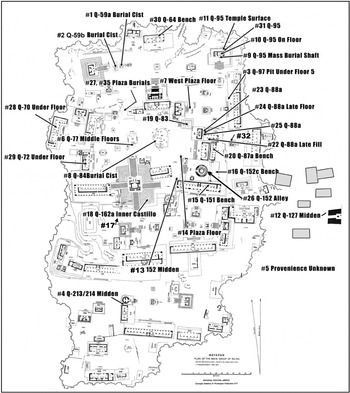
We present new data here concerning the Late Postclassic chronology of Mayapan, based on 38 new radiocarbon dates and associated ceramic samples. Radiocarbon samples include those collected by the Carnegie Institution, in addition to samples collected in recent excavations in the monumental center by Peraza's Instituto Nacional de Antropología e História (INAH) project (Figure 1). Five of the samples are from our joint investigations in the city's settlement zone outside the site center. All radiocarbon dates were calibrated using the OxCal v3.9 program available on the Internet (Ramsey 2003). This chronological analysis provides new information about the temporal framework for the rise of Mayapan to power during the Late Postclassic period by dating key architectural features and events that marked the settlement's development. These data also imply violent conflict within the century prior to the city's abandonment.
Prior interpretations that the founding of Mayapan began by at least the twelfth century a.d. were based on ceramic evidence and the presence of multiple construction episodes in the site's major buildings and plazas (Milbrath and Peraza 2003). Carnegie ceramicist Robert Smith (1971) defined two ceramic phases with some overlapping types, Hocaba and Tases, based on frequencies of pottery in early, middle, and late lots at the site. The Hocaba phase, according to Smith (1971), began around a.d. 1200, although Milbrath and Peraza (2003) argue for earlier beginnings by at least one century, which would make the Late Postclassic more in line with dates recovered from southern lowland sites, with pottery assemblages that are dominated by type groups that are similar to Mama Red and Navula Unslipped (Masson 2000:56–57; Masson and Mock 2004; Masson and Rosenswig 2005).
Our results supplement a recent chronological and historical synthesis published by Milbrath and Peraza (2003) by providing absolute dates and quantitative ceramic analysis. The chronology of late sites in Yucatan is recently under reconsideration (Andrews et al. 2003; Bey et al. 1998; Milbrath and Peraza 2003; Ringle et al. 1998; Robles and Andrews 1986), and this article provides important evidence regarding the late end of the sequence. Of particular interest to Mesoamerican scholars is the temporal framework for the end of Chichen Itza's regional dominance and the relationship between the fall of this site and the rise of Mayapan to a primate position in northwest Yucatan. Scholars have long thought that some overlap in the occupation of these two sites was likely, particularly that a Puuc period occupation was present at Mayapan prior to its emergence as a major Postclassic center (Milbrath and Peraza 2003:8; Pollock 1962:8; Proskouriakoff 1962a:92; A. Smith 1962:264). Temporally ambiguous ethnohistoric sources allude to founding events that link Mayapan, Chichen Itza, and other cities (summarized in Pollock 1962; Roys 1962; Masson 2000:Table 6.8), although these accounts do not claim that these places were of equal contemporary significance. Evidence at Mayapan that led Shook (1954a:90) to suggest the presence of a prior Puuc “city” in the vicinity consists of traces of earlier ceramics in Mayapan lots and the presence of recycled pieces of cut stone blocks or a sculpture of Puuc style found in later Postclassic architecture. This sculpture includes two entire mosaic masks that framed the front of colonnaded hall Q-151 (Milbrath and Peraza 2003:8). Aside from this context, two other investigated structures had high numbers of recycled Puuc decorative stones, the R-85–R90 palace group (Proskouriakoff and Temple 1955) and the Z-50 group at the southern terminus of the principal sacbe (Pollock 1956a), although neither assemblage seems to represent a reconstructable mask.
Of key interest is the size and importance of any preceding settlement prior to the Postclassic at Mayapan. The Terminal Classic Period in northern Yucatan extends from around a.d. 800 to a.d. 1000, although at some sites, this period can begin within the eighth century or extend into the eleventh century (Rice and Forsyth 2004:Tables 3.3c, 3.3d) While Terminal Classic pottery is present in some lower lots at the site, these sherds are overwhelmed numerically by Postclassic material and rarely form more than 2% of most lots excavated at the site (Pollock 1962:6). Key lower lots in a Main Plaza trench described by Shook (1954a:90) that pertain to this question had only 4.2% “Puuc” (Terminal Classic Period Cehpech sphere) sherds; this proportion was calculated by tabulating the ceramic frequencies reported in the lot descriptions of Shook's report. As Pollock (1962:6) and Proskouriakoff (1962a:92) observed, not a single building remnant dating to the Terminal Classic period was ever found in the extensive Carnegie investigations, leading them to downplay the size and importance of any occupation preceding the Postclassic at Mayapan.
Our own ceramic analysis of 140,292 sherds from 101 test pits and 96 surface collections outside the site's monumental center indicates that the walled portion of Mayapan contains predominantly (96%) Late Postclassic pottery; only 3% of this sample is Terminal Classic. Earlier periods form less than 1% of the sample. There are only four contexts inside the city with significant proportions of Terminal Classic pottery (>50%), and three of those are located near the Itzmal Ch'en Cenote group at the far eastern end, including Milpa 17. The Itzmal Ch'en and X-Coton cenotes are the largest water-bearing cavities at the site, and they were likely attractive for Terminal Classic occupants (R. Smith 1953).
In a few contexts at Mayapan where Carnegie investigators worked, higher proportions of Terminal Classic sherds are reported. The contexts where these sherds form the majority of pottery recovered are not within the monumental zone, with one exception, a bedrock depression near the Q-69 shrine. However, Adams (1953:150), who excavated this feature, did not report exact quantities. Another notable context is the lower two levels of passageway fill behind the Templo Redondo, which had as much as 20% Terminal Classic sherds (Milbrath and Peraza 2003:7), although most of the sherds recovered were Postclassic. Sherds of this period also “predominated” (not quantified) in a burial in Structure J-49a (Ruppert and Smith 1952). Other abundant contexts are found along the east edge of the city wall (Smith 1953), notably within a sealed burial cave in Cenote X-Coton (81% Terminal Classic, with one complete vessel). This is the only quantified context that yielded a majority of Terminal Classic sherds at Mayapan. Other contexts with higher frequencies than observed elsewhere at the site include the fill of a shrine structure inside Cenote X-Coton (16.9%), as well as the fill of a nearby surface temple, T-70 (20.5%, Shook 1953). Fill of one structure (H-18) of the Itzmal Chen group (near Cenote Itzmal Chen) also had up to 13.5% Terminal Classic pottery (Chowning 1956). These fill lots suggest the use of Cehpech domestic refuse in construction fill in this vicinity, and they attest to prior occupation that may have clustered around these two major cenotes, the largest ones at the site. In summary, the earlier pottery suggests that scattered residents lived in the Mayapan area prior to the Postclassic period, but the presence of a prior city of any magnitude is not indicated.
THE SAMPLES
The Carnegie Mayapan Project radiocarbon samples described below (Table 1, Figure 2) were collected during the 1953 season by Shook, Adams, Stromsvik, and Pollock, whose names appeared on the labels. These samples were in the possession of Carlos Peraza at the Centro Instituto Nacional de Antropología e Historia (INAH)–Yucatan office, with their original labels, which were occasionally eroded or incomplete. We chose to date some of these samples because they represent key contexts from the site center, and the copal and charcoal were abundant and well preserved. Some of the Carnegie samples are unlike those available from the INAH project, in that they were found at different depths and locations beneath structures, and were of potential earlier age. Fourteen Carnegie samples were dated using regular 14C dating techniques (by the Isotope Geochemistry Laboratory, Department of Geosciences, University of Arizona), including five copal samples and nine charcoal samples. An additional nineteen samples were selected from Carlos Peraza's INAH excavations. Three of those were copal, and the others were charcoal. Six were dated using AMS (Accelerator Mass Spectrometry), and the others with regular dates (Table 1). Five additional dates were submitted from contexts in the site's settlement zone, outside of the monumental center (Table 1, Figure 3).

Mayapan's monumental center showing structures with radiocarbon dates. Modified from Proskouriakoff (1962b:map inset).

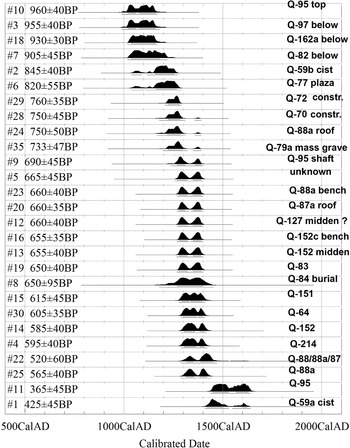
OxCal plot of selected calibrated radiocarbon date ranges of samples discussed in text (samples numbers shown in left column). Modified from Ramsey (2003) OxCal program shared on the Internet.
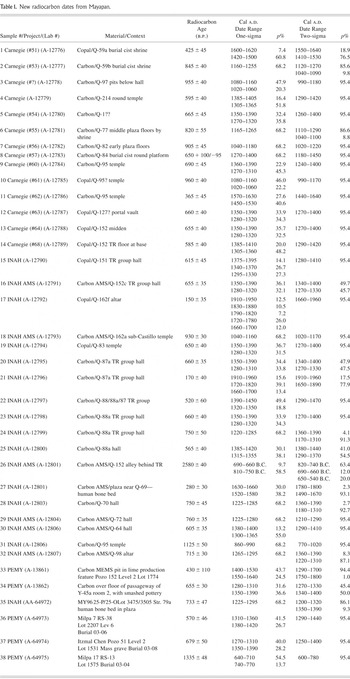
New radiocarbon dates from Mayapan.


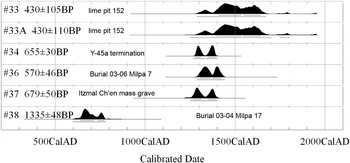
OxCal plot of calibrated radiocarbon date ranges from the settlement zone. Modified from Ramsey (2003) OxCal program shared on the Internet.
Our dates overlap with three published by the Carnegie Institution (Pollock 1956b, 1957): 700 ± 95 years b.p. (GRO 452), 335 ± 90 years b.p. (GRO 450), and 400 ± 55 years b.p. (GRO 1166). Calibrating these results with OxCal, they date to a.d. 1150–1440 (95.4%), a.d. 1470–1850 (93.4% or 1900–2000, 2%), and a.d. 1420–1640 (95.4%), respectively. GRO 452 comes from early plaza floors near the sub-Castillo Q-162a (Pollock 1962:8), yet its high range reaches into the fifteenth century. This sample's 95.4% probability range spans most of the Mayapan period, thus rendering it not particularly helpful. GRO 450 postdates Mayapan, and its maximal range extends into the industrial age; it may be invalid. GRO 1166 may also postdate the site's occupation or date to its final decades. These dates run by the Carnegie are thus not useful, and understanding Mayapan's chronology is greatly aided by the new dates discussed below.
All radiocarbon dates were calibrated using OxCal v3.10 (Ramsey 1995, 2001), a program available on the Internet (http://c14.arch.ox.ac.uk/oxcal.php). We used the IntCal04 calibration curve (Reimer et al. 2004). Table 1 lists the samples with information on their provenience and their calibrated dates with one-sigma and two-sigma ranges.
Figures 2 and 3 graphically present a sample of our calibration results from the monumental zone and the settlement area outside the center. The probability distribution for each sample is displayed, along with brackets from the one-sigma and two-sigma ranges on these graphics and in Table 1. The upper brackets indicate the one-sigma ranges (68.2% probability) and the lower brackets indicate the two-sigma ranges (95.4% probability). Many of the probability distributions have multimodal distributions that generate multiple data ranges at one-sigma, two-sigma, or both probability levels. Multimodal distributions result from fluctuations in the calibration curve, and Postclassic Period dates generally have two or more calibration ranges as a result of the peak in the curve around a.d. 1470 (Struiver and Kra 1986; Struiver et al. 1993; Reimer et al. 2004). Because of the nature of the probability distributions of calibrated dates, interpretations should be based on ranges and modes, not calibration-curve intercepts. Hence, we use the probability method implemented by OxCal to the calculate date ranges that are evaluated below.
DATES, CONTEXTS, IMPLICATIONS
Middle Preclassic Date
Charcoal collected from alley fill between the site's Templo Redondo (Q-152) and an adjoining hall (Q-152c) yielded a calibrated Middle Preclassic date of 540–820 b.c. (Sample 26, Table 1). As the majority of pottery in this fill was of Postclassic date, we infer that this sample represented old charcoal that predated the context in which it was found.
Terminal Classic Dates
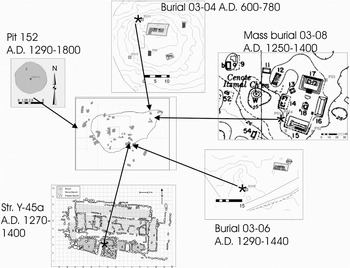
Sample 38 is from a burial found on bedrock within the houselot soils of a Postclassic solare in Milpa 17 (Figure 4, Table 1); it dates to between a.d. 600 and a.d. 780, within the Late and Terminal Classic Periods of Yucatan. Midden samples from test pits in this milpa indicate a Terminal Classic occupation in the area prior to the construction of later Postclassic houselots, although no pottery was found with the burial. The burial was only partially excavated as it intruded into the wall of a 1 × 1m unit; it appeared to be a secondary interment as the bones were not in an articulated position.

Location of contexts with radiocarbon dates located outside the monumental center. Two-sigma date ranges are listed (95.4%). Burial 03-04 (Milpa 17) is a Late or Terminal Classic Period interment beneath a Postclassic houselot, and Burial 03-06 (Milpa 7) is a late interment in a Postclassic houselot near the city wall. Dates from the Itzmal Ch'en mass grave (Burial 03-08) and burned offerings made at the abandonment of Structure Y-45a, an elite residence, reflect violence and destruction at the city prior to a.d. 1400. Pit 152 tested a probable circular lime production feature.
One other Terminal Classic result is represented by Sample 31, with a range of a.d. 770–1020. This charcoal came from upper floors of Temple Q-95 (Figure 1). As interior features and construction fill of the temple, as well as its upper floors, are of Postclassic age, this charcoal is presumably not associated with the context from which it was recovered.
Early Facet Late Postclassic Dates of the Eleventh and Twelfth Centuries a.d.
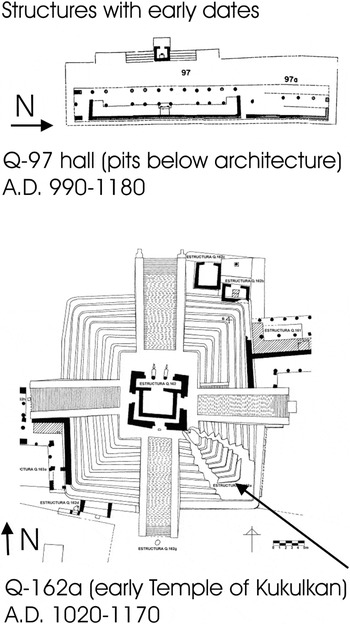
Three dates in particular provide ranges that fall into the early frame of Mayapan's occupation (sample numbers 10, 3, 18, Figures 1 and 5). The ranges of these dates fall within a.d. 990–1170. Two of these samples are from inexact contexts, as complete information from the Carnegie Project was not available on the surviving labels.

Structures with early radiocarbon dates. Illustrations of Q-97 from Proskouriakoff (1962b:map inset) and Q-162a from (Delgado 2004:Figure 29). Sample from Q-162a is in construction fill beneath this early building shown in the interior of the southeast corner. Date ranges are two-sigma (p = 95.4%).
Sample #10, burned copal, was collected from between floors in front of an east room and altar of an unknown structure in the monumental center, according to the sample's label (Table 1). The actual number of the structure had eroded from the label, but its designation from the “Q” square of the monumental zone was legible. According to its label, this sample was collected by Shook in 1953, and a perusal of his excavation reports (Shook 1954b:270) for that year reveals a description of floor excavations for the east room of Temple Q-95, el Templo del Pescador (Fisherman Temple), where a 4-cm layer of copal covered the floor in front of the altar. The floors of the east room, according to Shook, had been refinished multiple times. If the sample label is correct, the copal is from one set of these floors (the exact number of floors is not provided), and not the thick layer of copal referred to on the surface in his report. The two sigma calibrated range is a.d. 990–1170, which suggests that the temple was built and in use early in Mayapan's history. Shook's (1954b) report generally confirms this, and the east room could have accumulated debris, particularly resinous copal, over a long period. Other dates (discussed later) indicate the use of this temple until the city's end. Specifically, the burial shaft (Sample 9, below) reveals a date in line with the latter half of Mayapan's occupation, and a third date (Sample 11) from the upper floor suggests very late use of this structure. The temple's substructure and surface material may be mixed in this lot, as Proskouriakoff (1962a:109) suggests portions of the later temple were never completed. There is also the possibility that our detective work is off track and Sample 10 is not from Q-95.
Sample 3, also collected by the Carnegie project, came from occupation levels beneath one of the center's colonnaded halls, in a pit under “Floor 5,” according to the label (Table 1, Figure 5). Although no structure number was legible on the sample, the lot number and context descriptions match colonnaded hall Q-97 (Shook and Irving 1955). This context is quite valuable as it suggests that the date reflects occupation activities predating the construction of one of the city's buildings. Sample 3's range extends from a.d. 990 to a.d. 1180.
Sample 18 has a similar range (a.d. 1020–1170). Collected by Peraza's INAH-Mayapan Project in 1997, it comes from a key context, an early construction phase of the site's main pyramid, Q-162a (El Castillo de Kukulkan). This phase, the fourth beneath the structure's final form, is one phase earlier than that of the remarkable Structure Q-162a (Table 1, Figure 5), on which was found a stucco façade of skeletal warriors. The stucco façade is associated with the second or third building phase of the earlier Castillo temple. Although the origins of this charcoal are not entirely clear (it is from construction fill), the date is congruous with its context, a very early architectural feature at the city. If the charcoal is contemporaneous with the construction episode, an earlier phase of Structure Q-162a was likely built during the eleventh or twelfth centuries a.d. Milbrath and Peraza's reconstruction (2003:Table 1) places this structure in the twelfth or thirteenth centuries a.d., in possible agreement with Sample 18 (or later).
Considering these results together, it appears that two temples (Q-162a and probably Q-95) were present in the eleventh-twelfth centuries, while a hall (probably Q-97) was not yet built but the area was occupied. Unfortunately, we cannot determine the century in which these features were built—the eleventh century precedes the traditionally assigned range of Mayapan's occupation, but the samples could as easily date to the twelfth century. One of Mayapan's stela k'atun dates was placed by Morley at a.d. 1185 (Proskouriakoff 1962a:135), suggesting that the site's rise to power began during the twelfth century (Masson 2000:Table 6.8). Radiocarbon dates from Postclassic Belize sites (Masson 2000:Table 3.3) also suggest that polities using pottery that is generally similar to Mayapan's common utilitarian-type groups of Mama Red and Navula Unslipped had developed by the twelfth century.
Ranges Extending from the Eleventh or Twelfth–Thirteenth Centuries a.d.
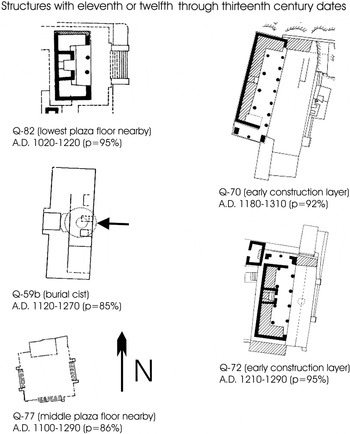
Sample 7 ranges from a.d. 1020 to a.d. 1220 (95.4% probability). It is from the lowest plaza floor detected along the east base of Structure Q-82, a temple located at the northeast corner of the Main Plaza (Figure 6). This structure faces away from the plaza and forms a court space with a shrine (Q-89), a large colonnaded hall (Q-97), and temple Q-95. Nine construction phases were detected for Q-82 in Carnegie excavations (Shook 1954b) that postdate this sample. Shook's description reveals that the plaza floor sealed a midden rich in charcoal, ash, and debris from which this sample was likely taken. Ceramics from the structure itself included 95% Late Postclassic pottery. Like Sample 3 described above, Sample 7 probably reflects occupational debris in the site center prior to the construction of architecture during the first part of the Postclassic Period in this location.

Structures with dates from the eleventh or twefth through thirteenth centuries. Illustrations of Q-82 and Q-77 are from Proskouriakoff (1962b:Map inset), Q-59b is from Shook (1954b:Figure 1), and Q-70 and Q-72 are from Delgado (2004:Figure 8). All dates listed are two-sigma ranges, with probabilities shown.
Samples 2 and 6 have nearly identical ranges (a.d. 1040 to 1270/1290), and there is a high probability (85.6%, 86.6%) that these samples date to the twelfth or thirteenth centuries (a.d. 1120/1110–1270/1290). Sample 2 consisted of charcoal associated with a cist burial found in one of three small shrines (Q-59b) in front of “El Crematorio,” a burial shaft temple (Q-58) that forms a key element of the north plaza of the site center (Figures 1 and 6). Three shrines extend in front of Q-58, aligned with its central staircase, including Q-59 (superimposed over Q-59b), Q-59a, and Q-60 (Proskouriakoff 1962a:100). Shrines Q-59/59b and Q-59a were both originally round, with burial cists. They were later remodeled to become square and rectangular small platforms, respectively.
Proskouriakoff (1962a:101) notes that Q-59a was the earliest of these shrines and that Q-59b was later, and Shook (1954b) presents the same sequence. Our dates conflict with this interpretation. One of the latest dates for the site (most likely representing the fifteenth century, Sample 22, discussed below) comes from copal in the cist burial in Q-59a. If the charcoal from Sample 2 is truly associated with the burial in Q-59b, then this burial is earlier than Q-59a. Both burials, however, are likely earlier than the square and rectangular shrines constructed over them. Given their similar location and association with small round platforms, we are surprised that their dates are not closer in time. We lament not having better information on the samples themselves and their relationships to the cist features.
Sample 6 is probably from a middle stratigraphic context, between the eighth and ninth floors above bedrock of the main plaza in the Castillo court next to a square shrine, Q-77 (Adams 1953: Figure 6). While Carnegie notes taken by Adams on the sample label itself claim it came from between the tenth and eleventh plaza floors, the lot number given, C-42, is described as coming from the eighth and ninth plaza floors in the Current Report describing the excavation (Adams 1953). Although this contradictory information makes it impossible to know from which floor the sample was taken, it is likely from between a set of the middle or upper floors of the plaza. Eleven or 12 superimposed floors of the main plaza were detected by Adams at this location (1953:156), although near the Castillo, up to 13 floors are mentioned (Shook 1954a). Sample 6 thus helps date the construction of later floors near Q-77 to at least the twelfth or thirteenth century (a.d. 1110–1290), if not earlier (Table 1, full two-sigma range is a.d. 1040–1290). It is difficult to know how often floors were resurfaced, but in this area, at least seven floors are earlier than Sample 6, and Milbrath and Peraza (2003:38, Table 1) argue for an early date for Structure Q-77 itself, which they state was built along with the initial Main Plaza floor.
Two samples have ranges from the twelfth century to the fourteenth century (Samples 28, 24), which extend from a.d. 1180/1170 to a.d. 1390. A much tighter date is Sample 29, limited to the thirteenth century (a.d. 1210–1290). A higher two-sigma probability exists that Samples 28 and 24 do not extend beyond a.d. 1310 (Table 1, 92.7%, 91.3%). These samples are thus comparable to Samples 2 and 6 above that represent primarily the twelfth and thirteenth centuries, or the earlier half of Mayapan's Late Postclassic occupation. Sample 32 is in the same general range (a.d. 1220–1390). Two of these dates provide a sound fit for our expectations with regard to their contexts, as Samples 28 and 29 come from internal construction episodes in two colonnaded halls of the site center, Q-70 and Q-72, respectively. Sample 29 comes from the fill at the base of hall Q-72, suggesting its construction dates to the thirteenth century, in the first half of Mayapan's sequence (Figure 6). Sample 28 comes from an internal floor of hall Q-70 in front of the central altar and indicates that the hall was being refurbished before 1390, or at a time up to 200 years prior to this date.
Sample 24, did not meet our expectations. It comes from burned roofing material over the final floor of hall Q-88a (Figure 1), at the north end of the Templo Redondo complex (Peraza et al. 1999), and thus it represents an exceptionally good context for dating. The roof of this building was burned, resulting in the structure's abandonment. This date suggests this structure was completed, occupied, and destroyed prior to a.d. 1390 (and probably by a.d. 1310), despite our initial suspicions that the building was burned at the site's abandonment around a.d. 1441. It is difficult to imagine the continued operation and occupation of the Templo Redondo compound, one of the major ceremonial and administrative groups of the site center, with a burned, ruined building in its midst, yet this possibility must be considered. The discussion below of additional dates for the burning of Q-88a (Sample 25), and especially nearby Q-87a (Sample 20), make this plausible, although Q-88a's destruction could also date to the city's fall.
Thirteenth–Fifteenth Century Date Ranges
Four samples from the settlement zone outside the monumental center have dates extending from the thirteenth century or later (Samples 33, 34, 36, and 37). At least three of these are definitely contemporaneous with Mayapan (Figure 4). A burial was found in a commoner houselot neighborhood in Milpa 7, adjacent to the southeast portion of the city wall. No grave goods were recovered, and preservation was poor, but the grave included an adult that may have been a female as the teeth of a very young child were also found. Sample 36 dates the human bone of this adult to a.d. 1290–1440. As the architecture of this area is associated with a low density of artifacts, we have inferred that this area was settled, briefly, late in the site's history (Masson and Peraza 2005:415). The date of Sample 36 provides support for the model that Mayapan's urban growth extended outward from the center to its margins through time. More samples are needed to evaluate the chronology of Mayapan's Postclassic settlement, however.
A probable lime plaster production facility was documented in Transect 2 (Russell 2004; Russell and Dahlin 2006), about 700 m to the west of the city wall (Figure 4). This large circular depression was filled with carbonized wood, some of which was submitted (Sample 33) for dating with the result of a.d.1290–1700 (94.4% probability, with a 1% chance of falling between a.d. 1750 and a.d. 1800). This feature may be contemporaneous with Mayapan, and the city utilized much lime in the construction of plaster floors and façades. However, we cannot positively confirm its association with the city based on this date range, which extends into the Colonial Period.
Two dates from the settlement zone shed light on abandonment and conflict linked to the city's last years of occupation (Samples 34 and 37). Sample 34 was carbonized wood burned on the floor of Room #2 of Structure Y-45a, an outlying upper status residence located in Milpa 6 near the south portion of the city wall (Figure 4). Broken pottery vessels were placed on the floors of Rooms 1 and 2 of this building immediately prior to abandonment; the rooms were filled with rubble after the vessels, presumably representing the residents' pottery assemblage, were broken over the floors. Sample 34 dates from a.d. 1270–1400, suggesting that this building was abandoned prior to Mayapan's historically documented collapse around 1441. Ironically, a vessel bearing the glyph of K'atun 8 Ahau (a.d. 1441–1461) was found on the floor of Room 1, which led us to presume that Structure Y-45a was abandoned when the city fell. Sample 34 suggests that it may have been abandoned earlier, and offers disjunctive evidence against our suppositions based on the glyph. Below, we describe more evidence for violence affecting Mayapan prior to K'atun 8 Ahau.
Test pits off of the southwest edge of the platform of the Itzmal Chen outlying ceremonial group revealed a mass grave of butchered and burned human remains (Figure 4). Within two 1 × 2 m adjacent pits, we recovered teeth and bones representing at least seven individuals, along with numerous smashed Chen Mul incense burners presumed to belong to the deceased. This human bone bed extended in all directions from the parameters of our test units. Sample 37 represents a piece of human bone from this deposit, and it dates to a.d. 1250–1400. We expected this deposit to be related to the city's reported collapse in K'atun 8 Ahau in the fifteenth century, but this date suggests the act of violence occurred earlier. Either the individuals associated with Itzmal Chen were massacred prior to the city's ultimate fall, or the patrons of Itzmal Chen themselves engaged in acts of warfare and sacrifice in a manner similar to that documented for plaza and burial shaft mass graves in the city's center. The central plaza shrine of Itzmal Chen, a round structure (Structure H-18), had a small shaft that contained multiple graves (Chowning 1956:446); this feature parallels, on a smaller scale, the burial shafts of square temples Q-95 and Q-58 of the Main Group. Mass burial, probably sacrifice, is a behavior that potentially links Itzmal Chen's burial shaft with the deposit along its southwest platform. Dates from a mass burial in the site's Main Plaza, described below, similarly precede the final collapse of the city.
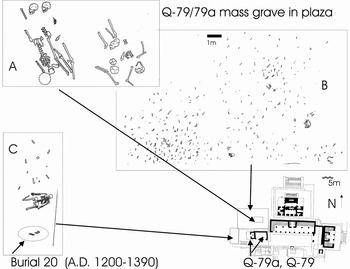
Sample 27 is from an ash zone filled with hastily buried human skeletons just outside the northwest corner of the Main Plaza (Figure 7). Adams (1953) first encountered this deposit to the north and west Structures Q-79 and Q-79, and east of Q-69. This area was further explored by Peraza and colleagues (2002). Burials found by Adams (1953:145) were articulated, and three burials had large flint knives embedded in either their rib cage (N = 2) or pelvis (N = 1), attesting to their violent deaths. Further interments uncovered by Peraza et al. included partly articulated and disarticulated individuals. This human bone bed is present within 30 cm of the site surface and is within a zone of ash. Adams (1953:146) offered that these were victims killed in a final defense of the site center when the city was overthrown, or were perhaps sacrificial victims connected with a different event. Our dates now imply that this latter interpretation is correct. Portions of smashed Chen Mul censers were mingled with the bodies, as was also observed for the Itzmal Chen bone bed described above. Landa (1941:120) described a practice of placing burials in plazas; however, burials are found in a great variety of contexts at Mayapan. We submitted a human bone sample from Burial #20 (Sample 35) of the Q-79/79a bone bed, which dates to a.d. 1200–1390. This date precedes the city's reported demise between a.d. 1441 and a.d. 1461, and overlaps with the range reported from the Itzmal Chen deposit. Sample 27 is also from this deposit, but this charcoal from the ash lens covering the burials likely postdates the feature, as the range postdates the city's occupation (a.d. 1490–1800). We feel that the date on human bone from Burial #20 is more accurate.

Mass human grave just outside northwest entrance to Main Plaza. Illustrations are modified from (a) Adams (1953:Figure 1), and (b, c) Peraza et al. 2002:Figure 57. Illustration of Q-79a/Q-79/Q-81/Q-80 group is from Delgado (2004:Figure 18). Two-sigma ranges listed (95.4%).
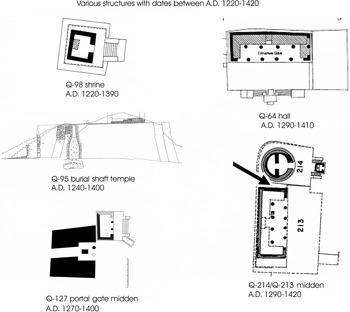
Thirteen dates have ranges that extend between a.d. 1240 and a.d. 1420 (Samples 9, 23, 20, 12, 16, 13, 19, 5, 15, 30, 4, 14, and 25, Figures 8 and 9). One other date, Sample 8, has a large range that is essentially useless as it extends from the twelfth to the fifteenth centuries. Sample 8 is a from a cist burial in circular “monument” platform Q-84 of the Main Plaza (Proskouriakoff 1962a:106). Adams (1953:160) notes that the burial was present in a late construction extension to the structure, so the later range of this date is probably more reliable (Figure 8).

Miscellaneous structures with dates between a.d. 1220 and a.d. 1420. Illustrations of Q-98 and Q-64 are from Delgado (2004:Figures 57, 38), Q-213/214 is from Proskouriakoff 1962b:map inset, Q-95 is from Shook (1954b:Figure 4), and Q-127 is from Stromsvik (1953:Figure 1). Two-sigma ranges listed (95.4%).

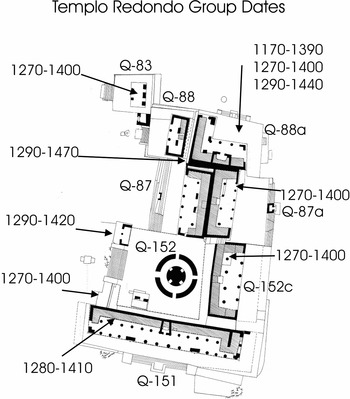
Templo Redondo Group structures with dates between a.d. 1270 and a.d. 1470. Illustration is modified from Delgado (2004:Figure 22). Two-sigma date ranges provided (95.4%).
The samples from Mayapan's final 200 years of occupation come from a variety of contexts that were built and used during Mayapan's height of power. Sample 32, slightly earlier than the other dates, falls between a.d. 1220 and a.d. 1390. It is from Q-98, a shrine (Figure 8). The shrine lies between the Templo Redondo compound and hall Q-99 (Figure 1). The charcoal was from internal levels of the shrine (Cuadro 5-F, Lot 8455).
Sample 9 (charcoal, a.d. 1240–1400) was collected by Carnegie investigators from the burial shaft of Temple Q-95 (Templo del Pescador), located outside the northeast corner of the Main Plaza (Figures 1 and 8). Over forty skeletons of children and adults were found in the shaft of this temple, along with much charcoal and ash. Shook (1953:271) thought that they were sacrificed on the tapered stone altar in front of the temple. The location of Sample 5 is not known, except that it was from a cist burial probably excavated in 1953 by Shook, who collected the sample from a monumental zone context.
Sample 23 is from the Q-88a hall of the Templo Redondo compound, from fill inside the structure's bench (Figure 9). Note that this date is later (a.d. 1270–1400) than that described above for Sample 24, providing evidence that Sample 24 does not accurately date the final burning event of the structure. A third date for Q-88a (Sample 25) dates to a.d. 1290–1440, and this sample is from materials that formed part of its burned roof. Logically, Sample 25, from the burned roof is later than Sample 23, from fill inside the bench. The upper range limit of Sample 25 makes it possible that this event dates to the fall of the city, but the 150 year range could also reflect an earlier occurrence. The date for Q-87a's destruction, described below, implies that Q-88a may also have been destroyed prior to a.d. 1440.
Q-87a was also burned around the same time, and it is also part of the Templo Redondo compound (Figure 9). Sample 20 (from the burned surface matrix of Q-87a) suggests this likely occurred in the fourteenth century (or the final two decades of the thirteenth century, a.d. 1270–1400). The terminal context of Q-87a's deposit implies that the later years of this range are more accurate. However, if this date is reliable, it would indicate destruction of Main Plaza buildings prior to the city's purported fall after a.d. 1441. We now know that at least mass burial events also pre-date the city's termination. Together, this evidence implies that the final century or so of Mayapan's occupation involved violent conflict.
Sample 12, copal from a midden probably associated with northeast side of Structure Q-127 (Figures 1 and 8), also has a range primarily encompassing the late thirteenth or fourteenth centuries (a.d. 1270–1400). There is confusion concerning this context, as the sample label attributes it to a midden to the northeast of Structure Q-128b and indicates that it was collected in 1953. However, the Carnegie Institution never reported an excavation of Q-128b, and Structure Q-127 was excavated during 1953 (Stromsvik 1953). To the northeast of Structure Q-127, a midden was found in which much copal was present. As the sample label identifies this copal as coming from a “northeast midden” with a similar structure number, it might in fact be from Q-127 (Figure 8), a portal vault next to a small shrine (Q-127a) that represented a major interior entrance to the east side of the monumental zone (Shook 1955:267).
With a date range similar to that of Sample 12, Sample 16 dates hall Q-152c of the Templo Redondo compound to the latter half of Mayapan's Postclassic occupation (Figure 9). This hall is located back-to-back with the Templo Redondo (Q-152). Peraza et al. (1999) identify Q-152c as a hall, based on their excavations, which revises Proskouriakoff's (1962a:114) identification of it as an open service building. A midden off the southeast corner of Q-152 also has a similar range of dates provided by a sample of copal (Sample 13). More copal (Sample 14) from over the plaza floor along the northwest base of Q-152 has a range of a.d. 1290–1420. Copal from the interior of Temple Q-83 (Sample 19), which occupies the northeast corner of the Main Plaza, also has a primarily fourteenth-century date range identical to that of Samples 12, 16, and 13 (Table 1).
Contemporary with these structures were Samples 15, 30, and 4 (all fall between a.d. 1280/1290 and a.d. 1410/1420), from the following respective contexts (Figures 1, 8, and 9): benches of halls Q-151 (south end of Templo Redondo compound) and Q-64 (north end of North Plaza); and a fire pit/midden deposit between hall Q-213 and round temple Q-214 (Shook 1954c). Sample 22, from the base of the corner intersection of three structures in the Templo Redondo compound (Q-87, Q-88, Q-88a), also dates primarily to the fourteenth or fifteenth centuries (a.d. 1290–1470). While the upper range is beyond the expected occupation of the city, the context suggests it dates to before the city's fall, during its final years of occupation. A similar estimate for the Templo Redondo's age has been published by Milbrath and Peraza (2003:Table 1). Various other contexts from the Templo Redondo platform group all indicate late use of this area in the century prior to a.d. 1420 (Samples 12, 13, 14, 15).
Date Ranges from the Fifteenth to the Seventeenth Centuries
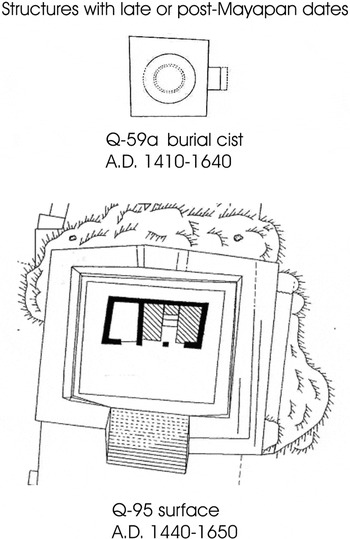
The lower ranges of two dates overlap with the latest Postclassic occupation of Mayapan in the fifteenth century (Figure 10), and their upper ranges extend beyond its known temporal settlement into the seventeenth century (Samples 1, 11). Samples 1 and 11 (a.d. 1410–1640 and a.d. 1440–1640, respectively) most likely date to the final years of Mayapan's pre-Hispanic history. Sample 1 represents copal taken from a cist burial within an altar (Q-59a) in front of Structure Q-58 (El Crematorio). We think it most likely that this burial predates the fall of the city between a.d. 1441 and a.d. 1461, as there is little evidence for construction of altars and burial cists after this date. Sample 11 represents the terminal/surface lot of materials recovered over temple Q-95 (Templo del Pescador). Minimally, this charcoal dates to the k'atun of the city's purported demise. Alternatively, this charcoal was deposited after the city was abandoned. It originates from a widespread general lot collected from over the temple and its substructure, and this lot contained 99.7% Late Postclassic Mayapan pottery (Shook 1954b). Other than these observations, little more can be inferred from this sample. There is no indication from the artifact assemblage that this charcoal represents a specific period of post-abandonment Postclassic or Colonial period use of this structure. This problem is difficult to resolve from ceramics, given similarities between Postclassic and early contact period material (Stromsvik et al. 1954:291), although Smith (1971) did define some Colonial types for the area that were not reported from Q-95's surface.

Structures with very late dates (a.d. 1410–1650). Illustration of Q-59a is from Shook (1954:Figure 1); Q-95 is from Delgado (2004:Figure 45).
Date Ranges beyond Mayapan's Fall
Three dates extend beyond the known range of Mayapan's occupation. Of these, two should not be considered valid as they span into the industrial era (Aitken 1990) and could be contaminated (Samples 21, 17), with ranges of a.d. 1650/1660–1960. There is nothing curious about these samples that would have led us to anticipate these results. Sample 21 is charcoal found over the bench of hall Q-87a of the Templo Redondo compound, and Sample 17 is copal from an altar, Q-162f, located near the southwest corner of the site's main temple, the Castillo de Kukulkan (Q-162). Although we consider it likely that later pilgrimage to the site may have occasioned the burning of copal at altars near the site's main temple, the industrial age span of these dates dictates caution in making such inferences. Sample 27 has been previously discussed; we infer that it represents charcoal post-dating the city's occupation and is not contemporaneous with the ash-covered mass grave near Q-79, where it was recovered.
CERAMICS
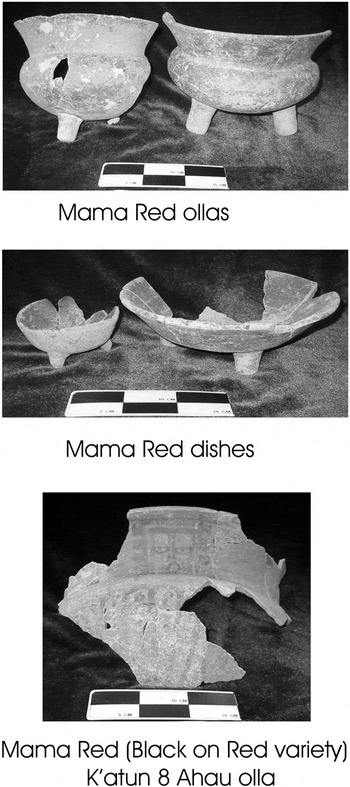
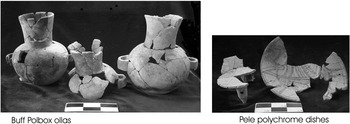
Two of the most common ceramic type groups, Mama Red (Figure 11) and Navula Unslipped, span the entire Postclassic sequence at Mayapan. Four other pottery types are more temporally sensitive within the Postclassic sequence, described below. The most distinct ceramics associated with the later Tases phase are the Chen Mul modeled censers and other effigy forms (Smith 1971; Masson 2000:58, Fig. 3.3). Archaeologists of the northern lowlands have also noted other specific forms linked to earlier or later segments of the Postclassic sequence, notably the Peto Cream group, the Buff Polbox group (Figure 12), and the Matillas Fine Orange group, as described below.

Examples of Mama Red Group pottery from Y-45a pottery concentrations broken at the time of abandonment (Sample 34, a.d.. 1270–1400). Partial vessel at lower left has a K'atun 8 Ahau glyph painted on it.

Examples of Buff Polbox Group pottery from Y-45a pottery concentrations broken at the time of abandonment (Sample 34, a.d.1270–1400).
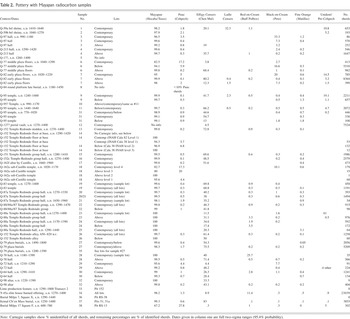
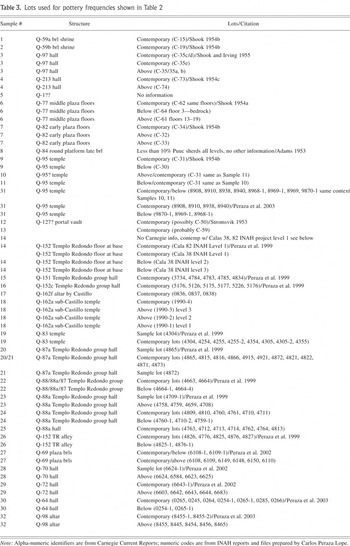
Table 2 summarizes the frequencies of these major Postclassic groups from selected contexts, as well as Terminal Classic Puuc Cehpech sphere pottery from lots associated with our radiocarbon samples. As ceramic samples were sometimes small for individual lots from which our samples were taken, we also present frequencies for lots from the same general phase or level. Where possible, we also provide percentages from earlier or later lots below or above our samples. Ceramic frequencies were extracted from lot descriptions in Carnegie Current Reports published between 1953 and 1955 (cited in Table 3), and from Carlos Peraza et al.'s (1999, 2002, 2003) INAH reports to the Consejo de Arqueología or from Peraza's Mayapan project records. Lots used to calculate ceramic frequencies are listed in Table 3. Table 2 follows the format for reporting ceramic frequencies by general type group used in the Carnegie Current Reports to facilitate comparisons, although detailed information on many more pottery types is available for the INAH project. Primarily interested in chronology, Carnegie investigators reported the overall frequencies of ceramics dating to the Mayapan period (later referred to as Hocaba and Tases in Smith 1971) and the Puuc period (later termed Cehpech). Within the Mayapan period sherds, they regularly noted the frequencies of specific types, including red-slipped pottery, unslipped pottery, effigy censers, non-effigy censers, red-on-cream (later called the Buff Polbox group), black-on-cream (later called Peto Cream), and Fine Orange (later called Matillas Fine Orange). Table 2 replicates these categories.
Pottery with Mayapan radiocarbon samples

Lots used for pottery frequencies shown in Table 2

Despite the temporal span of our radiocarbon dates, most pottery from all contexts tested was Late Postclassic period (Hocaba/Tases). Of 58 contexts examined that had pottery, only four had less than 94% Mayapan Postclassic pottery and those had between 67.2% and 82.5% (Table 2). This pattern points to the strong association of Postclassic ceramics with the contexts of our dates. Four contexts with lower frequencies of Postclassic pottery include Sample 6 (from middle plaza floors near Structure Q-77) with 82.5%, Sample 18 (preceding the earlier Castillo building Q-162a, level 4) with 82.7%, and from a construction level above the same sample (level 3) with 80% (although this sample size is quite small, with only 15 sherds). The presence of at least 80% Mayapan pottery types in these earlier contexts dates them to the Late Postclassic period, and it is possible that the relatively greater frequencies of Puuc/Cehpech ceramics in these lots is due to mixing of sherds from earlier domestic occupation in vicinity of the site center. Notably, all three contexts are from floor or building fill, and the presence of earlier sherds amidst construction rubble is to be expected. Stronger evidence that the Terminal Classic pottery of the floors near Q-77 is mixed in with a later construction episode is provided by the fact that floors beneath them had even greater amounts of Postclassic pottery (94.1%). In no contexts examined here do Terminal Classic period sherds dominate the assemblage, suggesting that none of these features antedate the Postclassic at Mayapan. The fourth context with a smaller proportion of Postclassic pottery is Burial 03-04 in Milpa 17 (Sample 38). The high proportion of Terminal Classic sherds (27.8%) from this test pit (RS-13) correlates well with the Late/Terminal Classic radiocarbon date of this burial and suggests earlier occupation in this area.
Frequencies of black-on-cream pottery, the term used by Carnegie investigators for the Peto Cream Group, are consistently present in higher quantities in lower lots (Hocaba) of structures with longer sequences, although they are never as abundant as the Postclassic Mama Red or Navula Unslipped groups with which they co-occur. For example, Phillip Smith (1955) notes that lower levels of Structure Q-153a, the Chen Mul Cenote Temple, had a high proportion (12%) of black-on-cream sherds. Another group, Buff Polbox (Figure 12), of which Tecoh Red-on-Buff type sherds are most commonly identified (termed red-on-cream by Carnegie investigators), appears more temporally sensitive than either the Mama or Navula groups. Higher relative frequencies of red-on-cream or red-on-buff are noted in later lots (Smith 1971:Chart 3). Smith links Matillas Fine Orange group types to earlier (Middle Postclassic) lots rather than “Late Postclassic” contexts (1971:Chart 3). Although greater frequencies of Fine Orange are sometimes present in lower lots, these sherds are regularly found throughout the sequence (as are Peto Cream sherds).
Other patterns attest to the diagnostic nature of specific pottery types (Table 2). In the lower plaza floors beneath Sample 6, notably high percentages of Peto Cream pottery (16.6%) are present compared to later floors and many other lots at the site. Higher quantities of Peto are also noted in the early floors near Q-82 (20%, Table 2). Peto Cream is also comparably high in Sample 18 from the sub-Castillo (10.1%, Table 2). Peto frequencies of just over 7% are noted for three other contexts, and in all three, very low frequencies of Chen Mul censers (a marker for the latter half of the Postclassic) are noted. These low proportions of Chen Mul further signify that the deposits originate from the earlier portion of Mayapan's history. The three contexts include the Q-72 hall (Sample 29), features below the Q-97 hall (Sample 3), and floors above Sample 7 near Q-82 (Table 2). Date ranges for three of these features are no later than a.d. 1220, and the fourth (Sample 29, Q-72) only reaches a.d. 1290 (Table 1). Ceramic frequencies, combined with the radiocarbon dates, place these features during the early portion of the city's Postclassic development and help date the popularity of Peto Cream ware to around this time.
Other early contexts reported by Carnegie scholars that had more quantities of black-on-cream than usual include fill under Structure Q-58 and within it (4.9% and 8.6%, Shook 1954b), and early floor fill beneath Q-81 (12.1%, Winters 1955). Black-on-cream percentages of 5.6% and 2.5% are also reported for fill of the T-70 X-Coton Group temple near a major eastern gate in the city wall (Shook 1953). An anomalously high proportion of these sherds also came from the basal levels of a burial cave beneath Q-165 (48.3%), although the sample size was small (N = 89, Chowning and Thompson 1956). These observations are in line with those of other key publications discussing the temporal placement of this type (e.g., Robles 1986:129; Ringle et al. 1998:189–192; Milbrath and Peraza 2003:5–6; Peraza 2005:84).
Fine Orange frequencies in our samples are not high for any contexts; they range from .05% to 1.8%. Only three contexts have Fine Orange percentages that exceed 1.0% (Table 2), and all three have very low quantities of late Chen Mul censers; this appears to support implications from Smith's study (1971:Chart 3) that Fine Orange was more popular during the earlier part of the Late Postclassic (Hocaba) at Mayapan. One of these three contexts includes the deposits below the Q-97 hall (Sample 3). A second context with higher Fine Orange quantities is the original subterranean burial chamber below Structure Q-95. The former two contexts are in early stratigraphic positions, below later buildings, which imply the use of Fine Orange early in the site's Postclassic sequence. This basal chamber lies beneath Q-95's later burial shaft, dated here by Sample 9, which implies that the earlier chamber predates a.d. 1240–1400. Lots over the Q-95 temple's latest floors and buildings also have more than 1.0% Matillas Fine Orange (Sample 31), so the ceramics of this building are not conclusive with respect to the argument that Fine Orange was used early in the sequence. Chen Mul censers comprised around 50% of the sherds in the upper half of the shaft, and they were absent in the lower half. This pattern led Shook (1954b:271) to propose that the shaft was used for a long span of Mayapan's Postclassic occupation. The pyramid was built in three phases, although the latter two were expansions of its basal platform. Thus, the surface of the structure was in use from its initial construction.
“Red-on-buff” (Buff Polbox group) is not present in high frequencies in the early contexts examined here, and some later contexts have the greatest quantities (Table 2). They are particularly common in surface lots of some halls, including Q-70 (Sample 28, 25.7%, although few sherds were recovered from this context). Other contexts with larger sherd samples have between 1.9% and 3.3% Buff Polbox sherds, including lots below, above, and contemporaneous with the surface material of the Q-88a hall (Samples 23, 24) and the upper lots of the Q-64 hall (Sample 30). All of these contexts also have abundant Chen Mul effigy censer sherds (Table 2), corroborating their late date. The Q-213 (Sample 4) hall had 1% Buff sherds, and the Q-59a (Sample 1) burial shrine had 1.1%. These samples all have date ranges that extend to at least a.d. 1390, which correlates with their late stratigraphic position and the inferred late popularity of Buff Polbox. All other contexts checked in our review had fewer than 1% of this type.
The late association of Chen Mul censers needs little further justification (Smith 1971), but for recent comparative summaries see Masson (2000:57–60) and Milbrath and Peraza (2003:5, 7). Nonetheless, Table 2 illustrates this pattern and also helps fine tune the chronological context of our dates. The levels of the Q-213 hall midden from which Sample 4 was taken has no effigy censers, although higher levels have 35.7%, suggesting significant temporal spread throughout Mayapan's occupation for this deposit. Few censers are found in middle plaza floors near Q-77 (Sample 6, 3.8%) compared to later floors (68.4%), and none are found in early floors near Q-82 (Sample 7), in contrast to later deposits there (80.2%). The late use of the Q-95 burial shaft (Sample 9) is corroborated by the presence of 41.7% effigy sherds, as are the surface deposits and late floors covering this temple (44.6–66.2%, Samples 10, 11, 31). Late chronological placement according to Chen Mul censer frequencies is also implied for plaza burials near Q-69 (54.3–75.5%, Sample 27), the Q-70 hall (40%, Sample 28), the Q-64 hall (26.3%, Sample 30), the Q-162f altar near the Castillo (51.6%, Sample 17), the Q-98 altar (33.3%, Sample 32), the Q-83 temple (Sample 19), the Templo Redondo (72.8%, Sample 13; 61.4%, Sample 26), and halls and buildings linked to this group (69.6%, Sample 15; 48.5%, Sample 16; 35.2%–40.2%, Samples 20, 21; 20.3%–34.6%, Samples 25, 24; 46.3%, Sample 22).
Of the ten of these samples with high Chen Mul frequencies that can be considered valid (i.e., those that are not Preclassic, Terminal Classic, Industrial, likely from post-occupational burning, or that possess ranges spanning more than two centuries), one has a date range that extends from a.d. 1220 to a.d. 1390 (Sample 32). Of the remaining nine high Chen Mul contexts, seven have ranges extending to a.d. 1400 or 1410 (Samples 19, 30, 9, 15, 16, 13, 25), and two extend to a.d. 1440 or 1470 (Samples 25, 22). These dates imply that contexts with high frequencies of Chen Mul censers are linked to the latter half of Mayapan's occupation, as Carnegie scholars initially observed (Pollock 1962; Adams 1953; Smith 1971). This pattern has been corroborated by work at east coast sites such as El Meco, Cozumel, and Laguna de On (Robles 1986, Peraza 1993, Masson 2000).
SUMMARY
The outcome of our new chronological analysis generally supports recent claims that the founding of Mayapan commenced minimally by the twelfth century a.d. (Andrews et al. 2003) and that the possibility that eleventh-century activities also occurred at the site cannot be dismissed (Milbrath and Peraza 2003:3). Although our reliable early dates are not abundant relative to the prevalence of samples available from later contexts, we have evidence for at least a small-scale center in the vicinity of the Main Plaza by the eleventh or twelfth centuries. At this time, copal was burned near an altar of an undetermined structure in the monumental zone, and occupational activities are detected in an area where a probable hall was later built. Between a.d. 1020 and a.d. 1170, an early sub-Castillo temple was present, along with plaza floors by a.d. 1020–1220 at Q-82 and other plaza floors around the same time (a.d. 1040–1290) at Q-77. Prior to at least a.d. 1290, from seven to nine floors were present below the floors dated at Q-77. At least two of the city's halls were probably built by a.d. 1290/1310 or as early as a.d. 1180/1210. The majority of the dates span the city's later, major occupation (thirteenth to fifteenth centuries). According to these dates, features of Mayapan's heyday include a burial shaft in Q-95, buildings and features linked to Templo Redondo compound, Hall Q-213 by the Q-214 round structure, probably the Q-127 portal vault, the Q-64 north hall, and the Q-82 temple
Very late features that overlap with the city's end date or beyond include a cist burial in shrine Q-59a, a shrine (Q-162f) near the Castillo, and material over the Q-95 temple. Two later dates have ranges that potentially extend past 1850, and thus are not reliable.
Radiocarbon ranges are not precise enough to evaluate Milbrath and Peraza's (2003) effort at reconciling the site's construction chronology with k'atun cycles, but our results provide general support for the date of specific buildings they consider. Our data provide evidence for limited construction activities in the site's Main Plaza by at least the end of the twelfth century, and we cannot rule out the possibility that such activities commenced between a.d. 1000 and 1100. However, these contexts do not indicate construction of a major monumental center. The construction phase preceding the earlier Castillo (Q-162a) would have been a small building, perhaps a temple or shrine. The construction of a series of plaza floors before this date is more impressive, and it is unfortunate that we are not able to identify specific, initial buildings belonging to the twelfth century (or earlier) because of the limitations of contexts available for dating. The plaza floors near Structures Q-77 and Q-82 were likely associated with other earlier structures besides the early Castillo, but our only other early dates are for unidentified structures or for features below structures. Numerous other early construction episodes were uncovered in Carnegie investigations that have no associated carbon dates; some that are recently summarized and reconsidered in Milbrath and Peraza (2003:9–11) do have ceramic evidence for placement at the beginning of the Postclassic Period. Also, INAH investigations have determined that many buildings of the Main Group have at least two major construction phases (Milbrath and Peraza 2003), although multiple minor renovations are common, as described for Q-58 and Q-82 (Shook 1953:254, 267). Most of our dates place the later, final construction episodes to the fourteenth century or slightly earlier. Some of the earlier buildings detected by past investigations may be associated with the initial Castillo temple phases and the floors we have dated here.
Although our intent in submitting and analyzing these dates was to provide an independent, empirical basis for dating Mayapan, in the end we have confirmed some impressions long ago drawn from ethnohistory: that a modest settlement, perhaps a small shrine center coeval with Chichen Itza, likely existed at Mayapan prior to its establishment as a major capital (Tozzer 1941:footnote 162). Perhaps plaza floor and early building construction, especially under the later Castillo, attests to features of a small place that possessed a shrine and central plaza, likely with associated minor buildings and a probable accompanying occupation.
Our data contribute indirectly to current research on the fall of Chichen Itza. Monumental activity at Chichen Itza is thought to have ceased by a.d. 1000 (Andrews et al. 2003:152; Ringle et al. 1998:192), and its presumed domination of the region was likely over by a.d. 1100 (Andrews et al. 2003:152). Results presented here suggest that Chichen's hypothesized eleventh-century decline cannot be attributed to the concurrent rise of Mayapan in its maximum glory, even though our date ranges leave open the possibility that construction of a small civic/religious center began during this century. Rather, our dates imply that Mayapan profited in the aftermath of Chichen Itza, rising in the twelfth century, following Chichen's fall, and peaking from the thirteenth to early fifteenth centuries a.d.
The argument that a transitional period existed for northern Yucatan during the eleventh-twelfth centuries is supported by our dates. The germination of the Mayapan confederacy was underway by this time. Models discussed for Hopi social history (Rushforth and Upham 1992:53–54) describe the problem that transitional periods pose for archaeologists. Most visible to archaeologists are what these authors term “power drives,” when leaders mobilize resources for major construction episodes that are easily identified and dated in the archaeological record. The analytical emphasis on such mobilizations can inhibit understanding of occupational discontinuities, relative plateaus free of major regime changes, or other processes that seem to represent time gaps (Rushforth and Upham 1992:54). This problem is similarly discussed for Terminal Classic Maya sites (Tourtellot et al. 1992). Perhaps the eleventh century a.d. decline of Chichen Itza was a relatively stable period, as alluded to by Andrews et al. (2003:152–153), and the establishment of Mayapan to its maximal extent occurred incrementally throughout the course of the twelfth century. Evidence for the political events leading to Mayapan's rise to dominance is offered primarily from ethnohistoric accounts of this polity's military defeat of Chichen Itza (e.g., Barrera Vasquez and Morley 1949:34–35), which Freidel and Suhler (1995) think may have some archaeological correlates. Further consideration of archaeological data is needed to evaluate these claims.
Evidence mounts that Postclassic pottery traditions were well established during the twelfth century, when the Main Plaza was being built and initially used. Ringle et al. (1998:Figure 5) place the beginning of the Sotuta/Hocaba tradition at a.d. 1000–1100, with full-blown Tases Postclassic traditions, which overlap considerably with Hocaba Mama and Navula Group pottery, present at Chichen Itza by the thirteenth century. Similarly, for Ek Balam, Bey et al. (1998:116) place Postclassic Mama Red and Navula Unslipped pottery at a.d. 1050–1250, and these groups extend to a.d. 1555. Postclassic pottery with close similarities in form and surface treatment to Mama Red and Navula Unslipped is dated at northern Belize sites to a.d. 1050–1450 (Masson 2000:Table 3.3), and based on new information presented here, we no longer entertain the idea that the east coast material might have been earlier than Mayapan's Postclassic pottery traditions. The three date clusters shown in Figure 2 likely correspond to the establishment of Mayapan's early center (a.d. 1000–1200), and two major building surges associated with the power drives of Mayapan's most influential regimes at a.d. 1150–1300 and a.d. 1300–1400.
Another important implication of our dates reflects episodes of violence and conflict prior to Mayapan's presumed collapse in K'atun 8 Ahau, a.d. 1441–1461. Human bone samples from shallow mass graves at the Itzmal Chen Group and in the plaza at the northwest entrance to the Main Group (near Structures Q-79/79a) date to a.d. 1260–1400 and a.d. 1200–1390, respectively. These shallow graves are likely those of victims of Mayapan's warriors, or alternatively, Mayapan family groups killed by the city's enemies during its final century or two of occupation. The fact that these temporal ranges do not reach the terminal date for the city's abandonment suggests that conflict accelerated late in Mayapan's history, and that processes leading to the city's collapse were linked to a larger context of escalating violence over time. At least one structure within the Main Group of the site center (Q-87a) was also destroyed and burned between a.d. 1270 and a.d. 1400, prior to the city's collapse, and nearby Q-88a may have been burned at the same time. An outlying elite house, Y-45a, was also abandoned during this same temporal interval (a.d. 1270–1400). This house's residents smashed their domestic vessels and deposited burned offerings on the floors of their rear rooms and then filled them with debris prior to departing. These terminal architectural dates also imply stress experienced at Mayapan prior to its final abandonment. Late commoner houses built out by the city wall were not lived in for long, as implied by scarce domestic debris and our date for Burial 03-06 (a.d. 1300–1440).
In summary, the radiocarbon dates presented here contribute new evidence to the growing pool of data regarding late northern Maya chronology. While our data do lend credence to the work of other scholars that Mayapan's Postclassic center was initiated prior to the thirteenth century, clearly, there is much work yet to be done to iron out the specifics of historical relationships between sites of this region and their implications for power cycles within Yucatan leading up to and including the Postclassic period.
RESUMEN
Treinta y ocho fechas de radiocarbono de contextos adentro y afuera de la zona monumental en Mayapan proveen nueva información acerca de la cronología del Postclásico de esta ciudad y de sus contemporáneas. Nosotros analizamos la frequencia de cerámicas asociadas con nuestras muestras de radiocarbono y discutimos tipos diagnósticos en la sequencia de Mayapan. Muestras de radiocarbono de contextos de construcción tempranos sugieren que el centro Posclásico fué fundado al menos en el siglo doce ó posiblemente en el siglo once d.C., en una escala modesta. Fechas adicionales ayudan a asignar mucha de la arquitectura tardía de la ciudad desde el siglo trece hasta temprano en el siglo quince d.C. y sugieren que el siglo final tuvó eventos violentos y episodios de abandano antes de la terminación de la ocupación del sitio. Nuestros resultados implican que Mayapan pudo haber empezado como un centro pequeño mientras Chichen Itza palidecía en su posición política en la península y que el establecimiento de Mayapan como una capital regional mayor pudo haber sido un proceso que tomó tanto como un siglo en lograrse.
ACKNOWLEDGMENTS
We thank Michael E. Smith, Susan Milbrath, Anthony Andrews, and William Ringle for commenting on or reviewing early versions of this paper, although we take full responsibility for its content and any final flaws. We are grateful to Bradley Russell for his indispensable assistance with the OxCal program and for initially drafting Figures 1, 2, and 3. We appreciate the assistance of Christopher Eastoe and Mitzi DeMartino of the Laboratory of Isotope Geochemistry at the University of Arizona for their assistance in processing these samples.
Our research at Mayapan is greatly facilitated by the talented efforts of project staff members Barbara del G. Escamilla Ojeda, Wilberth Cruz Alvarado, and Luis Flores Coba. Research at Mayapan is supported by grants from the National Science Foundation (SBR-1018919) and the Foundation for the Advancement of Mesoamerican Studies, and is accomplished with the gracious permission of the Consejo de Arqueología, Instituto Nacional de Antropología e Historia, México, D.F.