In the field of organisational environmental sustainability, it is argued that organisations cannot meaningfully address issues such as energy and water efficiency and emissions reduction without an appropriate ‘sustainability culture’ (Baumgartner, Reference Baumgartner2009; Dunphy, Griffiths, & Benn, Reference Dunphy, Griffiths and Benn2003; Linnenluecke & Griffiths, Reference Linnenluecke and Griffiths2010). Recognising that there will always be different conceptions of sustainability culture (see Linnenluecke & Griffiths, Reference Linnenluecke and Griffiths2010 in relation to ‘organisational sustainability’), the definition offered by Bertels, Papiana, and Papiana (Reference Bertels, Papania and Papania2010) provides a useful starting point:
A sustainability culture is one in which organizational members hold shared assumptions and beliefs about the importance of balancing economic efficiency, social equity and environmental accountability. Organizations with strong cultures of sustainability strive to support a healthy environment and improve the lives of others while continuing to operate successfully over the long term. (p. 10)
Despite agreement that the ‘right’ culture is important in improving an organisation's sustainability performance, there is less explicit guidance and research on how such a culture can be ‘created’. Previous work has focused on the overall adoption of sustainability practices by organisations, but confined the actual details of practice to the ‘organisational black box’ (Howard-Grenville, Reference Howard-Grenville2006; Linnenluecke & Griffiths, Reference Linnenluecke and Griffiths2010). Based on an extensive review, Bertels et al. (Reference Bertels, Papania and Papania2010) contend that: ‘There has been a limited amount of research addressing how to embed sustainability in organisational culture. In this area, practice often leads theory’ (p. 9).
Numerous authors have highlighted that staff engagement and education is key to developing a sustainability culture (Benn, Dunphy, & Griffiths, Reference Benn and Dunphy2006; Bertels et al., Reference Bertels, Papania and Papania2010; Willard, Reference Willard2009). From their research within a large multinational company, Haugh and Talwara (Reference Haugh and Talwara2010) developed the following principles for staff education in order to develop a sustainability culture:
• Learning about sustainability should not be restricted to leaders and senior managers;
• Approaches need to be cross-functional and spread across the full range of business functions;
• Embedding sustainability should include technical and action learning opportunities to increase employees’ knowledge and commitment.
As with sustainability culture, while broad principles have been developed to guide staff sustainability education, different practices on the ground have, at best, only received limited testing. Bertels et al. (Reference Bertels, Papania and Papania2010) argue that while education and training is an empirically supported practice to build or support a sustainability culture, additional research is needed to understand what kinds of programs are actually effective.
Here we present a case study of a staff training program implemented at the Wannon Region Water Corporation (Wannon Water), located in south-west Victoria, Australia. The Green Steps @ Wannon Water program was developed and delivered in partnership with the Monash University Sustainability Institute (MSI). The purpose of Green Steps @ Wannon Water was to create a group of skilled change agents among staff and through them, develop a sustainability culture within the organisation that leads to a more innovative and resilient water business (Davis, Reference Davis2010).
This article has two key aims. First, we describe the training program (its structure, format and learning outcomes) in detail. From our experience, Green Steps @ Wannon Water was a relatively unique staff sustainability training program within Australia, particularly through its focus on both training and work-based projects. Our intention is to contribute to general environmental education practice and, more specifically, to the practice of this within organisations, by providing practitioners with insight into, and ideas from, our program.
Second, we utilise a dialogic inquiry methodology (Most Significant Change) to collect evidence of the program's impacts on participants, as well as the sustainability culture at Wannon Water. We then utilise Mezirow's (Reference Mezirow1997, Reference Mezirow2000) phases of individual learners’ transformation and Schien's (Reference Schein1997) theoretical framework of organisational culture as ‘yardsticks’ against which to compare the evidence collected and to ask questions about the actual impact of the program.
This represents a relatively unexplored addition to research in organisational sustainability culture as well as for the environmental education field. In their review of Australian environmental education research, Stevenson and Evans (Reference Stevenson and Evans2011) identified only a small number of education programs that assess learning outcomes. They also highlighted that the majority of research has concentrated on the formal education sector (both in Australia and internationally), with much less focus on informal or non-formal education. By considering a training program in a water business, we thus expand the focus of current environmental education research, as well as reflect on the contribution of environmental education to organisational sustainability culture.
Program Description
The Green Steps @ Wannon WaterFootnote 1 program had the following intended learning outcomes for participants:
1. to gain a deeper understanding of environmental sustainability issues relevant to the workplace;
2. to be equipped with new skills to collect environmental data, develop and initiate sustainability programs and communicate outcomes;
3. to be able to engage and motivate colleagues through a better understanding of behaviour change theory and effective communication principles;
4. to develop, implement and report-back on a work-based sustainability project.
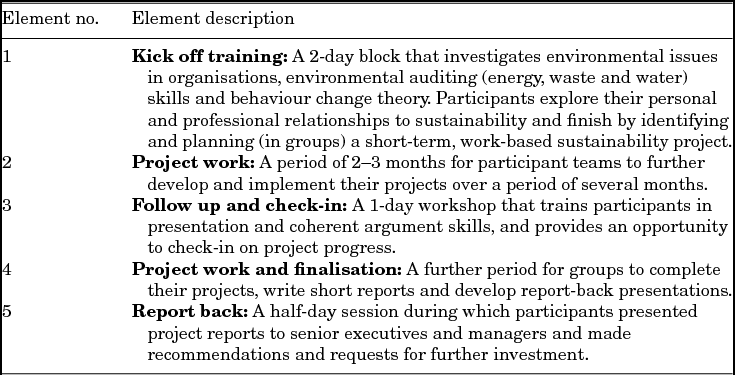
Dunphy et al. (Reference Dunphy, Griffiths and Benn2003) point out that when training is limited to technical skills focused on compliance, this is not likely to bring about the attitudinal or cultural change required for a sustainability culture in an organisation. Throughout the training, we focused on providing participants with a mix of knowledge about sustainability issues and the skills and experience to tackle these in the workplace. Table 1 shows the sequence of training elements over the average 5-month period of the program.
Sequence and Brief Description of Training Elements for Green Steps @ Wannon Water

Influenced by Mezirow's transformative learning theory, Sipos, Battisti, and Grimm (Reference Sipos, Battisti and Grimm2008) created a framework of transformative sustainability learning based on the organising principles of heads, hands and heart. This seeks to develop teaching units with learning objectives addressing the cognitive (head), psychomotor (hands), and affective (heart) domains of learning. They argue that this combination of objectives is required to ‘facilitate personal experience for participants resulting in profound changes in knowledge, skills and attitudes related to enhancing ecological, social and economic justice’ (p. 69).
While not used to create the actual program, this ‘head, hands and heart’ framework has been useful to retrospectively frame the learning outcomes, structure, and format of Green Steps @ Wannon Water, and links our work to existing practice and research. Training activities and discussions provided participants with knowledge about sustainability issues (head), while auditing and communication exercises gave practical skills (hands), and the entire program was focused on creating, or consolidating, sustainability values (heart).
We would also add that the work-based sustainability projects allowed participants to enact their learning, giving feet to the head, heart, and hands learning objectives. Beyond creating quantifiable impact from the program for the organisation, the projects helped to further develop participant sustainability skills and competencies (Brundiers, Wiek, & Redman, Reference Brundiers, Wiek and Redman2010; Brunetti, Petrell, & Sawada, Reference Brunetti, Petrell and Sawada2003; Haugh & Talwara, Reference Haugh and Talwara2010).
Teaching and Learning Format
To ensure cross-functional representation, participants were drawn from across Wannon Water's workforce of professionals, operations staff, engineers, scientists and technicians, and also included middle and senior managers. An expression of interest process was conducted each year to facilitate open selection of training participants who were highly motivated. Under-represented divisions within the organisation were directly approached to identify possible participants.
While we deliberately aimed for a broad representation of participants to enhance the program's impact on sustainability culture (Haugh & Talwara, Reference Haugh and Talwara2010), this created a challenge in pitching the training at the right level and scope. This was compounded by participants often having differing levels of exposure to, and understanding of, sustainability concepts (Christie, Miller, Cooke, & White, Reference Christie, Miller, Cooke and White2014; Howard-Grenville, Reference Howard-Grenville2006; Reid & Petocz, Reference Reid and Petocz2006).
To address these issues, the training had an emphasis on flexible and interactive delivery. This enabled us to delve deeper when participants wanted to stop and explore certain content in more depth. The training also focused on small-group work and group reflective discussion, drawing on the ‘knowledge in the room’ and engaging participants ‘where they are’ in terms of their motivations, world-views, experiences and knowledge (Willard, Reference Willard2009).
Most training topics commenced with broad questions (e.g., ‘What is sustainability?’ ‘What is a sustainable organisation?’ ‘How would we engage other staff in these issues?’), to draw out participants’ existing ideas and knowledge, and technical content and examples were then added by trainers to enhance and build on these discussions. There was also an emphasis on letting participants learn through hands-on activities (e.g., waste audits, energy audits, work-based projects), rather than providing too much detail and information through more ‘lecture-based’ sessions. Each element then typically concluded with opportunities for individual or group critical reflection on what was learnt, what changed for participants, how the new knowledge might be used, and so on. These allowed participants to challenge both theirs and others’ assumptions about particular issues and question what this might mean for both their work and personal lives.
Such an approach mirrors the action-learning framework advocated by Argyris (Reference Argyris1993) for employees to become active participants in their own learning, and acknowledges that learning also occurs from practical experience. In support of this, Haugh and Talwara (Reference Haugh and Talwara2010) argue that:
teaching employees about formal technical standards can be helpful; however, action learning, in which employees have the opportunity to participate in practical sustainability projects, makes learning both interesting and worthwhile for employees and also contributes to genuine advances, in . . . environmental sustainability. (p. 386)
Identifing Program Impacts — Methods
Identifying Impacts on Participants
It is relatively uncommon for environmental education programs in Australia to assess participant learning outcomes, and this is even less common in the case of informal programs (Stevenson & Evans, Reference Stevenson and Evans2011). Internationally, while a number of studies have attempted to identify impacts of environmental or sustainability education programs on participants, these have tended to focus on knowledge and awareness outcomes, and there has been much less focus on (and successful tracking of) impacts on their values, behaviour, and resulting professional practice (Adomßent et al., Reference Adomßent, Fischer, Godemann, Herzig, Otte, Rieckmann and Timm2014; Rickinson, Reference Rickinson2001; Ryu & Brody, Reference Ryu and Brody2006; Shephard et al., Reference Shephard, Harraway, Lovelock, Skeaff, Slooten, Strack and Jowett2013; Stern, Powell, & Hill, Reference Stern, Powell and Hill2014).
Stern et al. (Reference Stern, Powell and Hill2014) reviewed a number of studies that evaluated the outcomes of environmental education programs. They contend that the majority of evaluation is either summative or utilisation focused, developing measures of outcomes based on program goals. Beyond assuming a causative logic to education (Biesta, Reference Biesta2010), these approaches prevent broader lessons from being uncovered and do not pay attention to what the individual learner identifies as a significant impact of change based on their own context and values.
To this end, in addition to the usual end-of-program feedback forms that participants were asked to complete, each Green Steps @ Wannon Water participant was interviewed using a dialogic, story-based technique called Most Significant Change (MSC; Dart & Davies, Reference Dart and Davies2003, Reference Dart and Davies2005). MSC was initially developed to evaluate complex rural development programs. It involves the collection and (often participatory) interpretation of stories of change from those directly involved in a program rather than simply measuring success against predetermined indicators. To the best of our knowledge, this approach is not commonly used to evaluate environmental and sustainability education programs, and we believe it has great potential as an open inquiry into the impacts of training programs on participants and gives voice to learners to articulate their own processes of transformation and change.
Thirty-six participants (from a total of 39) were interviewed 2 weeks immediately after their involvement in Green Steps @ Wannon Water (see Appendix A for questions used). After the program's final year, three participants were randomly selected from across all training cohorts for evaluation interviews to capture longer-term learning outcomes, again using the MSC methodology (see Appendix B for questions).
Identifying Impacts on the Organisation
At the end of the work-based project phase for each training cohort, teams were asked to develop a short report that detailed the different elements of their project, as well as any observed and anticipated outcomes for Wannon Water. When considering the overall impact of the projects on the organisation, instead of attempting to collate such a diverse variety into single homogenous metrics, we chose instead to keep them as a table of unique endeavours, each with their own outcomes and potentials.
During the MSC interviews, participants were also asked to identify in their own words different impacts that they have observed for Wannon Water as a result of Green Steps @ Wannon Water.
Identifing Program Impacts: Results
Three cohorts of Wannon Water staff took part in three annual iterations of the program from 2011–13. The 35 participants represented about 17% of the organisation's workforce and came from various divisions and sites. Four additional participants were from partner organisations in the region.
Immediate Learning Outcomes of Participants
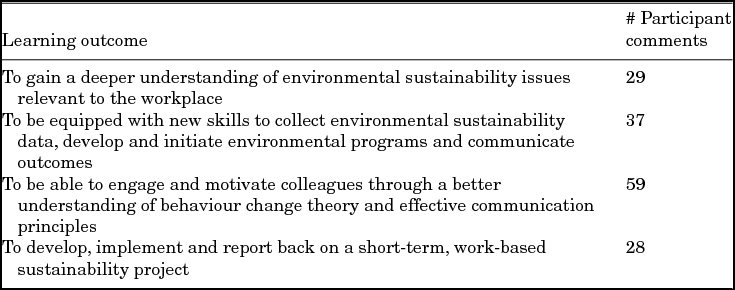
The transcripts from MSC interviews in the 2 weeks after program completion were thematically coded to match the program's intended learning outcomes. Table 2 collates the frequency that interviewees described personal, organisational, or other observed impacts of the program that related to its intended learning outcomes.
Collated Frequency of MSC Interviewees’ Descriptions of Program Impacts That Matched Intended Learning Outcomes
This simple analysis shows that, unprompted, there was a very strong parallel in the significant impacts as described by participants and the intended learning objectives of the program. There seemed to be a particularly strong impact on participants’ perceptions of their abilities and confidence to engage with colleagues on sustainability issues.
We identified other, more emergent, themes in relation to Green Steps @ Wannon Water's impact on participants. The themes are described below and example quotes from the interviews are also given.
1. Transformation of participants’ thinking: A new awareness of personal agency and organisational role for influencing change:
Not to view being sustainable as an specific effort or task, but to work towards including sustainability as just part of the decision making process when undertaking tasks or making decisions on products etc.
We know we have arrived when sustainability changes from a specific thought or effort to a natural part of our decision-making processes.
2. Building a critical mass of support or momentum for change: The effective application of change-agent skills is not always about the big changes; momentum comes from many small steps:
Little changes in attitude will build on more changes and hopefully spread to become culture.
The one thing that stayed with me was . . . about engaging others. How engagement for change depends on getting others involved, we can't do it alone.
3. Empowering training participants to lead for change: New ways to lead, influence and communicate change:
The Green Steps training has increased my confidence in presenting new ideas, and my ability to lead a project team on a sustainability journey.
I had not expected the training to provide me with so many opportunities to improve myself and improve my knowledge on implementing change from the very seed of the idea, all the way to completion/implementation of the idea.
I have lots of ideas for economically and environmentally sustainable practices within my department's operation. I am preparing to promote and discuss changes within my team that will encourage and promote greater efficiency and manageable practices to the betterment of Wannon Water and therefore the community that it services.
4. Increasing awareness of the need to take personal responsibility: The training style and practical opportunity for engaging with others influences an attitudinal change to personal responsibility and future cooperative action:
The [Green Steps] training has made me more conscious at home and at work. Especially in my work station area and group of co-workers. I'm now trying to get my colleagues to put things in the right waste bin and switch off their computers at the end of day.
. . . I will be continuing to work with our customers to highlight the [sustainability] contribution they make to the region and to the community by their involvement with Wannon Water.
Longer-Term Impact on Participants
We see the same emergent themes referred to again by participants interviewed several years after their involvement with the program:
1. Transformation of participants thinking: ‘Some of the learnings for me about sustainability leads me to reflect on how we can be ‘reactionary’ and caught up in the ‘day-to-day’ running of things and solving problems, rather than being more ‘proactive’ in our approach and (therefore) more sustainable.’
2. Building a critical mass of support or momentum for change: ‘Learning to acknowledge the little things, small things that people can contribute to the organisation, being more positive around others and sharing little successes is important.’
3. Empowering training participants to lead for change: ‘I don't think my leadership team skills and development would be where it is today if I hadn't [participated in] the program.’ ‘It was the little things, like . . . communicating with others . . . I have tried to incorporate some of that in my dealing with other people to influence them “on their terms” is important. It (the training) was a good reflection point for me and the training gave me tools to do this communication work differently.’
4. Increasing my awareness of the need to take personal responsibility: ‘I have modified my personal behaviours following the training to try and be more sustainable, like turning off my green switch, participating in car pooling and ride to work activities, recycling in the office, that kind of thing. I have been more willing to get involved in supporting the changes that others have been implementing at work.’
Organisational Impacts
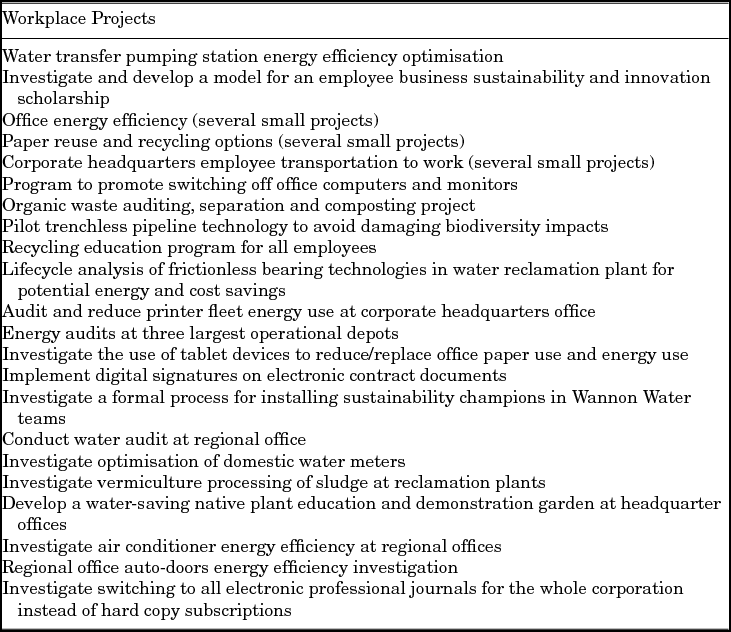
A total of 22 work-based sustainability projects were implemented by participant teams over the 3 years of Green Steps @ Wannon Water. These projects are collated in Table 3.
Collated Work-Based Sustainability Projects Developed and Lead by Green Steps @ Wannon Water Participants From 2011–2013
It is important to note that while some of these projects focused on more day-to-day operational management issues (e.g., energy use, waste production), a number of projects were concerned with the core water and sewage management and delivery business of the organisation. This moves from ‘greening the edges’ to addressing how sustainability is part of the core identity of an organisation (Dunphy et al., Reference Dunphy, Griffiths and Benn2003; Willard, Reference Willard2009).
While there is not space to provide detail of the different observed, and anticipated, outcomes on each project, some relevant examples include:
• 1.5 tonnes per year of food scraps diverted from landfill and composted at a local community garden due to waste diversion projects;
• an estimated $21,000 in resource savings identified through an office printer optimisation project;
• an operational systems project that investigated optimisation of a pumping station's running times to take advantage of off-peak electricity prices and manage demands on pumped water volumes to reduce overall electricity consumption and lower greenhouse emissions;
• over $8,000 saved and reduced paper consumption per year (over 7, 500 sheets) through a project that replaced hard-copy agendas and meeting minutes with electronic tablet devices for Board and Executive meetings.
It was evident from these projects that while a number had immediate quantifiable environmental and financial benefits, many also challenged ‘business as usual’ practices in the organisation and provided innovative alternatives. All projects involved a level of communication and engagement with different stakeholders both within and outside the organisation. A number of projects also had harder-to-quantify social impacts within the organisation, with potential benefits to staff wellbeing, morale and productivity.
The organisational impact is highlighted by a quote from a participant from the 2011 cohort:
The (waste management) project I worked on was successful at influencing behavioural changes regarding waste management . . . the content of the training made the program more effective regarding ongoing sustainability behaviours and waste management action across the organisation. It also influenced behaviours through the other Green Steps projects; for example, projects like the green switch-off project, which became part of normal practice. That's why the training was so influential, through its impact on changing normal [organisational] behaviours.
Discussion
When reflecting on the 3-year journey of Green Steps @ Wannon Water and the impacts that we have identified above, a question that we find ourselves coming back to is: ‘Did it work?’ Did it work in having a transformative impact on the participants involved in the program? And did it work in having an impact on the organisational culture of Wannon Water? We used the theoretical frameworks of Mezirow and Schein as a yardstick to further reflect on these questions.
Transformative Impacts on Participants
A challenge for any training program is not only to provide a mix of sustainability competencies for participants, but to also ensure that they are transformative in nature. Namely, how do we raise awareness of sustainability issues, provide participants with skills to address these, and then ensure that they actually change behaviours and practices (Ajzen, Joyce, Sheikh, & Cote, Reference Ajzen, Joyce, Sheikh and Cote2011; Arbuthnott, Reference Arbuthnott2009; Cranton & King, Reference Cranton and King2003)? This is not just the case for training programs in organisations, but for environmental education more generally (Sipos et al., Reference Sipos, Battisti and Grimm2008; Sterling, Reference Sterling2001, Reference Sterling2011).
Mezirow (Reference Mezirow2000) describes transformative learning as:
. . . the process by which we transform our taken-for granted frames of reference (meaning perspectives, habits of mind, mind sets) to make them more inclusive, discriminating, open, emotionally capable of change, and reflective so that they may generate beliefs and opinions that will prove more true or justified to guide action. (pp. 7–8)
Mezirow (Reference Mezirow2000) further outlines a number of phases that a learner goes through during a process of transformation, which can be broadly summarised into three main stages:
1. a disorientating dilemma (or ‘triggering event’) that may involve a degree of discomfort and angst and causes critical assessment of assumptions;
2. an exploration of options and actions in order to acquire new knowledge, skills, and so forth;
3. trying out, and building confidence, of new roles and actions, and reintegration into the learner's life.
Considering the themes emerging from the MSC interviews, we can say with some confidence that there is evidence that many of the Green Steps @ Wannon Water participants were engaged in at least the first two stages of the transformative process, as articulated by Mezirow (Reference Mezirow2000). The different content presented in the training, as well as the teaching and learning practices, provided triggering events for many participants, challenging their assumptions and causing them to consider particular issues from new perspectives or with fresh eyes. The work-based sustainability projects, as well as the hands-on nature of the training, also gave participants opportunity to explore different options and actions in order to acquire new skills. As a side note, while not presented in this study, the post-program feedback forms showed that the waste and energy audits during the training in particular provided such triggers for several participants.
While it could be suggested that the lack of baselines in regard to knowledge, attitudes, and behaviours make it difficult to identify whether any transformation occurred in participants, we argue that the strength of the MSC methodology is that it asks learners to identify change through a personal understanding of their own baselines. The wide variety of participants we had in the program would have made it very difficult to develop a homogenous baseline, which brings us back to the individual learner and their unique process of transformation.
What we are not able to answer with confidence is whether the program created any sort of ongoing transformation for participants, and what the level of reintegration of new knowledge and skills was into their personal and professional lives. Strong hints of this are evident in the interviews with the three participants included in the more longitudinal program evaluation, particularly their comments related to incorporation of the learning from Green Steps @ Wannon Water in other aspects of their professional roles. The relatively small size of this group, however, makes us wary of drawing more generalisable conclusions about the longer-term transformative impact of the program on participants.
Mezirow does identify some key requirements for any process of transformative learning (Mezirow, Reference Mezirow1997; Taylor, Reference Taylor2008), including providing appropriate context to support the learning process, ensuring there are opportunities for self-reflection by the learners, and critical discourse with others to validate assumptions. On this basis we can say with confidence that we have provided the ‘right’ environment for transformative learning in our participants, as these requirements underpinned the entire pedagogy of Green Steps @ Wannon Water.
At one level it might be possible to design a more comprehensive data collection process with participants to better answer the question of transformation, particularly in the long term. We highlight some possibilities for this below. At the same time, we are also conscious of the ontological dangers lurking for the researcher interested in identifying longitudinal impacts from education programs. Over a period of time, is it possible to link a particular behaviour or mindset ‘outcome’ to a particular education program or a particular element of that program (Stern et al., Reference Stern, Powell and Hill2014)? Do people ever ‘stop’ transforming? Are we at risk here of considering education and learning as linear and causal when in fact for each person, it is rather a more open and recursive system (Biesta, Reference Biesta2010)?
Transformative Impacts on Organisational Culture?
While the participant-led projects point to a number of organisational outcomes (financial, environmental, and potentially social), questions remain about the overall impact of the program on Wannon Water's sustainability culture overall. How much did the program in fact change, or enhance, this culture? Will these impacts be maintained into the future, and indeed be deepened? These questions are particularly pertinent, considering that the program is no longer run at Wannon Water.
According to Schein (Reference Schein1997), culture within an organisation can be analysed at three different levels, ranging from the very tangible to the deeply embedded and unconscious. These levels include:
1. artefacts (things one sees, hears and feels);
2. espoused values (strategies, goals, philosophies); and
3. basic assumptions (unconscious, taken for granted beliefs, thoughts and feelings).
Looking at our program through this theoretical framework, we can identify impacts at the artefact level in regard to sustainability culture. This includes, of course, the program itself and its presence in the organisation for 3 years, as well as the numerous sustainability projects that were carried out in different departments and units by participants. The impacts of these projects were not just operational ones (such as resource saving or financial gains), but also in the less easily quantifiable (but still visible) alternatives proposed to business-as-usual in the core operations of the organisation.
In the MSC interviews, participants clearly identified some shifts in their (as opposed to the organisation's) espoused values and basic assumptions. This increases the odds that they will act out some of these changed values and assumptions in their day-to-day work within the organisation, and in turn potentially shift the organisation's culture. The longer-term evaluation interviews conducted with three participants point to this possibility, showing some of the shifts in their values and assumptions that they have taken into their formal roles in the organisation.
Yet, when we consider what the program's impacts on the basic assumptions of the organisation itself might be, this becomes a difficult question to answer, particularly when considering that after 3 years, the program is no longer running at Wannon Water and has not been replaced with any alternative. It was felt that after 3 years of a sustainability leadership program, enough staff (approximately one fifth of the entire staff body) had been influenced by the initiative that they would, in turn, create a significant impact on the organisation's culture and practices. While we agree that due to limited resources, programs like Green Steps cannot be supported indefinitely in an organisation and must evolve into other initiatives, questions remain for us in regard to the links between the transformations of individuals to the transformation of an entire organisation's culture. How does one influence the other? While there is evidence of the transformation of individuals, has this led to the transformation of an organisation?
As with the previous section, we again come back to questions of what other empirical material we could have collected to show changes in sustainability culture, as well as what we can expect from education programs to contribute to organisational culture. We consider these further in our conclusion.
Concluding Remarks
We are excited about the process of change that has been initiated in Wannon Water as a result of this program. We believe that a community of change agents has been ‘seeded’ throughout the organisation, and while some immediate outcomes of their work have already been identified, there is even greater potential for this group to impact the sustainability culture of the organisation over time.
When attempting, by way of conclusion, to further answer the question ‘Did it work?’, two issues became apparent to us. The first is an opportunity to conduct further research to capture broader organisational impacts and longer-term transformative impacts on participants from a training program such as Green Steps. This could involve monitoring an organisation's policy documents, mission statements, short-to-medium term strategies, and budget priorities over an extended period of time to further understand impacts at the artefact and espoused values levels of organisational culture. This could be complemented by interviews with senior management and other staff not involved in the training program, to dig down into their basic assumptions and potentially identify shifts at this level. A similar, more detailed investigation into the activities and work of participants over the longer term after their involvement with the program, as well as interviews with those around them, could also give evidence of longer-term transformation.
The second issue is harder for us to articulate as it challenges notions of what ‘education’ can do to ‘change’ or ‘create’ sustainability culture or to transform people. Sustainability is considered to be an ongoing process for which there is no end and no one ‘solution’ (Wals, Reference Wals2010). Culture, in turn, is also a dynamic and fluid concept that evolves and changes over time through the interaction of internal and external influences on an organisation (Baumgartner, Reference Baumgartner2009; Schein, Reference Schein1997). The same applies to people as learners, and indeed to people as people (Biesta, Reference Biesta2010; Heimlich, Reference Heimlich2010). Education that tries to address these issues is therefore also an ideal, as Mogenson and Schnack (Reference Mogensen and Schnack2010) argue, and is never finished. Is it even useful to think about how a one-off training or education program has transformed people and changed sustainability culture? Or, is it much more useful to think about students and training participants as ‘seeds of influence’ that we equip to actively play their part in the ongoing evolution of an organisation's sustainability culture? As Wals (Reference Wals2010) states: ‘The processes of searching and engaging are as important, if not more important, than their outcomes as it is these processes that help create a reflexive and “learning” society that is capable of responding to setbacks, crises, and challenges’ (p. 147).
Appendix A Short-Term MSC Interview Questions
Interviews were conducted within two weeks of participants completing all training sessions for each year
1. Tell us how long have you been working with Wannon Water and briefly summarise what your work role is?
2. Prior to the Green Steps @ Wannon Water training, what did ‘sustainability’ mean for you personally, and in your job or workplace?
3. From your point of view, describe the most significant change that participating in the Green Steps at Wannon Water training will make for you personally, and which contributes to wider organisational sustainability?
4. Why do you think this is significant?
5. Was this expected?
6. Where there any other changes as a result?
7. What specific lessons from the training would you really like to share with others at Wannon Water?
8. Briefly describe your Green Steps at Wannon Water project
Appendix B Longitudinal MSC Interview Questions
1. How has Green Steps training changed your approach to working in your job?
2. How have you been applying what you learned from the training with other people in your team or across the organisation?
3. Looking back on the training, what has been the single most significant change the Green Steps training made for you personally, or for your work?
4. Why is this so important to you?
5. Would you like to see any aspects of the Green Steps training offered to other people at Wannon Water in the future?
6. What aspect/s of the training do you think would most benefit others?
Author Biographies
Keith Davis has been a Project Manager at Wannon Water Corporation in Victoria, Australia since 2009. Keith has four decades’ experience in private and public sector industries, encompassing the building sector, primary metals production, horticulture, facility management and environmental/sustainability roles, including a Catchment Management Authority and Local Government. Since 1997, Keith has engaged in sustainability education and training, delivering training within adult-learning, tertiary, and secondary student settings. Keith holds postgraduate degrees in both Sustainability and in Professional Education and Training, the Certificate IV in Workplace Assessment and Training, and the Applied Diploma of Permaculture Design, Education and Site Development.
Mark Boulet is a Research Fellow with BehaviourWorks Australia at the Monash Sustainability Institute, and his research interests include sustainability education practice and evaluation, behaviour change for sustainability and organisational change. Previously, Mark managed the award winning Green Steps program for 6 years and is still involved as a senior trainer with the program. Previous roles included work with Environment Victoria, the Office of the Victorian Commissioner for Environmental Sustainability and the Monash University environment office. Mark holds a Masters of Environmental Science.