Each city, as Richard Rodger and Roey Sweet have pointed out in a recent article, is unique, and though an earlier generation of urban historians made much of characterizing cities by category and type, the generation of scholars since the linguistic turn has returned to individual cities (or even neighbourhoods) as the category of analysis, taking advantage of the rich complexity they provide for studies of class, gender, sexuality, self- and group identification, as well as serving as sites of spatial, linguistic and sensory significance.Footnote 1 Cities are often far better sites than nation-states, for example, to explore the interrelated and overlapping identifications that exist among modern individuals and communities. Categorization of cities according to type – network, central place, etc. – remains useful, but it cannot fully appreciate the nuanced view that cultural histories of the city provide.Footnote 2 Yet, if the impulse to focus on cultural history and microhistory has occasioned a shift from likening cities by category, it does not mean that urban historians should no longer compare their objects of study with other cities. Indeed, urban history journals, scholarly listservs and themed conferences provide opportunities for urban historians to come up from deep analysis of individual cities and seek meaningful comparisons on a given theme, such as nationalism and cities.Footnote 3 We begin to see ways that the cities we study are alike, while noting their salient differences.
During the late nineteenth and early twentieth centuries, inhabitants of the primarily Polish-speaking city of Cracow often likened their city to other cities, as well. In doing so, they wished to emphasize certain aspects of the city's character, while establishing its place among other world cities. Among these comparisons, at least three major typologies stand out: Cracow as the Polish Mecca (and its close variants Athens or Rome); Cracow as the Little Vienna on the Vistula; and Cracow as a wielkie miasto or ‘great city’, which often entailed comparing the city to big cities like Paris, London or Berlin.
Each comparison was employed for a specific purpose. Comparisons to Mecca, Athens or Rome were most connected to Polish national identity and stressed the city's significance as a site of national pilgrimage. According to the historian Irena Homola-Skąpska, reference to ‘the Polish Athens’ marked the city ‘as a place where literature, learning and art could blossom’, while the moniker ‘the Polish Rome’ made sense because Cracow ‘was a city of churches, priests and nuns’.Footnote 4 Allusion to Vienna, meanwhile, acknowledged Cracow's position in the Habsburg empire and therefore the tendency of its inhabitants to share some of the customs and practices of the metropole. In this regard, Cracow was like other ‘Viennas of the East’, including its sister city in Austrian Galicia, Lemberg (Lwów, Lviv).Footnote 5 The phrase Little Vienna on the Vistula appeared less frequently as a trope, but still enjoyed wide currency as an idea, particularly when contemporaries knowingly participated in customs or behaviours ‘as in Vienna’. If the myth of the Polish Athens or Mecca pointed to the city's past and the myth of the Little Vienna on the Vistula revelled in its present; the myth of modern metropolitan Cracow pointed to a future of European-style modernity. At the beginning of the twentieth century as the city began to develop into a modern metropolis, journalists, modernizers and ordinary Cracovians began to compare their city to big cities abroad. Generally, this was not a flattering comparison as it suggested the city's backwardness, but its intent was by no means negative. To be a great city, even an aspiring one, was to take one's place as a member of modern European civilization, and as such remained quite attractive.
Patriots and preservationists were most likely to refer to the Polish Mecca or Athens, realists and Habsburg loyalists to the Little Vienna and modernizers to Big-City Cracow, but the myths were not necessarily mutually exclusive. Some Cracovians, such as the city's mayor during the first decades of the twentieth century, Juliusz Leo, could deftly speak the language of Polish patriotism, Habsburg loyalism and European modernization – at times even in the same speech.Footnote 6 Even if none of these identifications was always or necessarily exclusive of the other two, in the general historiography of the city, analyses of Cracow as the ‘Polish Athens’ and to a lesser extent, as the Little Vienna on the Vistula, have generally received much more attention.Footnote 7 In my recent book, Becoming Metropolitan: Urban Selfhood and the Making of Modern Cracow, I strive to correct this deficiency by pointing out the powerful role played by urbanization and the development of urban and interurban identities, even in a middling sort of city such as Cracow.Footnote 8
In this article, I analyse each of the myths to characterize the ways that contemporaries and historians have seen the city and themselves. I do not limit myself to exact iterations of the phrases, preferring instead to illustrate the range of attitudes implicit in viewing the city according to each analogy. In exploring these analogies, my analysis will rely, loosely, on Roland Barthes’ conception of myth, particularly in its attention to the ‘constructedness’ of analogies or ‘signs’ that might otherwise seem ‘natural’, and, like Barthes, I will seek to show ‘what is hidden there’.Footnote 9 The article will provide examples of each analogy of the city, both from the perspective of the period and in scholarship, before seeking to draw some conclusions about the city as a site of multiple identifications. Ultimately, all three of the analogies for Cracow referred to other cities as units of measurement. Cracovians derived meaning by comparing their city with others. In so doing, they sought to show at once the uniqueness of their hometown and its familiar place in the firmament of urban civilization.
Historical background
By 1900, Cracow had long held a place in the constellation of European civilization, but its relative luminescence had waxed and waned repeatedly over the prior millennium. In the tenth century, the city's status shifted from being a fortress and trading centre on Wawel Hill for the local Wiślane tribes to serving as a sister city to Prague within the orbit of Greater Moravia and the principality of Bohemia. One of the first cities in the region whose inhabitants converted to Christianity, Cracow enjoyed strong connections through its clergy to Latinate Europe, especially Cologne and Liège.Footnote 10 Acceptance of Christianity meant embracing the west's secular heritage as well. A chronicler from the turn of the twelfth and thirteenth centuries claimed the derivation of the city's name was connected to the Gracchus family of ancient Rome. ‘This endeavour to endow the city with an allegorical genealogy going back to Antiquity’, notes Jacek Purchla, ‘may be interpreted not merely as a need to demonstrate its adherence to the Latin civilisation, but also as the beginning of the creation of its myth.’Footnote 11 Cracow became the seat of Polish kings, before being laid waste by Mongol hordes. The new city charter, based on Magdeburg Law, inaugurated a period of growth, brilliant urban planning and ever greater connection to cities across Europe and Asia Minor.Footnote 12 In the fourteenth century, King Casimir the Great (1310–70) created the communities of Kazimierz and Garbary to accommodate Cracow's burgeoning population (much of it Jewish) and, in the latter district, to allow greater room for manufacturing. Casimir founded a university in 1364, the second in central Europe. Revived under the next dynasty of kings, the Jagiellonians, it took their name.
Cracow's membership in the Hanseatic League, which lasted from 1430 until the end of the fifteenth century, roughly coincided with the period of the city's greatest regional influence as the capital of the Polish state and, later, the Polish-Lithuanian Commonwealth, the largest European state of the time. The fifteenth century was the golden age of Cracow, when it was a major trading and manufacturing centre, home to wealthy German burghers, Polish lords and labourers and Jews of various social strata. The city was a multi-ethnic metropolis, attracting artists such as Viet Stoss from Franconia to design the altar at St Mary's Church and Bartolommeo Berrecci, a Florentine architect who spent most of his career in Cracow and who designed the Renaissance-style reconstruction of Wawel Castle.
This period of glory was followed by a major decline over the next few centuries, due to pervasive wars (the Swedish invasion was particularly devastating), the relocation of the Polish capital to Warsaw at the end of the sixteenth century, the shifting of European economic emphasis to maritime and colonial trade and the eventual collapse of the Polish state in the late eighteenth century. The city had participated in the key developments of western civilization, from feudalism, the Renaissance, Reformation and Counter-Reformation to the Enlightenment, but by the Enlightenment era it was a declining provincial backwater in a failing state.
Cracow began the nineteenth century under the dominion of the Habsburg empire as a result of the third partition of Poland (1795), in large part due to an uprising organized on its main square by the famous champion of liberty Tadeusz Kościuszko, who was also a veteran of the American Revolutionary War. The third partition spelled the end of an independent Polish state, the former Polish-Lithuanian Commonwealth, which had been absorbed by its stronger authoritarian neighbours, Russia, Prussia and Austria. During the Napoleonic Wars, Cracow was part of the duchy of Warsaw and was then re-annexed by the Habsburgs after Napoleon's defeat. As a beneficiary of the Congress of Vienna it emerged in 1815 as the Free City of Cracow. In 1846, the Habsburgs took over the city again in response to a Polish national uprising centred there and a peasant jacquerie in the countryside. Shortly afterwards, the Habsburgs made Cracow into a fortress city because of its location near the Russian and Prussian borders. The Austrians built barracks at Wawel, the former royal castle, and erected a ring of fortifications around the city. Festung Krakau was soon home to thousands of troops.
Two decades later, the troops were still there, but Cracow had won the right to autonomous self-government as an Imperial Royal Free City. The Austrian Commune Law of 1866 granted communal autonomy to villages, towns and cities in an effort by the Habsburg authorities to counter the centralizing aspects of the 1861 February Patent.Footnote 13 Meanwhile, a failed uprising in Russian Poland just three years before had encouraged many Poles to take a more conciliatory approach vis-à-vis their imperial masters. The Stanczyks (Stańczycy), a conservative political faction in Cracow, urged co-operation with the Habsburgs in order to focus on local development.Footnote 14 Their opponents by the 1880s, the liberal democrats, pushed even more for the city's modernization, while promoting Cracow's role as the centre of Polish heritage and culture.
The Polish Mecca
Patriotic Poles created the myth of the Polish Mecca in the last third of the nineteenth century in an effort to make the most of the city's situation as a dilapidated, but relatively free city with a storied past. Numerous visitors to the city during this period noted its ubiquitous ruins, results of longstanding neglect or the recent fire of 1850, which had gutted much of downtown. In the context of Austrian autonomy, these ruins were not necessarily a source of shame, however. For those who learned to ‘listen’ to their poignant message, they could serve as reminders of a glorious past, while inspiring pride and dreams for the future. Thanks to autonomous self-government, local Poles could begin to renovate the city, while city preservationists could make certain that edifices from Cracow's historic past were protected and preserved. In a book of verse for children published in 1869, Władysław Bełza sought to impart his patriotic love for the city's past to his son and other young readers by teaching them to listen reverently to the message of the city's stones:
In Bełza's poem, one notes the ubiquitous reference to the past as well as the prominent use of the first person plural possessive. Nationalists sought to use Cracow's past to promote national pride while linking Polish-speakers into an ‘imagined community’.Footnote 16 The founding of the ‘Society of Lovers of Cracow's History and Monuments’ (Towarzystwo Miłośników Historii i Zabytków Krakowa) in 1896 effectively formalized this imperative to protect and promote the ‘national’ past of the city.Footnote 17 By 1910, a founding member of the society, Stanisław Tomkowicz, exulted that Poles from all over the world came to the city to
breathe in its historic atmosphere [and] gather strength in the difficult battle . . . This is why parents of children born beyond the boundaries of the Fatherland bring them here, [to awaken] in their young hearts love for the Fatherland. For every stone speaks to a Pole in a powerful voice, telling him of the past of the nation, of its former greatness and glory.Footnote 18
Thanks to the efforts of patriots and preservationists, Cracow's speaking stones could begin to impart their message to Polish patriots in Cracow and abroad.
During the last third of the nineteenth century and the first decade of the twentieth, Poles from all over the lands of the former Commonwealth flocked to the city of Cracow for patriotic commemorations.Footnote 19 Some of these pilgrims made great sacrifices to get there, sleeping at times in city parks, just so they could see the prescribed sites of national memory and partake of the experience of national communion in the ‘spiritual heart of Poland’. The discovery of relics such as the bones of King Casimir the Great and the reburial of Adam Mickiewicz's remains in the crypts at Wawel proved to be powerful opportunities for public commemoration. The first of these commemorations, which took place in the recently renovated Clothiers’ Hall (Sukiennice) on Cracow's main square in 1879, was to commemorate a great Polish writer from Volhynia, Józef Ignacy Kraszewski. Already in 1871, Kraszewski had observed ‘Cracow has not changed its old face in the least; it is what it was, a reliquary in the bosom of Poland.’Footnote 20 Despite Kraszewski's pronouncement regarding the city's status as a national reliquary, there was no existing pattern of commemorations in Cracow, and when some of the writer's friends from Warsaw approached municipal leaders in Cracow for permission to hold a ceremony honouring him there, the Stanczyks balked, fearing that the anti-clerical writer would offend the church and the Habsburgs (they were correct about the former and less so regarding the latter). The city's mayor shrewdly decided to hold the celebration in the Clothiers’ Hall so that celebrants could, in theory, come to celebrate the building's renovation without endorsing Kraszewski per se.Footnote 21
In 1879, at the dinner to celebrate Kraszewski, Henryk Siemiradzki, an artist also from the eastern territories of the former Polish-Lithuanian Commonwealth, surprised the city by donating his massive historical painting Nero's Torches to the city of Cracow and thus helped to begin a national museum on the second floor of the Clothiers’ Hall. Despite the fact that the celebration had been given an imperial blessing in the form of a Cross of Merit for Kraszewski – who was not even a Habsburg citizen! – the message of Siemiradzki's painting, which depicted the dissolute Roman emperor and his court preparing to watch the burning of several pious Christians at the stake, remained a subversive anti-imperial reminder that the oppressed Christians had outlasted the empire. In a speech at the festivities, Alfred Szczepański, a patriotic Pole who worked in the Länderbank and as a journalist in Vienna, observed: ‘Cracow has always been the Mecca of national sanctity; . . .and thanks to Siemiradzki it's becoming a Polish Florence.’Footnote 22 Szczepański invoked Mecca to acknowledge Cracow's place as a site for pilgrimage and Florence to acknowledge Siemiradzki's gift as an artistic treasure that, alongside other such treasures, would draw sympathetic visitors from all over to see it in person.
Henryk Siemradzki, ‘Nero's torches’ (1876), public domain photo

In Szczepański's quotation, as in Kraszewski's observation about Cracow as a ‘reliquary in the bosom of Poland’, one notes the use of ahistorical time – ‘always’, ‘has not changed its old face in the least’ – to assert something that was in fact newly in the making. In this ‘invention of tradition’, Cracow's former glory as the capital of the medieval and early Renaissance Polish-Lithuanian state and its present status as a seemingly unchanging ‘reliquary’ helped give credence to the nation-making project that was just now under way.Footnote 23 Of course, the newly renovated Clothiers’ Hall and the ad hoc creation of a national museum thanks to an unexpected gift belied the unchanging nature of the city. It was changing, but allusion to Mecca, Florence or Athens could still make sense. Florence and Mecca were sites of pilgrimage, and just as Athens had served as the site of Hellenist revival and eventually as the capital of a new Greek state, so, too, Polish patriots hoped, would Cracow serve as the spiritual and then perhaps even the literal capital of a new Polish state.
The commemorative impulse was at once obsessed with the past and deeply concerned about assuring national loyalty into the future. By 1910, the year that the last and the largest of these national celebrations took place (the 500th anniversary of the Polish king's victory over the Teutonic Knights in the battle of Grunwald), the trope of the ‘Polish Athens’ was thoroughly ensconced in the patriotic vocabulary. In another celebration of that year to mark the creation of Greater Cracow (Wielki Kraków), the city's mayor Juliusz Leo proclaimed that Cracow had ‘not ceased to be the Athens and Rome and capital of Poland’, while the visiting mayor of Lemberg said, ‘Even though Lwów (Lemberg) is the capital of the country (kraj, meaning the crownland of Galicia), Cracow has not ceased to be that sacred city that causes every Pole's heart to beat whenever they think of it, [a place] where almost every stone speaks in a powerful voice of the past, calling us to walk the path of the fatherland.’Footnote 24 Five years later, when the incorporation of the city of Podgórze on the opposite bank of the Vistula River made Greater Cracow complete, a visiting provincial dignitary declared: ‘Behold the powerful spiritual capital of Poland, a metropolis with a thousand of years of culture, the treasure trove of our art and learning, this national Mecca, to which our descendants will come for encouragement and hope forevermore.’Footnote 25 In each instance, the dignitaries resorted to the use of sacral time, by stressing the timelessness of Cracow's role as the spiritual capital of the Polish nation. In the face of urban growth and expansion, each felt it necessary to affirm that the ‘metropolis with a thousand years of culture’ ‘that causes every Pole's heart to beat whenever they think of it’, had ‘not ceased’ to be ‘the Athens and Rome and capital of Poland’. And most importantly, nor would it. The creation of a greater metropolitan Cracow, they sought to assure their audience, only confirmed that their descendants would continue to come to the city to revel in its sacred past. Big-City Cracow could still be a Polish Mecca.
Modern Polish historians and particularly Cracovian historians have done much to perpetuate the myth of the Polish Mecca or Athens. Aware that the Habsburg empire would collapse and the Polish nationalist vision of an independent state would prevail, boosterist historians have had little reason to question the myth. The power of the teleological nationalist narrative is most evident in a brief article by Cracow's greatest living historian, Jan Małecki, who, given the task of describing the city's autonomous government from 1866 to 1918 at a conference sponsored by Jacek Purchla, chose to begin his story two centuries before, when Cracow was the capital of the Polish-Lithuanian Commonwealth, and end with independent government in the 1920s, when the city was part of a Polish state again.Footnote 26 Purchla, meanwhile, has characterized fin-de-siècle Cracow as a ‘Polish den’ (matecznik Polski), in which modernization and architectural growth was as likely to come about through private patriotic largesse as it was due to modern industrial capitalism.Footnote 27 Despite bearing the title W ‘Małym Wiedniu nad Wisłą’ (In the ‘Little Vienna on the Vistula’), Bernadeta Wilk's recent study of everyday life in Cracow during this period likewise reifies the national narrative, repeatedly stressing the city's role as a centre of Polishness (centrum polskości).Footnote 28 In emphasizing the Polishness of the city during the era of Galician autonomy, historians are not in error – the city was undoubtedly the site of commemorations and Polish nation-building – but they could be more critical of the creation of myth.
The Harvard-trained American scholar Patrice Dabrowski has been the foremost chronicler in English of the series of commemorations that helped turn Cracow into the Polish Mecca. She is particularly effective in offering a Geertzian ‘thick description’ that illustrates the messiness of the project and the ways that various groups, be they the liberal democrats, ecclesiastical leaders or peasant societies, sought to use commemorations for their own purposes.Footnote 29 The creation of Cracow as the Polish Mecca offered the possibility for what Dabrowski calls ‘horizontal, vertical, temporal and symbolic integration’.Footnote 30 As those who self-identified as Poles from Galicia or the Russian or German partitions came to Cracow to commemorate its Polish past and present, they were knit together horizontally across space. As peasants and urbanites increasingly contributed to these commemorations, the nation grew along a vertical axis as well, including more than just the nobility who had constituted the Polish nation a century before. As we have seen, the myth of the Polish Mecca relied on the invocation of mythic time in an effort to connect sites and events of the Polish past with its present and desired future. In this effort, Cracow became the symbol of the nation, par excellence.Footnote 31
Or at least a particular version of Cracow became the symbol of the nation. Dabrowski observes that the commemorative impulse was not merely integrative, it was also exclusionary. In the process of creating a new, much more ethnically consistent nation, the myth of the Polish Mecca, Athens or Rome left little room for the thousands of Jews and other religious or ethnic groupings who occupied the lands of the former Polish-Lithuanian Commonwealth. The ‘past being presented was streamlined, simplified, and selective’, she notes, while ‘the premodern concept of the Polish nation as an overarching political construct for a citizenry differentiated ethnically, denominationally, and regionally was abandoned by nationalistic activists for an ethno-linguistic definition’.Footnote 32 The myth of the Polish Mecca was neither natural nor neutral. Cracow's Jews, who constituted approximately one third of the city's population at the turn of the century, and the thousands of other non-Polish Habsburg subjects who lived there, many of whom were connected to the military, would have far less of a place in this vision of the city. Patriotic Poles participating in commemorations could claim, as one woman did, that ‘everyone, the rich and the poor, the old and the young, felt as brothers, children of a common mother, to whom with certainty they had never felt love so strongly as we did then’, but so long as the myth of the Polish Mecca stressed ethno-linguistic and denominational identification, their imaginings of unity and fellow feeling necessarily overlooked at least a third of their city's population.Footnote 33 If Cracow was the city where, according to the oft-repeated discourse, the ‘very stones could speak’, who, precisely, could hear what they had to say?Footnote 34 There were surely inhabitants of the city for whom the sacred stones remained mute.
The Little Vienna on the Vistula
The myth of the Little Vienna on the Vistula would be, on the surface at least, much more welcoming to citizens who could not easily self-identify as Poles. Surely there were some Jews and some soldiers who took part in the commemorations of the Polish Mecca, but the notion of Cracow as the Little Vienna on the Vistula remained more inclusive for them. The Cracovian Jewish elite subscribed to Viennese newspapers and travelled frequently to the capital for business and pleasure. For railway workers from locales throughout the empire and officers whose stay in the garrison town could have felt like a dull time in the provinces, the myth of the Polish Mecca offered little room for fellow feeling while anything that connected them to the broader imperial (and urban) culture of Vienna would be much more appealing.
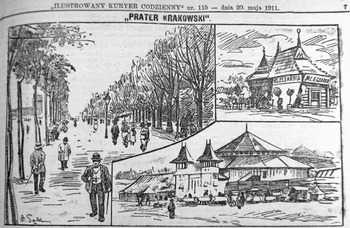
Identification with Vienna could be powerfully attractive to those who identified themselves as Poles, as well. Cabbies grew their facial hair in the style of Francis Joseph; people ate Kaiser rolls and eggs Viennese style for breakfast; they went to the opera, on walks in the forest and to sweetshops and cafes ‘like in Vienna’ – fully cognizant of their participation in the customs of the metropole. Cracovians got the majority of their musical instruments from Viennese workshops and danced to Strauss at their eagerly awaited annual carnival balls. Poorer Cracovians furnished their homes with entry-level Viennese furniture and housewares, while the wealthy purchased luxury items such as watches, jewellery, suitcases, hunting attire and implements and carriages made there.Footnote 35 Cracovians called their city meadow (Błonia), which was the location of a modest amusement park, ‘the Cracovian Prater’ – even if its blandishments were much more modest than the famed recreational area in Vienna. And occasionally, their conflation of the two riparian cities could be quite literal. According to a newspaper report, when a young man in his gymnasium uniform offered an elderly German woman his seat on the tram, he proudly told her ‘here in Galicia we always give our seats to our elders’. He had hardly finished when ‘a well-dressed man, who appeared to belong to the intelligentsia, stood up and said loudly while gesticulating, “Was plaudern Sie! dass ist nicht Galizien, dass ist Wien”’ (What are you jabbering? This is not Galicia, it is Vienna!). Even if the second man was being silly, it is clear that both men were cognizant of the relationship of their city to the imperial capital and capable of communicating in its language.Footnote 36
‘Prater Krakowski’, Ilustrowany Kuryer Codzienny, 20 May 1911, 7

And yet, according to the Polish writer Ferdynand Goetel, Cracovian mimicry of Vienna had its limits:
It's true that on Sundays and holidays the officers in full dress would parade along the A-B line chatting with their Viennese coquettes, exiting to go to the sweet shop Maurizzia, and it's true that the occasional [Cracovian would come back from a trip from Vienna singing] ‘Wien, Wien, nur Du allein’ . . . [but] the imperial-royal sentiments of Cracovian bureaucrats and a good portion of its inhabitants did not conflict [with local municipal pride and the widespread use of Polish].Footnote 37
As Goetel saw it, Cracovians could be surrounded by uniformed representatives of the empire, acculturated to its pervasive system of bureaucracy and even express civic attachment for the city, but this did not preclude local Polish patriotism.
Indeed, from the patriotic Polish perspective, identification with the Little Vienna on the Vistula was probably safest when one was convinced of the contemporaneous strength of the myth of the Polish Mecca. As Irena Homola-Skąpska observes, the word ‘Vienna’ was ‘variously used and understood’ in nineteenth-century Cracow. If ‘initially’ it connoted ‘the capital of an invading country, the home to an enemy of the Polish nation, [and] a symbol of domination’, ‘in the period of Galician autonomy [it was] the centre of a constitutional monarchy ruled by the dexterous hand of Francis Joseph I, a city full of light, life and entertainment, from which promotions, distinctions and advances flowed to Cracow and its inhabitants’.Footnote 38 Identification with Vienna was clearly safer in 1900, when the practice of Polish national commemoration was well established, than in the 1850s, when the city was being transformed into Festung Krakau and German was indeed heard all the time on the streets.
Not surprisingly, in the Polish historiography of the city, studies that stress Cracow's connection to Vienna tended to appear in the 1990s, when the myth of central Europe was a major agenda for intellectuals of Cracow, Prague and Budapest, who sought ‘a return to Europe’ after the collapse of the Iron Curtain. Secure in their freedom and desirous to remind western Europeans (and compatriots alike) of Cracow's longstanding connection to European civilization, local historians had reason to stress the powerful and lasting influence of Vienna in Cracow.Footnote 39 In 1991, after serving briefly as vice president of the city, the professor of architecture and historian of Cracow Jacek Purchla founded the International Cultural Centre/ Międzynarodowe Centrum Kultury and began hosting conferences with support from the Austrian consulate in Cracow. Purchla's impressive Centre, located in a prime corner spot on the Rynek (Main Market Square) in Cracow, has published scores of books and hosted numerous conferences and art exhibits designed in part, at least, to explore and assert Cracow's connection to European and especially central European culture. In popular culture, meanwhile, cafés and pubs named after Francis Joseph and filled with Habsburg kitsch quickly sprang up in Cracow, Lviv, Prague and Budapest, based largely on the same imperative. Stressing the city's place in the famous multinational empire could remind patrons of its European heritage.
Cracow as a large European city
Joining Europe was a major ideological imperative for Cracovians at the beginning of the twentieth century, too. As their city underwent the dramatic transformation of becoming a modern metropolis, many Cracovians looked to big cities abroad for models on how this transformation could be best achieved. During the first 15 years of the twentieth century Cracow's population doubled; its municipal waterlines and electricity began to operate; electric streetcars and automobiles began to hustle along its streets; the city's first sports teams and cinemas appeared; and thousands of Cracovians began to identify with modern urban life. They increasingly wore ‘western dress’, spoke in modern slang and ate meat imported from locales as far away as Argentina. Despite the fact that many people found these changes threatening, particularly for those presumed most vulnerable, it was frequently villagers, women and children who most readily identified with modern urban life, precisely because they felt empowered by the new ways of thinking and living.Footnote 40 For them, the myth of modern urban Cracow afforded the greatest opportunity for advancement and offered the greatest explanatory power in predicting the city's future. Paris, London, Vienna and Berlin were at once models of the danger and depravity of modern urban life and models of its thrilling possibilities.Footnote 41 To think of Cracow as a large European city may have been humbling at first – there was much to do to ‘catch up’ – but it also offered a promising future.
Earlier, I omitted the middle part of the Alfred Szczepański quotation about the Polish Mecca and the Polish Florence. The complete sentence reads: ‘Cracow has always been the Mecca of national sanctity; fortunately of late it has started to become a sort of Polish Munich and Düsseldorf – and thanks to Siemiradzki it's becoming a Polish Florence.’ That qualifier, ‘fortunately’, suggests that the worldly-wise Szczepański was just as eager to see Cracow become a thriving European metropolis like Düsseldorf, which was rapidly industrializing at the time – something demonstrably new for old Cracow – as he was to see its reconfiguration as an art centre, ‘the Polish Florence’.
About 15 years after he had penned these words, Szczepański's son Ludwik returned to Cracow following his law studies in Vienna, and after a brief career as a decadent poet and the editor of the pre-eminent Polish-language literary magazine of the time, went on to found the city's first illustrated weekly and then its first successful daily boulevard newspaper, Nowiny dla wszystkich (The news for everyone).Footnote 42 Ludwik Szczepański's major message in the paper, from its founding in 1903 until its collapse in the winter of 1913/14 and absorption by an even stronger illustrated daily, was the promotion of Cracow's modern metropolitan development. Szczepański advocated for the creation of Greater Cracow, which was achieved from 1910 to 1915, while promoting new technologies and new ways of thinking. He wrote and published two instalment novels about mechanized flight in his paper, followed by an imaginative short story entitled ‘In the year 1950’.Footnote 43 Szczepański and his protégé, Maryan Dąbrowski, who founded a rival illustrated daily that eventually absorbed Nowiny and became the most powerful press conglomerate in inter-war Poland, diligently studied the press in big cities abroad and brought the lessons they learned to Cracow. In promoting a forward-looking vision of Cracow as part of an inter-urban matrix of European civilization, Szczepański and Dąbrowski provided their readers with an appealing new way to think about their city.
One of the most common ways foreign cities appeared in the Cracovian popular illustrated press was as a point of comparison with Cracow. Journalists were often aware of conditions in other European metropolises, whether from visits as correspondents or from their daily scouring of the foreign press. A piece from 1913 placed Cracow among the ranks of European art centres, asserting that in each of the bigger cities there seemed to be a certain artistic specialty. ‘Vienna is known for its musicians, Munich for its painters, Warsaw for its actors and Cracow for its writers’, the journalist contended, perhaps a bit self-servingly.Footnote 44 Journalists consistently compared Cracovian street criminals to their counterparts in London, Paris, Berlin, Vienna, Warsaw and Lemberg, commenting on the particular characteristics of thugs in each city.Footnote 45 Statistics from other cities helped place Cracow in context, as in articles about working-class housing costs in a variety of European cities or the size of urban police forces, or a piece entitled ‘Cracow's Stomach’, followed a week later by ‘London's Stomach’, which detailed the amounts of food consumed per day in the respective cities.Footnote 46 A well-informed article about Cracow's lack of suburban development made numerous references to Vienna, Prague, Dresden, Warsaw and even Bielsko-Biała as examples of cities with developed suburbs and garden districts.Footnote 47 Citizens made comparisons with other European big cities, too. On more than one occasion, strollers on the A-B side of Market Square downtown said that they felt like they were in Paris, a clear indication that they felt a kinship between their city and the famous capital on the Seine.Footnote 48
Often, articles complained that Cracow lacked the full lustre of European civilization or was only a junior member of the family, as in a piece that likened Cracovians to children on the European scene because they had not yet mastered some basic skills of urban life, such as walking in crowds. The article observed that Cracovians did not know how to pass each other on the street, as their ‘older’ European siblings did, further grousing that they did not know how to eat properly at restaurants or enjoy themselves in the city.Footnote 49 An article entitled ‘Cracow gets civilized’ discussed the city's plan to replace outmoded public toilets with ‘Viennese style’ commodes, concluding: ‘The city must Europeanize itself (musi się europeizować) and cannot preserve the unhygienic and disgusting particularities it has had to this point.’Footnote 50 Another article bemoaned unhygienic conditions in the shops and stores in the city, berating Cracow's tendency to cling to tradition instead of embracing modern, civilized techniques. Complaining that ‘even in a first-rate store’ assistants wrap butter with filthy hands, people at the market still taste cream with their fingers and patrons of the public library can be so ‘uncivilized’ as to steal pages from the books, the author asserted
[a] visitor from the civilized west must have a strange experience if for a moment he stops on Galician territory and gets to know ancient Cracow, [where] . . . everything is still done according to the old accepted model. The seat of the Jagiellonians seems to have turned to stone; old customs have ossified; flaws, faults and old filthiness bloom in seemingly new beds.
The journalist's hope, of course, was that some of his thousands of readers would embrace more modern ways. ‘Today, the world over, even in old medieval cities upheld by tradition [i.e. Cracow], new orderly ways are being introduced’, the author contended. ‘The gleam of culture and civilization does not disfigure old monuments; it does not injure the past . . . Such is Cracow – the Polish Mecca, well-supplied with the sign of the Polish eagle, patriotic pictures and . . . old fogies!’Footnote 51 Here, the abundance of Polish eagles and patriotic pictures by Siemiradzki, for example, represented not the glory of the nation but rather its old-fashionedness, its status as a capital of old fogies. These stones did not speak of the nation's great past; instead, they symbolized its death, the ossification of old manners of thinking and doing. These stones were mute, or at least the modernizers had already chosen not to listen.
Contemporaries had no way of knowing that by late 1918 there would be an independent Polish state as a result of the destruction of the three partitioning powers; for them the likeliest scenario for their city involved continued membership in the Austrian monarchy and continued modernization and urbanization. Not only did the war bring about the destruction of the monarchy, it also interrupted one of the most intense periods of urban development in Cracow's history. Historians have largely forgotten Cracow's rapid modernization in the early twentieth century because, first, the city never really became a major metropolis once Warsaw became the capital of the new Polish state and, second, Cracow's forced industrialization due to the creation of the adjacent steel mill city of Nowa Huta by the communists in the 1950s seems not to be a central part of its preferred identity as a city of culture and education today. The myth of Big-City Cracow persists in the city's claims to excellent public transportation, vibrant nightlife and its popularity as a location for offices of multinational corporations and high-tech industry. But it is hardly the foremost vision of Poland's second largest city, which tends to emphasize Cracow's place as a historical gem and a centre of arts, learning and culture, as exemplified by its witty tourist slogan: ‘Here every weekend goes down in history’ (Tu każdy weekend przechodzi do historii).Footnote 52
Embracing culture and the past has served the city well. Cracow's good fortune in avoiding the physical destruction of World War II – unlike Warsaw, where some 80 per cent of the city was levelled – has meant that the Cracovians can express their city's value by referring to its glorious past. Those formerly sacred stones, cleansed of the decades of corrosive soot from Nowa Huta and repainted in lovely pastels, including Habsburg yellow, can now signify Cracow's sanitized Polish and Habsburg past. And it is no accident that the speaking stones of the city have also been scrubbed of their Polish exclusivity. The past that Cracow now commemorates is explicitly diverse and multiconfessional, as befitting a major European tourist destination. German and Italian influences from the city's late mediaeval and Renaissance heyday are acknowledged and celebrated, while tours of ‘Jewish Cracow’ and trips to the nearby memorial at Auschwitz/Oświęcim account for a large proportion of its tourists from abroad.
Conclusions
The myths of the Polish Athens, Mecca or Rome, particularly in their earlier incarnations, were a powerfully attractive way of picturing Cracow. In focusing attention on the symbolic value of the city's glorious past, they elevated a relatively small provincial backwater into an ersatz capital for a non-existent Polish state. Even if Russian-dominated Warsaw was much larger and Lemberg was the official capital of Austrian Galicia, Cracow could still be the spiritual capital of the Polish nation. For patriotic Poles, humbled by their persistent sense of national defeat in an age of nationalism, the Polish Mecca could attract the zeal of the pilgrim while imbuing adherents with the sensation of ‘brotherhood’ and fellow feeling.
But the commemorative impulse excluded those inhabitants of the city for whom the ‘speaking stones’ stuttered in the wrong tongue or remained mute altogether. Many of Cracow's Jews tended to be acculturated and got along relatively well with their Polish neighbours, but the myth of the Polish Rome, in particular, offered them little room to manoeuvre. For the emissaries of the Habsburg empire, from its soldiers to its bureaucrats and railway workers, the myth of the Polish Mecca found little purchase. While less prestigious because of its obvious attention to derivativeness, thinking of Cracow as a little Vienna made much more sense for anyone concerned with living in the present. It acknowledged the genuine political and cultural power of the metropole, while connecting citizens to a generally attractive way of life. Ultimately, as Homola-Skąpska observes, the role played by Vienna in Cracow was most clearly manifest in the realm of everyday life.Footnote 53 Cracovians, Polish-speaking or not, were thickly enmeshed in the customs and bureaucracy of the Habsburg monarchy in the decades before the Great War.
The myth of Cracow as a modern European metropolis could co-exist with the myth of the Little Vienna on the Vistula, but it sat a bit uneasily with the national vision of the city. As the previously cited journalist noted optimistically, modernization need not ‘disfigure old monuments’ or ‘injure the past’, but it was clear that the Polish Mecca remained an impediment to that process. As we have seen, civic and provincial dignitaries, recognizing the potential conflict between a vision of the city that was obsessed with symbols from the past and another that pointed resolutely toward its future, also strove to placate their audience by noting that Greater Cracow had ‘not ceased to be’ the spiritual capital of the Polish nation. Modernization was clearly a threat to a vision of Cracow obsessed with the past. As the historic preservationist Tomkowicz put it:
The more the modern world lives in the heat of the moment from day to day, the more there arises among educated people – or to use the fashionable expression: among intellectuals – an interest in the monuments of the past. It is the result of the natural reaction to the uproar and distractions, a longing for the silence, peace and harmony that the view of edifices from those centuries that did not know trains, telegraphs, newspapers, factories, capitalism, strikes and bombs can provide.Footnote 54
For conservative elites like Tomkowicz, Cracow's modernization was not necessarily a welcome change. The construction of new buildings, streets and tramlines threatened the city's historical landmarks, while the growing influence of the modern world in the form of capitalism, factories, strikes and bombs jeopardized traditional hierarchical relationships. Writing in the conservative newspaper Czas (Time) during a period of violence and revolution, Tomkowicz justified his interest in restoring Wawel and other landmarks as a soothing antidote to the ‘uproar and distractions’ of the frenetic modern world.Footnote 55 Intellectuals, he implied, naturally looked to the monuments of the past in an effort to preserve the peace and security of a bygone age. Tomkowicz's use of the word ‘natural’, as Barthes helps us to understand, reveals the presence of a myth.Footnote 56 Historic preservation, like the commemorative impulse, was a new development, a particular response to Cracow's modern predicament.
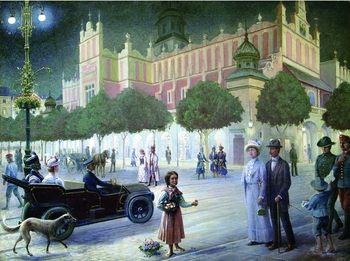
J.R., A Scene on Market Square (1912), photograph by Z. Witek; used with permission.

As Dabrowski has shown, the myth of the Polish Athens or Mecca proved powerful in knitting the nation together vertically. But attention to the attitudes of ordinary urbanites shows that many of them may have found the myths of the Little Vienna or Big-City Cracow more attractive in everyday life. Recent scholarship on Habsburg central Europe has increasingly shown that despite the wishes of nationalist activists, for most citizens, identification with the nation tended to be episodic, situational and frequently less fervent than desired.Footnote 57 There is no doubt that national identification became increasingly important in the cities of the empire during this period, but its existence need not rule out strong imperial, municipal or inter-urban identifications, as well.Footnote 58 As Eric Hobsbawm has observed, ‘we cannot assume that for most people national identification – when it exists – excludes or is always or ever superior to the remainder of the set of identifications which constitute the social being’. National self-identification, Hobsbawm further observes, could flare up or lie dormant, depending on the situation.Footnote 59 Historians have shown how events such as a politicized murder of a national activist could contribute to highly symbolic uses of urban space and the assertion of national identity,Footnote 60 but in the realm of everyday existence, national identity need not have mattered as much.
Even in moments of national-historical commemoration, there is evidence that national patriots felt that their urban co-nationals were insufficiently enthusiastic. During the tremendous celebration surrounding the 500th anniversary of the Battle of Grunwald in July 1910, Cracow's popular illustrated press felt it necessary to print articles justifying the celebration with titles such as ‘Why we celebrate the Grunwald anniversary.’ Once the commemorations were under way, the press complained bitterly that only the intelligentsia showed up, the crowds were too small and far too few people participated in the illumination of their windows as part of the celebration. Those who did, one article grumbled, had only been enterprising shopkeepers, who took advantage of the opportunity to advertise their wares at night.Footnote 61 This is not to say that the celebration had been a failure – as Dabrowski points out, the Grunwald commemorations represented the apogee of Polish pre-war commemorations in terms of participants and planningFootnote 62 – but to acknowledge that committed nationalists doubted the support of petty urbanites and were disappointed that those citizens most inclined to play along may have merely sought to profit from their public pronouncements of patriotism.
I would like to close by referring to one of my favourite paintings of early twentieth-century Cracow. A Scene on Market Square (Scena na Rynku), which is dated 1912 and signed only with the initials J.R., lacks the technique of Siemiradzki's historicist masterpiece, but it makes up for this deficiency in its straightforward Rockwellian charm. In the background, we see the Polish Athens in its glory, symbolized by the Clothiers’ Hall in rose and yellow pastels, along with social groups in traditional or neo-traditional dress keeping to their own. In the middle plane, we see the Little Vienna on the Vistula, as represented by the gendarme standing guard and the soldiers to the far right of the painting who are being solicited to buy a paper from a barefooted youngster. But it is the foreground that most draws our attention. Here we see a petty bourgeois couple in ‘western dress’, enterprising street children, tramlines and an automobile – all emblematic of modern, big-city Cracow. To ignore any part of this picture would be to elide the complexity of simultaneous group and self-identification that can take place in the city. The participants in this scene could have identified momentarily with any or none of the three mythic Cracows described in this article. But in drawing our attention to the foreground, I hope to challenge the hegemony of the heretofore dominant visions of the city. In all three examples, the Polish Mecca, the Little Vienna on the Vistula and Big-City Cracow, Cracovians with an agenda alluded to other cities in order best to emphasize their vision of the city, and so, too, have their historians. As units of comparison, cities offer powerful opportunities for the creation of meaning. I hope that in connecting Cracow to the global march of urbanization and transnational urban culture, I can thus expand our understanding of this process in a place we may not typically connote with modernity and modern urban life.