INTRODUCTION
Maize (Zea mays L.) together with rice and wheat provides at least 30% of the food calories to more than 4.5 billion people in 94 developing countries (Shiferaw et al., Reference Shiferaw, Prasanna, Hellin and Banziger2011). Maize is a versatile crop having wider adaptability and particularly important to the poor people for overcoming hunger and improving food security not only in India but also in other parts of the World (Banerjee et al., Reference Banerjee, Goswami, Chakraborty, Dutta, Majumdar, Satyanarayana, Jat and Zingore2014). Among the maize growing countries, India holds the 4th position in area (8.71 million ha) and production (24.35 million tonnes) and the 20th rank in productivity with 2.56 Mg ha−1 (FAOSTAT, 2015). For increasing productivity, better nutrient management systems are needed to complement genetic improvement efforts.
Hybrid maize requires high amount of nutrients, especially nitrogen, phosphorus and potassium for increasing and sustaining productivity (Banerjee et al., Reference Banerjee, Goswami, Chakraborty, Dutta, Majumdar, Satyanarayana, Jat and Zingore2014). Generally in South Asia, maize hybrids grown in winter season takes up around 200 kg N, 30 kg P and 167 kg K ha−1 to attain a grain yield of about 10–12 Mg ha−1, with similar amount of non-grain biomass (BARC, 2005). So, applying higher doses of NPK-fertilizer is indispensable for increasing yield of hybrid maize. However, NPK fertilizer should be applied in such a quantity that it becomes profitable and avoids adverse effects on environment (Timsina et al., Reference Timsina, Jat and Majumdar2010). Many attempts have been made by researchers to develop various methods to estimate optimal N, P and K application rates, to name a few, soil-test-based optimal nutrient supply and response-models-based economic optimum N rate. Most of these time-consuming and expensive techniques for making fertilizer recommendations consist of one predetermined rate of nutrients for vast areas, assuming that the need of a crop for nutrients will remain constant over time and space. These approaches do not take into account the existence of large variability in soil nutrient supply and crop response to nutrients among farms in Asia (Timsina et al., Reference Timsina, Jat and Majumdar2010). Then, managing the location and season-specific variability in nutrient supply is the key strategy to overcome the mismatch of fertilizer rates and crop nutrient demand (Dobermann et al., Reference Dobermann, Witt, Abdulrachman, Gines, Nagarajan, Son, Tan, Wang, Chien, Thoa, Phung, Stalin, Muthukrishnan, Ravi, Babu, Simbahan and Adviento2003).
The original concept of site-specific nutrient management (SSNM) was developed in Asia for field crops (Dobermann and Cassman, Reference Dobermann and Cassman2005). A distinct feature of ‘Asian’ SSNM approach is that it adds important regional and real-time components to the otherwise used approaches of SSNM in large-scale farming. In addition, the traditional approach mainly focuses on managing spatial variability of nutrients within large production systems (Liu et al., Reference Liu, He, Jin, Zhou, Sulewski and Phillips2011). Initiatives were made in recent years through nutrient omission approaches to evaluate soil and fertilizer nutrient contributions to the crop performance and finally develop SSNM recommendations for sustainable yield. This SSNM approach has been evaluated at numerous locations in Asia but mainly in rice, remaining unexploited for other cereals. In this approach, field-specific balanced amounts of N, P and K were prescribed to small farms based on crop-based estimations of the indigenous supply of N, P and K (Dobermann et al., Reference Dobermann, Witt, Abdulrachman, Gines, Nagarajan, Son, Tan, Wang, Chien, Thoa, Phung, Stalin, Muthukrishnan, Ravi, Babu, Simbahan and Adviento2003; Khurana et al., Reference Khurana, Phillips, Singh, Alley, Dobermann, Sidhu, Singh and Peng2008).
The issue was whether such knowledge-intensive nutrient management concepts can be simplified and practiced for a single-field experiment, instead of wider-scale dimension, without losing precision and gains in yield, profitability and nutrient use efficiency (NUE) for maize production systems. To address this, the present experiment was conducted to estimate indigenous nutrient supply in the study area and quantify the NUE of maize hybrids using the ‘omission plot’ concept.
MATERIALS AND METHODS
Experimental area
Field experiments were conducted during two consecutive winter seasons of 2012–2013 and 2013–2014 on farmer's field at Gayeshpur, Nadia, West Bengal, India (23°26.010'N latitude, 88°22.221'E longitude, 12.0 m above mean sea level). The climate of the region was humid−tropic with moderately cool winter (Supplementary Table S1). The maximum and minimum air temperatures fluctuated from 24.5 to 35.6 °C and from 9.8 to 18.9 °C during winter 2012–2013, and from 24.2 to 32.7 °C and from 10.5 to 17.8 °C during winter 2013–2014, respectively. In general, there was a gradual drop in air temperature from November to January, which favoured the growth and development of maize hybrids. The maximum and minimum air relative humidity prevailed between 89.5–95.5% and 34.5–59.5% during winter 2012–2013, and 84.5–85.8% and 48.5–63.0% during winter 2013–2014. The rainfall during the experimental period (November to March) was 14.6 and 13.7 mm during winter 2012–2013 and 2013–2014, respectively. The experimental soil of Gayeshpur region belongs to soil order inceptisols and it is characterized by least soil profile development, except beginning of B horizon with the accumulation of small amounts of clay, salts and organic material. On landscapes, young deposits of alluvial soil are found. The soil (0–30 cm depth) was clay loam in texture (Table S2), neutral in reaction (pH 7.31), non-saline (electrical conductivity of soil solution of 0.296 dS m−1), and medium in organic carbon (0.66%) and available K (83.2 mg kg−1), and high in available N (96.1 mg kg−1) and available P (18.6 mg kg−1).
Treatments and experimental design
The experiment was laid out in strip-plot design, assigning three maize (Zea mays L.) hybrids (P 3522, P 3396 and Rajkumar) in the vertical strip and nine fertilizer treatments [50% RDF, 75% RDF, 100% RDF (200-60-60 kg N-P2O5-K2O ha−1), 125% RDF, 150% RDF, 100% PK (N omission), 100% NK (P omission), 100% NP (K omission) and control (zero-NPK)] in the horizontal strip, with three replications. The 100% RDF was considered as the optimum nutrient treatment. The recommendation from Indian Institute of Maize Research (IIMR) was taken in to consideration (http://www.iimr.res.in/) while fixing the RDF (200 kg N, 60 kg P2O5 and 60 kg K2O ha−1) for this location. The gross plot size for individual treatment was 5 × 4 m.
Field observations and laboratory analysis
The net plot size for recording grain yield was 4 × 3 m. Maize plants were harvested and tied in bundles after removing all the matured cobs. Five sample plants (consists of leaves, stems, tassel and husk) and dried in an oven (80 °C for 10 h) until constant weights were obtained. Grains were deshelled from the cob, dried to constant weight in an oven (65 °C) and grain yield was reported at 14% moisture content.
For total N analysis, plant samples (consists representative part of stem, leaf, tassel, husk, deshelled cob and grain) was digested with concentrated H2SO4 for 1–2 h at 420 °C until green colour was obtained. Total N in the digest was determined by Micro–Kjeldahl steam distillation method (AOAC, 1995). Total P and K in plant samples were determined in digests of tri-acid mixture (HNO3:H2SO4:HClO4, 9:1:4) using UV–VIS spectrophotometer and flame photometer, respectively (Jackson, Reference Jackson1973).
Yield response to fertilizer NPK vis-a-vis indigenous nutrient supply (INS)
Yield response is the yield difference between 100% NPK and the nutrient limited yield, and can reflect soil indigenous nutrient supply (Xu et al., Reference Xu, He, Pampolino, Johnston, Qiu, Zhao, Chuan and Zhou2014). Total amount of fertilizer required by a crop for an entire growing season is directly related to the anticipated crop response to fertilizer (N/P/K), and can be estimated by the following equation:
 $$\begin{equation}
{\rm{YRF}} = {\rm{G}}{{\rm{Y}}_{{\rm{RDF}}}} - {\rm{G}}{{\rm{Y}}_{{\rm{OT}}}}
\end{equation}$$
where, YRF is yield response to fertilizer N/P/K (Mg ha−1); GYRDF is grain yield with 100% RDF (Mg ha−1); GYOT is grain yield with N/P/K omissions treatments (Mg ha−1). The nutrient-limited yield is directly related to the supply of nutrient from indigenous (non−fertilizer) sources, which include soil, crop residues, organic inputs, rainfall, atmospheric deposition and irrigation water. The indigenous nutrient supply is defined as the total amount of a particular nutrient that is available to the crop from the soil during a cropping cycle when other nutrients are non-limiting (Witt and Dobermann, Reference Witt and Dobermann2002), which can be determined with the omission plot technique as mentioned below:
 $$\begin{equation}
{\rm{INS}} & =& {\rm{\ N}}{{\rm{U}}_{{\rm{N\ omission}}}}\\
\end{equation}$$
 $$\begin{equation}
{\rm{IPS}} & =& {\rm{\ N}}{{\rm{U}}_{{\rm{P\ omission}}}}\\
\end{equation}$$
 $$\begin{equation}
{\rm{IKS}} & =& {\rm{\ N}}{{\rm{U}}_{{\rm{K\ omission}}}}
\end{equation}$$
Nutrient use efficiency
To estimate the NUE of maize, AE, internal efficiency (IE), recovery efficiency (RE), partial factor productivity (PFP) and partial nutrient budget (PNB) were calculated according to Liu et al. (Reference Liu, He, Jin, Zhou, Sulewski and Phillips2011), with slight modifications.
 $$\begin{equation}
{\rm{AE}} & =& \frac{{{\rm{G}}{{\rm{Y}}_{\rm{T}}} - {\rm{G}}{{\rm{Y}}_{\rm{C}}}}}{{{\rm{A}}{{\rm{F}}_{\rm{T}}}}}\\
\end{equation}$$
 $$\begin{equation}
{\rm{IE}} & =& \frac{{{\rm{G}}{{\rm{Y}}_{\rm{T}}}}}{{{\rm{N}}{{\rm{U}}_{\rm{T}}}}}\\
\end{equation}$$
 $$\begin{equation}
{\rm{RE}} & =& \frac{{{\rm{N}}{{\rm{U}}_{\rm{T}}} - {\rm{N}}{{\rm{U}}_{\rm{C}}}}}{{{\rm{A}}{{\rm{F}}_{\rm{T}}}}}\\
\end{equation}$$
 $$\begin{equation}
{\rm{PFP}} & =& \frac{{{\rm{G}}{{\rm{Y}}_{\rm{T}}}}}{{{\rm{A}}{{\rm{F}}_{\rm{T}}}}}\\
\end{equation}$$
 $$\begin{equation}
{\rm{PNB}} & =& \frac{{{\rm{N}}{{\rm{U}}_{\rm{T}}}}}{{{\rm{A}}{{\rm{F}}_{\rm{T}}}}}
\end{equation}$$
Profitability of nutrient management practices
Change in profitability due to adoption of a particular technology is important in case of SSNM. For this, gross return over fertilizer (GRF) cost calculations were made as suggested by Khurana et al. (Reference Khurana, Phillips, Singh, Alley, Dobermann, Sidhu, Singh and Peng2008).
 $$\begin{equation}
{\rm{TFC}} & =& {\rm{\ }}{{\rm{P}}_{\rm{N}}}{{\rm{F}}_{\rm{N}}}{\rm{\ }} + {\rm{\ }}{{\rm{P}}_{\rm{P}}}{{\rm{F}}_{\rm{P}}}{\rm{\ }} + {\rm{\ }}{{\rm{P}}_{\rm{K}}}{{\rm{F}}_{\rm{K}}}\\
\end{equation}$$
 $$\begin{equation}
{\rm{GRF}} & =& {\rm{\ }}{{\rm{P}}_{\rm{R}}}{{\rm{Y}}_{\rm{R}}} - {\rm{\ TFC}}
\end{equation}$$
For estimating GRF, TFC was estimated while the cost of urea, single super phosphate (SSP) and muriate of potash (MOP) was US$ 0.11, 0.14 and 0.30 kg−1, respectively. Value of TFC (US$ ha−1) for different levels of NPK were calculated as 50% RDF = 24.08; 75% RDF = 36.13; 100% RDF = 48.17; 125% RDF = 60.21; 150% RDF = 72.25; 100% PK (N omission) = 26.50; 100% NK (P omission) = 39.67; 100% NP (K omission) = 30.17 and Control (−NPK) = 0.00.
Statistical analysis
Data were subjected to the analysis of variance (ANOVA) as strip-plot design and the mean values were compared by the Tukey's HSD (honest significant difference) test method using the software SPSS v.21.0 (Version 21.0, IBM SPSS Statistics for Windows, IBM Corporation, Armonk, NY, USA). The variance over years was estimated homogeneously by performing Bartlett's chi-square test and pooled analyses of observations are presented to draw logical conclusions. The Excel software (version 2007, Microsoft Inc., WA, USA) was used to draw graphs and figures.
RESULTS
Nutrient uptake, yield and profitability as affected by NPK−fertilization
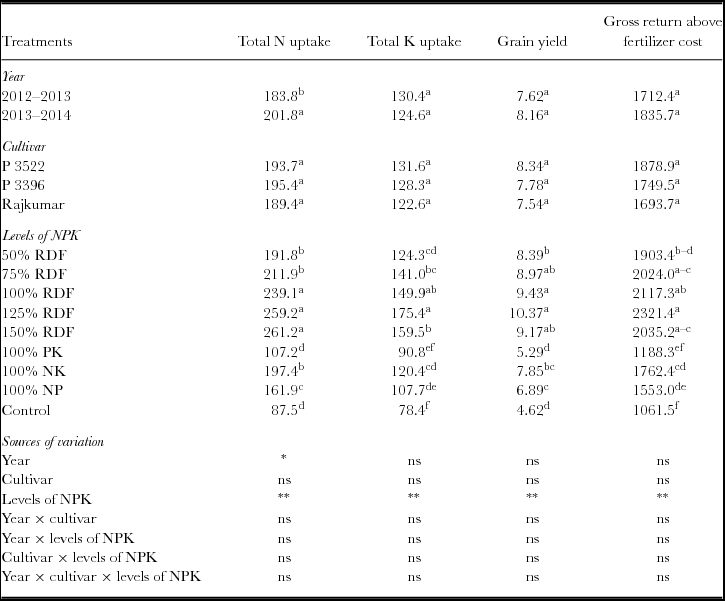
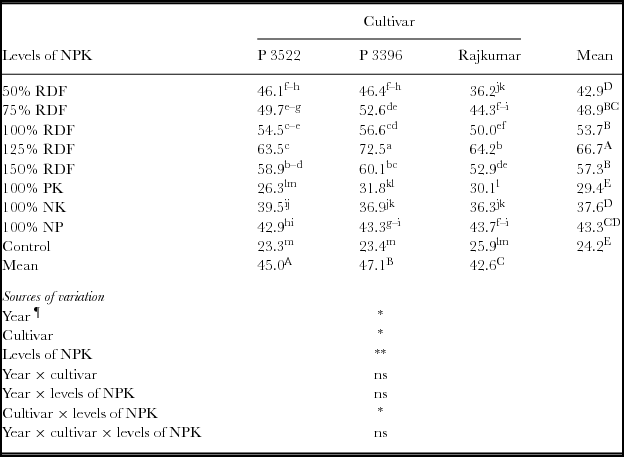
The year effect was significant only for N (Table 1) and P uptake (Table 2). Irrespective of NPK levels, maize cultivars showed significant differences only for total P uptake, and the cultivar P 3396 exhibited significantly higher total P uptake than other cultivars (Table 2). The NPK fertilization exerted significant effect on nutrient uptake (Tables 1 and 2). Application of 100, 125 and 150% RDF resulted in higher N uptake compared with all the other nutrient management treatments and the extent of increase was from 123 to 144% over minus N treatment. Application of 125% RDF resulted in higher total P and K uptake and the extent of increase was 24 and 17%, respectively, over 100% RDF. However, further increment of NPK dose (150% RDF) did not further increase both P and K uptake. The two-way interaction (cultivar × levels of NPK) had a significant effect on total P uptake by tested cultivars, and the cultivar P 3396 exhibited greater P uptake when fertilized with 125% RDF (Table 2).
Total N and K uptake (kg ha−1), grain yield (Mg ha−1) and gross return above fertilizer cost or GRF (US$ ha−1) in hybrid maize cultivation as influenced by cultivar and levels of NPK (mean of two years).

Within mean values for year, cultivar and levels of NPK, numbers followed by different letters indicate significant differences at p < 0.05 (otherwise statistically at par); ns: non-significant (p > 0.05). *Significant at p < 0.05. **Significant at p < 0.01; 1 US$ =  60.95; Recommended dose of fertilizer (RDF), 200-60-60 kg N-P2O5-K2O ha−1
Interactive effect between cultivar and levels of NPK on total P uptake (kg ha−1) in hybrid maize (mean of two years).

¶ Year-wise mean data of total P uptake were 46.3 and 43.4 kg ha−1 during 2012–2013 and 2013–2014, respectively. Within mean values for cultivar, levels of NPK and their interaction, numbers followed by different letters indicate significant differences at p < 0.05 (otherwise statistically at par); ns: non-significant (p > 0.05). Capital letters indicate a significant difference among mean values for cultivars and levels of NPK, whereas small letters indicate a significant difference among interaction (cultivar × levels of NPK) values; *Significant at p < 0.05. **Significant at p < 0.01; Recommended dose of fertilizer (RDF), 200-60-60 kg N-P2O5-K2O ha−1
While no significant differences were found among maize cultivars for grain yield (Table 1), it was significantly changed by NPK levels. Application of 125% RDF recorded higher grain yield compared with 50% RDF and it was statistically similar to 75, 100 and 150% RDF (Table 1). Significant yield reduction was observed in nutrient omission plots, while the lowest yield was recorded in control plot. When compared with 100% RDF, grain yield reduction with nutrient omission was 44, 17 and 27% for N, P and K omission, respectively.
Gross returns above fertilizer (GRF) were statistically similar for all maize cultivars (Table 1). GRF was significantly influenced only by NPK levels. Application of 125% RDF recorded higher (22%) GRF compared with 50% RDF, which was similar to 75, 100 and 150% RDF. Significant reduction in GRF was found in nutrient omission plots, while the lowest GRF was recorded in control plot. When compared with 100% RDF, omission of N caused greater reduction in GRF (44%), followed by K omission (36%) and P omission (20%).
Yield response to NPK and indigenous nutrient supply
The maize hybrids showed greater response to fertilizer N (4.14 Mg ha−1) during winter, followed by K (2.54 Mg ha−1) and P fertilization (1.58 Mg ha−1), as shown in Table 1. Soil indigenous N, P and K supply was estimated in 107.2, 37.6 and 107.7 kg ha−1, respectively (Tables 1 and 2).
Nutrient use efficiency
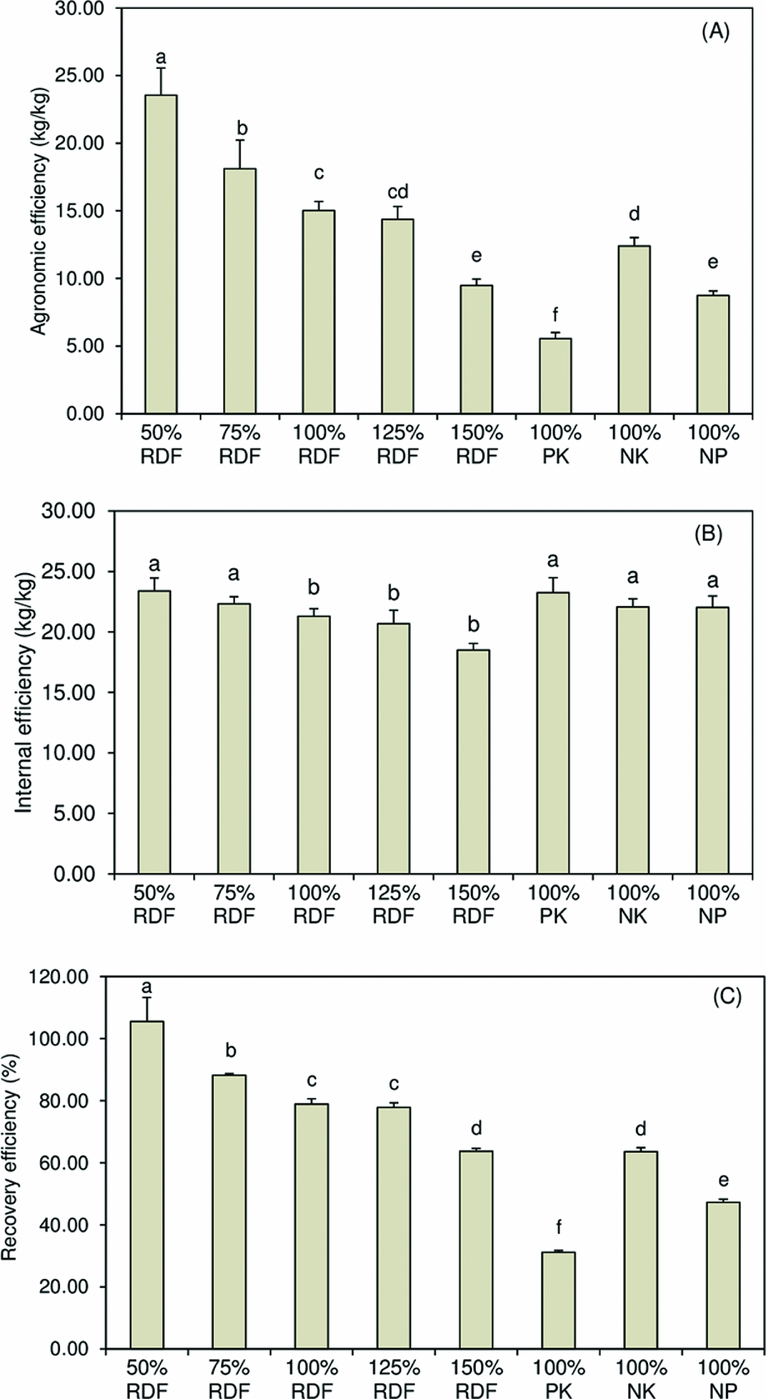
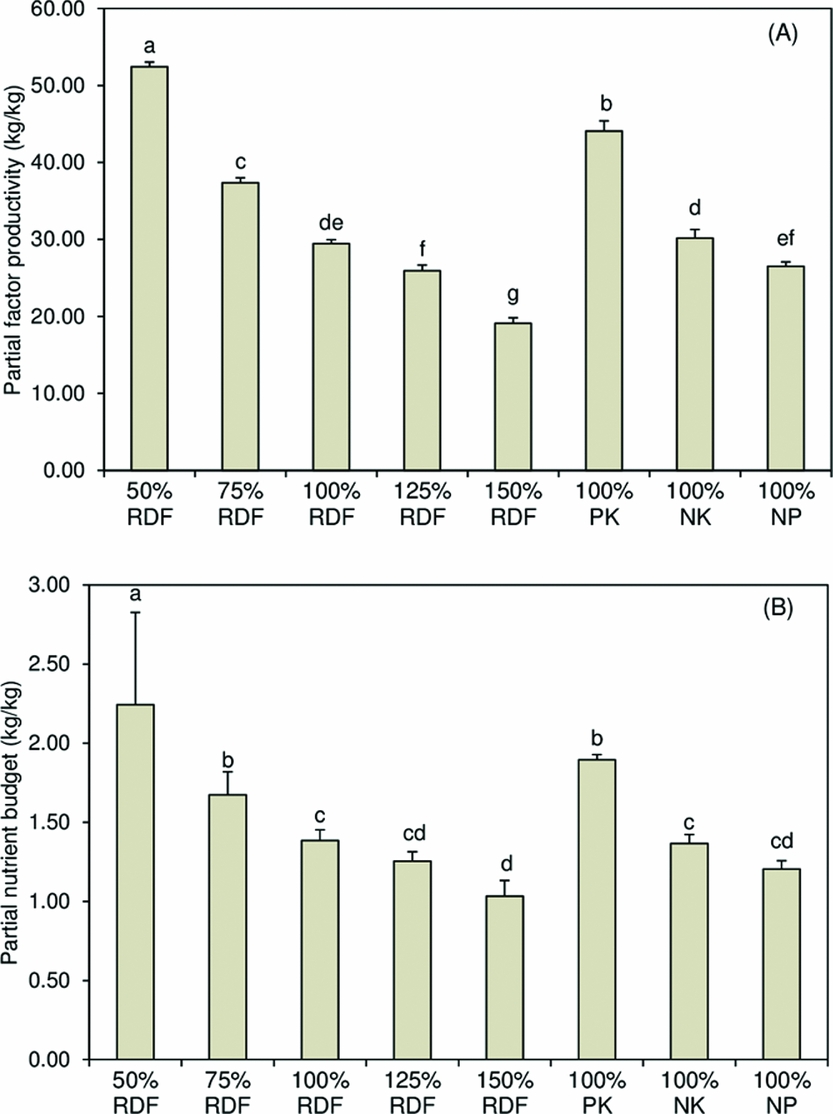
The average AE was higher with 50% RDF and it decreased with further increase in NPK levels up to 150% RDF. Nutrient omission treatments caused low AE, with the lowest AE being obtained with minus N treatment (Figure 1a). The average RE exhibited the similar trend to that of AE (Figure 1a, c). The average IE was significantly higher with 50% RDF, closely followed by the treatment with minus N (Figure 1b). As the nutrient levels increased from 75 to 150% RDF, the IE decreased. Similar trend was found for average PFP and PNB of NPK (Figure 2a, b).
Agronomic efficiency (a), internal efficiency (b) and recovery efficiency (c) of hybrid maize as influenced by different levels of NPK fertilizer [Bars indicate standard error; numbers followed by different letters indicate significant differences at p < 0.05 (otherwise statistically at par); recommended dose of fertilizer (RDF), 200-60-60 kg N-P2O5-K2O ha−1].

Partial factor productivity (a) and partial nutrient budget (b) of hybrid maize as influenced by different levels of NPK fertilizer [Bars indicate standard error; numbers followed by different letters indicate significant differences at p < 0.05 (otherwise statistically at par); recommended dose of fertilizer (RDF), 200-60-60 kg N-P2O5-K2O ha−1].

DISCUSSION
Nutrient uptake, productivity and profitability
Uptake of nutrients (N and P) was observed to vary significantly across the experimental years (Tables 1 and 2). High absorption of P at low concentrations of N, as observed in winter 2012–2013 (data not shown) was likely caused by high mobility of N, which tends to depress the absorption of P under high N concentration. However, several workers have reported positive interaction between N and P, which leads to increase in P absorption and higher yields due to undefined soil and plant related mechanisms (Mengel and Kirkby, Reference Mengel and Kirkby2006). Wilkinson et al. (Reference Wilkinson, Grunes, Sumner and Sumner1999) also reported that N can increase P uptake in plants by increasing root growth, ability of roots to absorb and translocate P, and also by decreasing soil pH (as a result of NH4+ absorption) resulting in increased solubility of P fertilizer.
Application of 100 to 150% recommended doses of NPK resulted in significantly higher N uptake over other nutrient management treatments, while P and K uptake was higher with 125% RDF (Tables 1 and 2). The cultivar ‘P 3396’ exhibited higher P uptake with 125% RDF, closely followed by ‘Rajkumar’ and ‘P 3522’ (Table 2). Application of 125% RDF might have brought higher nutrient concentration in plant, and simultaneously plants did not witness the ‘dilution effect’ on nutrient concentration as influenced by higher dose of fertilizer application.
Maximum reductions in NPK uptake were associated with N omission, while K omission reduced both N and K uptake, which suggest positive N × K interaction in soil. Maize can absorb N either as NH4+ or NO3− form and it is suggested that K+ does not compete with NH4+ for uptake; rather it increases NH4+ assimilation in plants and avoids possible NH4+ toxicity (Aulakh and Malhi, Reference Aulakh, Malhi, Mosier, Syers and Freney2004). Potassium could also be involved in NO3− uptake, through co-transport with NO3− in xylem as an accompanying cation from roots to shoots. Second, K has a strong influence on the translocation of photosynthetic assimilates, which supports active uptake of NO3− (Mengel and Kirkby, Reference Mengel and Kirkby2006). In the present study, effect of nutrient omission treatments clearly showed an inverse relationship between K fertilization and uptake of P by maize hybrids (Table 2), revealing higher P uptake by maize hybrids in K omitted plots (Table 2). Higher absorption of P at lower K concentrations is also caused by mobility of K, which reduces the absorption of other ions (Fageria, Reference Fageria2001).
It is interesting to note that grain yields with 75 to 150% RDF of NPK were statistically similar and we may recommend 75% RDF as optimum (Table 1), beyond which further increase in NPK levels failed to achieve significant improvement in plant height, dry matter accumulation and yield (data not shown). The reduction in yield by nutrient omission treatments was in the order of −N > −K > −P. During vegetative stage, N nutrition controls growth rate to a large extent. Under low N supply, plants accumulate carbohydrate, particularly starch and fructans in leaves and stems while crude protein contents are depressed. Such circumstances where N nutrition is inadequate, photosynthates can only be utilized, in a limited extent, in the synthesis of organic N compounds (Mengel and Kirkby, Reference Mengel and Kirkby2006). More so, adequate supply of N might have helped maize growth, which in turn put forth more photosynthetic surface and leaf area index (LAI), thus contributing to more dry matter production (Shanti et al., Reference Shanti, Rao, Reddy, Reddy and Sarma1997). The level of N nutrition required for optimum growth during the vegetative period must also be balanced with the presence of other macronutrients in adequate amounts. Insufficient K and P supply may retard vegetative growth associated with an accumulation of carbohydrates in leaves. The synthesis of nucleic acids depends on phosphate; likewise K+ concentration in cytosol is also responsible for protein synthesis (Mengel and Kirkby, Reference Mengel and Kirkby2006).
In the present study, GRF obtained with 75 to 125% RDF were similar and hence 75% RDF was considered the best fertilization practice (Table 1). Beyond 75% RDF, no significant increase in grain yield realized up to 125% RDF, which reflected non-significant increase in GRF also. Increase in profitability with increasing NPK-fertilizer up to certain level has also been reported in maize previously (Kaledhonkar et al., Reference Kaledhonkar, Raskar, Sontakke and Jagtap2011). Cost of cultivation differed marginally on account of nutrient omissions but resulted in large differences in GRF. N-omission treatments significantly reduced the GRF, followed by K and P-omission treatments. This might be due to poor growth and low productivity of the crop. The advantage of SSNM over common farmers’ practices of maize has been reported with an extra profit of US$ 57.4 ha−1 in Thailand (Attanandana and Yost, Reference Attanandana and Yost2003) and US$ 82.7 ha−1 in Indonesia, Philippines and Vietnam (Pasuquin et al., Reference Pasuquin, Witt and Pampolino2010) with improved yield (0.9 to 1.3 Mg ha−1) and increased AEN (53% more than FFP). Akmal et al. (Reference Akmal and SariGirsang2008) found that SSNM technology can increase maize production and farmers’ income by about 11.5 and 17.1%, respectively. Thus, balanced fertilization in hybrid maize is very important to maintain sustainability and profitability.
Yield response to fertilizer NPK and indigenous nutrient supply
Herein, total grain yield obtained under 100% NPK was considered as targeted yield. The N-limited yield (difference between a yield target and yield without fertilizer-N) was higher followed by K and P-limited yields (Table 1), which implies that N is the most limiting nutrient for hybrid maize followed by K and P. This is in accordance to Xu et al. (Reference Xu, He, Pampolino, Johnston, Qiu, Zhao, Chuan and Zhou2014), who reported the greater importance of N to maize productivity. The nutrient (N/P/K) limited yield was directly related to the supply of nutrient (N/P/K) from indigenous source. The results presented here reveal that grain yield could have been strongly affected by the limited indigenous P supply, until the nutrient (P) is supplied through fertilizer. On the contrary, N and K-supplying capacity of experimental soil were higher, which might be due to historically higher N and K application rate. But the crop demand-driven conversion of non-exchangeable K to exchangeable K in soils and losses of N-fertilizer through leaching, denitrification and volatilization turn up into nutrient (NK) mining, hence the greater yield response to N and K fertilizers in the present study. Therefore, N and K supplying should be done for maintaining soil health in long term. Pathak et al. (Reference Pathak, Singh, Singh, Singh, Singh, Nayyar and Singh2003) suggested that large temporal fluctuations in fertilizer rates have considerable effect on large variability in indigenous nutrient supply values. Finally, it appears that yield response can reflect the soil indigenous nutrient supply (Dobermann et al., Reference Dobermann, Witt, Abdulrachman, Gines, Nagarajan, Son, Tan, Wang, Chien, Thoa, Phung, Stalin, Muthukrishnan, Ravi, Babu, Simbahan and Adviento2003; Xu et al., Reference Xu, He, Pampolino, Johnston, Qiu, Zhao, Chuan and Zhou2014).
Nutrient use efficiency
The AE of applied NPK varied from 5.6 to 23.6 kg kg−1, and it was comparatively lower in nutrient omission treatments (Figure 1a). Dobermann et al. (Reference Dobermann, Witt, Abdulrachman, Gines, Nagarajan, Son, Tan, Wang, Chien, Thoa, Phung, Stalin, Muthukrishnan, Ravi, Babu, Simbahan and Adviento2003) found that the AENPK in cereals varies from 10 to 30 kg kg−1 and can reach >30 kg kg−1 only in well-managed systems with low levels of N fertilizer or with a low soil N supply. Our findings are in agreement with that of Xu et al. (Reference Xu, He, Pampolino, Johnston, Qiu, Zhao, Chuan and Zhou2014), who obtained higher AE of NPK with lower doses. IE was used to evaluate the ability of plants to transform nutrients acquired from all sources (soil and fertilizer) into economic yield (grain). Herein, IENPK varied from 18.5 to 23.4 kg kg−1 (Figure 1b), which falls within the range of IE observed in cereal-based systems (18.3–65.9 kg kg−1), as reported by Pathak et al. (Reference Pathak, Singh, Singh, Singh, Singh, Nayyar and Singh2003). Low IE obtained with high dose of NPK (150% RDF) suggests poor internal nutrient conversion due to stress relating to mineral toxicities. Presumably, luxury consumption of nutrients (especially for N and K) and their storage in stalk tissue resulted in low IE values. The apparent increase in nutrient accumulation in stalk may be attributable to greater dry matter production during late reproductive development along with reduced leaf senescence of modern stay-green hybrids. Therefore, total nutrient uptake requires accurate fertilization according to the principles of 4R Nutrient Stewardship (identifying the right source of nutrients at right rate, time and place) in order to increase maize yields, farmer profits and improve NUE.
Our results also revealed that average NPK recovery efficiencies varied from 31.2 to 105.6%, as influenced by different levels of NPK-fertilization (Figure 1c). Fertilizer nutrients applied but not taken up by the crop, as observed with higher rate of NPK application in our experiment, are vulnerable to losses by leaching, erosion and denitrification or volatilization (for N only), and all of these influence RE (Xu et al., Reference Xu, He, Pampolino, Johnston, Qiu, Zhao, Chuan and Zhou2014). NPK recovery in crops grown by farmers rarely exceeds 50% and is often much lower (Ghosh et al., Reference Ghosh, Singh, Mishra, Rakshit, Singh and Sen2015). However, RENPK found in this experiment was higher than those obtained by the previous workers (Ladha et al., Reference Ladha, Tirol-Padre, Reddy, Cassman, Verma, Powlson, van Kessel, Richter, Chakraborty and Pathak2016). According to them, low RE may be related to N losses from soil via denitrification, ammonia volatilization and nitrate-N leaching. Moreover, variation in nutrient removal exists across genotypes and growing environments, turning the estimation of nutrient replacement rates a hard task. Information regarding NPK recovery in maize is meager and this issue should be further studied.
PFP is an appropriate index for comparing the economic benefit of fertilization. PFP was higher with low NPK application rates and it decreases with the increase in NPK levels up to 150% RDF (Figure 2a). This suggests that increases in NPK application have increased the grain yield but at a decreasing rate. According to Dobermann and Cassman (Reference Dobermann and Cassman2005), differences in the average PFP among regions in the world depend on the yield potential, soil quality, nutrient application (amount and form) and other crop management operations (overall timeliness and quality). In our study, the PNB (PNBNPK) was lower across cultivars with high doses of NPK application (Figure 2b) which might be due to lower NPK uptake in aboveground plant biomass. As maize stover was not recycled in the field, one can argue that the NPK was surplus (under-replacement) in the field and thereby giving a clear indication of the dynamics of indigenous nutrient supply (Xu et al., Reference Xu, He, Pampolino, Johnston, Qiu, Zhao, Chuan and Zhou2014). The decrease in PNBNPK during winter presumably caused reduction in indigenous nutrient supply with a corresponding reduction in AENPK. Values of PNBNPK > 1 give an indication of the need for fertility replenishment through N, P and K fertilization.
CONCLUSION
Differential responses of maize cultivars to NPK supply were generally non-significant. As grain yields and gross return above fertilizer under 75 to 150% NPK treatments were similar, nutrient doses of 150 kg N, 45 kg P2O5 and 45 kg K2O ha−1 are recommended for hybrid maize as SSNMpractice in inceptisol of West Bengal, India.
Acknowledgements
Authors are grateful to the Department of Science and Technology, Ministry of Science and Technology, Government of India for providing necessary fund to the leading author in the form of INSPIRE Fellowship.
SUPPLEMENTARY MATERIAL
To view supplementary material for this article, please visit https://doi.org/10.1017/S001447971700045X