1. Introduction
Many languages divide nouns up into gender-based semantic classes. While some cases of grammatical gender appear to be arbitrary, many cases are less so. For example, some words show a grammatical gender that is the opposite of its conceptual genderFootnote 1 (e.g., German ‘the girl’ das Mädchen), and other languages mark the same objects with the opposite grammatical gender (e.g., fork is masculine in Spanish and feminine in French), suggesting that grammatical gender categorization is arbitrary. However, many word classes are semantically driven (e.g., chica vs. chico in Spanish to distinguish male from female), suggesting that languages with masculine and feminine noun classes may have roots in non-linguistic gender-based distinctions. Because languages use both semantic and phonological cues to mark grammatical gender, sometimes these cues are in conflict (e.g., das Mädchen), which can muddle effects of arbitrary and systematic cues to noun class identification (Culbertson et al., Reference Culbertson, Gagliardi and Smith2017, Reference Culbertson, Jarvinen, Haggarty and Smith2019; Lidz & Gagliardi, Reference Lidz and Gagliardi2015; Vuksanović et al., Reference Vuksanović, Bjekić and Radivojević2015).
While the majority of previous research exploring the relationship between grammatical gender and cognition has focused on the question of linguistic relativity (e.g., whether there is a causal link between grammatical gender and categorization; Bassetti & Nicoladis, Reference Bassetti and Nicoladis2016; Samuel et al., Reference Samuel, Cole and Eacott2019), the present study explores how language learners apply gender stereotypes when learning a language with a binary grammatical gender classification system that distinguishes between male and female. Previewing our results, adult, English-speaking learners were trained on a miniature artificial language with a masculine/feminine grammatical gender, and then tested on novel objects that were either stereotypically male (tools) or stereotypically female (makeup), or neutral (office supplies). Participants were significantly more likely to assign masculine gender to items that were stereotypically male, and likewise for stereotypically female objects, but not for neutral objects.
Previous research exploring the role of grammatical gender and cognition has suggested that both children and adults show a bias to assign conceptual genders to inanimate objects in line with the grammatical gender of the native language (Forbes et al., Reference Forbes, Poulin-Dubois, Rivero and Sera2008; Sera et al., Reference Sera, Berge and Pintado1994, Reference Sera, Elieff, Burch, Forbes, Rodríguez and Dubois2002). In a voice-assignment task, participants were asked to choose whether an animated object should be played by a female voice actor or a male voice actor. Participants were more likely to choose the female actor for objects with feminine gender assignment, and male actors for objects with a masculine gender assignment. These preferences also emerged after exposure to Spanish as an L2 for both native English (Kurinski & Sera, Reference Kurinski and Sera2011) and native Hungarian speakers (Kurinski et al., Reference Kurinski, Jambor and Sera2016). Borodistky and Schmidt (Reference Boroditsky and Schmidt2000) showed that Spanish and German speakers were more likely to remember arbitrary pairings between a name and an inanimate object when the conceptual gender of the name matched the grammatical gender of their language. English speakers’ intuitions about conceptual gender for animals aligned with Spanish grammatical gender for these nouns (but not artifacts) (Boroditsky & Schmidt, Reference Boroditsky and Schmidt2000).
While many studies point to a relationship between grammatical gender and conceptual gender, the results are often mixed and idiosyncratic, and appear to be largely task-dependent (Samuel et al., Reference Samuel, Cole and Eacott2019). First, the effects for German speakers, and languages with a neuter gender may show a weaker effect than languages with a binary masculine–feminine distinction (Sera et al., Reference Sera, Elieff, Burch, Forbes, Rodríguez and Dubois2002). Second, speakers of multiple languages may show weaker effects on gender assignment tasks (Bassetti & Nicoladis, Reference Bassetti and Nicoladis2016), suggesting that exposure to multiple noun categorization schemas highlights the arbitrariness of grammatical gender marking in their languages. Third, some studies showed stronger effects for feminine forms (Bassetti, Reference Bassetti2007; Bassetti & Nicoladis, Reference Bassetti and Nicoladis2016; Segel & Boroditsky, Reference Segel and Boroditsky2011). For example, Segel and Boroditsky (Reference Segel and Boroditsky2011) found that 84% of grammatically feminine items were personified as female, but 60% of grammatically masculine items were personified as male (though both were statistically different from 50% chance). This has largely been attributed to the fact that masculine is often the ‘default’ grammatical gender in many languages with a masculine–feminine distinction, meaning that more gender-neutral terms are marked as masculine, diluting the correspondence between masculine as a grammatical gender and masculine attributes. Fourth, some effects may be task-dependent (Samuel et al., Reference Samuel, Cole and Eacott2019), such as whether the stimuli makes use of written words or pictures (Ramos & Roberson, Reference Ramos and Roberson2011; Vigliocco et al., Reference Vigliocco, Vinson, Paganelli and Dworzynski2005), as effects are weaker when the stimuli do not contain written words. This suggests that links between language and cognition require direct activation of linguistic structures. Finally, some studies have failed to replicate (Mickan et al., Reference Mickan, Schiefke and Stefanowitsch2014), or may be subject to alternative explanations such as cultural stereotypes (Beller et al., Reference Beller, Brattebø, Lavik, Reigstad and Bender2015).
While task effects may play a role in some of the differences in effects across studies (Samuel et al., Reference Samuel, Cole and Eacott2019), another factor related to these mixed results is that the link between grammatical gender and conceptual gender may be mediated by a variety of factors, such as the grammar of the language, phonology, and gender stereotypes. It is possible that, rather than language having a direct effect on thought, cultural attitudes and gender roles may have played a role in the evolution of languages with grammatical gender systems. The links between grammatical gender and conceptual gender may therefore reflect speakers’ non-linguistic factors related to gender classification (Bassetti & Nicoladis, Reference Bassetti and Nicoladis2016). For example, some studies have shown that participants are more likely to assign feminine gender to natural kinds, and masculine gender to artifacts, even when grammatical gender was controlled for (Forbes et al., Reference Forbes, Poulin-Dubois, Rivero and Sera2008; Sera et al., Reference Sera, Berge and Pintado1994). Other studies have also shown that natural items are more likely to be described as female, while artifacts are more likely to be described as male, even in languages without grammatical gender (Martinez & Shatz, Reference Martinez and Shatz1996; Ramos & Roberson, Reference Ramos and Roberson2011; Sera et al., Reference Sera, Berge and Pintado1994).
Some studies have shown correlations between grammatical gender and gender stereotypes (Lewis & Lupyan, Reference Lewis and Lupyan2020). While Lewis and Lupyan argue that the direction of the correlation suggests a causal link between the words and structures in a language and implicit stereotypes, they do not rule out the possibility that gender stereotypes influence language use. For example, someone with strong gender associations might be more likely to use gendered language (such as waitress and waiter), while someone with weaker stereotypical associations may be more likely to use non-gendered language (such as server). Meagher (Reference Meagher2017) found that participants who held stronger beliefs in gender roles showed stronger preferences to classify inanimate objects as either masculine or feminine.
Several studies have shown support for the effect of gender stereotypes in language use (Flaherty, Reference Flaherty2001; Sato & Athanasopoulos, Reference Sato and Athanasopoulos2018; Segel & Boroditsky, Reference Segel and Boroditsky2011; Yorkston & De Mello, Reference Yorkston and De Mello2005). In languages without grammatical gender, such as English, participants frequently assign gender roles based on cultural stereotypes (Flaherty, Reference Flaherty2001; Sato & Athanasopoulos, Reference Sato and Athanasopoulos2018). When asked to assign attributes to objects, English-speaking adults (and young Spanish-speaking children) assigned names on the basis of gender-based stereotypes, suggesting a role for stereotyped information in cognition.
Yorkston and De Mello (Reference Yorkston and De Mello2005) asked Spanish- and English-speaking participants to rate and recall various product names. Spanish-speaking participants were more likely to recall product names when there was agreement between the grammatical gender of the product and the name of the product, but semantic agreement (e.g., stereotyped as more female/male) was associated with greater likability of the product. English-speaking participants’ recall and likeability judgments were based on semantic agreement only, as the English gender system is limited to pronouns. This suggests that language users may store grammatical gender as part of the representation of individual words, and use it for recall when the language contains grammatical gender; otherwise speakers may default to gender stereotypes in forming such associations.
One way of addressing some of the issues related to how linguistic representations are affected by gender stereotypes is to study the role of gender stereotypes in language learning. In addition to studies focusing on learning a second language in the classroom (Kurinski et al., Reference Kurinski, Jambor and Sera2016; Kurinski & Sera, Reference Kurinski and Sera2011), the artificial grammar learning paradigm can be helpful to understand the role of learning in the relationship between gender and cognition. In an artificial grammar learning paradigm, it is possible to control for many aspects of the language in question, and test for effects after a very brief exposure phase. Several artificial language learning studies showed an effect of brief exposure to a language with grammatical gender can result in changes to performance on gender-based categorization tasks, such as the voice assignment task (Sera et al., Reference Sera, Elieff, Burch, Forbes, Rodríguez and Dubois2002) or a similarity task (Eberhard et al., Reference Eberhard, Scheutz and Heilman2005; Phillips & Boroditsky, Reference Phillips and Boroditsky2003). Sera et al. (Reference Sera, Elieff, Burch, Forbes, Rodríguez and Dubois2002) showed that participants who were exposed to a binary (Spanish-like) gender pattern were more likely to assign voices in line with the grammatical gender of the artificial language, like native Spanish speakers, but participants who were exposed to a language with three grammatical genders (German-like) did not show the same effect, similar to the behavior of native German speakers.
Eberhard et al. (Reference Eberhard, Scheutz and Heilman2005) trained native English participants on a miniature language with a binary gender-based noun class mapping (e.g., some nouns were marked with ‘oos’ and others were marked with ‘sou’). Once participants successfully learned this mapping, they were given a similarity rating task, where they rated the similarity of each object to a picture of a face. Overall, participants showed consistency with the grammatical gender of the noun in the artificial language and the sex of the face, but the effect was most likely carried by participants who learned the language the fastest. These results are consistent with Phillips and Boroditsky’s (Reference Phillips and Boroditsky2003) experiment that used a similar method.
While artificial grammar learning experiments have explored the relationship between language and cognition, few studies have used this paradigm to examine the role of gender stereotypes on language learning. Exploring this effect in natural languages is challenging because many seemingly arbitrary noun class categories may have an historical basis that could be effected by stereotypes that are no longer present (Sera et al., Reference Sera, Berge and Pintado1994). Using an artificial language allows the researcher to control for many aspects of the language and manipulate stimuli based on current gender stereotypes. The present study uses an artificial grammar learning experiment to explore how gender stereotypes might be applied to learning a novel language. Participants were exposed to a miniature artificial language where gender was explicitly marked via a suffix ([-go] for females and [-gu] for males) for matched professions (via pictures). Following exposure, participants were tested via a two alternative forced-choice test with novel objects, choosing between a word ending in [-gu] and a word ending in [-go] to best describe the picture. Participants were tested on novel professions, as well as items that were either stereotypically associated with males (tools) or stereotypically associated with females (makeup), or gender neutral (office supplies). If participants apply gender stereotypes in language learning, then we expect that participants will be more likely to assign [-gu] (male) endings to tools and [-go] (female) endings to makeup items.
2. Method
2.1. Participants
All participants were adult English speakers who were recruited from a small liberal arts college in the Pacific Northwest of the United States, and received course credit for their participation. A total of 35 participants completed the experiment, but data from seven participants were excluded because their data was uninterpretable (they pressed the incorrect response button on all test trials); data from 28 participants are therefore included in the analyses.
2.2. Materials
Participants were trained on words from an artificial language that consisted of 32 images derived from 16 professions matched for gender (e.g., male chef and female chef). All images were drawings found on Google Image search, labeled for non-commercial reuse. Images were vetted by the authors for transparency and ease of interpretation. If an image was not clearly interpretable, it was replaced.
Each image was paired with an auditorily presented trisyllabic word that ended in [-gu] for masculine and [-go] for feminine. All words were of the form CVCVCV (where C is a consonant and V is a vowel), and were drawn from the consonant inventory of [p, t, k, b, d, g, m, n] and the vowel inventory [i, e, o, u]. All words were non-English words that did not bear close resemblance to a known English word (e.g., words like kelephant would not be included). Examples of training stimuli can be found in Table 1. Full stimuli lists can be found in the supplementary materials (available at: http://doi.org/10.1017/langcog.2021.21). Additional materials, analysis code, and anonymized data are available on the OSF (Open Science Framework) at <https://osf.io/bm54e/>.
Examples of training items

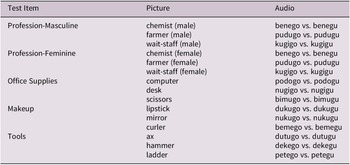
Learning and generalization to novel items was assessed via a two alternative forced choice test that pitted the masculine form (/-gu/) against the feminine form (/-go/). There were five different sets of test items (with eight of each), which included novel professions (Professions_Male, Professions_Female), stereotypically female items (Makeup), and stereotypically male items (Tools).
The professions were matched so that there were eight male versions, and eight female versions of each profession, and the corresponding audio choices were the same (e.g., the chemist was paired with [benego] vs. [benegu] for both the male and female choices). The eight stereotypically female objects were all makeup items, and included items such as a mirror, hair curler, and lipstick. The eight stereotypically male objects were all different types of tools, and included items such as an ax, lawnmower, and ladder. The eight neutral objects were all office supplies, and included items such as a computer, eraser, and paperclip. The materials for the test items were selected in the same manner as the pictures used in the exposure phase; audio files had the same CVCVCV format and consonant and vowel inventory, and pictures were drawings found from Google Image (with permissions for reuse). Examples of test items can be found in Table 2.
Examples of test items (note that order of presentation of audio files was counterbalanced across items)

The items were chosen based on gender schema theory (Bem, Reference Bem1981), and fit into the classifications of gender roles described in Bem (Reference Bem1974). The authors used their own intuitions about gender stereotypes and consulted friends and roommates for verification of the stereotypical nature of the stimuli. The gender associations of the items used in the experiment were also verified by cross-referencing with studies that either made explicit use of gender-based or gender-neutral stimuli (Baer et al., Reference Baer, Trumpeter and Weathington2006; Conry-Murray, Reference Conry-Murray2015; Sato & Athanasopoulos, Reference Sato and Athanasopoulos2018; Sereno & O’Donnell, Reference Sereno and O’Donnell2009), or explicitly asked participants to provide a gendered association for items (Blakemore & Centers, Reference Blakemore and Centers2005; Crawford et al., Reference Crawford, Leynes, Mayhorn and Bink2004; Meagher, Reference Meagher2017; Scott et al., Reference Scott, Keitel, Becirspahic, Donnell and Sereno2019). In all the studies surveyed, makeup items were classified as feminine, tool items were classified as masculine, and office supplies were classified as gender neutral. We also checked each item with the use or ratings in these studies, and found all the items that had data were coded in line with the assigned gender stereotype. There were some items that could not be identified exactly, but similar items could be found, and the ratings for these were used for verification. This included ‘makeup’ for ‘compact’, ‘hair straightener’ for ‘curler’, ‘file’ and ‘cabinet’ for ‘file cabinet’ (Scott et al., Reference Scott, Keitel, Becirspahic, Donnell and Sereno2019), ‘mascara’ for ‘eye shadow’, and ‘saw’ for ‘chainsaw’. Discussions of curlers ad chainsaws as feminine and masculine items, respectively, can be found in Dyer (Reference Dyer2018). All items fit within the gender norms of these studies.
The experiment made use of auditory materials that had been previously used for a different artificial language learning study. These auditory stimuli were recorded in a sound-attenuated booth by an adult male native English speaker. While the speaker was aware that the stimuli were to be used for an artificial grammar learning study, the speaker was unaware of the hypothesis of the study. Tokens were individually recorded. Each token was spoken four times in list format. A single token was chosen from the second or third element of the set in order to keep the prosody as uniform as possible. The first and last elements were avoided to avoid the intonation of first and last elements in a list. The speaker was told to speak each word as clearly and accurately as possible (without reducing vowels). Primary stress was placed on the initial syllable, but all vowels were fully pronounced. All stimuli were normalized to 70dB using Praat software (Boersma & Weenink, Reference Boersma and Weenink2017).
It was hypothesized that participants would select the feminine gender for the stereotypically female items at a rate greater than 50% chance, while participants would select the masculine gender for the stereotypically male items at a rate greater than 50% chance. If participants treat masculine gender as the ‘default’ gender, then learners may show a slight preference for the masculine gender for the gender-neutral items; otherwise it is expected that participants should select the masculine form at a rate no greater than 50% chance.
2.3. Procedure
The experiment was conducted using SuperLab 5 software (Heller et al., Reference Heller, Matsak, Abboud, Schultz and Zeitlin2014). Participants were told that they would be listening to words from a language that they had never heard before, and that their task was to remember the word with the picture, as best they could. Each image was displayed on a standard Dell monitor with 200×200 pixels, and centered on the screen. The images were paired with an audio file that played as the picture was displayed on the screen. Participants were instructed to press the space bar to move on to the next trial. The 32 (16 professions for each gender) were displayed five times each, for a total of 160 trials in the exposure phase.
The training was followed by a two-alternative forced-choice test that contained the 40 items discussed above (in a random order). Participants were told that they would hear two words, one corresponding to the meaning of the picture presented, and the other not corresponding to the meaning of the picture. If they believed the first word best captured the meaning of the picture, they were to press the ‘a’ key; if they believed the second word was a better portrayal of the picture’s meaning, they were to press the ‘l’ key. Order of presentation of items was counterbalanced such that half of the trials presented the masculine option first, and the other half presented the feminine option first. Participants were told to respond as quickly and accurately as possible, but no time limit was given for responses. Participants were given a verbal debriefing upon completion of the experiment, which took approximately 15 minutes to complete.
3. Statistical analysis and results
The data were entered into generalized mixed effects models using the glmer function in the lme4 package (Bates et al., Reference Bates, Mächler, Bolker and Walker2015) (version 1.127.1) in R (R Development Core Team, Reference Team2018) (version 4.1.0) in RStudio (RStudio Team, 2020) (version 1.4.1717), with the maximal model that would converge, as justified by the experimental design (Barr et al., Reference Barr, Levy, Scheepers and Tily2013). This included random intercepts for items and subjects (but models with random slopes failed to converge). To test whether each of the five types of test items were significantly different from chance, a separate model was run with the relevant test item set as the baseline, with a significant intercept interpreted as a significant difference from chance. In addition, pairwise comparisons for masculine responses were made for relevant pairs of items using office supplies as the baseline and the lsmeans function in the emeans package (version 1.6.1) (Lenth, Reference Lenth2016, Reference Lenth2018), with Tukey corrections for multiple comparisons.
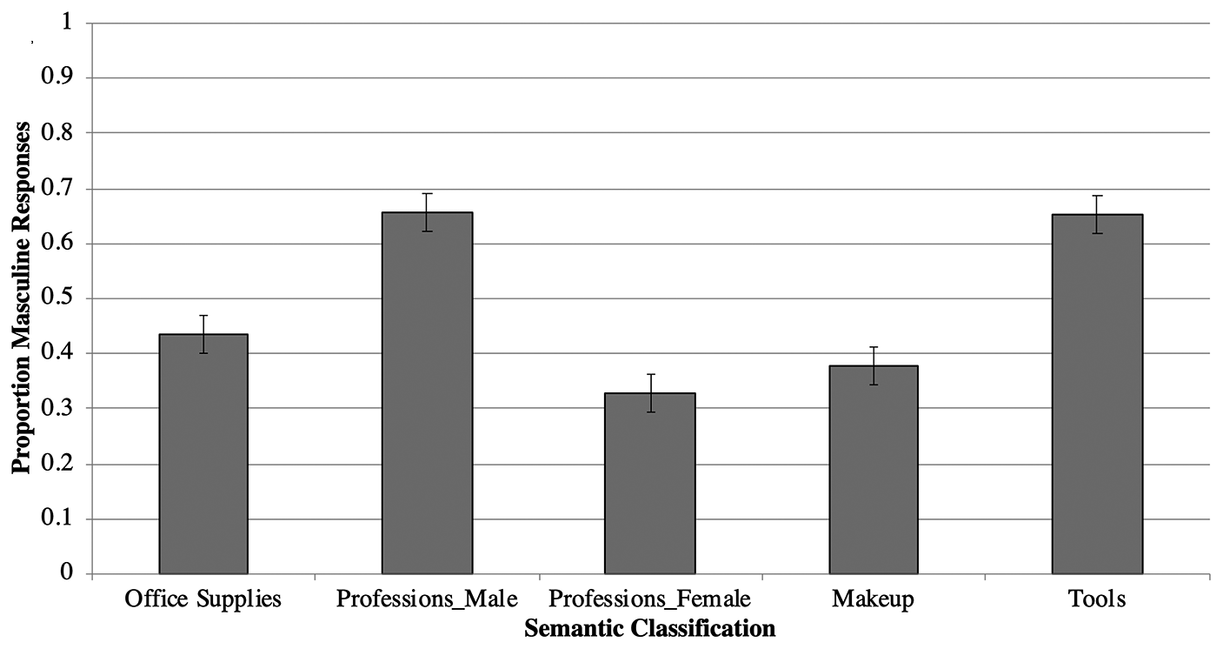
Means (and standard errors) of the analyzed data can be found in Figure 1. Due to experimenter error, some participants did not receive all trials. Of the 28 participants whose data were analyzed, nine participants received only 39 test trials, 10 participants received only 38 test trials, one participant received only 37 trials, and one participant received only 36 trials. In addition, some trials were removed because the participant failed to give an appropriate response, usually pressing the space bar instead of either the ‘a’ or ‘l’ key as instructed. This occurred for 101 trials across seven participants. Only interpretable data are included in the analysis.
Mean proportion of masculine responses (error bars indicate standard error of the mean).

Feminine responses to Professions_Female (mean = 0.67, CI ± 0.069), β = 0.88, SE = 0.27, z = 3.22, p = 0.0013, and masculine responses to Professions_Male (mean = 0.66, CI ± 0.068), β = 0.81, SE = 0.27, z = 2.99, p = 0.0028, were both selected at rates significantly different from 50% chance, suggesting that participants applied the gendered suffix appropriately to novel professions. In addition, masculine responses to Tools (mean = 0.65, CI ± 0.066), β = 0.78, SE = 0.26, z = 2.94, p = 0.0033, and feminine responses to Makeup (mean = 0.62 CI ± 0.067), β = 0.61, SE = 0.26, z = 2.34, p = 0.019, were also selected at a rate significantly greater than 50% chance, suggesting that participants made some use of gender stereotypes in selecting their responses. However, masculine responses to Office Supplies (mean = 0.44, CI ± 0.069), were not selected at a rate significantly different from chance, β = –0.30, SE = 0.26, z = –1.145, p = 0.25, suggesting no overall preference for masculine or feminine forms for these items.
Participants were more likely to select the masculine response for Tools compared to Makeup, β = 1.16, SE = 0.24, z = 4.825, p < 0.001, and were more likely to select the masculine response for Professions_Male compared to Professions_Female, β = 1.39, SE = 0.25, z = 5.50, p < 0.001. Participants were also more likely to select the masculine items for Tools compared to Office Supplies, β = 0.91, SE = 0.24, z = 3.80, p = 0.0013, and Professions_Male compared to Office Supplies, β = 0.93, SE = 0.24, z = 3.82, p = 0.0013. However, there were no significant differences between Makeup and Office Supplies, β = 0.25, SE = 0.24, z = 1.08, p = 0.82, or Professions_Female and Office Supplies, β = 0.47, SE = 0.24, z = 1.90, p = 0.32.
4. Discussion
The results support the hypothesis that, after exposure to a language with a binary grammatical distinction for gender, learners may apply that grammatical distinction to novel words that meet gender stereotypes at a rate greater than chance. Participants applied the feminine suffix to novel professions with a female actor, as well as to makeup – items that are stereotypically female – at rates greater than chance. Participants also applied the masculine suffix to novel professions with a male actor, as well as to tools – items that are stereotypically masculine – at rates greater than chance.
Participants also appear to be more likely to apply the masculine affix to masculine-stereotyped categories than feminine-stereotyped categories. However, masculine responses to gender-neutral items were only significantly different from stereotypically masculine categories. This may have been driven by a small (but not significant) tendency for participants to select the feminine response for Office Supplies. In addition, there were several items in the Office Supplies condition in which masculine gender was selected less than 40% of the time. These included the eraser (mean = 0.35, CI ± 0.20), the paperclip (mean = 0.27, CI ± 0.18), and the envelope (mean = 0.32, CI ± 0.20). This suggests a possibility that participants might show a feminine bias for some office supplies, possibly due to a bias to think of office workers (e.g., administrative assistants or secretaries) as female, or because many erasers (including the image used in this experiment) are pink, which is commonly associated with femininity in the United States. With these three items removed, the mean masculine responses was 0.51 (CI ± 0.088), and the differences between the Office Supplies and Makeup, β = 0.56, SE = 0.25, z = 2.26, p = 0.024, and Office Supplies and Professions_Female, β = 0.77, SE = 0.26, z = 3.02, p = 0.0025, were both significant.
In addition to the outliers in the Office Supplies condition, there were some items that did not pattern with the others in their category. There was a bias towards the masculine gender for the image of the female chemist (mean = 0.19, CI ± 0.21). There are several possibilities for this. One is that participants were biased to view the scientist as a masculine profession, and noted the picture as such. However, the male chemist did not show a large bias (mean = 0.58, CI ± 0.33), and other male-dominated professions did not show the same bias (e.g., participants generally applied the feminine ending to the female doctor, mean = 0.80, CI ± 0.17). Another possibility is that the drawing of the female chemist featured a woman with short hair, which could have been interpreted by some to be a picture of a man. The combination of a bias to view scientists as male along with a less stereotypical female (e.g., short hair) could have driven the interpretation.
Finally, some Makeup and Tool items did not show any clear bias. These include the curler (mean = 0.44, CI ± 0.20), the lawnmower (mean = 0.48, CI ± 0.21), and the wrench (mean = 0.54, CI ± 0.21). In addition, there was no bias for the male volleyball player (mean = 0.46, CI ± 0.21). A full list of the means and confidence intervals for all test items can be found in the supplementary materials.
Participants in the present experiment applied their knowledge of the grammatical gender of a novel language to novel items, based on gender stereotypes; participants appeared to be more likely to select the feminine suffix for female-stereotyped items and the masculine suffix for masculine-stereotyped items, but did not show a statistically significant bias for gender-neutral items. Participants also appeared to apply the gendered suffix appropriately to novel items that were similar to the training set (professions) demonstrating that they had encoded the gendered terms beyond rote memorization. These results support the hypothesis that gender stereotypes may play a role in language learning and development.
4.1. Limitations and directions for future research
While the present study shows some support of the notion of gender biases in language learning, there are important limitations to discuss. Many of these limitations could be addressed in future research. First, it is important to note that while the results reached statistical significance in most tests, there was variability across items and participants. This suggests that if the evolution of grammatical gender assignment in language makes some use of gender stereotypes, that this may be just one of many factors that played a role, and would be unlikely to explain the entire distribution of noun classes in gendered language. Gender assignment for inanimate objects can be arbitrary, as well as based on phonological and semantic factors (Culbertson et al., Reference Culbertson, Gagliardi and Smith2017; Gagliardi & Lidz, Reference Gagliardi and Lidz2014). Future research could address this by exploring some of the factors that may lead to variation across participants and items.
It is possible that some of the individual differences in the present results could be explained in terms of individual differences in implicit gender biases. Lewis and Lupyan (Reference Lewis and Lupyan2020) showed a correlation across languages between implicit sexism in the IAT (Implicit Associations Test; Greenwald et al., Reference Greenwald, McGhee and Schwartz1998). Meagher (Reference Meagher2017) also showed that sexist beliefs correlated with participants’ willingness to assign a gender to inanimate objects based on their gendered associations. These results suggest that participants who show stronger gendered associations might be more likely to hold more traditional, stereotyped beliefs about gender roles. Future research could explore whether differences between participants on how much they applied gender stereotypes in this language learning task are correlated with scores on the IAT or scales of gender stereotyping. It is possible that participants who hold stronger gender biases or more internalization of gender stereotypes might show a stronger effect in this artificial grammar learning task.
Eberhard et al. (Reference Eberhard, Scheutz and Heilman2005) found that the size of the effect of gender on a similarity-rating task was dependent on the speed of learning the grammatical gender of the language; fast learners showed a larger effect than slower learners. Because the present study did not measure speed of learning the grammatical gender, and all participants received the same number of exposure trials, we do not know if variation between participants was mediated by ease of learning. Future research could test whether participants who are faster learners show a stronger effect on this task.
It is important to note that while the artificial language made use of binary grammatical categories, biosocial gender is not binary. It has been suggested that the use of binary grammatical gender categories may force speakers to view conceptual gender in similarly binary terms, which may explain why languages with binary grammatical gender categories show larger effects in studies of gendered language on cognition (Beller et al., Reference Beller, Brattebø, Lavik, Reigstad and Bender2015; Bender et al., Reference Bender, Beller and Klauer2011; Sera et al., Reference Sera, Elieff, Burch, Forbes, Rodríguez and Dubois2002). In addition, it has been suggested that speakers of languages with binary grammatical gender categories show higher rates of sexist language, and possible negative effects for gender equity (Bassetti & Nicoladis, Reference Bassetti and Nicoladis2016). Future research could address this concern by manipulating the grammatical gender system (e.g., binary vs. ternary systems). Participants trained on a binary system (as in the present experiment) may show stronger effects than participants trained on a ternary system.
The effects of a binary grammatical gender system may have been exaggerated with the use of a two-alternative forced-choice test, where the only difference between alternatives was the suffix, either masculine or feminine. Previous research has shown that when the task does not have a forced choice between two genders, the effects are less consistent (Bassetti & Nicoladis, Reference Bassetti and Nicoladis2016). Thus, the task itself may have helped to steer participants towards gendered effects. Since participants had no other knowledge of the miniature language besides its use to indicate conceptual gender of professionals, participants may have used the gender as a tool to figure out the task.
Relatedly, it is possible that demand characteristics may have affected the results. If participants noticed that some of the items were stereotypically male or female, they may have surmised that this is what the study was testing, and adjusted their responses accordingly. While this generally provides support of the hypothesis (linking stereotypes to grammatical gender), it might have consequences for the external validity of the study. There are several ways in which future research could test these effects. First, one could directly ask participants after completion of the study if they had noticed that some of the items were stereotypically masculine or feminine, and whether this affected their responses. Second, future research could ask participants to produce novel forms, to test whether learners use a novel suffix, or apply the known suffixes in line with gender stereotypes.
In the present study, all of the novel items were from specific categories (tools, makeup, and office supplies). Future studies could test items from different categories, or more heterogeneous items. Participants’ responses to gender-stereotyped items suggest that learning the grammatical gender of objects should be easier if the stereotyped gender association matches the grammatical gender, since initial guesses were in line with this association. This assumption could be tested, where participants are specifically trained on items that either match or mismatch the stereotyped associations.
In order to engage in the future research described above, a much larger sample size would be required. While the sample size used in this study was similar to those used in previous artificial grammar learning studies, and was large enough for statistically significant effects for most comparisons, the sample size is generally too small to make more fine-grained comparisons related to the individual variation across participants. The use of a convenience sample from college students may not be generalizable, and may not be large enough to make broad conclusions about language learning in the general population. Thus, future research should make use of a larger and broader sample size to better address the questions that this study raises about the role of gender stereotypes in language learning.
While participants were primarily monolingual English speakers, many speakers did have exposure to Spanish, which makes use of a noun class system similar to the one used in the present experiment. In Spanish, words that end in [o] are more likely to be masculine. In the present experiment [-go] was used to mark the feminine. Thus, if participants made direct use of Spanish knowledge in the task, then we would expect a bias towards [-go] to be assigned to masculine nouns, but no such bias occurred.
It is possible that knowledge of a language like Spanish, French, or German, which all have gendered noun-class systems, may have make participants more willing to apply a gendered system to a novel language, which could have eased participants’ learning. However, there are several reasons to believe that effects of exposure to a language with a noun-class system are minimal in the present study. First, the items in the test were balanced for grammatical gender in Spanish (at least half of the makeup items were masculine, and at least half of the tool items were feminine in Spanish). Second, the results did not reflect Spanish gender. Third, very few participants had more than a beginner’s level of exposure to the Spanish language, meaning that participants would be unlikely to know the grammatical genders of many of the nouns used in this study. Fourth, it is possible that speakers might have used their knowledge of the relative arbitrariness of grammatical gender assignment to assume that grammatical gender applied in an arbitrary manner, which could have influenced the results in the opposite direction. Fifth, if participants used general knowledge that grammatical gender can be arbitrarily assigned, this would have pushed the results in the opposite direction than was found. Finally, the outliers in the Office Supply condition include only one item that is feminine in Spanish (the eraser). The other items (paperclip, and envelope) are masculine in Spanish, meaning that the gender of Spanish is unlikely to have substantially influenced the present results.
While the effects of prior knowledge of Spanish grammatical gender is likely to be minimal, one potential solution to this would be to remove any participant with even a rudimentary knowledge of Spanish. However, this would remove the majority of the participants, since Spanish is one of the most frequently spoken languages other than English in the United States, and is one of the most popular choices to fulfill language learning requirements at the high school and college levels. In addition, the large number of Spanish speakers in the Pacific Northwest of the United States would make it unlikely that any participant had not been exposed to some Spanish in their daily lives.
5. Conclusion
The present study used an artificial grammar learning experiment to explore gender biases in language learning. Participants were exposed to a language with a binary grammatical gender pattern (different suffixes were assigned to male and female professionals). When presented with novel items, participants appeared to choose the suffix that matched the stereotype of the word at a rate greater than chance. These results support the hypothesis that gender stereotypes may play a role in language learning.
Acknowledgements
We are grateful to the participants at Pacific Lutheran University for their cooperation and assistance, as well as to Wendelyn Shore, Michelle Ceynar, Marianne Taylor, and two anonymous reviewers for helpful comments related to this research. Many thanks to Ariel Goldberg for help with stimuli creation. We resume responsibility for any and all errors.
Conflicts of Interest
We have no conflicts of interest to declare.
Supplementary Materials
To view supplementary material for this article, please visit http://doi.org/10.1017/langcog.2021.21.