In a global context of a major terrorist threat, France hosted the European football championship, commonly referred to as Euro 2016, between 10th June and 10th July 2016. The health system response capacity to conventional and Chemical, Biological, Radiological, Nuclear (CBRN) threats was upgraded in the areas involved in the event. In the Paris region, three days prior to the beginning of the competition, a medium sized urban hospital of approximately 500 beds located two miles from the St Denis football stadium and surrounded by several designated mass gathering zones, was designated by the health authorities as a temporary chemical decontamination centre. This sector was considered particularly sensitive because the stadium was hosting seven matches including the opening and closing matches. It had also been the target of a bomb attack on 13th November 2015 causing four dead and about fifty wounded. The assigned mission was the provision of decontamination for victims of a chemical assault spontaneously arriving to the hospital for the entire duration of Euro 2016. The hospital lacked a number of the required resources: decontamination facilities, decontamination protocols and dedicated funds. It had fifteen CBRN Personal Protective Equipment (PPE) sets and 36 CBRN trained personnel most of them belonging to the Service Mobile d’Urgence et de Réanimation (SMUR), the French Emergency Medical System (EMS), and therefore supposed to intervene outwith the hospital. The time available to prepare was very short. The only external available help were new guidelines, dry decontamination sets and a decontamination unit. The health authorities had never tested the decontamination guidelines. These promoted early dry decontamination in contrast to wet contamination alone. Regional EMS-CBRN Services supplied a set of dry decontamination kits for field use, and a decontamination tent was provided by a fellow hospital. In such a context a swift, innovative and low cost approach to CBRN hospital surge capacity was needed.
REPORT
Chronology of Actions and Cost Evaluation
In order to set up an effective chemical decontamination chain in the shortest possible time, two SMUR doctors, also CBRN instructors, volunteered as coordinators of the project. The hospital’s Technical Services, Security, and Nursing directors were also informed and asked to provide collaboration. No special funds were allocated, and no simplified purchase procedures were identified. No extra personnel or working hours were assigned to the project nor were pre-existing work commitments of the involved personnel cancelled. However the hospital management did not require project documents or formal reporting, thus creating greater freedom of action for the coordinators.
With a clearly defined objective and limited time the decision was taken to focus on execution rather than further planning. The definition of the decontamination process was progressive as were technical choices. Therefore the project implementation was reiterative rather than linear and frequent changes of strategy were allowed. Technical choices were made simultaneously with the set-up. Records were kept of all activities.
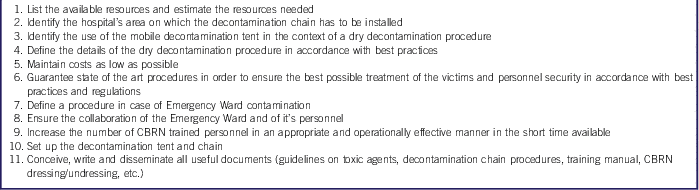
A list of operational objectives was defined (Table 1) while the decontamination tent was being conveyed to the hospital. An existing proposal was further developed in the new context of compulsory preparedness. This envisaged a fixed decontamination chain to be located in the covered ambulance bay, giving access to the emergency ward and was taken as the starting point.
Operational objectives as initially defined

It was decided to install the temporary chain under the ambulance bay. A specific patient flow pathway was designed. This mandated that in case of an influx of contaminated patients all hospital entrances would be closed, stopping movement in and out of the facility for the duration of the crisis. A planning assumption of 50 contaminated walking people arriving in one hour was identified as plausible.
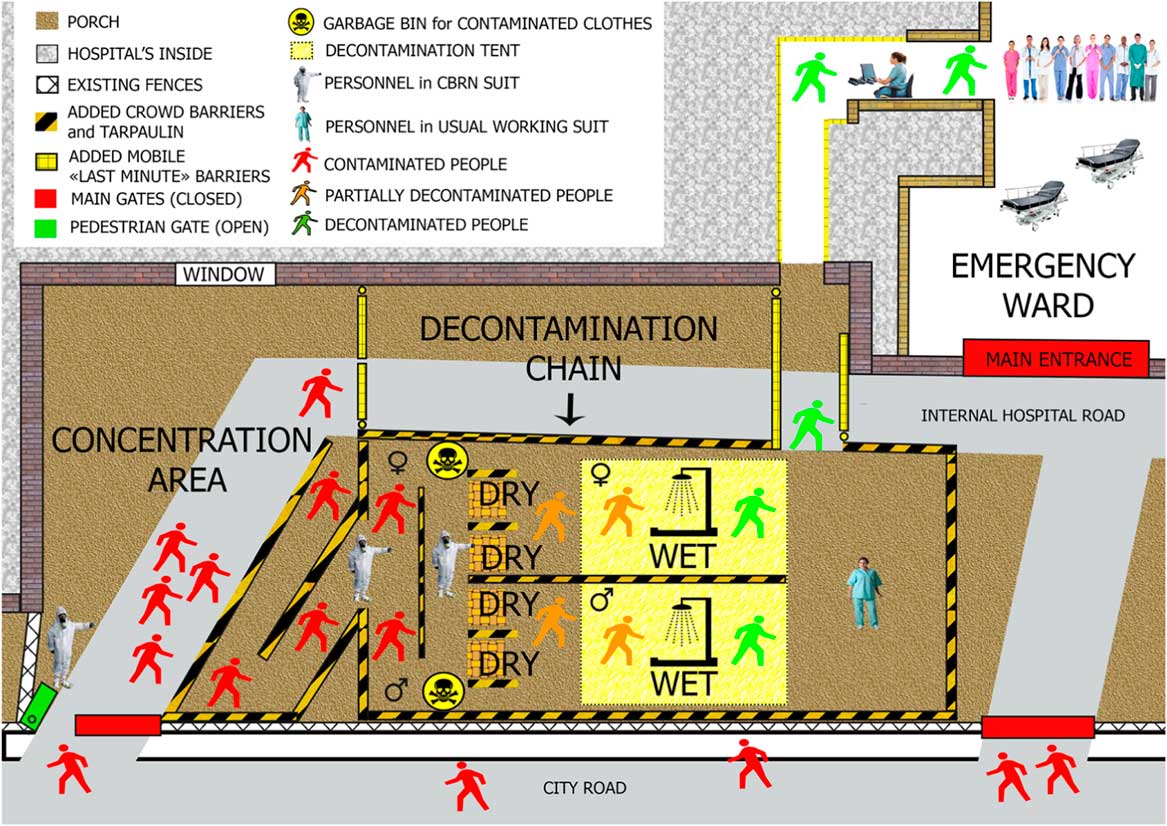
Literature researches on PubMed and Google together with expert advice helped in addressing the purpose, efficacy and methods of dry decontamination. The results of this background research together with an analysis of potential victim presentation patterns and their management led to a decontamination strategy combining dry and wet decontamination. This was different from that proposed by the Regional EMS-CBRN Services, as detailed in section two. Since the wet decontamination tent was too small to house the entire chain, a light, disposable, easily assembled low cost structure (made of recycled crowd control barriers, plastic sheeting, wooden poles and pallets) was added. A scheme of the complete structure is shown in Figure 1.
Scheme of the Decontamination Chain.

Only 2 of 36 personnel trained in CBRN PPE dressing-undressing were available for the decontamination chain, the majority having other priority assignments such as EMS or Intensive Care and management roles. None had received specific training in decontamination chain work. The sudden increase in CBRN activity caused anxiety in some of the Emergency ward personnel and in some cases led to open opposition to the project. A number of informal meetings were held in order to provide clear and concise information on the nature and intent of the project and in particular on what the chemical threat was. In the meantime a programme of very brief training was set-up focused on decontamination procedures and dressing/undressing with PPE.
By the 10th of June, day one of the Euro 2016 championships, the decontamination tent had been pitched, and on the 20th, 13 days after the hospital had been assigned its new mission, the decontamination facility construction was complete and all equipment required for the chain, together with signs, was available. Simulation training of the personnel started on the 14th and lasted until 21st of June. Groups ranging from three to six personnel were trained for two hours on the decontamination procedure and dressing and undressing. A total of 25 staff were trained: 13 nurses, 6 caregivers, 3 stretcher-bearers, two doctors and one secretary. Round the clock coverage became effective on the 22nd of June. While this is 12 days after the beginning of the event, it is worth noting that the capability was achieved only 15 days after being assigned the task. The certified trainers all belonged to the hospitals’ EMS. Training occurred during both day and night shifts and all trainees were volunteers.
Although planned, a full-scale exercise could not be undertaken, mainly because of fatigue among the coordinators, who were bearing the greatest burden of the workload. This was in addition to their regular commitments. An evaluation of the performance of the chain was made during training and by the coordinators personally passing through the whole process. Transition times were recorded. Pictures were taken and used to illustrate the decontamination protocol, both for the victims and the caregivers. The decontamination capacity was assessed at 24 persons per hour.
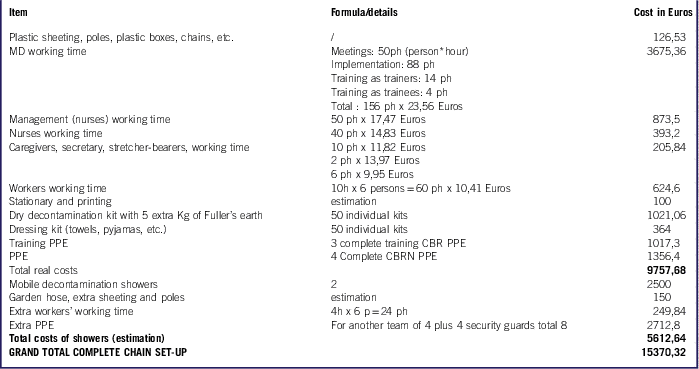
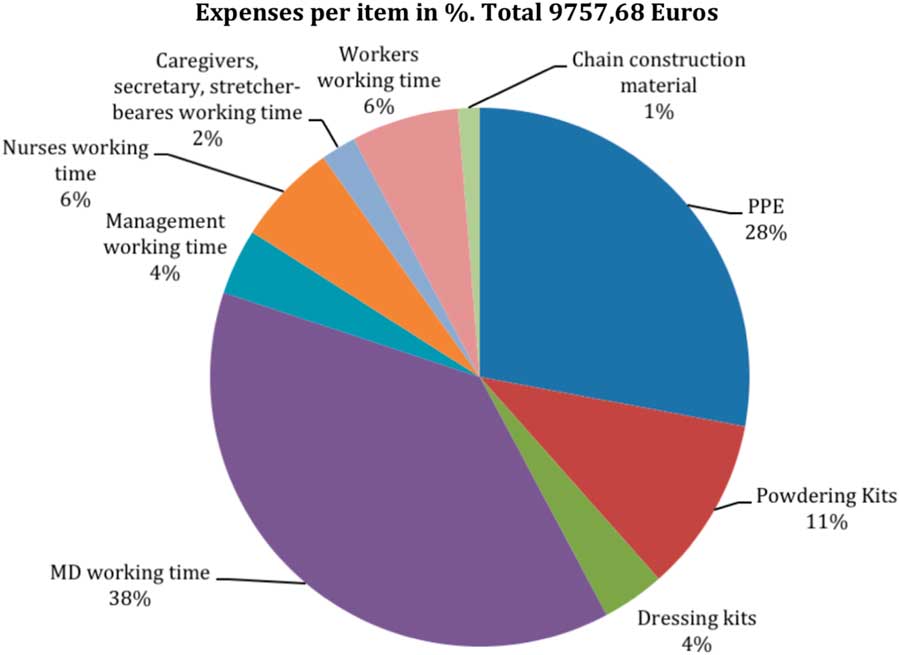
Total costs were assessed retrospectively at 9757,68 Euros for the creation of the entire chain as described in the article. Detailed costs can be seen in Table 2.
Real Costs & Estimated costs for full chain set-up 1

Following the end of the Euro football championship the entire chain was disassembled without having been used in a real event.
Decontamination Chain and Decontamination Procedure
The covered ambulance bay was chosen as a convenient place for the chain because it was a sufficiently large secure area, provided protection, was ventilated, and provided direct access to the street and the Emergency ward. A small gate allowed control of the pedestrian entrance while the main gates were to be kept closed. The presence of a gentle slope also allowed unidirectional flow of water.
The maximum number of patients that could be treated was decided in accordance with the total number of available individual dry decontamination kits. The kits were each made of a decontamination glove powdered with Fuller’s earth, two transparent plastic bags of different sizes, two sealing plastic collars, a surgical mask, a surgical bonnet and a disposable pyjama. Bags and collars were intended for cloth and personal belongings.
The new decontamination procedure put in place by civil defence authorities, 2 adapted from the French military procedure, foresaw a rapid decontamination with Fuller’s earth on naked surfaces, undressing of the first layer of clothes, dressing with pyjama, bonnet and mask and direct admission to the emergency ward. Only symptomatic patients were required to pass through a shower of tepid water prior to entering the hospital. 2 This assumed a medical triage and the coexistence of two different procedures.
It was decided to adopt a unique procedure instead. The main reasons for this were: fear that the victims would not readily accept two different treatments, thus potentially creating crowd management difficulties, the need to simplify the procedures in order to minimize the number of personnel in PPE and facilitate their rapid training, the consideration that the toxic agent might be unknown at the outset and might have a delayed onset of action.Reference Lake, Divarco, Schulze and Gougelet 4 All victims would undergo a dry decontamination with Fuller’s earth followed by a three minutes shower. It was also considered that no registration could be performed before entry to the emergency ward, mainly because of the lack of personnel and in order not to delay the decontamination of people arriving at least 10 minutes after exposure. On the other hand it was necessary to keep records and to make a link between the victims and their contaminated belongings. It was therefore decided that no nominal registration had to be made but every person would receive a numbered necklace and double faced matching tickets to be put in the personal belongings transparent bags.
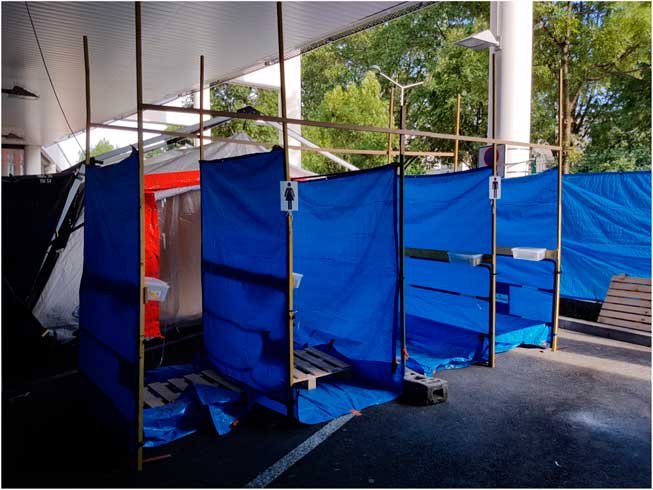
The different links in the chain were: the entrance gate; the concentration area; a zigzag corridor of crowd control barriers leading to a facility constructed from 2.5 meters high fencing made of crowd control barriers covered with tarpaulin; four undressing cabins (two for men and two for women), made of plastic sheeting; two corridors leading to the showers and the dressing cabins located in the tent; a short walk leading to the emergency ward entrance (Figure 1 and 2). Tarpaulin screens guaranteed privacy.
Decontamination Chain: At The Front: Undressing And Dry Decontamination “Homemade” Cabins; Behind: Wet Decontamination Tent.

Personnel in PPE would be posted at the entrance gate, at the entrance of the decontamination area, in front of the cabins and, if available, at the showers. Personnel in normal working dress would help orienting the patients to the emergency ward at the end of the chain. Three personnel in CBRN-PPE could therefore manage the whole chain. Although fifteen CBRN PPE sets were available they had to be shared in between the SMUR and the Emergency Ward. Once the ambulances were fully equipped, only four PPE sets remained available for the Emergency Ward. It was established that, if not needed on the field, the SMUR equipment and personnel would reinforce the Emergency Ward team. A purchase procedure was immediately launched but no PPE was available before the end of the Euro 2016. Ideally two teams of four, specifically trained for the decontamination chain, had to be present at the emergency ward all the time. It was possible to provide a team of three trained personnel who were present at the emergency department 24 hours a day. The personnel at the gate and at the decontamination area entrance had a filter and crowd management role, while the one at the cabins was the undressing supervisor. He/she would guide the victims to the cabins, give them a dry decontamination kit and show them the posters illustrating with pictograms the undressing procedure, and would occasionally help the victims.
The contaminated victims would initially don a mask to avoid inhalation of Fuller’s earth, 5 take off all jewels and glasses, use the decontamination glove starting from the naked surfaces, then undress and remain in underwear. For all the clothes that needed to be removed passing around the head a pair of scissors attached to a chain and plunged in chlorine was available. All clothes and personal belongings would be introduced in plastic bags sealed with a collar identified with the numbered tickets matching the badge that the patients would put at their neck. The bags would be collected by the supervisor and put in a garbage container for future disposal and decontamination. The floor of the cabin was made of tarpaulin on top of which lay a pallet in order to facilitate contaminated powder management. All Fuller’s earth would fall in between the pallets boards on the tarpaulin, if needed with the help of a broom, in order to be collected by wrapping the tarpaulin at the end of the whole decontamination procedure. Once undressed, the victim would walk to the shower. The recommendation was a three minutes showerReference Ciampi, Rouman and Cano 6 including one minute of soaping and two of rinsing with water. 7 Clocks would allow shower time management. A few steps further in the dressing room, hospital sheets were available for drying, together with disposable pyjamas and overshoes for dressing.
Kits and PPE were prepositioned in the emergency ward while the chain with all signs was left ready to be used under camera surveillance. Only water and electricity connections had to be made. Wastewater was pumped from the tent and directed through a garden hose to the sewers. The whole chain, in terms of infrastructure, decontamination procedures and practical details, was designed in an integrated manner in order to reduce to the minimum the need of human resources.
A minimum of three persons in PPE were supposed to keep the chain functioning for two hours, by which time it was anticipated that a second team would be ready or external help available from neighbouring hospitals or the firemen.
Training of Personnel
All necessary personnel received the required training within eight days. The training commenced seven days after the beginning of the whole process. This was mainly due to the necessity to establish all decontamination details prior to the beginning of the training and the difficulty in having the personnel available in groups. The brief two hours training of this project, which was completely different from the three days official programme, was officially validated and authorized by the CBRN regional authorities.
The training greatly helped in reducing the emotional impact of the chemical threat. An initial lack of communication from management allowed the spread of rumours and led to confusion and an initial lack of compliance with the new procedures. Formal meetings held by the management, and occasional talks on the construction site during informal visits made by staff out of curiosity, greatly helped in restoring a feeling of safety and confidence.
DISCUSSION
This experience offers insights into a novel approach to chemical decontamination in a specific context of adaptation in a medium sized European hospital: less in terms of decontamination techniques but mainly in terms of attitude and given limited resources and constraints in terms of staff and funding. The CBRN classical approach is extremely demanding requiring consistent financial and human resources with adequate implementation time, thus largely limiting its utility to contexts where these resources are available.
This case study suggests that it is possible to obtain effective operational results, starting from a very low level of initial preparedness, within a short time frame and with limited financial resources. The main objective, as officially but unrealistically stated, was to set up the decontamination chain in three days. While this could not be achieved the implementation time was still very short, considering the low level of baseline preparedness. In case of a chemical event victims’ decontamination has to be as early as possible. The hospital failed in guaranteeing an early decontamination for the initial two weeks of the Euro 2016 but became an effective part of the preparedness framework for the second half of the championships. Preparedness time should therefore be adequately evaluated.
The low level of preparedness can be seen from two different perspectives: technical and cultural. Technically the hospital lacked the entire infrastructure and culturally the vast majority of the involved personnel had, at best, very superficial CBRN notions. The official recognition of the project as the primary priority and the allocation of specific human and financial resources would have helped in speeding the whole set-up process. Similarly, the absence of specific rapid purchase procedures did not allow quick procurement of the material and equipment needed to build the chain. The only solution that could be found was the purchase with the coordinator’s private funds with no guarantee of reimbursement.
The original features of this decontamination chain lie in the use of equipment and material commonly found in hardware stores and in the numerous details aiming to reduce costs and personnel. Of course the availability of a decontamination tent was helpful but similar results could be obtained with low cost non-specialized hardware.
The estimated costs of the whole operation, even in the case of a complete construction of the dry and wet chain, are low, at least if compared to the commercial costs of mobile decontamination units. It can be seen (Table 2, Figure 3) that these are different from what might be assumed: the decontamination chain and decontamination material and equipment represent only around 16% of the costs. PPE represents about 28% with the main expenditure being for personnel at 56%.
Expenses Per Item in % of Total.

In terms of personnel costs, Medical Doctors’ working time represents approx. 63% of the costs. 56% of this time was used for project implementation with half of it, representing 28% of total medical time, dedicated to the construction and supervision of the chain, tasks that could be performed by less costly personnel. Nurses and other personnel working time was mainly dedicated to training. An increase in training duration would lead to an increase of costs.
Cultural preparedness was tackled in two different ways: information and training. Information awareness was a major issue but had initially been underestimated. Immediate, concise but complete information on chemical threat, project justification and implementation appears to be fundamental. It has to be directed towards managers and clinical and support staff and it has to precede implementation activities. Trainers and trainees shared the feeling that training time was significantly deficient. Future procedures should include longer and repeated training in order to increase personnel safety, independently from costs.
A procedure adapted to the low level of training was adopted for the undressing of the personnel in PPE. Supervised undressing had to be preceded by a three minutes shower in order to minimize risk due to undressing errors.Reference Balty, Guilleux and Le Roy 8 , 9
A major point of concern was the shortage of trained personnel available for decontamination procedures not allowing more than one team of three per shift. Reinforcement and replacement of team members was a necessity in case of prolonged action or exhaustion. A first option was to use EMS personnel. But EMS was considered an unreliable source because of its institutional mission external to the hospital. The Firemen could be an option but, belonging to another administration, they could not be officially included in the plan. The most realistic option was the collaboration of a hospital 5 km away equipped with a decontamination unit and having numbers of trained personnel. A non-written agreement had been made for a quick reinforcement in personnel and PPE. Arrival time had been estimated in 1h. Still, no specific roster existed in that hospital and its support could not be considered certain.
The maximum autonomy of the decontamination team had been estimated in two hours following the French official guidelines. The switch from one team to another without an external support in PPE was not taken into consideration mainly because of the lack of mask filters whose life expectancy is in between one and two hours. In case of an event it had been foreseen to explore all the options described above in order to maximize the probability to receive timely help. To include external help in disaster preparedness plans should be considered with appropriate advance.
Once the Euro 2016 finished the tent was returned to its owner and the rest of the chain disassembled. No written report, evaluation or feed-back was requested by the hospital management or the health authorities.
A number of informal meetings identified the absence of post event recognition and the lack of ‘capitalization’ of the acquired knowledge as a source of frustration and demotivation of the personnel involved in case of future similar events. Overall it was felt that a greater involvement and a better communication strategy by the management would have been helpful and supportive.
Another institutional burden was represented by the absence of clear instructions and procedures from competent institutions and of supportive institutional experts. For example, no instructions or procedures for the disposal of contaminated objects exist, nor a procedure for the undressing of the last person in CBRN PPE. No focal points or institutions could be identified to solve these problems, leaving them to a last minute solution in case of an event. Last but not least, the absence of a structured feed-back procedure and knowledge transfer limits the opportunity to capitalize on this experience to improve procedures on a wider scale.
Due to the lack of time and human resources a number of planned activities could not be implemented. A ten minutes slide presentation with commentary, continuously running in a room accessible 24 hours a day, providing general information on CBRN threat and on the decontamination chain project, was intended to be the main communication tool with the entire hospital’s staff. Similarly, a silent film or a slide projection describing the decontamination procedure was to be shown to the victims waiting in the concentration area through a window of the emergency ward facing the victims’ concentration area. This was intended to speed-up the procedure and facilitate crowd management.
One of the drawbacks of this decontamination chain is its relatively low performance of 24 persons/hour. Two ways to speed-up the process have been discussed: an increase in undressing cabins and showers, requiring increased personnel in PPE or the modification of the procedure with an early mass undressing and dry decontamination in the concentration area. As the first hypothesis would lead to increased costs and implementation time due to a higher number of personnel to be trained, the second might be a more practically viable solution but it poses problems such as respect of privacy, contaminated items disposal and crowd management. No special measures were foreseen in case of an important gender imbalance as might be expected in a particular context such as a football championship. In similar conditions the management of patients’ flow should be flexible enough so as to adapt to the population, taking into account factors such as gender, age and cultural behaviour. Mobile screens separating male from female lines could be an example.
Other topics requiring further consideration are cold weather decontamination, management of non-ambulant or wounded victims and contaminated bodies (victims that might die before or during decontamination).
A revision of the procedures is still on-going, with a view to making a new proposal to the Hospital’s Management for a continual level of CBRN preparedness plan in accordance with French legal obligations. 10 , 11 , 12 Although not discussed in this article, a procedure in case of contamination of part of the Emergency Ward had also been defined and this is now included in the procedures’ revision program.
CONCLUSIONS
This case study shows that it is possible for a medium sized urban European hospital with a very low baseline preparedness level for CBRN threats to set up a low cost but functional chemical decontamination chain in about two weeks, starting from almost nothing. The proposed scheme, although adequate, suffers from a number of potential weaknesses, and further work is needed to create a fully satisfactory low-cost system. The fundamental resource is the availability of a few competent and committed persons. The involvement and support of the management and health authorities seems to be a strong motivating force and its insufficiency may lead to failure and a loss of motivation, especially in the long term.
This experience also suggests that expensive facilities and equipment are not fundamental. Low cost chemical decontamination chains such as that which is the subject of this case study may be of some interest in an era of budgetary restrictions and in less advanced countries or in humanitarian contexts. Disposable, tailored and home made pre-positioned chains could be an alternative to costly tents or fixed structures for hospitals with limited resources while allowing rapid deployment if pre-existing in a kit form. Practical details may have a big incidence on the overall functionality of the chain and efforts have to be made in order to find simple and cheap solutions. Chemical threats are unfamiliar, poorly understood and engender anxiety. To ensure the full cooperation of all personnel a sound communication and training strategy are essential. Although volunteering might be considered as an unquestionable organisational strength it also has to be considered as an unpredictable and unstable resource. Management should therefore not consider it as a structural component of surge capacity. In order to be fully satisfactory, disaster preparedness, in particular for CBRN, needs proper anticipation, planning and resources, with particular attention to communication and other human factors.
Acknowledgments
We thank Dr. Malcolm Loudon for language editing and all the personnel of the SMUR of the Delafontaine Hospital for their numerous, voluntary and helpful contributions to the implementation of the project.