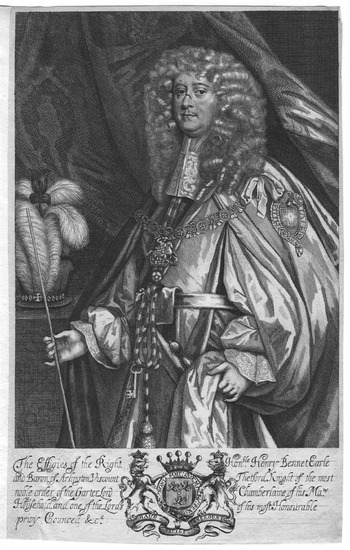
Of all the prominent politicians of Charles II's reign, Henry Bennet, earl of Arlington, has received the least attention from historians (Figure 1).Footnote 1 Despite being the longest-serving secretary of state, holding the highest household office for ten years, and marrying his daughter to a royal bastard, his contribution to Charles II's monarchy has been underestimated and his reputation has suffered accordingly, no doubt partly due to the vilification he received from contemporary rivals. Henry Hyde, earl of Clarendon, damningly described him as ‘without money, without friends, without industry or any one notable virtue, or the reputation of having any’ and yet Arlington had managed to achieve ‘office and honour, and the highest trust in business, without any experience in it, or capacity of understanding it’.Footnote 2 Bishop Gilbert Burnet was even more scathing, referring to him as ‘a proud and insolent man. His parts were solid, not quick … He was a man of great vanity, and lived at a vast expense without paying the debts which he contracted to support that.’Footnote 3 Both Burnet and Clarendon also referred to Bennet's Papist tendencies and suggested that he had cleverly insinuated himself with the Roman Catholic faction at court which had helped his rise to power. The duke of Buckingham, Arlington's rival in the group of influential ministers known as the ‘Cabal’, likewise described Arlington as ‘an arrant fop, from top to toe’.Footnote 4 Subsequent scholars have drawn a picture of a man who cleverly worked his way into a position of influence but with no real talent or conviction and, although this depiction has been slightly tempered recently, his legacy is not commonly held to be that of a great English statesman.Footnote 5 A closer look at his career suggests, however, that Arlington's influence extended beyond the better-known contributions he made as secretary of state.Footnote 6
Henry Bennet, earl of Arlington, after Peter Lely. National Portrait Gallery, London.

Like many of his contemporaries, Arlington displayed both political and social ambition and, from gentry beginnings, worked his way through royal favour and court politics to attain the identity of an aristocratic grandee. This identity, which was carefully forged and managed, involved voracious artistic patronage which, in its turn, helped the perception to become reality. As well as being of concern to art historians, however, a close analysis of Arlington's cultural and material world evidences the way in which luxury consumption was of crucial importance to a career in political service at the Restoration court. Whilst there has been much scholarship on the importance of connoisseurship and the visual arts at the courts of James I and his son, the activities of later seventeenth-century English patrons is under-researched and, consequently, their political impact underestimated.Footnote 7 Just as Kevin Sharpe referred to masque, play, and portrait as ‘the materials of politics’ in the Caroline era, we cannot overlook the political significance of architecture, interiors, and music at Charles II's court.Footnote 8 Consumption was not just a means of displaying power: it was power and was as integral to politics as spectacle and pageantry.Footnote 9 By the end of the seventeenth century, Sharpe's ‘documents of political ideology’ were not limited to paintings and poems, masques and plays, but also included beds, coaches, fabrics, silver, and gardens.Footnote 10 Arlington's role as a leader of taste at the Restoration court and the political significance thereof needs to be acknowledged. He displayed a cultural awareness and notable discernment that became a strategic political tool, and analysis of his material world illustrates the ‘political instrumentality’ of consumption.Footnote 11
The rationale behind such luxury consumption was, however, complex. In addition to displaying wealth or status, Arlington's artistic patronage evidenced a myriad of differing motives, confirming Colin Campbell's point that the intention behind conspicuous consumption is not always simply ‘to consume’.Footnote 12 Arlington appears to have clearly understood the rhetorical and social use of luxury objects and, in his struggle for distinction within the political environment, recognized that the possession of certain objects not only indicated elite status, but also simultaneously differentiated him from other members of the establishment.Footnote 13 He constructed a formidable political identity through his control of the diplomatic network and its conduits and displayed this power through judicious use of the arts that he accessed from overseas. The knowledge and aesthetic awareness that he acquired abroad and through international connections were instrumental in his achieving preferment, most notably when he acceded to the position of lord chamberlain in 1674.Footnote 14 He then used his position and his connoisseurship to help fashion royal imagery with absolutist visions of the Stuart dynasty in paint, music, architecture, and interiors that ably complemented the actions of a king looking to preserve the royal prerogative from parliamentary interference.
This article is concerned with analysing the extent to which a political agenda informed the cultural choices of a statesman like Arlington. While other members of the political world may also have been building and furnishing great houses for themselves, Arlington recognized that value was not linked solely to monetary worth and distanced himself from the broader elite by acquiring works of art which, through a combination of their scarcity value and the networks of patronage they denoted, carried high status.Footnote 15 Abstract notions of taste may be difficult to define but an investigation into Arlington's cultural and aesthetic choices is rewarding. We should look as seriously at the architecture of Euston Hall, the Verrio interiors at Goring House, the furnishings of the royal palaces, and the promotion of continental music at the Restoration court as we do at the policies pursued by Arlington as secretary of state for the southern department. Moreover, there is little doubt that the effects of his artistic patronage enjoyed a considerably longer life than the diplomacy with which he was associated.
I
A younger son, born in 1618, Henry Bennet was initially destined for a clerical career but the Civil Wars necessitated a change of direction. After fighting for the royalists at the battle of Edgehill in 1642, where he was wounded, Bennet went into virtual exile, running errands out of the country for Charles I and later acting as secretary to the Catholic royalist and sometime diplomat, Sir Kenelm Digby, in both Rome and Paris. In 1648, he obtained a position with James, duke of York, and came into contact with Prince Charles who increasingly employed him as an unofficial secretary and who became a close personal friend. During the years of Charles's exile in Cologne and Brussels, Bennet remained in Paris and maintained relations with both the French royal court and the court of Henrietta Maria. As early as 1654, Charles wrote that he trusted ‘Harry’ ‘more than any other’ and it is clear that the two men shared much in common, including a love of fashion and fine clothes.Footnote 16 Charles used Bennet to source suits, shoes, beaver hats, and even swords from Paris when he was unable to find anything sufficiently modish in Cologne or Bruges.Footnote 17
Bennet's first official diplomatic post was as Charles II's envoy to Savoy in 1650. Six years later he was knighted and sent as Resident to the Spanish court, a diplomatic position that entailed protracted residency in Spain; his instructions were to help build support for the exiled king. He returned to England in January 1661 where he duly became MP for Callington and began his Restoration career in earnest. His continental travels, experiencing at first hand the opulence and display of ancien régime courts, undoubtedly informed his taste for art and architecture, and the continual position of supplicant in which he and other exiles had previously found themselves may explain the lavishness with which he spent money when he later acquired it. One of his first appointments recognized his appreciation of the arts: he was made a member of the committee authorized to search for the works of art that had been sold from Charles I's collection, which it was hoped to restore to royal ownership.Footnote 18 The ‘wit and ability’ discerned in him by Francesco Giavarina, the Venetian Resident in London, doubtless assisted his rapid preferment and, in 1662, he was appointed secretary of state for the southern department.Footnote 19 Correspondence of other foreign ministers likewise shows that Bennet was making an impression at court and that his influence prevailed with Charles II. The French ambassador, for example, wrote to Secretary of State Lionne in Paris that ‘le Secretaire Benet … n'est pas à la tête des afaires [sic] mais il a cognoissance de toutes’, and two years later Bennet was personally responsible for greeting and entertaining foreign ministers, which he often did at his home.Footnote 20
The period of his political ascendancy, from 1661 to the fall of Clarendon in 1667, was matched by his steady accumulation of wealth. He had been in receipt of Spanish money during his residency in that country and, on his return, benefited from a pension that is likely to have helped him acquire the fine equipage with which he returned to England.Footnote 21 Aware of the importance of display, he did not want to appear an impecunious petitioner at the Restoration court. Over the next few years Charles II generously conferred additional grants and offices and, by 1666, Bennet was able to claim in his marriage contract that he was in receipt of a ‘full and clear yearly value of foure thousand pounds over and above charges and incumbrances whatsoever, publick Taxes onely excepted’ from his estates alone.Footnote 22 He was paid a further £1,800 as secretary of state and also received fees from the office; he obtained the position of postmaster general, entitling him to a large share of the profits of that office, and was given valuable land in England, including Marylebone Park, St John's Wood, and Holmby House, and also in Ireland.Footnote 23
In 1665 Bennet was created Lord Arlington. His financial and political situation encouraged him to gather the material trappings appropriate to a wealthy member of the political elite and, from the start, Bennet sought to distinguish himself from Charles II's other advisers. Despite not being first minister, he set about creating the life and environment appropriate to such a position and he drew on his diplomatic links to set himself apart. By 1667 Arlington had made the area of foreign policy his particular sphere of influence; it remained firmly the king's prerogative and few politicians were involved, but aided by his own diplomatic experiences abroad, his command of languages, affable character, and close relationship with Charles, Arlington positioned himself as the minister most closely involved with foreign negotiations. His judicious use of the personnel of the southern department, particularly his secretary, Joseph Williamson, in whom he identified a natural administrator well suited to support the business of diplomacy and with whom he developed an effective intelligence service, meant that he controlled virtually all diplomatic patronage.Footnote 24 His clients held positions in Paris, Florence, Madrid, Lisbon, Constantinople, and The Hague, giving him control over information and access to networks unmatched by his rivals.
It was not only access to intelligence that Arlington controlled and which he provided for the king. He also set himself the role of providing Charles II with the luxuries with which other royal princes were surrounded abroad, but which had been beyond the impoverished king's reach while he lived in exile. Arlington used his diplomatic network to source novelties and luxuries for Charles and to handle the logistical support for such acquisitions; importantly, he also ensured that he personally enjoyed similar access. None of this was frivolous consumption. His procurement of luxury goods was much more than a way of pleasing his master, or showing his wealth, or making life more comfortable, notwithstanding the simultaneous fulfilment of these functions. It was also a subtle, but highly effective, strategy to distance himself from his political rivals while simultaneously exhibiting his friendship with the king. Hence it is not the fact that Arlington had Italian marble chimney pieces in his house that is important, but the fact that his came directly from Carrara while those in the duke of Lauderdale's house came from a merchant in London and Ashley Cooper only managed to obtain Plymouth or Chichester marble for his house in Wimborne St Giles.Footnote 25 Moreover, Arlington arranged for the king to have similar chimney pieces from Italy; implicit in his material world was the evidence of the intimacy of his relationship with the king and his dominance of foreign policy, both of which would have been clear to his rivals and his clients.
Whereas Clarendon's new town house was built on the less fashionable Old Bond Street, in 1665 Arlington took a lease on Goring House, on the site of the present Buckingham Palace. Next to St James's Palace and closer to Whitehall than Clarendon House, he ensured that it offered Charles II a comfortable welcome and provided a focal point for the monarch's walks through St James's Park.Footnote 26 Goring House thereby gave spatial representation to Arlington's position in the royal nexus. John Evelyn was initially less than impressed with the outward appearance of Goring House, deeming it ‘ill built, but the place capable of being made a pretty villa’, but less than ten years later he had to admit that it contained ‘the best and most princely furniture that any subject had in England’.Footnote 27 The house's decoration displayed Arlington's familiarity with a continental aesthetic whilst the diplomatic correspondence shows that his envoys helped him to source its contents.Footnote 28
John Dodington, previously secretary to Viscount Fauconberg's embassy to Venice in 1670, was appointed Resident in the republic after the ambassador's departure and proceeded to keep Arlington informed of important local art sales. The sales he detailed included works by Poussin, Rubens, Guido Reni, Titian, Palma Vecchio, Veronese, Tintoretto, Guercino, Schiavone, Bronzino, Caravaggio, Manetti, Bassano, Domenico, and Salvator Rosa.Footnote 29 In the event that Arlington wanted other pictures from Italian masters, Dodington assured him that a talented copyist he knew could provide ‘a Copy of any peece [sic] in Italy’ for the secretary of state.Footnote 30 Dodington drew Arlington's attention to a Donatello marble and a Giambologna bronze of Mercury, two looking glasses with crystal frames, a clock, a design for a carved and gilt table, a carved and painted bedstead, and maiolica dishes.Footnote 31 He also sent Arlington ‘A relation of the antiquities of Athens’, with descriptions of the architecture and sculpture of Greece.Footnote 32 Arlington used another envoy, Sir Bernard Gascoigne, to source paintings from Italy for himself and his brother, although no details of the pictures that Gascoigne acquired for the Bennet brothers are given in the correspondence.Footnote 33 Gascoigne was an Italian adventurer who had fought for the royalist cause and whom Arlington used regularly for both official and unofficial diplomatic missions after the Restoration. From 1664 Gascoigne sent Arlington books from Florence ‘enough in Italian for your learning of our tongh [sic]’, and regularly sent wine (‘old Chianti’ and ‘Monte Palciano’) for him and the king.Footnote 34 His appreciation extended beyond fine art to other artistic priorities, becoming particularly excited, for example, about a new carriage being developed in Florence: ‘only for two Persons, as esye in Going as a Good litter; never more as I believe see [sic] in England … Were [very] fitt, for going quietly, and att a great Passe’.Footnote 35 Arlington was clearly aware of the prestige value of coaches and his reply reflects both his and Charles II's enthusiasm for a new model.Footnote 36 It is also testament to his friendship with Charles and their shared love of fashionable accoutrements, which had helped cement their relationship in the early days of exile. When Bishop Burnet and many subsequent historians have accused Arlington of ‘toadying’ to the king, they overlook an essential ingredient in the relationship: their mutual interest in novelty and luxury consumption.
Italian furnishings, as well as fine art and carriages, soon made their way to Goring House, and the first Restoration Resident in Florence, Sir John Finch, found himself acting as Arlington's interior decorating agent. Since he wholly lacked any commercial experience and had no knowledge of trade relations, Finch was ostensibly a curious choice for Resident in a post that was primarily about maintaining trade negotiations whilst safeguarding English interests at the free port of Livorno. He was, however, erudite and learned, as evidenced both from his career as a physician at Padua University and for the grand duke of Tuscany at Pisa and also by the notebooks he left on various topics ranging from philosophy to the natural world, and by his extensive library. A client of Arlington's, Finch was personally interested in art and collected works during his Residency and afterwards, involving himself in the contemporary art world, patronizing the Florentine artist, Carlo Dolci, and visiting the artist in his workshop to study his technique. These personal interests were important factors behind Finch's preferment, and his artistic patronage should not be overlooked in assessments of his career. He used his unique position as the crown's representative in Italy to sustain his professional reputation through effective use of locally produced decorative art and consumables. Wine, essences, perfumed water, objets d'art, and gifts for Lady Arlington flattered his patron; he commissioned three paintings from Dolci for the king and queen; and supervised the shipping of the pictures sent by Cardinal Barbarino to Charles II.Footnote 37
The most intractable problem of Finch's posting proved not to be trade negotiation with the grand duke but the critical issue of supplying Charles II and Arlington with Carrara marble chimney pieces. It took Arlington two years to obtain six chimney pieces for the king and nine for himself, and he also commissioned some marble paving tiles and an oval marble table.Footnote 38 Arlington had sent ‘modells’ for the design of the chimney pieces but, on Finch's advice, decided to have plain ones, which Finch wrote were ‘indeed the fashion of Italy’.Footnote 39 In addition to Arlington's own involvement, the commissioning of these marbles for the king and the secretary of state involved four crown servants: Hugh May, Thomas Chillingworth, Joseph Williamson, and Finch. Material display, diplomacy, and politics were all matters of state. Such rarities were expensive as well as difficult to access and the total cost was approximately £650.Footnote 40
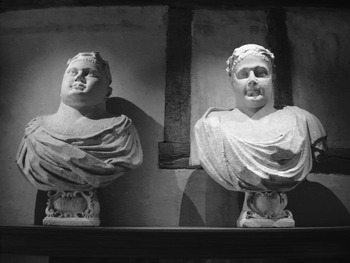
Finch's other contribution was specifically intended to augment the work at Euston Hall, Arlington's new country house: a set of marble busts of the twelve Caesars, a suitable gift from client to patron with their implicit allusion to political power. Antique sculptures were as expensive as large important Italian paintings and their acquisition was further thwarted by the difficulties of getting them out of Rome legally. Thus copies were considered acceptable: French sculptors produced busts in huge numbers, prompting Antoine Schnapper to ask ‘qui n'a pas sa série des Douze Césars?’.Footnote 41 Finch was well travelled and had visited France many times; finding himself close to local supply in Italy, he ordered Florentine busts to impress Arlington. Finch had direct design control over this commission and was not impressed by the quality of the first six when he received them. ‘I find fault with them that they have ignorantly planted beards upon those chinns which never wore any’, he wrote to Arlington and, to correct the deficiencies of the local sculptor, submitted his own collection of medals and coins as models.Footnote 42 Finch urged his patron to take care when choosing the position for the figures at Euston: ‘They may be placed high for they are as they ought to be beyond the proportion of a naturall body.’Footnote 43 Arlington took his advice, but one suspects that Finch would have been rather dismayed by Evelyn's dismissive verdict on the aesthetic integrity of the busts. When the diarist visited Euston in 1677, he noted that the 100-foot long conservatory was adorned with ‘the heads of Caesars, ill cut in alabaster’ (Figure 2).Footnote 44
Otto and Tiberius: two of the marble busts of the Caesars sent by Sir John Finch from Florence to Arlington for Euston Hall, 1669–70. Ancient House Museum, Thetford.

It was not only clothes and accessories that Arlington had obtained for Charles from Paris in the mid-1650s, but also music. The two shared a love of foreign compositions, especially French dance music;Footnote 45 and after the Restoration Arlington used his diplomatic links to attract musicians to England. He had acquired a reputation as a musical patron, and in 1664 Gascoigne negotiated terms with an Italian singer/composer who would come to England and compose for Arlington, and who would also be able to teach the king's choristers since he could compose ‘as well for the Cerch as for the Ciamber; att the Italian way’.Footnote 46 Other musicians found favour at court through Arlington's offices, and the diplomatic correspondence reveals the lengths to which he went to satisfy the court's appetite for novelty. He directed Gascoigne to find a fashionable ‘eunuch’ in Italy, such singers being rare in England.Footnote 47 Gascoigne's first choice was dispatched to Queen Christina in Rome, meaning that Gascoigne had to send a temporary replacement.Footnote 48 A castrato was required more permanently, however, and Gascoigne found ‘another young boy of eleven yeares of Age, that ist nott Gelded; and ist willing to be … if you order me I will treate with his father’.Footnote 49 This does not seem to have appealed to Arlington, whose reaction is clear from Gascoigne's subsequent letter: ‘As for the relife of your conscience, to not putt you in a necessity, to do so great a scinne as to geld a boy, I sciall sciortly send you one, al ready gelt, and a good musician about 16 yeare of Age.’Footnote 50
Mediterranean gastronomy was also popular with Arlington. Provided with delicacies such as parmesan, olive oil and balsamic vinegar by the consul in Livorno and Gascoigne, Arlington also maintained a well-stocked cellar, the contents of which were augmented by almost every one of the diplomatic representatives he appointed.Footnote 51 Sir William Godolphin, for example, sent Rabadania wine from Spain and had the envoy in Oporto ship Balditio on his behalf; Sir Daniel Harvey in Constantinople ensured the supply of Smyrna wine was replenished; Ralph Montagu sent French wine from Paris; and Finch played his part in educating Arlington's palate with Italian wines.Footnote 52 In April 1667, Finch used the opportunity of shipping a crate of pictures acquired by Gascoigne for Arlington to include three chests of wine. Since 1667 had been a good vintage, Finch was able to include quantities of Monte Allino, Carmignano and Chianti.Footnote 53 The following year, he sent four chests of ‘Red Florence’ (‘which I believe will be very good & if your Lordship drinkes it not till towards Easter the better’), three of white Moscatelli di Castello (‘these must be dranke presently being in their perfection’), and a chest of ‘the new Muskadine of Saragosa which will last a long time’.Footnote 54 Arlington's diplomatic clients thus enabled him to offer his guests hand-selected wines. Knowledge of the correct way to consume such wines was equally as important and transformed a common Italian commodity into a prized luxury. Prestige value, rather than monetary worth, was on display. That the wine further enhanced Arlington's reputation for magnificent entertaining added to its value.Footnote 55
II
Arlington was at the centre of court life by virtue of his ministerial position and he ensured that his public persona reflected, if not magnified, his importance in the eyes of the court elite. The blurring of public and private spheres rendered a successful patron's home as important as the magnificence of his dress at court and the status of his carriage, and the need ‘to see and be seen’ in this competitive world extended from court to the town houses of courtiers, where political and social factions were managed. Arlington's transformation of Goring House allowed him to entertain lavishly in London and, simultaneously, to display the material representation of his diplomatic network. In return for the mediation of his clients in cultural affairs, Arlington could strengthen his political influence and his patronage powers, distance himself from his peers, and provide hospitality in London at the end of the 1660s in a setting unmatched by his closest rivals. The duke of Lauderdale refurbished his house at Ham with the help of his assertive duchess after their marriage in 1673 and incorporated many of the latest fashions, such as a bathroom, an aviary, and lavish French and Dutch furniture, but not until later in the decade. Meanwhile, the duke of Buckingham lived in grace-and-favour apartments at Whitehall which attracted no particular comment from contemporaries, and the work he put in train at Cliveden in the late 1660s dragged on into the late 1670s.Footnote 56 Elsewhere, Anthony Ashley Cooper, later first earl of Shaftesbury, lived in Exeter House, an old-fashioned building begun in the reign of Edward VI on the less fashionable north side of the Strand. He also had a country house well away from the political capital in Dorset, but his biographer noted that there was ‘no evidence that Ashley had any intention of filling his house with an expensive collection of paintings and objets d'art’.Footnote 57 The fifth member of the ‘Cabal’, Thomas Clifford, was a client of Arlington's and did not become lord treasurer until 1672; his subsequent rapid departure from court after the Test Act marked the end of his political career, and he died shortly afterwards.
It was perhaps Euston Hall that distinguished Arlington most from other political managers. As with Goring House, its location was testament to his political acuity: Euston is a short distance from Newmarket, where the king and duke of York visited frequently and were at their most relaxed. At Euston, Arlington made the politicization of household space complete. Instead of retiring to the country to escape the unpleasant London summer and entertain local dignitaries and close family – the customary use to which country estates were put – Arlington transformed Euston into as much of a working home as any town house and into an unrivalled locus of power, wealth, intrigue, entertainment, and erudition.
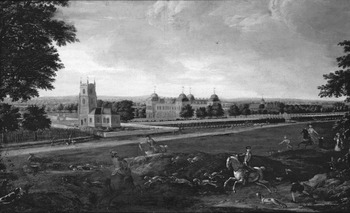
Architecturally, it was also exceptional (Figure 3). In 1666 Arlington bought an old house and, perhaps owing to the speed with which he wanted his country palace to be completed, added to the existing building rather than starting anew. The architect is unknown, but the style of the refurbishment is distinctly French and architectural historians have suggested that the four pavilions at each corner with their domed roofs look back to Salomon de Brosse, architect of the Luxembourg and Chateau de Blérancourt, and are themselves derived from those used by du Cerceau at Verneuil.Footnote 58 These are buildings with which Arlington is likely to have been familiar from his ten years in Paris. He may have had designs produced in Paris for Euston, perhaps sourced by his agent William Perwich, or he may have entrusted the work to an English architect/mason using French sources, such as engravings from his own library. The Wren Society cited an attribution for the house to William Samwell, who worked for Charles II at Newmarket; but he is not known to have produced anything particularly French and his involvement is purely hypothetical.Footnote 59 The speed with which Arlington wished to complete the house is attested by his refusal to halt the works during the second Dutch War, which Thomas Povey, a friend of Pepys who managed the building project, told the diarist he had suggested for patriotic reasons.Footnote 60
Euston Hall and church, by English School (seventeenth century). Private Collection. Mark Fiennes_Bridgeman Art.tif #FB27.

Arlington's choice of French-inspired architecture immediately differentiated him from other country house builders of the day, as did the scale on which he built. His house was nothing less than a secondary court where the king, his brother, courtiers, and foreign ministers could, and did, find entertainment. His grand entertainments were legendary: Evelyn records a house party Arlington held in October 1671 for the king, to which
came all the great men from Newmarket, and other parts both of Suffolk and Norfolk, to make their court, the whole house filled from one end to the other with lords, ladies and gallants … so that for fifteen days there were entertained at least 200 people, and half as many horses, besides servants and guards, at infinite expense.Footnote 61
Enhanced by the king's presence, it did Arlington no harm to have this elite gathering ‘make their court’ in his house and he used high living most effectively to insinuate himself with both the king and courtiers. Arlington's court was also as cosmopolitan as the king's, both materially and politically; and he was aware that his reputation abroad was integral to his domestic power. Recognizing that foreign diplomats were an important audience, he included them in his ‘private’ entertainments. He was well liked by foreign ambassadors: in addition to being favoured by the Dutch ambassador, who was also his brother-in-law, he was referred to by the Venetian ambassador as ‘the most polite and obliging minister that the English Court has’, and the French ambassador, Colbert de Croissy, told how his wife was particularly excited to be included as a guest at the house party in October 1671.Footnote 62 To reinforce display of his international network, Arlington's diplomatic clients were invited guests to Euston when they were in England.Footnote 63 Unlike any of his rivals, Arlington was thereby able to demonstrate a broad political reach beyond the world of Whitehall and took every opportunity of doing so.
The innovative exterior of Euston would have been an anti-climax had it not been matched by equally stunning interiors; the frescoes painted by the Italian, Antonio Verrio, provided the required impact. In 1672 or 1673, Verrio came to England and started working for Arlington, first at Euston and then at Goring House. Italian by birth and training, Verrio had worked on several royal residences in Paris, and his appearance in London was the result of diplomatic mediation, although previous interpretations may have overlooked the identity of his real sponsor. George Vertue claimed that Verrio had been ‘brought into England by the late Lord Montague’; since Montagu was ambassador to France from 1669 to 1672 and subsequently displayed a great interest in the arts, this appears a reasonable explanation and hitherto has been unquestioned.Footnote 64 Research, however, shows that Montagu was not the driving force behind the initial patronage of Verrio in England. Kathryn Baron suggests that Montagu brought Verrio over to paint the great room of Montagu House in London;Footnote 65 but Montagu House was not started until the second half of the decade and in 1672 Montagu had not yet married the woman who would bring the required funds to facilitate his subsequent lavish artistic patronage. Arlington, however, both needed to decorate the refurbished Goring House and the grand country palace that he had just completed in a distinctly French style, and was also a recognized connoisseur.Footnote 66 He also had the opportunity to learn first-hand of Verrio's skill from senior royal officials in France when, in the summer of 1672, he was appointed a senior ambassador to the French court. Verrio appeared in England soon after Arlington's return and began working at Euston; Evelyn's diary confirms that Euston was indeed the first interior he painted in England.Footnote 67
In keeping with a palace rather than a country house, at Euston Verrio painted ‘above the stayre-case, in the greate hall and some of the chambers and roomes of state’.Footnote 68 The importance of this commission, and the work Verrio did at Goring House in the centre of fashionable London, is unquestionable. This was the first decorative paintwork of its type to be completed in England on such a grand scale; it was effectively ‘exhibited’ to the diplomatic, political, and social elite who frequented Arlington's houses and it underlined his position as a leader, if not the leader, of taste at the English court. Where Arlington had gone, others followed, and soon Charles II, relying on his example, commissioned Verrio to paint the new apartments at Windsor. A royal seal of approval led to many more aristocratic commissions, including one from Ralph Montagu when his new house was built at the end of the 1670s, and the vogue for French-style decorative wall and ceiling paintings was secure.
It was not only decorative art that interested Arlington. He was a keen collector of Italian old masters, as suggested by the correspondence of Dodington and Gascoigne and evidenced by Evelyn, who was shown ‘that incomparable piece of Raphael's, being a Minister of State dictating to Guicciardini’, ‘a Woman's head of Leonardo da Vinci’ and ‘a Madonna of old Palma’ when he visited Goring House in 1676.Footnote 69 He also owned two Van Dycks, including a self-portrait.Footnote 70 In the contemporary art world, Arlington was a notable patron of Sir Peter Lely, and he and Lady Arlington commissioned portraits from the artist, Benedetto Gennari, when the Italian came to England in the autumn of 1674 from France.Footnote 71 While there is no evidence that Arlington specifically asked Gennari to visit, it is likely that Gennari was persuaded to come to England through the medium of English diplomats. Envoys in Paris were attuned to developments in the local art market and Gennari's sojourn in London coincided with Arlington's appointment as lord chamberlain, in which position he supervised royal artistic patronage.Footnote 72 Notwithstanding the generous patronage of both Catherine of Braganza and Mary of Modena – herself an Italian who had travelled through Paris and may have seen Gennari's work during her visit – Arlington's support and patronage was important to Gennari. As lord chamberlain he authorized a pension of £500, compared with Lely's of £200, and Gennari went on to paint 137 pictures for royal and other patrons during his time in London.Footnote 73
Having married a Dutch wife, Arlington showed an interest in Dutch developments in art, architecture, sculpture, and gardens that is revealed in diplomatic correspondence.Footnote 74 This interest and, perhaps, the quest for novelty that characterized much of his artistic patronage, ensured that Arlington met local art dealers and artists when he went to the Low Countries in 1672 on an embassy to Louis XIV, who was campaigning there.Footnote 75 Charles II had also boosted the taste for northern European artists by his purchases from William Frizell in 1660, buying works by Dürer, Heemskerck, Breughel, Brill, and Beuckelaer, as well as more traditional sixteenth-century Italian artists.Footnote 76 The Dutch and Flemish pictures that Arlington bought were by lesser-known artists, but evidenced a distinct development in English taste for new genres such as landscapes, domestic interiors, and still-lifes which, as Brotton points out, had rarely attracted the more Italianate eye of earlier Caroline collectors. Ever pragmatic, Arlington may have been drawn by the relatively inexpensive prices commanded by contemporary northern artists, suffering the economic impact of the French war.Footnote 77 The expense report of his trip contained details of his art purchases: they included payments ‘to Aertsen for 4 Pieces £124 4s 0d’, ‘to Tassaet for Lord Arlington's Pictures £10 2s 0d’, ‘to Hocquet for like for him £50 10s 1d’, ‘Three pieces for Ld Arlington – a Flowers £1 4s 2d, a sea Piece £0 16s 1d, the man with Spectacles £0 14s 0d’, ‘for a Picture for the Earl of Arlington to Hen. Vander Werff £40 8s 0d’, and ‘for several to Hoschett [Hocquet] as by note £41 16s 2d’.Footnote 78
Arlington's cultural and artistic patronage in the 1670s needs to be seen against the political background of Charles II's court. After Clarendon's fall, various ministers advised the king but they disagreed on major policy issues and continually vied with one another for the position of first minister, using factions and client management to enhance their support. Amidst such circumstances, the visibility of a patron was particularly important, and this consideration informed much of Arlington's lavish expenditure. By 1669 Arlington had, perhaps against his better interests, been persuaded to support Charles's pro-French policy and had become a member of the anti-Dutch faction, betraying his client Sir William Temple in The Hague and taking a personal and forceful role in the negotiation of the secret treaty of Dover.Footnote 79 On a personal level, supporting Charles's strategy paid off for Arlington. The king agreed to the marriage of his bastard son, Henry Fitzroy, to Arlington's daughter and the wedding, and Arlington's elevation to an earldom and the Order of the Garter, followed in 1672. Later that year, he was appointed ambassador to the French king to participate in the Franco-Dutch peace negotiations. In August 1673, despite the direction that the unpopular Dutch War had taken, Arlington's favour was still sufficiently high for him to entertain Charles and Catherine of Braganza at Goring House and for rumours to circulate of a forthcoming dukedom. He was not, however, elevated and the enigmatic king appointed Buckingham's client, Thomas Osborne, later earl of Danby, as lord treasurer.Footnote 80 J. R. Jones has linked the promotion of anti-Dutch policies after 1670 with a desire by Charles and certain members of the ‘Cabal’, including Arlington, to establish absolutism in the British Isles.Footnote 81 Whether or not this was the case, such suspicions were strongly held in the country and, after the failure of the war in 1674, the ‘Cabal’ ministry was destroyed and Arlington's resignation followed shortly thereafter.
III
This was not, however, the end of Arlington's influence at court. In September 1674, Arlington became lord chamberlain and, far from entering a period of political decline as claimed by most historians, he now ran the largest government department and commanded patronage over approximately 450 offices.Footnote 82 Moreover, the lord chamberlain was responsible for all royal and diplomatic ceremonial, as well as the social and artistic life of monarch and court. The combination of Arlington's close friendship with the king and his acknowledged position at the vanguard of taste meant that he was instrumental in fashioning the royal image over the next ten years.Footnote 83 Frances Harris has suggested that these years represented ‘an ambitious cultural programme of enhancement of the glory of the English monarchy’ and developments at court and in the royal palaces certainly seem to have been targeted at achieving an English version of the French ‘gloire’ that dominated Louis XIV's aesthetic programmes.Footnote 84 Arlington's contribution to these English developments now came through artistic, rather than political, patronage. His alleged popery and support for absolutism is evidenced by the aesthetic projects he and Charles entertained over the next decade, rather than by foreign policy decisions.
It is Arlington's taste for French fashions that is noteworthy, despite the pictures, marbles, and social habits imported from Italy, and it became increasingly evident in the artistic patronage under his control from the mid-1670s. Other members of the court elite also increasingly adopted French modes, whilst both the treaty of Dover of 1670 and the arrival of Louise de Keroualle as effective maîtresse en titre – a connection promoted in part by Arlington – gave an impetus to French fashions in dress, decorative art, and etiquette. Through his client Ralph Montagu, ambassador in Paris, Arlington procured French furniture for the king in the early 1670s. Letters to Montagu discuss his concern for the new beds ordered for Charles, and the accounts for the year ended Michelmas 1672 submitted to the Great Wardrobe, the department of the royal household responsible for procuring palace furnishings, detailed four beds bought in Paris under his direction.Footnote 85 The prominence of similar French-inspired aesthetic decisions taken by Arlington, which increased after 1674 when he was appointed lord chamberlain, contributed to a Francophile boom at court. Arlington's influence with Charles II should, therefore, be considered as a contributing factor in the development of the English court style of the 1670s.
The first notable cultural event under Arlington's control was the performance of ‘Calisto’ in early 1675. This masque, in a new and magnificent style that outshone anything seen at court since the Restoration and which equalled the grandest of the masques performed at Charles I's court, was under the overall direction of the lord chamberlain's department. Not only did Arlington supervise the artistic expenditure, but he was also responsible for appointing the master of the king's music, Nicholas Staggins, who was commissioned to write the score. Staggins co-operated with John Crowne for the libretto, and the result is a piece of work more indebted to French courtly models than to anything previously seen or heard in England. Musical historians suggest that Ben Jonson and Inigo Jones would probably not have recognized it; not only was it different from other Restoration masques, but it was also closer ‘to the operas of Perrin and Lully for its allegorical prologue and to Corneille and comédie-ballet for its basic structure’ than to any of the emerging new English operas.Footnote 86 The scale of this masque was vast. Preparations and rehearsals occupied the court from September 1674 until the performances in February, March, and April 1675; a conservative estimate of its cost has been put at £5,000.Footnote 87 In terms of purpose, the two princesses took leading roles in the masque, as did two of Charles's illegitimate children, the duke of Monmouth and the countess of Sussex. All were unmarried and all were, in effect, paraded as royal protégés on the international marriage mart. With its lavish costumes and complex allegories, the masque was thereby intended to display the monarch's power, wealth, and glory. It was just the type of entertainment seen at the French court and through his diplomatic experiences, both personal and second hand, and his international friendships, Arlington would have been well aware of the cultural programme instituted by Louis XIV and Colbert in their attempts to find further media through which to express royal authority.Footnote 88 Moreover, the masque's audience was, significantly, restricted to foreign ambassadors and those in court circles, who were precisely the people whom Charles most needed to awe with the potency of his position.
It was not just musical allegories that were performed during Arlington's chamberlainship. From 1674, the royal apartments at Windsor were extensively refurbished, a project which came closest to expressing absolutist ideals of any completed by Charles II. While Hugh May set about remodelling the exterior, Grinling Gibbons and Antonio Verrio, who had recently completed work for Arlington at Euston and Goring House, were commissioned to decorate the interiors. Verrio's previous experience had included work on French royal palaces, including Versailles, and there was no native painter who could have produced similar decoration at Windsor. Over a period of nine years, Charles II spent £190,000 on Windsor, mainly on the interiors;Footnote 89 Verrio and his team painted twenty ceilings, three staircases, the chapel, and St George's Hall. Both Katharine Gibson and Howard Colvin believed that the frescoes were ‘fulsomely and unrealistically propagandist in the manner accepted throughout Europe’ in their depiction of intricate allegories glorifying the monarchy.Footnote 90 The hall was devoted to the glorification of Charles II and the Order of the Garter, with the Black Prince heading a triumphal procession towards the founder, Edward III. Other allegories alluded to contemporary events such as the return of the monarchy, the restoration of the Church of England and the introduction of wise authority, mercy, peace, and prosperity. It is inconceivable that an Italian artist recently arrived in England from France could have devised such an intellectually complex and historically contextualized allegorical programme without assistance, and the evidence points to Arlington's specific involvement. As Gibson noted from her work in the Royal Library at Windsor, the ‘Account of Works’ included a payment to Verrio for work in St George's Hall ‘with severall figures and other Ornaments of painting according to an agreement made with him by the Lord Arlington, now Lord Chamberlain’.Footnote 91 This not only hints at Arlington's personal role in promoting the visual representations of monarchy during his time as lord chamberlain, but also alludes to his influence in artistic matters even before his appointment. Perhaps even more significantly, the Windsor accounts show that Arlington's influence continued long after the period when most commentators have assumed it to have become negligible. His hand is still discernible as late as 1683 in the iconography of St George's Hall and the chapel, a warrant for the payment of which shows that, even if he had not originated the allegorical programme, he gave it his official approval at all stages of its realization. The warrant states
Signor Verrio for Painting and adorning St Georges Hall in Windsor Castle with several Figures and other Ornaments of painting, finding all workemanshipp and Colours (the Gildinge worke excepted) according to an Agreement made by him with the late Lord Arlington for one yeare ending at Midsomer 1683. £1,000.Footnote 92
The last ten years of Charles II's reign corresponded to the final years of Arlington's life and he continued in his post as lord chamberlain until he died. During this time, the works at Windsor were completed and construction started on a new palace for Charles II at Winchester, which was to have been a vast baroque edifice that would have helped to epitomize, more than any other royal residence, the king's power by allowing Sir Christopher Wren to plan on a huge scale. With first-hand experience of both the French and Spanish royal palaces, and in his role as lord chamberlain, it is likely that Arlington was involved in the project for a new royal palace that would leave the indelible mark of monarchy on the English landscape and constitute a worthy statement of kingly power interpreted by a home-grown architect worthy of international acclaim. More prosaically, and under Arlington's direct control – in that he signed all the warrants of instruction – the Wardrobe accounts show a significant increase in expenditure on royal furnishings during this period.Footnote 93 The interiors of the royal palaces, yachts, and country residences were decked out in new finery, employing English joiners and upholsterers to express the majesty of the restored monarch. That the overhaul of the royal image did not occur until the late 1670s is significant. Certainly Charles II lacked the financial resources to do so in the early part of his reign, even had he wished to, but it was in this decade that the growing tensions of incipient party politics made it more necessary to establish monarchical authority and to evidence it through visual means.Footnote 94 Moreover, before Arlington's appointment as lord chamberlain there had not been anyone with the necessary knowledge and experience to act as the driving force and to follow through such a concerted programme of royal artistic patronage. It was with his trusted friend, Harry Bennet, whose aesthetic choices he had admired and emulated for twenty years, that Charles felt able to modernize the visual imagery of Stuart monarchy.
Arlington was not a Colbert; he understood the power and influence of artistic suggestion, but he also had to act within the constraints of his own position, both financial and political. Within these confines, he emerges as a notable patron who helped to transform the direction of artistic appreciation in England, and allowed court taste to recover the pronounced continental aesthetic absent since 1649. It would be erroneous to suggest, however, that Arlington was merely aping the French. French taste was absolutist, aristocratic, and characterized by an abundance of material trappings. Accordingly, it was the representation of power that made this taste attractive in a court environment, not the fact that it was French, as evidenced by the ubiquity with which it was embraced not just in England but all over ancien régime Europe.
Arlington's period of office as lord chamberlain amply illustrates the potential for political power vested in the role. From the early days of his royalist exile, he had understood the potential for the arts to influence and impress, and as chamberlain he worked to promote the institution of monarchy through visual media. Throughout his career, he managed impressions and expectations through the power of imagery, even at the most personal level. Three decades after being wounded at Edgehill, and long after it was necessary for him to wear the plaster that covered the scar on his nose, Arlington continued to appear in public with the bandage as a constant and highly visible reminder to his rivals of his personal bravery and loyalty to the king. By having his portrait painted wearing the plaster, he showed that he understood the memorializing quality of art, and as lord chamberlain he attempted similarly to immortalize the Stuart dynasty in paintings at Windsor. He was not the first member of the court or political elite to appreciate French architecture and furniture, Italian paintings and foreign books, but his access to sources of supply in the 1660s distinguished him from his rivals during a period characterized by restricted availability, and his consciously political display of such luxuries was unrivalled. Arlington understood the importance of affirming his participation in the exclusive club of the diplomatic, political, and social elite while differentiating himself from his closest rivals, and he used continental arts to do so. His own experiences as a diplomat and his adroit manipulation of English envoys abroad had helped him create an identity that kept him close to the heart of government far longer than would have been warranted by the ‘arrant fop’ described by Buckingham.