1. Introduction
The interplay between language and cognition has triggered intensive debate over recent decades, with evidence showing that language-specific ways of depicting the reality may contribute to cross-linguistic differences in cognition (Lupyan, Reference Lupyan2012; Slobin, Reference Slobin, Shibatani and Thompson1996b; Wolff & Holmes, Reference Wolff and Holmes2011). Whilst most of the current research focuses on monolingual speakers, it is important to extend our enquiries to bilingual speakers or second language learners to further explore how the learning and use of a second language affect cognitive behaviours such as perception, attention, recognition memory, and categorization. A growing body of research has demonstrated that acquiring another language means internalizing a novel way of thinking and L1-specific ‘thinking-for-speaking’ is subject to change due to variations in speakers’ learning trajectories, such as age of acquisition, language proficiency, and the amount of contact with each language (see Pavlenko, Reference Pavlenko and Pavlenko2011, for a detailed review). Another line of research suggests that recent linguistic exposure can trigger conceptual switching between language-specific representations as a function of language in operation. Most studies along these lines are conducted with late bilingual speakers or adult L2 learners with typologically contrastive languages (Athanasopoulos et al., Reference Athanasopoulos, Bylund, Montero-Melis, Damjanovic, Schartner, Kibbe and Thierry2015a; Montero-Melis, Jaeger, & Bylund, Reference Montero-Melis, Jaeger and Bylund2016; Stocker & Berthele, Reference Stocker and Berthele2019). However, little is known about how early bilinguals with partial overlapping linguistic systems tend to behave: whether they establish distinct sets of lexical and conceptual representations and switch between them, or if they have a single pattern of ‘thinking-for-speaking’ that is compatible with both languages.
The current study combines these two lines of enquiry and aims to address how early Cantonese–English bilinguals lexicalize and conceptualize voluntary motion in different language contexts. Specifically, we examine how bilinguals in a monolingual (L1) and a bilingual (L1 and L2) context lexicalize and categorize motion compared with monolinguals of each language as a function of recent L2 activation. In addition, it also addresses whether the amount of language contact with each language affects bilinguals’ performance while controlling for other variables such as age of L2 acquisition and L2 proficiency.
This study combines two research paradigms: a linguistic encoding paradigm that allows us to manipulate participants’ short-term language activation, and a triads-matching paradigm that has been widely used in the domain of motion to access participants’ perceptions of event similarity (Athanasopoulos, Damjanovic, Burnand, & Bylund, Reference Athanasopoulos, Damjanovic, Burnand and Bylund2015b; Ji & Hohenstein, Reference Ji and Hohenstein2018).
2. The interplay between language and cognition
The question of whether language affects cognition has triggered vigorous debates in recent decades (see Bylund & Athanasopoulos, Reference Bylund and Athanasopoulos2014b, for a detailed review). According to Linguistic Relativity (Whorf, Reference Whorf1956), cross-linguistic differences in lexicalization may have an effect on general cognition. Empirical evidence shows that, on the one hand, the effects of language on thought have been detected in a wide range of conceptual domains, such as colours (Athanasopoulos, Damjanovic, Krajciova, & Sasaki, Reference Athanasopoulos, Damjanovic, Krajciova and Sasaki2011), objects (Pavlenko & Malt, Reference Pavlenko and Malt2011), time (Boroditsky, Fuhrman, & McCormick, Reference Boroditsky, Fuhrman and McCormick2011), and motion (Ji & Hohenstein, Reference Ji and Hohenstein2018). On the other hand, such effects are context-bound and seen under certain conditions. For example, the effects may appear when language is used as a strategy to solve a task (Gennari, Sloman, Malt, & Fitch, Reference Gennari, Sloman, Malt and Fitch2002), but disappear when verbal interference is introduced (Flecken, Athanasopoulos, Kuipers, & Thierry, Reference Flecken, Athanasopoulos, Kuipers and Thierry2015; Montero-Melis & Bylund, Reference Montero-Melis and Bylund2017). A growing body of research has demonstrated that the effects of language on thought depend on various factors, such as the nature of the experimental stimuli (simplex or complex), the involvement of language (explicit, implicit, or with verbal interference), and task manipulation (linguistic priming). Thus, instead of asking whether or not language determines thought, current studies have shifted the focus to determining which language-specific categories affect which cognitive domains under what conditions (Bylund & Athanasopoulos, Reference Bylund and Athanasopoulos2014b).
This multi-faceted picture has motivated researchers to explore further how language affects thinking under different circumstances. For example, the thinking-for-speaking hypothesis (Slobin, Reference Slobin, Shibatani and Thompson1996b) emphasizes the effects of language on online thinking, that is, when language is explicitly used in cognitive processing. This approach has generated reliable evidence that speakers of different languages exhibit different conceptualization patterns when engaged in language comprehension or production (Athanasopoulos et al., Reference Athanasopoulos, Bylund, Montero-Melis, Damjanovic, Schartner, Kibbe and Thierry2015a; Montero-Melis & Bylund, Reference Montero-Melis and Bylund2017; Soroli, Hickmann, & Hendriks, Reference Soroli, Hickmann, Hendriks, Aurnague and Stosić2019). In line with the ‘thinking-for-speaking’ hypothesis, other studies show that language can be used as a strategy to solve a particular task, especially when the task lacks an objective or correct answer (Flecken, Carroll, Weimar, & Von Stutterheim, Reference Flecken, Athanasopoulos, Kuipers and Thierry2015). This ‘thinking with language’ effect, as termed by Wolff and Holmes (Reference Wolff and Holmes2011), emphasizes the spontaneous recruitment of linguistic labels to facilitate answer formulation. In addition, in a more recent view, the label-feedback hypothesis suggests that the effects of language on cognition are dynamic and occur in an ad hoc fashion (Lupyan, Reference Lupyan2012). In this view, recent linguistic experience can activate related non-linguistic representations that speakers can draw on to carry out a subsequent cognitive task. Mutual feedback between linguistic and non-linguistic representations can be achieved by short-term manipulations such as verbalization immediately prior to or during mental processing (Montero-Melis & Bylund, Reference Montero-Melis and Bylund2017).
3. Conceptual representations in the bilingual mind
The fact that language can modulate cognition in various ways raises many intriguing questions: if speakers of different languages have different modes of thinking, how do bilinguals with two typologically different languages behave? Do they have two independent modes of thought and behave like monolinguals of each language? Or do they develop a dominant mode of thinking integrating typical features of all the languages they know?
Empirical evidence shows that L2 learning needs not only the internalization of novel linguistic frames, but also related conceptual distinctions. This may give rise to the restructuring of existing conceptual categories in the L1 (Jarvis & Pavlenko, Reference Jarvis and Pavlenko2008). This process, termed ‘conceptual’ or ‘cognitive restructuring’, refers to conceptual changes that bilinguals undergo in the process of acquiring a new language. It is a gradual process and occurs in bilinguals’ verbal and non-verbal behaviours (Pavlenko, Reference Pavlenko and Pavlenko2011). The conceptual changes bilinguals have are gradient and exhibit various forms, such as the co-existence of L1- and L2-based concepts (Hohenstein, Eisenberg, & Naigles, Reference Hohenstein, Eisenberg and Naigles2006; Sachs & Coley, Reference Sachs, Coley and Pavlenko2006), convergence (Brown & Gullberg, Reference Brown and Gullberg2013; Cook, Bassetti, Kasai, Sasaki, & Takahashi, Reference Cook, Bassetti, Kasai, Sasaki and Takahashi2006), shift to L2-based concepts (Athanasopoulos et al., Reference Athanasopoulos, Damjanovic, Burnand and Bylund2015b; Park & Ziegler, Reference Park and Ziegler2014), and the attrition of L1-based concepts (Bylund, Reference Bylund2009; Bylund & Jarvis, Reference Bylund and Jarvis2011). The degree of cognitive restructuring may be modulated by various long-term learning effects, such as L2 proficiency (Ji, Reference Ji2017; Park, Reference Park2019), age of L2 acquisition (Boroditsky, Reference Boroditsky2001; Lai, Rodriguez, & Narasimhan, Reference Lai, Rodriguez and Narasimhan2014), and language contact (Bylund & Athanasopoulos, Reference Bylund and Athanasopoulos2014a, Reference Bylund and Athanasopoulos2015).
Another line of research suggests that the conceptualization patterns that bilinguals have are context-bound and susceptible to immediate experimental manipulations, such as linguistic priming (Lai et al., Reference Lai, Rodriguez and Narasimhan2014; Montero-Melis et al., Reference Montero-Melis, Jaeger and Bylund2016), biased instruction (Brown & Gullberg, Reference Brown and Gullberg2008; Kersten et al., Reference Kersten, Meissner, Lechuga, Schwartz, Albrechtsen and Iglesias2010) and language context (Athanasopoulos et al., Reference Athanasopoulos, Bylund, Montero-Melis, Damjanovic, Schartner, Kibbe and Thierry2015a; Stocker & Berthele, Reference Stocker and Berthele2019). For example, Athanasopoulos et al. (Reference Athanasopoulos, Bylund, Montero-Melis, Damjanovic, Schartner, Kibbe and Thierry2015a) reported that German–English bilinguals switched between language-specific categorization patterns as a function of language in operation. Participants in a German context patterned with German monolinguals in basing their similarity judgements on endpoint saliency, whereas participants in an English context patterned with English monolinguals in basing their judgements on event ongoingness.
The overall picture demonstrates that bilinguals’ conceptual representations are dynamic and multimodal in the sense that they can be affected by various factors. However, it still remains unclear how long- and short-term variations interact with each other in modulating bilinguals’ cognition.
4. Motion event encoding and conceptualization
4.1. the encoding of voluntary motion in english and cantonese
The domain of motion has served as a suitable testing ground to explore the interplay between language and cognition because world languages exhibit great diversity in how motion is typically expressed. Talmy (Reference Talmy2000) divided languages into two distinct categories: satellite-framed languages (S-languages) and verb-framed languages (V-languages), depending on the semantic distribution of path. S-languages, such as English and German, express path in a satellite (e.g., verb particles), but manner in the verb root. In contrast, V-languages, such as Spanish and French, express path in the main verb, leaving manner not expressed (by default) or via peripheral devices (e.g., positional phrases or gerundive constituents). Examples (1) and (2) illustrate typical motion constructions in English and French (Talmy, Reference Talmy2000):
(1) English: He ran [Manner] across [Path] the street.
(2) French: Path verb+ Manner subordinate (optional in the expression)
Il traverse [Path] la rue en courant [Manner]
‘He crossed the street running.’
Talmy’s typology is useful for analyzing Indo-European languages, but not applicable to serial-verb languages such as Chinese, Tai, and other Sino-Tibetan languages where path and manner are encoded in compound forms of equal grammatical status. Thus, Slobin introduced a third type known as ‘equipollent-framed languages’ (E-languages), where “both Manner and Path are expressed by equipollent elements, that is, elements that are equal in formal linguistic terms, and appear to be equal in force or significance” (Slobin, Reference Slobin, Strömqvist and Verhoeven2004, p. 226).
Cantonese, widely spoken in Hong Kong and Guangdong Province in China, is a serial-verb language (Matthews & Yip, Reference Matthews and Yip2011). A serial-verb construction in Cantonese consists of two or more components. Each is able to stand alone as an independent element (Matthews, Reference Matthews, Aikhenvald and Dixon2006). For instance, the path of motion, 翻 (faan1) and入 (jap6), can be expressed as either verb complements, as in example (3), or as independent verbs, as in example (4) and (5). Both constructions are frequently and pervasively used in oral production (Yiu, Reference Yiu2013). Therefore, Cantonese is considered to be an equipollent-framed language, standing midway on the continuum of S- and V-languages (Lamarre, Reference Lamarre, Lamarre and Ohori2007; Yiu, Reference Yiu2013, Reference Yiu and Yiu2014).
(3) 佢 跑 咗 翻 入 睡房
Keoi5 paau2 zo2 faan1 jap6 seoi6 fong2.
S/he run asp return enter bedroom
‘S/he ran back into the bedroom.’
(4) 佢 翻 咗 睡房
Keoi5 faan1 zo2 seoi6 fong2
S/he return asp bedroom
‘S/he returned to the bedroom.’
(5) 佢 入 咗 睡房
Keoi5 jap6 zo2 seoi6 fong2
S/he enter asp bedroom
‘S/he entered the bedroom.’
The typological status of Cantonese is similar to Mandarin Chinese (Ji, Hendriks, & Hickmann, Reference Ji, Hendriks and Hickmann2011a, Reference Ji, Hendriks and Hickmann2011b, Reference Ji, Hendriks and Hickmann2011c), as these two languages have equipollent framing systems with satellite- and verb-framed properties. In addition, Talmy (Reference Talmy, Guo, Lieven and Budwig2009) has suggested that Chinese is the only language that fits the case of equipollence. This can be attributed to diachronic transformations that classical Chinese went through from a V-language to an S-language (Peyraube, Reference Peyraube, Hickmann and Robert2006), and such typological transformations in Cantonese are not yet completed (Xu, Reference Xu2006; Yiu, Reference Yiu2013). Thus, it has been argued that typological distinctions between S- and V-languages should not be viewed as an absolute dichotomy, but as a continuum with various degrees of manner and path salience (Slobin, Reference Slobin, Strömqvist and Verhoeven2004; Zlatev & Yangklang, Reference Zlatev, Yangklang, Strömqvist and Verhoeven2004).
Given their typological differences, it is important to investigate whether language-specific ways of talking about motion affect how motion is presented in cognition. According to Slobin’s (Reference Slobin, Strömqvist and Verhoeven2004) manner salience hypothesis, the codability of manner in lexicalization increases its accessibility in cognitive processing. In this view, S-language speakers tend to attach more salience to manner of motion due to its high codability. However, as manner of motion is not obligatory in V-languages, the frequent omission of manner reduces its cognitive salience in mental representations for V-language speakers. Thus, the current study hypothesizes that English monolinguals attach more salience to manner of motion compared with Cantonese monolinguals in non-verbal categorization.
4.2. cross-linguistic differences in motion event encoding with monolingual and bilingual speakers
Cross-linguistic research demonstrates that language-specific lexicalization patterns emerge from an early age (Allen et al., Reference Allen, Özyürek, Kita, Brown, Furman, Ishizuka and Fujii2007; Choi & Bowerman, Reference Choi and Bowerman1991; Hickmann & Hendriks, Reference Hickmann and Hendriks2010; Ji et al., Reference Ji, Hendriks and Hickmann2011a). For instance, Hickmann and Hendriks (Reference Hickmann and Hendriks2006) showed that monolingual children began to display L1-specific lexicalization patterns of motion as early as three years old. Similarly, Choi and Bowerman (Reference Choi and Bowerman1991) reported that bilingual children showed sensitivity to the typical patterns of two languages from 17–20 months old. This finding is closely related to the current study, as bilinguals with early L2 exposure may become sensitive to the particular ways of linguistic encoding in both languages.
Moving to bilingual speakers, some studies have demonstrated that bilinguals or L2 learners with typologically different languages may transfer certain L1-based lexicalization patterns into the L2. For example, V-language speakers (Japanese, French) tend to encode manner of motion less frequently in their L2 S-languages (English, Danish) compared with S-language monolinguals (Brown & Gullberg, Reference Brown and Gullberg2008; Cadierno, Reference Cadierno, Han and Cadierno2010), whereas S-language speakers learning L2 V-languages may have difficulty in acquiring target lexicalization patterns of manner encoding (Cadierno & Ruiz, Reference Cadierno and Ruiz2006; Hendriks & Hickmann, Reference Hendriks and Hickmann2015; Hendriks, Hickmann, & Demagny, Reference Hendriks, Hickmann and Demagny2008). However, other studies report that bilinguals and L2 learners are able to restructure their L1-based patterns of ‘thinking-for-speaking’ when lexicalizing motion events with an L2 (Hendriks & Hickmann, Reference Hendriks, Hickmann, Cook and Bassetti2011; Ji & Hohenstein, Reference Ji and Hohenstein2014), and the influence between L1- and L2-based concepts is bi-directional (Brown & Gullberg, Reference Brown and Gullberg2011; Daller, Treffers-Daller, & Furman, Reference Daller, Treffers-Daller and Furman2011; Hohenstein et al., Reference Hohenstein, Eisenberg and Naigles2006). For example, Hendriks and Hickmann (Reference Hendriks, Hickmann, Cook and Bassetti2011) showed that intermediate and advanced English learners of French were able to acquire target L2 patterns of conflating path in the main verb when describing voluntary motion. In addition, Hohenstein et al. (Reference Hohenstein, Eisenberg and Naigles2006) reported that Spanish–English bilinguals’ lexical choice of manner verbs fell in-between monolingual baselines, suggesting a convergence of L1- and L2-based concepts in the bilingual mind. Last, several studies provide evidence for restructuring of the L1-based conceptualization patterns (Bylund & Jarvis, Reference Bylund and Jarvis2011), indicating that conceptual restructuring is a dynamic process and susceptible to individual differences, such as age of acquisition (Filipović, Reference Filipović2011; Hohenstein et al., Reference Hohenstein, Eisenberg and Naigles2006), L2 proficiency (Cadierno & Ruiz, Reference Cadierno and Ruiz2006; Treffers-Daller & Calude, Reference Treffers-Daller and Calude2015), language contact (Daller et al., Reference Daller, Treffers-Daller and Furman2011), and language context (Stocker & Berthele, Reference Stocker and Berthele2019).
4.3. cross-linguistic differences in motion event conceptualization with monolingual and bilingual speakers
Numerous studies have investigated whether different degrees of manner salience in event encoding affect event cognition. Some studies have reported S-and V-language speakers categorizing motion events along the same parameters regardless of typological differences (Loucks & Pederson, Reference Loucks, Pederson, Bohnemeyer and Pederson2011; Papafragou, Massey, & Gleitman, Reference Papafragou, Massey and Gleitman2002). However, other studies have demonstrated a clear language effect on non-verbal behaviours, such as event categorization, recognition memory, and attention allocation, when speakers’ access to language is not blocked in the decision-making process (Gennari et al., Reference Gennari, Sloman, Malt and Fitch2002; Papafragou, Hulbert, & Trueswell, Reference Papafragou, Hulbert and Trueswell2008; Soroli, Reference Soroli2012; Soroli & Hickmann, Reference Soroli, Hickmann, Marotta, Lenci, Meini and Rovai2010; Trueswell & Papafragou, Reference Trueswell and Papafragou2010). For example, Soroli and Hickmann (Reference Soroli, Hickmann, Marotta, Lenci, Meini and Rovai2010) investigated whether cross-linguistic differences in motion event lexicalization modulated English and French speakers’ categorical preferences by using a triads-matching paradigm. The results suggested that, in line with language-specific encoding patterns, French speakers showed a preference for path in both verbal and non-verbal categorization tasks, whereas English speakers presented a significant manner preference only in a verbal condition where linguistic encoding was provided prior to event categorization. Similarly, Montero-Melis and Bylund (Reference Montero-Melis and Bylund2017) examined the effect of language on cognition with Swedish (S-language) and Spanish (V-language) native speakers in different conditions. The results suggested that Swedish monolinguals were more likely to use ‘same-manner’ criteria for similarity assessments as long as they could access the language. However, the language effects disappeared under verbal interference. These converging findings are in line with the hypothesis of ‘thinking-for-speaking’ that the effects of language on thought exist only when language is actively involved in online thinking.
Turning to bilingual speakers, the key issue is how spatial concepts are mentally represented. Some studies have reported that event representations in bilinguals are context-bound and can be modulated by short-term language meditation (Athanasopoulos et al., Reference Athanasopoulos, Bylund, Montero-Melis, Damjanovic, Schartner, Kibbe and Thierry2015a; Lai et al., Reference Lai, Rodriguez and Narasimhan2014; Montero-Melis et al., Reference Montero-Melis, Jaeger and Bylund2016). For example, Montero-Melis et al. (Reference Montero-Melis, Jaeger and Bylund2016) examined whether recent L2 exposure affected similarity assessments of caused motion with Swedish adult learners of L2 Spanish. Participants repeated L2-priming sentences with different degrees of manner salience prior to making similarity arrangements. The findings showed that Swedish speakers preferred to base their arrangements on ‘same-path’ criteria when primed with path-biased sentences. A similar pattern was reported in Lai et al. (2014), where late English–Spanish bilinguals who were primed with Spanish sentences preferred to base their similarity judgements on path of motion, compared with those who were primed with English sentences prior to categorization. These findings indicate that conceptual representations of bilinguals are flexible and can switch to language-modulated patterns within a short timescale.
In contrast, other studies have shown that bilinguals’ mental representations are resistant to change with short-term language manipulations. For example, Filipović (Reference Filipović2011) investigated whether early English–Spanish bilinguals performed differently on recognition memory in different language contexts. The results suggested that bilinguals’ performances resembled Spanish monolinguals in manner recognition irrespective of the language context. The results echoed Kersten et al. (Reference Kersten, Meissner, Lechuga, Schwartz, Albrechtsen and Iglesias2010), who examined how Spanish–English bilinguals classified novel objects by using a supervised learning paradigm. The results showed that bilinguals with early exposure to English patterned with English monolinguals in manner classification regardless of the test language.
In summary, the evidence regarding the short-term effects of cross-linguistic differences remains mixed, and several issues remain unsolved. First, most studies examining the short-term effects of L2 exposure use L2 linguistic priming as a way to manipulate immediate language use. However, it remains unclear whether participants are aware of such priming effects and whether pseudo-priming can properly reflect real-life situations (Montero-Melis et al., Reference Montero-Melis, Jaeger and Bylund2016). In contrast, Filipović (Reference Filipović2011) elicited participants’ language production in each of their languages as a way to manipulate the language context. But the activation of two languages at the same time may counterbalance any potential effects that language places on cognition. Second, although some studies have reported that early bilinguals may differ from late bilinguals in event conceptualization (Lai et al., Reference Lai, Rodriguez and Narasimhan2014), it remains unknown how other long-term variations such as language contact affect bilinguals’ performance, and how long- and short-term variations interact with each other. Third, the existing literature mainly targets language pairs with contrastive typological features (S- and V-languages), whereas little has been done with languages located between these two extremes (E-languages).
5. The present study
This study extends language pairs under investigation to one of the non-Indo-European languages, Cantonese, with characteristics of both satellite-framed and verb-framed languages. It aims to investigate the immediate effect of language use on event categorization in early Cantonese–English bilinguals with varying degrees of language contact with Cantonese and English. We manipulate bilinguals’ immediate language use by eliciting their oral descriptions prior to categorization. The purpose of eliciting participants’ oral descriptions is twofold: first it can reflect participants’ preferences in event encoding based on natural descriptions; and second, we can maximize the effects of language on thought by engaging participants in language production. We also manipulate the degree of language activation in bilinguals by randomly assigning them to one of the two contexts: a monolingual (L1) context where Cantonese is the only activated language, and a bilingual (L1 and L2) context where both Cantonese and English are kept activated during verbalization and categorization.
The overall aim is to investigate whether and to what extent cross-linguistic differences in lexicalization go beyond the linguistic domain and how bilingual speakers tend to behave under short-term language manipulations. Research questions are:
1. How do Cantonese and English monolingual speakers lexicalize and conceptualize voluntary motion events? Is higher salience in manner encoding associated with more attention to manner in event categorization?
2. How do Cantonese–English bilingual speakers in different language contexts lexicalize and conceptualize motion events compared with Cantonese and English monolinguals?
3. To what extent is language contact associated with bilinguals’ motion event encoding and mental representations?
6. Method
6.1. participants
Altogether, 90 adult participants were recruited for the study: 30 Cantonese monolingual native speakers, 30 English monolingual native speakers, and 30 Cantonese–English bilingual speakers. All were university students. Cantonese monolinguals (Mage = 22.1, SD = 2.7) were recruited from a local university in Shenzhen, China, where Cantonese is the mother tongue. English monolinguals (Mage = 23.7, SD = 1.9) were involved from a local university in London, UK. The monolinguals in the study refer to functional monolinguals with limited proficiency and minimal exposure to any foreign language (Brown & Gullberg, Reference Brown and Gullberg2011; Park & Ziegler, Reference Park and Ziegler2014). Their dominant language in daily communication is the native language, and none of them regard themselves as functional bilinguals according to the language history questionnaire. Cantonese–English bilinguals (Mage = 20.7, SD = 2.1) were from Hong Kong, where both Cantonese and English are the official languages and are used interchangeably in daily communication. Speakers normally start their English language learning at an average age of three as early bilinguals and achieve a high proficiency in English at university. So bilingualism here is defined as the alternate use of two languages of equal status in terms of proficiency.
In line with previous studies (Montero-Melis et al., Reference Montero-Melis, Jaeger and Bylund2016; Park & Ziegler, Reference Park and Ziegler2014), bilinguals’ language proficiency was assessed in a language history questionnaire (Li, Zhang, Tsai, & Puls, Reference Li, Zhang, Tsai and Puls2014) in two forms: self-reported scores of any standardized English proficiency tests taken within the last two years and self-rated scores of current English proficiency. According to the Common European Framework of Reference for Language (Council of Europe, 2011), their proficiency was above the upper intermediate level (B2), as measured by their IELTS or TOEFL scores. Participants also evaluated their current proficiency in English based on a seven-point scale, where 7 was the maximum rating (M = 6.41, SD = 0.51). To measure bilinguals’ language contact with Cantonese and English, daily language use was estimated by hours. Participants were asked to indicate the time they spent doing daily activities with each language (e.g., watching television, reading for school, writing emails to friends, etc.).
To further explore the effect of language context, bilinguals were randomly assigned to one of the two contexts: a monolingual context (N = 15) and a bilingual context (N = 15). Both groups had comparable level of English proficiency as measured by their self-rated scores (M = 6.26, SD = 0.53 for bilinguals in a monolinguals context; M = 6.56, SD = 0.45 for bilinguals in a bilingual context, t(28) = 1.65, p = .108) and the onset of English acquisition (M = 3.53, SD = 0.91 for bilinguals in a monolinguals context; M = 3.20, SD = 0.56 for bilinguals in a bilingual context; t(28) =1.20, p = .239).
6.2. materials
A cartoon-based test was specially designed for the study with an elicited verbal encoding task and a triads matching task to assess participants’ performance across each group.
6.3. experimental tasks
6.3.1. Task 1: linguistic verbal encoding task
The stimulus consisted of 54 sets of animated cartoons with 36 test items and 18 control items. Each cartoon was 6 seconds long. The test items depicted a boy performing a voluntary motion event with various path and manner, whereas the control items minimize the path of motion with highlights on manner of motion only. The involvement of control items had two aims: (1) to distract participants from using the same lexicalization patterns throughout the task; and (2) to establish a bilingual context (see Section 6.4 ‘Procedure’ for details). The model was originally developed by Hickmann and Hendriks (Reference Hickmann and Hendriks2010). Different from the previous model, the current stimuli included a total of eight types of path, falling into three categories: vertical path (up and down), deictic path (along, towards, away from), and path of a boundary-crossing (across, into, out of). Altogether, 11 types of manner were included, ranging from general manners (walk, run) to manners with instruments (bicycle, skateboard). For detailed information, please refer to ‘Appendix A’.
6.3.2. Task 2: non-linguistic similarity judgement task
A total of 54 animated video clips involving 12 sets of test triads and 6 sets of distractors were used as stimuli. The test triads shared the same content with the stimuli used in the linguistic encoding task. This was to make sure that participants had described all scenes prior to event categorization. Each triad consisted of three video clips: a target video illustrated a boy performing a voluntary motion event (A boy walks up a hill), and two alternative videos with either manner or path contrasts. For manner-match alternatives, manner of motion was kept consistent, whereas the path was changed (A boy walks down a hill). In contrast, for path-match alternatives, path of motion was kept the same, whereas manner was altered (A boy runs up a hill). All triads were displayed in a fully randomized order. The target event appeared first, followed by its manner- and path-match alternatives displayed simultaneously on the same screen. The presentation order of each triad was counterbalanced across participants in each group. The placement of manner- and path-match alternatives on the screen (right-hand side or left-hand side) was counterbalanced in a fixed order (please refer to ‘Appendix B’).
6.4. procedure
Each participant was tested individually by the experimenter. All the stimuli were displayed and run by the software Superlab 5.0 on a MacBook laptop. In line with Montero-Melis and Bylund (Reference Montero-Melis and Bylund2017), participants performed an overt verbal encoding task prior to the similarity judgement task to ensure the activation of language(s) during the decision-making process.
In the first experiment, participants of each group were asked to watch the cartoon stimuli first and then describe ‘what happened’ in each video clip. Monolinguals were instructed and narrated using the native language. Bilinguals in the monolingual context were asked to describe all test items and control items in Cantonese. To trigger a bilingual context and avoid a translation effect, bilinguals in the bilingual context were instructed to narrate all test items in Cantonese, but the control items in English. The control items were presented with a different background colour and participants in a bilingual context were informed before the experiment that items with a white background should be narrated in English and that responses to critical items should be in Cantonese. Speakers in a monolingual context were instructed to narrate all items in Cantonese. Two sets of training items were presented at the beginning of the experiment to get participants familiar with the procedures. The stimuli were fully randomized and counterbalanced across participants in each language group.
Right after the encoding, participants were given a similarity judgement task. Monolinguals were instructed in their L1s. Bilinguals in a monolingual context were instructed in Cantonese to keep the L1 as the only active language. Bilinguals in a bilingual context were instructed in English so that both L1 and L2 were kept active during event conceptualization. Participants were informed that the stimuli were presented in a synchronized order: the target video played first and disappeared once completed. Then two simultaneous alternatives started playing side by side. Within each triad, a half-second black screen was arranged between the target event and its two alternatives, and between each triad there was one-second black screen. Participants needed to decide which alternative video was more similar to the target by pressing one of the two keys, A and L, on the keyboard. They were required to make their decisions as quickly as possible.
A practice session was given at the beginning of each experiment. Right after the experiment session, participants completed the language history questionnaire.
6.5. coding
The linguistic data was transcribed in a CHAT format (cha.) following the CLAN manual, and coded according to the guidelines for transcribing English and Chinese data (Ji & Hohenstein, Reference Ji and Hohenstein2014). Only test items were included for coding and analysis. The data was first segmented into utterances. Each utterance study was defined in terms of syntactic simplicity: either simple sentences or complex sentences with subordination. Sentences with two or more coordinative clauses, as indicated by conjunctions or with phonological pauses in-between, were regarded as a single utterance (Ji & Hohenstein, Reference Ji and Hohenstein2014). Descriptions without a specific focus on motion were excluded from the analysis (e.g., The river was frozen). Within each utterance, the frequency of manner and path encoding was calculated by whether or not this element was encoded and where the element was encoded (i.e., in the main verb or in a satellite). To take the frequency of manner encoding as an example, it was coded as 0 when manner was absent (e.g., A boy crossed the street), but as 1 when it was expressed (e.g., A boy walked down the hill).
The categorization data in the similarity judgement task was coded as a binary categorical variable, where ‘0’ indicates participants’ overt selection for path-match preferences, and ‘1’ represents manner-match preferences.
7. Results
7.1. linguistic encoding of motion event
7.1.1. Frequency of manner and path encoding across different language groups
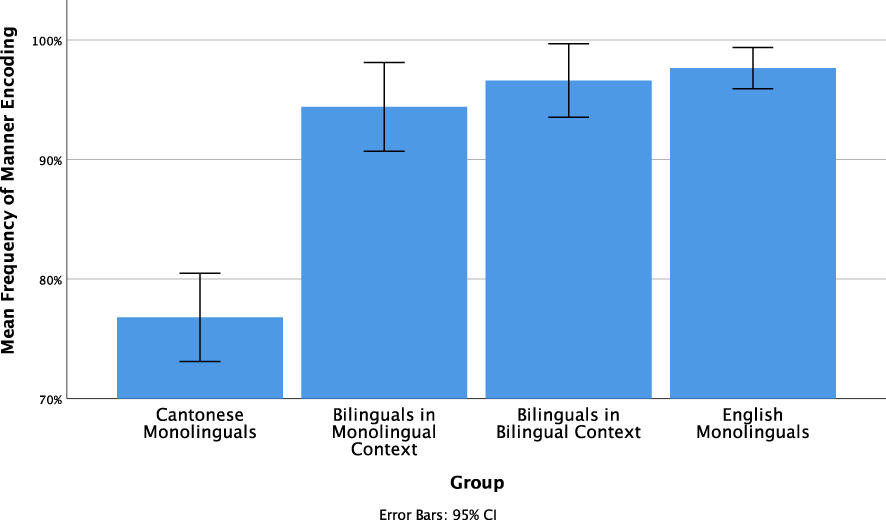
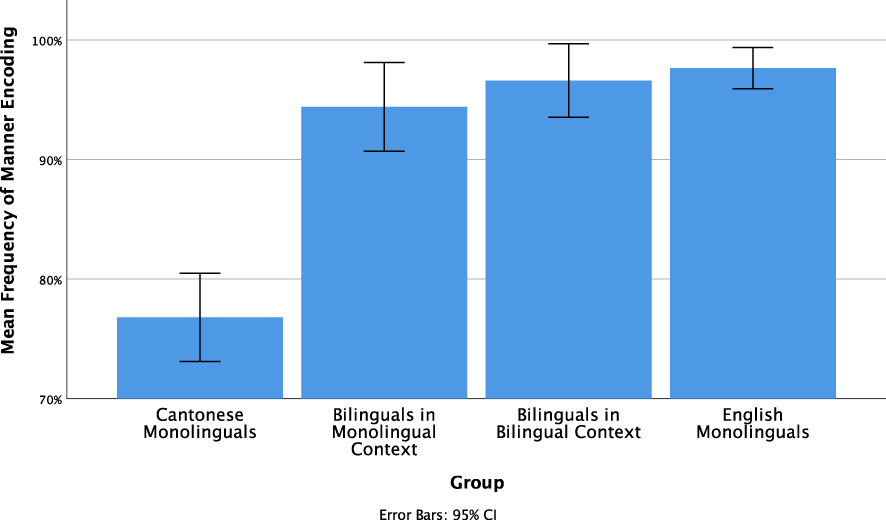
Participants’ linguistic encodings were calculated by the frequency of manner and path selection. Participants’ responses to each stimulus were transformed into percentages and the mean percentage for each group was compared in terms of participant group and language context. Participants of each group presented a high tendency of path encoding, with a ceiling effect across four language groups (Cantonese: M = 96.97%, SD = 6.09%; bilingual in a monolingual context: M = 96.93, SD = 6.02%; bilingual in a bilingual context: M = 97.41%, SD = 4.61%; English: M = 98.11%, SD = 3.71%). However, with regard to manner encoding, bilinguals and English monolinguals encoded manner more often than Cantonese monolinguals (Cantonese: M = 76.70%, SD = 10.52%; bilingual in a monolingual context: M = 94.60%, SD = 6.69%; bilingual in a bilingual context: M = 96.60%, SD = 5.53%; English: M = 97.90%, SD = 4.73%).
To access whether speakers from different groups differed in their likelihood of manner and path encoding, two separate logistic mixed-effect modelsFootnote 1 were built with the lme4 package (Bates, Maechler, Bolker, & Walker, Reference Bates, Maechler, Bolker and Walker2014) in R (R Development Core Team, 2018). Within each model, the binary dependent variable was whether the target semantic element (e.g., manner and path of motion) was encoded (code = 1) or not (code = 0). The fixed effect was participant group (four levels: Cantonese monolinguals vs. bilinguals in a monolingual context vs. bilinguals in a bilingual context vs. English monolinguals). The random effects were random intercepts for participant and item. For path encoding, results showed that the inclusion of group did not significantly increase the model fit compared with the null model (χ2 (3) = 0.63, p = .88), indicating that group was not a main effect. In other words, there is no consistent evidence that participants differed across groups in the likelihood of path encoding.
However, for the frequency of manner encoding, including participant group as the fixed effect significantly optimized the model compared with the null model (χFootnote 2 (3) = 56.4, p < .001), indicating that group was a main effect. Then forward coding was used to compare the likelihood of manner encoding with the next group. As shown in Figure 1, bilinguals in a monolingual context encoded more manner than Cantonese monolinguals (β Cantonese-Bilinguals in monolingual context = –1.79, SE = 0.50, Wald z = –3.57, p < .001), but patterned with bilinguals in a bilingual context (β Bilinguals in monolingual context–Bilinguals in bilingual context = –1.47, SE = 0.75, Wald z = –1.95, p = .1). Meanwhile, no difference between bilinguals in a bilingual context and English monolinguals was detected (β Bilinguals in bilinguals in bilingual context–English monolinguals = –0.23, SE = 0.77, Wald z = –0.30, p = .76). As predicted, Cantonese monolinguals encoded significantly less manner than English monolinguals (β Cantonese-English = –3.51, SE = 0.57, Wald z = –6.11, p < .001). The findings indicated that bilinguals demonstrated a cognitive shift towards L2-based encoding patterns regardless of language context.
Mean percentage of manner encoding across participant group and language context.
7.1.2. Framing strategies of voluntary motion event across different language groups
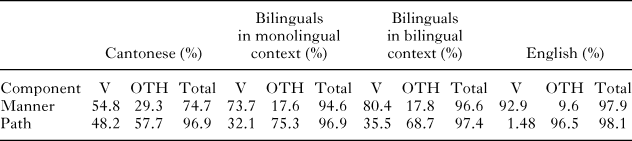
Based on the frequency of manner and path encoding, we further explored the semantic distribution of each component within the utterance (Table 1). Results indicated that, as a typical S-language, English monolinguals encoded manner in the main verb (M = 92.9%, SD = 11.6%), but path in the verb particle (M = 96.5%, SD = 7.1%). As an E-language, Cantonese showed flexibility in the semantic distribution of manner and path. For manner encoding, Cantonese monolinguals encoded manner in either the main verb (M = 54.8%, SD = 16.3%) or outside the verb via a gerund (M = 29.3%, SD = 10.8%). In addition, path was encoded as either directional verbs (M = 48.2%, SD = 14.8%) or satellites (M = 57.7%, SD = 12.1%).
Percentages of semantic distribution of manner/path in verb (V) or outside of it (OHT)

notes: The sum of the first two columns within each language group doesn’t always add up to the total proportion as the manner or path of motion can be double-encoded in V and OTH at the same time (e.g.: The boy is [jumping]verb downstairs [with one leg] OTH).
The semantic distribution of manner and path is in line with the typological status of Cantonese, an equipollent-framed language standing midway on the continuum of S- and V-languages. To take path encoding as an example, it could be encoded either in the main verb as a V-language, or in a satellite as an S-language. Examples are given below in (8), (9), and (10).
A qualitative analysis was conducted regarding the framing strategies of each language. English monolinguals used satellite-framing as the dominant strategy for motion event encoding, whereas verb-framing was hardly used. Examples are given in (6) and (7).
(6) Satellite-framing: A boy is cycling [manner in verb] up [path in satellite] the hill.
(7) Verb-framing: A boy crossed [path in the verb] the road on a skateboard [manner in OTH].
In contrast, in an E-language where path of motion can stand alone as an independent element, Cantonese monolinguals used both satellite- and verb-framing as primary strategies in the linguistic encoding. The example of satellite-framing is illustrated in example (8). There are two sub-types in verb-framing strategies. In the first type, manner of motion is not expressed, as shown in example (9). In the second type, manner of motion is encoded in a gerund, as illustrated in example (10).
(8) Satellite-framing: manner in the verb, path outside
個男仔 係度 鴨仔跳[Manner in verb] 由左至右[Path in the satellite]
a boy there jump from right to left
‘A boy is jumping from left to right.’
(9) Verb-framing (type 1): path in verb without expressing manner of motion
個男仔 入 [Path in verb] 去 間房
a boy entered go (deictic) the room
‘A boy entered the room.’
(10) Verb-framing (type 2): path in verb and manner in a gerund
個男仔 踩住單車 [Manner in the gerund] 落 [Path in verb] 山
a boy cycling dur descend the mountain
‘A boy descended the mountain cycling.’
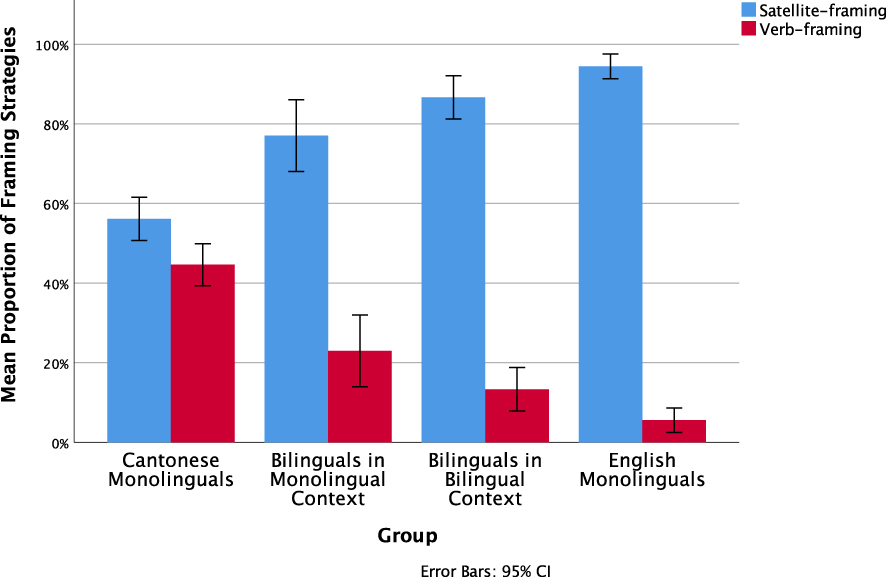
Bilinguals expressed more manner and adopted a predominant satellite-framing strategy compared with Cantonese monolinguals, as illustrated by Figure 2 (Cantonese monolinguals: M = 56.11%, SD = 14.54%; bilinguals in a monolingual context: M = 77.03%, SD = 14.24%; bilinguals in a bilingual context: M = 85.60%, SD = 9.80%; English monolinguals: M = 94.44%, SD = 8.25%). A mixed-effect logistic model2 was fitted with the presence or absence of verb-framing as the binary dependent variable. The fixed effect was group and the random effects were intercepts for participant and item. Results showed that bilinguals in a monolingual context used less verb-framing strategies than Cantonese monolinguals (β Cantonese–Bilinguals in monolingual context = 1.12, SE = 0.31, Wald z = 3.54, p < .001), but patterned with bilinguals in a bilingual context (β Bilinguals in monolingual context–Bilinguals in bilingual context = 1.25, SE = 0.44, Wald z = 2.81, p = .09). Meanwhile, bilinguals in a bilingual context used more verb-framing strategies than English monolinguals (β Bilinguals in bilingual context–English monolinguals = –2.21, SE = 0.86, Wald z = –2.54, p < .01).
Mean percentage of different framing tendencies (satellite-framing and verb-framing) across participant group and language context.

7.2. similarity judgement of motion event
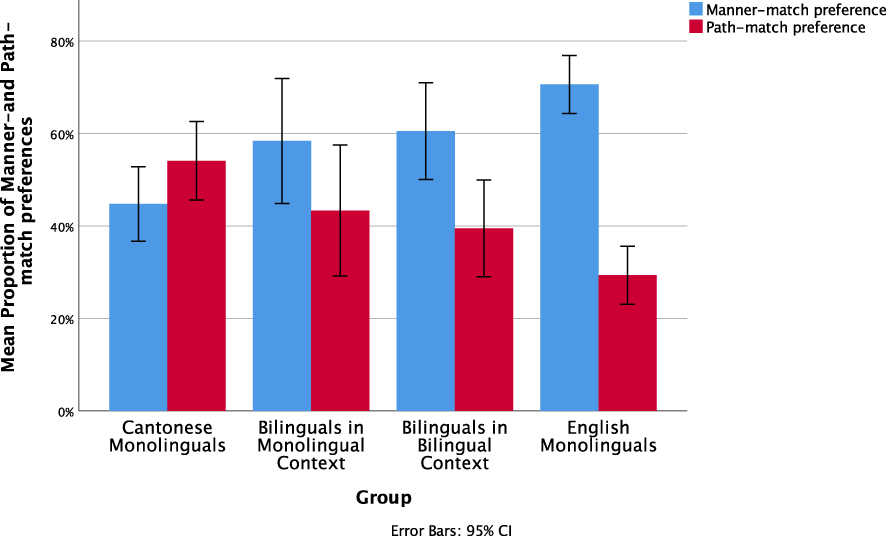
Regarding participants’ manner- or path-match preferences in a subsequent categorization task (Figure 3), English monolinguals (M = 70.63%, SD = 16.81%) and bilinguals in different language contexts (M = 58.87%, SD = 24.52% for monolingual context and M = 60.53%, SD = 18.87% for bilingual context) had a manner-match preference compared with Cantonese monolinguals (M = 44.80%, SD = 21.49%). A mixed-effect logistic modelFootnote 3 was fitted with participants’ manner-match preferences as a binary dependent variable. The fixed effect was participant group. The random effects were crossed-random intercepts for participant and item. Involving participant group as the fixed-effect significantly optimized the model (χ2 (3) = 21.55, p < .001) compared with the null model, indicating that group is a main effect in participants’ similarity judgements. The lack of significance in overall intercept (β0 = 0.64, SE = 0.36, Wald z = 1.77, p = .07) indicated that participants across language groups did not have an overall preference for either manner- or path-match alternates. Forward difference coding was then given to compare the likelihood of manner-match selection in this group with the next group. Results confirmed that bilinguals in a monolingual context preferred more manner-match alternates than Cantonese monolinguals (β Cantonese-Bilinguals in monolingual context = –0.88, SE = 0.34, Wald z = –2.59, p = .03), but patterned with bilinguals in a bilingual context (β Bilinguals in monolingual context–Bilinguals in bilingual context = –0.07, SE = 0.39, Wald z = –0.19, p = .84). Meanwhile, no difference was found between bilinguals in a bilingual context and English monolinguals (β Bilinguals in bilinguals in bilingual context–English monolinguals = –0.36, SE = 0.34, Wald z = –1.05, p = .60). As expected, Cantonese monolinguals selected less manner-match alternates than English monolinguals (β Cantonese-English = –1.31, SE = 0.28, Wald z = –4.67, p < .001). The findings suggested that bilinguals showed a cognitive shift towards L2-based categorization patterns regardless of the language context.
Mean percentage of manner/path preferences across participant group and language context.

7.3. factors predictive of bilinguals’ motion event lexicalization and categorization
We further explored to what extent language contact was associated with bilinguals’ performance, and whether language contact and language context interact with each other. Following Athanasopoulos (Reference Athanasopoulos2009), language contact is defined as the amount of use bilingual speakers have with each language and is measured by participants’ self-reported scores. The daily amount of language use was converted into percentage scores. As the proportion of English and Cantonese use was added up to 1, we used the former as the explanatory variable. Two separate logistic mixed effect models were built with frequency of manner encoding, and manner-match preferences as separate binary dependent variables. The random effects were random intercepts for participant and item. The main effects were language context and the amount of English use. As the interaction of these two factors was not statistically significant, and including the interaction did not significantly optimize the model (χ2 (1) = 1.334, p = .248 for manner encoding in lexicalization; χ2 (1) = 0.781, p = .376 for manner-match preferences in categorization), the final modelsFootnote 4,Footnote 5 included the main effects only. As shown in Tables 2 and 3, only language contact was significantly correlated with bilinguals’ frequency of manner encoding and manner-match preferences.
Fixed effects on the probability of manner encoding in event lexicalization

notes: The intercept represents the predicted probability of manner verb encoding (log-odds) when language context is bilingual and the frequency of English use is 0.
Fixed effects on the probability of manner-match preferences in event categorization

notes: The intercept represents the predicted probability of manner-match preference (log-odds) when language context is bilingual and the frequency of English use is 0.
8. General discussion
The current study investigated whether language utilized at the time of speaking had a ‘thinking-for-speaking’ effect on subsequent categorization. We tested early Cantonese–English bilinguals in both a monolingual and a bilingual context to explore whether recent L2 activation had immediate consequences for categorization behaviour. To establish a baseline, we first asked how monolinguals of each language lexicalize and conceptualize voluntary motion using a similarity judgement task with verbal encoding. The results provided clear evidence that in a typical S-language (satellite-framed), English monolinguals reached a ceiling level in manner encoding and had a manner-match preference in categorization. Cantonese monolinguals, on the other hand, demonstrated a lower frequency of manner encoding and a lower level of manner-match preferences in categorization. These differences can be attributed to the typological status of English and Cantonese. Due to the availability of path verbs in Cantonese, manner of motion can be easily added or dropped in descriptions. This allows Cantonese monolinguals to choose from different framing strategies with varying degrees of manner salience. Although English has a set of path verbs (ascend, descend), most of them are Latinate borrowings and less colloquial in style. Thus, path verbs in English are seldom used in oral expressions (Slobin, Reference Slobin, Gumperz and Levinson1996a). Thus, the frequency of manner encoding in Cantonese is lower than in English. The current findings lend support to the manner salience hypothesis (Slobin, Reference Slobin, Strömqvist and Verhoeven2004) that cross-linguistic differences in motion event encoding are only detected in the likelihood of manner selection. And the codability of manner in lexicalization is associated with the accessibility of this information in cognition.
The cross-linguistic differences observed in categorization echoed previous findings that participants’ lexicalization patterns are predictive of their conceptual preferences when access to language is not blocked in the decision-making process (Gennari et al., Reference Gennari, Sloman, Malt and Fitch2002; Montero-Melis & Bylund, Reference Montero-Melis and Bylund2017; Papafragou & Selimis, Reference Papafragou and Selimis2010; Soroli & Hickmann, Reference Soroli, Hickmann, Marotta, Lenci, Meini and Rovai2010). One possible explanation for this is that, when participants are asked to do a categorization task that lacks a correct answer, they might depend on all available resources, including recent linguistic experience, to solve the task. In this case, as proposed by the ‘thinking-for-speaking’ and ‘thinking-with-language’ accounts, the involvement of language as a strategy for categorical perception exhibits language-specific features (Lupyan, Reference Lupyan2012; Slobin, Reference Slobin, Gumperz and Levinson1996a; Wolff & Holmes, Reference Wolff and Holmes2011). Therefore, the different weight or salience that speakers attach to each semantic element in the linguistic encoding tends to trigger a language-specific way of thinking during similarity judgements.
The second research question examined how bilinguals in different language contexts lexicalized and conceptualized motion events compared with the monolingual baseline. Bilinguals’ responses in a monolingual and a bilingual context were compared. The results suggested that, on the one hand, bilinguals’ overall performances were significantly different from those of Cantonese monolinguals but patterned with English monolinguals in manner encoding and manner-match selection. On the other hand, bilinguals’ performances patterned with each other, irrespective of the language context. Their attested behaviours indicated a cognitive shift towards English-based conceptualization patterns. Qualitative analysis of the linguistic encoding further indicated that bilinguals chose to use more manner verbs with finer details and opted for fewer verb-framing strategies compared with Cantonese monolinguals. Thus, the higher manner of salience in linguistic encoding modulated speakers’ reliance on this component in subsequent similarity judgements. Similar results were reported in previous findings, in that language-specific labels tend to modulate categorization when a certain linguistic element is made salient during or prior to event categorization (Kersten et al., Reference Kersten, Meissner, Lechuga, Schwartz, Albrechtsen and Iglesias2010; Lupyan, Reference Lupyan2012; Montero-Melis et al., Reference Montero-Melis, Jaeger and Bylund2016). Furthermore, it suggests that the active learning and using of two languages in daily life gives rise to readjustment of the original categories developed in the L1 and provides positive evidence for cognitive restructuring (Jarvis & Pavlenko, Reference Jarvis and Pavlenko2008).
However, we did not detect any effect of recent L2-activation on event lexicalization or categorization. There are two reasons that may account for these results. One possible explanation is that, for early bilinguals, it may be more efficient to rely on a common linguistic framework that works well for two languages. According to Talmy (Reference Talmy2000), the most typical way of expressing a voluntary motion in English is to encode manner in the main verb, whereas a path particle cannot stand alone as an independent element; therefore path is encoded in the satellite. For example, sentence like ‘A boy up the hill’ is regarded as ungrammatical in English. Although there is a set of path verbs in English, they are rarely used in daily communication (Slobin, Reference Slobin, Gumperz and Levinson1996a). However, in Cantonese, as path verbs can be used independently, the encoding of manner is optional and depends on whether speakers opt for it or not. For example, descriptions like ‘A boy ascends the hill’ and ‘A boy walks up a hill’ in Cantonese are grammatically correct and frequently used in daily communication. Given the different linguistic patterns available in Cantonese but not in English, it may be more efficient for early bilinguals to draw on a single linguistic pattern which is workable in both languages and generalizable to a wide range of communication contexts.
In addition, previous findings have shown that language-specific concepts are established in early childhood (Hickmann & Hendriks, Reference Hickmann and Hendriks2006; Ji & Hohenstein, Reference Ji and Hohenstein2018). Early exposure to a second language may enable bilinguals to be more sensitive to the typical patterns of both languages. In the current case, both Cantonese and English are official languages in Hong Kong. Participants usually acquire an L2 at an average age of three and use both languages actively at school and in daily interactions. Thus, early exposure to and active use of two languages may lead to a convergence of different conceptual categories, which will not be affected by short-term linguistic manipulations. Similar findings are reported for other cognitive processes such as classification (Kersten et al., Reference Kersten, Meissner, Lechuga, Schwartz, Albrechtsen and Iglesias2010; Lai et al., Reference Lai, Rodriguez and Narasimhan2014) and memory recognition (Filipović, Reference Filipović2011). For example, Lai et al. (Reference Lai, Rodriguez and Narasimhan2014) reported that early English–Spanish bilinguals patterned with L2-Spanish in event categorization, regardless of the language in use. It is suggested that the effects of speaking on thinking are not limited to the languages in immediate operation, but also applicable to a common pattern of ‘thinking-for-speaking’ developed through a whole lifetime’s experience. Similar results were reported by Filipović (Reference Filipović2011), who found that early English–Spanish bilinguals demonstrated an L2-based conceptualization pattern irrespective of the test language. It was suggested that bilinguals tended to opt for a ‘whatever-works-in-both’ approach in cognitive processing in terms of processing the costs and benefits. Filipović concluded that “bilinguals do not seem to have two separate processing systems but rather an intertwined use of the two” (2011, p. 481).
We are aware that not all studies have reported similar results. For example, Berthele and Stocker (Reference Berthele and Stocker2017) examined the influence of language mode on event lexicalization with German–French bilinguals. The results showed that participants in bilingual mode were more likely to converge towards a French pattern when both languages were kept active. One possible reason for this discrepancy may be attributed to the typological status of the languages under investigation. In fact, the extent of discrepancies between English and Cantonese (and in general, between S- and E-languages) is not as clear-cut as that between S-languages and V-languages in terms of manner salience. Strictly speaking, learning L2-English is more about the activation of an already existing pattern in Cantonese rather than the internalization of a brand-new linguistic frame. In this view, the partial overlap between Cantonese and English reinforces the degree of convergence between these two languages compared with other language pairs under investigation.
The final research question further examined whether language contact was predictive of early bilinguals’ performance. The results suggested that the amount of language contact with English per day was positively associated with their language-specific performance. Thus, the more frequently English was used in daily communication, the more likely was the speaker to encode manner information in lexicalization and to present manner-match preferences in event categorization. Similar findings have been reported by previous studies that language contact plays an important role in cognitive restructuring. That is, the more frequently learners use an L2, the more likely are their cognitive behaviours to shift away from the L1 and pattern with the target language (Bylund & Athanasopoulos, Reference Bylund and Athanasopoulos2014a, Reference Bylund and Athanasopoulos2015; Daller et al., Reference Daller, Treffers-Daller and Furman2011). The findings suggest that frequent exposure to and active use of an L2 presents learners with sufficient instances of language-specific patterns. For instance, with sufficient exposure, bilinguals may understand that English attaches great importance to manner in linguistic encoding. The reinforcement of language-specific encoding patterns may strengthen the associations with conceptual representations (Bylund & Athanasopoulos, Reference Bylund and Athanasopoulos2014a; Jarvis, Reference Jarvis2011). Consequently, participants who used English more frequently tend to exhibit categorization preferences based on manner variants.
9. Limitations and conclusion
One limitation of this study is the use of a triads-matching task in event categorization. Although the triads-matching paradigm has been extensively used as a classical measure of participants’ preferences and successfully implemented in different cognitive domains (Bylund & Athanasopoulos, Reference Bylund and Athanasopoulos2014b; Ji & Hohenstein, Reference Ji and Hohenstein2018; Park, Reference Park2019), a shortcoming of the design is that, to some extent, it confounds path preference with manner preference. That is, this paradigm assumes that a higher proportion of manner preference is equivalent to a lower proportion of path preference. Therefore, recent studies suggest that it is necessary to adequately tease out manner and path preferences when addressing motion-event cognition (Kersten et al., Reference Kersten, Meissner, Lechuga, Schwartz, Albrechtsen and Iglesias2010; Montero-Melis & Bylund, Reference Montero-Melis and Bylund2017).
In conclusion, the current study has sought to investigate whether early Cantonese–English bilinguals behaved differently from monolinguals in each language when lexicalizing and categorizing voluntary motion based on different language contexts. The results showed that early bilinguals patterned with English monolinguals in both event lexicalization and categorization, regardless of the language context. The findings indicated that long-term L2-learning experience restructured L1-specific conceptual categories towards a convergent mode of ‘thinking-for-speaking’. And the degree of cognitive restructuring was modulated by the amount of contact with each language. The current study contributes to the literature in two ways. First, it demonstrates that cross-linguistic differences in lexicalization can go beyond the linguistic domain and modulate cognitive representations when participants are involved in the process of ‘thinking-for-speaking’. And second, the effects of language on mental representations are context-bound and open to change due to variations in learners’ language-learning history.
Appendix A
A full list of 36 test stimuli in linguistic encoding and similarity judgements

Appendix B
A demonstration of the video stimuli used in the similarity judgement task (Item 1)