Reason is, and ought always to be, the slave of the passions.
—David Hume, A Treatise of Human Nature (Reference Hume1739)
The idea that goals can function as autonomous agents, and that conscious and controlled processes are often merely along for the ride, is a thought-provoking one, with some honored historical antecedents. In his 1739 A Treatise of Human Nature, David Hume penned his famous line about reason being the slave of the passions, and in 1986 Marvin Minsky argued along similar lines in his The Society of Mind. Critically, though, Minsky also postulated hierarchical organization of control. Goals are not just arbitrarily activated by situational ephemera willy-nilly, but are more likely to be activated according to an evolved system of goal priorities. Being primed with words connoting “elderly” might make us walk down the hall a little slower, but if we suddenly had to run from a hatchet wielding madman, we suspect that the running would be just as fast. Avoiding murder is a mandatory goal, whereas other goals, such as egalitarianism or the avoidance of age-discrimination, are optional luxuries, emerging only when more basic goals are satisfied.
We have argued, based on considerations of evolutionary life history, that goals can be organized into a natural taxonomy (e.g., Kenrick et al. Reference Kenrick, Griskevicius, Neuberg and Schaller2010). Fundamental biological and social goals dominate many more ephemeral or easily delayed goals, which can only be selfish when the big players are quiet. Goals like self-protection, social affiliation, and mating are prioritized and can seize control of our behavior even when we are consciously trying to pursue a different task. These goals reflect fundamental motivational systems, which can be conceptualized in terms of Martindale's (Reference Martindale and Wheeler1980) notion of “subselves” – sets of subprograms for dealing with general categories of adaptive problems. This view entails a critical role for environmental inputs. Certain stimuli elicit stronger reactions than others, because they have more significant and/or consistent consequences in the ancestral (or developmental) past. Cognitive systems have thus evolved (or are biologically prepared to learn) a vigilance for stimuli relevant to fundamental goals. Neither the stimuli nor the goals exist in isolation; the psychological system has coevolved with features of the ecology.
By thinking in terms of a hierarchy of evolved, stimulus-specific goals, predictions can begin to address: (1) how goal priorities shift in real-world tasks (which vary systematically with developmental stage and/or ecological threats and opportunities), and (2) how these goals reconfigure cognitive processing to achieve their aims.
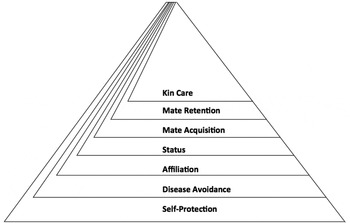
Haung & Bargh (H&B) are quite right to emphasize the automaticity of such goals, and their ability to override more controlled processes, but evolutionary theory suggests a pecking order. I might enter the room looking for a colleague, but the presence of a highly attractive person or someone who appears unstable and dangerous will reliably divert my attention from this goal. Of course, we should not expect that a single hierarchy exists for all people at all times. Even within a person, goals shift with time – standing up to an aggressor to impress a potential mate might characterize a man's modus operandi when young and single, but not at all a few years later when he has a family. On this view, different motivational systems have a natural developmental hierarchy, as depicted in Figure 1. Following Maslow's scheme, motives lower in the pyramid unfold earlier in life and also take priority over higher goals later in life.
Figure 1.
A hierarchy of fundamental goals. Following Maslow's classic scheme, those lower in the pyramid are presumed to develop earlier in life, and, at a proximate level, to take priority over those higher up. Following evolutionary life history considerations, the lower goals are linked to somatic effort, followed by mating effort, and finally parenting effort (see Kenrick et al. Reference Kenrick, Griskevicius, Neuberg and Schaller2010).
It is the fundamental social goals that will be more likely to reconfigure cognitive processing, doing so in ways that are functionally tuned to the outcomes they seek. Although people typically remember others of the same race better than racial out-group members, for example, that pattern is reversed when people's self-protective goals have been activated (Becker et al. Reference Becker, Anderson, Neuberg, Maner, Shapiro, Ackerman, Schaller and Kenrick2010). Furthermore, although activating self-protective goals leads to better memory for out-group men, it does so without an increase in overt visual attention to those men, because people pursuing a self-protective goal need to encode potential threats without staring at those threatening individuals, lest they invite the very peril they strive to avoid. On the other hand, proximate disease threats lead to the opposite disjunction of attention and memory: we find it difficult to look away from people whose faces appear to have disease symptoms, but this does not translate to greater memory for those people (Ackerman et al. Reference Ackerman, Becker, Mortensen, Sasaki, Neuberg and Kenrick2009).
In both of these studies, fundamental goals appeared to channel more cognitive effort into one process versus another, but goals might also more generally boost or undermine accuracy by liberating more cognitive resources. For example, we found that activating the goal of self-protection with a guided visualization enhanced people's accuracy at detecting enemies (Becker et al. Reference Becker, Mortensen, Ackerman, Shapiro, Anderson, Sasaki, Maner, Neuberg and Kenrick2011). In contrast, activating the goal of revenge/anger (absent self-protection goals) undermined accuracy in favor of a bias to identify slightly angry or foreign-looking faces as enemies. This suggests that fear liberates more cognitive resources than anger, sensitizing perception to maximize the benefits of detecting threats while minimizing the costs of false alarms when no threat is present. One of the most basic findings in social cognition is that people are miserly with their cognitive resources, and the studies above suggest that people may instinctively be saving these resources for occasions when more fundamental goals arise.
In conclusion, selfish goals are a good start, but it is critical to consider how different goals are organized into an adaptive system. The society of mind is just that – a society – it is not a Hobbesian state of nature with all goals being brutish and short with one another. We instead propose a hereditary oligarchy, a hierarchy of fundamental goals that work together to maximize reproductive fitness across highly variable environments.





Reason is, and ought always to be, the slave of the passions.
—David Hume, A Treatise of Human Nature (Reference Hume1739)The idea that goals can function as autonomous agents, and that conscious and controlled processes are often merely along for the ride, is a thought-provoking one, with some honored historical antecedents. In his 1739 A Treatise of Human Nature, David Hume penned his famous line about reason being the slave of the passions, and in 1986 Marvin Minsky argued along similar lines in his The Society of Mind. Critically, though, Minsky also postulated hierarchical organization of control. Goals are not just arbitrarily activated by situational ephemera willy-nilly, but are more likely to be activated according to an evolved system of goal priorities. Being primed with words connoting “elderly” might make us walk down the hall a little slower, but if we suddenly had to run from a hatchet wielding madman, we suspect that the running would be just as fast. Avoiding murder is a mandatory goal, whereas other goals, such as egalitarianism or the avoidance of age-discrimination, are optional luxuries, emerging only when more basic goals are satisfied.
We have argued, based on considerations of evolutionary life history, that goals can be organized into a natural taxonomy (e.g., Kenrick et al. Reference Kenrick, Griskevicius, Neuberg and Schaller2010). Fundamental biological and social goals dominate many more ephemeral or easily delayed goals, which can only be selfish when the big players are quiet. Goals like self-protection, social affiliation, and mating are prioritized and can seize control of our behavior even when we are consciously trying to pursue a different task. These goals reflect fundamental motivational systems, which can be conceptualized in terms of Martindale's (Reference Martindale and Wheeler1980) notion of “subselves” – sets of subprograms for dealing with general categories of adaptive problems. This view entails a critical role for environmental inputs. Certain stimuli elicit stronger reactions than others, because they have more significant and/or consistent consequences in the ancestral (or developmental) past. Cognitive systems have thus evolved (or are biologically prepared to learn) a vigilance for stimuli relevant to fundamental goals. Neither the stimuli nor the goals exist in isolation; the psychological system has coevolved with features of the ecology.
By thinking in terms of a hierarchy of evolved, stimulus-specific goals, predictions can begin to address: (1) how goal priorities shift in real-world tasks (which vary systematically with developmental stage and/or ecological threats and opportunities), and (2) how these goals reconfigure cognitive processing to achieve their aims.
Haung & Bargh (H&B) are quite right to emphasize the automaticity of such goals, and their ability to override more controlled processes, but evolutionary theory suggests a pecking order. I might enter the room looking for a colleague, but the presence of a highly attractive person or someone who appears unstable and dangerous will reliably divert my attention from this goal. Of course, we should not expect that a single hierarchy exists for all people at all times. Even within a person, goals shift with time – standing up to an aggressor to impress a potential mate might characterize a man's modus operandi when young and single, but not at all a few years later when he has a family. On this view, different motivational systems have a natural developmental hierarchy, as depicted in Figure 1. Following Maslow's scheme, motives lower in the pyramid unfold earlier in life and also take priority over higher goals later in life.
A hierarchy of fundamental goals. Following Maslow's classic scheme, those lower in the pyramid are presumed to develop earlier in life, and, at a proximate level, to take priority over those higher up. Following evolutionary life history considerations, the lower goals are linked to somatic effort, followed by mating effort, and finally parenting effort (see Kenrick et al. Reference Kenrick, Griskevicius, Neuberg and Schaller2010).
It is the fundamental social goals that will be more likely to reconfigure cognitive processing, doing so in ways that are functionally tuned to the outcomes they seek. Although people typically remember others of the same race better than racial out-group members, for example, that pattern is reversed when people's self-protective goals have been activated (Becker et al. Reference Becker, Anderson, Neuberg, Maner, Shapiro, Ackerman, Schaller and Kenrick2010). Furthermore, although activating self-protective goals leads to better memory for out-group men, it does so without an increase in overt visual attention to those men, because people pursuing a self-protective goal need to encode potential threats without staring at those threatening individuals, lest they invite the very peril they strive to avoid. On the other hand, proximate disease threats lead to the opposite disjunction of attention and memory: we find it difficult to look away from people whose faces appear to have disease symptoms, but this does not translate to greater memory for those people (Ackerman et al. Reference Ackerman, Becker, Mortensen, Sasaki, Neuberg and Kenrick2009).
In both of these studies, fundamental goals appeared to channel more cognitive effort into one process versus another, but goals might also more generally boost or undermine accuracy by liberating more cognitive resources. For example, we found that activating the goal of self-protection with a guided visualization enhanced people's accuracy at detecting enemies (Becker et al. Reference Becker, Mortensen, Ackerman, Shapiro, Anderson, Sasaki, Maner, Neuberg and Kenrick2011). In contrast, activating the goal of revenge/anger (absent self-protection goals) undermined accuracy in favor of a bias to identify slightly angry or foreign-looking faces as enemies. This suggests that fear liberates more cognitive resources than anger, sensitizing perception to maximize the benefits of detecting threats while minimizing the costs of false alarms when no threat is present. One of the most basic findings in social cognition is that people are miserly with their cognitive resources, and the studies above suggest that people may instinctively be saving these resources for occasions when more fundamental goals arise.
In conclusion, selfish goals are a good start, but it is critical to consider how different goals are organized into an adaptive system. The society of mind is just that – a society – it is not a Hobbesian state of nature with all goals being brutish and short with one another. We instead propose a hereditary oligarchy, a hierarchy of fundamental goals that work together to maximize reproductive fitness across highly variable environments.