Introduction
The Great East Japan Earthquake of March 11, 2011 involved not only a magnitude (M) 9 earthquake, but it also triggered a massive tsunami, causing widespread devastation and leaving approximately 18,500 people dead or missing. 1 Over 90% of deaths were by drowning in the tsunami. 2
Large-scale earthquake disasters that have occurred globally since 2000 include: the Indian Ocean Earthquake (December 26, 2004), a M 9.1 earthquake off the coast of Sumatra with a death toll of approximately 286,000 people, of which, at least 283,000 were due to the related tsunami;Reference Lay, Kanamori and Ammon 3 the Sichuan Earthquake (March 12, 2008), a M 8 earthquake in the Sichuan region of China with a death toll of at least 69,000 people, of which, at least 60,000 were due to being trapped under collapsed buildings;Reference Chen, Lai and Liu 4 and the Haiti Earthquake (January 12, 2010), a M 7 earthquake in the Republic of Haiti with a death toll of 10,000-31,600 people, the majority of which were also due to being trapped under collapsed buildings.Reference Watts 5 As compared with these disasters, the characteristics of the Great East Japan Earthquake were that it occurred during winter in a cold region and was accompanied with extensive tsunami damage.
During disasters such as earthquakes, the increase in the number of sick and injured is accompanied by a decrease in the ability and capacity of patient care from medical institutions, making it difficult to maintain normal levels of medical care. In such circumstances, preventable disaster death (PDD) may arise; however, this concept, and its related definitions, are vague. Although PDD reportedly occurred during Hurricane Sandy (2012), 6 no detailed field surveys or verification reports of PDD during earthquakes and other large-scale disasters affecting wide areas have been conducted to date, and details of PDD during the Great East Japan Earthquake also remain to be clarified.Reference Nishiyama 7 Verifying PDD during the Great East Japan Earthquake is extremely important for improving disaster medical systems. The present study investigated PDD at medical institutions in areas affected by the Great East Japan Earthquake in order to improve disaster medical systems.
Methods
In the present study, PDD was defined as “deaths occurring during a disaster that would have been preventable under normal regional and hospital environmental conditions and medical systems.”
In 2012, the authors of this study conducted a preliminary study to lay the groundwork for a field survey of PDD in Miyagi Prefecture (Japan). A questionnaire survey regarding the number of in-hospital patient deaths between March 11, 2011 and April 1, 2011 was conducted on all 147 hospitals in Miyagi Prefecture. Responses were obtained from 121 hospitals (collection rate=82.3%),Reference Yamanouchi 8 with 1,380 in-hospital patient deaths reportedly occurring during this period. In order to assess the incidence of PDD at medical institutions in Miyagi Prefecture, the present study investigated the 25 hospitals that were disaster base hospitals (DBHs), or had at least 20 patient deaths, among those that responded. Disaster base hospitals are hospitals that are equipped to take a central role in regional medical activities at the time of a disaster, such as accepting and transporting seriously sick and injured patients within the disaster area, and from dispatching medical teams. 9 Designations have been occurring in Miyagi Prefecture since 1997, with 14 designated DBHs in the prefecture at the time of the Great East Japan Earthquake.
Medical record information for all patient deaths at the 25 hospitals between March 11, 2011 and April 1, 2011 (n=868, 62.9% of the total in-hospital patient deaths in Miyagi Prefecture) was obtained during on-site surveys conducted by the authors (SY and HS) and input into a database. Participating hospitals were classified as “coastal” or “inland” based on their location and the tsunami inundation area (Figure 1). Database items comprised: sex; age; inpatient or outpatient death; date of hospitalization (inpatient deaths) or date of outpatient visits (outpatient deaths); date and time of death; diagnosis on initial examination; diagnosis at death; course from hospitalization to death; relationship between cause of death and disaster; whether the case was PDD; and, if so, the cause of PDD. Regarding the relationship between cause of death and the disaster, cases were classified as “related,” “potentially related,” or “unrelated.” The total number of related and potentially related deaths was defined as the number of disaster-related deaths (DRD). In order to evaluate the incidence of PDD, cases were classified as “PDD,” “high possibility of PDD,” “cannot rule out PDD,” or “not PDD.” The “PDD” and “high possibility of PDD” cases were totaled to provide the overall number of PDD cases. Inclusion in the database as DRD and PDD was determined on discussion with two disaster health care professionals responsible for the hospital surveys.
Location of Participating Hospitals in the Miyagi Prefecture Tsunami Inundation Area. Hospitals participating in the present study were classified as either coastal or inland based on their positional relationship with the tsunami inundation area. They were further classified as DBHs or GHs based on their hospital function at the time of the disaster. Abbreviations: DBHs, disaster base hospitals; GHs, general hospitals

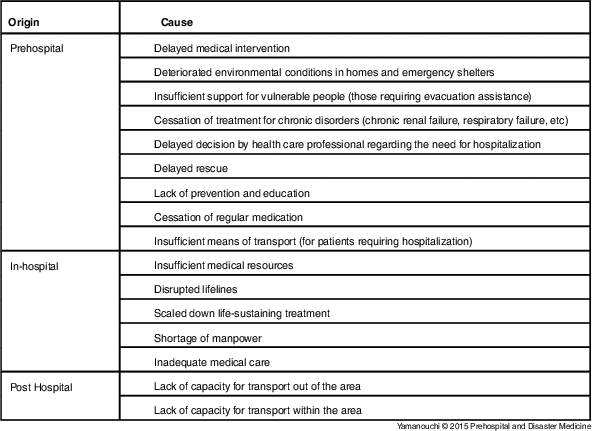
Final determination of DRD and PDD classification was based on the created database after further discussion with 10 disaster health care professionals. Preventable disaster death cases were further classified based on origin of cause of PDD (prehospital, in-hospital, or post hospital) and by cause (Table 1).
Causes of Preventable Disaster Death

The present study was approved by the Ethics Committees of the Tohoku University School of Medicine (Sendai, Japan) and each participating hospital. Inter-group comparisons were performed using Fisher’s exact test. Statistical analysis was performed using GraphPad Prism 6.0e (GraphPad Software; San Diego, California USA) with the level of significance at P<.05.
Results
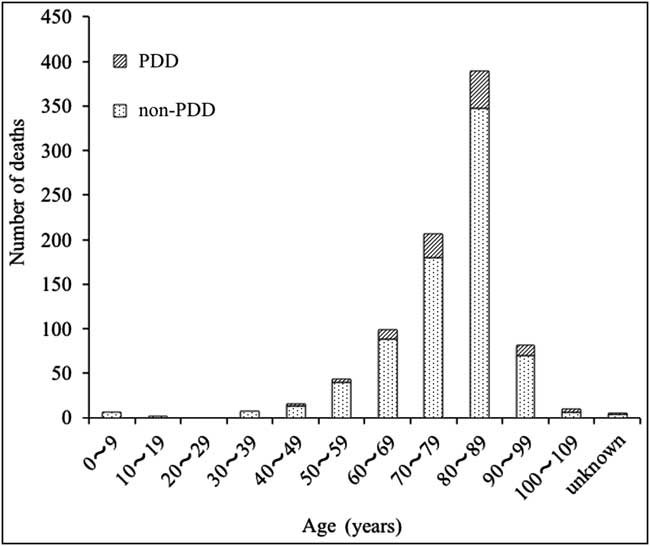
The 868 patient deaths at participating hospitals included 456 men, 411 women, and one patient of undetermined sex. Age composition was as follows for overall patient deaths and PDD cases, respectively: median age (inter-quartile range)=81 (73-87) years and 81 (75-87) years; peak age group=80-89 years (n=389, 45.1%) and 80-89 years (n=42, 41.6%); age≥60 years, 787 (91.2%) and 95 (94.1%); age≥70 years, 688 (79.7%) and 85 (84.2%); and age≥80 years, 481 (55.7%) and 58 (57.4%; Figure 2).
Age Distribution of Patient Deaths and PDD Cases. Histogram showing patient deaths at participating hospitals by 10-year age groups. A similar trend was observed for both overall in-hospital patient deaths and PDD cases, with 80-90 years constituting the peak age group for both. Abbreviation: PDD, preventable disaster death.

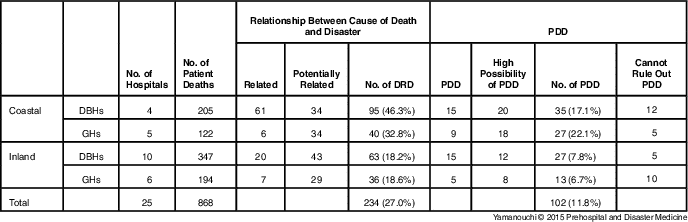
Table 2 presents the numbers of patient deaths, DRD and PDD by type of medical institution (inland, coastal, DBHs, or general hospitals (GHs)). Of the 868 patient deaths, 102 (11.8%) were determined to be PDD.
Numbers of DRD and PDD by Type of Medical Institution

Abbreviations: DBH, disaster base hospital; DRD, disaster-related death; GH, general hospital; PDD, preventable disaster death.
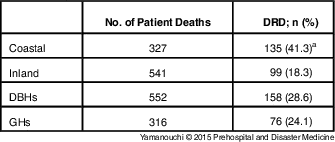
Disaster-related Deaths by Type of Medical Institution
Analysis of the relationship between type of medical institution and DRD showed a significantly higher rate of DRD at coastal hospitals compared to inland hospitals (135/327, 41.3% vs 99/541, 18.3%; P<.01). No difference was observed in DRD incidence between DBHs and GHs (Table 3).
DRD by Type of Medical Institution

Abbreviations: DBHs, disaster base hospitals; DRD, disaster-related death; GHs, general hospitals.
aP<.01 vs inland hospitals.
Preventable Disaster Death by Type of Medical Institution
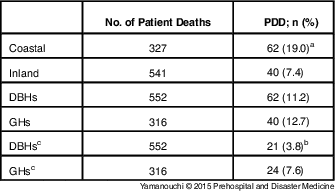
Analysis of the relationship between type of medical institution and PDD showed a significantly higher rate of PDD at coastal hospitals compared to inland hospitals (62/327, 19.0% vs 40/541, 7.4%; P<.01). No difference was observed in overall PDD incidence between DBHs and GHs. However, when analysis was limited to cases with an in-hospital cause of PDD, the rate of PDD was significantly higher at GHs than DBHs (24/316, 7.6% vs 21/552, 3.8%; P<.05; Table 4).
PDD by Type of Medical Institution

Abbreviations: DBHs, disaster base hospitals; GHs, general hospitals; PDD, preventable disaster death.
aP<.01 vs inland.
bP<.5 vs general hospitals.
cAnalysis limited to cases with an in-hospital cause of PDD.
Timing of Hospitalization (Outpatient Visits) in Preventable Disaster Death Cases
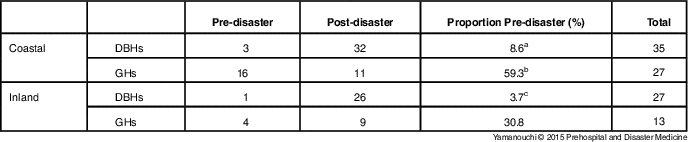
At DBHs, post-disaster hospitalization was prevalent at both coastal and inland DBHs (32/35, 91.4% and 26/27, 96.3%, respectively). Meanwhile, compared to DBHs, a higher proportion of cases at GHs involved pre-disaster hospitalization (coastal, 16/27, 59.3%; inland, 4/13, 30.8%; Table 5).
Timing of Hospitalization (Outpatient Visits) in PDD Cases

Abbreviations: DBHs, disaster base hospitals; GHs, general hospitals; PDD, preventable disaster death.
aP<.01 vs coastal, GHs.
bP<.01 vs inland, DBHs.
cP<.05 vs inland, GHs.
Origin of Cause of Preventable Disaster Death
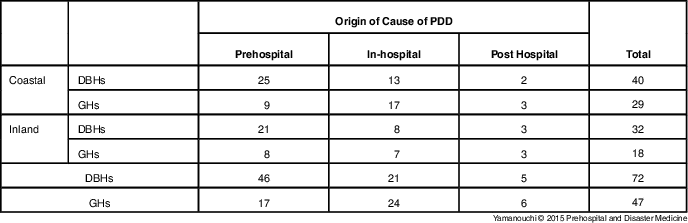
At DBHs, the cause of PDD originated prehospital (46/72, 63.9%) in the majority of cases. In GHs, the cause of PDD originated in-hospital (47/24, 51.1%) in the majority of cases. In-hospital causes of PDD were most common at coastal GHs (17/29, 58.6%; Table 6).
Origin of Cause of PDD (Some Overlap)

Abbreviations: DBHs, disaster base hospitals; GHs, general hospitals; PDD, preventable disaster death.
Causes of Preventable Disaster Death
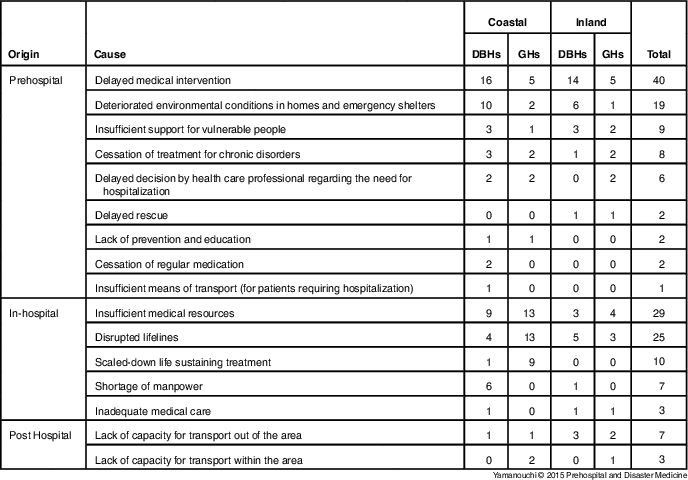
The main causes of prehospital PDD were delayed medical intervention and deteriorated environmental conditions in homes and emergency shelters. The main causes of in-hospital PDD were insufficient medical resources and disrupted lifelines. The main cause of post-hospital PDD was lack of capacity for transport out of the area.
By area, the most common causes of PDD comprised delayed medical intervention, insufficient medical resources, disrupted lifelines, deteriorated environmental conditions in homes and emergency shelters at coastal hospitals, and delayed medical intervention at inland hospitals.
By type of medical institution, the most common causes of PDD at DBHs were delayed medical intervention and deteriorated environmental conditions in homes and emergency shelters. Conversely, causes at GHs included insufficient medical resources and disrupted lifelines (Table 7).
Causes of PDD (Some Overlap)

Abbreviations: DBHs, disaster base hospitals; GHs, general hospitals; PDD, preventable disaster death.
Discussion
According to data from the Ministry of Health, Labour, and Welfare (MHLW; Tokyo, Japan), 10 the peak age group for deaths in the Great East Japan Earthquake was 70-79 years old, with 66.1% of victims aged ≥60 years, 47.1% aged ≥70 years, and 22.0% aged ≥80 years old. The ages of cases of in-hospital patient deaths and PDD in Miyagi Prefecture identified in the present study were higher than those reported by the MHLW.
The incidence of DRD was significantly greater at coastal hospitals compared to inland hospitals. However, the high rate of DRD in coastal areas may be attributable not only to drowning, but also to pneumonia. Living in a coastal area constitutes an independent risk factor for pneumonia, which may have affected the incidence of DRD at coastal hospitals, in addition to direct injury from the earthquake and tsunami.Reference Aoki, Fukumoto and Yasuda 11
Looking at the causes of PDD by area, the most common causes at coastal hospitals were delayed medical intervention, insufficient medical resources, disrupted lifelines, and deteriorated environmental conditions in homes and emergency shelters. This was largely because demand for medical treatment vastly outweighed resources while the infrastructure necessary to maintain hospital operations was destroyed due to the disaster. The incidences of the various causes of PDD were lower at inland hospitals compared to coastal hospitals, due, in part, to the fact that inland hospital functions were maintained.
Looking at the causes of PDD by type of medical institution, the present findings indicated that many causes at DBHs originated prehospital. The transport of large numbers of patients, often in a poor state of health due to delayed medical intervention and deteriorated environmental conditions in homes and emergency shelters, was concentrated on DBHs, leading to shortages of manpower and insufficient medical resources, and potentially resulting in PDD. To prevent PDD, cooperation among public administration bodies, health care centers, fire departments, and the Japan Self-Defense Force, as well as health care professionals, is required in order to stay alert to deteriorated environmental conditions in homes and emergency shelters and provide medical intervention in a timely manner.
At GHs, PDD was caused by insufficient medical resources and disrupted lifelines. This is likely because medical resource and lifeline preparations are not as thorough at GHs compared to DBHs. At GHs, particularly in coastal areas, many patients had chronic disorders involving prolonged hospitalization from before the disaster. By the earthquake, their treatment had to be scaled down, potentially reducing life expectancy. Many patients were elderly, and it is possible to envisage cases where dementia and family background made inter-hospital transfer difficult. Meaningful debate regarding appropriate medical support during disasters for these vulnerable patients is required as an issue of social importance.
Common in-hospital causes of PDD comprised insufficient medical resources and disrupted lifelines, factors that should be taken into consideration during preparation and provision of disaster-related support. In a previous study, the authors found that at the time of the Great East Japan Earthquake, reserves at DBHs were insufficient and requests for supplies had to be made to the Miyagi Prefecture Crisis Measures Division (Japan).Reference Kudo, Furukawa and Nakagawa 12 Insufficient medical resources and disrupted lifelines are a potential cause of PDD at both DBHs and GHs, thus requiring careful consideration during disaster preparation. A business continuity plan (BCP) incorporating such preparations is essential. Regarding post-hospital causes of PDD, patients at DBHs required transport outside the disaster area for advanced medical treatment, and half of the PDD cases at GHs may have been saved by also being transferred to another hospital.
Limitations
The present study had the following limitations. Many of the PDD case patients may not have been transported to the hospital, meaning that patients transported to the hospital may represent only a portion of the overall PDD cases. Preventable disaster death cases may have arisen among the sick and injured patients accepted into medical institutions with fewer than 20 patient deaths. Therefore, the present study may not reflect PDD at hospitals across the entire prefecture. Further investigation is required regarding hospitals with fewer than 20 patient deaths. As there is no official definition of PDD, its incidence in the present study was determined based on discussions among experts. However, the findings may vary under different definitions of PDD. In the present study, PDD was defined as “deaths occurring during a disaster that would have been preventable under normal regional and hospital environmental conditions and medical systems;” however, during earthquakes and other disasters, the generation of large numbers of sick and injured, and the decreased capacity of medical institutions, means that PDD cases in the present study may have included many cases who were not “true” PDD under narrower definitions. Nevertheless, the goal of improvements to disaster medical systems should be zero cases of PDD under the present, broad definition.
Conclusion
Over 100 cases of PDD were identified at medical institutions in Miyagi Prefecture during the Great East Japan Earthquake. In disasters such as this, involving widespread tsunami devastation, the incidence of DRD and PDD differ between coastal and inland hospitals. At coastal hospitals, the main causes of PDD are delayed medical intervention, insufficient medical resources, disrupted lifelines, and deteriorated environmental conditions in homes and emergency shelters. The issues of insufficient human and material medical resources are particularly problematic at coastal GHs. In order to prevent PDD, additional organizational support to directly affected areas and enhancement of functional capacity at DBHs is required, as well as preparation of a BCP for medical institutions, including GHs. In order to obtain a complete picture of PDD in Miyagi Prefecture following the Great East Japan Earthquake, further investigation of hospitals with fewer than 20 patient deaths is required.