I. INTRODUCTION
Biodiesel is an alternative fuel that can replace the conventional one in the diesel engine without further modifications of the engine design. Moreover, the inherent content of oxygen in biodiesel enhances its combustion, reducing in this way the emissions of CO, SOx, hydrocarbons, and smoke.Reference Datta and Mandal1,Reference Thangaraja, Anand and Mehta2 This biofuel is produced by the transesterification of feedstocks composed mainly of triglycerides and fatty acids such as vegetable oils and animal fats. However, due to its natural slow reaction rate, the transesterification reaction needs to be catalyzed. Traditionally homogeneous basic catalysts have been used for this process, which involves costly subsequent stages of neutralization and purification of the main products.Reference Tariq, Ali and Khalid3 It is well known that solid basic catalysts are capable of catalyzing the transesterification reaction with both high biodiesel yield and high purity glycerol.Reference Sharma, Singh and Korstad4
Some examples of these heterogeneous basic catalysts are zeolites,Reference Sasidharan and Kumar5–Reference Martínez, Romero, López, Romero, Sánchez Mendieta and Natividad7 carbonates, and oxides constituted by elements of the group IIAReference Dossin, Reyniers and Marin8–Reference Galadima and Muraza10 and mixed oxides containing elements of the groups IA, IIA, and transition metals such as Zr and Ti.Reference Sun, Ding, Duan, Zhang, Wang, Lou and Zheng11–Reference Hernández-Hipólito, García-Castillejos, Martínez-Klimova, Juárez-Flores, Gómez-Cortés and Klimova13 Most of these catalysts have shown problems in their catalytic stability, mainly due to the dissolution of the active phase in the reaction medium.Reference Sharma, Singh and Korstad4,Reference Galadima and Muraza10 However, some types of hydrotalcites are resistant to deactivation and did not show appreciable dissolution of the active phase in the reaction medium.Reference Liu, Lotero, Goodwin and Mo14–Reference Sun, Qiu, Yang and Ye16 This interesting property of hydrotalcite-type materials is related to its particular framework of layered double hydroxides with general formula: [M2+1−xM3+x(OH)2](An−)x/n·yH2O.Reference Sun, Qiu, Yang and Ye16 Nevertheless, Mg+2 is commonly used as the divalent cation, and it can easily react with glycerol to form salts that reduce their catalytic activity.Reference Hernández-Hipólito, García-Castillejos, Martínez-Klimova, Juárez-Flores, Gómez-Cortés and Klimova13,Reference Nowicki, Lach, Organek and Sabura17 An interesting alternative is to replace Mg+2 by Zn+2 which could lead to a more robust catalyst with high tolerance to free fatty acids and water, but with limited basic properties when compared to MgAl hydrotalcites.Reference Jiang, Lu, Qi, Yan and Liang18 To improve the basic properties of these catalysts, some authors have tried to incorporate different trivalent and tetravalent metal cations such as La+3, Ce+3, and Zr+4 to ZnAl hydrotalcites.Reference Tzompantzi, Carrera, Morales-Mendoza, Valverde-Aguilar and Mantilla19–Reference Liu, Wang, Qu, Wang, Tian, Ma and Xu21 The activation temperature of hydrotalcites also plays a key role on their basicity as well as in the strength of their basic active sites. It is well known that at temperatures below 150 °C, the interlamellar molecules of water are expelled generating mainly Brönsted basic sites (−OH); between 300 °C and 500 °C mixed oxides of the corresponding metals are formed due to the process of dehydroxylation and loss of CO2 leading to Lewis acid–basic pairs (M–O−) of medium strength. At temperatures higher than 500 °C, the structure collapses giving rise to the segregation of metal oxides and the formation of the spinel, forming terminal oxygens (O−2) on the surface with very high basicity.Reference Cavani, Trifiró and Vaccari22 In previous research,Reference Liu, Wang, Qu, Wang, Tian, Ma and Xu21 it was reported that the incorporation of Zr+4 to hydrotalcite-like ZnAl compounds enhanced their basic properties at low calcination temperature. However, the physicochemical and catalytic properties resulted from the incorporation of Zr+4 into the hydrotalcite structure and its activation at low temperature have not yet been assessed. As an effort to clarify this inquiry, some previous results were summarized in a conference proceeding.Reference Cabrera-Munguia, Tzompantzi, Gutiérrez-Alejandre, Rico and González23 This previous research work has been extended and enriched with further discussion, new characterizations (XPS, 27Al NMR), and new catalytic experiments, and it is herein reported. Therefore, the aim of this work was to delve into the effect of the activation temperature of the ZnAl catalyst on the transesterification of soybean oil and to obtain a better understanding regarding the effect of Zr+4 on the textural, basic, crystalline, and catalytic properties of ZnAl–Zr(X) materials, with various Zr/Al(X) molar ratios. In addition, the catalytic stability of the ZnAl–Zr(X) materials was evaluated after five subsequent reaction cycles, and a simplified reaction scheme was proposed according to the characterization results.
II. EXPERIMENTAL
A. Synthesis and characterization of ZnAl–Zr(X) catalysts
An aqueous solution of Zn(NO3)2·6H2O, Al(NO3)3·9H2O, and ZrOCl2·8H2O was prepared to obtain a molar ratio of Zn/Al = 2 with variations in the molar ratio of Zr/Al(X) = 0.0, 0.10, and 0.25. The pH solution was adjusted to 9 ± 0.5 with a saturated solution of Na2CO3 and NaOH. The suspension was refluxed at 90 °C during 36 h and filtered, to obtain a white solid which was washed and dried at 80 °C during 12 h. Using the same procedure, ZrOCl2·8H2O salt was also precipitated to obtain Zr(OH)4. To define the appropriate activation temperature, the ZnAl–Zr(0.0) was heated at 100, 150, 200, and 250 °C at 0.5 °C/min during 6 h, and then, the material was tested in the transesterification reaction to compare their catalytic activity. Afterward, the ZnAl–Zr(X) hydrotalcites were activated at the temperature in which the ZnAl–Zr(0.0) catalyst showed the highest yield.Reference Cabrera-Munguia, Tzompantzi, Gutiérrez-Alejandre, Rico and González23
Bruker D2 PHASER equipment (Bruker Corp., Madison, Winsconsin) with a lynx eye detector and a Cu Kα X-ray source was used to acquire the X-ray patterns of the materials and also the JCPDS database was utilized to identify crystalline phases.Reference Cabrera-Munguia, Tzompantzi, Gutiérrez-Alejandre, Rico and González23 The lattice parameters a and c were estimated using the Bragg law, assuming a rhombohedral structure. The adsorption–desorption isotherms of N2 were obtained using a Micromeritics TriStar instrument (Micromeritics, Norcross, Georgia). To determine the surface area and pore size distribution, the BET method and BJH model were used, respectively.Reference Cabrera-Munguia, Tzompantzi, Gutiérrez-Alejandre, Rico and González23 The single pulse solid-state 27Al MAS NMR spectra were acquired under MAS conditions on a Bruker Avance-II 300 (Bruker Corp., Rheinstetten, Germany), using a probe CP-MAS of 4 mm, 31P-15N. The samples were spinning at 9 kHz, and the chemical shifts were expressed as ppm of aqueous complex [Al(H2O)6]3+. UV-Vis-DRS spectra were collected from 200 nm to 2500 nm using a Cary 500 (Varian, Mulgrave, Australia) scan model in a Varian UV-Vis-NIR spectrophotometer. ZnAl–Zr(X) samples were heated up from 25 °C to 800 °C at 10 °C/min under N2 atmosphere (100 mL/min) in a TA Instruments, SDT 2960 (TA Instruments, New Castle, Delaware) to obtain thermogravimetric analysis.Reference Cabrera-Munguia, Tzompantzi, Gutiérrez-Alejandre, Rico and González23
The basicity of ZnAl–Zr(X) samples was quantified by titration with benzoic acidReference Fraile, García, Mayoral, Pires and Roldán24; and their base strength was determined by Hammet titration.Reference Jiang, Lu, Qi, Yan and Liang18 The Hammet indicators included bromothymol blue (pK = 7.2), phenolphthalein (pK = 8.2), 2,4-dinitroaniline (pK = 15), and 4-nitroaniline (pK = 18.4). Additionally, to study the surface basic properties, methanol adsorption experiments were carried out in a homemade glass cell with CaF2 windows, connected to a conventional gas-manipulation-evacuation apparatus. Methanol vapor (5 torr) was adsorbed on pressed discs of pure powder (20 mg) that were previously activated by outgassing the IR cell at 200 °C during 2 h. After the cell was evacuated at room temperature and 200 °C, the spectra were collected in a Nicolet 6700 spectrophotometer (Thermo Fisher, Madison, Winsconsin).Reference Cabrera-Munguia, Tzompantzi, Gutiérrez-Alejandre, Rico and González23
The X-ray photoelectron analysis (XPS) was carried out using a JEOL photoelectron spectrometer model JPS-9200 (JEOL, Tokyo, Japan) equipped with a monochromatic Mg X-ray radiation (300 W, 15 kV, and 1253.4 eV). The ZnAl–Zr(X) catalysts activated at 200 °C were deposited on a conducting scotch tape and studied without any pretreatment. The samples were located in Al tapes on stainless steel sample holders, which remained in a pre-analysis chamber until a pressure of 10−3 mbar was achieved before entering the analysis chamber. Survey spectra were recorded from 0 to 1100 eV at a constant pass energy of 100 eV, onto 900 µm2 of analysis area; narrow spectra of C1s, O1s, Al2p, Zn2p, and Zr5d regions were recorded in the constant pass energy mode at 20 eV, dwell 100 and 10 scans at least. Charge correction was adjusted with carbon signal C1s 284 eV. Specsurf Version 1.8.2 (JEOL, Tokyo, Japan) was used for acquisition and also origin v. 8.2 used for data analysis. A Shirley-type background was subtracted as baseline from the spectra and the signal was deconvoluted using Gaussian curves to determine binding energies of the different element core level. NIST database was used to identify the corresponding element of the measured binding energies.
B. Reaction study
Catalytic experiments were carried out in a stainless steel Parr-5000 batch reactor (Parr Instrument Company, Moline, Illinois), where 10 g of soybean oil were charged together with a MeOH/oil molar ratio of 30:1 and 3 wt% of catalyst with respect to the oil weight. The reactor was pressurized with N2 at 20 MPa to keep methanol in the liquid phase, and it was also heated up to 200 °C, and at this moment, the stirring was set to 600 rpm. After 2 h of reaction, the reactor was cooled down and then depressurized. To remove the catalyst, the reaction mixture was centrifuged; methanol in excess was removed by evaporation at 70 °C and glycerol was separated by decantation. Na2SO4 was added to the FAMEs’ mixture to remove any moisture. The GC analysis of FAMEs was performed in a Hewlett Packard 5890 gas chromatograph (Hewlett Packard Company, Wilmington, Delaware) equipped with a HP-2 (30 m × 0.25 mm × 0.25 μm) column.Reference Cabrera-Munguia, Tzompantzi, Gutiérrez-Alejandre, Rico and González23 The temperature of the injector and the flame ionization detector was set at 250 °C and 300 °C, respectively. To quantify the amount of methyl ester, heptadecanoic acid of methyl ester, heptane, and nitrogen were used as the internal standard, solvent, and gas carrier, respectively. The FAME yield was calculated from the following equationReference Cabrera-Munguía, González, Gutiérrez-Alejandre, Rico, Huirache-Acuña, Maya-Yescas and del Río25:
 $$\% {\rm{FAME}}\;{\rm{yield}} = \left( {{{{n_{{\rm{FAME}}}}} / {3{n_{{\rm{TG}}}}}}} \right) \times 100\quad ,$$
where n TG represents the initial mol of triglycerides, n FAME represents the mol of FAME produced and quantified by GC–MS, and 3 is the stoichiometric coefficient of the transesterification reaction. The catalytic experiments were conducted three times and the FAME yields reported are the average data with the standard deviation (σ) of 0.5–3.0%.
III. RESULTS AND DISCUSSION
In this section, the experimental results are systematically discussed. The physicochemical properties of the synthesized catalysts, which were dried at 80 °C, are first analyzed, then the effect of the activation temperature on the crystalline phases, basic, and catalytic properties of the ZnAl–Zr(0.0) catalyst is studied. Following with the discussion about the crystalline phases, basic properties and types of basic sites of ZnAl–Zr(X) samples activated at 200 °C, which are then compared and related to the reaction rate constant calculated for each material. Finally, a simplified reaction scheme for the transesterification reaction over ZnAl–Zr(X) hydrotalcites is proposed.
A. Characterization of the ZnAl–Zr(X) materials dried at 80 °C
The XRD diffractograms of the ZnAl–Zr(X) materials dried at 80 °C, not shown, were previously reported.Reference Cabrera-Munguia, Tzompantzi, Gutiérrez-Alejandre, Rico and González23 The XRD patterns display the typical diffraction signals of hydrotalcite-like ZnAl materials, which are distinguished at 2θ = 11.6, 23.3, 34.4, 39.1, 46.7, 60.1, and 61.6° (PDF 04-011-8023). The intensity of these diffraction signals decreases when the Zr/Al molar ratio increases from 0 to 0.25 which results from the distortion of the hydrotalcite layers induced by the substitution of Al+3 by Zr+4 ions.Reference Velu, Sabde, Shah and Sivasanker26–Reference Koilraj and Kannan28 Table SI (Supplementary Material) shows the estimated value of the a and c cell parameters. It can be observed in this table that the a lattice parameter increases as the content of Zr in the hydrotalcite augments, which is attributed to the isomorphic substitution of Al+3 ions (0.53 Å) by Zr+4 (0.72 Å).Reference Das, Konar, Mohanta and Srivastava29 It is reported in the literature that the replacement of Al+3 by Zr+4 is more effective in ZnAl hydrotalcites with a Zn/Al molar ratio of 2 due to the higher content of Al+3.Reference Koilraj and Kannan28 Similarly, the c lattice parameter calculated from the (0 0 3) crystallographic plane increases, which resulted from the substitution of Al+3 by Zr+4, augmenting the carbonate ions required to neutralize the positive charge in excess.Reference Velu, Sabde, Shah and Sivasanker26,Reference Seftel, Popovici, Mertens, De Witte, Van Tendeloo, Cool and Vansant30
The adsorption–desorption isotherms obtained from the N2 physisorption experiments for ZnAl–Zr(X) samples, not shown, were previously reported.Reference Cabrera-Munguia, Tzompantzi, Gutiérrez-Alejandre, Rico and González23 Type II isotherms and the H3 hysteresis loop characteristic of aggregates of platy particles containing slip-shaped pores were observed. Table SI (Supplementary Material) also indicates an increase in their specific surface area when the Zr+4 loading (X) increases, which involves a decrease in their mean pore diameter; this result is attributed to the isomorphic substitution of Al+3 by Zr+4 ions leading to an enlargement of the unit cell of ZnAl–Zr(X) hydrotalcites, and thus a deformation of the hydrotalcite framework.Reference Koilraj and Kannan28
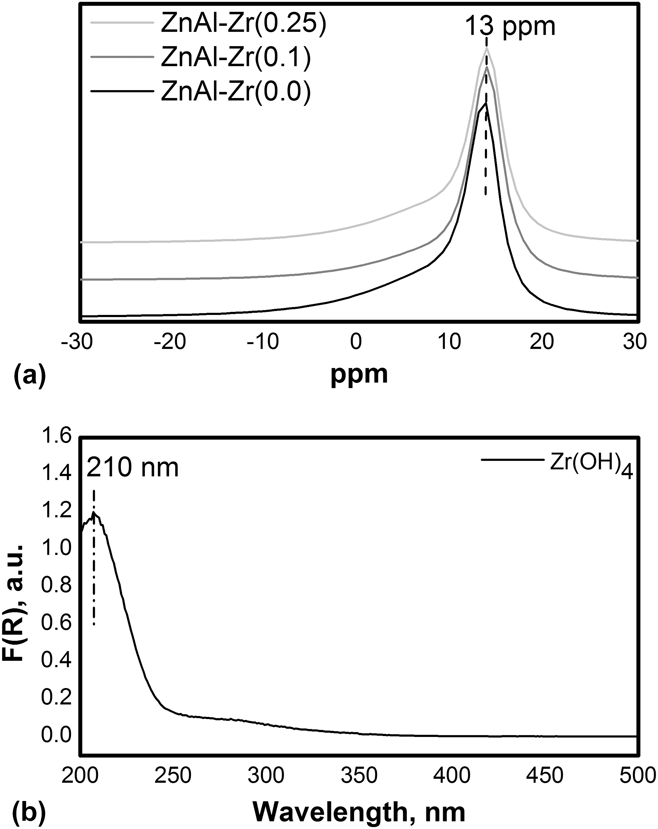
27Al NMR spectra [Fig. 1(a)] of the synthesized ZnAl–Zr(X) catalysts show an intense signal close to 0 ppm (∼13 ppm) assigned to aluminum species in octahedral coordination (AlVI), indicating an adequate formation of the brucite-like structure.Reference Valente, Pfeiffer, Lima, Prince and Flores31,Reference Álvarez, Chimentᾶo, Barrabés, Föttinger, Gispert-Guirado, Kleymenov, Tichit and Medina32 UV-Vis DRS spectra of ZnAl–Zr(X) materials, not shown, were previously reported.Reference Cabrera-Munguia, Tzompantzi, Gutiérrez-Alejandre, Rico and González23 A small broadband with a maximum at 350 nm was observed in all ZnAl–Zr samples, which was attributed to Zn species in the form of zincite (ZnO).Reference Wu, Wang, Tan, Sun, Lu and Qiao33 Furthermore, the absence of a broad band at 210 nm in the UV-Vis DRS spectra of ZnAl–Zr(X) materials indicates the successful incorporation of Zr+4 into the hydrotalcite-like structure. This band is related to charge-transfer transitions of isolated Zr+4 species.Reference Velu, Sabde, Shah and Sivasanker26 This electronic transition is clearly observed in the UV-Vis-DRS spectrum of Zr(OH)4 [Fig. 1(b)], which was identified as a precipitation product of ZrOCl2·8H2O following the same procedure as that used for the synthesis of ZnAl–Zr(X).
(a) 27Al MAS NMR and (b) UV-Vis-DRS spectra of Zr(OH)4 dried at 80 °C.

The characterization results for the ZnAl–Zr(X) catalysts dried at 80 °C showed that the incorporation of Zr+4 into the hydrotalcite structure of ZnAl is carried out by the substitution of Al+3 by Zr+4 ions, resulting in materials with larger specific surface area than its counterpart ZnAl–Zr(0.0) hydrotalcite.
B. Selection of the activation temperature
When hydrotalcites are used as solid base catalysts in the transesterification of vegetable oils,Reference Jiang, Lu, Qi, Yan and Liang18 a relatively high calcination temperature, about 450 °C, is commonly used. However, a lower activation temperature is desirable to avoid the collapse of the hydrotalcite framework (300 to 500 °C) which leads to mixed oxide segregation, affecting the catalyst stability performance.
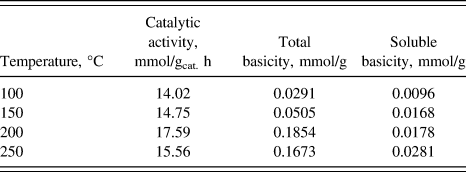
To this aim, portions of the ZnAl–Zr(0.0) sample were activated at 100, 150, 200, and 250 °C and then tested in the transesterification of soybean oil. According to Table I, the highest catalytic activity was obtained when ZnAl–Zr(0.0) was activated at 200 °C which is in line with the highest total basicity for this sample determined by titration. In fact, a good correlation exists between the total basicity of the ZnAl–Zr(0.0) catalyst activated at different temperatures and the catalytic activity for the transesterification reaction (Fig. S1, Supplementary Material). This behavior indicates that the catalytic performance of the ZnAl–Zr(0.0) material depends mainly on its surface basic properties tuned by the activation temperature.
Basicity and catalytic activity of the ZnAl–Zr(0.0) material at different activation temperatures. Adapted with permission from Ref. Reference Cabrera-Munguia, Tzompantzi, Gutiérrez-Alejandre, Rico and González23. Copyright 2017 Elsevier.

Figure S2 (Supplementary Material) presents the DTA curves of ZnAl–Zr(X) catalysts. Three weight loss-steps were identified, the first one associated with the dehydration process by the loss of physisorbed and interlamellar water, which is located at 208 °C for ZnAl–Zr(0.0) and at 202 °C for the ZnAl–Zr(0.25) sample. The second weight loss-step is attributed to carbonate decomposition, located around 262 °C and 267 °C for ZnAl–Zr(0.0) and ZnAl–Zr(0.25), respectively. The latter catalyst presents the higher basicity due to the greater retention of carbonate groups. The last weight loss-step corresponds to the decomposition of the brucite-like structureReference López, Ramos, Bosch, Asomoza and Gómez34 at 395 °C for ZnAl–Zr(0.0) and 386 °C for ZnAl–Zr(0.25). Moreover, the intensity (weight loss) of the DTA curves decreases when the Zr/Al molar ratio in the catalysts increases from 0 to 0.25, denoting the strengthening of the interaction between the hydrotalcite layer and the interlayer when Zr+4 is incorporated.Reference Velu, Sabde, Shah and Sivasanker26 In addition, Fig. S2 shows a similar behavior in the DTA profiles for ZnAl–Zr(0.0) and ZnAl–Zr(X) catalysts; therefore, it would be expected that the effect of the activation temperature on the catalysts containing Zr could be similar to that of the ZnAl catalyst without Zr.
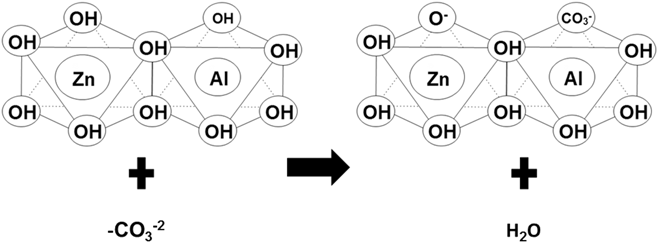
The diffractograms of the ZnAl–Zr(0.0) catalyst heated at 100 and 150 °C [Fig. S3(a), Supplementary Material] show a decrease in the intensity of the main diffraction lines of the brucite-like material, which reflects a dehydration process of the sample. Figure S3(b) (Supplementary Material) presents additional diffractograms for ZnAl–Zr(0.0)–200 °C and ZnAl–Zr(0.0)–250 °C samples, evidencing a dehydration process and also a possible grafting of the carbonate anions to the layers of the ZnAl–Zr(0.0) material as illustrated in Fig. 2.Reference Vaysse, Guerlou-Demorgues and Delmas35 The presence of zincite (ZnO) (PDF 01-089-1397), hydrozincite (Zn5(CO3)2(OH)6) (PDF 19-1458), and zinc carbonate (ZnCO3) (PDF 03-0774) in ZnAl–Zr(0.0)–200 °C and ZnAl–Zr(0.0)–250 °C is in agreement with the above explanation. Furthermore, zincite is recognized as an active phase in the transesterification of soybean oil with methanol,Reference Veiga, Luna, Portilho, Veloso and Henriques36 which results from the heating of ZnAl hydrotalcites. This compound appears as a broadband in the XRD patterns of hydrotalcite heated at 200 °C, while at 300 °C, the diffraction lines of hydrotalcite practically disappear, remaining just the typical peaks of zincite.Reference Jiang, Lu, Qi, Yan and Liang18 Therefore, according to the DTA analysis, the activation temperature of 200 °C mainly provokes the dehydration and dehydroxylation of ZnAl–Zr(X) materials, allowing a better accessibility to Brönsted basic sites (–OH−) and the formation of acid–basic Lewis pairs (M+–O−).Reference Cavani, Trifiró and Vaccari22,Reference Liu, Wang, Qu, Wang, Tian, Ma and Xu37 In addition, the XRD pattern of ZnAl–Zr(0.0)–200 °C exhibits the decarbonation process with the decrease of the main diffraction lines of hydrotalcites. This temperature of 200 °C was then selected to activate ZnAl–Zr(X) samples before the catalytic experiments.
Grafting process of hydrotalcite-like materials.

C. Effect of the Zr loading in the ZnAl–Zr(X) catalyst
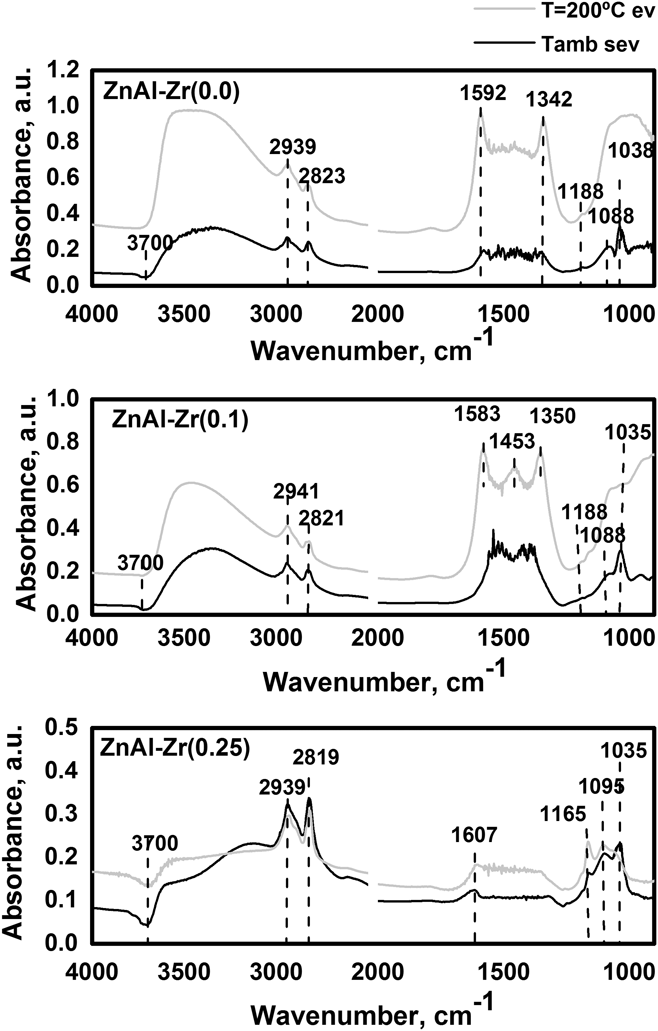
Figure 3 shows the FT-IR subtraction spectra of the ZnAl–Zr(X) samples exposed to methanol at ambient temperature with no evacuation (Tamb sev) and outgassed at 200 °C. An inverse band at ∼3700 cm−1 attributed to perturbed alumina hydroxyl groups by methanolReference Busca, Rossi, Lorenzelli, Benaissa, Travert and Lavalley38 is present in all spectra of ZnAl–Zr(X) at Tamb sev, which remains in the ZnAl–Zr(0.25) sample at T = 200 °C. The two maxima located at 2939 and 2819 cm−1 are assigned to the C–H stretching mode of adsorbed methanol species.Reference Riva, Trifiro, Vaccari, Mintchev and Busca39 ZnAl–Zr(X) spectra of the samples evacuated at T = 200 °C (denoted hereafter as T = 200 ev) show bands at ∼1610, ∼1590, ∼1450, and ∼1350 cm−1 related to adsorbed formate groups since methanol is decomposed when it is adsorbed through hydrogen bonding with basic sites of Zn.Reference Riva, Trifiro, Vaccari, Mintchev and Busca39,Reference Chauvin, Saussey, Lavalley, Idriss, Hindermann, Kiennemann, Chaumette and Courty40 Two kinds of methoxy surface groups with bands at 1095 and 1035 cm−1 are characteristic of the C–O stretching mode, while the methyl rocking mode is assigned to the band at 1188 cm−1.
FT-IR subtraction spectra of the ZnAl–Zr(X) catalyst with adsorbed methanol at room temperature (Tamb sev) and after outgassing at 200 °C (T = 200 °C ev). Spectra for the ZnAl–Zr(0.25) material was adapted with permission from Ref. Reference Cabrera-Munguia, Tzompantzi, Gutiérrez-Alejandre, Rico and González23. Copyright 2017 Elsevier.

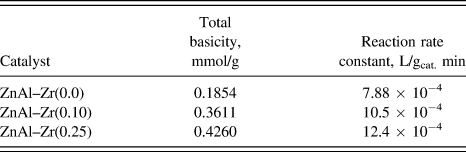
As for comparison, the C–O stretching mode of methoxy groups on γ-Al2O3 is located at 1095 cm−1 and those on ZnO systems are between 1080 and 1050 cm−1.Reference Montanari, Sisani, Nocchetti, Vivani, Herrera-Delgado, Ramis, Busca and Constantino41 The ZnAl–Zr(0.0) sample presents more intense bands inherent to Zn basic sites. However, as the amount of Zr+4 increases, the intensity of the bands located at (1300–1600 cm−1) decreases, whereas the intensity of the characteristic bands of alumina increases (3700 cm−1, 1095 cm−1), denoting that the Zr+4 addition into the hydrotalcite structure mainly improves the basic properties of Al+3 ions, which is in line with the N2 physisorption analysis, suggesting the replacement of Al+3 ions by Zr+4.Reference Velu, Sabde, Shah and Sivasanker26–Reference Koilraj and Kannan28 Table II shows the values of the total basicity of ZnAl–Zr(X) materials quantified by titration with benzoic acid. According to these results, the increase in the Zr+4 loading (X) has a positive effect on their basicity, and hence in their catalytic activity. Indeed, FAME yields of 68.3%, 79.1%, and 82.1% for ZnAl–Zr(0.0), ZnAl–Zr(0.1), and ZnAl–Zr(0.25), respectively, were measured after 2 h of reaction.
Basicity and reaction rate constants of ZnAl–Zr(X) catalysts. Adapted with permission from Ref. Reference Cabrera-Munguia, Tzompantzi, Gutiérrez-Alejandre, Rico and González23. Copyright 2017 Elsevier.

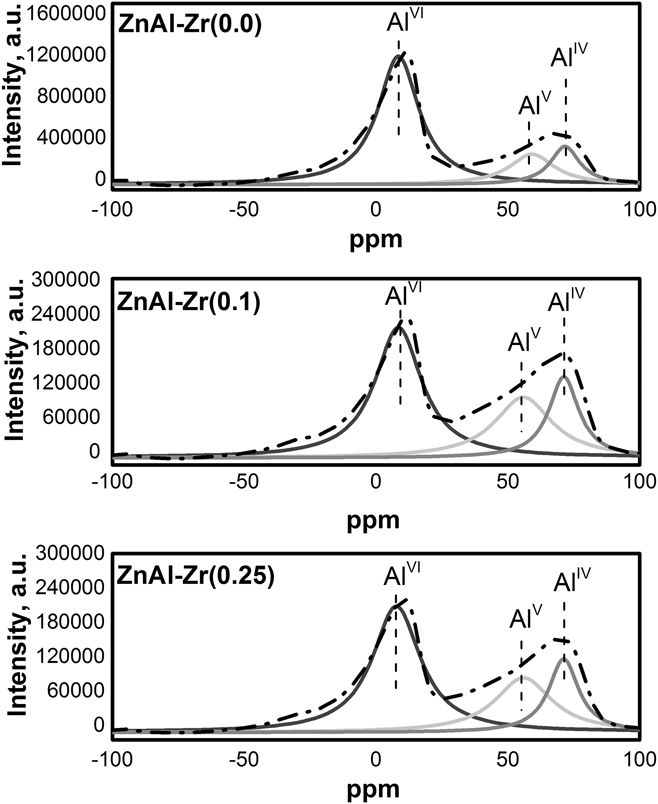
27Al NMR spectra of the ZnAl–Zr(X) samples activated at 200 °C (Fig. 4) exhibit two important peaks, one with a chemical shift close to 10 ppm assigned to aluminum species in octahedral coordination (AlVI) and the other at about 70 ppm, which is related to aluminum in tetrahedral coordination.Reference Álvarez, Chimentᾶo, Barrabés, Föttinger, Gispert-Guirado, Kleymenov, Tichit and Medina32 However, the peaks are unresolved to the baseline, Lorentzian deconvolution was carried out to distinguish the probable formation of pentacoordinated aluminum (AlV), whose appearance has been previously reported in ZnAl hydrotalcites, containing carbonates and sulphate anions in the interlayer, exposed to thermal treatment.Reference Velu, Ramkumar, Narayanan and Swamy42 It is important to mention that AlV is a distorted aluminum with strongly perturbed oxygen coordination that can be easily transformed in AlVI or AlIV and is related to Lewis acid sites.Reference Chen, Davis and Fripiat43 Furthermore, this AlV is assigned to oxygen defects produced during the process of dehydroxylation where some AlVI are converted to AlIV which generates oxygen vacancies and then coordinatively unsaturated sites (CUS) of aluminum.Reference Álvarez, Chimentᾶo, Barrabés, Föttinger, Gispert-Guirado, Kleymenov, Tichit and Medina32,Reference Coster and Fripiat44
27Al MAS NMR spectra of ZnAl–Zr(X) activated at 200 °C.

Table III depicts the position and the relative abundance for each possible aluminum coordination in all ZnAl–Zr(X) catalysts. Initially, ZnAl–Zr hydrotalcites possess aluminum in octahedral coordination [Fig. 1(a)], which is representative of the hydrotalcite framework; when ZnAl–Zr(X) catalysts are heated at 200 °C, the process of dehydration and dehydroxylation occurred as it is shown in DTA curves (Fig. S2 Supplementary Material) resulted in AlIV and AlV, respectively. In addition, AlV could be formed when the carbonate ions are decomposed with metal ions in the brucite-like layer.Reference Velu, Ramkumar, Narayanan and Swamy42 According to Table III, when the Zr/Al molar ratio increases from 0 to 0.25, the octahedral aluminum coordination sphere easily changes into tetrahedral or pentacoordinated, increasing the relative population of AlIV and AlV to 5.8% and 11.4%, respectively. This increase in AlV generates oxygen vacancies where the electron density is larger than that of AlIV coordinated to four oxygens.Reference Wang, Bokhimi, Novaro, López, Tzompantzi, Gómez, Navarrete, Llanos and López-Salinas45 Thus, tetrahedral aluminum related to Al(OH)3 species possesses a more acidic character than pentacoordinated aluminum and hence the oxygens coordinated to AlV are more basic sites. Then, a high population of AlV favors the transesterification reaction with the ZnAl–Zr(0.25) catalyst, leading to a FAME yield of 82.1% after 2 h of reaction.
Deconvolution of 27Al NMR spectra of ZnAl–Zr(X) catalysts activated at 200 °C.

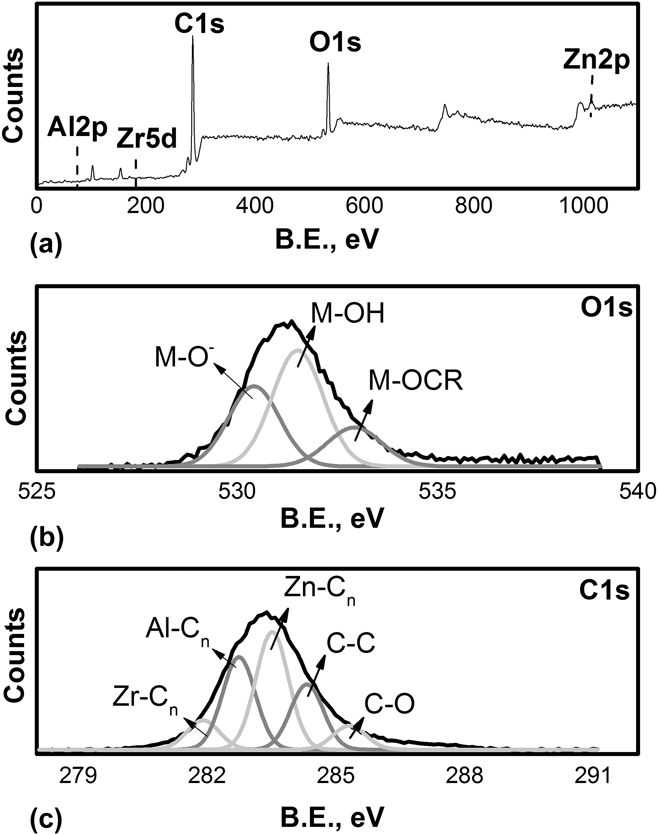
Figure 5(a) shows the survey spectrum of the ZnAl–Zr(0.25) sample when it is heated at 200 °C, which indicates the emissions of Zn, Al, Zr, C, and O elements. The high resolution XPS spectrum of O1s and its corresponding deconvolution [Fig. 5(b)] exhibited that the chemical environment of O1s is formed by three peaks, the first one centered in a binding energy of ∼531.4 eV is associated with the presence of Lewis acid–basic pairs (M–O−), where M can be Zn, Al or Zr, indicating the partial dehydroxylation of the brucite-like sheets. Another peak centered at ∼532.2 eV is assigned to the presence of M-OH groups, Brönsted basic sites. The last band at ∼533.4 eV is attributed to M-OCR chemical bonds, which can be formed through the dehydroxylation process and the subsequent insertion of –CO3−2 groups in the brucite-like sheet.Reference Vaysse, Guerlou-Demorgues and Delmas35 The latter was confirmed with the deconvolution of the narrow spectrum of C1s [Fig. 5(c)], which is formed by five peaks. The peaks centered at ∼282.7 eV, ∼283.1, and ∼283.9 eV are associated with a carbon chain bonding to zirconium, aluminum, and zinc, respectively. The signals observed in the ZnAl–Zr(X) sample activated at 200 °C resulted from the organometallic interactions between a polarized metal and the grafted carbonates, in agreement with other reports in the literature, which show signals at about 283.4 eV and 283.7 eV assigned to organic molecules bonded to Zn and Al.Reference Vohs and Barteau46,Reference Stoyanov, Akhtert and White47 Furthermore, the peaks centered at ∼284.6 and ∼285.4 eV were assigned to carbon bonding to carbon and carbon bonding to oxygen, respectively. The latter is associated with carbonates interacting with the inherent basic sites formed when ZnAl–Zr(0.25) is activated at 200 °C.
(a) Survey spectra and narrow spectra of (b) O1s and (c) C1s of the ZnAl–Zr(0.25) catalyst activated at 200 °C.

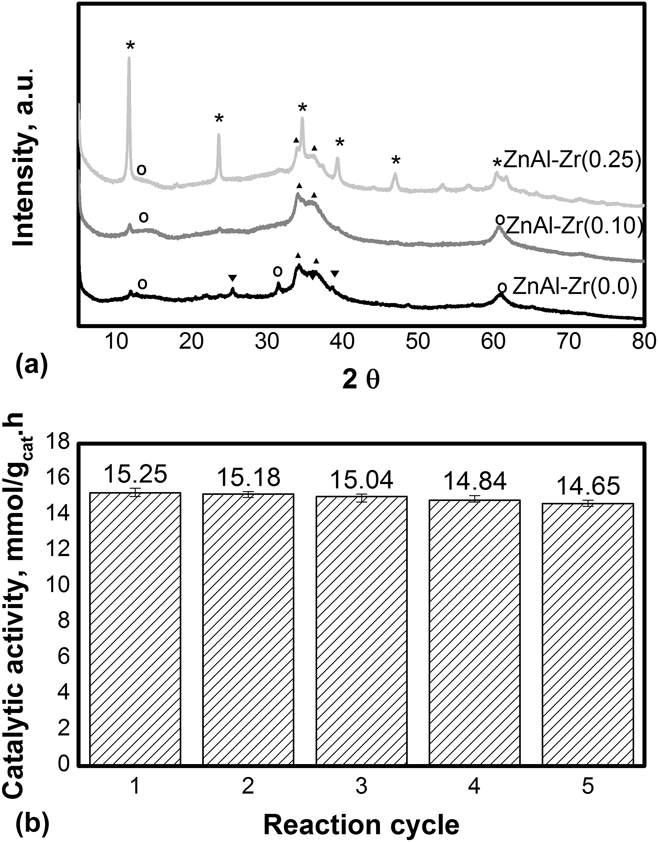
The diffractograms of ZnAl–Zr(X) samples activated at 200 °C [Fig. 6(a)] denote the loss of both, water from the interlayer and CO3−2 groups, indicated by the decrease of the typical peaks of hydrotalcite. However, these diffraction lines still remain on the ZnAl–Zr(0.25) catalyst which is related to the retention of CO3−2 groups by its strong basic sites, in agreement with the TGA analysis. Moreover, all ZnAl–Zr(X) samples possess a broad band at 30° < 2θ < 40° indicating the presence of hydrotalcite and zincite phases (ZnO, PDF 01-089-1397). Hydrotalcite is identified by the broadband at 13.07 and a peak at 60.67° 2θ degrees [Zn5(CO3)2(OH)6, PDF 19-1458], which is the precursor of zincite since when hydrotalcite is heated up to 200 °C, it is partially decomposed into ZnO.Reference Sanna, Medas, Poddda, Meneghini, Casu, Lattanzi, Scorciapino, Floris, Cannas and de Giudici48 Therefore, a mixture of hydrotalcite, zincite, and hydrozincite phases is a key parameter in the catalytic performance of ZnAl–Zr(X) samples heated up to 200 °C. Moreover, diffraction peaks of ZnCO3 (PDF 03-0774) were observed at 2θ = 25.1° and 38.9° for ZnAl–Zr(0.0), denoting a partial segregation of this material during thermal activation.
(a) XRD patterns of ZnAl–Zr(X) treated at 200 °C, identified species: * hydrotalcite, ▲ zincite (ZnO), ▼ zinc carbonate (ZnCO3), hydrozincite (Zn5(CO3)2(OH)6); and (b) catalytic stability of ZnAl–Zr(0.25). Adapted with permission from Ref. Reference Cabrera-Munguia, Tzompantzi, Gutiérrez-Alejandre, Rico and González23. Copyright 2017 Elsevier.

Thus, when an activation temperature of 200 °C is used for ZnAl–Zr(X) materials, a partial collapse of their framework due to the loss of physisorbed water is observed, giving rise to a better accessibility to Brönsted basic sites (M-OH). Water is additionally produced by the partial dehydroxylation of the brucite-like sheets leading to the formation of Lewis acid–basic pairs (M–O−).
The reaction rate constants for the pseudo-first order transesterification reaction over ZnAl–Zr(X) catalysts (Table II) were calculated making the assumption that the transesterification is an irreversible reaction since an excess of methanol was used. The experimental data were fitted to a pseudo first order reaction model with respect to triglycerides as reported in previous work.Reference Cabrera-Munguía, González, Gutiérrez-Alejandre, Rico, Huirache-Acuña, Maya-Yescas and del Río25 The calculated values of the reaction rate constants indicate that when a high content of Zr is incorporated into the ZnAl–Zr(0.25) brucite-like material, the reaction rate constant increases 1.5 times when compared with the ZnAl–Zr(0.0) catalyst without Zr+4.
All spent ZnAl–Zr(X) catalysts were washed with acetone and without further activation were reused in the transesterification of soybean oil with negligible deactivation, as shown in Fig. 6(b) for the ZnAl–Zr(0.25) catalyst after five subsequent reaction cycles.
D. Simplified reaction scheme for the transesterification of soybean oil
The octahedral configuration of Zn in ZnAl–Zr(X) catalysts activated at 200 °C, changes to a tetrahedral–octahedral–tetrahedral one intercalated with –OH and CO3−2 groups leading to the active phase hydrozincite,Reference Sanna, Medas, Poddda, Meneghini, Casu, Lattanzi, Scorciapino, Floris, Cannas and de Giudici48 which precede the zincite phase in tetrahedral coordination (Lewis acid–basic pairs). The loss of physisorbed water and the partial dehydroxylation of the brucite-like structure provoke that a fraction of aluminum hydroxycarbonates (AlVI) changes their coordination into AlIV and AlV species, associated with Brönsted basic sites and Lewis acid–basic pairs. Additionally, Zr plays a key role in the concentration of AlIV and AlV species since its incorporation involves the substitution of Al+3 ions. In addition, a high Zr/Al molar ratio favors the presence of tetrahedral and pentacoordinated aluminum. Furthermore, Zr possesses an electronegativity value of 1.33 which is lower than that of Al(1.61) and Zn(1.65), implying a greater electronic density in the neighbor oxygen (–OH or Zr–O−), and thus a larger Brönsted and Lewis basic strength, which explains the enhanced catalytic activity obtained with the catalysts containing Zr.
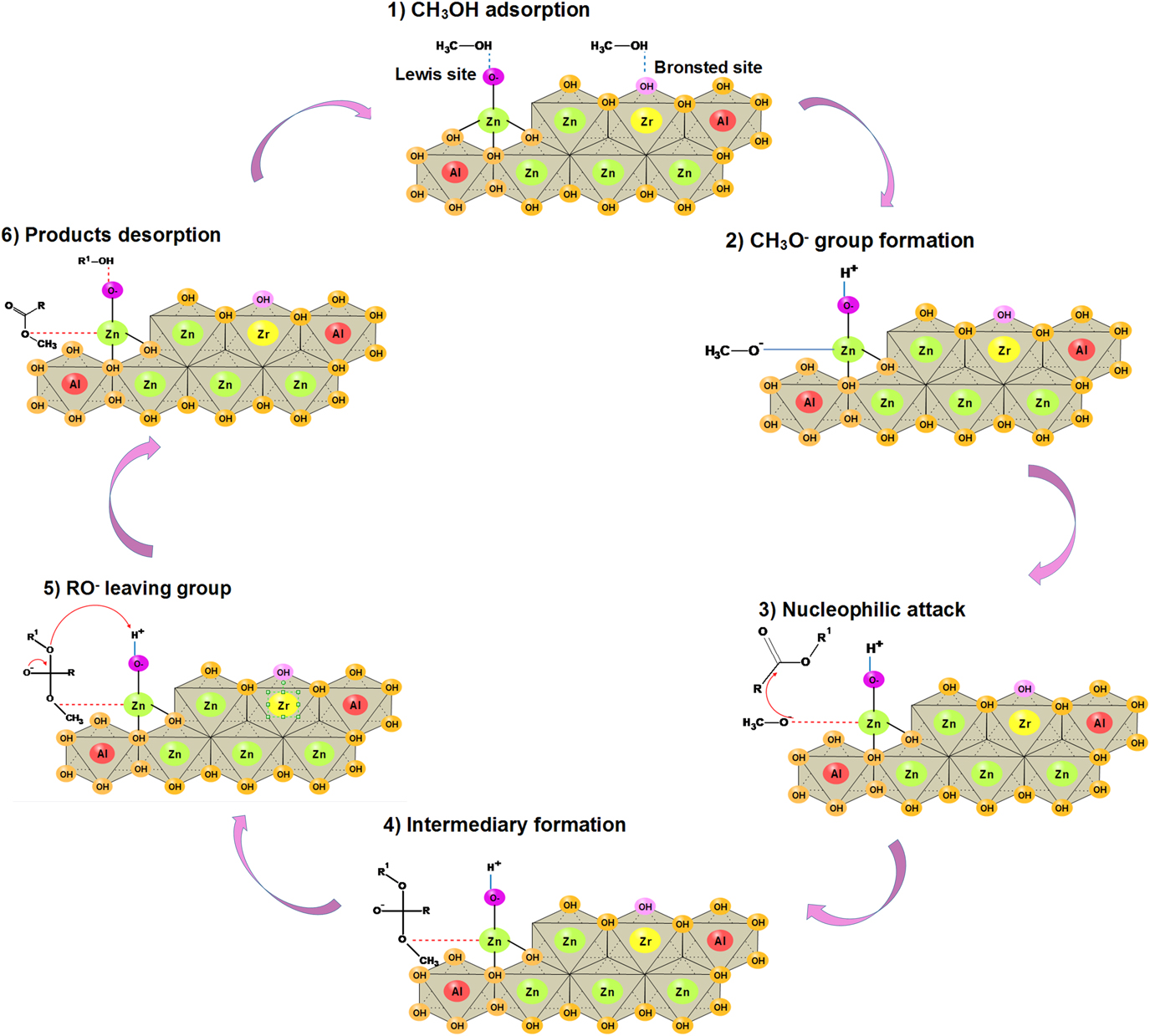
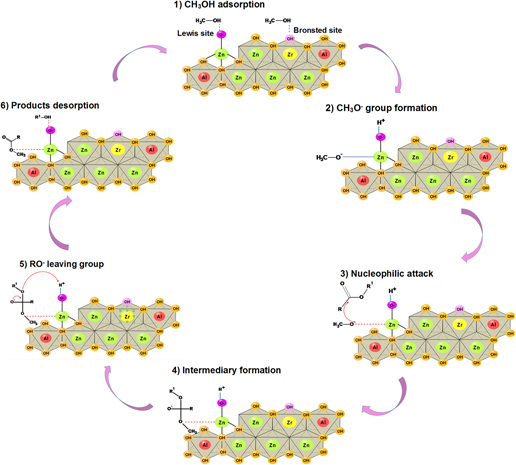
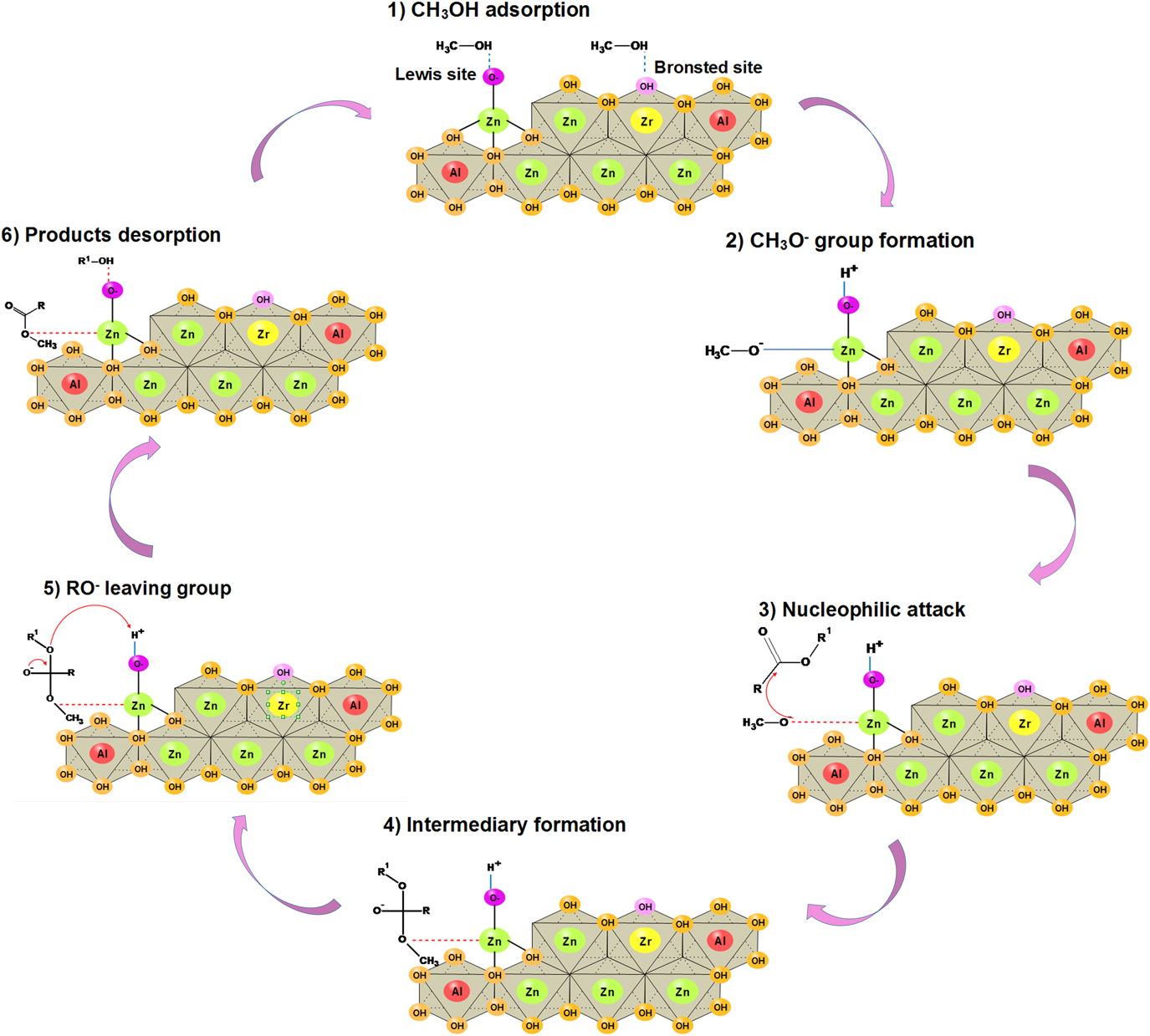
It is well known that the methoxy group formed through the subtraction of a proton from methanol is a key step during the transesterification reaction.Reference Dermibas49 This alkoxide is an alcohol base, which is the reaction product of an alcohol with a strong base, like NaOH, commonly used as a homogeneous catalyst for biodiesel production. The hydroxyl ion is a weak base to produce the alkoxide in higher amounts, but a Lewis acid–basic pair is capable of stabilizing the methoxy groupReference Liu, Wang, Qu, Wang, Tian, Ma and Xu37 when a high reaction temperature is used (200 °C) as in the present work since methanol begins to decompose partially at 140 °C.Reference Montanari, Sisani, Nocchetti, Vivani, Herrera-Delgado, Ramis, Busca and Constantino41 The methoxy group is then formed when methanol is in contact with Brönsted basic sites and Lewis acid–basic pairs located in ZnAl–Zr(X) samples activated at 200 °C. Figure 7 represents a simplified sequence of steps for the transesterification of soybean oil over ZnAl–Zr(X) catalysts, involving (i) the methoxy group formation through proton subtraction from methanol by a Brönsted or Lewis basic site; (ii) methoxy group stabilization by the positive charge of Zn, Zr, or Al (Lewis acid site); (iii) the oxygen from the methoxy group makes a nucleophilic attack to the carbon atom with sp 2 hybridization in the triglyceride, (iv) a tetrahedral intermediary is formed and stabilized with a free electron pair located in the oxygen atom of the carbonyl group; (v) the latter oxygen forms again a double bond with the quaternary carbon atom, which cause the release of the RO− group (diglyceride, monoglyceride, or glycerol); this latter takes a proton from a Lewis basic site; and (vi) desorption of FAME from the Lewis acid site.
Simplified reaction scheme for the transesterification reaction over ZnAl–Zr(X) hydrotalcites.
IV. CONCLUSIONS
The activation of hydrotalcite-like ZnAl–Zr(X) catalysts at 200 °C is suitable for the transesterification reaction due to the formation of Brönsted basic sites and Lewis acid–basic pairs, which resulted from the dehydration and dehydroxylation of the hydrotalcite-like framework. These active sites are associated with the presence of hydrotalcite, hydrozincite, and zincite crystalline phases. Incorporation of Zr+4 into the hydrotalcite-like structure of ZnAl catalysts proceeds mainly via the substitution of Al+3 by Zr+4 ions generating materials with great specific surface areas and improved basic properties. Indeed, a high Zr/Al molar ratio favors the presence of tetrahedral and pentacoordinated aluminum, chemical species that are related to Brönsted basic sites and Lewis acid–basic pairs. Such sites seem to be responsible for the high FAME yield obtained with the ZnAl–Zr(X) catalysts. Furthermore, a good correlation was determined between the total basicity of ZnAl–Zr(X) catalysts and their catalytic activity.
The stability of the ZnAl–Zr(0.25) catalyst was further studied, showing insignificant deactivation after five subsequent reaction cycles. Therefore, these types of catalysts are promising for biodiesel synthesis; however, according to the EN14214 regulation, FAME yield should be over 95%. Assuming the use of our catalysts in the commercial production of biodiesel, a proper reactor design to avoid the thermodynamic and transport constraints that rule out the transesterification reaction would be required to obtain higher biodiesel yields than those observed in the present work.
Supplementary Material
To view supplementary material for this article, please visit https://doi.org/10.1557/jmr.2018.312.
ACKNOWLEDGMENT
The authors greatly appreciate financial support by CIC-UMSNH. DACM thanks CONACyT for the grant (487883) received during the development of this work. The authors also thank Rogelio Cuevas García for his assistance with the TGA experiments.