Introduction
Improvements in diagnostic imaging, surgical strategies, and peri-operative management of children with heart disease have led to a significant reduction in mortality rates over the past several decades. Reference Tweddell, Hoffman and Mussatto1–Reference Wernovsky3 With more children born with complex heart disease surviving into childhood and beyond, longitudinal studies have illuminated the longer-term consequences of heart disease and its necessary treatment. Neurodevelopmental disabilities are one of the most common morbidities experienced by children with heart disease.Reference Marino, Lipkin and Li4 Neurodevelopmental disabilities are revealed throughout childhood and the phenotypes are variable, ranging from mild learning differences to severe global developmental disabilities.Reference Marino, Lipkin and Li4,Reference Wernovsky3 Risk factors for neurodevelopmental disabilities are multifactorial, sequential, cumulative, and interactional and may be characterised as modifiable (e.g., environment, infant parent bond) or non-modifiable (e.g. genetic disorders, prematurity). These risks begin in utero with altered fetal brain development and continue through infancy, childhood, and adulthood, with periods of highest risk in the perioperative period.Reference Andescavage, Pradhan and Gimovsky5–Reference Verrall, Patel and Travitz7,Reference Marino, Lipkin and Li4
The International Cardiac Collaborative on Neurodevelopment Investigators analysed neurodevelopmental outcomes of 1770 children from 22 centres after cardiopulmonary bypass surgery and found that Bayley Scales of Infant Development-Second Edition Psychomotor Development Index and Mental Development Index scores were more highly associated with patient preoperative and postoperative factors than specific cardiopulmonary bypass strategies. The post-operative factors include length of hospitalisation in the cardiac ICU, an area where we believe many modifiable risk factors for neurodevelopmental delays and disabilities existReference Gaynor, Stopp and Wypij8
Our team identified an opportunity to fill a gap in inpatient neurocardiac critical care that existed between our well-established Prenatal Cardiology Program and the Cardiac Neurodevelopmental Outcomes Program. In addition to diagnosing heart disease in the fetal period and developing safe delivery plans,Reference Sethi, Klugman and Said9 the Prenatal Cardiology team collaborates with geneticists, neurologists and radiologists to identify fetal brain anomalies in utero. The Cardiac Neurodevelopmental Outcomes Program is a multidisciplinary clinic that follows the developmental trajectory of children with heart disease through childhood. The purpose of this manuscript is to describe the development of a Neurocardiac Critical Care Program aimed at “bridging the gap” between our established fetal and outpatient programs, focused on optimising brain development, early detection of brain abnormalities, and promoting healthy family bonding in the cardiac ICU.
Neurocardiac critical care programme foundation
In 2011, in preparation for moving to a dedicated cardiac ICU, a formalised relationship between the cardiac surgery, cardiac intensive care, and neurology teams was established through several foundational meetings. The teams shared a mutual understanding of the benefits of expanding neurological elements of care. Initially, the goal was to increase the presence of neurologists in the cardiac ICU and develop a trusting, collaborative relationship. A small, dedicated team of neurology providers with clinical expertise suited to the cardiac ICU sought to provide consistency and continuity of care.
Once the neurology consultation service was established, aspects of neurological care were introduced into nursing and physician educational platforms in the cardiac ICU. Neurologists were regularly invited to case conferences and lectures were provided to trainees and multidisciplinary audiences.
As the programme expanded, additional resources were required to keep pace with clinical and educational demands. In year 4 (2015), the executive leadership allocated funding to develop a critical care neurology nurse practitioner position with 50% time dedicated to the cardiac ICU service. The addition of a nurse practitioner tn the team was pivotal. It allowed the team to continue to provide a high level of care as the number of patient consults expanded. There was an immediate improvement in care directly related to the continuity provided by the nurse practitioner as physician team members rotated on and off service. Both written and verbal communication with cardiac ICU team members was also notably improved. The nurse practitioner gained an understanding of the neurological risk factors related specifically to the CHDs, developed expertise in cardiac care and had a consistent presence in the cardiac ICU. Ultimately, the nurse practitioner contributed to the education of trainees and led quality improvement projects, including the development of clinical pathways and the improvement of neuroimaging ordering processes.
Neurocardiac critical care program expansion
An important turning point in program development occurred in year 6 (2017), when the program expanded considerably. Expert and committed representatives from physical, occupational, and speech therapy teams, child life, social work, and developmental paediatrics met with the existing group of cardiologists, intensivists, neurologists, nurses, and nurse practitioners to discuss expanding the scope of the existing Neurocardiac Critical Care Program (see acknowledgements). In addition to meeting regularly as a group, two leaders of the team met with individuals from each of the disciplines to better understand their scope of practice in the cardiac ICU, their existing team dynamics and reporting structures, and any barriers to care delivery. The expertise and enthusiasm of this group were immediately evident. The leaders sought to elevate and disseminate their expertise and further integrate them into the cardiac ICU team. Consistent with the approach of the neurology team integrating into the cardiac ICU, a core group was established to provide continuity and develop expertise with our specific patient population. Group and individual discussions informed the mission, vision, and goals of the Neurocardiac Critical Care Program. Program expansion began with leadership engagement, specifically cardiac surgery and cardiac intensive care, and evolved with team education, clinical practice changes, and research priorities.
Team education
Educational content was developed by the core Neurocardiac Critical Care Program team and offered in a variety of formats to multidisciplinary audiences, including nurses, physicians, social workers, physical, occupational, and speech therapists. The overarching goal of the education sessions was to convey why the expansion of our Neurocardiac Critical Care Program was important and how each member of the team could contribute to improving neurodevelopmental outcomes, through both programmatic change and individual clinical decisions made at the bedside while caring for critically ill patients. The team sought to impart knowledge about long-term neurodevelopmental outcomes of children with heart disease, describe at-risk populations, and emphasize cardiac ICU-specific modifiable risk factors.
The Individual Family-Centered Care Model developed by Lisanti et al was introduced in each of education sessions to encourage reflection and generate ideas for implementing evidence-based developmental care practices.Reference Lisanti, Vittner, Medoff-Cooper, Fogel, Wernovsky and Butler10 Many of the interventions suggested in the model have been adopted and are now part of routine practice, specifically non-pharmacologic support of pain, breastfeeding support, parent engagement in care, and routine early consultation of physical, occupational, and speech therapists.
Each of the early education sessions had dedicated time for reflection and discussion about both individual and unit-wide practice changes to be prioritized. Ideas generated in these sessions informed the early clinical practice changes and ultimately helped secure buy-in from the cardiac ICU bedside team. The neurocardiac critical care team now has a standing session in each of the mandatory nursing education days, and nursing and fellow unit orientation. In addition to formal education, several nurses and physicians have become informal leaders who role model and promote developmental care at the bedside.
Clinical practice
Neurodevelopmental rounds
Early clinical practice changes focused on building an integrated team to establish weekly neurodevelopmental rounds. Iterative changes were made to the rounding process to ensure efficiency and meet our goal of elevating the expertise of the team and amplifying the importance of neurodevelopmental practices. The approach to neurodevelopmental rounds has evolved over time. Rounds were modified but continued through the COVID-19 pandemic and have adapted to various staffing changes over the years. However, a comprehensive summary of evaluations and recommendations made at neurodevelopmental rounds is consistently disseminated by email to the full cardiac ICU team each week and specific developmental care goals and recommendations are written on a white board in each patient’s room.
Comfort curriculum
Non-pharmacologic pain management and parental engagement were prioritized as an early focus for clinical practice changes. During the education sessions, experienced cardiac ICU nurses noted that parents were not consistently holding their infants, potentially leading to impaired bonding and unnecessary sedation. This insight led to the development of the Comfort Curriculum, including Infant and Toddler Holding guidelines, cardiac ICU Pain and Sedation Pathway and Non-Pharmacologic Support Resources (see Appendices 1–3). The goals of the Comfort Curriculum are to (1) use critical assessment skills to inform the treatment for pain or discomfort, (2) expand the arsenal of interventions to include non-pharmacologic support and holding, in addition to pharmacologic interventions, and (3) engage parents in the assessment and interventions to support patient comfort.
Neuromonitoring and imaging guidelines
In an effort to standardise our neuroimaging practices, the cardiac ICU and neurology teams gained consensus and established cardiac ICU neuromonitoring and imaging guidelines. The guidelines support proactive imaging for neonates pre- and post-operatively and reactive practices in the event of an acute neurologic injury, as well as 48 hours of EEG monitoring post-operatively, as recommended by American Clinical Neurophysiology Society (See Appendix 4).Reference Shellhaas, Chang and Tsuchida11 The intention of the guidelines was to standardise neuromonitoring and imaging and reduce the cognitive burden of the front-line teams.
Weekly neurology huddle
In year 12 (2023), a weekly “neurology huddle” was established and led by a critical care neurologist to review clinical findings, neuroimaging, and EEG monitoring results for current cardiac ICU patients. The entire cardiac ICU team is invited, and the on-service provider team as well as the on-service critical care neurologist and nurse practitioner join the huddle each week. The face-to-face clinical context provided by the cardiac ICU team, and the findings presented by the neurologists enable a rich discussion about neurologic injury, management, and prognosis. The neurology huddles are educational and serve to communicate complicated and nuanced findings and support consistent communication among the team and with families.
Family support team
Members of the interdisciplinary team were recruited to participate in the cardiac ICU Family Support Team, an initiative informed by the recently published model of family-based psychosocial care.Reference Driscoll, Christofferson and McWhorter12 Cardiac ICU nurses, nurse practitioners, physicians, a chaplain, social worker, nurse navigator, and child life specialist volunteered to participate. The team was convened to review current unit based and hospital-wide family support practices, conduct a review of the literature about interventions to support families, reflect and brainstorm opportunities to improve our current practice, and prioritize projects and measure outcomes. This team partners with our Heart Center Parent and Family Advisory Council to advance the care of families in our unit.
Research and quality improvement
Our research and quality improvement priorities stemmed from the education sessions and clinical practice changes in the unit. Reflections from our team during education sessions related to the cardiac ICU environment informed the initiation of a study related to baseline noise levels and patterns in the cardiac ICU and their association with sedation administration and haemodynamic changes. This work will inform future interventional work to minimise environmental stressor during recovery. Studies related to the implementation of our comfort curriculum are underway and investigating its impact on opioid exposure in the post-operative period and maternal and infant effects of skin-to-skin care. Our neuromonitoring and imaging guidelines have allowed us to measure compliance with the guideline and examine the incidence of seizure and brain injury. Importantly, the interdisciplinary collaboration to answer important short and longer-term questions has been established.
Challenges
The relationship between neurology, the cardiac ICU, and cardiac surgery formally began over 12 years ago and was the foundation for the launch of the interdisciplinary Neurocardiac Critical Care Program in 2017. Our program has responded, adapted, and evolved, even in the setting of major leadership (Cardiac Surgery, Cardiology, Cardiac Nursing, Cardiac Intensive Care) and staffing changes (particularly surrounding the COVID-19 pandemic). The composition of our team has changed, however even with a partial team at times, we worked to maintain a consistent presence in the cardiac ICU. There have been occasional periods of resistance to change among some in the cardiac ICU. Nonetheless, our vision and mission have kept us committed and moving forward and our lessons learned to this point have informed our next steps.
Lessons learned
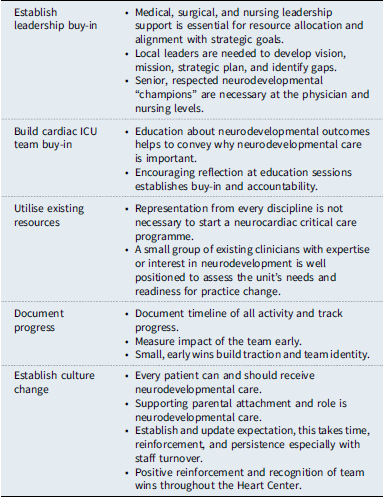
Expanding the focus from predominantly cardiorespiratory care and survivorship to a holistic approach that includes long-term neurodevelopment has been both challenging and highly rewarding. Building a Neurocardiac Critical Care Program was not a straight path, and like any new practice change, required patience and perseverance. We have learned many lessons as we developed, expanded, and sustained this program (see Table 2).
Lessons learned

Executive and service line leadership
The support of executive leaders was essential to allocate and maximise the impact of available resources and ensure that efforts are aligned with overarching strategic goals. Frequent, visible, and vocal support of the program by the Directors of Cardiac Surgery, Cardiac Intensive Care, and Cardiac Nursing was essential. A position for the Director of the Neurocardiac Critical Care Program (MBJ) was initially funded by philanthropic fellowship and subsequently by the Division of Cardiac Critical Care. We strongly believe that a neurocardiac care program is no-longer a “nice-to-have” program but is a “must-have” program to assure optimal patient outcomes.
Sustainable funding for professional development, research initiatives, rehabilitation equipment, and parent support programs was achieved through a collaboration with the hospital’s foundation. The foundation cultivated relationships with grateful families who generously supported the work Neurocardiac Critical Care Program. We found that the work of this program resonated with families who have spent time in the cardiac ICU, and for those who are inclined to donate financial resources, this program is often appealing.
Local leaders
The local leader or programme director guided the development of the vision, mission, and strategic goals with the team. This individual was well-positioned to set priorities for the programme, with an understanding of the readiness of the unit to adopt new practices. Team building skills and adaptability were key characteristics of a local leader. This individual fostered interdisciplinary teamwork and elevated and disseminated the expertise of the Neurocardiac Critical Care Program team. An important responsibility of the local leader was to prepare the team for challenges, build resilience, and maintain engagement, energy, and focus, particularly during leadership and/or staffing changes (or a global pandemic). Buy-in, visibility and public support from senior respected physicians and nurses were key elements of “leading by example”
Continuous education and buy-in
Establishing a consistent presence at nursing and physician unit-based orientation sessions and ongoing education sessions was vital to maintaining the engagement of the cardiac ICU team. In addition to formal education sessions, members of the Neurocardiac Critical Care Program team are encouraged to provide informal education to the bedside team and parents. These sessions are also an opportunity to solicit staff feedback about current initiatives. The scientific literature is reviewed regularly and discussed informally in care settings, as well as formally in journal clubs.
Work with the existing hospital resources
Though many disciplines have valuable contributions to a Neurocardiac Critical Care Program, it was not necessary to have all in place to start or maintain it. Evaluating existing human resources and convening a motivated group is the first step to develop a program. An understanding of the specific roles of the therapists, their reporting structure, individual passions, and barriers to providing care in the cardiac ICU was important to establish before developing expectations, timelines, and accountability. The value of informal leadership and role modelling at the bedside cannot be overstated. Developmental care opportunities are embedded in many micro-decisions at the bedside each day. Bedside clinicians are well-positioned to promote developmental care simply by adopting and role-modelling these practices.
Prioritise early small wins
While there are seemingly endless clinical and research projects related to neurocardiac critical care, carefully selecting projects that will produce early wins help the program develop traction. This work overlaps with the existing responsibility of the members of the team; however, meetings and research initiatives are often above and beyond routine job responsibilities, and therefore, projects frequently take longer than expected to complete. Selecting projects or initiatives that build the identity of the team early helped to create visibility within the unit.
Neurocardiac critical care is for all patients
Neurocardiac critical care can and should be provided to every patient in the cardiac ICU. Neurodevelopmental care including positioning, environmental modifications, comfort management, as well as standardised neurology consultation, appropriate neuroimaging, and parent engagement are examples of how neurocardiac critical care can be delivered to even the most acutely ill patients. The Care Partnership Pyramid developed by Klug and colleagues illustrates this concept by describing specific strategies for parent engagement at every level of acuity.Reference Klug, Hall and Delaplane13 Though decisions to include parents in care or reduce environmental stimuli may seem routine and inconsequential, the cumulative effect of these decisions can be powerful.
Summary
Building and sustaining a Neurocardiac Critical Care Program is not only feasible, but necessary given the risks for impaired brain development and neurodevelopmental disabilities in children with heart disease. Recent publications from the Cardiac Neurodevelopmental Outcome Collaborative and an AHA Science Advisory outline important clinical practice and research priorities for developmental care of hospitalised infants with heart disease.Reference Lisanti, Vittner and Peterson14,Reference Lisanti, Uzark and Harrison15 Our Neurocardiac Critical Care Program is one example of how to incorporate neurologic and neurodevelopmental aspects of care into the paediatric cardiac ICU. Engaged and collaborative leadership from cardiac surgery, cardiology and neurology, diverse expertise, and a cohesive, motivated team built the foundation for our programme. The exact composition and priorities of the team are best determined by local leaders with the knowledge of existing human resources, programmatic needs, and readiness for change. Adaptability, perseverance, and an unwavering focus on improving neurodevelopmental outcomes and quality of life for our patients and their families are needed to sustain a Neurocardiac Critical Care Program through expected and unexpected change.
Summary of program development, implementation, and 13 years of sustainability

Supplementary material
The supplementary material for this article can be found at https://doi.org/10.1017/S104795112500037X.
Acknowledgements
Cardiac Critical Care
-
• John T. Berger, MD
Cardiac Neurodevelopmental Outcomes Program
-
• Rebecca Chen, RN
-
• Mary Donofrio, MD
-
• Michael Mintz, PsyD
-
• Jacqueline Sanz, PhD
Cardiac Surgery
-
• Manan Desai, MD
-
• Pranava Sinha, MD
-
• Aybala Tongut, MD
-
• Can Yerebakan, MD
Child Life
-
• Lanie Berk, MS, CCLS
-
• Erin Gris, MS, CCLS
Dietician
-
• Sarah Prochaska, RD, CNSC, CSP, LD
-
• Siobhan Vogel, MS, RD, CSP, LD
Executive Leadership
-
• David Wessel, MD
Neurology
-
• Dana Harrar, MD, PhD
-
• Meredith Baker, CPNP
-
• Caroline Conley, DNP, CPNP-AC
Nurses
-
• Melissa Dazo, MSN, CPNP-AC
-
• Justine Fortkiewicz, MSN
-
• Erin Griffin MSN, CPNP-AC
Occupational Therapy
-
• Lindsey Chiarello, DROT, OTR/L
-
• Meredith Griffin, MHS, OTR/L
Pharmacist
-
• Laura Leathers, PharmD, BCPPS
-
• Olivia Renaldo, PharmD, BCPPS
-
• Paige Ruffier, PharmD, BCPPS
Social Work
-
• Emily Stein, LICSW
-
• Heather Langlois, LICSW
Speech-Language Pathology
-
• Meagan Ledder, M.S., CCC-SLP
-
• Kimberly Wood, MA, CCC-SLP
-
• Courtney Long, M.Ed, CCC-SLP, CLC
Financial support
This project was funded through institutional support and the Zickler Family grant.
Competing interests
None.