Whey, a by-product of cheese and curd manufacturing, is mainly composed of lactose (44–52 g/l), proteins (6–8 g/l) and minerals salts (4–9 g/l) (Gonzalez-Siso, Reference Gonzalez-Siso1996; Urbina et al. Reference Urbina, Munoz, Rojas, Ramirez, Ordaz and Mayer2000). The bioactive potential of whey elevated it as a nutraceutical (Blendford, Reference Blendford1996) able to mitigate or to prevent diseases (Jimenez-Colmenero et al. Reference Jimenez-Colmenero, Carballo and Cofrades2001). For example, bioactive peptides from whey proteins offer potential health benefits against hypertension through Angiotensin Converting Enzyme (ACE) inhibitors (Ferreira et al. Reference Ferreira, Pino, Mota, Tavares, Pereira, Gonçalves, Torres, Rocha and Teixeira2007), an interesting alternative to synthetic inhibitors with side effects. Ingestion of ingredients containing whey ACE inhibitory peptides showed beneficial effects on blood pressure in spontaneously hypertensive rats (SHR) and humans (Tuomilehto et al. Reference Tuomilehto, Lindström, Hyrynen, Korpela, Karhunen, Mikola, Jauhiainen, Seppo and Nissinen2004; Jauhiainen et al. Reference Jauhiainen, Colline, Narva, Cheng, Poussa, Vapaatalo and Korpela2005; Lopez-Fandiño et al. Reference Lopez-Fandiño, Otte and Van Camp2006).
ACE inhibitors from whey proteins can be produced through enzymatic hydrolysis by digestive enzymes (Mullaly et al. Reference Mullaly, Meisel and FitzGerald1997a), or microbial enzymes (Otte et al. Reference Otte, Shalaby, Zakora and Nielsen2007) but also by fermentation. Indeed, starter cultures from the milk industry contain numerous enzymes responsible for protein degradation into peptides and amino acids. Belem et al. (Reference Belem, Gibbs and Lee1999) showed that dried whey based media fermented by Kluyveromyces marxianus allowed the production of oligopeptides derived from β-lg and containing the known biologically active peptide sequence of β-lactorphin (YLLF). Yamamoto et al. (Reference Yamamoto, Maeno and Takano1999) evidenced an ACE inhibitory dipeptide (YP) obtained after whey proteins fermentation with Lactobacillus helveticus CPN4 strain. Using a co-culture of Lb. helveticus and Saccharomyces cerevisiae, Vermeirssen et al. (Reference Vermeirssen, Van Camp, Decroos, Van Wijmelbeke and Verstraete2003) described the production of whey protein hydrolysates with antihypertensive activities.
We previously found that a co-culture of Candida parapsilosis and Lb. paracasei efficiently fermented unsupplemented goat whey and produced ACE inhibitory peptides (Didelot et al. Reference Didelot, Bordenave-Juchereau, Rosenfeld, Piot and Sannier2006a). Since the yeast Cand. parapsilosis is a pathogenic opportunist, a new screening for safer microflora was performed in order to produce fermented whey with ACE inhibitory activity.
Materials and Methods
Enzymes and substrate
Angiotensin I-Converting Enzyme (E.C. 3.4.15.1) extracted from rabbit lung and ACE synthetic substrate N-(3[furyl]acryloyl)-Phe-Gly-Gly (FAPGG) were purchased from Sigma-Aldrich (F38070 Saint-Quentin Fallavier).
Preparation of whey and pre-culture, screening of cheeses and dairy products microflora, were done as previously described (Didelot et al. Reference Didelot, Bordenave-Juchereau, Rosenfeld, Piot and Sannier2006a).
Whey fermentation by selected microflora, study of growth parameters and protein hydrolysis
Fermentations Selected fermented sample previously stored at −80°C were inoculated in whey at a ratio of 1:8 (v/v) and cultured twice 24 h to remove glycerol. Then, 5 ml whey were inoculated at a ratio of 1:100 (v/v) with the previous pre-culture. Fermentations were performed at 37°C under aerobic conditions using continuous stirring (100 rpm) for 168 h.
Yeast and bacteria isolated from the microflora of interest were inoculated separately and aerobically at the same optical density (0·061) in 5 ml crude whey at 30°C and 37°C, respectively, under a continuous stirring of 100 rpm.
To elucidate the contribution to proteolysis of each micro-organism from the selected microflora, 50 μl sterile ampicilin (2 g/l) (Sigma Aldrich), cycloheximide (2 g/l) (Sigma Aldrich) or water (as control) were added after 48 h of whey fermentation, prior to aerobic incubation under continuous stirring (100 rpm) at 37°C for bacteria and 30°C for yeast.
Aliquots (500 μl) were taken every day during fermentation for cell growth, pH, proteolysis and ACE inhibitory activity determination.
Growth parameters, protein content and hydrolysis
The fermented whey was centrifuged (4045 g, 4 min). Harvested cells were suspended in 1 ml crude whey before microbial growth assessment by measuring OD600 nm (Spectrophotometer Shimadzu 1240, D47261 Duisburg). Appropriate dilutions were successively done in crude whey to obtain OD600 nm between 0 and 1.
Four hundred microlitres of the supernatant (hydrolysate) were used to determine the pH (pH-meter Knick 761, G14134 Berlin), and then filtered (Millex GV) and stored at −20°C until further analysis.
Protein content was determined using the bicinchoninic acid method (BCA) (Interchim, F03100 Montluçon) using bovine serum albumin as standard protein.
Reversed-Phase (RP)-HPLC of protein and peptides was done as described by Didelot et al. Reference Didelot, Bordenave-Juchereau, Rosenfeld, Piot and Sannier2006a. Spectrophotometric assay of ACE inhibitory activity was described by Didelot et al. Reference Didelot, Bordenave-Juchereau, Rosenfeld, Fruitier-Arnaudin, Piot and Sannier2006b.
Identification of micro-organism content of the selected microflora was performed as described by Didelot et al. Reference Didelot, Bordenave-Juchereau, Rosenfeld, Piot and Sannier2006a except that 11 colonies of lactobacilli and 9 colonies of yeast were characterized.
Results and Discussion
The aim of this study was to select micro-organisms able to generate peptides with ACE inhibitory activity from unsupplemented whey. To find appropriate candidates, micro-organisms from cow, goat and sheep cheeses and dairy products were extracted and inoculated in crude acid goat whey.
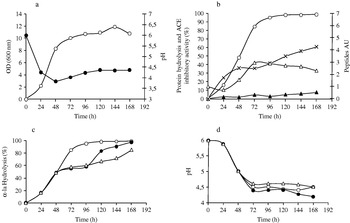
Thirty two microflora extracted from selected ripened cheeses and dairy products were able to grow on acid caprine whey. Five of them were able to degrade whey protein and produce peptides in the culture medium after 72 h of fermentation in micro plates. Microflora were extracted from Bamalou des Pyrénées, Mont d'Or, Pur brebis, Salers and Raclette. They were then inoculated in 5 ml crude whey for 168 h to ensure that time was not a limiting factor. Major whey protein degradation and ACE inhibitory activities were studied. Results are summarised in Table 1. Fermented whey obtained by the microflora extracted from Bamalou des Pyrenees cheese showed both α-la and β-lg hydrolysis at a level of 99·6 and 7·6% respectively whereas others hydrolysates resulted only from α-la degradation. They displayed ACE inhibition ranging from 42 to 61% for 100 μg of protein tested. The highest ACE inhibitory activity (61±2%) was obtained after the aerobic fermentation of crude whey with the microflora extracted from Bamalou des Pyrénées cheese. Such ACE inhibitory activity was concomitant with the high peptide production leading us to focus our attention on this microflora. The ACE inhibitory activity development during microflora fermentation is shown in Fig. 1b. After 24 h fermentation, the ACE inhibitory activity of 100 μg protein was 23% and increased daily to reach 61% after 168 h. This continuous increase during the fermentation process indicates that new inhibitory peptides were generated or that synergistic effects on ACE inhibition were observed. IC50 (50% inhibitory concentration) was 72 μg/ml±5 after 168 h fermentation. This IC50 value is one of the lowest found for whey protein hydrolysates. The study of Vermeissen et al. (Reference Vermeirssen, Van Camp, Decroos, Van Wijmelbeke and Verstraete2003) showed that fermentation of a whey based medium gave ACE IC50 values over 2730 μg/ml. Fermentation was followed by a simulated gastrointestinal digestion to reach IC50 140 to 70 μg/ml. Hydrolysis of whey by enzymes like α-chymotrypsin can lead to IC50 value of 50 μg/ml (Lourenço da Costa et al. Reference Lourenço da Costa, da Rocha Gontijo and Netto2007). Selection and growth of microorganisms directly on whey after cheese extraction allowed us to obtain good candidates to produce fermented whey with high ACE inhibitory activities without additional enzymes.
Parameters measured during whey fermentation by the co-culture: (a) pH (•) and OD600 nm (○); (b) Hydrolysis of α-la (○) and β-lg (▴), peptides generation (▵), and ACE inhibitory activity (x). α-la hydrolysis (c) and pH (d) measured during whey fermentation by the co-culture after addition of 2 mg cycloheximide/ml (•), or 2 mg ampicillin/ml (▵) or water as control (○).

Major whey protein hydrolysis and ACE inhibitory activities* of peptide enriched hydrolysates obtained from whey fermentation by 5 cheeses microflora
Fermentation of crude whey was performed during 168 h under aerobic condition. Protein hydrolysis percentage and peptide generation were determined by RP-HPLC as described in materials and methods. * ACE inhibitory activity was measured with 100 μg of protein of fermented whey

Non-fermented whey had no ACE inhibitory activity
Characterisation of Bamalou des Pyrenées extracted microflora was performed. Colonial morphology and microscopy analysis allowed the identification of two groups of micro-organisms: lactobacilli and yeasts. A first identification by API® Galleries suggested that the microflora extracted from Bamalou des Pyrénées cheese consisted of only one yeast and one lactobacillus. After taxonomic characterisation, Lb. rhamonosus and K. marxianus were identified.
Isolating a lactobacillus and a yeast is not surprising since both micro-organism are usually present in many cheeses and contribute to proteolysis and flavour development. For example, Bintsis et al. (Reference Bintsis, Vafopoulou-Mastrojiannaki, Litopoulou-Tzanetaki and Robinson2003) suggested that Lb. paracasei subsp. paracasei, Debaryomyces hansenii and Saccharomyces cerevisiae were responsible of the aroma of Feta cheese.
Lactobacilli strains have been frequently used to produce fermented dairy products containing inhibitors of ACE. As an example, Leclerc et al. (Reference Leclerc, Gauthier, Bachelard, Santure and Roy2002) prepared antihypertensive casein enriched milk after fermentation by Lb. helveticus. Lb. helveticus, alone or in combination with yeast, is known for its capacity to generate ACE inhibitory peptides from casein (Yamamoto et al. Reference Yamamoto, Maeno and Takano1999) or from whey protein (Vermeissen et al. Reference Vermeirssen, Van Camp, Decroos, Van Wijmelbeke and Verstraete2003). Other peptides with ACE inhibitory activity have been isolated from milk fermented with Lb. delbrueckii subsp. bulgaricus (Gobbetti et al. Reference Gobbetti, Ferranti, Smacchi, Goffredi and Addeo2000). Lb. rhamnosus is less notorious in the generation of ACE inhibitory peptides. However, Hernández-Ledesma et al (Reference Hernández-Ledesma, Recio, Ramos and Amigo2002) obtained modest ACE inhibitory activity after 72 h of milk fermentation by Lb. rhamnosus but simulated gastrointestinal digestion was needed to generate more potent peptides. It is interesting to note that some strains of Lb. rhamnosus are considered as probiotic. Indeed, Lb rhamnosus GG is a probiotic strain (Salminen et al. Reference Salminen, Isolauri and Salminen1996, Saxelin, Reference Saxelin1997), which has been used since 1990 in fermented dairy products in several countries or as freeze-dried powder for pharmaceutical purposes. The collaborative micro-organism selected with the lactobacillus under our growth conditions was the yeast K. marxianus. K. marxianus is frequently found in cheese (Nguyen et al. Reference Nguyen, Pulvirenti and Gaillardin2000) and isolated from yoghurt and other fermented dairy product (Loureiro & Querol, Reference Loureiro and Querol1999; Pitt & Hocking, Reference Pitt and Hocking1999). This yeast has a great potential for growth on whey, due to its β-galactosidase production when lactose is used as carbon source (Ichaurrondo et al. Reference Ichaurrondo, Yantorno and Voget1993; Klein et al. Reference Klein, Zourari and Lortal2002).
Growth parameter of the co-culture constituted of Lb. rhamnosus and K. marxianus were measured in addition with proteolytic activities toward whey proteins (Fig 1). Lb. rhamnosus and K. marxianus grew on whey (final OD600 nm: 10·79) and produced organic acid leading to medium acidification from pH 6·00 to 4·38 after 168 h fermentation (Fig. 1a). Two distinct phases of protein hydrolysis were observed (Fig. 1b). During the first 72 h, the hydrolysis of α-la was fast and reached 85% to slow down and attain 99% after more 96 h of fermentation. The β-lg hydrolysis reached 8% in 168 h, 13 times less than α-la degradation. At acidic pH, α-la is more susceptible to hydrolysis than β-lg (Schmidt & Poll, Reference Schmidt and Poll1991) which remains intact because of its conformational stability (Reddy et al. Reference Reddy, Kella and Kinsella1988). The generation of peptides was three time higher after 72 h fermentation than in crude whey (2·9 AU of peptides were produced). Hydrolysis and peptide generation were concomitant with the pH decrease indicating that acidic protease(s) could be responsible for the hydrolysis. After 72 h of fermentation, peptide content decreased (2·31 AU after 168 h of fermentation) indicating that peptides were probably further metabolised by micro-organism.
The aforementioned results led us to study micro-organism collaboration inhibiting one or the other by antibiotic addition during a co-culture. Cycloheximide (yeast inhibitor) or ampicillin (bacterial inhibitor) was added after 48 h of co-culture to elucidate the contribution of each micro-organism to α-la proteolysis and medium pH variation. The inhibition of the one or other of micro-organisms considerably reduced the rate of α-la hydrolysis (Fig. 1c) for 48 h after the addition of antibiotic. Hydrolysis became again effective after 120 h fermentation and was faster for the lactobacillus. α-la digestion was complete when lactobacillus was not inhibited and seemed just delayed when yeast subsist in the fermented medium.
Whichever micro-organism remaining after the addition of antibiotic, the pH medium decreased as observed in the co-culture (Fig. 1d) indicating that most of the organic acids were produced during the first 48 h of fermentation by both micro-organisms. Mixed cultures of K. marxianus and Lb. rhamnosus led to enhance proteolysis, indicating a probable interaction. This interaction between yeasts and bacteria has often been observed especially during the later ripening stages of cheeses (Viljoen, Reference Viljoen2001).
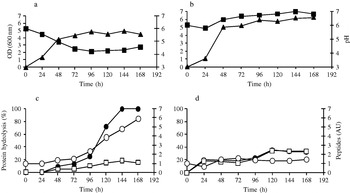
To examine the involvement of single micro-organism in fermentation and protein hydrolysis, lactobacillus and yeast were inoculated separately in whey at 0·061 OD. Results obtained are presented Fig. 2. Lb. rhamnosus was able to grow on whey (OD600 nm: 4·48) (Fig. 2a) and led to medium acidification from pH 6·00 to pH 4·58 after 72 h fermentation. The medium pH remained constant for the following 96 h. Complete α-la degradation was observed after 144 h fermentation (Fig. 2c) and 15·5% of β-lg was hydrolysed. The peptide area increased gradually to reach 5·92 AU after 168 h.
pH (▪) and OD600 nm (▴), hydrolysis of α-la (•) and β-lg (□), peptides generation (○), measured during whey fermentation by (a, c) Lactobacillus rhamnosus and (b, d) Kluyveromyces marxianus.

K. marxianus was also able to grow on whey (OD600 nm: 6·20) (Fig. 2b) and increased pH of the medium from pH 6·00 to pH 6·78 after 168 h fermentation. This result is quite surprising since K. marxianus is known to produce lactic acid (Plessas et al. Reference Plessas, Bosnea, Psarianos, Koutinas, Marchant and Banat2007). Such acid was probably consumed during the stationary phase. Monoculture of K. marxianus allowed similar α-la and β-lg hydrolysis which reached 33·7%. Peptide area remained close to 1·45 AU (Fig. 2d).
α-La hydrolysis was less important than observed for monoculture of Lb. rhamnosus and during co-culture probably because of an inadequate pH for protein denaturation or acidic protease activation.
β-Lb degradation reached 30% indicating that K. marxianus excreted proteases able to degrade β-lg or that the pH of the medium is more favourable for β-lg proteolysis. This result is in accordance with Belem et al. (Reference Belem, Gibbs and Lee1999) which described the production of β-lb oligopeptides from whey based medium after fermentation by K. marxianus var. marxianus.
Fermented whey from monoculture of K. marxianus and Lb. rhamnosus were in vitro tested for ACE inhibitory activities: 100 μg proteins from whey fermented by Lb. rhamnosus had an ACE inhibitory activity of 52±5%. In the same condition, K. marxianus fermented whey had an inhibitory activity of 45±4% indicating that both microorganisms could produce peptides able to inhibit ACE from whey.
Two of the most commonly isolated non-starter lactic acid bacteria are Lb. paracasei and Lb. rhamnosus (Crow et al. Reference Crow, Curry and Hayes2001). Lb. paracasei was previously isolated from Comté after 18 month ripening (Didelot et al. Reference Didelot, Bordenave-Juchereau, Rosenfeld, Fruitier-Arnaudin, Piot and Sannier2006b) in association with yeast: Candida parapsilosis. Both were able to ferment acid goat whey but Candida parapsilosis is an opportunistic pathogen.
Lb. rhamnosus and K. marxianus, selected in this study after cheese microflora extraction and whey fermentation, are Generally Regarded As Safe (GRAS) (Dziekak, Reference Dziekak1987; Saxelin, Reference Saxelin1997). They were able to generate, in the fermentation medium, peptides exhibiting ACE inhibitory activity giving an antihypertensive potential to fermented whey. To confirm the potentiality of both microorganisms to become nutraceutical ferments, subspecies characterisation is needed as well as identification of bioactive peptides.
The fermentation approach will allow in the near future production of whey fermented beverage carefully choosing micro-organism combinations that give rise to high yield of bioactive peptides and some probiotic effect. The yeast-lactobacillus association should be adjusted to find more appropriate conditions for production of bioactive hydrolysates. The ACE inhibitory activity of the hydrolysate observed in vitro must be also evaluated in vivo.
Vanessa Hammé thanks the Conseil General of Charente Maritime for her Ph.D. grant.