Paul Dukas's opera Ariane et Barbe-Bleue (Ariane and Bluebeard, 1907) has been revived during the past decade in noteworthy circumstances. For the first time in its history, not one but two productions of the work were filmed for commercial purposes. Claus Guth's 2011 staging for the Gran Teatre del Liceu, Barcelona was released on DVD in 2013, while Olivier Py's interpretation for L'Opéra national du Rhin (ONR) was broadcast live online in 2015 and subsequently shared on YouTube until mid-2017.Footnote 1 The flourishing opera-video format (via DVD, online streaming, cinecasts), as I elaborate below, has recently been much discussed. One aim of this article is to offer a new perspective on opera's relationship with an audiovisual culture that includes film and television, and harnesses viewing platforms such as YouTube. Following its small-screen revival, Dukas's work has migrated to a media landscape of personalized consumption and digital streaming services. Now one of multiple entertainment options at the touch of a mousepad, it sits alongside films available as DVDs or downloads and television series broadcast exclusively online. But this recontextualization of the opera extends beyond technological reformatting. The 2013 and 2015 opera videos are embedded in a pervasive cultural practice that repackages the Bluebeard myth as drama for today's audiences. The contemporary Ariane resonates in various ways with three major examples from popular culture in 2015: the blockbuster film Fifty Shades of Grey (dir. Sam Taylor-Johnson), the Oscar-winning Room (dir. Lenny Abrahamson), and the first series of the hit Netflix comedy The Unbreakable Kimmy Schmidt.
With the Ariane opera videos framing the action through the lenses of captivity and sexual exploitation, the bigger issue arising from the opera's twenty-first-century revival is that it prompts audiences to reconsider the work's feminist reputation. That originated with the Paris Opéra-Comique premiere on 10 May 1907 and was consolidated with its March 1911 run at the New York Metropolitan Opera. To use the terminology of that time, Ariane was understood as a commentary on the New Woman and its heroine as a socially liberated modern woman. But cultural and social realities nowadays challenge whether spectators can continue to understand this work as one that espouses egalitarian gender ideals. Not only do the recent productions evoke comparison with fictional portrayals of abused women, but they also reimagine Ariane as a commentary on a wave of real-life news stories about abduction, rape, and enslavement committed by Bluebeard-like criminals across Europe and the United States. Watching in the #MeToo era, Ariane further embodies the latest in a string of women systematically abused by the same powerful man. For these reasons, it is time to re-evaluate the work this opera does in the arena of sexual politics. At odds with the historical notion that Ariane endorsed female emancipation, intimations of violence against women are rife in both aforementioned opera videos. My response to this issue contributes to a conversation about opera and sexual violence which has gathered new momentum since 2016.Footnote 2
To start though, I illustrate how audiences developed a feminist reading of the opera stemming from its social origins, libretto and music, and reception c. 1907–11. Subsequently I consider how elements of four separate ‘Bluebeard’ cases that made international headlines in 2006–13 echo in the 2013 and 2015 Ariane opera videos. Finally, I trace how the topical angles those directors bring to the myth are in step with general tendencies prevalent in examples from current popular culture. These tendencies encompass narratives centred on individuals from predominantly white, middle-class, urban social demographics in the US or Europe; the iconic stylization of symbols of freedom (doors, windows, keys, light); and the use of sexual degradation and violence, whether graphically depicted or subtly implied, as pivotal plot devices.
A New Woman in Bluebeard's castle: Ariane et Barbe-Bleue in the early twentieth century
Maurice Maeterlinck's 1899 symbolist libretto for Ariane transformed a story about a man who systematically murders women. In Charles Perrault's original seventeenth-century tale, Bluebeard brings his unnamed bride home to his castle and gives her a grand tour but warns she is prohibited from entering one room. Left alone one day, the woman trespasses into the forbidden chamber and stumbles upon the corpses of her husband's previous wives. Discovering this transgression, the enraged husband intends to slaughter his newly betrothed. She raises the alarm, hastening the arrival of her brothers, who kill Bluebeard and rescue her. Two early twentieth-century operas – Ariane and Bartók's 1911 Duke Bluebeard's Castle – rewrote the Bluebeard plot such that the new bride discovers the other women alive rather than dead.Footnote 3 Bartók's work remains a horror story, though. As punishment for snooping, Bluebeard banishes Judith to his dungeon and repeatedly chants ‘darkness’ as the last words of the opera. The image of Judith the transgressor was appropriated by Susan McClary in 1991 to introduce her own intellectual quest. Like Judith who could not be placated with Bluebeard's gifts, McClary was intent on exploring what was off-limits, ‘asking new kinds of questions about music with the aid of feminist critical theory’.Footnote 4 McClary's analogy has acquired the status of interdisciplinary trope as scholars continue to analyse the sexual politics of the Bluebeard myth.Footnote 5
This musicological legacy renders it difficult not to conceive of Ariane et Barbe-Bleue in feminist terms, at least as a starting point. Pre-McClary, two studies of the opera offered limited engagement with its gender politics. William Angus Moore II uncritically reproduced Dukas's oft-quoted claim that the protagonist ‘does not act by virtue of feminist conviction’; Moore further discussed the ‘heroism of Ariane's actions’ but glossed over the transgressive behaviour this character exhibits for a woman of her era.Footnote 6 Austin B. Caswell reiterated the composer's disavowal of feminist intent but conceded that his setting ‘creates a woman of great force and determination, a feminist leader’.Footnote 7 Yet he concluded that ‘if this opera is to be considered a feminist one . . . then we must accept that it is so by accident . . . in spite of the conscious intentions of both of its authors’.Footnote 8 This is problematic for two reasons: first, it implies that feminism as understood in the Anglophone world during the 1980s (towards the end of the movement's second wave) mapped straightforwardly onto a work that originated in France at a different moment in feminist history (now broadly defined as the first wave). Second, it downplays the agency of Georgette Leblanc, who created the Ariane stage role and tirelessly debated the status of women when promoting the work. Post-Feminine Endings, scholars attended more to Ariane’s portrayals of gender and sexuality. Anya Suschitzky acknowledged the libretto's ‘liberal, erotic and feminist undertones’, including the ‘joyful eroticism of Ariane's encounter with the wives’, which Dukas partly suppressed in his libretto revisions.Footnote 9 Julie McQuinn's study of fin-de-siècle opera discourses is sensitively attuned to Leblanc's input into the libretto and to her indomitable stage presence in 1907.Footnote 10 Elsewhere I have traced how Dukas's revisions to Maeterlinck's libretto enhanced the work's potential feminism.Footnote 11 Later, Helen Julia Minors returned to that libretto, arguing that the revisions diluted the drama's sensuality.Footnote 12 As noted, here I seek to address Ariane in terms of present-day sexual politics.
Feminist and New Woman backstories
Duke Bluebeard's Castle concludes with the stage shrouded in darkness and Judith condemned to her fate as Bluebeard's prisoner. Ariane’s bright symbolism of dazzling diamonds and streaming sunlight augurs a better outcome – a feminist ending, so to speak – for its female protagonist. In Act Three a group of local men attack Barbe-Bleue, granting his captives an escape opportunity. But the first five wives he locked up fuss over his injuries, refusing to abandon him or their dysfunctional family unit. His newest bride departs alone, leaving the place known as Orlamonde. Intertextual knowledge of Maeterlinck's Pelléas et Mélisande (1893) points to the eventual liberation of one of the other women. Pelléas begins with Golaud's discovery of a traumatized woman wandering around a forest in Allemonde. Mélisande's death at the end of that play positions Ariane as a kind of prequel to Pelléas and to Debussy's Pelléas et Mélisande (1902). Mélisande is a minor character in Ariane, along with the other wives Ygraine, Bellangère, Sélysette, and Alladine.
In categorizing Ariane as a New Woman work, I borrow a phrase coined in 1894.Footnote 13 This cultural trope was central to Mona Caird's novel The Daughters of Danaus (1894), which explored the life of fictional composer Hadria Fullerton.Footnote 14 Shortly after moving to Paris to launch her career, Hadria is obliged to return home. A potential suitor reinforces her sense that her freedom was fleeting – ‘he knew that this new womanhood business was only a phase, don't you know’ – and that Paris represented brief parole from a life-sentence of domesticity.Footnote 15 Fate, she laments, ‘lured her on gently, cunningly, closing behind her, one by one, the doors of escape’.Footnote 16 Ariane, in contrast, forces open those doors in a work which echoed turn-of-the-century debates about the status of women.
Before the New Woman became a talking point, there was a burgeoning French feminist movement. The nation's losses in the Franco-Prussian War reinforced expectations that women should focus on raising ‘future French soldiers, workers, and citizens in the best way possible’.Footnote 17 Feminists thus grounded their demands for equality ‘precisely in their roles as domestic wives and mothers’.Footnote 18 Top of their agenda were suffrage, legal reform, and equality in education and employment. Only a few radicals campaigned for contraception and abortion – demands which could be construed as attacks on the family. Mary Louise Roberts cites attitudes towards the home as a key distinction between French feminists of this era and New Women. Whereas feminist activism was sparked by domestic realities, New Women ‘rarely invoked a domestic self in their writings’.Footnote 19 While feminists were expressly political, femmes nouvelles prioritized personal and economic independence, as well as romantic and sexual freedom. As will become clear, however, the early twentieth-century US discourse referred to terminology such as ‘New Woman’, ‘feminist’, and ‘suffragette’ interchangeably.
Leblanc was a model of the apolitical yet ambitious New Woman. When asked in 1912 if she was a suffragette, she replied: ‘from a social point of view, yes . . . from a political point of view, no. I have no interest in voting.’Footnote 20 Leblanc typified the femme nouvelle who remained invested in some aspects of the ‘traditional feminine ideal’, reaping the rewards promised by beauty, respectability, and male approval.Footnote 21 Overall, the New Woman's identity neither comfortably conformed to convention nor tallied easily with ‘histories of resistance to gender norms’.Footnote 22 Still, the trope of an independent woman who chafed against domestic constraints was ingrained by the time Dukas began Ariane. A dramatic prototype existed in Ibsen's A Doll's House (1879), which reached the Paris stage in 1894. In a gesture that reverberates in Ariane, it ends with Nora slamming the door as she walks out on her husband and children. During the following decade the transgressive actions of New Women took centre stage in French theatre, including in opera and ballet.Footnote 23
Hearing the New Woman in the Ariane libretto and score
Written as a vehicle for his partner Leblanc, Maeterlinck's drama captures her disregard for the norms of marriage and monogamy. Flouting social and moral codes, she had cohabited with Maeterlinck since the mid-1890s despite being married to another man. Although France had legalized divorce in 1884, the Catholic Church refused to dissolve Leblanc's union. While living with Maeterlinck, she had affairs with other men and women.Footnote 24 Ariane attacks the institution of marriage and advocates liberal attitudes towards relationships and sexuality. Maeterlinck started by making Barbe-Bleue a mostly absent, abusive husband. He spits a few words at Ariane after she violates his orders not to unlock the last door – and this outburst constitutes the full extent of his vocal part. The confrontation occurs towards the end of Act One and begins as follows:
Barbe-Bleue (approaching): You too?
Ariane (quivers, turns around, leaves the vault and glittering diamonds, advances towards Barbe-Bleue): Me, especially.
Barbe-Bleue: I had thought you were stronger and wiser than your sisters.
Ariane: How long have they suffered this subordination?
Barbe-Bleue: A couple of them a few days, some of the others a few months, the last one a year.
Ariane: It was only the last one who should have been punished.
Their argument continues, culminating with the stage direction: Barbe-Bleue tries to drag Ariane by force; she gasps a long, painful cry.Footnote 25 Her screams prompt local men to attempt a rescue mission. Recovering her composure, she shoos them away, protesting that he has not harmed her. Ariane returns towards Barbe-Bleue is the last stage direction before the curtain falls on Act One. For modern spectators this scene is a portrait of Ariane as a victim of psychological and physical domestic abuse. Barbe-Bleue assaults and imprisons her, while she responds by putting on a front in public to protect him from recrimination. Privately, Ariane is more assertive but still prone to appeasing him. Her response to his confession – ‘it was only the last one who should have been punished’ – is a jarring instance of victim-blaming but could be interpreted as a battered wife's attempt to mollify her abuser or rationalize his actions.
Judging this scene by the standards of the early 1900s, however, Ariane's denial of her husband's wrongdoing and decision to manage the situation alone serve her image as an independent, assertive New Woman, as does her criticism of the passive woman held hostage for a year. That is how Dukas read and musically responded to the libretto. Writing in 1910 about his opera, he interpreted the central relationship as a complex one and essentially rejected any notion of Ariane as a victim. He said:
she immediately dominates the situation. Barbe-Bleue does not inspire any fear in her . . . She does not hate Barbe-Bleue at all; on the contrary, she loves him, as she loves all natural power . . . The relationship between Ariane and Barbe-Bleue is particularly interesting and must be suggested with sensitivity . . . he establishes with Ariane a kind of tacit complicity.Footnote 26
Dukas's view of the couple's ‘tacit complicity’ resounds in his score. Perceived similarities between Ariane and Barbe-Bleue, plus what he called ‘the absolute opposition between Ariane and her companions’, guided his compositional characterization.Footnote 27
Those latter women are differentiated from the protagonist through their compliance with traditional values and status as passive sex objects. Ariane's eventual decision to leave her dysfunctional marriage involves abandoning her surrogate sisters. Their Orlamonde prison symbolizes suffocating domesticity, with one of its inhabitants even regressing to the role of distressed child. The otherwise silent Alladine sobs and turns to Ariane for maternal comfort. The heroine's abnegation of quasi-familial responsibility chimes with societal concerns that domestic order was under siege, with the country heading for a depopulation crisis. Between 1871 and 1911, French population growth was the lowest of any European state.Footnote 28 Among the causes blamed were women's desire for bodily autonomy and the pursuit of decadent pleasures.Footnote 29 Moral crusaders frowned upon sex for gratification rather than reproductive purposes. As part of its marriage critique, the Ariane libretto flirts with the Sapphic subculture that frequently formed part of the New Woman image. Theatrical figures such as Sarah Bernhardt and Leblanc conducted lesbian relationships, and in the early 1900s women ‘began writing about their experience of female same-sex desire from their own perspective’.Footnote 30 The evocation of lesbian desire in Ariane, including some nuanced distinctions between Maeterlinck's published text and Dukas's final libretto, therefore merits scrutiny.
After securing permission from Maeterlinck to make minor revisions, Dukas toned down the main erotic scene. At the start of Act Two Ariane wanders in darkness searching for the source of a song she has heard and stumbles across the women. Elements of the playwright's portrayal of Sapphic desire pander to the male gaze, with Mélisande, Sélysette, Bellangère, Ygraine, and Alladine introduced as a quivering mass of nubile flesh. Identical stage directions in the play and opera refer to how Ariane runs to the women and caresses them, groping around.Footnote 31 Dukas's heroine then cries: ‘I feared I would find them dead and am now in tears kissing the sweet creatures!’Footnote 32 The playwright's more sensual Ariane originally spoke about kissing the women's ‘sweet lips’ and caressing their ‘round breasts’.Footnote 33 In the modified libretto, Ariane's hands stops at their ‘round shoulders’.Footnote 34 While Maeterlinck's protagonist surrendered to her desires – ‘all around me I'm kissing naked bosoms and lips’ – Dukas rewrote this passage to stress the humanity of these women: ‘What spring has suddenly burst from the shadows! Your eyes sparkle and I can feel your breath on my hands!’Footnote 35 Ariane's final monologue still partly objectifies the other women as her playthings and titillates the audience – but with the offstage Barbe-Bleue denied the same scopophilic thrills, it partly decouples sexual pleasure from the male gaze.
Further revisions amplify the contrasts between Ariane and her companions. In Act Three of Maeterlinck's text, Ariane, anticipating freedom, briefly speaks about preparing for life outside Orlamonde. In a new passage Dukas wrote, she gives a longer speech. Addressing Alladine first, the protagonist begins: ‘under our clouds, the sun shines less brightly, the flowers are less brilliant and the birdsong duller. Thus, women should always follow the examples of the birds and flowers, who translate the sun's ways for them.’Footnote 36 She preaches a message steeped in essentialist rhetoric about ‘natural’ behaviours expected from women, while resisting those norms herself. The conversation turns to jewellery as she distributes Barbe-Bleue's wedding gifts: pearls for Ygraine, sapphires for Mélisande, an opal and amethyst necklace for Bellangère, and emeralds for Sélysette.Footnote 37 In Act One Ariane was unmoved by these treasures whereas now they impress the other women. The only jewels Ariane admired were diamonds whose ‘light that penetrates everything’ symbolized the truth and clarity she sought.Footnote 38
To return to my earlier point, Dukas's musical language evokes the New Woman through two main musical processes: first, the ‘tacit complicity’ between the central couple is expressed symphonically and vocally; second, the ‘opposition between Ariane and her companions’ is projected vocally. As detailed below, Ariane was lauded as a symphonic score, with this trait cited as evidence of a masculine aesthetic. But the opera demands the leading lady's presence on stage throughout. The vocal writing is not unusually virtuosic but there is little respite. Leblanc's creation of the part almost certainly represented her first enactment of Ariane in any theatrical context. Contrary to claims that she portrayed the character previously, this drama only reached French readers when published in 1901.Footnote 39 Leblanc's memoir solely refers to ‘Ariane in 1907’; remembering the text as a ‘story, which Paul Dukas put to sensuous music’, she distinguished it from Maeterlinck works that originated as plays in which she also starred.Footnote 40 The composer wrote for a performer whose strengths and limitations he had studied during his tenure as a critic, having reviewed her in operas such as Alfred Bruneau's L'Attaque du moulin (1893) and Alexandre Georges's Charlotte Corday (1901). On the first occasion he said nothing about her musical ability – a silence that might be read as diplomacy, for eight years later he championed her ‘exceptional aptitude’ as an actress in Charlotte Corday but could only say that she ‘worked courageously’ as a singer.Footnote 41 Leblanc revelled in her unorthodox methods. A self-described actress ‘free from all that was stereotyped’ who ‘broke with the tradition of the period, in which the singer . . . was always held on the leash of the conductor's eye’, she admitted that her voice sometimes got ‘lost in the wings’.Footnote 42 Her account of travelling to Granada for dance lessons with a ‘real gypsy’ in preparation for playing Carmen in 1898 indicates she was more committed to realistic expression and movement than to vocal technique.Footnote 43 Ariane’s writing appears designed to capitalize on that approach.
Same as other fin-de-siècle composers and critics, Dukas was grappling with what constituted opera – first, in a post-Wagnerian landscape when he began Ariane and, second, in a post-Pelléas era by the time of its conclusion. Before embarking on this project, he had praised the so-called ‘French Parsifal’, Vincent d'Indy's Fervaal (1897), as ‘the first-born of French symphonic drama’.Footnote 44 Ariane is a symphonic-drama sister work to Fervaal and bears a family resemblance to d'Indy's Symphony No. 2 (1904), from which Dukas borrowed the third movement's folk-tune for ‘Les Cinq Filles d'Orlamonde.’ Of course, Ariane has a further relation in Debussy's Maeterlinck opera. Like Pelléas, Ariane’s vocal writing mostly but not uniformly comprises accompanied recitative. Other Debussy influences include the use of the whole-tone idiom in a tonal context and the quotation of his pentatonic Mélisande motif. Those aspects of Ariane situating it dialogically with d'Indy and Debussy were somewhat overshadowed by another aspect of its reception history. Days before Dukas's premiere, Strauss conducted the first Paris production of Salome. Fauré’s judgement on this work – that Strauss had composed ‘a symphonic poem, with vocal parts added’ – became the anchor for critical responses to Ariane.Footnote 45
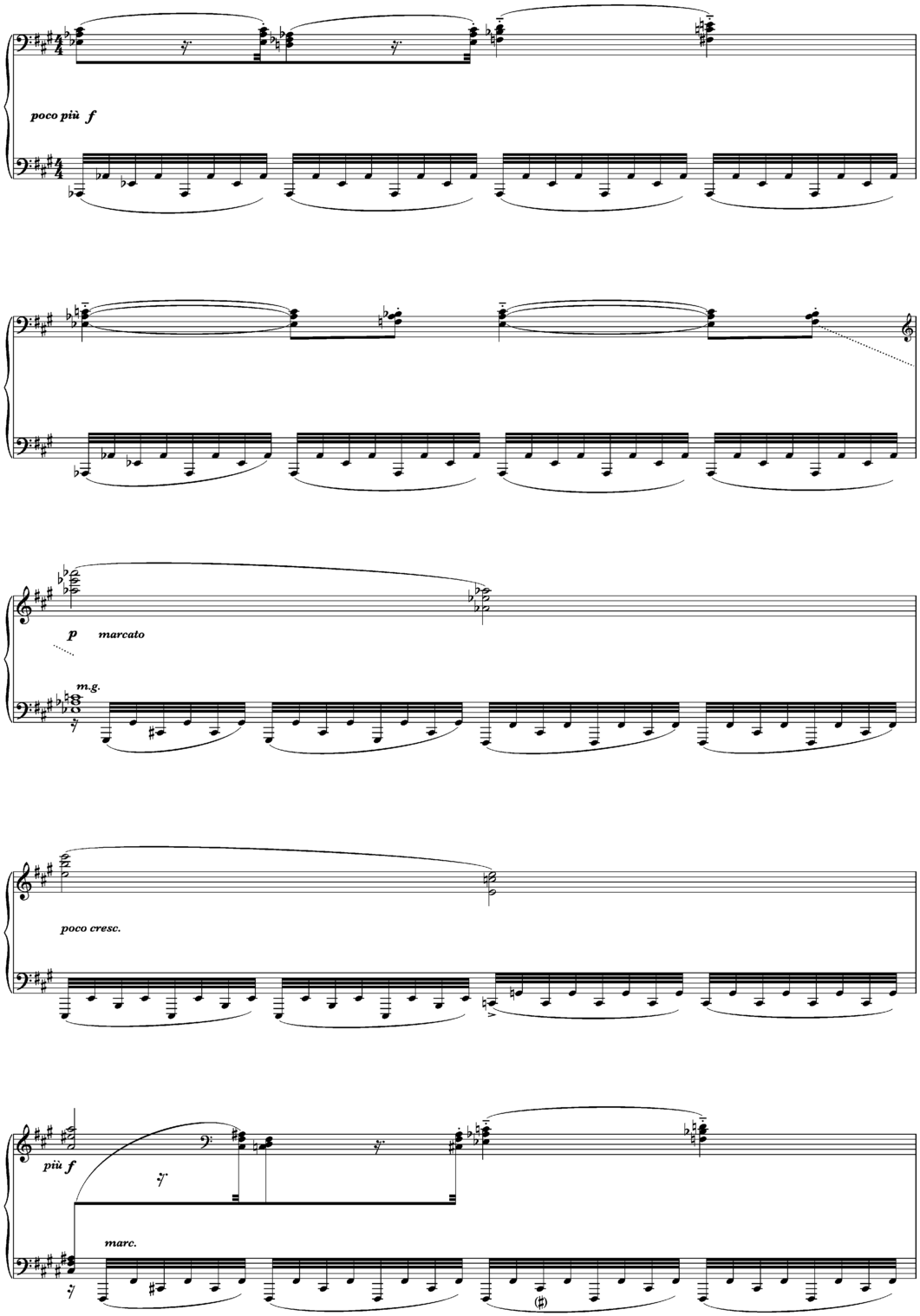
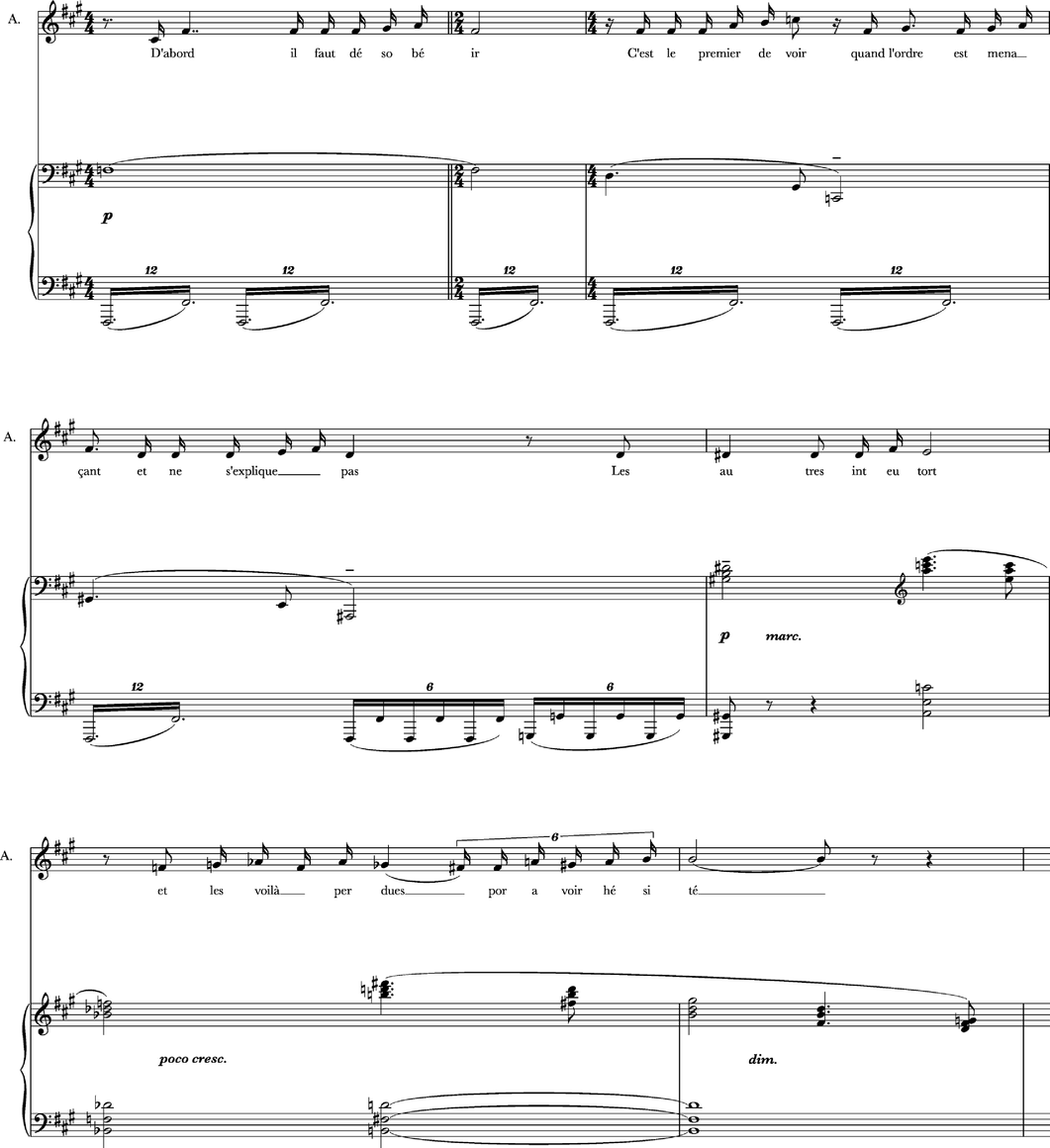
Ariane begins and closes in F♯ minor, the tonic suggesting darkness, Bluebeard's castle, and the unknown. Later, the parallel F♯ major key stands for light, freedom, and truth. The Act One prelude outlines two motifs respectively associated with Ariane (first heard in bb. 12–14) and Barbe-Bleue (first heard in bb. 18–20) (Example 1).Footnote 46 The brass fanfare and decisive dotted rhythm of Ariane's motif heralds her arrival in Orlamonde, while Barbe-Bleue's leaden guttural motif plunges tritonally into murky depths. Dukas embeds both characters into the symphonic framework, placing husband and wife on a level footing. This decision accords with his belief in their mutual understanding and circumvents the issue of Barbe-Bleue's physical and vocal absence from the stage. Prowling in its orchestral shadows, the brutal patriarch pervades the score just as he haunts his victims’ thoughts. For example, a reminiscence of the motif sounds on solo bassoon when Ariane announces to her ever-present Nurse in Act One: ‘First of all, we must disobey him. It's the only way when an unexplained threatening order is given’ (Example 2).Footnote 47 Beyond his limited vocal utterances, he possesses a proxy symphonic ‘voice’ that reflects perceptions of his evil omnipotence.
Paul Dukas, Ariane et Barbe-Bleue, Act One. Reduced vocal and piano score (Paris: A. Durand & Fils, 1906). Act One prelude, pp. 3–5, bars 12–20. © With kind authorization of Editions Durand.

Dukas, Ariane et Barbe-Bleue, Act One. Reduced vocal and piano score, p. 32. © With kind authorization of Editions Durand.

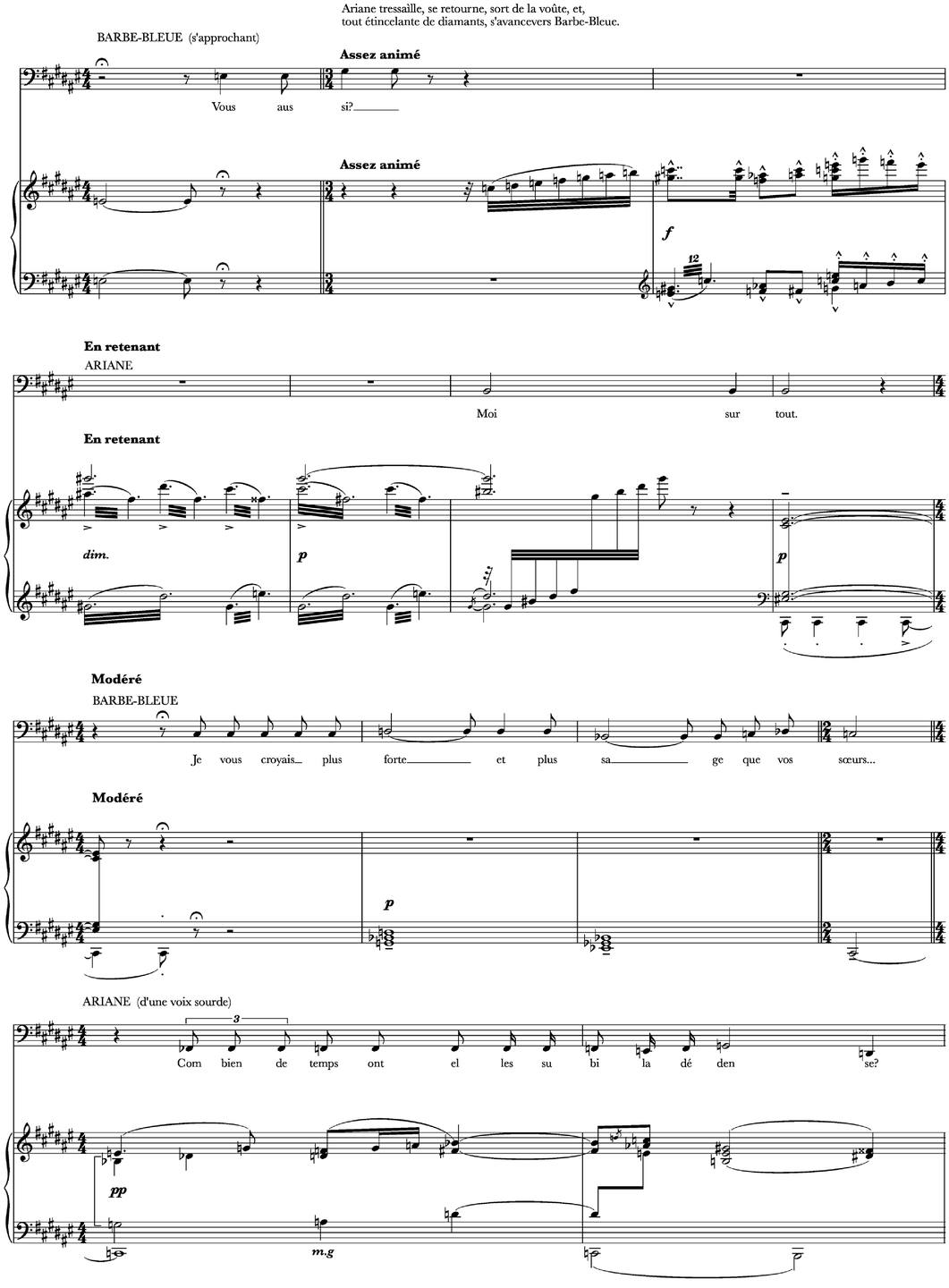
Before addressing how Dukas composed the Act One confrontation, it is instructive to consider Ariane's first words. Refuting allegations that previous wives were murdered, she quietly avers ‘they are not dead’. In retrospect, her measured, almost monotone delivery hints at a marital bond with Barbe-Bleue, for she appropriates what is subsequently revealed as his syllabic, mostly unaccompanied recitative idiom.Footnote 48 Now, to their row. The orchestra falls silent as he barks ‘You, too?’ (Example 3). A variant of the Ariane orchestral motif responds before she does – her riposte ‘Me, especially’ seems eerily prescient for the #MeToo era. A tentative accompaniment underpins Barbe-Bleue's next insult – ‘I had thought you were stronger and wiser than your sisters.’ Remaining calm, Ariane responds in the same unemotional tone, asking how long they have suffered, but the orchestra grows impassioned as her continued questioning infuriates Barbe-Bleue. It explodes in a recurrence of his prelude motif as he hauls her away.
Dukas, Ariane et Barbe-Bleue, Act One. Reduced vocal and piano score, p. 77. © With kind authorization of Editions Durand.

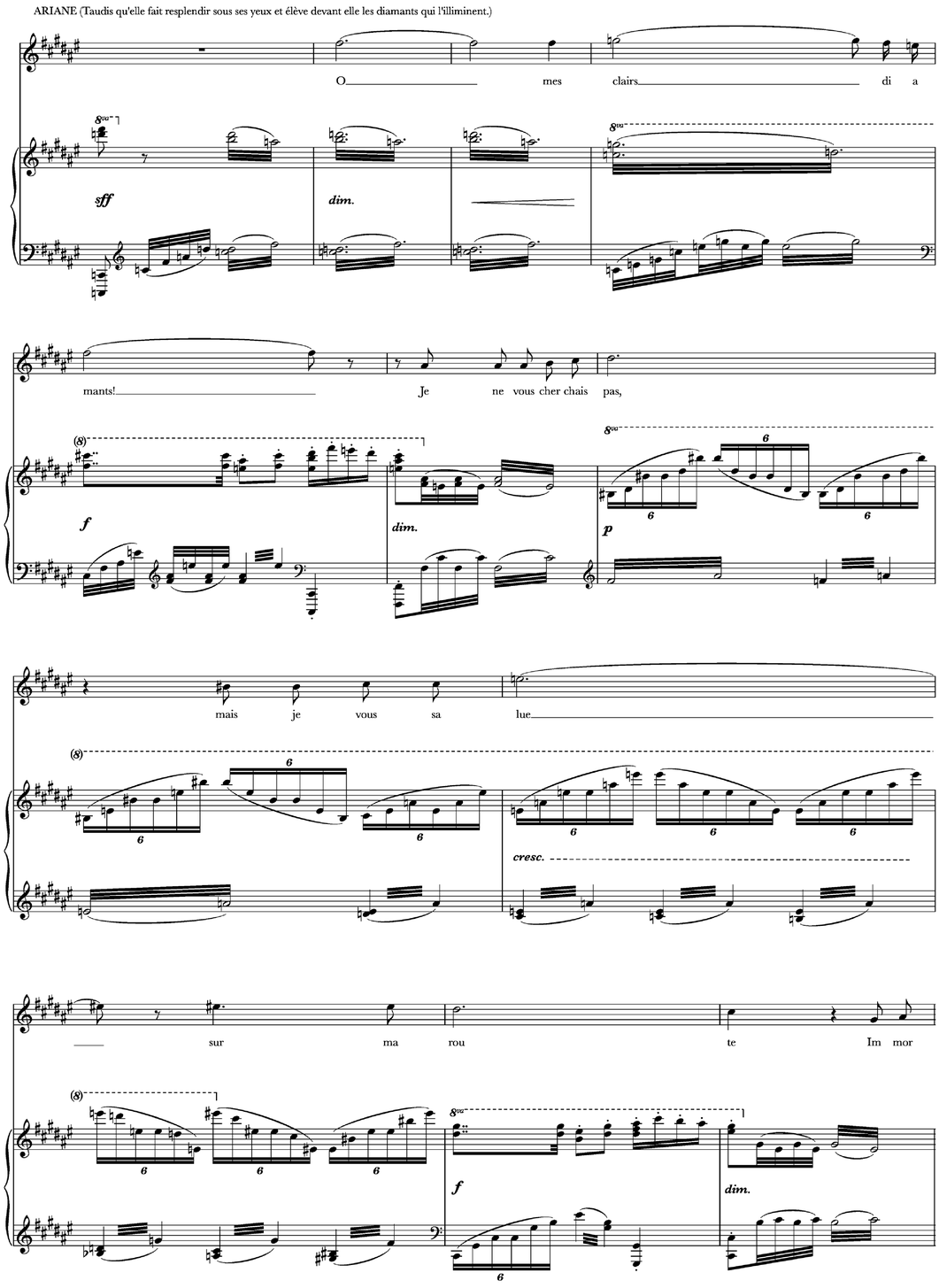
Appropriately for a New Woman, Ariane is written for that non-conforming voice-type, the mezzo-soprano. The mezzo, Catherine Clément writes, ‘possesses active thought; she is articulate’; citing Carmen, Clément asserts that the mezzo ‘poses resistance to each and every order’.Footnote 49 Similarly, Elizabeth Wood theorizes a ‘Sapphonic voice’ that primarily articulates ‘lesbian difference and desire’ – which we could link to the Ariane of Act Two – but also applies to heterosexual mezzo roles such as Carmen.Footnote 50 That ‘powerful and problematic, defiant and defective’ voice challenges ‘polarities of both gender and sexuality as these are socially – and vocally – constructed’.Footnote 51 Ariane, at first on the same wavelength as Bluebeard as far as their characters are symphonically and vocally projected, defies this default musical order with the ‘Diamond Aria’ that comprises the sixth, climactic variation of the Act One ‘Jewel Scene’. Based on the Ariane prelude motif, these variations correspond to the unlocking of the six doors and the types of jewels behind each one. Indifferent to the first five discoveries, the heroine bursts into a voluptuous aria at the sight of the sparkling diamonds, her voice soaring and swelling in a high tessitura (Example 4, start of Diamond Aria).Footnote 52 The tutti orchestral accompaniment reinforces the drama. By basing this scene on the orchestral Ariane motif, Dukas interwove symphonic motivic drama and heightened vocal expression in a potent, expansive style that departs from the subtleties of Debussy's opera.
Dukas, Ariane et Barbe-Bleue, Act One. Reduced vocal and piano score, pp. 60–61. © With kind authorization of Editions Durand.

Ariane, this music indicates, is a versatile communicator, unlike her husband who trades in grunts and glowering. Her outspoken ways have little in common with the other wives either. In an instance of diegetic music late in Act One, we encounter these women via the whispered strains of ‘Les Cinq Filles d'Orlamonde’ seeping from a subterranean cell (Example 5). What begins as a muffled wordless chant blossoms into a plaintive folk-tune sung in unison from women who remain out of sight until Act Two. Their voices serve as instruments of pleasure rather than power, lingering melismatically on poetic rather than prosaic words. As opposed to the independent protagonist for whom even a duet is out of the question, these women sing collectively. In this context, their musical characterization is coded as stereotypically feminine.Footnote 53 Moreover, their performance acts as a siren call to Ariane. Owing to this dramatic function and the use of folk melody, the Orlamonde song recalls the Pelléas scene where Mélisande seduces Pelléas by singing ‘Mes longs cheveux’ from her tower.
Dukas, Ariane et Barbe-Bleue, Act One. Reduced vocal and piano score, pp. 71–2. © With kind authorization of Editions Durand.

The divergence between the folksong and Ariane's complex compositional portrayal symbolizes the distance between the women. Unlike the protagonist, the other wives struggle to communicate, with Alladine lacking the capacity for self-expression. Sélysette explains to Ariane: ‘she does not speak our language . . . She still hasn't stopped crying.’Footnote 54 Alladine is a mimed role, reduced to an exotic feminine trope in the orchestral part by a solo oboe sounding undulating figures inflected with augmented seconds.Footnote 55 Voice, as the Ariane creator Leblanc was acutely aware, is essential to female selfhood in this opera.Footnote 56
Leblanc's New Woman legacy to Ariane in Paris and New York, 1907–11
In character at the Opéra-Comique and behind the scenes, Leblanc assumed a New Woman identity that drove the work's early reception. She also championed women's issues in the New York press around the time of the work's Metropolitan Opera premiere, which was conducted by Arturo Toscanini on 29 March 1911. Transatlantic audiences proved more receptive to Leblanc than French reviewers in 1907 who had derided her multifaceted contributions to the opera. Louis Laloy complained that parts of the libretto were beneath a poet of Maeterlinck's calibre and asked: ‘Are they more worthy of Mme Georgette Leblanc?’Footnote 57 His disdain is apparent: ‘We would be more interested in [Ariane] if she spoke a bit less and did not churn out real nonsense to her companions, such as “Where do you hide your divine arms?”’Footnote 58 Laloy had correctly intuited Leblanc's stamp on Ariane. She later confirmed to an American reporter: ‘Maurice came to me one day and said, “Georgette, for four years I have followed you about, taking down things you said. Finally I had enough for a play. Here it is. I have written it about you and for you.”’Footnote 59 Laloy might have known of Leblanc's prior influence on her partner's Wisdom and Destiny, which began: ‘To Madame Georgette Leblanc: I dedicate this book to you, which is, so to speak, your work. There is a higher, truer collaboration than that of the pen – that of thought and example.’Footnote 60 Henri de Curzon recognized this ‘thought and example’ in Ariane. Almost conflating person and stage persona, he said the singer was ‘the incarnation of her character, such that one could not imagine the role without her; and her vocal weaknesses . . . are often compensated for by poetic diction and expression which leave nothing to chance’.Footnote 61 A likeminded Dukas appreciated Leblanc's intellectual commitment to the part but was disappointed by her voice. After watching his opera at Belgium's Théâtre Royal de la Monnaie in 1909, he confided to a friend: ‘We did not have Georgette's multiple intelligent intentions here, but we did get to hear the character at last, who until now was reduced to a few sublime gestures and less sublime hiccups.’Footnote 62
The question of what audiences heard in May Reference Laloy1907 was a loaded one. While Laloy reprimanded Ariane for having the temerity to speak, such a step seemed hardly necessary to other critics. The ‘curiously violent character of the harmony and sonorities’ in the opera reassured Litté that ‘Dukas's most remarkable quality is his virility’.Footnote 63 Further coding the score, especially its symphonic foundation, as masculine, Alfred Bruneau admired the composer's ‘architectural strength, instrumental genius, virility’.Footnote 64 Reference to Dukas's symphonic aesthetic became a common refrain.Footnote 65 Laloy, à la Fauré’s response to Salome, repeatedly tried to persuade the public that the opera was a symphonic poem: in one review he labelled it ‘a symphonic poem, developed according to the eternal laws of motivic relationships and variation’.Footnote 66 Elsewhere he judged the libretto ‘superfluous’, repeating his ‘symphonic poem, ornamented with song’ comparison.Footnote 67 Laloy's attempts to strip the opera of its text and silence its mostly female characters mirror his effort to stifle Leblanc's voice.
His tactics failed. Covering the production for an August 1907 article, a New York Times correspondent began by noting that at least one demographic appreciated and scrutinized the libretto:
All Paris, particularly the tout Paris feminine, which so prides itself on its intelligence and progressiveness, is discussing the new work at the Opéra-Comique . . . The Belgian philosopher has chosen to set forth his views on women in the form of a highly spiritualized version of the old nursery story. An added interest comes from the fact that the leading role in the opera is taken by Mme Georgette Leblanc, his wife, who symbolized the new woman, the liberator of the poor little wives.Footnote 68
This became the main angle of US interest for the next few years. In an interview printed two days before the New York premiere, Met director Giulio Gatti-Casazza said:
Ariane et Barbe-Bleue has interested me from the beginning . . . the subject of the book interested me. It is fin-de-siècle if you like; it treats of the feminist question, and all the world is talking of suffragettes right now.Footnote 69
Leblanc had been promoting that agenda to US audiences since Reference Leblanc1910 when the New York Times published her essay on Maeterlinck's heroines. Anointing Ariane ‘the daughter of the present’, she explained that the character is ‘complex, doubting and inquiring’ but ‘her revolt is smiling and full of grace’.Footnote 70 With ‘New Woman’ having entered the transatlantic lexicon as a shorthand for Ariane in August 1907, Leblanc's piece strengthened an association that became solidified in January 1911 when the New York Times ran an article headlined ‘Bluebeard and the New Woman in an Opera’.Footnote 71 In a full-page spread illustrated with photographs of Leblanc and New York cast members, the author announced: ‘Ariane is doubtless the New Woman’. Interpreter Geraldine Farrar demurred on this point, however, asserting in an interview which formed part of the article that the opera could be interpreted as ‘an allegorical satire on the feminist question’ or ‘a fairy story’.Footnote 72
The gendered nature of Farrar's fame and her career trajectory compare to Leblanc's. Like her French counterpart who starred in the 1924 silent film L'Inhumaine, Farrar was an opera singer who became a cinema sensation. Her energetic screen debut in 1915 as Carmen informed her Met interpretation of this role in 1916, when she pursued a realistic approach to opera reminiscent of Leblanc's practices.Footnote 73 She too attracted legions of female fans (known in the 1920s as ‘Gerry-flappers’) and was quizzed by male journalists about the psychology of subversive heroines such as Carmen and Ariane.Footnote 74 Theorising Ariane's motivations, she told the author of the 1911 article: ‘It isn't exactly a suffragette matter, it is larger than that. The question is whether women aren't as intelligent as men, equal to them in every way.’Footnote 75 Reassuring readers she had ‘no intention of making Ariane a forcible woman’, Farrar was of a similar mindset to Leblanc, whose ‘feminism was not militant’.Footnote 76 Farrar's emphasis on a philosophy ‘larger’ than feminism probably reflects Dukas's influence, his insistence that the protagonist is driven instead by her ‘superior, supernaturally good and active nature’.Footnote 77
Farrar and Dukas had met in July 1910 and rehearsed together over the summer. The singer had struggled with the score but, convinced it was ‘all important that the words be understood’, she devised a plan: ‘I worked out a scheme where I could half speak, half sing the notes. I laid this plan before Mr Dukas . . . He told me he was delighted with it.’Footnote 78 Her performance was well received.Footnote 79 Yet rendering a predominantly recitative part more speech-like exaggerated the gulf between Ariane's vocal idiom and her companions’ more lyrical style. This characterization reinforced the protagonist's tendency to break ranks with gender convention. So, despite equivocating about how to conceptualize the role, Farrar's approach re-inscribed a ‘New Woman’ interpretation as instigated by Leblanc. US audiences continued to frame Ariane thus, as evident from two pieces on Leblanc published nearly a year later. The first, ‘Maeterlinck's Work as His Wife Sees It’, is subtitled: ‘Famous actress and singer gives her views of the dramas he has written. One was inspired by her. She has distinctly progressive ideas, revels in quaint costumes, and advocates suffrage.’Footnote 80 In the second, Leblanc reportedly described herself as a ‘modern woman’, a ‘woman of ideas’.Footnote 81 As she told the interviewer: ‘I love your liberty here . . . the idea that women can do what they want.’Footnote 82 By 1912 Ariane epitomized the liberated woman but a century later she was recast as a victim of abuse and enslavement.
Ariane in the twenty-first century: ‘Bluebeard’ crime across Europe and the United States
The first audiences of Ariane noticed how the work played out tensions that fuelled feminist movements. Public discourse about the New Woman and the existence of books and plays on this theme prompted operagoers to interpret Ariane in gendered terms. Now, with directorial assistance, the contemporary opera-video viewer is primed to receive Ariane as a statement about gendered violence. Whereas the post-1900 protagonist embodied female emancipation, to the present generation she more readily symbolizes several North American and European women who over the course of three decades from 1984 to 2013 were imprisoned (and eventually escaped) in circumstances reminiscent of those portrayed in the opera. While these cases represent extremes of abuse, they lie on a spectrum of gendered violence that also encompasses domestic abuse and sexual harassment. The post-2000 Ariane opera videos allude to various points on that spectrum as well as to the heinous ‘Bluebeard’ abductions.
On 23 August 2006, eighteen-year-old Natascha Kampusch fled from a seemingly unremarkable house on a street in the town of Strasshof an der Nordbahn, Austria. She had been held captive for eight years, spending most of that time in a tiny cellar beneath her kidnapper's home where she was raped or in the house proper where she was treated as a skivvy. Not unlike Barbe-Bleue confronted with his diminishing power at the end of Dukas's opera, Wolfgang Přiklopil realized that his victim's escape meant defeat; he consequently killed himself hours after Kampusch bolted. Media interest in this abduction remained high for years afterwards partly due to Kampusch expressing a degree of sympathy for her kidnapper. As explained below, this aspect of the case mirrors the complexity of the Ariane/Barbe-Bleue relationship. Less than two years after Kampusch escaped, an unfathomably chilling story broke in Austria again. In April 2008, Elisabeth Fritzl stepped into the outside world after twenty-four years of incarceration in the basement of her family home. Imprisoned at eighteen and repeatedly raped by her father Josef Fritzl, she gave birth seven times during those years. One of her surviving children experienced a medical emergency which sparked the unravelling of Fritzl's double life with his ‘missing’ daughter and their children in a purpose-built dungeon. Echoing how Ariane begins with local men sounding warnings about Barbe-Bleue's violent past, the Fritzl backstory starts with his known history of attacking women before he set his sights on his daughter. Not unlike Ariane either, Elisabeth was set free by the truth: a tip-off to police from the hospital where her daughter received treatment led to Elisabeth and her father being taken into custody, where she could safely reveal his secrets.
Other mysterious disappearances in the US were solved around the same time as the Austrian crimes. In 1991, eleven-year-old Jaycee Dugard vanished. Abducted near her California home by Phillip and Nancy Garrido, she lived in a compound behind their house for eighteen years where Phillip Garrido regularly raped her. After giving birth to two daughters by Garrido, she was confined to tents and outbuildings with her children. In 2006 they were noticed by neighbours who raised the alarm. Yet, in echoes of Ariane’s opening scenes where local concerns go ignored, the Garrido property was not searched, despite his status as a registered sex offender with a history of abduction.Footnote 83 Dugard and her daughters remained captive until the Garridos’ arrest in 2009. By then three other women and a child were years into their incarceration at the hands of Ariel Castro in Cleveland, Ohio. On 6 May 2013, they were rescued. One aspect integral to the Perrault plot and Maeterlinck–Dukas opera absent from the other three cases survives in this grotesque re-enactment of Bluebeard. Castro imprisoned multiple young women, one at a time, over an extended period. Twenty-one-year-old Michelle Knight was his first victim in 2002, then sixteen-year-old Amanda Berry in 2003 (with whom he fathered a daughter in 2006), and fourteen-year-old Gina DeJesus in 2004. In a fortress-like house they were brutally assaulted until 2013, when Berry realized Castro had gone out leaving a door unlocked. She caught neighbours’ attention by screaming and – evoking images of Ariane fracturing a window pane in Act Two – forced a crack in a door to escape. Assisted by neighbours, Berry alerted police to the scene to rescue the others.
In all cases, the abductors’ private properties doubled as crime scenes, where girls and women were coerced into pseudo-relationships of a sexual and domestic nature, deprived of their autonomy for years on end. Given the parallels to Ariane and the proximity of these news stories to the 2013 and 2015 opera videos, it was perhaps inevitable that these stories would form part of the work's contemporary revival.
Ariane as opera video: on DVD (2013) and on YouTube (2015)
In Reference Morris2010 Christopher Morris highlighted the growing significance of the opera-video format: ‘Opera on video now proliferates in so many forms that belittling it as a second-hand imitation, supplement, or record of something that happened elsewhere begins to seem hopelessly inadequate: its here and now is increasingly found in its remediated form.’Footnote 84
Remediation – first theorised in relation to digital media by Bolter and Grusin in the late 1990s – here refers to the intervention of video technology in repackaging and (re)presenting opera for television broadcasts, live cinema screenings, DVD releases, and online streaming.Footnote 85 Elsewhere Morris writes that opera videos remain ‘very much their own medium’, playing a dual role as ‘document of a creative act and creative artefact’.Footnote 86 Focusing on the DVD format, Roger Parker notes that the medium ‘has textualized opera anew’,Footnote 87 while Carlo Cenciarelli argues that DVD producers ‘place opera in a richer dialogue with contemporary visual culture’.Footnote 88 To these observations I add that opera on YouTube constitutes a further, quintessentially twenty-first-century remediation of the genre.
Analysing opera video's place in contemporary culture, Cenciarelli cites the materiality of the DVD – its paratexts of cover design, camera stills, menu interfaces and so on. Áine Sheil's study of opera DVD paratexts traces how ‘bonus materials’ such as interviews with stage directors enable companies ‘to promote . . . discs in terms of cultural value and timelessness’.Footnote 89 Hedda Høgåsen recognizes in opera DVDs the ‘potential to create new canons of (theatrical) interpretations’.Footnote 90 Building on this scholarship, I argue that the Ariane opera videos and paratexts on DVD and YouTube generate a new understanding of Dukas's work. While these ‘creative artefacts’ present different visions of the opera, both are rooted in the realism of the recent ‘Bluebeard’ crimes. They comprise remediations that reach beyond technological intervention to construct new meaning. In a world where Dukas's opera remains a relative stage rarity, the force of enduring, digitally rendered, widely accessible opera videos should not be underestimated.
Opus Arte produced the 2013 Ariane DVD from Guth's 2011 Barcelona staging. Mixed reaction to the DVD centred on objections to Guth's presenting the opera in the shadow of the abduction scandals. ‘Is Bluebeard's castle, here a routine suburban two-storey, intended to be recognized as the house in Amstetten where Joseph Fritzl kept his daughter in a dungeon?’ queried Max Loppert in Opera Magazine.Footnote 91 On the BBC Music Magazine website, Christopher Dingle complained that by ‘alluding to high-profile cases of women being held against their will’, Guth ‘misfires in several key respects of the drama’.Footnote 92 Andrew Moravesik in Opera Today lamented that Guth ignored ‘existential and historical undertones’ in favour of a ‘topical setting’ that portrayed Barbe-Bleue as ‘a suburban psychopath’.Footnote 93 Despite this resistance, the production was brought into the canonic fold and screened during a festival at the Paris Louvre in late 2014.Footnote 94
In distinction to such ‘event broadcasting’, private viewing of opera-video DVDs facilitates a bespoke user experience. Interactive menus allow instantaneous revisiting of scenes. Subtitles (in multiple languages) are optional. ‘Binge-watching’ opera without enforced intervals is possible. In short, this format fosters a personalized mode of consumption that mimics viewing patterns associated with mass-audience, popular-culture streaming platforms such as Netflix. Awareness of this cultural slippage is crucial given that the twenty-first-century Bluebeard has been sighted in films, a television comedy, and music video too.
The paratexts of this Ariane DVD seem designed to jog viewers’ memories of where they last saw the suspect. Part of the blurb on the back cover reads: ‘Guth's production updates the action to the present day, placing it in a brightly lit and sanitised modern villa, consciously at odds with the horror of the wives’ incarceration in a concealed basement below.’ The DVD bonus material contains further visual prompts. Instead of interviews, the only extra feature is a ‘cast gallery’ of seven individual stills: Barbe-Bleue, Ariane, and each of the other wives (no Nurse). Here, the perpetrator looks smartly dressed and respectable, but evidence for the prosecution mounts with six consecutive shots of the missing women taken from inside his house. In contrast, the DVD front cover functions as a defence plea. In an image from the last act, the wounded Barbe-Bleue lies supine on what looks like a hospital bed, ropes restraining him as he reaches for Ariane who stiffly resists his overtures. He assumes the pose of vulnerable, anguished patient. Viewers are asked to sympathize with a tyrant who has committed unspeakable crimes. For audiences familiar with the Fritzl trial, this image recalls how the defendant's legal team pleaded ‘psychological abnormalities’ on their client's behalf.Footnote 95 Fritzl was ultimately sentenced to life in a psychiatric unit rather than prison.
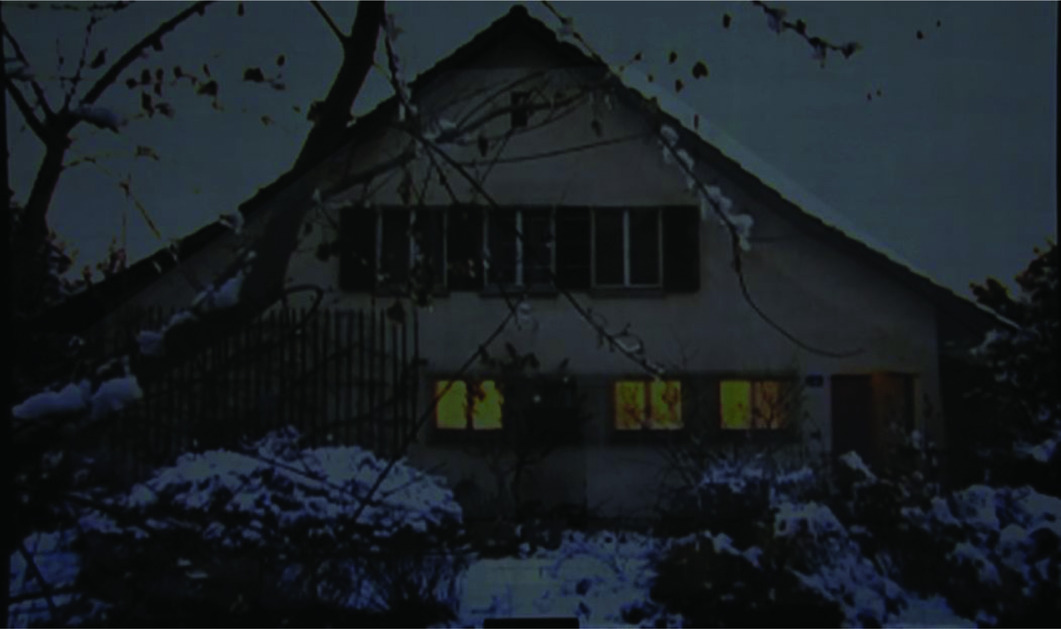
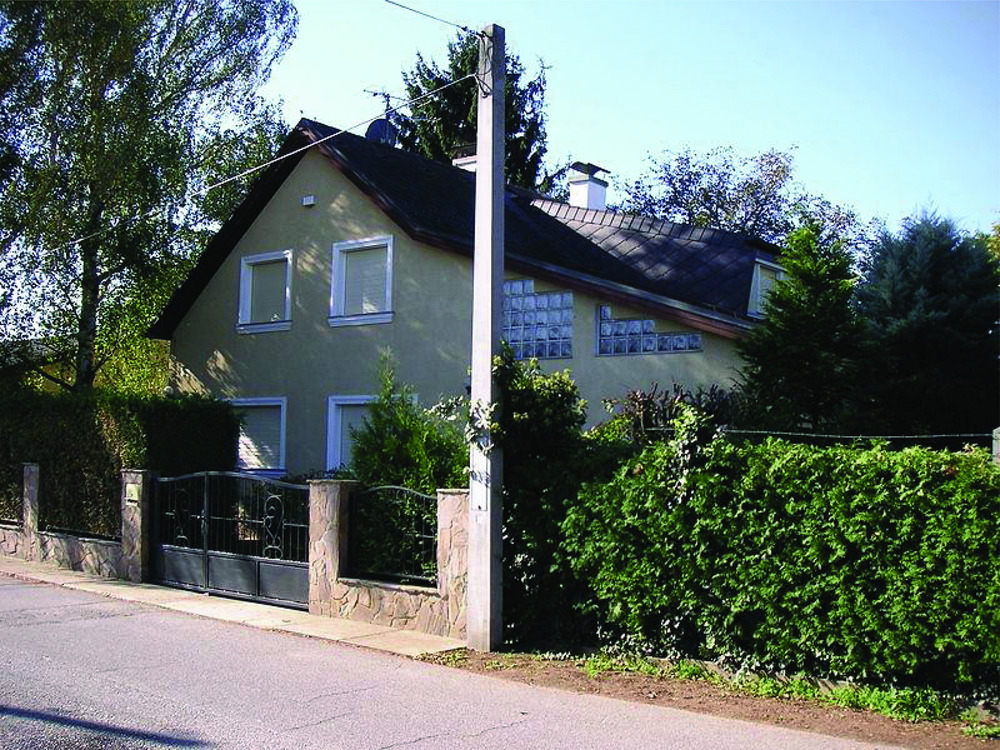
To the production itself, where the backdrop resembles the location of Kampusch's ordeal. As the Act One Prelude plays, a screen behind the stage projects the front exterior of Barbe-Bleue's home in a snowy, suburban setting easily envisaged as wintry Austria (Figure 1). A car passes by, its driver oblivious to anything out of the ordinary. Through the windows, audiences glimpse Barbe-Bleue switching lights on inside, a gesture which inverts the original symbolism of Ariane's search for daylight and signals Guth's reinterpretation of the opera. The residence is a two-storey dwelling, set slightly back from the road, like Přiklopil's house (Figure 2).
Opus Arte/Gran Teatre del Liceu DVD of Paul Dukas, Ariane et Barbe-Bleue, 2013. Screenshot from Act One prelude. Opus Arte, OA 1098 D.

House where Natascha Kampusch was incarcerated. Copyright: ‘Priwo’. Reproduced from Wikimedia with permission under GNU Free Documentation License. https://commons.wikimedia.org/wiki/File:Das_Haus_von_Wolfgang_Priklopil.jpg.

Inside, Guth's dramatization of the newly-weds’ relationship casts light on an uncomfortable truth about the Kampusch case. Deviating from the libretto, Ariane and Barbe-Bleue greet each other tenderly at the front door before the husband leads his wife across the threshold. Concluding the Act One confrontation with Ariane (Jeanne-Michèle Charbonnet), Barbe-Bleue (José van Dam) goes off-script by dropping to his knees in a momentary gesture of remorse. Portraying him as a deeply flawed man, not a monster, Guth proposes a credible basis for Ariane's empathy towards Barbe-Bleue and controversially neutralizes the need for outright condemnation of his behaviour. Ariane's compassion mirrors what has become public knowledge about Kampusch's feelings towards Přiklopil. In her memoir 3096 Days, Kampusch stated:
Nothing is all black or all white. And nobody is all good or all evil. That also goes for the kidnapper. These are words that people don't like to hear from an abduction victim . . . People who have no insight into the complexities of imprisonment deny me the ability to judge my own experience by pronouncing two words: Stockholm Syndrome.Footnote 96
Kampusch acknowledges that her resistance to simplistic narratives of her ordeal and her refusal to identify in straightforward terms as a victim has confounded outsiders. From Guth's production to the DVD paratexts, the 2013 Ariane opera video offers a similarly unsettling vision of abusive relationships and makes for thought-provoking drama.
L'Opéra du Rhin, 2015
L'Opéra national du Rhin (ONR) mounted an X-rated staging of the opera in 2015. Running from 26 April to 6 May 2015, the last performance was filmed and live-streamed on the Culturebox website of the France Télévision network.Footnote 97 On 13 June 2015, France Musique subsequently broadcasted the recording in an extended radio programme. That radio broadcast was framed before and after by interviews with ONR director Marc Clément, conductor Daniele Callegari, stage director Olivier Py, cast members including Ariane interpreter Lori Phillips, and musical interludes. The musical selections drew on Bartók's Bluebeard and Dance of the Seven Veils from Strauss's Salome as well as selections from Dukas's œuvre.Footnote 98 Using these paratexts, the programme constructed a music-history narrative primarily relating Ariane to two early twentieth-century operas that overtly deal with female sexuality (instead of drawing more obvious historical parallels with Debussy's Pelléas). Following the upload of the ONR performance on the Culturebox YouTube channel on 4 August 2015 where it remained available until mid-2017, this revisionist Ariane garnered approximately 9,000 views.Footnote 99 During that period it was highlighted on the channel's curated ‘Opéra’ playlist, thus effectively marketed at tens of thousands of subscribers. As opportunities to watch productions of Ariane (live or on video) were rare until 2013, its YouTube presence exponentially expanded its potential audience reach, as the platform facilitated a free, almost globally accessible viewing experience.Footnote 100 Although the full opera video is not currently online, a short promotional clip released separately by ONR on their YouTube channel in April 2015 remains available.Footnote 101 Hence, the essence of this visual interpretation still circulates in the public domain. The clip shows a montage of the production's most dramatic moments, over which the Act One prelude plays. By using montage technique and re-tooling the prelude as a soundtrack, the trailer formally aligns Ariane with film and television cultures, more of which later.
First, to the ONR production. Informed by the opera's mythological influences, Py's staging is surrealist and seedy. According to Greek legend, Ariadne sent Theseus into the labyrinth to kill the Minotaur. Here, Barbe-Bleue, donning a black PVC mask and horns, is the Minotaur, whom Ariane must confront. Half-man, half-bull, the Minotaur embodies a duality magnified in the mise-en-scène. Py spoke about his use of a two-tiered stage: the ‘very concrete’ foundation signifies the women's reality, while the upper level projects ‘Barbe-Bleue's fantasies’.Footnote 102 Split-personality Barbe-Bleue is dominated by his animalistic urges until the closing scenes, when Ariane strips him of his Minotaur garb. She exposes him as merely another sleazy punter at his ‘Bluebeard's Castle’ bordello. The ‘castle’ is a derelict building in the ‘labyrinth’ of a forest. Inside the building's crumbling facade, we spy a private space available to clients, the faded grandeur of a bedroom illuminated by a tacky glittering chandelier. The virtual house tour also encompasses the property's woodland surroundings, the enslaved women's living quarters, and a garish, red-hued double-storey space divided into metal cages with naked women gyrating behind the grilles.
This Ariane evokes the sexual depravities associated with the Bluebeard crimes, with the Act One confrontation between the newly-weds ratcheted up a notch to suggest rape and attempted murder. The row takes place in a bedroom. After Ariane screams, Barbe-Bleue pins her to the bed, nearly choking her before two security men burst through the doors and wrestle him off her. Ariane sends the interlopers away, placating Barbe-Bleue with kisses. Standing on the bed, she leans back, eyes averted, breathing deeply to steel herself while he gropes her. As the curtain falls on Act One it is implied she submits to sex in circumstances which are far from consensual: sex is the non-negotiable price she pays for survival. Whereas the libretto is vague about how the scene ends – Ariane returns towards Barbe-Bleue – Py frankly depicts how the abuser has chipped away at her defences. Ariane's hasty gestures of affection might appear to absolve Barbe-Bleue of the implied crime – but the threat to her personal safety demands a reassessment of the situation. In highlighting Py's interpretation, I take my cue from Kassandra Hartford who asserts that ‘sexual violence [in opera] must be named as such’.Footnote 103 Audiences can no longer complacently accept readings of the opera that posit Ariane as a character in a relationship of equals. The encounter focused on here would have merited little comment in the early twentieth century: marital rape was only recognized as unlawful in most Western countries in the late twentieth century (1994 in France). By foregrounding the libretto's undercurrents of rape, the ONR production reveals a latent dimension of the opera.
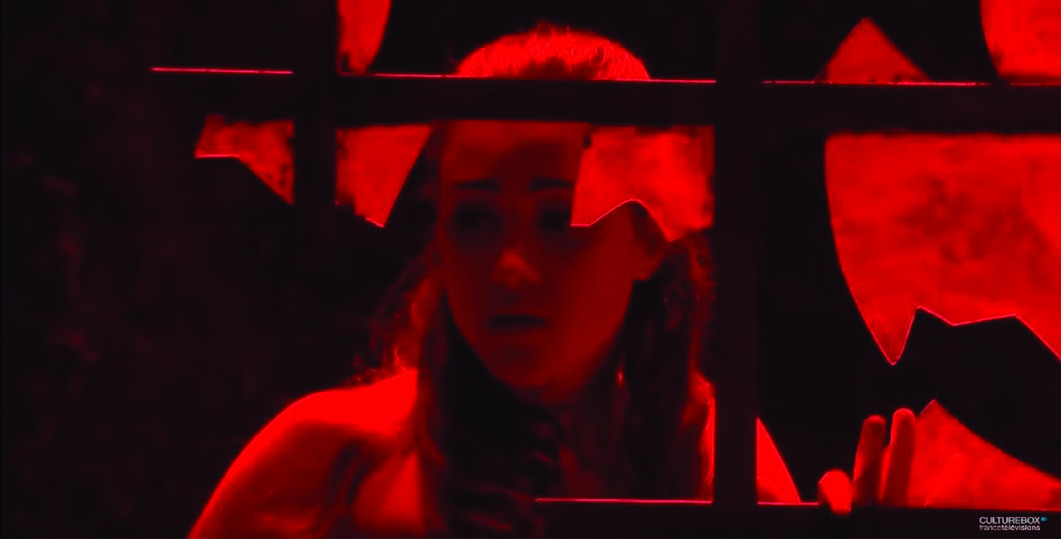
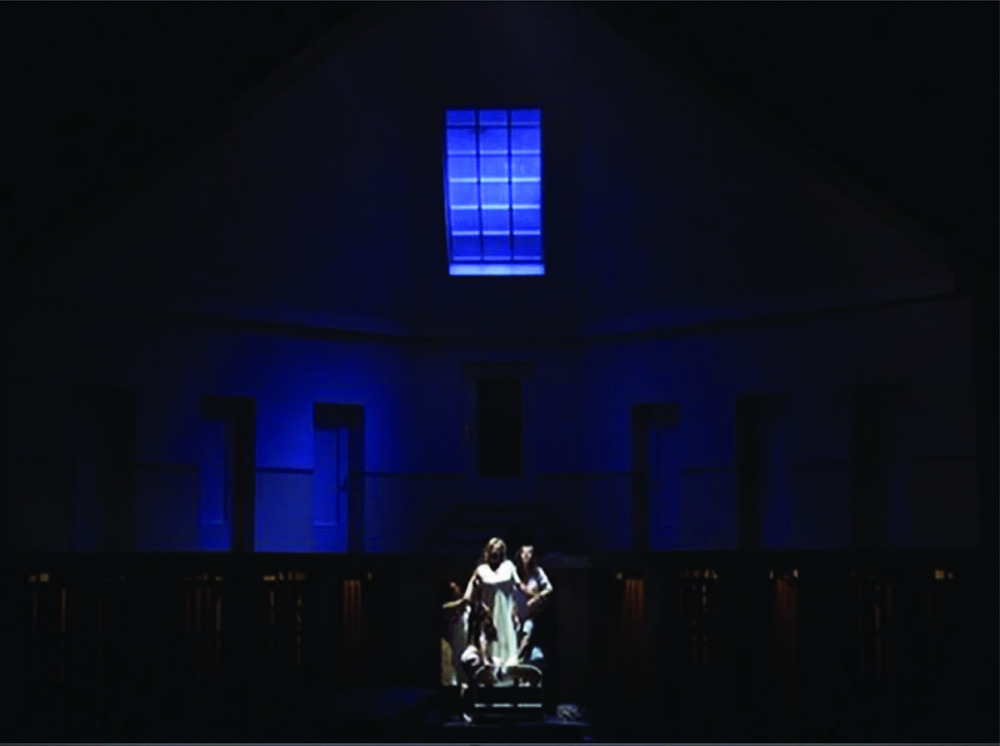
To re-appropriate Dukas's remarks about the central couple's relationship, the voyeuristic staging for the Act Two prelude promotes a ‘tacit complicity’ between Barbe-Bleue and the opera spectators, who alongside him watch women writhing in cages. In a compelling illustration of how remediated opera video can reconstruct meaning, the YouTube viewer occasionally experiences events from the perspective of the mistreated sex workers. Zooming in on their anxious expressions as they witness the consequences of an attempted escape, the lens forces an uncomfortable emotional intimacy (Figure 3). A dancer on the floor below tries to scurry away but is dragged on a leash and tied to a chair in the centre of the room by masked guards. Barbe-Bleue straddles her and leers at four other naked women performing in front of him. Via camerawork that tracks and mirrors Barbe-Bleue's gaze, the viewer staring at a screen at home frequently watches the women through his eyes (Figure 4). To encounter pornographic aesthetics in opera video is not unusual for, as Cenciarelli notes, the ‘fetishizing qualities of the camera's eye’ tends to seek out close-ups of singers’ faces at heightened moments.Footnote 104 What is exceptional about this Ariane is a union of style and content that situates it more directly in a pornographic culture.
Oxymore/L'Opéra du Rhin (ONR) production of Dukas, Ariane et Barbe-Bleue, 2015. Released on YouTube channel Culturebox on 4 August 2015. www.youtube.com/watch?v=UYRC5Y9k5jc> (accessed on 15 February 2017). Screenshot from Act Two prelude, 36:41.

Oxymore/L'Opéra du Rhin (ONR) production of Dukas, Ariane et Barbe-Bleue, 2015. Released on YouTube channel Culturebox on 4 August 2015. www.youtube.com/watch?v=UYRC5Y9k5jc> (accessed on 15 February 2017). Screenshot from Act Two prelude, 38:44.

Py's Orlamonde is a grubby underworld of sham marriages and sex trafficking. Failed escapes feature in the prelude to Act One too. The drama begins with a victim in a flimsy wedding gown racing through the forest before being bundled away by masked men later seen working for Barbe-Bleue. The systematic abduction echoes the Garridos’ carefully executed kidnapping of Dugard in California. By showing how attempted absconders are punished, this production implicitly criticizes Ariane's victim-blaming of the woman who had tolerated her situation. It also explores how paralysing fear inhibits victims from acting. One of the Cleveland captives, Michelle Knight, recalled in her memoir the abject terror of what Castro might do:
A couple of times I thought about trying to make a run for the backdoor, but I was too afraid he would shoot me from behind and then kill everyone else. I also remembered the times when he would leave a door unlocked to see if he could catch me trying to get out. He seemed to always be testing us, ready to pounce if he caught us even looking at the door.Footnote 105
The staging of the preludes responds to the challenge of maintaining the spectator's interest in a slow-paced, symbolist work but at some cost to its feminist potential. Maeterlinck had designated Alladine a mimed role, a foil to the outspoken Ariane. Py paradoxically amplifies Alladine's silence by filling the stage during the preludes with multiple mute dancing women, objects only for the eyes instead of the ears. Considering how Dukas made Ariane's voice crucial to her agency, the gratuitous use of women as silent, naked props defies the spirit of the opera. Gender equality of sorts is partially restored in Act Three. In its prelude a bare-chested Barbe-Bleue sits at a table in a clearing in the woods where nude dancers serve him drinks; meanwhile, two naked Minotaurs prowl around him. As part of the split-stage backdrop in Act Three, a woman in a white dress uses ropes to restrain one of the Minotaurs on the upper level, while the main action of Ariane preparing the other wives for the outside world continues below. Intensifying the Minotaur image and inverting that of the dancer tied to the chair in Act Two, Act Three sees the emasculated Barbe-Bleue strapped to a chair, naked except for his Minotaur helmet. Reversing gender roles in what could be considered an act of revenge, Ariane removes his helmet. Denuded of this primal disguise, he no longer poses a threat.
Shades of Bluebeard in film and on Netflix in 2015
ONR's highly visual Ariane renders it comparable with three other creations from 2015 rooted in Bluebeard mythology, albeit this time packaged as mainstream entertainment. Fifty Shades of Grey was a top-grossing movie; Room, released in late 2015, came to wider attention with Academy Award wins in 2016; and the debut series of the Netflix-produced sitcom The Unbreakable Kimmy Schmidt was a success for the film and television streaming service. Notwithstanding their contemporary settings, all three examples revolve around protagonists who embody traits of the early twentieth-century New Woman. Resembling Leblanc who had just turned thirty when Maeterlinck drafted Ariane, the 2015 characters are in their twenties, all middle-class white women with cosmopolitan aspirations who strive for social status associated with autonomy, education, financial independence, and heterosexual romantic relationships. Ana (Fifty Shades), Joy (Room), and Kimmy (Kimmy Schmidt) may take for granted legal rights denied to women c. 1900 but the struggle for equality continues in the more opaque, unregulated sphere of their private lives. Conflict arises when they resist the will of men who seek to possess them: resistance takes the form of pursuing a career and ending the relationship (Ana), structuring daily life on her own terms in captivity (Joy), and prioritising education and personal growth after escaping (Kimmy).
Fifty Shades of Grey is an adaptation of E. L. James's erotic novel. Like the book, the film is the first in a trilogy, with sequels released in 2017 and 2018. The series portrays the BDSM relationship between the dominant businessman Christian Grey (Jamie Dornan) and the submissive college graduate Anastasia (‘Ana’) Steele (Dakota Johnson). Not only do the Fifty Shades narrative arc and characterization intersect with Ariane, but the cinematic portrayal of the couple's physical relationship converges with the pornographic tendencies of the ONR production. Py and Taylor-Johnson take their visual cues from a pornographic lexicon that tends towards objectifying women for a heterosexual male gaze (the presence of a female director in Fifty Shades makes little difference on that count).
The novel is narrated by Ana who, after spending her first night with the mysterious publishing magnate, rings her flatmate Kate to reassure her that she has come to no harm with Christian, whom she as narrator explicitly identifies as Bluebeard. Ana's inner monologue continues with another direct reference to Christian as Bluebeard, which this time links her personal safety around him to her maintenance of an attractive girlish appearance.Footnote 106 Minus a narrator, the screenplay lacks literal mention of Bluebeard but is saturated with symbolic references. His castle is remodelled as Christian's penthouse apartment in Seattle and his off-limits chamber as a BDSM ‘playroom’. Camera close-ups of the key to the ‘Red Room of Pain’, as Ana later nicknames it, tease out an iconography of the Bluebeard myth. Other details evoke Ariane. Kate, acting as Ana's confidante, plays a role akin to that of the Nurse in Dukas's opera. Like Ariane and Barbe-Bleue, Ana and Christian are in the early stages of formalizing their liaison, albeit not via a marriage contract but through a document Christian drafts stipulating the sadomasochistic parameters of their relationship. Recalling the imagery in Dukas's opera, Fifty Shades metaphorically uses light and darkness in a pivotal early scene. Ana stands in a dark doorway as she prepares to cross the threshold into Christian's forbidden room. Illuminating the truth about himself, Christian switches on the light to reveal an array of ropes, chains, and other bondage gear. What follows is an exchange akin to the argument between Ariane and Barbe-Bleue:
Christian: I have rules. If you follow them, I'll reward you. If you don't, I'll punish you . . .
Ana: What do I get out of this?
Christian: Me . . . This is the only sort of relationship I have.
Ana: Why?
Christian: It's the way I am.Footnote 107
Like the Orlamonde tyrant, Christian tries to assert his authority here and elsewhere, but Ana's Ariane-like constant questioning undermines him. She discovers fifteen women have visited the playroom before her. In the Bluebeard tradition, Christian tries to seduce Ana with extravagant gifts and scotch her attempts to negotiate a relationship on mutual terms. It ends in stalemate. Having procrastinated over signing the agreement, asserting that she intends to hold on to her free will a little longer, Ana tearfully ends their affair. Leaving Christian's apartment, she orders him to stop following her. For once submitting to her demands, he watches as, following in Ariane's footsteps, she abandons her Bluebeard.
Bluebeard allusions channelled in Ariane are abundant in the biggest hit from the Fifty Shades soundtrack. ‘Love Me Like You Do’ functions as a major paratext to the film through its lyrics, Ellie Goulding's vocal performance, and accompanying music video.Footnote 108 The first words of the song invoke familiar Bluebeard imagery of daylight and darkness. Correspondingly, the video opens with Goulding exploring a dark corridor to emerge in the gloomy foyer of what looks like a castle. Ascending the staircase towards the light, she lingers in a room lit by an enormous chandelier. The video is a montage of Goulding's performance here and under the strip-lighting of a garage, plus film scenes of Ana and Christian. The music, a piece of mid-tempo slickly produced pop, is vocally intriguing. As befits a pop diva, Goulding belts out the bridge and later choruses but is restrained until the end of the first chorus. Compounding the repetitive, nearly monotone delivery of the lyrics during the first chorus, her performance at this point is highly technologically processed. It sounds robotic and disembodied, as if resisting the breath and flesh of the singer's voice. Vocoder technology has been commonplace in commercial pop for over twenty years and vital to how the genre configures femininities.Footnote 109 As Kay Dickinson writes, ‘the manipulated human voice bangs into some deeply rooted beliefs about expressiveness within popular music, beliefs which so often grow out of how we constitute the “human body”’ and how we hear the ‘expulsion of feeling through the voice, through visceral bodily vibrations’.Footnote 110 Particularly in the first chorus of ‘Love Me Like You Do’, the vocoder inhibits the ‘natural’ mode of feminine corporeal utterance, thereby rendering Goulding sonically analogous to the virginal Ana encountered at the start of the film who suppresses her physical instincts. Precise articulation of those lyrics arguably lends the first chorus semantic force, however, which recalls the strength conveyed by Ariane in recitative mode.
Whereas the Fifty Shades book was rooted in the Bluebeard fairytale, Emma Donoghue stated that her novel Room was ‘triggered’ by the Austrian Fritzl case, specifically ‘reports of Felix Fritzl [the youngest child of Elisabeth and Josef], aged five, emerging into a world he didn't know about’.Footnote 111 The screenplay, also authored by Donoghue,Footnote 112 is set in Ohio, which suggests a second allusion to the Cleveland case. The novel is told through the eyes of five-year-old Jack (Jacob Tremblay), who lives with his Ma (Brie Larson) in a tiny purpose-built shed which represents the totality of his world and all Ma (Joy) has known since Old Nick kidnapped her as a teenager. The ‘Room’ sits in the garden behind Old Nick's house, enabling him to bring his captives weekly supplies and to rape Ma while Jack sleeps. The first half of the film takes place in this claustrophobic space, until Ma engineers their escape.
The name ‘Old Nick’ conjures an image of an archetypal villain and Donoghue's treatment of the character is reminiscent of how Maeterlinck portrayed Barbe-Bleue. Like the Belgian playwright, Donoghue limited the abductor's role in the protagonists’ daily lives. ‘I never wanted to give Old Nick that much prominence in my novel’, she said; ‘just as Ma does, I chose to keep him at arm's length, not letting him set the terms of the story.’Footnote 113 The dynamic between Ma and Old Nick mirrors that of Ariane and Barbe-Bleue. Like the ‘tacit complicity’ Dukas claimed his operatic newly-weds shared, Donoghue's ‘couple’ co-exist in an unhealthy pseudo-partnership. Having once tried to kill Old Nick, Ma now tolerates him for the sake of survival. Like Ariane readying the women for freedom in Act Three, Ma raises Jack in the hope of one day experiencing life in the outside world, organizing a daily routine of meals, schooling, exercise, and play in ‘Room’. During this first part of the film, in addition to Stephen Rennicks’ subtle instrumental soundtrack, an instance of diegetic music may be heard. Joy sings the folk song ‘Big Rock Candy Mountain’. Ostensibly a lullaby to Jack, it also serves to self-soothe, thereby performing a similar function to ‘Les Cinq Filles d'Orlamonde’ as sung by Barbe-Bleue's wives. At other times, Joy acts more like Ariane in recognising voice as a means of resistance. She trains Jack to scream at the top of his lungs in ‘Room’, which later equips him to roar for help as he fights to escape from Old Nick. A little like the Orlamonde women who relish the idea of freedom in the abstract but fear it in reality, once in the outside world Jack confesses to missing the confines of ‘Room’.
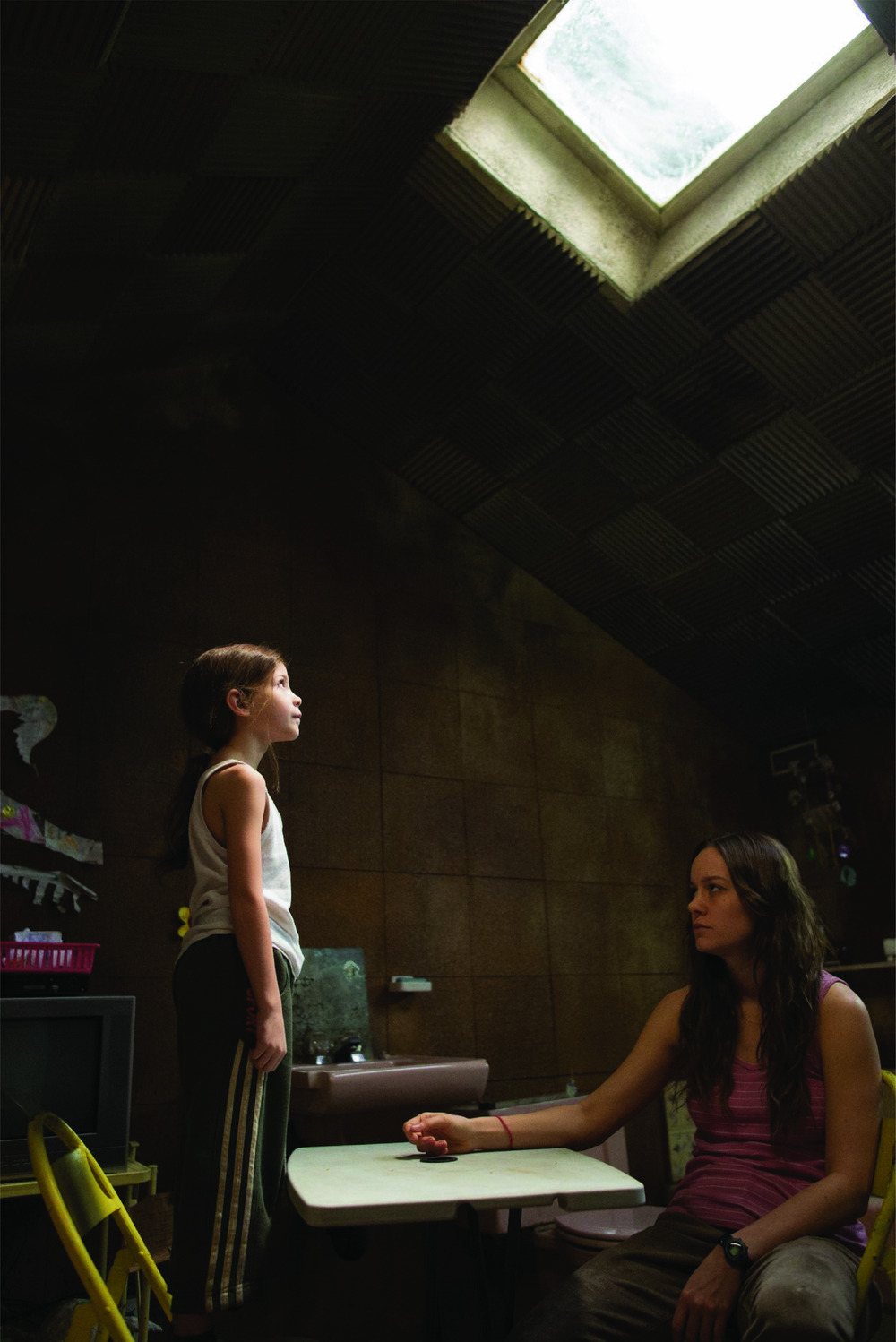
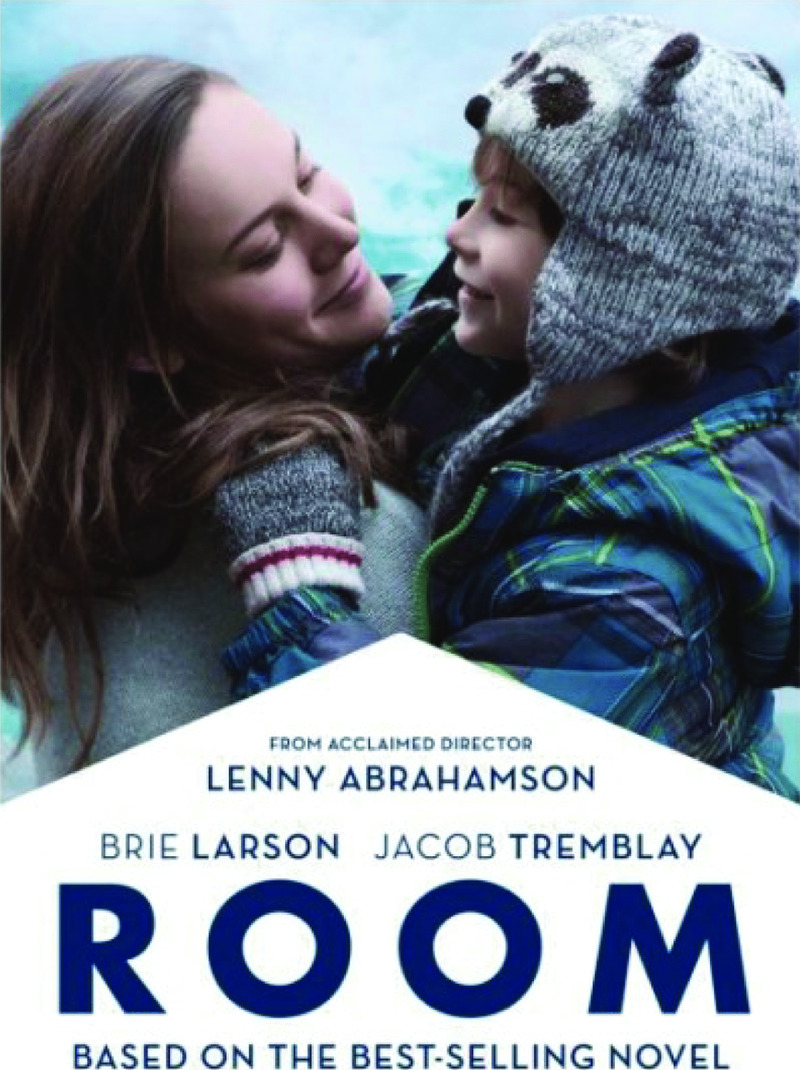
Not only does Room bear thematic resemblances to Ariane, but there are parallels between the film's set design and how Guth's 2013 production explores the opera's symbolism. Figure 5 shows a screenshot from Act Two of the 2013 Ariane DVD and Figure 6 a still from Room. In both settings, a skylight in a slanted roof offers the sole source of daylight, with the captives drawn towards windows that represent potential contact with an outside world. Synergies between these two Bluebeard works extend to exterior shots of the makeshift prisons. As noted, the 2013 opera video began with an image of the house, while publicity posters for Room trace the similar architectural outlines of the shed (Figure 7). The shared iconography of photographic reports of the Kampusch house, the Ariane DVD, and Room reinforce the pervasiveness of the Bluebeard trope in the twenty-first century.
Opus Arte/Gran Teatre del Liceu DVD of Dukas, Ariane et Barbe-Bleue, 2013. Screenshot from Act Two, 59:00, showing the wives beneath a slanted skylight. Opus Arte, OA 1098 D.

Room, dir. Lenny Abrahamson. Still of Jack (Jacob Tremblay) and Joy (Brie Larson) beneath a slanted skylight. © Element Pictures, 2015. Reproduced with permission.

Image featured on publicity materials for Room. © Element Pictures, 2015. Reproduced with permission.

A wholly different tone underpins The Unbreakable Kimmy Schmidt, a comedy following the adventures of the title character (played by Ellie Kemper) as she builds a life in New York City after escaping captivity. The series opens with police officers freeing her and three other so-called ‘mole women’ from a bunker in Indiana where cult leader Reverend Richard imprisoned and molested them. Led by Kimmy, they emerge from a hatch into daylight. We learn more about the ‘mole women’ in a talk-show appearance during the pilot episode. In a parallel to the Maeterlinck libretto, the Hispanic ‘mole woman’ Donna Maria plays a role akin to Alladine who struggles to communicate with her peers. The interviewer scolds her for never learning to speak English. All the ‘mole women’ bar Kimmy return to the familiar past of their hometown lives, fearing freedom just as Ariane's companions did. Comedy springs from Kimmy's attempts to navigate life in the city: outwardly an adult woman, mentally and emotionally she is still the teenager abducted by the Reverend.
While Kimmy Schmidt’s Midwest origins and abduction of individual women already recall the Cleveland case, the most powerful association stems from the comedy's recurrent musical paratext. That paratext, in turn, echoes Dukas's opera. A news montage in the Kimmy Schmidt pilot features interviews with the Reverend's neighbour.Footnote 114 Choice quotes from the neighbour's description of the crime scene are repeated, edited, and remixed with a synthesized dance beat and theme composed by Jeff Richmond. Produced by the Gregory Brothers pop outfit, this sonic mash-up frames every subsequent episode as the soundtrack to the opening and closing credits. The opening credits’ montage starts with Kimmy lifted out of the bunker into the light, then a shot of the neighbour being interviewed. The audiovisual stylisation of those credits is a homage to a creative artefact derived from an interview with Charles Ramsey, the neighbour who aided Amanda Berry's escape from Castro's house. Like the fictional neighbour in Kimmy, the real-life Ramsey gave a memorable account of the rescue to reporters.Footnote 115 And two years before they produced the Kimmy Schmidt theme, the same Gregory Brothers sampled snippets from Ramsey's oral testimony to transform his witness account into a two-minute pop song titled ‘Dead Giveaway’. This track mythologizes the Cleveland event and accompanies a newsreel montage of the rescue; it is this aesthetic which the first shots in Kimmy’s opening credits replicate.
‘Dead Giveaway’ has become a viral video sensation, attracting over thirty-two million YouTube views to date.Footnote 116 The Gregory Brothers moulded Ramsey's account into lyrics for a partly rhymed, quasi-rap performance backed by a mid-tempo dance track. His remark ‘I knew something was wrong when a little pretty white girl ran into a black man's arms’ serves as the opening line. The track thus called attention to the intersection of gender politics and systemic racism, something which is otherwise underexplored in the contemporary Ariane productions and Bluebeard popular-culture examples.Footnote 117 Mid-way through, Ramsey's comments are edited into a narrative overview of what happened:
A girl was in that house
She said, ‘please help me get out’
So I open the door – we can't get in that way
Nobody can't fit through the door, only a hand
So we ki-ki-ki-kicked the bottom and she comes out
And she says, ‘there's some more girls, up in that house – call 911’
And they called him, and McDonalds
I knew something was wrong when a little pretty white girl ran into a black man's arms
Dead giveaway!Footnote 118
Ramsey, turned town-crier, spread word of Castro's crimes by invoking Perrault's fairytale tropes – a ‘little pretty white girl’, a villain, and an impenetrable dwelling. While the subsequent Gregory Brothers’ ‘Dead Giveaway’ confronts racism, the lyrical narrative centres on English-speaking white girls and women. It risks marginalizing the experience of individuals such as the Hispanic woman Gina DeJesus who suffered the extra indignity of losing her native Spanish during years of captivity at the hands of Castro.Footnote 119
Conclusion
Via ‘Dead Giveaway’ I return to Act One of Dukas's opera. Ariane’s action starts with Barbe-Bleue's neighbours mythologizing his misdeeds. Repeating rumours that he killed his wives, local men narrate his chilling, albeit exaggerated, history.Footnote 120 Common threads such as this weave the opera's fictional plot into a larger narrative of crimes committed a century later and creative responses to news of those events. As traced above, there are uncanny echoes of Ariane in the fabric of twenty-first century mass-media culture. The opera's revival via technologies primarily associated with film, television, and popular-music genres promotes the identification of these connections.
Mapping out Ariane’s meaning as it can be construed nowadays, I sought to critique how the work's ostensibly feminist politics sometimes falls short of twenty-first-century standards. This is not to undermine the progressive gender ideologies it epitomised c. 1907–11, nor to overlook how it represented a radical departure for a genre traditionally contingent upon the death of a female character to achieve closure in a work.Footnote 121 Moreover, the New Woman figure of Ariane remains partly recognisable in the profiles of modern film and television protagonists. Today, however, the libretto's instances of victim-blaming and aversion to acknowledging abuse are troubling. Nor is it possible to casually tolerate the silencing of Alladine: to suppress the voice of a woman marginalized as Other cannot be reconciled with an inclusive, intersectional feminism that strives to represent a multitude of viewpoints and to resist hegemonic hierarchies that privilege individuals of a particular class, ethnic group, background, sexuality, or gender identity.Footnote 122 Yet opera is infinitely adaptable. Despite the work's problematic elements, productions of Ariane carry the potential to reflect on and engage with how the crisis of gendered violence affects women of every description.