

Employees are not passive individuals who are merely affected by their surroundings. In fact, they can navigate through and exert influence over their work situations through proactive behaviors, described as taking initiative to improve current circumstances, as opposed to being reactive to present conditions (Crant, Reference Crant2000). Existing literature suggests different ways in which employees can behave proactively, such as helping, taking charge, job crafting, and, indeed, expressing voice (Li, Liang, & Crant, Reference Li, Liang and Crant2010; Wrzesniewski & Dutton, Reference Wrzesniewski and Dutton2001; Xu, Qin, Dust, & DiRenzo, Reference Xu, Qin, Dust and DiRenzo2019). Employee voice involves making constructive suggestions on how work procedures and practices can be improved (Van Dyne & LePine, Reference Van Dyne and LePine1998). Subsequently, voice results in various positive outcomes for organizations, such as higher levels of learning, effective changes at work, and improved unit-level performance (Argote & Ingram, Reference Argote and Ingram2000; MacKenzie, Podsakoff, & Podsakoff, Reference MacKenzie, Podsakoff and Podsakoff2011; Morrison & Milliken, Reference Morrison and Milliken2000). Informed by the model of proactive motivation (Parker, Bindl, & Strauss, Reference Parker, Bindl and Strauss2010), individuals behave proactively because of a desire to be proactive and/or they see the value of being proactive. Research revealed that personal needs, notably need for achievement, are essential precursors to proactive motivation (Bateman & Crant, Reference Bateman and Crant1993; Crant, Reference Crant2000). Individuals with a high need for achievement seek to solve task difficulties and challenges, aspire to achieve performance excellence, and desire accomplishments in their work life (Jenkins, Reference Jenkins1987; McClelland, Reference McClelland1965). In this regard, we propose the need for achievement as an essential precursor of employee voice. For instance, due to the desire to achieve performance excellence, achievement-driven employees may become proactive in voicing their opinions and suggestions that will pave ways to a more efficient and effective approach to task completion. There is also empirical evidence supporting the positive relationship between the employee voice and task performance (Thomas, Whitman, & Viswesvaran, Reference Thomas, Whitman and Viswesvaran2010).
However, employee voice entails interpersonal risks. Despite the positive intention of achievement-driven employees to bring about work improvement, speaking up at work can be misconstrued as complaining, criticizing, and bossiness (Burris, Rockmann, & Kimmons, Reference Burris, Rockmann and Kimmons2017; Van Dyne & LePine, Reference Van Dyne and LePine1998). Furthermore, the ideas being put forth are not necessarily agreed upon by others, resulting in undesirable social consequences (Morrison & Milliken, Reference Morrison and Milliken2000; Tepper, Duffy, Hoobler, & Ensley, Reference Tepper, Duffy, Hoobler and Ensley2004). For this reason, while employee voice is widely regarded as a beneficial work behavior that has a positive impact on organizational functioning (Budd, Gollan, & Wilkinson, Reference Budd, Gollan and Wilkinson2010; MacKenzie, Podsakoff, & Podsakoff, Reference MacKenzie, Podsakoff and Podsakoff2011), some studies suggest that voice does not necessarily yield positive outcomes to individuals who perform the behavior itself. For instance, research revealed that expressing one's voice at work could potentially harm supervisors' evaluations of employee career progression (Seibert, Kraimer, & Crant, Reference Seibert, Kraimer and Crant2001). To address empirical inconsistencies, this study further determines the extent to which voice behaviors performed by achievement-driven employees will be assessed positively by their supervisors. We do so by using supervisors' assessments of employee task performance (i.e., activities that directly contribute to the organization's core functioning; Borman & Motowidlo, Reference Borman, Motowidlo, Schmitt and Borman1993) and discretionary work effort (i.e., extra effort exerted by employees beyond the level expected by the employment contract; Frenkel & Bednall, Reference Frenkel and Bednall2016).
The model of proactive motivation (Parker, Bindl, & Strauss, Reference Parker, Bindl and Strauss2010) further asserts that the extent to which a desired change and future end state will be achieved is contingent on how effective employees perform the proactive action. For instance, if voice is well communicated, the ideas being put forth are likely deemed constructive and credible and subsequently endorsed by managers (Whiting, Maynes, Podsakoff, & Podsakoff, Reference Whiting, Maynes, Podsakoff and Podsakoff2012). To exercise voice effectively, employees should be able to substantially support the ideas they raise to establish credibility. In this regard, we posit supervisor developmental feedback as a relevant boundary condition that may determine the effectiveness of voice behavior. Supervisor developmental feedback reflects ‘the extent to which supervisors provide their employees with helpful or valuable information that enables the employees to learn, develop and make improvements’ (Zhou, Reference Zhou2003: 415). Essentially, this feedback contains information related to in-role and extra-role expectations, cultural norms within the workplace, and other relevant information that employees can utilize to become better equipped to exercise voice (George & Zhou, Reference George and Zhou2007). Such feedback particularly suits individuals with a high need for achievement as it is primarily aimed toward learning and making improvements.
This study offers important contributions to the existing research on employee voice. First, we draw on Parker, Bindl, and Strauss’ (Reference Parker, Bindl and Strauss2010) model of proactive motivation as an overarching theoretical perspective to provide a more informed understanding to (a) why some people are motivated to engage in voice behavior, (b) the role of voice for individual employees, and (c) why some voice attempts may be more successful in bringing about positive outcomes. First, those who display a high need for achievement show a strong desire to be proactive (Parker, Bindl, & Strauss, Reference Parker, Bindl and Strauss2010). As described by Murray (Reference Murray1938), achievement-driven individuals like to ‘master, or organize physical objects, human beings, or ideas’ (p. 164). One way by which they can exert such influence over their surroundings is through the expression of voice. Furthermore, those with a high need for achievement may also see the value of being proactive (Parker, Bindl, & Strauss, Reference Parker, Bindl and Strauss2010). Indeed, expressing ideas or suggestions for work improvement is in line with the task-oriented nature of achievement-driven employees who aspire to achieve performance excellence and maintain high performance standards (Jackson, Reference Jackson1974).
However, not all proactive initiatives will be successful in bringing about a desired outcome (Parker, Bindl, & Strauss, Reference Parker, Bindl and Strauss2010). The second contribution of this study is, therefore, to address empirical inconsistencies of employee voice outcomes. Specifically, we attempt to address why some voice initiatives may be more or less successful than others in enabling employees to instigate their anticipated changes. Our argument is for any voicing ideas or suggestions to be endorsed by those in higher positions, such as supervisors, and it depends largely on how positively the behavior is perceived by them (Whiting et al., Reference Whiting, Maynes, Podsakoff and Podsakoff2012). In this study, we determine supervisors' receptions of employee voice using supervisors' ratings of employee task performance and discretionary work effort. Another important contribution of this study is to illuminate a fundamental element of voice: it is an interpersonally risky behavior that needs to be exercised in a judicious manner. Our argument is if employees are well equipped to speak up, which can be supported by supervisor developmental feedback, their voice initiatives are more likely to be well received by supervisors.
Finally, this study is conducted in the Japanese work context, which is essential to the examination of need for achievement and employee voice in some important ways. First, achievement drive is highly prominent among Japanese workers because making substantial efforts to pursue a greater sense of achievement or a feeling of fulfillment (‘tasseikan’ or ‘yarigai’) represents the life and work values of the Japanese society (Holthus & Manzenreiter, Reference Holthus and Manzenreiter2017). Second, the Japanese work culture can be generally described as having a high uncertainty avoidance (Yeh, Reference Yeh1988). Uncertainty avoidance reflects the degree to which individuals feel uncomfortable with uncertainty, ambiguity, and risks (Hofstede, Reference Hofstede1984). Hence, employees embedded in such a cultural context may be particularly proactive in exerting control over their work environment, for instance by engaging in voice, in an attempt to reduce any potential work-related risks and mistakes. Nonetheless, if employees wish to express their voice with their supervisors and other higher-ups, they have to do so in a skillful manner to avoid any interpersonal repercussions of speaking up. This is especially important among Japanese workers as their cultural work context can be regarded as having a high power distance, whereby subordinate employees are deferential to those in more senior positions (Hofstede, Reference Hofstede1984). In such context, employee voice can be misconstrued as going against those figures of authority (Botero & Van Dyne, Reference Botero and Van Dyne2009), therefore requiring employees to be especially meticulous when exercising voice.
In sum, we propose and empirically test simple mediation and moderated mediation relationships as depicted in Figure 1.
The proposed research model.

Hypotheses development
Need for achievement, employee voice, and supervisors' assessments
Informed by Parker, Bindl, and Strauss (Reference Parker, Bindl and Strauss2010) model of proactive motivation, proactive action is ‘motivated, conscious and goal directed’ (p. 830). Hence, this study draws on the proactive motivation model to offer a theoretical sound explanation to (a) why employees are motivated to express their voice and (b) how voice can be used to achieve goal-directed outcomes. First, the model posits that being proactive signifies a strong aspiration to bring about changes in one's surrounding environment and/or oneself with the objective of achieving a different future end state (Parker, Bindl, & Strauss, Reference Parker, Bindl and Strauss2010). This ‘strong aspiration’ may be rooted in a person's need structure. Empirical evidence suggests that those who display a high need for achievement are particularly driven to behave proactively (Bateman & Crant, Reference Bateman and Crant1993; Crant, Reference Crant2000). For instance, achievement need has been found to be highly prominent among Japanese workers, further reinforcing behaviors such as the adoption of technological innovations (Herbig & Palumbo, Reference Herbig and Palumbo1994). Accordingly, we posit need for achievement as a proactive motivational state that helps explain why some individuals are more compelled than others to engage in voice as a form of proactive behavior.
Employees high on need for achievement seek to achieve and maintain high performance standards and look for solutions that would address difficulties and challenges at work (McClelland, Reference McClelland1965). For such individuals, they may find voice extrinsically motivating. That is, the behavior enables them to achieve a desired end state (Parker, Bindl, & Strauss, Reference Parker, Bindl and Strauss2010). Due to the task-oriented nature of achievement-driven employees, they may engage in voice because the behavior is aimed toward instigating relevant changes in current work policies, procedures, and practices, which will further facilitate their performance on the job (Van Dyne & LePine, Reference Van Dyne and LePine1998). For such individuals, intrinsic satisfaction can also be gained from having engaged in voice itself (Parker, Bindl, & Strauss, Reference Parker, Bindl and Strauss2010). For instance, voice behavior involves identifying operational problems that may be overlooked by others. This is in line with the desire to seek out solutions to task difficulties and challenges of achievement-driven individuals (Axtell, Holman, & Wall, Reference Axtell, Holman and Wall2006). Hence, voice can be the desired end in and of itself. Informed by the aforementioned lines of argument, we hypothesize the following:
Hypothesis 1: Need for achievement is positively associated with employee voice.
The model of proactive motivation (Parker, Bindl, & Strauss, Reference Parker, Bindl and Strauss2010) further suggests that the goals of proactive behaviors are directed toward making changes and achieving a future end state (Grant & Ashford, Reference Grant and Ashford2008). Indeed, voice involves expressing change-oriented ideas and constructive suggestions for work improvement, thereby enabling a more efficient and effective task completion (Liang, Farh, & Farh, Reference Liang, Farh and Farh2012; Van Dyne & LePine, Reference Van Dyne and LePine1998). In the Japanese work context where uncertainty avoidance is regarded to be high, employees may use voice to reduce work-related risks, errors, and mistakes that present themselves in the workplace. However, the extent to which employees' endorsed changes can be achieved depends largely on how those in higher positions, such as supervisors, perceive employee voice. The more positive the behavior is perceived by their supervisors, the more likely that their voicing ideas and suggestions will be endorsed and implemented (Burris, Reference Burris2012; Isaakyan, Sherf, Tangirala, & Guenter, Reference Isaakyan, Sherf, Tangirala and Guenter2021). Accordingly, we use supervisors' assessments of employee task performance and discretionary work effort as key proxies to determine supervisors' receptions of employee voice.
We expect employees who express their voice to receive positive evaluations from their supervisors for two main reasons. First, under current dynamic work environments, managers tend to view an employee's ability to provide constructive ideas that stimulate positive changes in the organization as an important aspect of job performance (Whiting, Podsakoff, & Pierce, Reference Whiting, Podsakoff and Pierce2008), which can be reflected in positive ratings of employee task performance. Second, managers may perceive employees who offer suggestions for work improvement as highly competent and/or more committed to the organization's success (Allen & Rush, Reference Allen and Rush1998), which can be reflected in positive ratings of employee discretionary work effort. Past empirical evidence also supports the positive associations between the employee voice and supervisors' evaluations of employee task performance (Thomas, Whitman, & Viswesvaran, Reference Thomas, Whitman and Viswesvaran2010) and organizational citizenship behaviors (Colquitt, Conlon, Wesson, Porter, & Ng, Reference Colquitt, Conlon, Wesson, Porter and Ng2001). Informed by these lines of argument, we hypothesize the following:
Hypothesis 2: Employee voice is positively associated with supervisors' evaluations of employee (a) task performance and (b) discretionary work effort.
Using the model of proactive motivation (Parker, Bindl, & Strauss, Reference Parker, Bindl and Strauss2010) as a theoretical anchor, we can expect that employees who exhibit a strong need for achievement (i.e., a strong aspiration to bring about changes) may engage in voice (i.e., a proactive, change-oriented behavior) because the behavior allows them to promote relevant changes in work procedures and practices, which will then facilitate the completion of one's tasks at a high standard level (i.e., a different future end state). However, the extent to which their recommended changes will be endorsed by their supervisors and other higher-ups depends largely on how positively received their voice behavior is, which can be determined using supervisors' assessments of employee task performance and discretionary work effort. Thus, we further establish the following hypothesis:
Hypothesis 3: Employee voice mediates the positive relationship between need for achievement, and supervisors' evaluations of employee (a) task performance and (b) discretionary work effort.
The moderating role of supervisor developmental feedback
Voice involves challenging the status quo, for example, by recommending modifications to current work procedures and practices (Van Dyne & LePine, Reference Van Dyne and LePine1998). However, these recommendations are not necessarily agreed upon by others, and changes are oftentimes not welcomed. Defensiveness coming from authority figures can be observed in organizations where power inequalities are significant, and employees are expected to be deferential to their authority figures, such as in Japan (Hofstede, Reference Hofstede1984; Hsiung & Tsai, Reference Hsiung and Tsai2017). Therefore, if employees wish to express their voice, they have to do so meticulously. The model of proactive motivation (Parker, Bindl, & Strauss, Reference Parker, Bindl and Strauss2010) argues that the extent to which a desired change and future end state will be achieved depends on the quality of the proactive action initiated. Similarly, when ideas coming from employee voice are communicated effectively, the behavior is likely deemed constructive and credible, thereby promoting a supervisor's positive impression of the employee who speaks up as well as their endorsement of the voicing inputs (Burris, Reference Burris2012; Isaakyan et al., Reference Isaakyan, Sherf, Tangirala and Guenter2021; Van Dyne, Cummings, & Parks, Reference Van Dyne, Cummings, Parks, Cummings and Staw1995). For instance, when employees use objective information to support their concerns about a particular project, a manager's assessment of the feasibility of their voicing concerns is likely to be enhanced (Shepherd, Patzelt, & Berry, Reference Shepherd, Patzelt and Berry2019). Further argued by Whiting et al. (Reference Whiting, Maynes, Podsakoff and Podsakoff2012), when ideas are expressed by an employee whom a supervisor perceives to have relevant knowledge, these inputs are likely to be considered beneficial to organizational functioning. Therefore, it is important that suggestions being raised by employee voice are substantiated by relevant knowledge and information because the behavior intends to persuade others to accept the directions being proposed (Van Dyne & LePine, Reference Van Dyne and LePine1998). In this regard, we argue that developmental feedback received from supervisors can be utilized to enhance the effectiveness of voice behavior.
We posit supervisor developmental feedback as a boundary condition that is supporting the effectiveness of voice behavior for four main reasons. First, the information contained in the developmental feedback is future-oriented as the feedback given is aimed toward making improvements on future performance (Zhou, Reference Zhou2003). Likewise, voice is a future-oriented behavior (e.g., ‘it could be better’) that emphasizes the expression of constructive challenges intended to make improvement (Van Dyne & LePine, Reference Van Dyne and LePine1998). Hence, employees can learn from the feedback received and make use of this ‘future-oriented’ information to support their voicing ideas. Second, the future-oriented nature of the developmental feedback facilitates a learning and improvement mindset, which spurs employees to ‘come up with creative ideas to solve problems and make improvements’ (George & Zhou, Reference George and Zhou2007: 608). Accordingly, supervisor developmental feedback improves employee creative performance (De Stobbeleir, Ashford, & Buyens, Reference De Stobbeleir, Ashford and Buyens2011; Zhou, Reference Zhou2003), which is essential for the quality of employee voice because the behavior involves making innovative suggestions for change (Van Dyne & LePine, Reference Van Dyne and LePine1998). Third, the developmental feedback also contains information pertaining to the social environment at work, such as extra-role expectations, norms, and culture (George & Zhou, Reference George and Zhou2007) – useful information for employees to engage in voice effectively in a social context. Empirical evidence suggests that this developmental feedback plays an important role in enabling employees to navigate through the social context of their work environment (Li, Harris, Boswell, & Xie, Reference Li, Harris, Boswell and Xie2011). Importantly, when employees use the feedback received from their supervisors to support their voicing ideas, supervisors are less likely to respond defensively toward the recommended changes that employee voice brings to them (Burris, Reference Burris2012), but rather appreciate them for taking their inputs into account.
Informed by the aforementioned lines of argument, we suggest that employees who exhibit a high need for achievement are able to engage in voice more effectively if they receive the supervisor developmental feedback. However, we cannot conclude that employees will necessarily utilize the benefits that the developmental feedback can bring to employee voice. Instead, our argument is such feedback sessions will provide employees more opportunities to become better equipped to exercise voice effectively. Consequently, their voice is more likely to be well received by others, such as supervisors, which can be manifested in positive evaluations of employee task performance and discretionary work effort. By contrast, those who have not gone through developmental feedback sessions may perform their voice less effectively. This is because they have fewer opportunities to receive beneficial information that they can utilize to support their voicing ideas.
In sum, we propose the supervisor developmental feedback as a conductive environment that can facilitate the voice (i.e., employee voice × supervisor developmental feedback) expressed by achievement-driven employees and, subsequently, affect supervisors' ratings of employee (a) task performance and (b) discretionary work effort. Specifically, these relationships will become stronger when the exercise of employee voice is coupled with the availability of supervisor developmental feedback, but rather weaker when there is limited support of the developmental feedback. Therefore, we hypothesize the following:
Hypothesis 4: The mediating relationships between need for achievement, employee voice, and supervisors' evaluations of employee (a) task performance and (b) discretionary work effort become stronger at high levels of supervisor developmental feedback and weaker at low levels of supervisor developmental feedback.
Methods
Participants and procedures
We obtained data from two manufacturing companies based in Japan. The sample consists of 450 independently matched subordinate-supervisor dyads. Accordingly, two separate questionnaires were developed for participating subordinates and supervisors. Subordinates assessed themselves on their levels of need for achievement, their expressed engagement in voice, and the extent to which they have received supervisor developmental feedback. Supervisors rated their subordinates on their task performance and discretionary work effort. The order of our questionnaire items was mixed using the counterbalancing question order approach (Podsakoff, MacKenzie, Lee, & Podsakoff, Reference Podsakoff, MacKenzie, Lee and Podsakoff2003) to alleviate the likelihood of the respondents cognitively making associations among predictor and criterion variables. Furthermore, because English is not a native language of the Japanese participants, we adopted a back-translation procedure when developing the questionnaire surveys (Brislin, Reference Brislin1970). Hence, the questionnaires initially developed in English were first translated into Japanese and then back into English. This is to ensure consistency across the original meaning and the translated meaning.
Self-reported surveys were administered by the Human Resource (HR) departments of the participating companies. HR staff passed on a large envelope containing two questionnaires (i.e., subordinate and supervisor questionnaires) – both of which were also kept in two separate smaller envelopes – to each participating subordinate. The participating subordinates were instructed to complete their own questionnaire first. Once completed, they were instructed to pass on another sealed envelope, which contained the supervisor questionnaire, to their immediate supervisor. To match dyadic data sources, we asked the subordinates to create a unique code identifier and then assign the code to their supervisor. All completed and sealed questionnaires were directly returned to the HR departments. Of the 450 independently matched subordinate–supervisor dyads that received the surveys, 392 dyads completed and returned the surveys, yielding a valid response rate of 87.1%. Among the focal employees, 88.3% were male, the average age was 29.37 years, and the average tenure was approximately 7.95 years.
For data analyses, we used the IBM SPSS statistics 26 to calculate descriptive statistics (e.g., means and standard deviations), determine zero-order correlations, and, finally, run multiple regression analyses to test our hypothesized relationships. We further employed SmartPLS 4.0 to compute reliability coefficients of the key variables examined, determine the fit of the proposed research model, and run path analyses.
Measures
Except for the participants' demographic details (i.e., age, gender, and organizational tenure), the response format for the following scale items was a 7-point Likert scale (1 = strongly disagree to 7 = strongly agree).
Need for achievement
Subordinates reported their level of need for achievement using the five-item scale developed by Steers and Braunstein (Reference Steers and Braunstein1976). Sample items include ‘I do my best work when my job assignments are fairly difficult’, ‘I try very hard to improve on my past performance at work’, and ‘I take moderate risks and stick my neck out to get ahead at work’. In this study, the Cronbach's α was .77.
Employee voice
Subordinates rated the extent to which they have engaged in voice behavior by using the six-item scale developed by Van Dyne and LePine (Reference Van Dyne and LePine1998). Sample items include ‘I develop and make recommendations concerning issues that affect this work group’, ‘I speak up and encourage others to get involved in issues that affect our workgroup’, and ‘I speak up with ideas for new projects or changes in procedures’. In this study, the Cronbach's α was .85.
Supervisor developmental feedback
We further asked the participating subordinates to rate the extent to which they have received supervisor developmental feedback using Zhou's (Reference Zhou2003) three-item measure. The three items are ‘while giving me feedback, my supervisor focuses on helping me to learn and improve’, ‘my immediate supervisor never gives me developmental feedback’ (reversed item), and ‘my supervisor provides me with useful information on how to improve my job performance’. The scale yielded a reliability coefficient of 0.81.
Task performance
Supervisors assessed their subordinates' task performance using the 11-item measure developed by Tsui, Pearce, Porter, and Tripoli (Reference Tsui, Pearce, Porter and Tripoli1997). Examples of items are ‘this employee's efficiency is much higher than average’, ‘this employee's standards of work quality are higher than the formal standards for this job’, and ‘this employee upholds highest professional standards’. The scale yielded a reliability coefficient of 0.96.
Discretionary work effort
Supervisors evaluated their employees on discretionary work effort using May, Korczynski, and Frenkel (Reference May, Korczynski and Frenkel2002) three-item measure. The three items include ‘this employee goes beyond the scope of his/her duties when necessary’, ‘this employee puts in extra effort’, and ‘this employee does more than acceptable level’. Correspondingly, the Cronbach's α for this measure was .82.
Control variables
Following previous research that examined employee voice and its impacts (e.g., Burris, Rockmann, & Kimmons, Reference Burris, Rockmann and Kimmons2017; Guarana, Li, & Hernandez, Reference Guarana, Li and Hernandez2017; Hung, Yeh, & Shih, Reference Hung, Yeh and Shih2012), we controlled for the participants' age, gender, and organizational tenure to rule out alternative explanations for the obtained findings. Employee demographics, such as age and tenure, may have impact on how they are evaluated by their supervisors for speaking up their ideas. For instance, the more senior they are, the more likely their ideas will be well perceived by supervisors (Burris, Rockmann, & Kimmons, Reference Burris, Rockmann and Kimmons2017). In this study, both age and organizational tenure were assessed in years. Empirical evidence also suggests that supervisors' evaluations of employee performance can potentially vary depending on the gender of their subordinate employees (Stroh, Brett, & Reilly, Reference Stroh, Brett and Reilly1992). For instance, it has been found that in male-dominated contexts, such as the Japanese work culture that can be generally described as scoring high on masculinity (Yeh, Reference Yeh1988), voice behavior is more associated with men (Eibl, Lang, & Niessen, Reference Eibl, Lang and Niessen2020). As a result, employee voice may be more positively received when it is expressed by male employees, compared to their female counterparts. Gender was dummy coded with ‘0’ representing female and ‘1’ representing male.
Results
The descriptive statistics (i.e., means and standard deviations), zero-order correlations, and reliability estimates are shown in Table 1. The key variables of interest all exhibited acceptable reliabilities, with Cronbach's αs of at least .70 (Kline, Reference Kline1999; Nunnally, Reference Nunnally1978). In terms of the multicollinearity, except for the correlation between task performance and discretionary work effort, none of the remaining zero-order correlations among the variables of interest exceeds .75 (Tabachnick, Fidell, & Ullman, Reference Tabachnick, Fidell and Ullman2007). Despite a high correlation between task performance and discretionary work effort (r = .81, p < .01), the collinear variables should not pose a threat to the remaining analyses. This is because multicollinearity is of concern only when independent variables show a strong correlation with one another (Kumar, Reference Kumar1975). However, both task performance and discretionary work effort were treated as criterion variables.
Descriptive statistics, zero-order correlations, and reliability estimates

Note: SD = standard deviation. N = 392; *p < .05, **p < .01.
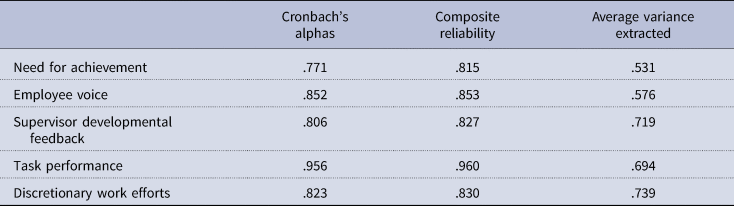
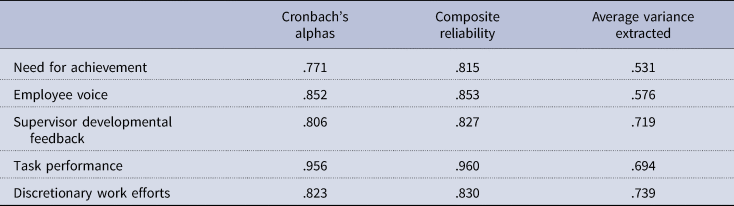
Using the PLS-SEM algorithm, we conducted a thorough evaluation of our measurement model. As shown in Table 2, the composite reliability values of the key variables of interest were higher than the threshold value of .70, thus confirming their internal reliability. Additionally, we assessed the convergent validity. The average variance extracted analysis indicates that the values of our five variables ranged from .53 to .74, and they were higher than the minimum threshold value of .50 (Bagozzi & Yi, Reference Bagozzi and Yi1988; Fornell & Larcker, Reference Fornell and Larcker1981; Hair, Sarstedt, Ringle, & Mena, Reference Hair, Sarstedt, Ringle and Mena2012). Almost all the outer loadings of the indicators used to measure our latent variables were larger than the accepted value of .70 (Hair, Ringle, & Sarstedt, Reference Hair, Ringle and Sarstedt2011, 2017). Therefore, we can confirm a reliable degree of convergent validity of the constructs used for our study. Finally, standardized root mean square residual (SRMR) is considered as an essential tool to validate a model in the PLS method. When a value of the SRMR is less than .08 in covariance-based structural equation modeling (CB-SEM), one can generally conclude a good model fit (Hu & Bentler, Reference Hu and Bentler1998). A value of SRMR of .059 for our study satisfies the recommended criterion, thus indicating that the overall model fit is highly reasonable. Importantly, Figure 2 illustrates some important results. First, the standardized factor loadings from the PLS analysis were above the .40 threshold value (Hair, Ringle, & Sarstedt, Reference Hair, Ringle and Sarstedt2011). Second, the preliminary results show support for our hypothesized relationships as follows: the association between the need for achievement and employee voice was statistically significant and positive (β = .71, p < .01); the associations between employee voice and task performance (β = .34, p < .01) and discretionary work effort (β = .23, p < .01) were statistically significant and positive. Table 3 further revealed that employee voice mediated the positive relationship between the need for achievement and supervisors' evaluations of employee task performance (β = .24, p < .01) and discretionary work effort (β = .16, p < .01).
Cronbach's alphas, composite reliability, and average variance extracted values
Path coefficients, t-values, R 2, standardized factor loadings, and p values. *** p < .01, N = 392.

Evaluation of mediation effects from the PLS analysis

Hypotheses testing
First, we hypothesized that the need for achievement would predict an individual's engagement in voice behavior. Our results revealed a positive and statistically significant association between the need for achievement and employee voice (β = .65, p < .01), which provides support for Hypothesis 1. We further determined how employees would be assessed by their supervisors as a result of having engaged in voice. Accordingly, our regression results showed positive and statistically significant associations between employee voice and (a) task performance (β = .33, p < .01) and (b) discretionary work behavior (β = .18, p < .01), hence supporting Hypothesis 2. These results are shown in Table 4.
Regression results for the interaction term in predicting task performance and discretionary work behavior

Note: SDF = supervisor developmental feedback. N = 392; *p < .05, **p < .01.
We then tested the mediation and moderated mediation hypotheses using the PROCESS macro developed by Hayes (Reference Hayes2013). We first posited that the expression of voice may enable individuals with a high need for achievement to achieve positive ratings from supervisors on their task performance and discretionary work effort. As shown in Table 5, the total effects of need for achievement on (a) task performance (total effect = .29, SE = .06, 95% CI from .18 to .40) and (b) discretionary work effort (total effect = .31, SE = .06, 95% CI from .20 to .42) were positive and significant, the direct effects of need for achievement on (a) task performance (direct effect = .05, SE = .07, 95% CI from −.10 to .19) and (b) discretionary work effort became non-significant after accounting for employee voice (direct effect = .15, SE = .08, 95% CI from −.004 to .30), and the indirect effects of need for achievement on (a) task performance (indirect effect = .25, SE = .06, 95% CI from .13 to .37) and (b) discretionary work effort (indirect effect = .17, SE = .06, 95% CI from .05 to .28) were positive and significant. These results suggest that while employees who display a high need for achievement can achieve positive supervisory ratings on task performance and discretionary work effort (i.e., as reflected in the positive and significant total effects), they may do so through the expression of voice, which is a proactive action that enables them to make relevant improvements in work-related areas (i.e., as reflected in positive and significant indirect effects). Importantly, the direct effects became non-significant after having controlled for voice, suggesting that employee voice fully mediates the relationships between the need for achievement and the two task-related outcomes. Therefore, Hypothesis 3 was fully supported.
Regression results for the indirect effect and conditional indirect effect of need for achievement on supervisors' evaluations of employee (a) task performance and (b) discretionary work effort through employee voice
Note: SE = standard error; CI = confidence intervals. N = 392. Bootstrap sample size = 5,000.
Turning next to Hypothesis 4, we predicted that the strength of indirect effects of need for achievement on (a) task performance and (b) discretionary work effort through employee voice would be conditional on the developmental feedback received from supervisors. Specifically, we proposed the moderating role of supervisor developmental feedback. First, we observed a statistically significant interaction term (employee voice × supervisor developmental feedback) in predicting supervisors' ratings of employee task performance (β = .15, p < .01) (see Table 4). A slope analysis (see Figure 3) revealed that the positive association between the employee voice and task performance became stronger at high levels of supervisor developmental feedback (+1SD above mean, β = .46, p < .001, t = 6.92) but weaker at low levels of supervisor developmental feedback (−1SD below mean, β = .22, p < .001, t = 3.28). Conditional analyses were further conducted to determine how the strength of the relationship between the employee voice and task performance would vary across the PROCESS macro's two default levels (Hayes, Reference Hayes2013), including low (16th percentile) and high (84th percentile) levels of supervisor developmental feedback. Correspondingly, the conditional indirect effect of the need for achievement on task performance through the employee voice became stronger at high levels of supervisor developmental feedback (84th percentile = 6.00, indirect effect = .34, SE = .07, 95% CI .20 to .48) but weaker at low levels of supervisor developmental feedback (16th percentile = 3.67, indirect effect = .16, SE = .06, 95% CI .05 to .29). Following Preacher, Rucker, and Hayes (Reference Preacher, Rucker and Hayes2007) technique when testing for the conditional indirect effect, we also obtained an index of moderated mediation using the PROCESS macro (Hayes, Reference Hayes2013). Accordingly, the index of moderated mediation was significant (index = 07, SE = .02, 95% CI from .03 to .12). This index provides evidence that the moderator is linearly related to the mediated model and not just a specific path in the model (e.g., the a or b path of the indirect effect) (Hayes, Reference Hayes2013). Thus, Hypothesis 4(a) received empirical support. These results are presented in Table 5.
The interactive association between employee voice and supervisor developmental feedback in predicting task performance.

Similarly, we observed a statistically significant interaction term (employee voice × supervisor developmental feedback) in predicting supervisors' ratings of employee discretionary work effort (β = .16, p < .01) (see Table 4). Specifically, the slope analysis (see Figure 4) revealed that the positive association between the employee voice and discretionary work effort became stronger at high levels of supervisor developmental feedback (+1SD above mean, β = .43, p < .001, t = 5.36) but rather non-significant at low levels of supervisor developmental feedback (−1SD below mean, β = .05, p = .52, t = .64). Accordingly, the conditional indirect effect of need for achievement on discretionary work effort through the employee voice was also stronger at high levels of supervisor developmental feedback (84th percentile = 6.00, indirect effect = .27, SE = .07, 95% CI .14 to .41) but became statistically non-significant at low levels of supervisor developmental feedback (16th percentile = 3.67, indirect effect = .08, SE = .06, 95% CI −.04 to .20) (see Table 5). The index of moderated mediation was significant (index = 08, SE = .02, 95% CI from .03 to .13). Hence, Hypothesis 4(b) also received empirical support.
The interactive association between employee voice and supervisor developmental feedback in predicting discretionary work effort.

Supplementary analyses
As a robustness check, we tested the proposed mediation and moderated mediation models again without taking into account control variables (Becker, Reference Becker2005). The results revealed that the indirect effects of the need for achievement on (a) task performance (indirect effect = .23, SE = .06, 95% CI .12 to .34) and (b) discretionary work effort (indirect effect = .13, SE = .06, 95% CI .02 to .23) via employee voice were significant when not controlling for subordinate employees' age, gender, and organizational tenure. Thus, we found no meaningful differences in the results. The consistency of results regardless of statistical controls suggests the robustness of the observed results.
It is also plausible that supervisor developmental feedback may act as a first-stage moderator. That is, it may moderate the two mediated relationships by interacting with need for achievement in predicting the employee voice. We tested these two alternative models and found that the interaction between the need for achievement and supervisor developmental feedback was not significant (β = .004, p = .89), which provides further support to Hypotheses 4(a) and 4(b).
Discussion
Summary of results
This study utilizes the Japanese work context to explicate the relationships between the need for achievement, employee voice, and supervisors' evaluations of employee task performance and discretionary work effort. Drawing upon Parker, Bindl, and Strauss (Reference Parker, Bindl and Strauss2010) model of proactive motivation as an overarching theoretical perspective, our results largely support our hypotheses. First, our results show that individuals with a high need for achievement reported to have higher engagement in voice behavior, subsequently promoting supervisors' evaluations of their task performance and discretionary work effort. Indeed, a sense of achievement is a core essential value within the Japanese society (Holthus & Manzenreiter, Reference Holthus and Manzenreiter2017). Furthermore, the Japanese work culture can be regarded as displaying a high uncertainty avoidance (Yeh, Reference Yeh1988), which may predispose employees to behave proactively, such as through voice, thereby addressing work-related uncertainty, risks, or mistakes. Second, our results show that voice expressed by achievement-driven employees would be more positively received by supervisors with the presence of supervisor developmental feedback. Thus, employees should be well equipped with necessary skills and knowledge to exercise voice effectively. The facilitative role of supervisor developmental feedback is especially important in work contexts where power inequalities are substantial and employees are expected to defer to those with authority, such as in Japan (Hofstede, Reference Hofstede1984; Hsiung & Tsai, Reference Hsiung and Tsai2017). These results provide some important theoretical as well as practical implications.
Theoretical implications
This study contributes to the employee voice literature in some important ways. First, this study utilizes the proactive motivation model (Parker, Bindl, & Strauss, Reference Parker, Bindl and Strauss2010) to offer a theoretical sound explanation to ‘why’ employees are motivated to express their voice. In so doing, this study also addresses the call to explore personal motives behind employees' engagement in voice behavior (Morrison, Reference Morrison2011; Mowbray, Wilkinson, & Tse, Reference Mowbray, Wilkinson and Tse2015). Although the examination of antecedents of employee voice is not new, past research mainly focused on an individual's efficacy to voice (e.g., Duan, Kwan, & Ling, Reference Duan, Kwan and Ling2014) and feelings of safety to speak up their ideas (e.g., Detert & Treviño, Reference Detert and Treviño2010). However, while this ‘can do’ perspective is important to understand the motivation underlying proactive actions, they do not answer ‘why’ people select to engage in a certain proactive behavior. Employees may feel competent to voice out their ideas, but they have no compelling ‘reasons to do’ so. Therefore, we drew on the model of proactive motivation (Parker, Bindl, & Strauss, Reference Parker, Bindl and Strauss2010) and argued that proactive action is initiated by those who show a strong desire to be proactive and/or see the value of being proactive. In this regard, we posited the need for achievement as one of the essential predictors of voice behavior and, accordingly, received empirical support for this prediction.
Second, we deviate from the traditional perspective that employees engage in voice for prosocial reasons. That is, voice is motivated by the desire to bring beneficial outcomes to the organization and/or other stakeholders, such as felt responsibility for constructive change (e.g., Fuller, Marler, & Hester, Reference Fuller, Marler and Hester2006), work unit identification (e.g., Burris, Rockmann, & Kimmons, Reference Burris, Rockmann and Kimmons2017), and organizational commitment (e.g., Cheng, Bai, & Hu, Reference Cheng, Bai and Hu2019). This study extends the previous research by arguing that employees may engage in voice not only for reasons to serve others but also for reasons to serve one's personal needs. Specifically, as a result of having expressed constructive changes in the workplace, voice behavior may pave ways for employees with a high need for achievement to a more efficient and effective approach to task completion. In a nutshell, employee voice is self-initiated and goal-directed.
Furthermore, we contribute to the current knowledge of employee voice by providing a better understanding to ‘why’ some voicing ideas may be more or less positively received by others, such as supervisors. Our argument is employees who have received supervisor developmental feedback will have more opportunities to become equipped with the relevant information that can support their voicing inputs, thereby overcoming a supervisor's skepticism and doubts about the feasibility of the voicing concerns (Shepherd, Patzelt, & Berry, Reference Shepherd, Patzelt and Berry2019). Furthermore, the developmental feedback given by supervisors should be particularly stimulating for achievement-driven employees. Individuals who exhibit a strong need for achievement are highly sensitive to opportunities that enable them to perform better than before (Brunstein, Reference Brunstein, Heckhausen and Heckhausen2008; McClelland, Reference McClelland1985). As reflected in our findings, voice attempts initiated by achievement-driven employees were perceived more positively (i.e., positive supervisors' assessments of employee task performance and discretionary work effort) with the presence of supervisor developmental feedback.
Practical implications
There are important practical implications for both employees and organizations. Importantly, these implications can be inferred not only to the Japanese work context, but also others that may display somewhat similar cultural values such as high uncertainty avoidance and power distance. First, for those employees who wish to speak up, it is important for them to keep in mind that the expression of voice should be done carefully and in a skillful way. While the employee voice can bring various benefits to organizations, the behavior can be easily misinterpreted as bossiness, criticisms, interference, and an effort to undermine the credibility of others, such as co-workers, supervisors, and other higher-ups. Specifically, our results suggest that the supervisor developmental feedback plays an important role in facilitating the effectiveness of employee voice. Employees who receive developmental feedback from supervisors may become better equipped with the relevant knowledge and capabilities to perform voice effectively.
Given that our results revealed the positive role that supervisor developmental feedback can play in promoting the effectiveness of employee voice, organizations may encourage more of such a practice, for instance, by setting up one-on-one developmental feedback sessions where supervisors and their subordinate employees can touch base on their work progress on a defined time-basis. For employees to be able to express their voice that is aimed toward bringing about improvement to the workplace, they themselves also need to be well-equipped with a development mindset. Indeed, the supervisor developmental feedback contains information that enables employees to learn, develop, and make improvements (Zhou, Reference Zhou2003). Furthermore, during the feedback session, employees can also learn from their supervisors by observing how they communicate their feedback in a manner that would stimulate employees' learning. Through observational learning (Stajkovic & Luthans, Reference Stajkovic and Luthans1998), employees may become more skilled in their communication of ideas and suggestions.
Limitations and future research directions
This study is not without limitations, which should be carefully considered when interpreting its results. First, this study was conducted using a cross-sectional design, and data were, thus, collected at a single point in time. As a result, cause and effect relationships cannot be inferred. However, we took an important precaution to minimize the method bias that could potentially arise from the use of a cross-sectional design by utilizing multi-source data (i.e., subordinate–supervisor dyads), following methodological prescriptions by Podsakoff et al. (Reference Podsakoff, MacKenzie, Lee and Podsakoff2003). These multi-sources were also independently matched. Furthermore, statistically significant interaction effects (i.e., employee voice × supervisor developmental feedback) cannot emerge as statistical artefacts of common method bias (Siemsen, Roth, & Oliveira, Reference Siemsen, Roth and Oliveira2010). To move this research forward, future studies may adopt a longitudinal design to examine the interrelationships of the variables over time, for example, by determining independent variables (i.e., need for achievement, employee voice and supervisor developmental feedback) at Time 1 and determining outcome variables (i.e., supervisors' ratings of employee task performance and discretionary work effort) at Time 2.
Second, we acknowledge the limitations associated with some of the short-item measures used in this study, notably the three-item scales of both supervisor developmental feedback and discretionary work effort. For instance, these short-item measures are less able to capture the constructs in question, which may result in a low content validity. Furthermore, fewer items being used can potentially affect the reliability of the two measures as they are less able to determine the consistency of the participants' responses to the questions asked to them. However, our study revealed that both supervisor developmental feedback (Cronbach's α = .81) and discretionary work effort (Cronbach's α = .82) show strong reliability estimates. Future studies can address the limitations associated with short-item scales by incorporating additional items from other existing measures that also capture the key variables examined. In Frenkel and Bednall (Reference Frenkel and Bednall2016) study, they determined discretionary work effort by incorporating items from various measures, including the three-item scale developed by May, Korczynski, and Frenkel (Reference May, Korczynski and Frenkel2002) and two additional items taken from the conscientiousness dimension of the organizational citizenship behavior scale developed by Farh, Earley, and Lin (Reference Farh, Earley and Lin1997).
Third, the relationship between supervisors and subordinates could potentially be a source of bias. This is particularly the case when supervisors rated their employees on task performance and discretionary work effort. Future studies may consider controlling for factors such as the degree of acquaintanceship and the duration of their collaboration. Finally, this study was conducted in the Japanese work context and the manufacturing sector, which may limit the generalization of our obtained findings. However, our results still provide important implications for organizations that display somewhat similar cultural values, notably high uncertainty avoidance and power distance. These cultural values are highly apparent among firms operating in the Easter context (Hofstede, Reference Hofstede1989). To address this limitation, future research may consider replicating our findings in different cultural contexts and also different industries.
Bringing our research on voice forward, there is ample room for future studies to provide more insight into the antecedents and outcomes of employee voice by considering the different ways in which voice can play out. For instance, promotive voice involves expressing new ideas and suggestions in order to make improvement (Liang, Farh, & Farh, Reference Liang, Farh and Farh2012), which reflects a proactive initiative to improve current circumstances. Due to the proactive nature of achievement-driven employees, they may show a stronger motivational propensity to engage in promotive voice because the behavior focuses on bringing forward constructive changes. Prohibitive voice, however, involves expressing concerns about current work practices that are harmful to the organization (Liang, Farh, & Farh, Reference Liang, Farh and Farh2012), which reflects a reactive action toward current conditions. Hence, others may perceive this form of voice, in comparison to promotive voice, less positively as the behavior brings attention to harmful factors, which can potentially prompt conflicts and negative emotions among colleagues and supervisors.
Conclusion
In conclusion, this study drew on Parker, Bindl, and Strauss (Reference Parker, Bindl and Strauss2010) model of proactive motivation and examined employee voice as a form of proactive behavior. Such proactive action can be driven by a need for achievement, a lesser investigated aspect of the proactive motivation model. However, the extent to which the employee voice will promote relevant changes in the workplace is highly contingent on how positively the behavior is viewed by those in high positions such as supervisors, which may be reflected in supervisors' assessments of employee task performance and discretionary work effort. Importantly, to address discrepancies in the literature concerning the effectiveness of voice behavior, we highlighted the facilitating role of supervisor developmental feedback.
Hataya is a Senior Lecturer in Human Resource Management at the University of Waikato, New Zealand. She received her PhD in Management (Organisational Behavior) from the Australian National University. Hataya is a research active faculty with publications in international outlets, such as European Management Journal, Journal of Vocational Behavior, Journal of Career Assessment, Journal of Management and Organization, Personality and Individual Differences, Personnel Review, and Handbook of Organizational Politics (2nd Edition).
Norifumi Kawai is an Associate Professor of International Business in the Department of Management at the Università degli Studi di Bergamo, Italy. He holds a PhD in Managerial Economics from the Mercator School of Management at the Universität Duisburg-Essen, Germany. His research has appeared in journals such as British Journal of Management, European Management Journal, International Business Review, International Journal of Human Resource Management, Journal of Management & Organization, and Journal of World Business. He serves as a member of the Editorial Advisory Board of International Business Review.



