Introduction
Suicide is a leading cause of death among young males (Centers for Disease Control and Prevention, 2005) and past year suicidal thoughts (10.5%) and attempt (4.6%) are relatively common among adolescent boys (Centers for Disease Control and Prevention, 2008). Suicidal behavior in adolescence not only confers short-term risk for suicide but is also associated with long-term maladjustment. For example, a suicide attempt by age 15 years predicts higher rates of major depressive disorder and suicide attempt in the following 15 years (Fergusson et al. Reference Fergusson, Horwood, Ridder and Beautrais2005).
There are clear reasons to expect negative relationship outcomes for men who were suicidal in adolescence. Yet prospective studies have not examined this important domain of young-adult functioning. The tendency to behave impulsively in states of intense negative affect – also known as reactive or impulsive aggression – greatly increases risk for suicide and may be an endophenotype underlying suicidal behaviors and violence (e.g. Conner et al. Reference Conner, Duberstein, Conwell, Seidlitz and Caine2001; Brent & Mann, Reference Brent and Mann2005; Dawes et al. Reference Dawes, Mathias, Richard, Hill-Kapturczak and Dougherty2008; Mann et al. Reference Mann, Arango, Avenevoli, Brent, Champagne, Clayton, Currier, Dougherty, Haghighi, Hodge, Kleinman, Lehner, McMahon, Mościcki, Oquendo, Pandey, Pearson, Stanley, Terwillliger and Wenzel2009). Relationships can be a source of significant conflict and profound emotional distress. Thus, if a suicide-attempt history marks a vulnerability to impulsive aggression, this propensity may be manifested in intimate partner violence (IPV) and relationship instability. Individuals showing impulsive aggression are also more prone to making hostile attributions and experiencing bitterness and dysphoric mood in response to interpersonal conflict (Conner et al. Reference Conner, Duberstein, Conwell and Caine2003). Therefore, suicidal adolescents may also be more jealous and less satisfied with their romantic relationships in adulthood.
Discerning an association between suicide risk and later relationship dysfunction would be highly relevant to suicide and IPV prevention. First, relationship conflict may potentiate suicide risk. That is, impulsive aggression may not only confer the capacity for suicide but, if expressed in arguments or partner violence, may lead to the very incidents (e.g. break-ups) that precipitate attempts and suicide (Beautrais et al. Reference Beautrais, Joyce and Mulder1997). Second, findings may enhance prediction of IPV escalation (Campbell, Reference Campbell and Campbell2007). One study of men with petition orders against them for domestic violence found that 46% had threatened suicide, one-quarter of whom had made the threat within 1 week of the petition. Furthermore, men who had threatened or attempted suicide had perpetrated more severe partner violence than others (Conner et al. Reference Conner, Cerulli and Caine2002). Identifying a vulnerability common to suicidal behavior and IPV may improve predictions of dangerousness. Finally, IPV is often conceptualized as a primarily calculated, controlling and emotionally cold behavior (Walker, Reference Walker1984; Pence & Paymar, Reference Pence and Paymar1993), rather than one involving mental health risk factors. An association between suicide-attempt history and IPV would not be wholly consistent with this view and may suggest that additional prevention and treatment approaches are needed.
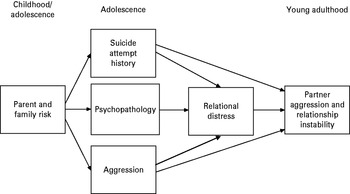
Our primary aims concern hypotheses guided by our conceptual model (Fig. 1). Suicide attempt and aggression in adolescence are hypothesized to predict men's maladaptive relational behaviors in young adulthood; namely, partner-directed aggression, injury to partners, arrests for domestic violence and relationship instability. Models must control for risk factors that may be common to suicide attempt, aggression and IPV, including parent/family context (e.g. poor parenting, marital conflict and parent psychopathology) and adolescent psychopathology (suicidal thoughts, depressive symptoms and substance use; e.g. Capaldi & Clark, Reference Capaldi and Clark1998; Woodward et al. Reference Woodward, Fergusson and Horwood2002; Bridge et al. Reference Bridge, Goldstein and Brent2006). Predictions from adolescent suicide-attempt history and aggression to relationship behaviors are hypothesized to be at least partially indirect via relational distress (jealousy and relationship dissatisfaction). Finally, because multi-informant studies are rare in research on suicide risk and IPV, our secondary aim concerns associations that mother, father, teacher and self-reports of youth aggression may have with suicide-attempt history and later IPV. We examine these issues in at-risk men assessed annually from ages 10–32 years and their participating female romantic partners.
Conceptual model of relationship outcomes for aggressive and suicidal adolescents.

Method
Participants
Participants were 153 men who originally participated in the Oregon Youth Study (OYS), a community-based sample of 206 young men at risk for delinquency. OYS participants were recruited through fourth-grade classes (ages 9–10 years) in higher crime areas of a medium-size metropolitan region in the Pacific Northwest. The sample was 90% Euro-American and 75% lower and working class. The men have been assessed annually and the retention rate of the original 203 men who are still living was 94% in the 23rd year of data collection.
Most OYS men also participated in the Couples Study; 153 of the men were considered presently because they had participated with a partner at two or more of the three Couples Study assessments conducted in late adolescence [ages 17–20 years; wave 1 (W1)], young adulthood [ages 20–23 years; wave 2 (W2)] and early adulthood [ages 23–25 years; wave 3 (W3)]; 64 (42%) participated at two of the three waves and 89 (58%) participated at all three waves. Given low base rates, injuries, arrests and relationship break-ups were based on assessments through wave 6 [(W6); ages 29–31 years].
W1 included 118 men and their female partners (mean ages=18.7 and 18.2 years, respectively) who had been in a relationship for 48.6 weeks on average; 82 of the couples were dating, five were married, and 31 were cohabitating. At W2, 157 men and their partners (ages 21.3 and 20.8 years), who had been together for 82.3 weeks on average, participated; 71 were dating, 28 were married and 58 were cohabitating. At W3, 147 men and their partners (ages 24.1 and 23.1 years) participated, having been in a relationship for 149.3 weeks on average; 41 of these couples were dating, 51 were married and 55 were cohabitating.
InstrumentsFootnote 1Footnote †
Coding of family and dyadic interactions
The Family Process Code (FPC; Dishion et al. Reference Dishion, Gardner, Patterson, Reid, Spyrou and Thibodeaux1983) and Family and Peer Process Code (FPPC; Stubbs et al. Reference Stubbs, Crosby, Forgatch and Capaldi1998) are two systems used to code the content (24 codes, e.g. verbal, compliance and physical) and emotional valence (six codes based on vocal tone, body posture and facial expression) of interpersonal behaviors. Further details, including inter-rater reliability, can be found elsewhere (Capaldi & Clark, Reference Capaldi and Clark1998; Capaldi et al. Reference Capaldi, Shortt, Kim, Wilson, Crosby and Tucci2009).
Parent/family risk factors
Parental depressive symptoms were assessed when boys were ages 10, 11 and 12 years using the Center for Epidemiologic Studies Depression Scale (CESD; Radloff, Reference Radloff1977; α=0.76–0.92); mothers' and fathers' symptoms were associated at each year (r=0.22–0.37, p<0.05). A construct was calculated as the mean of reports by both parents across 3 years (α=0.74).
Parental dyadic aggression was measured using four indicators: (a) mother (α=0.68) and father (α=0.76) reports on the Conflict Tactics Scale (Straus, Reference Straus1979) when boys were age 14 years; (b) mother (α=0.76–0.78) and father reports (α=0.73–0.77) on four items from the Dyadic Adjustment Scale (DAS; Spanier, Reference Spanier1976) when boys were ages 10, 12, and 14; (c) home observer coder ratings (Oregon Social Learning Center, 1984 c); (d) coding of inter-parental negative engagement [rates per minute (RPM)] during home observations when boys were ages 10 and 12 years using FPC. Indicators were standardized and averaged within and then across informants/methods. Scales based on parent reports and observations were significantly associated (r=0.31, p<0.05) and were standardized and averaged to form the final construct.
Unskilled parenting was measured when boys were ages 10, 12 and 14 years. Indicators of poor monitoring included parent and child in-person and phone interviews and questionnaires (Dishion et al. Reference Dishion, Patterson, Reid, Capaldi, Forgatch and McCarthy1984 a, Reference Dishion, Patterson, Reid, Capaldi, Forgatch and McCarthyb; Oregon Social Learning Center, 1984 a, b; e.g. ‘How often do you talk with your son about plans for the coming day?’) and parent and child interviewer ratings (Oregon Social Learning Center, 1984–87; e.g. ‘How carefully does each parent monitor this child?’). Indicators of poor discipline included parent and child interviews and questionnaires (e.g. ‘How often do you think that the kind of punishment you give your son depends on your mood?’), FPPC coding of family interaction tasks (e.g. ‘nattering’) and parent interviewer and home observer ratings (Oregon Social Learning Center, 1984 c; e.g. ‘Erratic, inconsistent and haphazard discipline’). Poor monitoring and discipline constructs were significantly associated (r=0.53, p<0.05) and were standardized and averaged to form the unskilled parenting construct.
Adolescent psychopathology
Suicide-attempt history was derived from the Diagnostic Interview Schedule for Children (Shaffer et al. Reference Shaffer, Fisher, Piacentini, Schwab-Stone and Wicks1989) question, ‘Have you ever in your whole life tried to kill yourself?’, administered to the boy and his parent (regarding the boy's history) at the age 16- and 17-year assessments. The maximum number of attempts reported by either informant at either assessment was recorded. A suicide attempt was documented for 19 (12%) of the participants; 11 reported a single suicide attempt, three made two attempts and five made three or more suicide attempts. Attempt history was dichotomized to negative (0) or positive (1) for analyses.
Suicidal ideation was self-reported five times from ages 13–17 years on an item adapted from the Beck Depression Inventory (Beck, Reference Beck1967); responses were coded 0 (I do not think about killing myself), 1 (I think about killing myself but would not do it) or 2 (I would like to kill myself). Given face validity, items were averaged despite weak internal consistency (α=0.455).
Depressive symptoms were measured annually seven times using the Depression Self-Rating Scale for children (Birleson, Reference Birleson1981) at ages 11–13 years and the CESD at ages 14–17 years. Internal consistencies were adequate within (α=0.76–0.93) and across (α=0.79) the seven assessments; thus, the mean of the seven standardized scores was used.
Aggression was measured using four indicators spanning ages 10–17 years. Frequencies of self-reported physical aggression and threats thereof in the past year based on 10 items (e.g. ‘How many times have you attacked someone with the idea of seriously hurting or killing that person?’) of the Elliott Delinquency Scale (Elliott et al. Reference Elliott, Ageton, Huizinga, Knowles and Canter1983) were collected at yearly intervals from ages 14–17 years; at each year, frequencies were capped at 365 and log transformed.
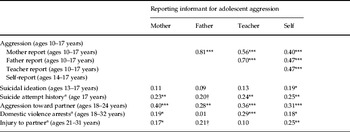
Mothers, fathers and teachers completed the Child Behavior Checklist and Teacher Report Form (Achenbach & Edelbrock, Reference Achenbach and Edelbrock1983) at eight annual visits (ages 10–17 years); two physical aggression items (‘gets in many fights’ and ‘physically attacks people’) rated 0 (not true), 1 (somewhat/sometimes true) or 2 (very true or always true) were used. Mean self-, mother-, father- and teacher-report scores were first averaged across years within informants (α=0.69, 0.83, 0.86 and 0.90, respectively). The informants' reports were interrelated (see Table 1); these reports were standardized and averaged (α=0.81) to create an adolescent aggression composite for use in primary analyses and considered separately to address the secondary study aim.
Correlations among indicators of adolescent aggression, adolescent suicide-attempt history and partner-directed aggression in young adulthood

a Dichotomously coded. N 's for correlations between father reports and other variables ranged from 83 to 90; otherwise, N's ranged from 141 to 152.
* p<0.05, ** p<0.01, *** p<0.001, † p<0.10.
Substance use was assessed annually by interview from ages 12–17 years. Participants reported the number of times in the past year that they had consumed/used beer, wine, liquor, marijuana and other drugs. Alcohol, marijuana and other drug use were each recoded to a 9-point scale (ranging from never to two to three times per day) to reduce skewness and then were standardized and averaged at each assessment (α=0.34–0.81; values were weak at the youngest ages, when use is unusual). A composite score was calculated as the mean of standardized scores across assessments (α=0.79).
Young-adult outcomes – relational distress
Jealousy was based on reports from three agents at Couples Study W2 and W3Footnote 2: two self-report items on the Couples Interview (Capaldi & Wilson, Reference Capaldi and Wilson1994 a), partner-reports on the Couples Interview and the Partner Issues Checklist (Capaldi et al. Reference Capaldi, Wilson and Collier1994) and one rating from the FPPC coder impressions (Capaldi & Crosby, Reference Capaldi and Crosby1995). The final construct was based on the average of the standardized jealousy variables at W2 and W3.
Relationship satisfaction was based on indicators from three reporting agents at W1 to W3: (a) self-reports on the DAS and the Couples Interview; (b) partner-reports on the DAS and Couples Interview; (c) observer reports – FPPC items from interaction tasks (see below) and an assessor rating item from the Couples Interview (Capaldi & Wilson, Reference Capaldi and Wilson1994 b). Details on the development of relational distress constructs are provided in the Supplementary Appendix (available online).
Young-adult outcomes – maladaptive relationship behavior
Aggression toward a partner was based on separately developed physical and psychological aggression constructs at W1–W3. Items and scales from the following self- and partner-report indicators were used: Adjustment with Partner Scale (Kessler, Reference Kessler1990); Conflict Tactics Scale; Dyadic Social Skills Questionnaire (Capaldi, Reference Capaldi1994); Partner Interaction Questionnaire (Capaldi, Reference Capaldi1991); Couples Interviews. The men and their partners also participated in 34–36 min videotaped interaction tasks. Tasks varied somewhat by wave but included party planning, problem-solving on self-selected relationship issues and discussion of dating and marriage issues.
Observational measures of RPM of men's aggression toward their partner during the tasks were coded by trained, professional research assistants using FPPC. RPM of physically aggressive behaviors included all aversive physical contact, from a slight shove to hard hits, regardless of affect. The psychological aggression observational variable was based on the sum of RPM of two FPPC content codes (also regardless of affect): negative verbal (blaming or disapproval, e.g. ‘you really blew that one, didn't you?’); verbal attack (more extreme name calling, threats and humiliation, e.g. ‘You're such a loser.’). Observers also rated the occurrence of men's psychological aggression and moderate and severe physical aggression toward partners that occurred during the observation, as well as references to the men's moderate and severe physical aggression toward the partner in the past.
Scales comprising face valid but low base rate behaviors were retained despite weak internal consistencies (α<0.60). Physical and psychological aggression constructs were strongly associated (r=0.65, p<0.001) and each showed similar associations with adolescent aggression (r=0.31 and 0.45, p<0.001, respectively) and suicide-attempt history (r=0.24, p<0.01 and 0.32, p<0.001, respectively). Therefore, a single aggression toward a partner construct was calculated as the mean of standardized aggression variables at the three waves (i.e. six indicators, α=0.73).
Domestic violence arrests were based on official court record searches conducted annually from ages 18 to 30–32 years in the locales where participants lived. Police reports were examined for all violence-related arrests. Those arrests that involved aggression toward a romantic partner were summed for use in the present study. Additional information on coding and the nature of arrests can be found in Capaldi et al. (Reference Capaldi, Shortt, Kim, Wilson, Crosby and Tucci2009). Linear regression was inappropriate given the distributions of arrests [16 (10%) were arrested once, five (3%) twice and four (3%) three or more times]. Therefore, this outcome was dichotomized into either negative (n=128, 84%) or positive (n=25, 16%) history of domestic violence arrest.
Relationship instability was based on men's interviews at ages 24, 25, 26, 28, 30 and 32 years regarding whether or not they had had a relationship break-up in the past year. The proportion of positive responses was used to measure relationship instability (0=no break-ups at any assessment, 1=a break-up at every assessment year).
Partner injury caused by participating men was assessed at W2–W6. At each wave, partners reported in the Couples Interview whether they had been physically injured by the OYS man and, if so, what the worst injury had been. Injury types were classified as minor (pushed/slapped, knocked down, grabbed self in pain, bruised) or major [unconscious, cut/bleeding, broken bone(s), had to see a doctor]. In total, 24 (15.7%) of the men caused a minor injury to their partner and 25 (16.3%) caused a major injury. Rates were too low for separate analyses by severity. Thus, this outcome was dichotomized into either no injury (n=112, 73%) or at least one injury (n=41, 27%). The Supplementary Appendix includes further details on the development of maladaptive relationship behavior constructs.
Data analysis
Multiple linear and logistic regressions were conducted using SPSS 15.0. Mplus version 5.21 (Muthén & Muthén, Reference Muthén and Muthén2009) was used to model relationship instability, an ordered categorical outcome, using probit regression.
Primary hypotheses concerned prediction of young-adult relationship outcomes from adolescent aggression and suicide-attempt history. Therefore, these variables were entered first (step 1) in regression models. Next, covariates that were univariately associated with the outcome (p<0.05) were entered in developmental sequence: parent/family context, adolescent psychopathology and (for maladaptive behavior outcome models only) young-adult relational distress variables. At each step, covariates were retained if coefficients were marginally significant (p<0.10). In all, this approach is prone to Type I error with regard to effects of covariates, but provides the most stringent tests of the hypothesized predictions from adolescent aggression and suicide attempt. Indirect effects of adolescent aggression and attempt history on maladaptive relationship behaviors via relational distress were tested using Mplus.
Results
Univariate associations
Table 1 relates to the secondary aim of the study. Self-reports of boys' aggression, but not adult's reports, were significantly associated with suicidal ideation. Across informants, adolescent aggression was generally associated with adolescent suicide-attempt history and young-adult aggression toward a partner. Informants' reports of adolescent aggression generally predicted domestic violence arrest and injury to partner in young adulthood. All subsequent analyses used the multi-informant aggression construct.
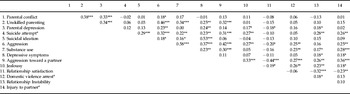
Univariate correlations among parent/family, adolescence and young adulthood variables in Table 2 were used to identify covariates in regression models. Associations that suicide-attempt history had with dichotomous adult outcomes (domestic violence arrest and injury to partner) were cross-tabulated to clarify patterns. Four (21%) of the 19 men who made a suicide attempt in adolescence were arrested for domestic violence in adulthood, compared with 21 (16%) of the 133 other men. Of the 19 men who made a suicide attempt in adolescence, 11 (58%) injured a partner in adulthood, compared with 30 (23%) of the 133 other men.
Correlations among study variables

a Dichotomously coded.
* p<0.05, ** p<0.01, *** p<0.001.
Multivariate regression models
Adolescent suicide-attempt history
Logistic regression supported aggression [B (s.e.)=0.73 (0.23), Wald=10.48, exp(B)=2.07, p<0.01] and suicidal ideation [B (s.e.)=0.65 (0.23), Wald=8.19, exp(B)=1.92, p<0.01], as unique correlates of suicide attempt, model χ2 (degrees of freedom=2, n=152)=21.4, p<0.001; depressive symptoms and substance use, although univariately associated with suicide attempt, did not contribute significantly to the model.
Multivariate prediction of relationship distress in young adulthood
Jealousy was predicted by adolescent aggression and suicide-attempt history using linear regression [F(2, 151)=9.23, p<0.001, B (s.e.)=0.18 (0.07) and 0.51 (0.21), β=0.21 and 0.20, p<0.05, respectively]; parental depressive symptoms (the only univariately significant covariate) did not.
Relationship satisfaction was regressed on adolescent aggression [B (s.e.)=−0.15 (0.07), β=−0.19, p<0.05] and suicide-attempt history [B (s.e.)=−0.11 (0.21), β=−0.04, n.s.]. When parental depressive symptoms were entered, the model remained significant [F(3, 151)=3.11, p<0.05], but neither aggression [B (s.e.)=−0.13 (0.07), β=−0.16, p=0.068], nor parental depressive symptoms [B (s.e.)=−0.11 (0.07), β=−0.14, p=0.099], reached statistical significance.
Multivariate prediction of maladaptive relationship behaviors in young adulthood
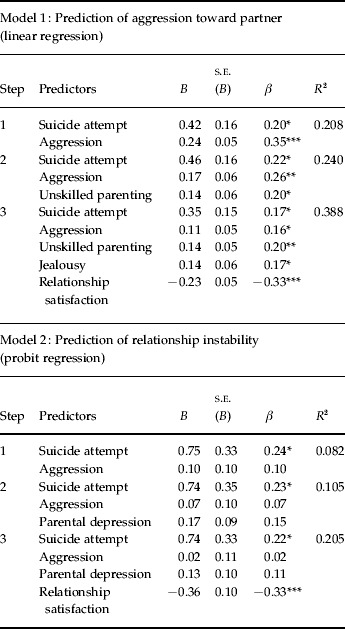
Aggression toward a partner was regressed on adolescent aggression and suicide-attempt history (see Table 3, model 1). Both associations were significant (step 1). In step 2, unskilled parenting was independently associated with aggression toward a partner. Next, substance use was not uniquely associated with the outcome and, therefore, was not considered further. In step 3, jealousy and relationship satisfaction, the two proximal relational distress variables, uniquely contributed to prediction of aggression toward a partner. The effects of suicide-attempt history and aggression on partner aggression remained significant. Finally, the indirect effects of these predictors on the outcome via jealousy and relationship satisfaction were tested. Total indirect effects of adolescent aggression on aggression toward a partner were significant [B (s.e.)=0.07 (0.02), β=0.10, p<0.01], primarily because of an effect via low relationship satisfaction [B (s.e.)=0.04 (0.02), β=0.06, p<0.05]. There were no significant indirect effects of suicide-attempt history on aggression toward a partner.
Results of linear regression of aggression toward a partner and probit regression of relationship stability on adolescent aggression, suicide-attempt history and covariates

* p<0.05, ** p<0.01, *** p<0.001.
Prediction of relationship stability was modeled using probit regression (see Table 3, model 2). In step 1, adolescent suicide-attempt history predicted relationship instability, controlling for adolescent aggression (n.s.). In step 2, parental depressive symptoms were marginally associated with the outcome. With these variables in the model, univariately significant adolescent psychopathology covariates did not contribute to the model. Finally, relationship satisfaction was a significant predictor in the final model (see step 3); jealousy was not. Because prior models did not support an effect of suicide attempt on relationship satisfaction, indirect effects of attempt on relationship instability were not tested.
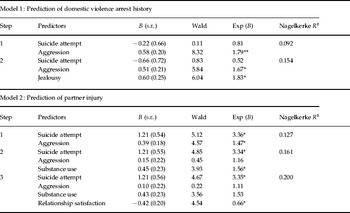
Domestic violence arrests were evaluated using logistic regression (see Table 4, model 1). In step 1, aggression in adolescence but not a suicide-attempt history significantly increased the odds of a domestic violence arrest in adulthood. Inclusion of adolescent substance use did not improve the model significantly and, therefore, was not considered further. In step 2, jealousy in young adulthood further increased risk for arrest; aggression in adolescence remained a significant predictor. The indirect effect of adolescent aggression on domestic violence arrest via jealousy in young adulthood was not significant.
Results of logistic regression of domestic violence arrest history and partner injury on adolescent aggression, suicide-attempt history and covariates

* p<0.05, ** p<0.01.
Partner injury was modeled using logistic regression (see Table 4, model 2). As shown in step 1, an adolescent suicide-attempt history was associated with a three-fold increased risk of causing injury to a partner in young adulthood. Aggression in adolescence independently predicted increased risk for this outcome. In step 2, substance use in adolescence improved the model significantly and appeared to account for the effects of aggression (which was no longer significant). Jealousy in young adulthood did not improve the prediction model significantly and thus was not considered further. In step 3, relationship satisfaction was associated with a decreased risk for injuring a partner and did not apparently diminish the effect of a suicide-attempt history on this outcome. Neither aggression nor substance use in adolescence were independent predictors of partner injury in step 3, likely due to overlap in the variance that these variables explained; indeed, when aggression was removed from the model, substance use [exp(B)=1.62], suicide-attempt history [exp(B)=3.56] and relationship satisfaction [exp(B)=0.65] all predicted (p's <0.05) the outcome (Nagelkerke R 2=0.198). Indirect effects of aggression in adolescence on partner injury via relationship satisfaction were not significant in any of these models.
Discussion
This prospective study of boys from higher crime neighborhoods found that those who attempted suicide before age 18 years were more likely in their young-adult years to be aggressive toward their romantic partners, to injure them and to experience more jealousy and relationship break-ups than were others. A risk factor for such uniformly negative outcomes may be useful for screening and prevention efforts. Indeed, the magnitude of the association between youth suicide-attempt history and young-adult injury of a partner was especially striking: 58% of attempting youth went on to injure a partner, compared with 23% of non-attempting youth. Notably, although boys who made a suicide attempt had co-occurring problems, none of these better accounted for their adult relationship problems. These findings add to the prospective evidence on the long-term negative outcomes associated with youth suicide attempts (e.g. Fergusson et al. Reference Fergusson, Horwood, Ridder and Beautrais2005). In contrast, suicidal thinking, which Reinherz et al. (Reference Reinherz, Tanner, Berger, Beardslee and Fitzmaurice2006) found to predict mental health and suicide risk in adulthood, was not even univariately associated with relationship outcomes. Differences in samples (community boys and girls versus at-risk boys) and outcomes of interest may explain these different findings.
Contrary to hypotheses, relational distress (jealousy or low relationship satisfaction) did not account for associations between suicide-attempt history and behavioral relationship outcomes. Thus, the findings support that a suicide attempt was associated with poor relationship adjustment for multiple reasons. First, suicidal adolescents' proneness to jealousy in young adulthood is consistent with research suggesting these youth show higher levels of anger, aggression-related cognitive distortions and neuroticism (Bridge et al. Reference Bridge, Goldstein and Brent2006; Spirito & Esposito-Smythers, Reference Spirito and Esposito-Smythers2006). Jealousy may be a form of hostile attributional style and propensity for bitterness and negative mood following interpersonal conflict that has been found to relate to reactive aggression (Conner et al. Reference Conner, Duberstein, Conwell and Caine2003). Second, independent of their tendencies toward jealousy, men with an adolescent attempt history showed increased rates of partner-directed aggression, partner injury and break-ups. This finding is consistent with the theory that trait impulsive aggression increases the capacity to attempt suicide (Brent & Mann, Reference Brent and Mann2005) and risk for intimate partner aggression. Prior genetic studies highlight impulsive aggression and impulsivity as potential endophenotypes for suicidal behavior and problems of under-control, with which it is consistently found to co-occur (Dawes et al. Reference Dawes, Mathias, Richard, Hill-Kapturczak and Dougherty2008; Mann et al. Reference Mann, Arango, Avenevoli, Brent, Champagne, Clayton, Currier, Dougherty, Haghighi, Hodge, Kleinman, Lehner, McMahon, Mościcki, Oquendo, Pandey, Pearson, Stanley, Terwillliger and Wenzel2009).
Youth suicide-attempt history was not significantly associated with later relationship satisfaction. Taken together, one interpretation of the present findings is that an attempt history reflects specific vulnerabilities that are expressed in times of conflict, threat and uncertainty, rather than a global tendency toward dysphoria. The unmediated contributions of suicide-attempt history to later relationship violence are consistent with theoretical approaches to IPV that focus on developmental psychopathology, especially as related to impulsive, under-controlled aggression, rather than those that primarily frame IPV as a calculated, instrumental behavior (Pence & Paymar, Reference Pence and Paymar1993).
A suicide-attempt history did not significantly predict subsequent arrest for domestic violence. Although power was limited, findings may reflect an upper limit to the risk for serious IPV conferred by a suicide-attempt history. On balance, the association of suicide-attempt history with partner injury indicates that such histories indicate risk for significant aggression toward a partner. Injuries requiring medical attention are a relatively low frequency outcome of IPV (Stets & Straus, Reference Stets, Straus, Straus and Gelles1990) and rates of major injuries were too low in the present study for more fine-grained analyses. However, a prior study found that a history of threatened or attempted suicide was associated with more severe partner violence (Conner et al. Reference Conner, Cerulli and Caine2002). Suicide attempts indicate a history of at least a transient lack of concern for personal safety and willingness and capacity to inflict self-harm. Such a history may well be associated with suspended concern for the physical well-being of loved ones and should be considered further as an IPV risk factor.
Regarding our secondary aim, adolescent aggression showed a similar, though modest, association with adolescent suicide-attempt history regardless of whether aggression was reported by mothers, fathers, teachers or the boys themselves. The independent associations that the cross-informant aggregate aggression score and suicidal ideation had to suicide-attempt history in adolescence are consistent with research on suicide risk factors (e.g. Spirito & Esposito-Smythers, Reference Spirito and Esposito-Smythers2006). The associations that adolescent aggression had with young-adult aggression to partner and arrest for domestic violence in young adulthood are not entirely surprising. Findings highlight the pervasive negative consequences of aggression, perhaps due to ongoing behavioral manifestations of underlying traits (e.g. impulsive aggression endophenotype) or the generalization of maladaptive learning histories from youth family and peer contexts to adult intimate partnerships (Capaldi et al. Reference Capaldi, Shortt, Kim, Pinsof and Lebow2005).
Limitations
There were some limitations to this study. First, young adult outcomes (e.g. jealousy and partner injury) could not be temporally disentangled and may have bidirectional influences. Second, partners' behaviors and characteristics were not considered. Assortative partnering by depression and antisocial behavior and mutuality of relationship aggression have been demonstrated previously (e.g. Kim & Capaldi, Reference Kim and Capaldi2004; Capaldi et al. Reference Capaldi, Shortt, Kim, Wilson, Crosby and Tucci2009). Aggressive and/or suicidal men may differentially partner with women who are also impulsive and emotionally dysregulated, further compounding relationship dysfunction. Third, some causal inferences were limited because suicide attempt(s) may have predated the measurement of covariates. Fourth, suicidal ideation was measured using a single (albeit repeatedly administered) self-report item. Fifth, biological data on endophenotypes were not collected. Finally, generalizability may be limited; participants were heterosexual, primarily white men recruited from the same geographic locale and time period. Relationship outcomes for women with suicide attempt histories should be examined.
Conclusions
The present study further specifies the negative sequelae of youth suicide attempt. Adolescent suicide attempts are of clinical interest, not only as risk factors for suicide and indicators of psychiatric illness but also as prevention targets. Furthermore, a suicide-attempt history indicates risk for serious negative consequences, not just for individuals but also for their intimate partners.
Note
Supplementary material accompanies this paper on the Journal's website (http://journals.cambridge.org/psm).
Acknowledgements
The project described was supported by awards from National Institutes of Health (NIH), US PHS to Dr Capaldi: Award Number HD 46364 (Risk for Dysfunctional Relationships in Young Adults) from the National Institute of Child Health and Development (NICHD); 1R01AA018669 (Understanding Alcohol Use over Time in Early Mid-Adulthood for At-Risk Men) from the National Institute on Alcohol Abuse and Alcoholism (NIAAA); and R01 DA 015485 (Adjustment Problems and Substance Use in Three Generations) from the National Institute of Drug Abuse (NIDA). The content is solely the responsibility of the authors and does not necessarily represent the official views of the NIH, NICHD, NIDA, or NIAAA. We wish to thank Jane Wilson, Rhody Hinks, Lynn Crosby, Lee Owen, and Sally Schwader for their contributions.
Declaration of Interest
None.