Morphological awareness refers to the “awareness of morphemic structures of words and the ability to reflect on and manipulate that structure” (Carlisle, Reference Carlisle1995, p. 194). Morphological awareness is a multidimensional construct that includes awareness of inflections, derivations, and compounds. These three aspects have different developmental trajectories and play somewhat different roles in word reading (Carlisle, Reference Carlisle2000, Reference Carlisle2003; Kuo & Anderson, Reference Kuo and Anderson2006). For English language learners (ELLs), language background may add another level of complexity. Although ELLs are often viewed as a homogeneous group, for children from different first language (L1) backgrounds, their morphological awareness and literacy development in English may vary depending on the characteristics of their L1.
This study examined the development of morphological awareness in relation to word reading among ELLs. The first purpose was to examine the effects of L1 structure on the development of derivational awareness and compound awareness in English. To accomplish this purpose, we compared the levels of performance of ELLs whose L1 was either Spanish or Chinese, two languages with contrasting morphological structures. The levels of performance of these two ELL groups were also compared with that of monolingual English-speaking children. The second purpose was to investigate the contribution of derivational and compound awareness to word reading in Spanish- and Chinese-speaking ELLs as well as in monolingual English-speaking children.
EFFECTS OF L1 BACKGROUND ON MORPHOLOGICAL AWARENESS
Across English, Spanish, and Chinese, words are formed by inflection, derivation, and compounding. Inflectional morphemes are relatively small in number and are added to root words to indicate tense (e.g., work–worked), number (e.g., car–cars), mood (e.g., in Spanish venir–venga), person (e.g., listen–listens), possession (e.g., her–hers), or comparison (e.g., slow–slowest) without altering the meaning of words. Derivational morphemes are numerous, and unlike inflectional morphemes, can alter the meaning of a word, for example, consistent–inconsistent. Derivational morphemes may also change the syntactic property of a word, for example, communicate (verb)–communication (noun). There are restrictions in terms of the syntactic category to which a derivational suffix can attach (Tyler & Nagy, Reference Tyler and Nagy1989). For example, the suffix -ize converts adjectives to verbs, and -y turns nouns into adjectives. Spanish and English have many similarities in derivational morphology, which stem from their shared affixes from Greek and Latin. Derivational morphemes are rare in Chinese.
Compounding is the process of forming a new word by putting two or more words together, for example, fireplace. Both English and Chinese compounds are right-headed, which means that the word on the right is the head and the one on the left is the modifier. For example, dishsoap is a soap used to clean dishes, whereas a soapdish would be a dish used for soap. Despite the similarities, Chinese and English differ in the prominence of compound morphology. More than 75% of Chinese words are compounds (Taylor & Taylor, Reference Taylor and Taylor1995), whereas English words are formed more often by inflection and derivation than by compounding. Among the three languages, compounding is least productive in Spanish. A particularly interesting feature of the Spanish compound morphology is that all of the noun–noun compounds are left-headed, which means that the modifier follows the head (e.g., perro policia, police dog). This feature may cause confusion when ELLs from Spanish background encounter English compound words.
An important factor affecting second language (L2) reading is the characteristics of learners’ L1. L1 characteristics have been consistently found to influence visual and auditory word identification in adult L2 learners (Akamatsu, Reference Akamatsu1999; Jackson, Lu, & Ju, Reference Jackson, Lu and Ju1994; Koda, Reference Koda1999, Reference Koda2000; Wang & Koda, Reference Wang and Koda2007; Wang, Koda, & Perfetti, Reference Wang, Koda and Perfetti2003). There is also increasing evidence that for young L2 learners, phonological awareness, the ability to reflect on and manipulate smaller units of sound, develops as a function of the phonological structures of both the L1 and the L2 (Bialystok, McBride-Chang, & Luk, Reference Bialystok, McBride-Chang and Luk2005; Bruck & Genesee, Reference Bruck and Genesee1995; Chen et al., Reference Chen, Anderson, Li, Hao, Wu and Shu2004; McBride-Chang et al., Reference McBride-Chang, Cho, Liu, Wagner, Shu and Zhou2005). Given these findings, it is likely that for ELLs, development of morphological awareness in English reflects the linguistic structure of their L1.
The present study compared the development of derivational and compound awareness in ELLs from Chinese and Spanish backgrounds. We anticipated that Spanish-speaking ELLs would develop more advanced derivational awareness in English than Chinese-speaking ELLs for two reasons. First, derivational morphology is a more important word formation process in Spanish than in Chinese. Second, many similarities exist in derivational morphology between Spanish and English, but there is little overlap between Chinese and English. The developmental patterns are likely to be different for compound awareness. Because Chinese and English share many compounding rules, Chinese-speaking ELLs may readily transfer the compound awareness developed in their L1 to English. Spanish-speaking ELLs, by contrast, face double challenges. They have relatively little experience with compounds in their L1. Further, Spanish compound words are left-headed, which may cause confusion when they learn right-headed English compounds. As a result, we expected that Chinese-speaking ELLs would develop more advanced compound awareness in English than Spanish-speaking ELLs.
Aside from L1 background, we are also interested in the effect of length of stay in Canada on the development of morphological awareness in ELLs. ELLs from different L1 backgrounds often have different immigration experiences. Spanish-speaking families in general came to Canada earlier than Chinese families, and the Spanish-speaking children in our sample had lived in Canada longer than their Chinese-speaking peers. Because chronological age does not always captures ELLs’ immigration experiences, in the present study we examined the impact of length of stay in Canada on morphological awareness after controlling for age.
THE ROLE OF MORPHOLOGICAL AWARENESS IN WORD READING
Morphological awareness is important for reading English, a “deep” orthography, because it provides insights about the mapping between print and speech in addition to the alphabetic principle (Kuo & Anderson, Reference Kuo and Anderson2006; Nagy, Berninger, & Abbott, Reference Nagy, Berninger and Abbott2006; Nagy, Berninger, Abbott, Vaughan, & Vermeulen, Reference Nagy, Berninger, Abbott, Vaughan and Vermeulen2003). Research has convincingly demonstrated that derivational awareness plays a crucial role in English word reading from elementary to high school (Carlisle, Reference Carlisle2000; Carlisle & Fleming, Reference Carlisle and Fleming2003; Deacon & Kirby, Reference Deacon and Kirby2004; Nagy et al., Reference Nagy, Berninger, Abbott, Vaughan and Vermeulen2003, Reference Nagy, Berninger and Abbott2006). By contrast, compound awareness has received far less attention in English.
Only a small number of studies have tested the link between morphological awareness and word reading in English among bilingual/ELL children (Deacon, Wade-Woolley, & Kirby, Reference Deacon, Wade-Woolley and Kirby2007; Saiegh-Haddad & Geva, Reference Saiegh-Hadadd and Geva2008; Schiff & Calif, Reference Schiff and Calif2007; Siegel, Reference Siegel2008; Wang, Cheng, & Chen, Reference Wang, Cheng and Chen2006). Wang et al. (Reference Wang, Cheng and Chen2006) showed that for Chinese-speaking ELLs from Grades 1 to 4, English derivational morphological awareness, but not compound awareness, was a significant predictor of English word reading. Schiff and Calif (Reference Schiff and Calif2007) found that for Israeli fifth graders learning English as an L2, English morphological awareness was significantly related to English word reading. In a study involving English-speaking children attending Grades 3 to 6 in an English–Arabic bilingual school, Saiegh-Haddad and Geva (Reference Saiegh-Hadadd and Geva2008) observed that English derivational morphological awareness explained unique variance in English word reading.
Although these studies point to the importance of morphological awareness for word reading among ELLs/bilinguals, there are several limitations. The previous studies only included one ELL/bilingual group, rendering it impossible to compare the relative contributions of morphological awareness to word reading among ELLs from different language backgrounds. Because ELLs’ L2 reading is influenced by their L1 backgrounds, it is important to examine, in the same study, ELLs from different language backgrounds as well as monolingual children. Moreover, although all of the previous studies acknowledged the importance of controlling for other reading related variables in order to establish a unique connection between morphological awareness and word reading, most studies only considered the effects of phonemic awareness and vocabulary. Because of the vast diversity in the ELL population, the effects of nonverbal ability and socioeconomic status should also be considered. In the present study, we controlled for maternal education, a proxy for socioeconomic status and home literacy activities, and nonverbal ability, in addition to linguistic variables such as vocabulary and phonological awareness in the analyses.
There is a body of research suggesting that the same set of variables predict word reading in ELLs and in monolingual children (Lesaux & Geva, Reference Lesaux, Geva, August and Shanahan2006; Lipka, Siegel, & Vukovic, Reference Lipka, Siegel and Vukovic2005). Phonological awareness in particular appears to be a critical predictor of reading success for all children regardless of their language background (August & Shanahan, Reference August, Shanahan, August and Shanahan2006; Lesaux & Geva, Reference Lesaux, Geva, August and Shanahan2006). It should be noted, however, that the developmental trajectory of phonological awareness and morphological awareness appear to be somewhat different in ELLs. Although ELLs achieve the same or even a higher level of performance on phonological processing tasks than monolingual children (e.g., Bruck & Genesee, Reference Bruck and Genesee1995; Geva, Zadeh-Yaghoub, & Schuster, Reference Geva, Zadeh Yaghoub and Schuster2000; McBride-Chang & Kail, Reference McBride-Chang and Kail2002; Schwartz, Share, Leikin, & Kozminsky, Reference Schwartz, Share, Leikin and Kozminsky2008), they continue to experience difficulties in vocabulary and reading comprehension in high school and beyond (National Center for Education Statistics, 2006). Because of the close relationship between morphological awareness and these literacy outcomes (Carlisle, Reference Carlisle2000; Reed, Reference Reed2008), ELLs may also lag behind in morphological awareness. Thus, it remains to be seen whether morphological awareness would make similar contributions to word reading in different groups of ELLs and monolinguals.
METHOD
Participants
Participants of the study included 260 fourth and seventh graders from 22 schools located in a large multicultural Canadian city. Eight children were excluded from the sample because they scored below the 10th percentile on nonverbal reasoning or had a known learning disability. Eight children were excluded because they had resided in Canada for less than 2 years. The final sample included 244 children, of which 42% were boys and 58% were girls. There were 89 Spanish-speaking ELLs (39 fourth graders, 50 seventh graders), 77 Chinese-speaking ELLs (36 fourth graders, 41 seventh graders), and 78 monolingual English-speaking children (39 in each grade). English was the language of instruction for all of the children. The children were participating as a part of a larger study on bilingual reading development.
Measures
Family questionnaire. A family questionnaire was used to collect information about home language use, immigration experience, and parental educational levels. The questionnaire was provided in both English and in the child's L1, and parents completed the questionnaire in their preferred language. Maternal education and length of stay in Canada (used to represent exposure to English) were two variables used in subsequent data analyses. Parents were asked to indicate their education level on a 6-point Likert scale (1 = primary school, 2 = junior high school, 3 = high school, 4 = college, 5 = university degree, 6 = graduate degree).
Nonverbal reasoning. Nonverbal ability was measured with the Raven's Standard Progressive Matrices (Raven, Reference Raven1958, Reference Raven2000). This test requires the child to complete 60 visual–spatial matrixes by choosing the missing piece from six or eight patterned segments. Percentage scores were obtained and used in the analyses.
Phonological awareness. This skill was measured using the Elision subtest of the Complete Test of Phonological Processing (Wagner, Torgeson, & Rashote, Reference Wagner, Torgesen and Rashotte1999). Children were asked to delete phonemes (individual sound) from words and give the remaining part. For example, say cat, now say it without /k/. The test contains 5 practice items and 20 test items involving initial, middle, and last phoneme deletion. The test was discontinued after three consecutive errors. Standard scores were obtained and used in the analyses.
Vocabulary. Peabody Picture Vocabulary Test, Third Edition, Form III A (Dunn & Dunn, Reference Dunn and Dunn1997) was used to assess children's oral vocabulary. To save testing time, every third item from the original test was selected to create a shortened version of 60 items. This test was conducted in a group format in which all of the 60 items were administered. Each child received a booklet with pictures depicting the four options for each test item and a scoring sheet. The experimenter read each item twice and children selected the picture that represented the word heard. Percentage scores were obtained and used in the analyses. The interitem reliability was α = 0.77 for the Spanish-speaking ELLs, α = 0.89 for the Chinese-speaking ELLs, and α = 0.68 for the English-speaking monolinguals.
Derivational awareness. A modified version of the Test of Morphological Structure (Carlisle, Reference Carlisle2000) was used to assess children's ability to manipulate derivational suffixes. The child was presented orally with a target word, for example, Magic, followed by an incomplete sentence, for example, The performer was a good_______. The child was then required to complete the sentence orally with the proper derived form of the target word, for example, magician. There were 3 practice items and 25 test items. Percentage scores were obtained and used in the analyses. The interitem reliability was α = 0.84 for the Spanish-speaking ELLs, α = 0.94 for the Chinese-speaking ELLs, and α = 0.75 for the English-speaking monolinguals.
Compound awareness. This test was adapted from Nagy et al. (Reference Nagy, Berninger, Abbott, Vaughan and Vermeulen2003). The test required the child to identify the head of a compound noun. The child heard a description of an animal or object that does not exist in real life, and was asked to select the combination of words that made the most sense. The number of options varied. The test had 16 items, 12 of them involved two-morpheme compounds; for example, Which is a better name for a fish that wears a dress? A fish dress or a dress fish? The remaining four items involved three- or four-morpheme compounds; for example, “There is a drawer in my dresser where we keep books and I have a key that locks it. What would be the best name for the key? Drawer book key, book key drawer, book drawer key, or key book drawer.” To ease memory burden, each item was accompanied by a picture. Percentage scores were obtained and used in the analyses. The interitem reliability was α = 0.75 for the Spanish-speaking ELLs, α = 0.77 for the Chinese-speaking ELLs, and α = 0.68 for English-speaking monolinguals.
Word reading. The letter–word identification subtest from the Woodcock Language Proficiency Battery (Woodcock, Reference Woodcock1984) was used to assess word recognition skills. Children were required to read 62 words of increasing difficulty. The test was discontinued if the child incorrectly read 6 words in a row. Percentage scores were derived from the number of words read correctly.
Procedure
Participants were assessed in a quiet room at their schools during school hours. The derivational awareness test and the word reading test were administered individually in one 30- to 45-min session. All of the other tests were administered in groups of 5 to 15 children under the supervision of two to three trained research assistants in two group-testing sessions of about 60 min each. Testing at each school was completed within a period of 2 to 3 weeks.
RESULTS
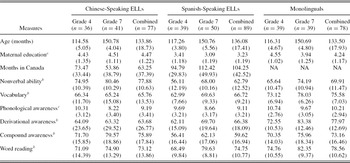
The means and standard deviations of all of the measures are displayed in Table 1 for each of the three groups. Children's age and length of stay in Canada are reported in months, phonological awareness is reported in standard scores. Maternal education is reported on a 6-point scale. Scores for all of the other tests are reported in percentages.
Mean (standard deviation) for all measures per language group

Note: ELLs, English language learners; NA, not available.
aMaternal education was measured on a 1 to 6 scale, where 1 = primary school, 2 = junior high school, 3 = high school, 4 = college, 5 = university degree, 6 = graduate degree.
bNonverbal ability, vocabulary, derivational awareness, compound awareness, and word reading are percentages.
cPhonological awareness is reported in standard scores.
According to the family questionnaire, 48% of the Spanish-speaking ELLs were born outside Canada. These children came from 13 different Latin American countries. About 83% of Chinese-speaking ELLs were born outside Canada and the majority came from Mainland China. The mean age of arrival in Canada was 31.27 months for the Spanish-speaking ELLs, ranging from 2 to 130 months. The mean age of arrival was 60 months for the Chinese-speaking ELLs, ranging from 14 months to 132 months. In general, the Spanish-speaking ELLs had lived in Canada for 104 months (M = 95 months for the fourth graders, M = 112 months for the seventh graders), whereas the Chinese-speaking ELLs have lived in Canada for 64 months (M = 74 months for the fourth graders, M = 54 months for the seventh graders). Most ELLs spoke their L1 at home.
The ELLs status of the Chinese- and Spanish-speaking children was confirmed by their performance on the vocabulary test. Both groups scored significantly lower than the monolinguals; mean difference (MD) = 9.78, p < .001, for the Chinese-speaking children, and MD = 9.26, p < .001, for the Spanish-speaking children. There was no difference between the two ELL groups. Differences were also found in maternal education and nonverbal ability among the three groups. The average maternal education was college for the monolinguals and the Chinese-speaking ELLs but high school for the Spanish-speaking ELLs. With respect to nonverbal ability, the Chinese-speaking ELLs scored the highest, followed by the monolinguals (MD = 7.79), who in turn scored higher than the Spanish-speaking ELLs (MD = 15.65, all ps < .001).
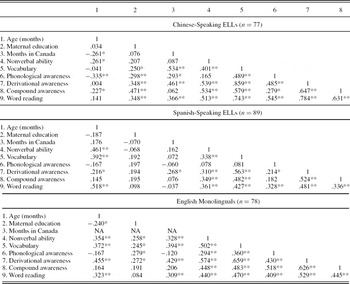
Bivariate correlations for the three groups of children are presented in Table 2. Moderate to high correlations were found between the two morphological awareness measures across the three groups, r = .52 for the Spanish-speaking ELLs, r = .65 for the Chinese-speaking ELLs, and r = .63 for the monolinguals (all ps < .01). For the monolingual group, word reading was strongly associated with both derivational awareness (r = .53) and compound awareness (r = .45, ps < .01). For the Spanish-speaking ELLs, moderate correlations were found between word reading and derivational awareness (r = .48) and between word reading and compound awareness (r = .34). For the Chinese-speaking ELLs, the correlations were strong (r = .78 and .63, respectively, all ps < .01). Length of stay in Canada was associated with derivational awareness for both the Spanish-speaking ELLs (r = .27, p < .05) and the Chinese-speaking ELLs (r = .46, p < .01). Length of stay was not correlated with the compound awareness task in either ELL group.
Correlations among all measures per language group

Note: ELLs, English language learners; NA, not available.
*p < .05. **p < .01.
Effect of L1 background on morphological awareness
We carried out planned contrasts comparing the levels of performance of the three groups of children on derivational awareness and compound awareness. We entered age, nonverbal ability, and maternal education as covariates whenever the assumption of analysis of covariance was met. For derivational awareness, maternal education was used as a covariate. Raven and age were not entered because the interactions with language background were significant. Results showed that the Spanish-speaking ELLs performed similarly to the monolinguals on the derivational awareness test, and both groups outperformed the Chinese-speaking ELLs (MD = 8.25, p < .05, and MD = 15.30, p < .001, respectively). For compound awareness, all three variables were used as covariates. The Chinese-speaking ELLs performed similarly to the English-speaking monolinguals on the compound awareness test; the Spanish-speaking ELLs performed significantly lower than the monolinguals (MD = 6.11, p < .05). The difference between the Chinese- and Spanish-speaking ELLs, however, was not significant.
Effect of length of stay in Canada on morphological awareness in Spanish-speaking and Chinese-speaking ELLs
We carried out hierarchical regressions to examine the impact of length of stay in Canada on the development of derivational awareness and compound awareness. Only Spanish-speaking and Chinese-speaking ELLs were included in these regressions. Monolingual English-speaking children were not included because age and length of stay in Canada were identical for most children in this group. In each regression, maternal education and nonverbal ability were entered in the first step, age in the second step, and length of stay in Canada in the third step. A language background vector, with Chinese coded as 1 and Spanish coded as −1, was created to examine the L1 background effect. This vector was entered in the fourth step. The interaction between length of stay and language background was entered in the last step. The initial regression models also included the interaction between language background and maternal education, and the interaction between language background and nonverbal ability. These interactions were dropped from the final models because neither was significant.
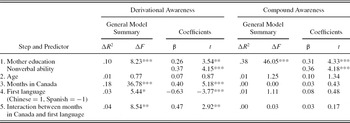
The left panel of Table 3 shows that for derivational awareness, length of stay in Canada contributed about 18% of the variance, F (1, 148) = 36.78, p < .001, and L1 background contributed an additional 3% of the variance, F (1, 147) = 5.44, p < .05. However, there was a significant interaction between length of stay in Canada and L1 background, F (1, 146) = 8.54, p < .01. Following the significant interaction, separate regressions were performed on the derivational awareness test for Spanish- and Chinese-speaking ELLs. These analyses showed that although length of stay in Canada explained a significant amount of variance in derivational awareness for both ELL groups, the contribution was larger for the Chinese-speaking ELLs (15%), F (1, 66) = 19.04, p < .001, than for the Spanish-speaking ELLs (5%), F (1, 77) = 4.46, p < .05. An examination of the betas indicated that nonverbal ability, maternal education, length of stay in Canada, and L1 background were all unique predictors of derivational awareness. As shown in the right panel in Table 3, the only significant predictors for compound awareness were nonverbal ability and maternal education. Age was not a significant predictor in either model.
Multiple regressions examining first language effect and time in Canada on derivational and compound awareness

*p < .05. **p < .01. ***p < .001.
The contribution of morphological awareness to word reading in three groups
A hierarchical regression was conducted to assess the contribution of derivational and compound awareness to word reading. All three language groups were included in this analysis. Two orthogonal contrasts were created to represent the three language groups. In the Chinese–Spanish contrast, the English-, Chinese-, and Spanish-speaking groups were coded as 0, 1, and −1, respectively. This contrast compared Chinese-speaking ELLs with Spanish-speaking ELLs. In the Monolingual-ELL contrast, the English-, Chinese-, and Spanish-speaking groups were coded as −2, 1, and 1, respectively, to compare the monolinguals with ELLs. An interaction term was created between each of the two contrast variables and each of the two morphological awareness measures.
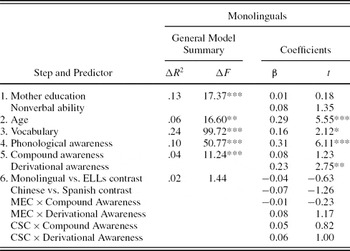
In the regression model, we entered maternal education and nonverbal ability in Step 1, age in Step 2, vocabulary in Step 3, phonological awareness in Step 4, and the two morphological awareness measures in Step 5. The two language contrast variables and the four contrasts by morphological awareness interaction terms were entered in Step 6, the final step. The results of this regression model are presented in Table 4. In the initial regression model, the interaction between language background and maternal education, and the interaction between language background and nonverbal ability were also entered. These interactions were dropped from the final model because they were not significant.
Multiple regression analysis examining the role of morphological awareness on word reading

Note: ELLs, English language learners; MEC, monolinguals versus ELLs contrast; CSC, Chinese versus Spanish contrast.
*p < .05. **p < .01. ***p< .001.
As shown in Table 4, the two morphological awareness measures in combination explained 4% of unique variance in word reading after controlling for maternal education, nonverbal ability, age, vocabulary, and phonological awareness, F (2, 234) = 11.24, p < .001. The beta coefficients in the final model revealed that derivational awareness was a unique predictor of word reading, but compound awareness was not. The morphological awareness by language background interaction terms entered in the last step of the model were not significant, indicating that the effect of morphological awareness on reading was similar across the three language groups. Thus, for monolinguals and ELLs alike, derivational awareness made a unique contribution to word reading. Age, vocabulary, and phonological awareness also predicted unique variance in word reading.
DISCUSSION
This study examines systematically the development of derivational and compound awareness and the relationship between these two aspects of morphological awareness and word reading in Spanish- and Chinese-speaking ELLs. We find that although L1 background and the amount of exposure both have strong effects on derivational awareness, only the former has a moderate effect on compound awareness. Another key finding is that morphological awareness plays a similar role in word reading among ELLs and English monolingual children.
With respect to derivational awareness, the Spanish-speaking ELLs performed similarly to the native speakers of English after controlling for maternal education, whereas the Chinese-speaking ELLs performed significantly lower than either group. The syntactic and distributional properties of derivational morphology are similar in English and Spanish, which may explain why the Spanish-speaking ELLs performed on the same level as the monolinguals. In contrast, Chinese-speaking ELLs have fewer opportunities to develop these derivational morphological skills in their L1 due to the limited role that derivational morphemes play in the word formation process in Chinese.
A different pattern was observed for compound awareness. After controlling for age, maternal education, and nonverbal ability, there was no difference between the Chinese-speaking ELLs and the English-speaking monolinguals on the compound awareness test, but the Spanish-speaking ELLs performed significantly lower than the English-speaking monolinguals. These results confirm our hypothesis that ELLs’ compound awareness in English is also influenced by their L1 background. Chinese-speaking ELLs are exposed to similar compounding rules in Chinese and English. Spanish-speaking ELLs, by contrast, have less experience with compounds in their L1, and have to overcome left-headedness when learning English compounds. The effect of L1 background, however, was smaller than expected, as the difference between the two groups of ELLs was not significant. This may result from the partial ceiling effect on the test. Twelve of the 16 items in this test required children to make headedness judgment on two-morpheme compounds. Further analysis revealed that there were no differences among the three language groups on these items. The four items that required children to make judgment on three- and four-morpheme compounds were more discriminative, but unfortunately the number of these items was small. It is possible that Chinese-speaking ELLs will outperform Spanish-speaking children on more demanding compound awareness tests.
Besides L1 background, we also examined the effect of length of stay in Canada on the development of morphological awareness and word reading. Length of stay in Canada made a larger contribution to derivational awareness in the Chinese-speaking ELLs than in the Spanish-speaking ELLs. This finding may be related to the Chinese-speaking ELLs generally lived in Canada for a shorter period of time than the Spanish-speaking ELLs. In addition, because Chinese and English are quite different in derivational morphology, Chinese-speaking ELLs have to rely solely on experience with spoken and written English when developing derivational awareness. It is thus critical for these children to have sufficient exposure to English, even more so than Spanish-speaking ELLs. By contrast, length of stay in Canada did not seem to influence performance on the compound awareness test in either group of ELLs. As mentioned earlier, we observed partial ceiling effects on the compound awareness test, which may have weakened the relationship. Future research should investigate this issue with a more complex compound awareness test.
Our study provides strong evidence that morphological awareness is associated with word reading for ELLs as well as for English monolinguals. In all three groups of children, morphological awareness predicted unique variance in word reading after controlling for nonverbal skills, maternal education, age, vocabulary, and phonological awareness. Notably, the interaction between morphological awareness and L1 background was not significant, suggesting that the contribution was similar across the three groups. Previous research has reported that phonological processing skills, especially phonological awareness, predict reading success in ELLs and native speakers (e.g., Chiappe & Siegel, Reference Chiappe and Siegel2006; Lesaux, Rupp, & Siegel, Reference Lesaux, Rupp and Siegel2007). Our study is the first to extend these findings to morphological awareness. In addition, results from the present study reveal that derivational awareness was a better predictor of English word reading than compound awareness regardless of children's language background. This is not surprising considering that derivation is a major word formation process in English.
Two sets of theoretical frameworks have been proposed to explain processes in L1 and L2 reading. The first set, represented by the orthographic depth hypothesis, emphasizes the influence of the structural features of a specific language. This hypothesis is supported by evidence that frequency and lexicality effects are larger in deep orthographies than shallow orthographies (Frost, Katz, & Bentin Reference Frost, Katz and Bentin1987; Katz & Frost Reference Katz, Frost, Frost and Katz1992; Turvey, Feldman, & Lukatela Reference Turvey, Feldman, Lukatela and Henderson1984). The second set, represented by the central processing hypothesis (Geva & Siegel, Reference Geva and Siegel2000; Stanovich, Cunningham, & Feeman, Reference Stanovich, Cunningham and Feeman1984), highlights similarities in L1 and L2 reading. The central processing hypothesis maintains that the same set of cognitive skills including memory, phonological awareness, and phonological recoding predict reading success in any language, whether it is an L1 or L2. A number of studies examining phonological processing skills have found support for both sets of frameworks, pointing to the possibility that they are complementary rather than contradictory (Geva & Siegel, Reference Geva and Siegel2000; Saiegh-Haddad & Geva, Reference Saiegh-Hadadd and Geva2008). The present study suggests that the complementary relationship also exists for morphological awareness. Morphological processing appears to be language specific in the sense that for ELLs from different language backgrounds, performance levels on morphological awareness tasks reflect their L1 structural features; it is language-universal in the sense that the predictive relationship with word reading is similar across groups regardless of L1 backgrounds.
Our study had several limitations. First, because it was a cross-sectional study, the results cannot attest to the causal relationship between morphological awareness and word reading. The relationship is likely to be reciprocal, and this hypothesis needs to be further tested in longitudinal and intervention studies. Second, each construct was only assessed with a single measure in the present study. Results would be stronger with multiple measures. Third, we used length of stay in Canada to represent exposure to English because our main interest was to compare the relative impact of chronological age and immigration experience on ELLs’ morphological awareness. It must be pointed out, however, that length of stay in Canada may not accurately capture exposure to English. Other factors such as the amount of English used at home need to be considered. Fourth and finally, future research should also shed light on how ELLs use morphological strategies to read words. In languages sharing lexical forms, such as English and Spanish, the role of cognates needs to be investigated
The unique contribution of morphological awareness to word reading among ELLs observed in the current study is promising. Research involving mostly monolingual children has shown that training on morphological awareness leads to gains in word reading (for a meta-analysis, see Reed, Reference Reed2008). This research needs to be expanded to include ELLs. Morphological awareness training may be particularly effective for improving word reading skills for ELLs because of their limited exposure to English. Moreover, because the morphological characteristics of children's L1 influence their development of morphological awareness in English, differentiated literacy instruction may be required for ELLs from different language backgrounds. These hypotheses should be tested in intervention studies.
ACKNOWLEDGMENTS
We gratefully acknowledge funding from the Social Sciences and Humanities Research Council of Canada for a graduate scholarship (to G.R.) and a standard grant (to X.C.) for this research.