Introduction
Feather pecking was described by Oettel as early as 1873. Today, it is still one of the major problems in egg production; causing economic losses and impairing chicken welfare (Huber-Eicher and Wechsler, Reference HUBER-EICHER and WECHSLER1997; Blokhuis and Wiepkema, Reference BLOKHUIS and WIEPKEMA1998; Riedstra and Groothuis, Reference RIEDSTRA and GROOTHUIS2002; Rodenburg et al., Reference RODENBURG, VAN HIERDEN, BUITENHUIS, RIEDSTRA, KOENE, KORTE, VAN DER POEL, GROOTHUIS and BLOKHUIS2004c). Both endogenous (genetic and physiological) and environmental (feeding, density and housing conditions) factors seem to be responsible for this problem. The main objective of this paper is to summarize recent findings regarding genetic and physiological components of feather pecking. In the first section a definition of feather pecking and the most crucial motivational aspects affecting this phenomenon are presented. In the second section, all known genetic factors are described in detail. Finally, a literature review featuring the physiological mechanisms underlying feather pecking is provided. The paper ends with a short conclusion which contains some possible future research directions.
Definition of feather pecking and motivational aspects
Feather pecking occurs in various forms; pecking without removal of feathers causing only little damage such as barb pulling (Hughes, Reference HUGHES1973), barb pecking (Savory, Reference SAVORY1995), gentle pecking (Keeling, Reference KEELING1995) and stereotypic pecking (Bessei, Reference BESSEI1983; Kjaer and Vestergaard, Reference KJAER and VESTERGAARD1999), or pecking causing damage such as feather removal (Hughes, Reference HUGHES1973), feather pulling (Savory, Reference SAVORY1995) and severe pecking (Keeling, Reference KEELING1995). Feather pulling can result in severe damage of the integument (Bilcik and Keeling, Reference BILCIK and KEELING1999). Birds may be wounded and even pecked to death. This is called cannibalism and is regarded by some authors as the final phase of severe feather pecking (Bessei, Reference BESSEI1983; Blokhuis and Arkes, Reference BLOKHUIS and ARKES1984; Savory and Mann, Reference SAVORY and MANN1997). Cannibalism can occur without previous feather pecking. This form is mostly directed at the cloaca and is referred to as cloacal cannibalism, ‘vent-pecking’ (Hughes and Duncan, Reference HUGHES and DUNCAN1972; Allen and Perry, Reference ALLEN and PERRY1975). In most cases feather pecking and cannibalistic pecking is carried out in a non-aggressive way. Feather pecking should not be confounded with aggressive pecks which are used to establish or to ensure the social ranking order.
Despite extensive research on feather pecking and cannibalism during the last decades, the causal factors of this behaviour are not well understood. Hughes (Reference HUGHES1982) presented a comprehensive theoretical model where the motivation of feather pecking is influenced by the genetic basis of the individuals or breeds and the prevailing environmental conditions. This model comprises a threshold which determines the expression of the behaviour. Environmental factors have a dual function. They may increase the motivation and modify the set point of the threshold of feather pecking. More simplistic models explain feather pecking as redirected food pecking and/or food searching (foraging) behaviour (Blokhuis, Reference BLOKHUIS1986; Wechsler et al., Reference WECHSLER, HUBER-EICHER and NASH1998; Klein et al., Reference KLEIN, ZELTNER and HUBER-EICHER2000). These theories are based on the assumption that food pecking underlies an autonomous motivation or drive, which is independent of the state of satiation. This drive may be directed towards the feathers of group mates under conditions which do not provide the environmental stimuli required for the expression of foraging behaviour (Blokhuis, Reference BLOKHUIS1986).
This explanation of feather pecking was supported by experiments where pullets and laying hens were kept with or without litter (Blokhuis and Arkes, Reference BLOKHUIS and ARKES1984; Baum Reference BAUM1992; Johnsen et al., Reference JOHNSEN, VESTERGAARD and NORGAARD-NIELSEN1998). Similarly the enrichment of the environment with hay, grain or chaff reduced feather pecking and improved feather quality in laying hens (Blokhuis and van der Haar, Reference BLOKHUIS and VAN DER HAAR1992; Rudkin, Reference RUDKIN1996). This effect, however, was not consistent and a number of experiments showed no effect of litter or enrichment, or even opposite effects. Blokhuis et al. (Reference BLOKHUIS, VAN DER HAAR and KOOLE1987) did not find any effect of litter versus wire floor on the plumage condition in pellets. Huber-Eicher and Wechsler (Reference HUBER-EICHER and WECHSLER1998) found a significant reduction of feather pecking by litter versus slatted floor only when feed was provided, but not when the birds were fed mash. Gvaryahu et al. (Reference GVARYAHU, ARARAT, ASAF, LEV, WELLER, ROBINZON and SNAPIR1994) and Bell et al. (Reference BELL, ADAMS and GVARYAHU1998) did not find positive effects on feather pecking when special plastic toys were offered to cage layers. Cuthertson (Reference CUTHERTSON1978) reported an increase of pecking behaviour in a rich versus a barren environment. The latter results show that feather pecking cannot be fully explained by redirected foraging or exploration. This was supported by recent findings of Häusler (Reference HÄUSLER2008) who compared hens of a high and a low feather pecking line in a multi-choice arena with food, wood-shaving and feathers at different places (i.e. open and hidden). There was no difference between the lines with regard to exploration for feed. But the line with high feather pecking frequency showed significantly more activities towards feathers than the line with low feather pecking frequency. Newberry et al. (Reference NEWBERRY, KEELING, ESTEVEZ and BILCIK2007) investigated the development of severe feather pecking in individual domestic fowl. No evidence was found that severe feather pecking is a substitute for foraging behaviour.
Rodenburg et al. (Reference RODENBURG, ZIMMERMAN and KOENE2002, Reference RODENBURG, KOENE and SPRUIJT2004a) considered frustration, e.g. thwarting of an expected reward may influence the development and targeting of feather pecking behaviour. Vestergaard et al. (Reference VESTERGAARD, KRUJITT and HOGAN1993, Reference VESTERGAARD, SKADHAUGE and LAWSON1997) assumed that feather pecking was the result of frustrated dust bathing behaviour of chickens kept on wire floor. Feather pecking and poor feather conditions were reported to be connected with high levels of fear in several experiments (Bessei, Reference BESSEI1980; Quart and Adams Reference QUART and ADAMS1982; Craig and Muir, Reference CRAIG and MUIR1989; Vestergaard et al., Reference VESTERGAARD, KRUJITT and HOGAN1993). However, the causal relationships between feather pecking and fear are not known.
Genetic factors affecting feather pecking
line and individual differences in propensity to feather pecking
There are differences in propensity to feather pecking between different pure lines and commercial hybrids of laying hens. Indeed, in many studies so-called High Feather Pecking line (HFP) and Low Feather Pecking line (LFP) were compared regarding behavioural or genetic factors (Kjaer and Sørensen, Reference KJAER and SØRENSEN1997; Kjaer, Reference KJAER2000; Kjaer et al., Reference KJAER, SØRENSEN and SU2001; McKeegan and Savory, Reference MCKEEGAN and SAVORY2001; McAdie and Keeling, Reference MCADIE and KEELING2002; Albentosa et al., Reference ALBENTOSA, KJAER and NICOL2003; Rodenburg et al., Reference RODENBURG, BUITENHUIS, ASK, UITDEHAAG, KOENE, VAN DER POEL and BOVENHUIS2003; Su et al., Reference SU, KJAER and SØRENSEN2005; Kjaer, Reference KJAER2009). HFP and LFP can be used to describe unselected lines (Bessei, Reference BESSEI1984; Blokhuis and Beutler, Reference BLOKHUIS and BEUTLER1992) or lines selected against and for feather pecking behaviour (Flisikowski et al., Reference FLISIKOWSKI, SCHWARZENBACHER, WYSOCKI, WEIGEND, PREISINGER, KJAER and FRIES2009; Kjaer, Reference KJAER2009). The differences in locomotory activity and its relation to feather pecking behaviour in two lines selected for low and high levels of feather pecking was compared by Kjaer (Reference KJAER2009). Birds from the HFP were more active and travelled a significantly higher distance as compared to LFP. Wysocki (Reference WYSOCKI2007) obtained similar results comparing two commercial strains i.e. LSL and LB representing HFP and LFP, respectively. The correlated changes in production traits due to selection for feather pecking were investigated by Su et al. (Reference SU, KJAER and SØRENSEN2006). In conclusion LFP laid more eggs, had greater egg mass and better feed efficiency than HFP. In contrary Albentosa et al. (Reference ALBENTOSA, KJAER and NICOL2003) disagreed with HFP and LFP classification and claimed that hens cannot be easily ranked in behavioural ‘types’ according to some behavioural test responses.
The feather pecking rate is usually calculated for the whole group, however, as reported by Bilcik and Keeling (Reference BILCIK and KEELING2000), only a small percentage of birds are responsible for most of the pecks. The authors claim that only 8.3% of all hens are severe peckers. That result is in line with the previous study carried out by Keeling (Reference KEELING1994) where less than 9% of hens kept in floor pens accounted for over 50% of all severe pecks. Wechsler et al. (Reference WECHSLER, HUBER-EICHER and NASH1998) concluded that feather pecking behaviour is not performed by just a few members of a group. However, they noticed that some individuals are characterized by relatively high rates and more severe forms of feather pecking. The same tendency was observed in a White Leghorn line selected on feather pecking behaviour (Labouriau et al., Reference LABOURIAU, KJAER, ABREU, HEDEGAARD and BUITENHUIS2009). These ‘super-peckers’ were characterized by a gene transcription profile differing from the profile of the other birds performing feather pecking (456 genes differentially expressed from a total of 14,077 investigated genes). Van Hierden et al. (Reference VAN HIERDEN, KORTE, RUESINK, VAN REENEN, ENGEL, KOOLHAAS and BLOKHUIS2002b) suggested that differences between HFP and LFP can already be observed at a very early age. However, Newberry et al. (Reference NEWBERRY, KEELING, ESTEVEZ and BILCIK2007) pointed out that individual behaviour variables recorded when young cannot be used as an indicator for an increased risk of severe feather pecking when adult.
An increased number of feather pecking incidences in the group of chickens can be the result of social transmission (Galef, Reference GALEF1988; Nicol, Reference NICOL1995; Zeltner et al., Reference ZELTNER, KLEIN and HUBER-EICHER2000; Keeling et al., Reference KEELING, ANDERSSON, SCHUTZ, KERJE, FREDRIKSSON, CARLBORG, CORNWALLIS, PIZZARI and JENSEN2004). An experimental concept based on the introduction of chicks with high frequency of feather pecking confirms this theory, as it increased the general feather pecking rate (Zeltner et al., Reference ZELTNER, KLEIN and HUBER-EICHER2000). McAdie and Keeling (Reference MCADIE and KEELING2002) investigated whether feather pecking spreads from hens of HFP to hens of LFP strain when kept together. The authors observed indeed the social transmission of gentle feather pecking.
heritability of feather pecking and genetic correlations with other traits
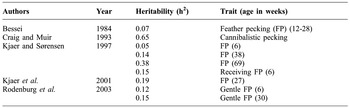
Heritability of feather pecking varies between h2=0.07 (Bessei, Reference BESSEI1984) and h2=0.38 (Kjaer and Sørensen, Reference KJAER and SØRENSEN1997). Kjaer and Sørensen (Reference KJAER and SØRENSEN1997) investigated the heritability of performing feather pecking in White Leghorn layers and estimated the values for sum of pecks at 0.05, 0.14 and 0.38 for 6, 38 and 69 weeks, respectively. Heritability values estimated for the sum of bouts were 0.13 for weeks 6 and 38, and 0.35 for week 69. For receiving feather pecking heritability was estimated at 0.15 for 6 weeks of age only. The authors reported high genetic correlations of performing feather pecking among age classes and suggested that selection of birds with no or a very low tendency to perform feather pecking is possible. Craig and Muir (Reference CRAIG and MUIR1993) estimated a realized family heritability of 0.65 for beak-inflicted injuries. Kjaer et al. (Reference KJAER, SØRENSEN and SU2001) reported that direct selection for and against feather pecking was possible and they found a realized heritability value of 0.19 and significant differences in the level of feather pecking between LFP and HFP after three generations of selection. In the second generation the number of observed pecks was twice as high in HFP as in LFP. The difference reached seven folds in the third generation. Moreover, selection had no effect on aggressive behaviour. Using a social feather pecking test, the heritability of gentle feather pecking was estimated by Rodenburg et al. (Reference RODENBURG, BUITENHUIS, ASK, UITDEHAAG, KOENE, VAN DER POEL and BOVENHUIS2003) at 0.12 and 0.15 at 6 and 30 weeks of age, respectively. For clarity Table 1 summarizes heritabilities that have been estimated for feather pecking.
Genetic and phenotypic correlation between feather pecking and open-field activity was investigated by Rodenburg et al. (Reference RODENBURG, BUITENHUIS, ASK, UITDEHAAG, KOENE, VAN DER POEL, VAN ARENDONK and BOVENHUIS2004b) at 6 and 30 weeks of age. In young birds, a positive phenotypic correlation of 0.24 was found. In adults, similar genetic correlation was 0.62. The authors observed ground pecking, gentle feather pecking and wall pecking in young birds whereas severe feather pecking was characteristic for adults. In a multi-strain experiment Hocking et al. (Reference HOCKING, CHANNING, ROBERTSON, EDMOND and JONES2004) compared genetic correlations of feather pecking and other behaviours using twelve commercial and thirteen traditional strains of laying hens. The authors found no strong between breed genetic correlations among many behavioural traits. These results indicate that undesired behaviours, like damaging feather pecking, are genetically independent and highly breed specific. Consequently, it should be possible to select birds with no propensity for feather pecking that exhibit the normal range of other behaviours.
Heritability estimates reported for feather pecking in chickens.

Quantitative Trait Loci (QTL) study for performing and receiving feather pecking
Quantitative Trait Loci (QTL) analysis is an important step in uncovering the genetic background of behavioural traits. A large number of genetic loci of small effect that influence behaviour has been mapped (Flint, Reference FLINT2003). Several significant and suggestive QTL for behavioural traits were found by Schütz et al. (Reference SCHÜTZ, KERJE, CARLBORG, JACOBSSON, ANDERSSON and JENSEN2002; Reference SCHÜTZ, KERJE, JACOBSSON, FORKMAN, CARLBORG, ANDERSSON and JENSEN2004). The main aim was to explore the influence of domestication and artificial selection on fear-related reactions following the hypothesis that animals selected for high production show more passive behaviour in order to save resources that can be used for their productivity. The results show that loci affecting important production traits and different fear-related behaviours share the same chromosomal location.
Considering feather pecking behaviour, one can distinguish between QTL studies carried out for birds that perform pecks and those that receive them. Furthermore, there is a possibility that both behavioural patterns are stimulated by different genes. Jensen et al. (Reference JENSEN, KEELING, SCHÜTZ, ANDERSSON, KERJE, CARLBORG, Ö. and JACOBSON2003; Reference JENSEN, KEELING, SCHÜTZ, ANDERSSON, MORMEDE, BRÄNDSTRÖM, FORKMAN, KERJE, FREDRIKSSON, OHLSSON, LARSSON, MALLMIN and KINDMARK2005) carried out QTL-analysis for a large scale F2-intercross between Red Jungle Fowl and White Leghorn layers. They did not find any significant QTL for the performance of feather pecking. However, they suggested that the plumage condition, a measure for severe feather pecking, could be associated with a QTL coinciding with the colour gene ‘Dominant white’.
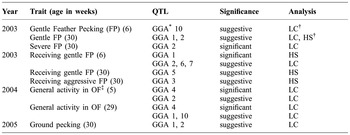
Buitenhuis et al. (Reference BUITENHUIS, RODENBURG, VAN HIERDEN, SIWEK, CORNELISSEN, NIEUWLAND, CROOIJMANS, GROENEN, KOENE and KORTE2003a) identified several QTL for feather pecking in laying hens. Traits like gentle feather pecking, severe feather pecking and aggressive pecking were measured at 6 and 30 weeks of age. Putative QTL for gentle feather pecking were identified on chicken chromosome (GGA) 10 at 6 weeks of age and on GGA1 and GGA2 at 30 weeks of age. Considering severe feather pecking, a significant QTL was found on GGA2 at an adult age. Simultaneously, the authors’ defined phenotypes for receiving gentle, severe and aggressive pecking and carried out QTL analyses (Buitenhuis et al., Reference BUITENHUIS, RODENBURG, SIWEK, CORNELISSEN, NIEUWLAND, CROOIJMANS, GROENEN, KOENE, BOVENHUIS and VAN DER POEL2003b). For receiving gentle feather pecking at 6 weeks of age, a significant QTL on GGA1 and three additional suggestive QTL were identified on GGA2, GGA6, and GGA7. For receiving gentle feather pecking and aggressive pecking at 30 weeks of age suggestive QTL were detected on GGA5 and GGA3, respectively. The various QTL identified at different ages indicates that receiving pecks is regulated by different genes in young and adult hens. This conclusion is consistent with results obtained by Buitenhuis et al. (Reference BUITENHUIS, RODENBURG, SIWEK, CORNELISSEN, NIEUWLAND, CROOIJMANS, GROENEN, KOENE, BOVENHUIS and VAN DER POEL2004) after QTL analysis for open-field behaviour that was carried out for young and adult laying hens. A short overview of QTL found by Buitenhuis et al. (2003a,b; 2004 and 2005) is shown in Table 2.
Overview of quantitative trait loci reported for feather pecking in chickens (Buitenhuis et al., Reference BUITENHUIS, RODENBURG, VAN HIERDEN, SIWEK, CORNELISSEN, NIEUWLAND, CROOIJMANS, GROENEN, KOENE and KORTE2003a; Reference BUITENHUIS, RODENBURG, SIWEK, CORNELISSEN, NIEUWLAND, CROOIJMANS, GROENEN, KOENE, BOVENHUIS and VAN DER POEL2003b; Reference BUITENHUIS, RODENBURG, SIWEK, CORNELISSEN, NIEUWLAND, CROOIJMANS, GROENEN, KOENE, BOVENHUIS and VAN DER POEL2004 and 2005).

* GGA=chicken chromosome Gallus gallus domesticus
† HS =half-sib analysis, LC =line-cross analysis
‡ OF=open-filed test
putative candidate genes
Molecular analyses carried out for feather pecking have helped to define several putative candidate genes. Unfortunately, the analyses did not elucidate endogenous factors of this trait, which is more likely influenced by more than one gene. Feather pecking behaviour may be considered as a result of different pigmentation (Keeling et al., Reference KEELING, ANDERSSON, SCHUTZ, KERJE, FREDRIKSSON, CARLBORG, CORNWALLIS, PIZZARI and JENSEN2004; Bright, Reference BRIGHT2007). According to Keeling et al. (Reference KEELING, ANDERSSON, SCHUTZ, KERJE, FREDRIKSSON, CARLBORG, CORNWALLIS, PIZZARI and JENSEN2004), experimental birds (an inter-cross between a White Leghorn line and the Red Jungle Fowl) suffered more drastic feather pecking when the colour of their plumage is a result of the expression of the wild recessive allele at PMEL17 (gene which controls plumage melanisation). Keeling et al. (Reference KEELING, ANDERSSON, SCHUTZ, KERJE, FREDRIKSSON, CARLBORG, CORNWALLIS, PIZZARI and JENSEN2004) defined a highly significant QTL for feather damage that coincided with the dominant white locus. The dominant white colour is caused by an insertion in exon 10 of the PMEL17. The birds homozygous for the wild-type allele show a variety of pigmented (non-white) plumage and are significantly more vulnerable to feather-pecking than white homozygotes (I/I) or less pigmented heterozygous (I/i) animals. Moreover, the presence of the pigmentation victims in the flock may lead to an increase of the pecking behaviour through social transmission. Similar results were obtained by Bright (Reference BRIGHT2007) after comparing feather damage due to feather pecking influenced by plumage colour in Oakham Blue laying hens. Oakham Blue birds with black or grey plumage are more susceptible to feather pecking than white birds (Bright, Reference BRIGHT2007).
Nätt et al. (Reference NÄTT, KERJE, ANDERSSON and JENSEN2007) confirmed the previous results. Similar to Keeling et al. (Reference KEELING, ANDERSSON, SCHUTZ, KERJE, FREDRIKSSON, CARLBORG, CORNWALLIS, PIZZARI and JENSEN2004), they observed behaviour of two PMEL17 homozygous groups, white (II) versus dark colour wild-type (ii). Birds from the wild-type group were pecked more and had poorer feather condition. This leads to the conclusion that genotypes of PMEL17 affect some aspects of receiving feather pecking behaviour in flocks of chicken being heterozygous with respect to the I-locus. It does not, however, explain feather pecking (performing as well as receiving) in flocks of homozygous (II) chicken, like White Leghorn populations. White Leghorn populations are defined as HFP in some studies (Wysocki, Reference WYSOCKI2007). Polymorphisms in the PMEL17 gene associated with colour variants in chicken are described in detail by Kerje et al. (Reference KERJE, SHARMA, GUNNARSSON, KIM, BAGCHI, FREDRIKSSON, SCHÜTZ, JENSEN, VON HEIJNE, OKIMOTO and ANDERSSON2004).
Two further candidate genes were suggested by Flisikowski et al. (Reference FLISIKOWSKI, SCHWARZENBACHER, WYSOCKI, WEIGEND, PREISINGER, KJAER and FRIES2009). The dopamine receptor D4 is associated with temperament and behaviour. Fidler et al. (Reference FIDLER, VAN OERS, DRENT, KUHN, MUELLER and KEMPENAERS2007) reported significant association of DRD4 polymorphisms with early exploratory behaviour in a passerine bird species (Parus major). It has been revealed that dopaminergic and serotonergic systems are involved in feather pecking (van Hierden et al., Reference VAN HIERDEN, KORTE, RUESINK, VAN REENEN, ENGEL, KORTE-BOUWS, KOOLHAAS and BLOKHUIS2002a; Kjaer et al., Reference KJAER, HJARVARD, JENSEN, HANSEN-MÜLLER and NAESBYE LARSEN2004). Following these findings Flisikowski et al. (Reference FLISIKOWSKI, SCHWARZENBACHER, WYSOCKI, WEIGEND, PREISINGER, KJAER and FRIES2009) hypothesized that variation in the DRD4 gene might be associated with pecking behaviour in laying hens. The neighbouring gene encoding deformed epidermal auto regulatory factor 1 (DEAF1) was also investigated. The product of DEAF1 regulates the transcription of the gene encoding the serotonin (5-hydroxytryptamine) 1A receptor. The panel of sequence animals used in this experiment included experimental layer lines divergently selected for high and low propensity to feather pecking, the unselected founder population, and two commercial lines with low and high propensity to feather pecking. None of the polymorphisms found were functional, however, the defined haplotype information might be helpful to select against the propensity to feather pecking.
The panel of candidate genes generated after a literature search, microarray experiments and signalling pathways analysis was presented and explored by Wysocki (Wysocki et al., Reference WYSOCKI, PREISINGER and FRIES2006; Wysocki, Reference WYSOCKI2007). In the experiments, the LSL represented the HFP, and the LB represented the LFP. One of the selected candidate genes was TPH1 (Tryptophan hydroxylase 1), a rate-limiting enzyme in biosynthesis of serotonin. Serotonergic neurotransmission is altered in obsessive-compulsive disorders in humans (Wang et al., Reference WANG, ERLANDSEN, HAAVIK, KNAPPSKOG and STEVENS2002) and, as reported by van Hierden et al. (Reference VAN HIERDEN, DE BOER, KOOLHAAS and KORTE2004), feather pecking behaviour is triggered by low serotonin neurotransmission. PRKG1 encodes cGMP-dependent protein kinase type 1 and was also suggested as an interesting candidate gene for feather pecking by Wysocki (Reference WYSOCKI2007). In the fruit fly (Drosophila melanogaster) and in honeybee (Apis mellifera), the cGMP dependent protein kinase is encoded by the foraging gene (for), which has been identified as a major gene involved in food-search behaviour (Sokolowski, Reference SOKOLOWSKI1980; de Belle et al., Reference DE BELLE, HILLIKER and SOKOLOWSKI1989; Ben-Shahar et al., Reference BEN-SHAHAR, ROBICHON, SOKOLOWSKI and ROBINSON2002; Ben-Shahar, Reference BEN-SHAHAR2005). Foraging behaviour involves the search and intake of food (Hurnik et al., Reference HURNIK, WEBSTER and SIEGEL1995) and feather pecking might be a redirected form of foraging behaviour (Blokhuis, Reference BLOKHUIS1986; Blokhuis and van der Haar, Reference BLOKHUIS and VAN DER HAAR1992; Huber-Eicher and Wechsler, Reference HUBER-EICHER and WECHSLER1997; Huber-Eicher and Wechsler, Reference HUBER-EICHER and WECHSLER1998). Wysocki (Reference WYSOCKI2007) did not find highly significant statistical differences in gene expression among selected genes between HFP and LFP. However, it seems that it would be worth investigating them further using lines selected against and for feather pecking instead of commercial strains.
Physiological factors and feather pecking
Physiological factors of the bird and its internal state are possible causes for feather pecking (Hughes and Duncan, Reference HUGHES and DUNCAN1972; van Hierden et al., Reference VAN HIERDEN, DE BOER, KOOLHAAS and KORTE2004; Buitenhuis and Kjaer, Reference BUITENHUIS and KJAER2008; Bolhuis et al., Reference BOLHUIS, ELLEN, VAN REENEN, DE GROOT, NAPEL, KOOPMANSCHAP, DE VRIES REILINGH, UITDEHAAG, KEMP and RODENBURG2009). Serotonin (5-HT) is being considered as a neurotransmitter involved in feather pecking behaviour (van Hierden et al., Reference VAN HIERDEN, KORTE, RUESINK, VAN REENEN, ENGEL, KORTE-BOUWS, KOOLHAAS and BLOKHUIS2002a). In the human brain serotonin is responsible for several physiological functions such as sleep, appetite and mood. It has been suggested that serotonergic neurotransmission is changed in depression, schizophrenia and obsessive-compulsive disorders (Wang et al., Reference WANG, ERLANDSEN, HAAVIK, KNAPPSKOG and STEVENS2002). Moreover, a dis-regulation of brain 5-HT was observed in response to stress and aggressive behaviour in chickens (van Hierden et al., Reference VAN HIERDEN, DE BOER, KOOLHAAS and KORTE2004). The authors assumed that the serotonergic system might be responsible for feather pecking in the same way as in psychopathological disorders in humans. In their experiments 5-HT turnover in the forebrain of LFP and HFP animals was reduced by using a somatodendritic 5-HT1A autoreceptor agonist. The results confirmed that low serotonergic neurotransmission was associated with increased feather pecking behaviour. Previously, van Hierden et al. (Reference VAN HIERDEN, KORTE, RUESINK, VAN REENEN, ENGEL, KORTE-BOUWS, KOOLHAAS and BLOKHUIS2002a) observed lower 5-HT turnover levels after manual restraint in birds of a HFP as compared to birds of a LFP. Cheng et al. (Reference CHENG, DILLWORTH, SINGLETON, CHEN and MUIR2001) investigated the regulation of neuro-endocrine homeostasis in High (HGPS) and Low (LGPS) Group Productivity and Survivability. LGPS birds were characterized by aggressive, cannibalistic behaviour and high mortality, whereas the HGPS birds were characterized by high production and longevity. The blood concentration of serotonin, dopamine and the ratio of epinephrine to norepinephrine were higher in LGPS. The function of 5-HT in the central nervous system is to inhibit aggression; however, the peripheral increase of serotonin might be associated with feather pecking and cannibalism. Changes in the serotonin activity may be the cause or the result of feather pecking. Hens group-selected against mortality due to cannibalism and a control group were investigated for changes in 5-HT activity (Bolhuis et al., Reference BOLHUIS, ELLEN, VAN REENEN, DE GROOT, NAPEL, KOOPMANSCHAP, DE VRIES REILINGH, UITDEHAAG, KEMP and RODENBURG2009). Half of the hens from each genetic line were beak-trimmed. After several behavioural tests the authors observed that peripheral 5-HT level was not responsive to beak-trimming, however, there were noticeable differences in a peripheral 5-HT activity between genetic lines. This shows that changes in 5-HT parameters reflect the predisposition for severe feather pecking rather than result of beak-trimming. Serotonergic mediation of aggression in HGPS, LGPS and out-group control was also studied by Dennis et al. (Reference DENNIS, CHEN and CHENG2008). An increased aggressive behaviour was observed in the control group and LGPS treated with 5-HT1A antagonist and in the HGPS hens treated with 5-HT1B antagonist. Furthermore, both experimental groups, i.e. HGPS and LGPS, showed increased feather pecking. Various reactions for 5-HT1A and 5-HT1B receptors antagonist in all three groups provide evidence for different heritable serotonergic mediation of feather pecking in chickens.
The second important neurotransmitter that might be involved in feather pecking is dopamine. HFP is thought to have a dopamine (DA) system of higher sensitivity than LFP and therefore show more behavioural response to apomorphine treatment (van Hierden et al., Reference VAN HIERDEN, KOOLHAAS, KOSTAL, VYBOH, SEDLACKOVA, RAJMAN, JURANI and KORTE2005). It manifests itself as an increase in locomotor activity and a stereotyped behaviour, including stereotypic pecking. Kjaer et al. (Reference KJAER, HJARVARD, JENSEN, HANSEN-MÜLLER and NAESBYE LARSEN2004) also supported the hypotheses that feather pecking behaviour in adult hens can be influenced by the dopamine system. They demonstrated that feather pecking was significantly reduced when haloperidol (dopamine D2 receptor antagonist) was administered.
Hughes (Reference HUGHES1973) suggested that a small dose of testosterone could prevent feather pecking in pullets. Similar results were presented by Cuthertson (Reference CUTHERTSON1978). She noticed, however, that large dose of testosterone and oestrogen increased feather pecking. The hormonal corticosteroids group plays an important role in the response to stress and fear (Korte et al., Reference KORTE, BEUVING, RUESINK and BLOKHUIS1997; Korte, Reference KORTE2001). Two lines that differed in the predispositions to feather pecking also tended to do so in the plasma level of corticosterone observed during resting and manual restraint conditions. Plasma corticosterone levels in LFP were significantly higher during resting conditions and restraint when compared with the HFP.
Conclusions
In this review we have tried to compile papers that explain the potential endogenous foundation of feather pecking. In a short summary the feather pecking behaviour can be related to many external or internal stimuli and actions that alter the relationship between an organism and its environment. Moreover, most likely more than one, single gene might influence feather pecking (Jensen et al., Reference JENSEN, KEELING, SCHÜTZ, ANDERSSON, MORMEDE, BRÄNDSTRÖM, FORKMAN, KERJE, FREDRIKSSON, OHLSSON, LARSSON, MALLMIN and KINDMARK2005). The panel of putative candidate genes will depend on age of the chicken and whether it is a victim or a pecker. The question arose, why despite the number and variety of experiments carried out over past years; it is still not possible to define genetic and physiological background of this trait. One of the problems is the inhomogeneous approach which implicates impossible integration of results from various experiments summarized in this paper.
The studies mentioned above often use HFP and LFP for which it is unknown if they stemmed from a common ancestor population. However, differences found between these two lines, for example in gene expression could be due to the functionality of the gene or can be a characteristic of the respective line without being involved in feather pecking. One obvious solution would be to use a base population and conduct a selection experiment (e.g. select up and down for this trait). The resulting lines share the same genetic background and show differences only in the gene frequency of genes related to the trait (except for random drift and genes that are in linkage disequilibrium with the causative gene). These selected lines are a powerful experimental source for QTL analysis using combined linkage and linkage disequilibrium mapping (Meuwissen et al., Reference MEUWISSEN, KARLSEN, LIEN, OLSAKER and GODDARD2002) using a dense SNP chip. Subsequently they can be used to create an advance intercross line (Davarsi und Soller, 1995) in order to further narrow down the estimated QTL position. Additionally they are well suited for the gene expression study, Expression Quantitative Trait Locus (eQTL) (Jansen and Nap, Reference JANSEN and NAP2001; Schadt et al., Reference SCHADT, MONKS, DRAKE, LUSIS, CHE, COLINAYO, RUFF, MILLIGAN, LAMB, CAVET, LINSLEY, MAO, STOUGHTON and FRIEND2003) and pathway analysis (Jiménez-Marín et al., Reference JIMÉNEZ-MARÍN, COLLADO-ROMERO, RAMIREZ-BOO, ARCE and GARRIDO2009). In conclusion, combining a selection experiment together with the power of laboratory techniques, statistical genomics and bioinformatics has the potential to result in more successful genetic dissection of feather pecking.
Acknowledgments
The authors wish to thank Christine Baes (Institute of Animal Husbandry and Animal Breeding, University of Hohenheim) for language assistance and for valuable comments on this manuscript.