Introduction
The use of telehealth has long been advocated as a mechanism to increase access to health care for rural and remote communities (Blandford et al., Reference Blandford, Wesson and Amalberti2020). In these settings, multiple studies have detailed high levels of patient and physician satisfaction, with telehealth cited as permitting effective communication, access to specialist opinion, and continuity of care, while significantly reducing cost and travelling effort (Jennett et al., Reference Jennett, Smith, Watanabe and Tan2009; Sevean et al., Reference Sevean, Dampier and Spadoni2009; Sabesan et al., Reference Sabesan, Simcox and Marr2011). Since the COVID-19 pandemic, the use of telehealth has expanded rapidly to involve many areas of healthcare including oncology and palliative care (Meti et al., Reference Meti, Rossos and Cheung2020; Knudsen et al., Reference Knudsen, Willman and Winn2021).
Cormi et al. have noted that the term telemedicine covers a range of situations including a “teleconsultation (clinician to patient); tele-expertise (clinician to clinician); telemonitoring (remote collection of data for simultaneous or later interpretation), or teleassistance (a healthcare professional remotely advises another when carrying out a procedure” (Cormi et al., Reference Cormi, Petit and Auclair2021). In Australia, the use of the term telehealth has become synonymous with the teleconsultation or clinician to patient interaction using online electronic visual platforms or, in some instances, telephone only. Throughout this study, the term telehealth was used to refer to this clinician to patient consultation.
In Australia, specific funding models to support telehealth delivery were introduced during the pandemic in order to reduce patient risk through minimizing hospital attendances. Previously in Australia, telehealth would have attracted publicly funded subsidized support only if: (1) there was use of an audio/visual link and (2) the patient was located in a residential-aged care facility OR lived in an area classified as remote and more than 15 km from the physician. The new, expanded funding models resulted in substantially increased use of telehealth, including telephone only, regardless of the location of residence — essentially for any patient in any setting.
Overall, studies have reported broad satisfaction with this form of care delivery during the pandemic (Yildiz and Oksuzoglu, Reference Yildiz and Oksuzoglu2020; Hasson et al., Reference Hasson, Waissengrin and Shachar2021; Darcourt et al., Reference Darcourt, Aparicio and Dorsey2021). Steindal and colleagues highlighted that telehealth appears feasible, facilitated access to health professionals, and provided an enhanced sense of security for palliative care patients at home (Steindal et al., Reference Steindal, Nes and Godskesen2020). A systematic review of palliative care caregiver outcomes following telehealth intervention revealed that satisfaction was improved, although there was no substantive change in measured outcomes overall (Zheng et al., Reference Zheng, Head and Schapmire2016). Meanwhile, a systematic review of eHealth interventions and information provision for palliative care patients revealed no overall improvement for patient, caregiver, or health professional outcomes, though the authors reported marked heterogeneity in the study design and the outcomes measured (Capurro et al., Reference Capurro, Ganzinger and Perez-Lu2014). Several studies have highlighted certain scenarios where telehealth was less suitable such as first consultations and a number noted a wish to return to in-person consultations when the pandemic resolves (Rodler et al., Reference Rodler, Apfelbeck and Bastian Schulz2020; Yildiz and Oksuzoglu, Reference Yildiz and Oksuzoglu2020; Zimmerman et al., Reference Zimmerman, Seidman and Tiersten2020; Tevaarwerk et al., Reference Tevaarwerk, Osterman and Arafat2021; Wehrle et al., Reference Wehrle, Lee and Devarakonda2021). Some physicians raised concerns about equitable access using this medium, particularly for those patients from lower socio-economic status groups, non-English speakers, and elderly patients (Burbury et al., Reference Burbury, Wong and Yip2021; Darcourt et al., Reference Darcourt, Aparicio and Dorsey2021; Knudsen et al., Reference Knudsen, Willman and Winn2021). By contrast, others have highlighted the opportunity that telehealth raises for greater patient access and great opportunities for continuity of care and follow-up, including for those who may be considered vulnerable and who, over time, have demonstrated greater willingness to engage with electronic platforms of healthcare delivery (Calton et al., Reference Calton, Rabow and Branagan2019).
As new models of care delivery are considered both during and beyond the pandemic, it is important to understand the experiences of telehealth of both palliative care patients and their physicians. We therefore aimed to explore in depth the experience of telehealth in outpatient palliative care delivery according to patients and physicians. In particular, we sought to understand the patients’ and clinicians’ experiences of all aspects of the telehealth consultation from the experience of using the technology in this setting, the quality of the interaction and impact on relationships within this format, as well as their views on its future role in healthcare.
Methods
Study design and setting
This study, utilizing an exploratory qualitative design, involved semi-structured interviews conducted with participants across three metropolitan tertiary teaching hospitals in Victoria, Australia. The study was part of a larger mixed-methods study, which also included a cross-sectional exploratory survey to assess matched patient and clinician-reported acceptability and satisfaction with the use of telehealth in the specialist palliative care outpatient setting — the results of which are reported elsewhere (Philip et al., Reference Philip, Wawryk and Pasanen2022). All participating hospitals utilized the HealthDirect platform for audio-visual telehealth consultations, while the telephone alone was available if using audio only. The study received ethical approval from the Institutional Human Research Ethics Committee (LRR 096/20).
Participants
Purposive sampling was used to identify and recruit a total of 23 participants including 12 physicians and 11 patients. All palliative care physicians who worked in outpatient settings of the three hospitals and who undertook telehealth consultations were invited to participate via email. Patients from the cross-sectional survey (Philip et al., Reference Philip, Wawryk and Pasanen2022) who opted in to this study component were sampled to according to a range of socio-demographic characteristics with the potential to influence experiences of telehealth such as gender, age, stage of cancer illness, and distance of home residence from the hospital. Patients were eligible if they were: (1) receiving specialist palliative care at a participating hospital; (2) participated in a specialist palliative care outpatient telehealth appointment; and (3) able to understand English without the aid of an interpreter. Given the opt-in recruitment, no patients subsequently refused participation. For the purpose of this study, telehealth was defined as a medical consultation delivered via an audio (telephone) or audio-/video-link.
Data collection
Individual semi-structured interviews were conducted between November 2020 and March 2021 via telephone or Zoom Video Communications, Inc. by author, LP, a clinical researcher trained in qualitative interviewing and experienced in patient-reported outcome data who was not previously known to patient participants and independent to their treating health team. The researcher informed participants of the study aim to evaluate telehealth models of care in the oncology palliative care setting. The telehealth consultations referred to in the participant interviews occurred during a 15-week period when the state of Victoria was in “lockdown”, with severe restrictions upon movement outside the home other than for a few specified purposes which included access to medical care. Attendance at medical appointments was permitted with certain restrictions including an inability to be accompanied by carers, and limits on waiting room occupancy and other forms of consultation such as telehealth were encouraged. All interviews were conducted within three weeks of the telehealth consultation, and most were within the lockdown period.
A qualitative inquiry was chosen to prompt more in-depth data about participants’ experiences of telehealth in the context of palliative care. While both the patient and clinician cohorts were asked to recount their most recent telehealth appointment, clinicians were also probed about their experiences of telehealth palliative care more generally. An interview schedule included the following broad areas of enquiry: (1) Can you tell me about your last telehealth consultation; (2) What are your general thoughts and impressions of telehealth in palliative care delivery; and (3) How would you feel about the possibility of telehealth remaining a part of the delivery of palliative care in the future? A series of prompts under these topics were used to encourage participant reflection, importantly maintaining some flexibility to allow the interviewer to follow new lines of enquiry raised by the participants as they emerged. Interviews ranged from 12 to 33 min. Collection, coding, and analysis of data occurred simultaneously and recursively, ceasing once no new codes were arising from the interviews.
Data analysis
All interviews were audio recorded and transcribed verbatim using an independent transcription service. The interviewer (LP) de-identified and checked the transcriptions for accuracy. All 23 transcripts were coded manually by two researchers, independently (LP and RLG — a postdoctoral qualitative analyst). First-stage analysis involved careful reading of individual transcripts multiple times, with the coding schemes informed by themes outlined in the interview schedule. Both researchers met weekly during the coding process to discuss and resolve discrepancies across the dataset. Drawing on grounded theory approach, second-stage analysis involved inductively identifying additional themes and sub-themes, which were further refined through an iterative process of interpretation with the investigator group, comprising palliative care physicians and researchers. No participant member-checking was used.
Results
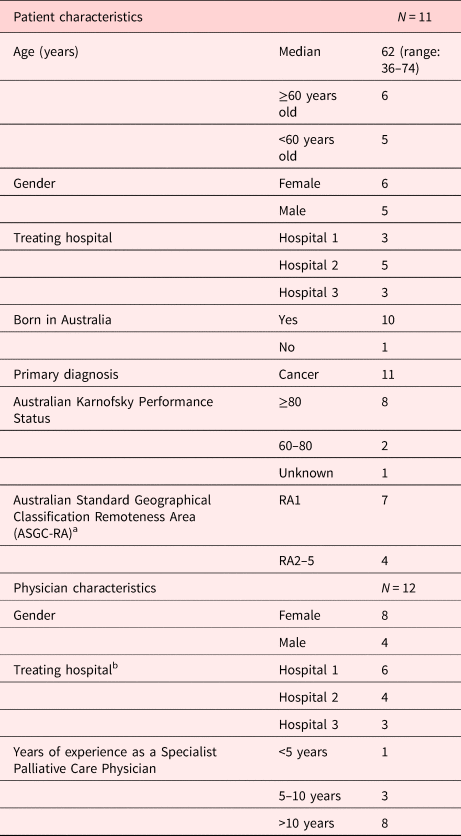
Physician interviewees represented all three hospital sites, with all those who were approached participating. Recruitment for patient interviews continued until after 11 interviews when it was noted no new themes or ideas were emerging. Among the patient cohort, all had a cancer diagnosis and lived in all areas of the state — both remote and metropolitan (Table 1). Of the 11 patients interviewed, 64% (n = 7) would not have been eligible to receive care via telehealth without the altered funding support systems introduced during the COVID-19 pandemic. Previous models of telehealth delivery were supported only for those residing in remote regions. Among the patient interviewees, most (n = 9) had audio-only appointments with palliative care.
Participant characteristics

a Includes a rating of remoteness of geographical location of residence, whereby RA1 is a major metropolitan area and RA5 is a very remote region.
b One physician worked across two hospitals.
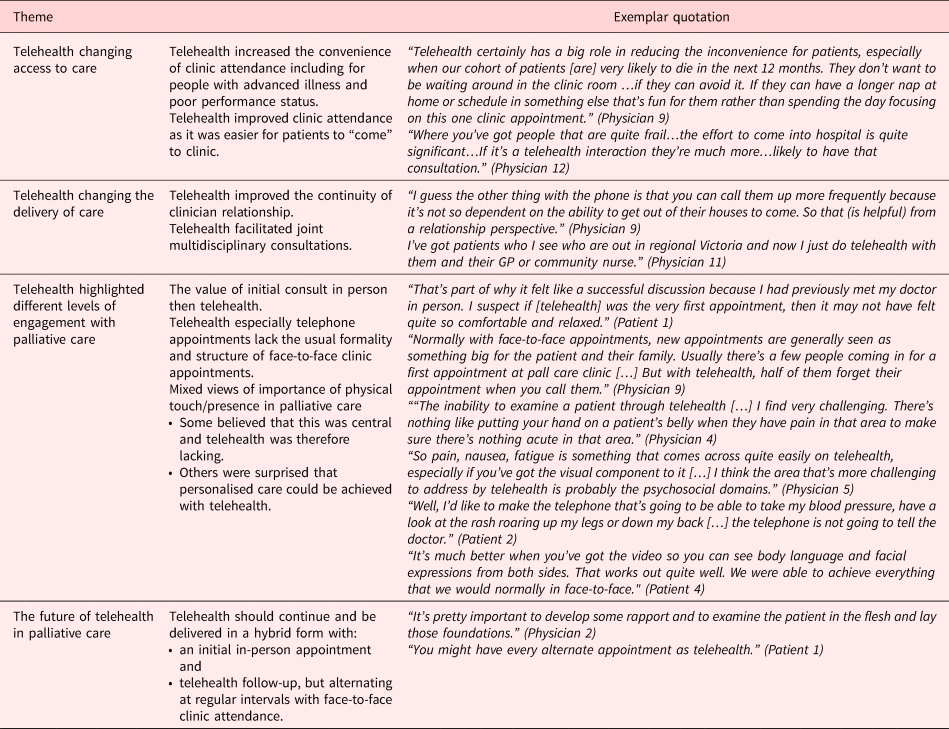
Patients and physicians interviewed in this study suggested ways by which the rapid uptake of telehealth resulting from the COVID-19 pandemic has, for the most part, transformed the ways in which they engaged with or delivered specialist palliative care in the outpatient setting. This was evident across the entire continuum of care — from how specialist palliative care was accessed, how it was delivered, as well as the impact upon the level of engagement between patient–physician relationships and broader clinical services. These aspects across the continuum formed the basis of the themes arising from the participants’ perceptions of telehealth in the specialist palliative care outpatient setting: (1) telehealth changing access to care; (2) telehealth changing the delivery of care; (3) telehealth highlighted different levels of engagement with palliative care; and (4) the future of telehealth in palliative care (Table 2).
Themes arising from the interviews

Telehealth changing access to care
The broadened access to specialist palliative care afforded by telehealth was a major “silver lining” of the pandemic, with both patients and physicians highlighting how the expansion of telehealth services to metropolitan patients — alongside regional or rural patients, dismantled barriers that had previously limited attendance to specialist palliative care. One physician, for example, reported that:
“We've seen failure-to-attend rates plummet dramatically, which meant that our clinics have become increasingly busy.” (Physician 7)
This greater access extended beyond the logistical barriers of distance, travel, and parking that were solved by telehealth — with both patients and physicians speaking of the benefits in a setting where “performance status and symptoms” often challenged patients to attend in-person appointments:
“Telehealth is great because I've had such a horrible night. If I've had an [in-person] appointment, I'd probably be ringing to cancel it because I wouldn't have felt up to travelling all the way into [hospital] and waiting in the waiting rooms.” (Patient 11)
Telehealth also increased the access to limited resources such as specialist palliative medicine advice.
“I think that is just a simple, effective way of providing specialist palliative care support to far, far, far more people…It [also] allows specialist medical palliative care attention to just be given more.” (Physician)
The ease with which telehealth was provided meant greater willingness to schedule follow-up care. This meant that the level of concern prompting a review was able to be lesser in magnitude, since telehealth was readily and easily scheduled. This was seemingly valued by physicians:
“I guess the other thing with the phone is that you can call them up more frequently because it's not so dependent on the ability to get out of their houses to come. So that from a relationship perspective, it seems like they appreciate that we're still making the effort.” (Physician 9)
“I work on the inpatient consultation services as well so when I'm discharging someone, I'm much more likely to say 'Oh, I'll give you a call on Friday' and they go 'yay'. I guess I'm more likely to do a follow-up outpatient appointment…because a phone appointment with me is not burdensome and they have improved continuity of care.” (Physician 10)
Increased access to a video-link telehealth consultation was, however, contingent. Physicians found that most palliative care appointments were “skewed more towards telephones” as many of their patients were “elderly”, “non-English-speaking”, and not technologically confident. Such observations reflected patients’ own experiences, as illustrated by the following sentiments: “I'm just not good with that sort of thing”, “I wouldn't know what to do with the video-link”, or “I found all this technology really overwhelming”. Another patient noted:
“I'm currently computer illiterate. The only line I've got is in the backyard, it's got pegs on it and the only computer I use is the one between my ears.” (Patient 2)
Unless family members or carers were present to facilitate the video-link, many patients preferred telephone appointments.
Telehealth changing the delivery of care
Central to most physicians’ accounts was the role of telehealth in facilitating the continuity of care, which, as one physician described, has been a “gamechanger”. Prior to COVID-19, palliative care appointments were commonly organized around other hospital appointments to reduce the burden of patients having to travel into the hospital multiple times. Doing so, however, meant “trading off against continuity of care” where patients attending on different days would see different palliative care physicians at each appointment. The wide adoption of telehealth services during the pandemic significantly changed these practices and opened new opportunities for delivering specialist palliative care:
“I'm always amazed when I say to a patient, 'You've got a couple of options. We can get someone else to see you on Friday when you come in. Or I can see you again via telehealth if you're happy with that […] Every single person said, 'Oh no, I'd much prefer [you]…They don't want to tell a story for the ninth time to a different clinician.” (Physician 3)
Some physicians also reported that compared to in-person appointments, which are often circumscribed by physical and logistical barriers, using telehealth meant there was less urgency to “discharge” patients from further outpatient clinic appointments — thus allowing the continuity of specialist palliative care alongside other specialist and community-based health services including community palliative care:
“[Patient] was deteriorating towards the end of life and she'd not connected particularly well with community palliative care […] Telehealth allowed me to…have continuity of care and to gradually chip away at her ability to let the community [palliative care] team in, which she eventually did do.” (Physician 7)
“I think the infrastructure is certainly a lot better [for] coordination between the teams – pharmacy, GP, community palliative care and the hospital specialty teams.” (Physician 7)
Of the few patients who had no pre-existing relationships with their physician prior to the telehealth appointment, all but one reported “no issues” — with one patient expressing, “I would opt for telehealth every single time”.
The opportunity for joint consultation by telehealth also served to increase the continuity of care as patients moved between specialist craft groups as well as between the hospital and the community.
“I've done a little more joint working with GPs or other professionals, even oncologists, because we've been able to actually just all join via telehealth.” (Physician 11)
“Part of the reason we've also been holding onto some of these patients for longer is because our community services were really struggling, particularly during the second wave of COVID-19.” (Physician 12)
In this way, telehealth provided a means of ensuring continuity as the locus of care moved to the home as the illness progressed, providing continued hospital-based support at a period of the pandemic when community palliative care services were experiencing extremely high demand — consequently constraining the capacity for timely responsiveness.
Telehealth highlighted different levels of engagement with care
Alongside accounts of access and the continuity of care were reflections upon how telehealth transformed the nature and the level of engagement with specialist palliative care. What emerged from these discussions was a more layered and nuanced understanding of the role of telehealth in responding to patient and physician needs.
Both patients and physicians pointed to the centrality of visual cues in guiding the physiological and psychosocial dimensions of palliative care, with most expressing a strong preference for initial reviews to be conducted face to face to perform comprehensive physical assessments and establish rapport. Doing so, not only instilled confidence in management plans but also laid the relational foundation for “successful” care via telehealth:
“I feel like for patients I already know and I have already assessed face-to-face and I'm doing a follow-up by telehealth that's much more acceptable to me than the new patients who nobody from our team has met.” (Physician 11)
For specific patient cohorts such as those with low levels of English proficiency, several physicians questioned the appropriateness of telehealth — regardless of form (audio and/or visual) and frequency. The barriers around language, combined with the lack of visual cues, often precluded the capacity to build any meaningful engagement and rapport, and it is within this context that the role of family became salient. While some physicians reported that telehealth facilitated better family engagement in patient care and “added a richness to the review”, most found that the involvement of family or carers over telehealth negatively impacted how they engaged with patients. Woven into these accounts were physicians’ accounts of patients who did not consider phone appointments as “real appointments” and delegated it to their carers:
“It's not as formal [as in-person], it's just a phone call so it's not as big a deal. And more often, they will hand the phone over to the carer.” (Physician 10)
“His wife did most of the talking and I think her agenda was different from my agenda. And it was difficult to get the conversation back to the actual patient without him being there.” (Physician 8)
Mirroring physician concerns, most patients also perceived telephone appointments as less formal than in-person appointments — with one patient explaining that “we're not often primed for phone calls because we haven't specifically gone out and geared ourselves up (like) for a face-to-face meeting.”
Without the physical rituals surrounding in-person appointments, patients can often “forget” about their palliative care appointments — especially if they're “having so many appointments and so many consultations.” Insights from patients’ accounts illustrates how this has negatively impacted their palliative care experience:
“I had the wrong time and I left home and did some shopping […] the consequences were that I was having a conversation [with the physician] on the main street.” (Patient 9)
“The reality is that phone calls are so much more casual in that regard. So consequently, any sort of negative information might just be a real bombshell hitting us.” (Patient 1)
The ethos of palliative care — as perceived by both patients and physicians, is built upon a foundation of “connection”, “personal touch”, and “therapeutic relationships”, but the procedural nature of telehealth, according to some participants, diminished such values:
“We're all a bit scared at the end of life and you know, some reassurance […] looking into somebody's face or even a touch on the shoulder or shake of the hand makes a huge difference.” (Patient 6)
“It's sort of a transactional sort of thing […] [telehealth] can diminish that therapeutic relationship to be sort of making you feel like a vending machine […] rather than a good therapeutic consultation.” (Physician 12)
Not all patients and physicians shared these concerns. One physician, for example, was pleasantly surprised by the capacity of clinicians to build rapport with patients over the phone and video: “I think I have been proven more and more wrong”. Others reported that the advent of telehealth to a broader patient population helped patients achieve “the best quality of life” as the “flexible” and “light touch” nature of phone calls allowed “frequent reviews” without “disrupting [patients’] day very much”. Similarly, some patients were not troubled by the lack of visual information over telehealth. One patient, for example, explained that in the palliative care setting, it is sufficient for physicians to:
“Just go by what you're telling them” because “they're not going to wave a magic wand and fix [you] all of a sudden.”(Patient 11)
Another found that:
“Telephone makes it easier to talk about intimate or personal subjects because you're not looking at someone staring back at you.” (Patient 3)
The future of telehealth in palliative care
Based on patients and physicians’ diverse experiences and perceptions of telehealth in the specialist palliative care outpatient setting — both individually and collectively, it was unsurprising that most have proposed a hybrid mix of telehealth and in-person appointments moving forward. Among physicians, a key concern was ensuring that evidence-based processes and guidelines are set in place to identify “which sorts of appointments are suitable and not suitable” and that the provision of telehealth is “not detriment to [patients’] care” (Physician 10). As one physician described it: “it feels like we're building a plane while flying and we're kind of learning the processes as we go — what suits and what doesn't suit.” (Physician 7)
As noted, physicians positively reported that telehealth has facilitated the expansion of specialist palliative care into other healthcare settings such as residential aged care, general practice, and community palliative care services. However, with these and other plans for ongoing telehealth use, the issue of “job satisfaction” was raised, which is associated with “that relationship we develop with patients and feeling like we have done the best job we can”. Physicians noted that “we don't feel that with telehealth and so it is less rewarding”. To overcome this, both physicians and patients suggested that initial consults should be conducted in-person and telehealth appointments considered thereafter:
“The initial should be done in person…. But if it's mutually decided between the practitioner and the patient that it works better for them to have telehealth in the future, then that could be agreed to.” (Physician 2)
“If you had regular appointments, you might have every alternate appointment as telehealth because I would argue that you need to be seen […] you need to reconnect in a physical way to help maintain a strong tie […] it's obviously really sensitive information that you're dealing with and you want to be comfortable to open up about it all.” (Patient 1)
Discussion
This study provides novel data bringing together the perspective of patients and physicians to highlight the benefits and advantages as well as limitations of telehealth in the specialist palliative care outpatient setting that, pre-pandemic, would not have been fully captured or understood. Both patients and physicians embraced the opportunities that telehealth presented — from reducing logistic barriers of consultations through continued and more frequent care as a person's illness progresses. Given that such enthusiasm for telehealth was expressed during a time of low vaccination levels, alongside acute fears of infection in both the community and health services, there is — to some degree, a level of uncertainty around whether the attitudes expressed here would be maintained in the future beyond the pandemic. That said, the opportunities highlighted by participants were less focused on COVID-related issues and more focused on how the integration of telehealth as part of health service provision positively altered the operation of specialist palliative in the outpatient setting.
The present findings provided key insights into how the convenience of telehealth delivery not only facilitated more frequent reviews but also enabled reviews to occur in response to lower levels of concern than that would be considered the “norm” in the context of scheduling face-to-face reviews. This was exemplified by one physician's willingness to schedule a follow-up appointment by telehealth as it was less “burdensome” for the patient to attend. Non-attendance at palliative care clinic appointments is a common occurrence and is often associated with deteriorating performance status (Porta-Sales et al., Reference Porta-Sales, Codorniu and Gómez-Batiste2005). This, along with a series of other factors including the level of distress, stability of symptom/illness, likelihood of anticipated and unanticipated problems, as well as needs for further conversation and/or decision-making play a key role when scheduling such appointments (Porta-Sales et al., Reference Porta-Sales, Codorniu and Gómez-Batiste2005; Smith et al., Reference Smith, Thai and Bakitas2013; Finlay et al., Reference Finlay, Rabow and Buss2018). Moreover, these dynamic factors are weighed in the context of the point in the illness course and the difficulty or ease with which reviews occur. Telehealth tips this balance substantially, such that reviews can now occur more frequently without posing much burden to patients and in the setting of lower levels of concern. The enhanced access to care through telehealth described by patients and clinicians alike (Head et al., Reference Head, Schapmire and Zheng2017) appears to not only be concerned with how care is delivered, but also, as evident in our study, to whom care is delivered given an expanded cohort of patients can now receive and continue to receive outpatient palliative care.
In this study, accounts of the benefits of telehealth were often juxtaposed alongside preferences for first reviews to be face-to-face to perform comprehensive assessments as well as establish the relational foundation for ongoing (telehealth) care. While medical oncologists in recent qualitative research strongly regard telehealth as the second best compared to face-to-face reviews (Aung et al., Reference Aung, Pasanen and LeGautier2022), palliative care physicians in this study appeared not as determined to endorse telehealth as inferior. Perhaps, this is confirming the patient's view who implied that much of palliative care could be done by “talking” since there is not a magic wand to be waved for cure. Or perhaps it is the opportunity afforded by telehealth for greater continuity of care and easier follow-up, all of which enhances overall care and thus mitigates against the disadvantages of the transactional nature of telehealth.
Other studies have found that changing physical status and needs of the patient considerably influences the perceived value of telehealth (Philip et al., Reference Philip, Wawryk and Pasanen2022). Survey responses from the quantitative dimension of this study found that patients with a greater need for urgent symptom control or discussions of goals of care rated telehealth less favorably and expressed a preference for face-to-face reviews (Philip et al., Reference Philip, Wawryk and Pasanen2022). Similarly, palliative care physicians less frequently endorsed telehealth consultations for patients with unstable symptoms or who required discussions around goals of care as well as those who were older or for whom English was not their preferred language (Philip et al., Reference Philip, Wawryk and Pasanen2022). Furthermore, palliative care physicians are much less likely to find the consultation satisfactory if the telehealth review was telephone only, without visual media (Eastman et al., Reference Eastman, Dowd and White2021; Philip et al., Reference Philip, Wawryk and Pasanen2022). It is possible that the addition of visual media to these consultations would enhance the information available as well as the perceived adequacy of the consultation.
Overall, patients and clinicians appear to support the ongoing use of telehealth in the future, beyond COVID-19 (Steindal et al., Reference Steindal, Nes and Godskesen2020; Eastman et al., Reference Eastman, Dowd and White2021; Philip et al., Reference Philip, Wawryk and Pasanen2022). Based on this study, such support seemed strongest for a hybrid model of telehealth and face-to–face consultations with key parameters providing guidance. These would include first consultations being held face to face, and subsequent telehealth consultations punctuated with face-to-face contact at key illness points such as when significant conversations or goals of care discussions are required or patients experience rapidly changing symptom status. The ability to formally undertake joint telehealth consultations at times of transition between new treating teams or when moving to predominantly community delivered care offers new opportunities to enhance care. However, to realize such opportunities, support for patients to increase confidence using audio-visual platforms is required, and specific attention must be given to identifying those groups who are at risk of being disadvantaged by telehealth such as those from non-English speaking backgrounds (Porta-Sales et al., Reference Porta-Sales, Codorniu and Gómez-Batiste2005). The alternative of exclusively face-to-face care delivery must be available in future models of care.
The study has some limitations. Firstly, the findings were set against a time of high community anxiety about COVID-19 transmission — which may not be enduring in the future when vaccination levels are high and the pandemic wanes. Secondly, the interviews were held only with those who had participated in telehealth appointments and so did not garner the views of all patients. Those who participate in telehealth already demonstrate a willingness to engage on these platforms thus representing a selected sample. Moreover, those who do not speak English were not included in the sampling, again revealing a selection bias. A specific approach to those who choose not to participate in telehealth would form the basis of a useful complementary study.
Nevertheless, the findings of this study confirm the utility of telehealth in palliative care according to both patients and physicians. The opportunities to enlist telehealth to enhance the continuity of care across and between settings, as well as the way telehealth “lowers the bar” to provide follow-up represent an enriched understanding of its role. Future models of telehealth delivery that incorporate face-to–face reviews at key times or in the event of particular circumstances with ongoing telehealth delivery in between times may represent an enhanced approach to care which enlists the advantages of both forms of care delivery. Such a model would require prospective evaluation specifically at a time beyond the pandemic to understand its full potential.
Supplementary material
The supplementary material for this article can be found at https://doi.org/10.1017/S1478951522000670.
Acknowledgments
The authors wish to acknowledge the support for data collection by the Western Central Melbourne Integrated Cancer Service team.
Author contributions
JP, SS, AC, OW, and LP contributed to the design and methodology of the study. LP and AW undertook data collection. LP and RLG undertook the initial data analysis. All authors reviewed and further refined the data analysis. All authors contributed to the manuscript preparation and editing.
Funding
This research received no specific grant from any funding agency in the public, commercial, or not-for-profit sectors.
Conflict of interest
The authors have no conflicts of interest to declare in relation to this work.