1. Introduction
Vector-borne diseases, such as chikungunya, dengue, malaria, West Nile virus, yellow fever and Zika, posed a major global public health problem worldwide. For instance, dengue is endemic in more than 100 countries with 100–400 million infections occur yearly (WHO [55]). In 2014–2015, an outbreak of chikungunya originating on the Indian Ocean islands spread, via viremic travelers, to the Americas with a total of 1,071,696 and 635,955 suspected cases (including 169 and 82 deaths) in 2014 and 2015, respectively (PAHO [39]). In 2013–2014, a large-scale Zika outbreak was reported in Pacific islands and spread to Brazil and other countries and territories in the Americas, including the United States, with a total of 515,348 suspected cases in 2015–2016 (PAHO [40]).
For many vector-borne diseases, mosquitoes are the vectors. For example, Aedes mosquitoes are the primary vectors for transmitting chikungunya, dengue and Zika viruses (Gao et al. [Reference Gao, Lou, He, Porco, Kuang, Chowell and Ruan18], WHO [56]). In modern time, humans travel more frequently on scales from local to global. Such movements can spread disease pathogens over long distances and can threaten public health (Lounibos [Reference Lounibos31]). It has been observed that human movement is essential for the spread of vector-borne diseases (Stoddard et al. [Reference Stoddard, Forshey, Morrison, Paz-Soldan and Vazquez-Prokopec46, Reference Stoddard, Morrison, Vazquez-Prokopec, Paz Soldan and Kochel47]). Thus, it is crucial to consider the influence of host and vector movements on the transmission dynamics and spatial spread of vector-borne diseases.
Reaction-diffusion equations have been frequently used to model the spreading of some vector-borne diseases, see Favier et al. [Reference Favier, Schmit, Graf, Cazelles, Degallier, Mondet and Dubois14], Fitzgibbon et al. [Reference Fitzgibbon, Parrott and Webb17], Lewis et al. [Reference Lewis, Renclawowicza and van den Driessche24], Wang and Zhao [Reference Wang and Zhao49], and the reviews by Fitzgibbon and Langlais [Reference Fitzgibbon and Langlais15] and Ruan and Wu [Reference Ruan and Wu43]. In order to provide a qualitative description of the Zika outbreak in Rio de Janeiro in 2015–2016, Fitzgibbon et al. [Reference Fitzgibbon, Morgan and Webb16] proposed and investigated the following vector-borne epidemic model with spatial dependence:

with homogeneous Neumann boundary conditions and initial conditions

where $\Omega \subset \mathbb {R}^{2}$ is a smooth, bounded domain, and $\textbf {n}$
 is the outer normal vector, $V_s(x,t)$
 , $V_i(x,t)$
 and $H_i(x,t)$
 represent the densities of uninfected vectors, infected vectors and infected hosts in location $x$
 and at time $t$
 , respectively, $H_s (x)$
 is the density of uninfected hosts, $\beta (x)$
 formulates the breeding rate of vectors, $\mu (x)$
 is the loss rate of vectors due to the environmental crowding, $\rho (x)$
 denotes the loss rate of infected hosts, $\sigma _1(x)$
 and $\sigma _2(x)$
 are the transmission rates of uninfected vectors and uninfected hosts, respectively, $d_1(x)$
 and $d_2(x)$
 reflect the diffusion rates of vectors and infected hosts, respectively.
The simulation results in [Reference Fitzgibbon, Morgan and Webb16] indicate that the location and magnitude of local outbreaks of the epidemic at the beginning of the season can have significant impact on the spatial development and final size at the end of the season. Recently, there has been further investigation on reaction-diffusion model (1.1). Magal et al. [Reference Magal, Webb and Wu33, Reference Magal, Webb and Wu34] considered the global dynamics of solutions, redefined and investigated the basic reproduction number for this spatial epidemic model. When all parameters in (1.1) are positive constants, Cai et al. [Reference Cai, Wang and Wang5] studied global stability of the positive equilibrium. Recently, Li and Zhao [Reference Li and Zhao26] studied the global dynamics of a modified model of (1.1) by including the effect of seasonality.
Based on the extinction or persistence of vector-borne diseases formulated in [Reference Cai, Wang and Wang5, Reference Fitzgibbon, Morgan and Webb16, Reference Magal, Webb and Wu33, Reference Magal, Webb and Wu34], we plan to explore how fast the infected vectors and hosts expand when they are locally introduced into the whole space occupied by uninfected vectors. For this purpose, we first consider the asymptotic spreading of the following rescaled Cauchy problem as all parameters of (1.1) are spatially homogeneous

in which parameters and initial conditions satisfy the following hypotheses
(H1) $d$
 , $\sigma _1$, $\sigma _2$, $\rho$, $\beta$, $\mu$, $H_s$ are positive constants;
(H2) $V_{i,0}(x)$
, $H_{i,0}(x)$ are nonnegative, bounded, continuous functions, and $V_{i,0}(x)+H_{i,0}(x)$ admits nonempty compact support in $x\in \mathbb {R}$.


We then study the existence and nonexistence of travelling wave solutions. Here, a travelling wave solution is a special entire positive solution taking the form

in which $c$ is the wave speed while $\phi, \varphi, \psi$
 are wave profiles. By the definition, $c$
 and $(\phi, \varphi, \psi )$
 must satisfy the following wave profile system

for $\xi \in \mathbb {R}.$ Due to the biological background, the wave profile also satisfies

In this paper, we answer the above questions by estimating the speed at which the hosts and vectors expand spatially by the asymptotic speed of spreading (for short, the spreading speed) and the minimal wave speed of travelling wave solutions. For monotone semiflows, these two propagation thresholds have been widely studied in different parabolic type equations or systems [Reference Aronson and Weinberger1, Reference Aronson and Weinberger2, Reference Berestycki, Hamel and Nadin4, Reference Liang, Yi and Zhao27, Reference Liang and Zhao28, Reference Lui32, Reference Weinberger51, Reference Weinberger52, Reference Weinberger, Lewis and Li54]. Moreover, these two propagation thresholds of nonmonotone systems that can be controlled by two monotone systems admitting the same propagation threshold have been investigated in [Reference Hsu and Zhao21, Reference Li, Lewis and Weinberger25, Reference Wang48, Reference Weinberger, Kawasaki and Shigesada53, Reference Yi, Chen and Wu62].
Modeling the spatial propagation of infectious diseases by spreading speed and travelling wave solutions is an important topic in mathematical epidemiology [Reference Murray37, Reference Rass and Radcliffe41, Reference Shigesada and Kawasaki44, Reference Zhao64]. When the travelling wave solutions of epidemic models are concerned, there are many important and classical results, and we may refer to some monographs including [Reference Murray37, Reference Rass and Radcliffe41, Reference Shigesada and Kawasaki44, Reference Zhao64]. For the spreading speed of non-cooperative epidemic models, Ducrot [Reference Ducrot9] obtained the speed by using the idea of uniform persistence for a classical epidemic model, Lin et al. [Reference Lin, Pan and Yan30] established the speed of a delayed epidemic model. Ducrot and his co-authors [Reference Ducrot8, Reference Ducrot, Giletti, Guo and Shimojo10, Reference Ducrot, Giletti and Matano11] studied the spreading speed of several predator-prey reaction-diffusion systems, Lin et al. [Reference Lin, Niu, Pan and Ruan29] investigated the spreading speed in an integrodifference predator-prey system without comparison principle. We also refer to [Reference Chen and Tsai6, Reference Girardin19, Reference Maidana and Yang36, Reference Pan38, Reference Xiao and Mori58] and references therein for other non-cooperative systems.
Evidently, (1.2) is not even quasi-monotone, which leads to the lack of comparison principle for this system and the above results do not work directly to this system. To estimate the propagation threshold, we use the idea in Ducrot [Reference Ducrot9] to obtain the lower bound of the spreading speed. During this process, we further study the principal eigenvalue problem of a weakly coupled elliptic system in a bounded domain by applying the corresponding generalized principal eigenvalue problem in the whole space [Reference Girardin19]. In addition, we introduce a limiting system to estimate the principal eigenvalue and then achieve our desired results by taking a limiting procedure. Furthermore, we construct two auxiliary monotone systems and apply the theory of monotone dynamical systems to prove the convergence to the positive equilibrium. Finally, we find the spreading speed is the minimal wave speed of travelling wave solutions or the threshold such that (1.3)–(1.4) has a positive solution. As a by-product, we obtain the monotonicity and uniqueness in the sense of phase shift of positive solutions to (1.3)–(1.4).
The rest of this paper is organized as follows. We start in § 2 with some preliminaries and our main results. Section 3 is devoted to estimating the upper and lower bounds of the spreading speed. In § 4, we obtain the convergence of solutions. The minimal wave speed of travelling wave solutions is investigated in § 5. We give some numerical simulations in § 6 and present a discussion in § 7.
2. Preliminaries and main results
Before stating the main results of this paper, we give some preliminaries as follows. A matrix $\mathbf {A}=(a_{i,j})_{n\times n}$ is essentially nonnegative if $\mathbf {A}-\min _{1\le i\le n} (a_{i,i}) \mathbf {I}_n$
 is nonnegative, where $\mathbf {I}_n$
 is the $n\times n$
 identity matrix. Let the Banach space

denote the space of all bounded and uniformly continuous functions from $\mathbb {R}$ into $\mathbb {R}^{3}$
 , which is equipped with the usual supremum norm $\|\cdot \|_X$
 .
Let $m:=\max \{\sup _{x\in \mathbb {R}}V_{i,0}(x),\sup _{x\in \mathbb {R}}H_{i,0}(x)\}>0$ be given. Define the set of initial data $Y\subset X$
 as

We first recall a convergence result of the scalar Fisher-KPP equation [Reference Smoller45, Reference Ye, Li, Wang and Wu61].
Lemma 2.1 Consider the Fisher-KPP equation

where $\beta,$ $\mu >0$
 are constants and $v_0(x)\ge 0$
 is a bounded, continuous function satisfying $\liminf _{|x|\to \infty }v_0(x)>0$
 . Then

Moreover, assume that $v(x,t)=\zeta (x+ct)$ is a positive bounded travelling wave solution of (2.1) such that

then $\zeta (\xi )=\frac {\beta }{\mu },$ $\xi \in \mathbb {R}.$

Applying lemma 2.1 to the equation of $V_s+V_i$ , we obtain the following boundedness result.
Lemma 2.2 For any initial data $(V_{s,0},V_{i,0},H_{i,0})\in Y,$ system (1.2) admits a globally classical, positive and bounded solution; i.e. there exists a constant $M>0$
 independent of $(x,t)$
 such that

Proof. The local existence of (1.2) is evident. For any given $A\ge \frac {\beta }{\mu }$ , we define $B,C>0$
 by

Clearly, $A\to \infty$ implies that $B\to \infty,C\to \infty.$
 Then $(0,0,0)$
 and $(A,B,C)$
 are a pair of generalized upper-lower solutions of (1.2) by selecting $A\ge \beta /\mu$
 large enough such that the initial condition holds. Then there exists a constant $M(m)>0$
 such that $0\le V_s,V_i, H_i\le M$
 and the main result is clear.
Moreover, we show further bounds of solutions. For given $m>0$ , adding the $V_s$
 -equation to the $V_i$
 -equation implies that $V_s+V_i$
 satisfies

Lemma 2.1 ensures that


From the $V_s$ -equation, we also have

The proof is complete.
Based on the boundedness of solutions and the standard estimates in [Reference Ladyženskaya, Solonnikov and Ural'ceva23], we have the following uniform estimates:
Lemma 2.3 Assume that $(V_s,V_i,H_i)$ is the solution of (1.2) satisfying $|V_s|$
 , $|V_i|,$
 $|H_i|\le M_0$
 for some constant $M_0>0$
 . Then there exists a constant $M_1>0$
 such that

where $u\in \{V_s,V_i,H_i\}$ , $x\in \mathbb {R},$
 $t\ge 1$
 .
In the corresponding kinetic system of (1.2), the threshold

is called the basic reproduction number [Reference Fitzgibbon, Morgan and Webb16, Reference Magal, Webb and Wu33]. If $\mathcal {R}_0\le 1$ , then there exists a disease-free equilibrium $E_1= (\beta /\mu,0,0)$
 . When $\mathcal {R}_0>1$
 , it also admits a positive equilibrium [Reference Fitzgibbon, Morgan and Webb16, Reference Magal, Webb and Wu33]

To state our conclusion, we consider the following cooperative system

where $\psi _i (i=1,2)$ are bounded, uniformly continuous functions, and $0\le \psi _1\le V_i^{*}$
 , $0\le \psi _2\le H_i^{*}$
 . Note that (2.5) is a cooperative, irreducible system such that it generates a monotone semiflow. Thus the result in Liang and Zhao [Reference Liang and Zhao28] implies that (2.5) has the following propagation properties.
Lemma 2.4 If $\mathcal {R}_0>1,$ then there is a constant $c^{*}>0$
 that is the spreading speed and minimal wave speed of (2.5) in the following sense:
(i) Spreading speed: if $v_i(x,0)+h_i(x,0)$
admits nonempty compact support, then
\begin{align*} & \limsup\limits_{t\to\infty}\sup\limits_{|x|\ge ct} \left[v_i(x,t)+h_i(x,t)\right]=0\quad \textrm{for any } c>c^{*},\\ & \limsup\limits_{t\to\infty}\sup\limits_{|x|\le ct} (|v_i(x,t)-V_i^{*}|+|h_i(x,t)-H_i^{*}|)= 0 \quad \text{for any } 0< c< c^{*}, \end{align*}(ii) Minimal wave speed: (2.5) admits a monotone travelling wave solution $(\widetilde {\varphi },\widetilde {\psi })(\xi )$
with $\xi =x+ct,$ $c>0,$ connecting $(0,0)$ to $(V_i^{*},H_i^{*})$ if and only if $c\ge c^{*}$.


We now analyse the definition of $c^{*}$ in order to estimate it in applications. Since the system also satisfies the subhomogeneous property, results in Liang and Zhao [Reference Liang and Zhao28, sections 3 and 5] imply that $c^{*}$
 is determined by the following linear system

For such a linear cooperative system, the threshold $c^{*}$ has been investigated in several studies, see e.g., Hsu and Yang [Reference Hsu and Yang20], Wu and Hsu [Reference Wu and Hsu57]. To determine $c^{*},$
 we further consider the following eigenvalue problem

From [Reference Liang and Zhao28], $c^{*}$ is the threshold such that

has a positive eigenvector $(\varphi _1,\varphi _2)^{T}$ if $c\ge c^{*}.$

Note that $\mathbf {L}$ and $\mathbf {A}(\gamma ):=(\gamma ^{2}\mathbf {D}+\mathbf {L})$
 are essentially nonnegative and irreducible matrices, we can estimate $c^{*}$
 by using the idea in [Reference Girardin19, pp. 110]. Calculating the above eigenvalue problem, for any given $\gamma \ge 0$
 , the larger eigenvalue or the so-called Perron-Frobenius eigenvalue (see [Reference Girardin19]) of $\mathbf {A}(\gamma )$
 is given by

Moreover, $\lambda (\gamma )$ is simple and has a positive eigenvector $(\varphi _1,\varphi _2)^{T}$
 . In fact, $(\varphi _1,\varphi _2)^{T}$
 is also the corresponding eigenvector of the principal eigenvalue (the larger eigenvalue) of the following irreducible and positive matrix

for which we can use the Perron-Frobenius theorem. Evidently, regarding $\gamma$ as the unique variable, there exists $\gamma ^{\prime }>0$
 such that

which further implies that

Using these two limits, we know that

is positive and finite, which is also attained for some finite $\gamma ^{*} >0$ . By direct calculation, we know that $\frac {\lambda (\gamma )}{\gamma }$
 is strictly convex (also see [Reference Girardin19, lemma 6.2]), so $\gamma ^{*}>0$
 is unique.
At the same time, due to the special form of travelling wave solutions, (2.5) has a travelling wave solution $(\widetilde {\varphi },\widetilde {\psi })$ if and only if $\widetilde {\varphi }$
 satisfies the following quasimonotone equation

with $\widetilde {\varphi }(-\infty )=0$ , $\widetilde {\varphi }(\infty )=V_i^{*}$
 , where

is obtained by using the elementary solution of heat equations.
Linearizing (2.7) at zero and plugging $e^{\gamma \xi }$ into it, we obtain the corresponding characteristic equation

where $\gamma ^{+}=\frac {c+ \sqrt {c^{2} + 4d\rho }}{2d}$ . By direct calculation, we obtain that $\Lambda (0,c)= \beta (\mathcal {R}_{0}-1)>0$
 , $\Lambda (\gamma,c)\to \infty$
 for any $c\ge 0$
 as $\gamma \to \gamma ^{+}-$
 , and $\partial _{\gamma \gamma }\Lambda (\gamma,c)>0$
 for any $c\ge 0$
 , $\gamma \in [0,\gamma ^{+})$
 , which implies that $\Lambda (\gamma,c)$
 is convex in $\gamma \in [0,\gamma ^{+})$
 . Moreover, since $\partial _{c}\Lambda (\gamma,c)<0$
 for any given $\gamma \in [0,\gamma ^{+})$
 , $\Lambda (\gamma,c)$
 is continuous and strictly decreasing in $c\in [0,\infty )$
 such that for any $\gamma \in [0,\gamma ^{+})$
 , $\Lambda (\gamma,0)\ge \beta (\mathcal {R}_{0}-1)>0$
 , $\lim_{c\to \infty }\Lambda (\gamma,c)=-\infty$
 . We now define the following bounded constant

which is the minimal wave speed of (2.7) ([Reference Xu and Xiao60, Reference Zhao and Xiao65]). Since the travelling wave in lemma 2.4 is equivalent to that of (2.7), lemma 2.4 implies that the two definitions of $c^{*}$ are equivalent.
With the above constants, we now state our main results as follows.
Theorem 2.5 Suppose that $\mathcal {R}_0>1$ holds. Then the solution of (1.2) satisfies the following spreading properties:
(i) For any given $c>c^{*},$
one has
\[ \limsup\limits_{t\to\infty}\sup\limits_{|x|\ge ct}\left[\left|V_s(x,t)-\frac{\beta}{\mu}\right|+V_i(x,t)+H_i(x,t)\right]=0; \](ii) For any given $0< c< c^{*},$
one has
\[ \limsup\limits_{t\to\infty}\sup\limits_{|x|\le ct} (|V_s(x,t)-V_s^{*}|+|V_i(x,t)-V_i^{*}|+|H_i(x,t)-H_i^{*}|)= 0. \]


Moreover, (1.3)–(1.4) has a monotone solution if and only if $c\ge c^{*}.$ In particular, if (1.3)–(1.4) has a monotone solution, then it must satisfy

and it is unique in the sense of phase shift; that is, if $(\phi _1(\xi ),\varphi _1(\xi ), \psi _1(\xi ))$ is a positive solution of (1.3)–(1.4), then there exists $h\in \mathbb {R}$
 such that

In addition, $\phi (\xi )$ is strictly decreasing in $\xi$
 while $\varphi (\xi ),$
 $\psi (\xi )$
 are strictly increasing in $\xi$
 .
Remark 2.6 Theorem 2.5 implies that $c^{*}$ is the spreading speed of the infected population and the minimal wave speed of travelling wave solutions describing disease spreading.
When $\mathcal {R}_0\le 1$ , we state the following result on the convergence of solutions and the nonexistence of travelling waves.


3. Spreading properties
In this section, we are devoted to proving the main part of theorem 2.5 if $\mathcal {R}_0>1$ . To complete the proof of theorem 2.5 (i), we use an auxiliary system as the upper control system, and establish our results by constructing an upper solution and applying the comparison principle. We deal with theorem 2.5 (ii) in a weak sense by using the idea of uniform persistence [Reference Ducrot9] from dynamical system theory [Reference Magal and Zhao35]. In this procedure, we introduce the generalized principal eigenvalue problem [Reference Girardin19] of a weakly coupled elliptic system in the whole space to estimate the lower bounds of the spreading speed.
3.1 Upper bounds on the spreading speed
In this subsection, we prove theorem 2.5 (i) by showing the following lemma.
Lemma 3.1 For any given $\epsilon >0,$ the solution of (1.2) satisfies

Proof. It follows from lemma 2.2, (2.3)–(2.4) that $V_i(x,t)$ and $H_i(x,t)$
 satisfy

Let $c^{*},\gamma ^{*},\varphi ^{*}=(\varphi _1,\varphi _2)^{T}$ be given in § 2, we define a positive vector function

where $t_1>0$ is sufficiently large such that $(\overline {V_i},\overline {H_i})(x,0)\ge (V_i,H_i)(x,0)$
 . Based on the above arguments, we verify that if $(\overline {V_i},\overline {H_i})(x,t)$
 is differentiable, then

and $(V_i,H_i)$ is a lower solution of (3.2). Applying the classical parabolic comparison principle [Reference Smoller45, Reference Ye, Li, Wang and Wu61] to the cooperative system (3.2), we obtain

for any $\epsilon >0$ .
Next we show the convergence of $V_s$ by contradiction. Assume that for any $\epsilon >0$
 , there exist $\delta >0$
 , a sequence $\{t_n\}_{n\ge 0}$
 tending to infinity, and a sequence $\{x_n\}_{n\ge 0}\subset \mathbb {R}$
 such that

Consider a sequence of functions

By lemma 2.3 and the parabolic estimates, we obtain that $( V_{s,n},V_{i,n},H_{i,n})$ has a subsequence, still denoted by $( V_{s,n},V_{i,n},H_{i,n}),$
 converging to some entire solution $(V_{s,\infty },V_{i,\infty },H_{i,\infty })$
 of (1.2) locally uniformly. Thus $V_{s,\infty }$
 satisfies

Due to the convergence of $V_i$ and $H_i$
 , we have $(V_{i,\infty },H_{i,\infty })(0,0)=(0,0)$
 . Then the strong maximum principle implies that $(V_{i,\infty },H_{i,\infty })(x,t)\equiv (0,0)$
 . Thus

By (2.2), we have $(V_{s}+V_i)(x+x_n,t+t_n) \to \frac {\beta }{\mu }$ as $n\to \infty$
 , which further implies that $V_{s,\infty }\equiv \frac {\beta }{\mu }$
 by the uniqueness of the entire solution for the scalar Fisher-KPP equation [Reference Berestycki, Hamel and Nadin4]. It contradicts (3.3) and completes the proof.
3.2 Lower bounds on the spreading speed
In this subsection, we first prove a lemma as a weak version of (theorem 2.5(ii), which relies on the uniform persistence theory in dynamical systems. The final convergence in theorem 2.5(ii) will be completed in § 4.
Lemma 3.2 Suppose that $\mathcal {R}_0>1$ . Then for any given $0< c< c^{*},$
 the solution of (1.2) satisfies

In what follows, we divide the proof of the above lemma into three steps: (1) point-wise weak spreading property, (2) point-wise spreading property, and (3) uniform spreading property. Throughout this subsection, we assume that $c^{0}$ is an arbitrarily fixed constant such that $0\le c^{0}< c^{*}.$

3.2.1 An eigenvalue problem.
In order to prove the weak point-wise spreading property, we first investigate an eigenvalue problem of weakly coupled elliptic systems by the corresponding generalized principal eigenvalue. For $0< R$ , $0<\eta <\beta$
 , and $c\in \mathbb {R}$
 , we consider the following eigenvalue problem:

Lemma 3.3 For any given $|c|< c^{*},$ there exist $\eta _c>0$
 small enough and $\overline {R}_c>0$
 large enough such that the principal eigenvalue of (3.4) satisfies $\Lambda _{R}(\eta )<0$
 for any $R\ge \overline {R}_c$
 and $0\le \eta \le \eta _c$
 .
Proof. Since this weak coupled elliptic system is cooperative and irreducible, the celebrated Krein-Rutman theorem [Reference Du7] implies that there exists a unique principal eigenvalue $\Lambda _{R}(\eta )$ associated with a positive eigenfunction pair $(\psi _1 ,\psi _2 )$
 for (3.4).
We first consider the case $0\le c< c^{*}$ . From [Reference Girardin19, theorem 4.2], we obtain that as $R\to +\infty$
 , $\Lambda _R(\eta )$
 converges to a generalized principal eigenvalue of the operator

in which the generalized principal eigenvalue is defined by

where $C^{2}(\mathbb {R},\mathbb {R}^{2}_+)$ represents the space of all positive twice continuously differentiable vector functions. It follows from [Reference Girardin19, lemma 6.4] that

where $\lambda (\gamma,\eta )$ denotes the unique Perron-Frobenius eigenvalue of the matrix

Recalling the first definition of $c^{*}$ in § 2, $\mathbf {A}(\gamma,0)$
 is essentially nonnegative and irreducible, and admits the unique Perron-Frobenius eigenvalue $\lambda (\gamma,0)>0$
 associated with a positive eigenvector (see [Reference Girardin19]). Moreover,

For any given $c\in [0,c^{*})$ , one obtains that there exist $\eta _c>0$
 small enough and $\overline {R}_c$
 large enough such that

By a symmetric argument on $-x$ and the uniqueness of this eigenvalue, the conclusion for the case $-c^{*}< c\le 0$
 follows. This completes the proof.
3.2.2 The first step: point-wise weak spreading property
Lemma 3.4 There exists $\varepsilon _1(c^{0})>0$ such that for any $c\in [0,c^{0}]$
 and $x\in \mathbb {R},$
 the solution $(V_s,V_i,H_i)$
 of (1.2) with initial data in $Y$
 satisfies

Proof. Suppose by contradiction that there exist sequences

such that the solution $(V_{s}^{n},V_{i}^{n},H_{i}^{n})$ of (1.2) with initial data $(V^{n}_{s,0},V^{n}_{i,0},H^{n}_{i,0})$
 satisfies

Then it implies that there exists $\{t_n\}_{n\ge 0}\subset [0,\infty )$ tending to $\infty$
 , and

By (3.6), we claim that for any $R>0$ , there exists a sequence $t'_n\ge t_n$
 such that

In fact, it suffices to verify (3.7) with $\{t_n'=t_n\}$ . We suppose by contradiction that there exist $\delta >0$
 , sequences $s_n\ge t_n$
 , $c_n\to c_{\infty }\in [0,c^{0}]$
 and $x'_n\to x'_{\infty }\in [-R,R]$
 such that

Using lemma 2.3, the standard parabolic estimates imply that up to a subsequence,

locally uniformly for $(x,t)\in \mathbb {R}^{2}$ , where $(u_{\infty },v_{\infty },w_{\infty })$
 is an entire solution of

Note that (3.6) yields $(v_{\infty },w_{\infty })(0,0)=(0,0)$ . Applying the strong maximum principle, we obtain that $(u_{\infty },v_{\infty },w_{\infty })(x,t)\equiv (\beta /\mu,0,0)$
 . However, since the sequence $\{x_n'\}\subset [-R,R]$
 is relatively compact, $u_{\infty }(x,t)\equiv \frac {\beta }{\mu }$
 contradicts the fact that

which proves (3.7).
Now we return to prove lemma 3.4. Consider a sequence of functions $(u_n,v_n,w_n)$ with moving frames defined by

then (3.6) becomes

Let us fix small $\eta >0$ and large $R>0$
 such that lemma 3.3 holds for $c^{0}$
 . It follows from (2.3) and (3.7) that for any $n$
 large enough, one has

Then $(v_n,w_n)(x,t)$ satisfies

Thus the comparison principle yields that

where $\Lambda _R$ and $(\psi _1,\psi _2)$
 are the principal eigenvalue and the associated positive eigenfunction pair defined in lemma 3.3, $\tau >0$
 is small enough so that $(v_n,w_n)(x,0)\ge \tau (\psi _1,\psi _2)(x)$
 for all $|x|\le R$
 .
Using lemma 3.3, we have $\Lambda _R<0$ since $\eta$
 is small enough and $R$
 is large enough. Thus, $v_n(0,t)\ge \tau e^{-\Lambda _R t}\psi _1(0)\to \infty$
 as $t\to \infty$
 , which contradicts (3.8). The proof is complete.
3.2.3 The second step: point-wise strong spreading property
In the following lemma, we shall improve the weak spreading properties stated in the previous subsection.
Lemma 3.5 There exists $\varepsilon _2(c^{0})>0$ such that for any $c\in [0,c^{0}]$
 and $x\in \mathbb {R},$
 the solution $(V_s,V_i,H_i)$
 of (1.2) with initial data in $Y$
 satisfies

Proof. We prove (3.9) by contradiction. Assume that there exist sequences

such that

Without loss of generality, we further assume that $c_n\to c^{\infty }\in [0,c^{0}]$ as $n\to \infty$
 . Lemma 3.4 implies that there exist two sequences $t_n\to \infty$
 and $\tau _n\in \mathbb {R}_+$
 such that for each $n\ge 0$


where $\varepsilon _1(c^{0})$ is given in lemma 3.4.
By lemma 2.3, standard parabolic estimates and up to a sequence, we have

locally uniformly in $(x,t)\in \mathbb {R}^{2}$ as $n\to \infty$
 , where $(V^{\infty }_{s},V^{\infty }_{i},H^{\infty }_{i})$
 is an entire solution of (1.2). Due to the choice of $t_n$
 , we have

which further yields $V_i^{\infty }(x,t)+H_i^{\infty }(x,t)>0$ by the strong maximum principle.
We find that $\tau _n\to \infty$ as $n\to \infty$
 . Indeed, suppose by contradiction that its subsequence converges to some $t_0\in \mathbb {R}_+$
 , then one has

Then it follows that $V_i^{\infty }(c^{\infty }t_0,t_0)=H_i^{\infty }(c^{\infty }t_0,t_0)=0$ since these solutions are nonnegative. The strong maximum principle implies that $V_i^{\infty }=H_i^{\infty }\equiv 0$
 , a contradiction. Hence by the second construction we have

and it contradicts (3.5) in lemma 3.4 as $x=0$ and $c=c^{\infty }$
 . This completes the proof.
3.2.4 The third step: uniform spreading property
Lemma 3.6 For any $c\in [0,c^{0}]$ , the solution of (1.2) with initial data in $Y$
 satisfies


Proof. We first prove that

For any given $\widehat {c}\in (0,c^{0})$ , we suppose by contradiction that there exist sequences $t_n\to \infty$
 and $c_n\in [0,\widehat {c})$
 such that

Up to a subsequence, we assume, without loss of generality, that $c_n\to \widetilde {c}_{\infty }\in [0,\widehat {c}]$ as $n\to \infty$
 . Select $c'>0$
 such that $\widetilde {c}_{\infty }< c'\le c^{0}$
 , and define the sequence

We first consider the case that the sequence $\{c_nt_n\}_{n\ge 0}$ is bounded, which may occur if $\widetilde {c}_{\infty }=0$
 . Up to a subsequence, it follows from the strong maximum principle that as $n\to \infty$
 , $c_nt_n\to x_{\infty }$
 and

This implies in particular that $(V_i+H_i)(0,t_n)\to 0$ as $n\to \infty$
 , which contradicts the case $c=0$
 in lemma 3.5. Thus $\widetilde {c}_{\infty }>0$
 implies that the sequence $\{c_nt_n\}$
 has no bounded subsequence.
Now we assume that $t'_n\to \infty$ as $n\to \infty$
 . Since $c'\in (0,c^{0}]$
 , lemma 3.5 implies that

for each $n$ large enough.
Now we define the third time sequence $\{t_n''\}$ as follows

then $t_n''\in (t_n',t_n)$ . Since $(V_i+H_i)(c_nt_n,t_n)\to 0$
 as $n\to \infty$
 , we have

By using a similar limiting argument and a strong maximum principle, one also has

Then by lemma 2.3 and standard parabolic estimates and up to a subsequence, we obtain that

locally uniformly in $(x,t)$ such that

which contradicts (3.9) in lemma 3.5 as $c=0$ and $x=0$
 . Thus (3.12) holds.
Next we show (3.10) by contradiction. Assume that there exist sequences $t_n\to \infty$ and $0\le x_n\le ct_n$
 such that $V_i(x_n,t_n)\to 0$
 as $n\to \infty$
 , then up to a subsequence, lemma 2.3, parabolic estimates and the strong maximum principle imply that as $n\to \infty$
 ,

where $(u^{\infty },0,w^{\infty })$ is an entire solution of (1.2). But (3.12) yields $w^{\infty }>0$
 , which contradicts (1.2). Then it follows that for any $c\in [0,c^{0}]$
 ,

Thus we finish the proof of (3.10) by using a similar argument for $H_i$ .
To deal with (3.11), we first assume by contradiction that there exist sequences $t_n\to \infty$ and $0\le x_n\le ct_n$
 such that $V_s(x_n,t_n)\to \frac {\beta }{\mu }$
 as $n\to \infty$
 , then $(V_s,V_i,H_i)(x+x_n,t+t_n)$
 converges to an entire solution $(u_{\infty },v_{\infty },w_{\infty })(x,t)$
 of (1.2), which satisfies $u_{\infty }(0,0)=\frac {\beta }{\mu }$
 . Using the strong maximum principle, $u_{\infty }\equiv \frac {\beta }{\mu }$
 follows. However, it follows from (3.10) that $w_{\infty }>0$
 , which contradicts (1.2). For the remaining part, if $V_s(x_n,t_n)\to 0$
 as $n\to \infty$
 , then $V_i(x_n,t_n)\to 0$
 as $n\to \infty$
 , which contradicts (3.10). This completes the proof.
Recall that the aforementioned three lemmas addressed the rightward speed case of lemma 3.2, the leftward part of spreading follows by using a symmetric argument. Thus lemma 3.2 is proved.
4. Convergence of solutions
In this section, we show some convergence results to complete the proofs of theorem 2.5 (ii) and theorem 2.7. If $\mathcal {R}_0>1$ , we show that the solution converges to the positive equilibrium locally uniformly, which gives the final convergence in theorem 2.5 (ii). Then the disease will persist eventually. If $\mathcal {R}_0\le 1$
 , then the solution tends to the disease-free equilibrium, which indicates that the vector-borne disease will die out.
Before proving the final convergence in theorem 2.5 (ii), we state a convergence result for the bounded, persistent entire solutions of (1.2), which is established by constructing two auxiliary monotone systems.
Lemma 4.1 Suppose that $\mathcal {R}_0>1$ . If $(V_s,V_i,H_i)$
 is a bounded entire solution of (1.2) such that

then $(V_s,V_i,H_i)(x,t)\equiv (V_s^{*},V_i^{*},H_i^{*})$ for all $(x,t)\in \mathbb {R}^{2}.$

Proof. We set $V=V_s+V_i$ , then $V(x,t)$
 satisfies the following Cauchy problem

It follows from (2.2) that for any $\varepsilon >0$ , there exists $T>0$
 such that

Due to (4.1), we reset the initial function as $V(x,0)=(V_{s}+V_{i})(x,-t_0)$ for any $t_0>0$
 , we similarly have

Taking $t_0\to \infty$ , since the problem (4.2) is autonomous, we actually obtain that

Due to the arbitrariness of $\varepsilon$ , the above inequality implies that $V_s+V_i\equiv \frac {\beta }{\mu }$
 for all $(x,t)\in \mathbb {R}^{2}$
 . Thus the bounded entire solution $(V_s,V_i,H_i)$
 satisfies the following subsystem:

where the initial data $(V_{i,0}(x),H_{i,0}(x))$ satisfies

Now we deal with the long time behaviour of a spatial homogeneous solution to (4.3). Let $(\underline {v},\underline {h})(t)$ be the solution of

then $(\underline {v},\underline {h})(t)$ is a spatially homogeneous lower solution of (4.3). Since (4.4) is cooperative and $\mathcal {R}_0>1$
 holds, it is evident that

Similarly, we consider a spatial homogeneous upper solution $(\overline {v},\overline {h})(t)$ of (4.3) with initial data $(\sup _{x\in \mathbb {R}}|V_{i,0}(x)|, \sup _{x\in \mathbb {R}}|H_{i,0}(x)|)$
 . Since $\mathcal {R}_0>1$
 , we have

It follows from (4.5)–(4.6) and the comparison principle that for any $\widetilde {\varepsilon }>0$ , there exists $\widetilde {T}>0$
 such that

Applying a similar argument as at the beginning of the proof to (4.3), we actually obtain that

Due to the arbitrariness of $\widetilde {\varepsilon }$ , the above inequality together with $V_s+V_i\equiv \frac {\beta }{\mu }$
 yields that $(V_s,V_i,H_i)\equiv (V_s^{*},V_i^{*},H_i^{*})$
 for all $(x,t)\in \mathbb {R}^{2}$
 , which completes the proof.
Proof of the convergence in theorem 2.5 (ii): We suppose by contradiction that there exist $c\in [0,c^{*})$ , a sequence $\{t_n\}_{n\ge 0}\subset (0,\infty )$
 tending to $+\infty$
 , a sequence $\{x_n\}_{n\ge 0}\subset \mathbb {R}$
 and a $\delta >0$
 such that

Let us define a sequence of functions $(V_s,V_i,H_i)$ as follows:

We fix $c'>0$ such that $c< c'< c^{*}$
 . Note that $(V_s,V_i,H_i)$
 is bounded, it follows from lemma 3.2 that there exist $T_1>0$
 large enough and $\epsilon >0$
 small enough such that for all $n\ge 0$
 , $(x,t)\in \mathbb {R}^{2}$
 , if $t+t_n\ge T_1$
 and $|x|\le c't+(c'-c)t_n$
 , then

Due to lemma 2.3 and the parabolic estimates, up to a subsequence, one has

as $n\to \infty$ , where $(V_s^{\infty },V_i^{\infty },H_i^{\infty })$
 is a bounded entire solution of (1.2). Moreover, (4.8) yields

Therefore, lemma 4.1 implies that $(V_s^{\infty },V_i^{\infty },H_i^{\infty })(x,t)\equiv (V_s^{*},V_i^{*},H_i^{*})$ for all $(x,t)\in \mathbb {R}^{2}$
 .
But (4.7) implies that

which is a contradiction. This completes the proof of theorem 2.5 (ii).
To prove theorem 2.7, we show another convergence result for bounded entire solutions of (1.2) when $\mathcal {R}_0\le 1$ .
Lemma 4.2 Suppose that $\mathcal {R}_0\le 1$ . If $(V_s,V_i,H_i)$
 is a bounded entire solution of (1.2), then $(V_s,V_i,H_i)(x,t)\equiv (\frac {\beta }{\mu },0,0)$
 for all $(x,t)\in \mathbb {R}^{2}$
 .
Proof. Since the solution is bounded and nonnegative, there exists a sequence $\{(x_n,t_n)\}_{n\ge 0}\subset \mathbb {R}^{2}$ such that

Then we consider the sequence of functions

By the parabolic estimates and up to a subsequence, one has

as $n\to \infty$ , where $(\widehat {V}_s,\widehat {V}_i,\widehat {H}_i)$
 is a bounded entire solution of (1.2) and satisfies

The definition of $(x_n,t_n)$ implies that

Note that $0\le \widehat {V}_s\le \frac {\beta }{\mu }$ for all $(x,t)\in \mathbb {R}^{2}$
 . Then we apply the strong comparison principle to the $\widehat {V}_s$
 -equation and obtain that

which is a constant.
Next we consider two cases: (i) $V_{s}^{0}=0$ , (ii) $V_{s}^{0}>0.$
 For case (i), $V_{s}^{0}=0$
 implies that $\widehat {V}_s(x,t)=\widehat {V}_i(x,t)=\widehat {H}_i(x,t)\equiv 0$
 for all $(x,t)\in \mathbb {R}^{2}$
 . But lemma 2.1 yields that $(V_s+V_i)(x,t)$
 with initial data $(V_{s,0}+V_{i,0})(x)\ge \frac {\beta }{\mu }$
 converges to $\frac {\beta }{\mu }$
 uniformly in $x\in \mathbb {R}$
 as $t\to \infty$
 . It is a contradiction. Thus $V_{s}^{0}=0$
 is impossible.
For case (ii), $V_{s}^{0}>0$ ensures that $\inf _{(x,t)\in \mathbb {R}^{2}}(V_s+V_i)(x,t)>0$
 . Applying [Reference Berestycki, Hamel and Nadin4, proposition 1.8] to $V_s+V_i$
 satisfying a classical Fisher-KPP equation, we immediately obtain that $(V_s+V_i)(x,t)\equiv \frac {\beta }{\mu }$
 for all $(x,t)\in \mathbb {R}^{2}$
 , which implies $\widehat {V}_s+\widehat {V}_i\equiv \frac {\beta }{\mu }$
 . Together with (4.9)–(4.10), one obtains that $(\widehat {V}_{s},\widehat {V}_{i},\widehat {H}_{i})(x,t)\equiv (V_{s}^{0},V_{i}^{0},H_{i}^{0})$
 satisfies the system of stationary equations

Due to $\mathcal {R}_0\le 1$ , $(V_{s}^{0},V_{i}^{0},H_{i}^{0})=(\frac {\beta }{\mu },0,0)$
 follows. Combining (4.10) with the fact $0\le V_s\le \frac {\beta }{\mu }$
 for all $(x,t)\in \mathbb {R}^{2}$
 , we obtain $(V_{s},V_{i},H_{i})\equiv (\frac {\beta }{\mu },0,0)$
 , which completes the proof of this lemma.
Proof of theorem 2.7: Note that the travelling wave solution is also a special entire solution of (1.2), lemma 4.2 directly shows that if $\mathcal {R}_0\le 1$ , (1.3) and (1.4) does not have a positive solution for any $c\in \mathbb {R}.$

Now we prove that when $\mathcal {R}_0\le 1$ , the solution of (1.2) goes to the disease-free equilibrium as time tending $\infty$
 . Suppose by contradiction that there exist a constant $\widetilde {\delta }>0$
 , a sequence $\{(x_n,t_n)\}_{n\ge 0}$
 with $t_n\to \infty$
 , and $x_n\in \mathbb {R}$
 such that

We consider the sequence of functions $(V_s,V_i,H_i)$ as follows:

By lemma 2.3 and the parabolic estimates, up to a subsequence, one has

as $n\to \infty$ , where $(u,v,h)$
 is a bounded entire solution of (1.2). Moreover, it follows from (4.11) that

However, due to $\mathcal {R}_0\le 1$ , lemma 4.2 implies that $(u,v,h)(x,t)\equiv (\frac {\beta }{\mu },0,0)$
 for all $(x,t)\in \mathbb {R}^{2}$
 , which contradicts (4.12). We complete the proof of theorem 2.7.
5. Minimal wave speed
In this section, we prove the travelling wave results given in theorem 2.5. Let $\chi (\xi )=\phi (\xi )+\varphi (\xi ),$ then

such that

by (1.4). From lemma 2.1, we have the following conclusion.
Lemma 5.1 A solution of (1.3) and (1.4) must satisfy

By lemma 5.1, it suffices to study the monotone solutions of the following coupled system

Note that (5.1) is the wave profile system of (2.5). It directly follows from lemma 2.4 that the existence, nonexistence and monotonicity of solutions for (5.1) are obtained if $\mathcal {R}_0>1$ .
To better show the uniqueness of travelling wave solutions and provide a simple method to compute $c^{*},$ we further reduce the problem (5.1) to a scalar equation. Since a travelling wave solution is a special entire solution, it follows that $\psi (\xi ):=(J*\varphi )(\xi )$
 satisfies (2.8). Therefore, $\varphi (\xi )$
 satisfies the following differential-integral equation

From the second definition of $c^{*}$ in § 2, we recall

where $\Lambda (\gamma,c)$ is defined by (2.9).
Due to the equivalence between (5.1) and (5.2), it suffices to solve (5.2) with asymptotic boundary condition $\lim \limits _{\xi \to -\infty } \varphi (\xi )=0$ , $\liminf \limits _{\xi \to \infty } \varphi (\xi )>0$
 . By the theory of travelling wave solutions in nonlocal delayed equations [Reference Fang and Zhao13, Reference Ruan and Xiao42, Reference Wang, Li and Ruan50, Reference Xu and Xiao60, Reference Zhao and Xiao65], we immediately have the following existence, nonexistence, monotonicity and uniqueness of travelling wave solutions (for very recent results, see [Reference Xu and Xiao60, theorems 2.1 and 2.2]).
Lemma 5.2 Suppose that $\mathcal {R}_0>1$ . For any $c\ge c^{*},$
 (5.2) has a positive solution $\varphi (\xi )$
 with

In particular, such a travelling wave solution is strictly increasing and unique in the sense of phase shift. For any $0< c< c^{*},$ (5.2) has no positive solution $\varphi (\xi )$
 satisfying (5.3). Moreover, $c^{*}$
 is the minimal wave speed of (5.2) and (5.3).
Combining lemmas 5.1 and 5.2 with (5.1), we obtain the existence, nonexistence, uniqueness and monotonicity of $(\phi,\psi )$ . This completes the proof of travelling wave problem in theorem 2.5.
6. Numerical simulations
In this section, we illustrate the above theoretical results by performing numerical simulations in two examples. We select $\beta =\mu =H_s=1$ and consider the following system

By results in § 2, we obtain that

Example 6.1 Consider the following special case of (6.1)

We have

where $c^{*}$ is defined by (see Fig. 1)

and

The plot of the functions $f(\gamma )$ and $\Lambda (\gamma,1.6597 )$
 .

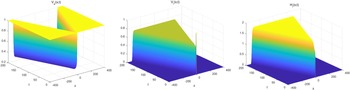
Figure 2 shows the spatial-temporal evolution of $V_s$ , $V_i$
 and $H_i$
 defined by (6.2). We show the distributions of three components at $t=200$
 in the first figure of figure 3. From figure 2, we find that $V_i$
 , $H_i$
 almost invade at a constant speed. In order to estimate the invasion speed, we introduce the level set to describe the expansion speed of fronts. Denote

The spatio-temporal plots of the solution $(V_s,V_i,H_i)$ of system (6.2).

The graphs of the solution $(V_s,V_i,H_i)(x,200)$ , $X_1(t)/t$
 and $X_2(t)/t$
 for (6.2).

We estimate the invasion speeds of $V_i$ and $H_i$
 by $X_1(t)/t$
 and $X_2(t)/t$
 in figure 3, which indicates that if $t$
 is large, then $X_1(t)/t$
 , $X_2(t)/t$
 are close to $c^{*}$
 (see table I). From figures 2–3, we also see the solution $(V_s,V_i,H_i)$
 on any compact interval converges to $(V_s^{*},V_i^{*},H_i^{*})$
 , which illustrates theorem 2.5.
Example 6.2 Consider the following special case of (6.1)

Numerical speed $c_{num}$ vs. theoretical speed $c^{*}$


We have two cases.
(i) When $\rho =2.5$
, $\mathcal {R}_0=0.9<1.$ Simulations of this case are presented in figures 4 and 5.(ii) When $\rho =2.25$
, $\mathcal {R}_0=1.$ Simulations of this case are presented in figures 6 and 7.


The spatio-temporal plots of the solution $(V_s,V_i,H_i)$ of (6.3) with $\rho =2.5$
 .

The spatial plots of the solution $(V_s,V_i,H_i)$ of (6.3) with $\rho =2.5$
 when $t=100,200.$


The spatio-temporal plots of the solution $(V_s,V_i,H_i)$ of (6.3) with $\rho =2.25$
 .

The spatial plots of the solution $(V_s,V_i,H_i)$ of (6.3) with $\rho =2.25$
 when $t=100,200.$


Figures 4–7 simulate the spatial-temporal evolutions of $V_s$ , $V_i$
 and $H_i$
 defined by (6.3). They show the spatial distributions of the three components, which demonstrate that when the basic reproduction number $\mathcal {R}_0\le 1$
 , $V_i$
 and $H_i$
 cannot invade successfully and will vanish as $t$
 tends to infinity. This illustrates theorem 2.7.
7. Discussion
In the present paper, we mainly investigated the spreading speed and travelling wave solutions of the diffusive vector-borne disease model (1.2). The lack of comparison principle for this model makes it nontrivial to estimate the bounds of the spreading speed. To overcome this difficulty, we combined the idea of uniform persistence [Reference Ducrot9] from dynamical system theory [Reference Magal and Zhao35] with the generalized principal eigenvalue problem of a weakly coupled elliptic system. From the definition of spreading speed, this could help us to identify the factors that affect the disease spreading. Additionally, when the disease invades successfully, we further showed that solutions converge to a unique positive steady state by constructing two control systems and using monotone dynamical system arguments in Zhao [Reference Zhao64]. Note that a similar convergence result was obtained by employing Lyapunov approach in [Reference Cai, Wang and Wang5]. However, the convergence in Cai et al. [Reference Cai, Wang and Wang5] requires that $1<\mathcal {R}_0<3$ , whereas our method removes this restriction such that it is possible to improve their conclusions.
Returning to the original model (1.1) proposed in Fitzgibbon et al. [Reference Fitzgibbon, Morgan and Webb16], their main goal was to illustrate the influences on the dynamics of an outbreak, in both the geographical spread and the final size of the epidemic caused by the spatial heterogeneity of vectors and hosts. Recently, Li and Zhao [Reference Li and Zhao26] considered a time-periodic model based on (1.1) and obtained the global dynamics. Their numerical results showed that the neglect of seasonality underestimates the value of $\mathcal {R}_0$ and the maximum carrying capacity affects the spread of the Zika virus. In [Reference Berestycki and Hamel3, Reference Berestycki, Hamel and Nadin4, Reference Fang, Yu and Zhao12, Reference Kong, Rawal and Shen22, Reference Xin59, Reference Yu and Zhao63], the propagation dynamics of spatial heterogeneity models have been widely studied. Motivated by the phenomena in these studies, the propagation dynamics of the following system

deserves further investigation, in which all the coefficients are space-time dependent functions and have the same epidemiological meanings as in (1.1). We believe that more complicated dynamics will arise in (7.1). In fact, even if in scalar equations with spatio-temporal dependent coefficients, the propagation dynamics may be richer comparing with the case of constant coefficients. There might exist generalized transition waves [Reference Berestycki and Hamel3] that are quite different from classical travelling waves. For space-time periodic habitat, there might occur a gap between the lower bound and upper bound of the spreading speed caused by spatial heterogeneity [Reference Fang, Yu and Zhao12, Reference Kong, Rawal and Shen22], which is different from that of (1.2). Investigating the effects of spatial heterogeneity and seasonality on spreading speed, pulsating wave speed and $\mathcal {R}_0$ may provide us some constructive suggestions to prevent the spread of the Zika virus. Before studying generalized transition waves, pulsating waves, and spreading speeds, we first need to explore the steady state problems including the existence and stability. However, the lack of comparison principle and the heterogeneous habitat make it more difficult to investigate the existence and stability of some desirable space-time periodic entire solutions, estimate the spreading speed and establish the existence of generalized transition waves or pulsating waves. These are challenging problems and deserve further consideration.
Acknowledgments
We are grateful to the two anonymous reviewers for their helpful comments and suggestions.
Research was partially supported by the National Natural Science Foundation of China (No. 11971213), Fundamental Research Funds for the Central Universities (lzujbky-2020-11), and National Science Foundation (DMS-1853622).