Introduction
A precise understanding of the effect of HIV infection on fecundity, i.e. the ability to conceive and pregnancy outcomes, is important: at the individual level for providing pregnancy-related counselling and care to infected women, and at the macro level for estimating the HIV prevalence among women and children (Ross et al., Reference Ross, Van Der Paal, Lubega, Mayanja, Shafer and Whitworth2004).
Although the common view is that HIV/AIDS leads to lower fertility among HIV-infected women (Gray et al., Reference Gray, Wawer, Serwadda, Sewankambo, Li and Wabwire-Mangen1998; Gregson et al., Reference Gregson, Zaba and Hunter1998; Desgrees du Lou et al., Reference Desgrees Du Lou, Msellati, Yao, Noba, Viho, Roman, Welffens-Ekra and Dabis1999; Ross et al., Reference Ross, Morgan, Lubega, Carpenter and Mayanja1999, 2004), there is no consensus. Though there is burgeoning evidence from Africa (Gray et al., Reference Gray, Wawer, Serwadda, Sewankambo, Li and Wabwire-Mangen1998; Gregson et al., Reference Gregson, Zaba and Hunter1998; Zaba & Gregson, Reference Zaba and Gregson1998; Glynn et al., Reference Glynn, Buve, Carael, Kahindo, Macauley, Musonda, Jungmann, Tembo and Zekeng2000; Kongnyuy & Wiysonge, Reference Kongnyuy and Wiysonge2008), Europe (van Benthem et al., Reference Van Benthem, De Vincenzi, Delmas, Larsen, Van Den Hoek and Prins2000) and the United States (Massad et al., Reference Massad, Springer, Jacobson, Watts, Anastos and Korn2004) that women with HIV infection have lower fertility, a higher incidence of adverse pregnancy outcomes (Carla et al., Reference Carla, Pezzotti, Rezza, Branca and Ippolito1998; Gray et al., Reference Gray, Wawer, Serwadda, Sewankambo, Li and Wabwire-Mangen1998) and reduced ability to conceive (Desgrees du Lou et al., Reference Desgrees Du Lou, Msellati, Yao, Noba, Viho, Roman, Welffens-Ekra and Dabis1999), some studies in Africa and the United States found no association between HIV infection and fertility, or even reported higher rates of pregnancies among HIV-infected women (Chu et al., Reference Chu, Hanson and Jones1996; Forsyth et al., Reference Forsyth, Coates, Grinstead, Sangiwa, Balmer, Kamenga and Gregorich2002; Sedgh et al., Reference Sedgh, Larsen, Spiegelman, Msamanga and Fawzi2006). Differences in confounding factors such as prevalence of sexually transmitted infections (Carpenter et al., Reference Carpenter, Nakiyingi, Ruberantwari, Malamba, Kamali and Whitworth1997), pre-existing sub-fertility (Ross et al., Reference Ross, Morgan, Lubega, Carpenter and Mayanja1999) and the stage of HIV disease (Gray et al., Reference Gray, Wawer, Serwadda, Sewankambo, Li and Wabwire-Mangen1998; Hunter et al., Reference Hunter, Isingo, Boerma, Urassa, Mwaluko and Zaba2003; Massad et al., Reference Massad, Springer, Jacobson, Watts, Anastos and Korn2004) across studies might explain the different results.
The association between HIV and fertility has not been studied in India. The findings from other studies may not be directly applicable to India due to differences in adult HIV prevalence, socio-cultural determinants of HIV transmission and fertility and the occurrence of sexually transmitted infections among women.
The overall adult HIV prevalence in India is estimated to be 0.36% (NACO, 2008b), and compared with many African countries this is very low. However, due to a population size of over 1.2 billion, it translates into a large number of people living with HIV in the country. It is estimated that 2–3 million people are living with HIV in India, one-third of them being women (NACO, 2008b). Most women who acquire HIV are apparently monogamous and the only risk factor for them to acquire HIV is having sexual relations with their husbands (Gangakhedkar et al., Reference Gangakhedkar, Bentley, Divekar, Gadkari, Mehendale, Shepherd, Bollinger and Quinn1997). Rising HIV prevalence among women attending antenatal care (ANC) clinics is a clear indication that the epidemic in India, which was first restricted to high-risk populations such as sex workers, intravenous drug uses and men who have sex with men, has reached the low-risk populations of monogamous married women in both urban and rural areas (NACO, 2007a).
As regards the socio-cultural determinants of HIV transmission and fertility, studies among HIV-infected women in India suggest that most women acquire HIV infection from their husbands shortly after marriage (Gangakhedkar et al., Reference Gangakhedkar, Bentley, Divekar, Gadkari, Mehendale, Shepherd, Bollinger and Quinn1997; Newmann et al., Reference Newmann, Sarin, Kumarasamy, Amalraj, Rogers and Madhivanan2000) and at a very young age. The median age at first marriage among women is 17.2 years and the median age at first birth is 20 years (IIPS & Macro International, 2007). Nationally, only 6% of women use contraception to space their first pregnancy (IIPS & Macro International, 2007) suggesting tremendous social pressure on women to prove their fertility by giving birth to the family successor. It therefore seems that ‘getting married’, ‘acquiring HIV’ and ‘becoming pregnant’ are closely timed events in the life of an HIV-infected Indian woman.
Fertility and pregnancy outcomes are also known to be affected by the presence of some sexually transmitted infections (STIs) such as syphilis, chlamydia and gonorrhoea (WHO, 2007). The prevalence of STIs varies substantially across countries. Among low-risk Indian women the prevalence of STIs is comparatively low. The prevalence of syphilis in pregnant women in Africa, for example, ranges from 4% to 15% (WHO, 2007), whereas in India it is estimated to be about 0.3% (George et al., Reference George, Thomas, Thyagarajan, Jeyaseelan, Peedicayil, Jeyaseelan and George2004). The prevalence of chlamydia in India is estimated to be 1.4% and that of gonorrhoea is 3.9% (George et al., Reference George, Thomas, Thyagarajan, Jeyaseelan, Peedicayil, Jeyaseelan and George2004). Differences in the prevalence of these STIs could be an important factor explaining the differences in fertility levels among HIV-infected women in different studies.
Studying the effect of HIV on fertility is highly relevant for India as the virus has affected a substantial proportion of women who are at the onset of their reproductive career, in the early stage of their disease and who mostly are unaware of their HIV status. It is estimated that currently approximately 75% of the HIV-infected women in India are unaware of their HIV status (NACO, 2007b). By analysing the data of women who are unaware of their HIV status, the possible behavioural effect of knowledge of HIV status on couple's fertility preferences can be eliminated, and the biological effect of the virus on the process and/or products of conception studied.
Many studies have assessed the biological and behavioural effects together (Carpenter et al., Reference Carpenter, Nakiyingi, Ruberantwari, Malamba, Kamali and Whitworth1997; Hunter et al., Reference Hunter, Isingo, Boerma, Urassa, Mwaluko and Zaba2003). The behavioural effect of HIV on fertility is a result of the complex interplay of socio-cultural determinants of fertility, perceived risk of mother-to-child transmission and the availability of services for prevention of mother-to-child transmission of HIV and anti-retroviral treatment for the couple. Therefore the findings from such studies have limited generalizability and hence separate analysis of the biological and behavioural effects of HIV on fertility is imperative for estimating the impact of HIV on fertility. The high share of women unaware of their status in India warrants, and makes possible, the study of the biological effect of HIV on fertility.
Understanding the effect of HIV on fertility in India is also important for evaluating the representativeness of HIV prevalence among women attending ANC clinics for the general population. Until 2005, the adult HIV prevalence in India, mainly derived from the prevalence among women attending ANC clinics, was estimated at around 0.9%, with an estimated 5.2 million people living with HIV (Dandona & Dandona, Reference Dandona and Dandona2007). However, the revision of HIV estimates published in 2008 calculated HIV prevalence to be 0.36%, with 2.47 million people living with HIV in the country (NACO, 2008a), much lower than previously thought. This major downward revision was a result of the availability of multiple data sources, population-based estimations on HIV prevalence through the third National Family Health Survey (NFHS-3) and better analytical techniques (Dandona & Dandona, Reference Dandona and Dandona2007; Pandey et al., Reference Pandey, Reddy, Ghys, Thomas, Sahu and Bhattacharya2009). The discrepancy in the estimates of HIV prevalence in the population-based data and the data from women attending ANC clinics, though partly explained by the factors leading to overestimation of HIV prevalence in ANC such as over-representation of women from low-socioeconomic strata in the ANC clinics and high referral of HIV-infected women from private health facilities to these clinics (Dandona & Dandona, Reference Dandona and Dandona2007; WHO, 2008), suggests the need to examine the assumptions made about the representativeness of ANC surveillance sites for the general population. These assumptions can be informed by knowing the differences in fecundity and pregnancy outcomes between HIV-infected and HIV-non-infected women.
The objective of this study is to understand the biological effect of HIV on fertility by separately looking at the effect of HIV on fecundity and on pregnancy outcomes within the Indian context.
Methods
Population-based data from the third National Family Health Survey (NFHS-3) of women who were not aware of their HIV statuses were analysed. The NFHS-3 was conducted in 2005–2006 and included HIV testing among the representative household population of women aged 15–49 (N=52,854) and men aged 15–54 (N=50,056) (IIPS & Macro International, 2007).
For analysis, women were selected who had never been tested for HIV before, aged 15–49 and married for less than 12 years from predominantly high-HIV-prevalent states, i.e. Manipur, Andhra Pradesh, Karnataka, Maharashtra, Tamil Nadu and Uttar Pradesh, with respective HIV prevalences of 1.57%, 0.97%, 0.75%, 0.67%, 0.44% and 0.09%. Because of the overall low HIV prevalence in the country, the NFHS-3 separately estimated HIV prevalence only for these previously identified high-HIV-prevalent states and included one low-prevalence state (Uttar Pradesh). In all other states, HIV testing was done as well but not among a representative population.
Matched case control study design (Gordis, Reference Gordis2004) was applied to the data by matching one HIV-infected woman with five HIV-non-infected women based on five important socio-demographic variables affecting fertility among Indian women (IIPS & Macro International, 2007), i.e. age (five-year groups), education (four categories), state, wealth index (five categories) and place of residence (rural/urban). In this way, an optimal balance between sample size and number of matching variables was obtained. After matching, no statistically significant difference between the two groups in mean duration of marriage (6.6 years) and husband living in the same household at time of survey (almost 94%) emerged.
Important direct or ‘proximate’ fertility determinants (Bongaarts & Potter, Reference Bongaarts and Potter1983), i.e. marital status, sexual activity and contraception use, as well as pregnancy rates and pregnancy outcomes, were compared between HIV-infected (N=69) and HIV-non-infected (N=345) women through non-parametric statistical tests. In doing so, the observations were re-scaled based on a weighted average of HIV prevalence among women in the six states.
The effect of HIV infection on interval between last two pregnancies was assessed by Cox regression analysis among 45 HIV-infected and 180 HIV-non-infected women controlling simultaneously for important determinants of the birth interval (Bongaarts & Potter, Reference Bongaarts and Potter1983): contraception use (categorical), outcome of last pregnancy (categorical), duration of post-partum infecundity (continuous) and age at last pregnancy (categorical). According to the framework of Bongaarts and Potters (Reference Bongaarts and Potter1983), other socio-cultural factors can affect fertility only by affecting the proximate determinants of fertility.
The pregnancy rates and pregnancy intervals were calculated based on monthly information on pregnancies and their outcomes, contraception use and marital duration for at least 60 months preceding the survey, i.e. the calendar period. Pregnancy rates were calculated by dividing the total number of pregnancies (excluding the pregnancies at the start of the calendar) by the duration of exposure to risk of pregnancy, i.e. from the month of end of the last pregnancy (either termination or live birth) to either the month of present pregnancy or the month of marriage dissolution.
Results
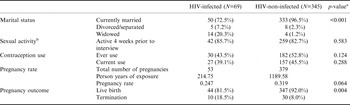
Among women married for less than 12 years, marriage dissolution due to widowhood (20.3%) and divorce/separation (7.2%) was statistically significantly higher among HIV-infected women unaware of their HIV status than HIV-non-infected women (p=<0.001). Among currently married women, 86% of HIV-infected and 82% of HIV-non-infected women were sexually active 4 weeks prior to the survey, showing no statistically significant difference (p=0.583). Also, no statistically significant difference between the groups appeared in ever use (p=0.124) or current use (p=0.288) of contraception (Table 1).
Comparison of proximate determinants of fertility, pregnancy rates and pregnancy outcomes among HIV-infected and HIV-non-infected women

a p-values are estimated by re-scaling the observations based on a weighted average of HIV prevalence among women in the states included in the analysis. A Chi squared test of significance was used for all comparisons, except for the comparison of the pregnancy rate, which is estimated by calculating the confidence interval for a rate ratio.
b Currently married, not abstaining post-partum (HIV-infected, N=49; HIV-non-infected, N=313).
During the calendar period, HIV-infected women had 53 pregnancies and contributed 215 person years of exposure to the risk of pregnancy, whereas HIV-non-infected women had 379 pregnancies and contributed 1190 person years. Though the pregnancy rate was lower among HIV-infected women, the pregnancy incidence rate ratio was not significantly different in the two groups (RR=0.77, 95% CI=0.592–1.015, p=0.063). More pregnancies among HIV-infected women resulted in termination because of miscarriage or stillbirths (p=0.004) (Table 1).
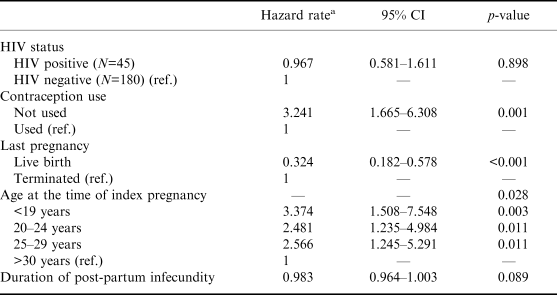
The interval between last two pregnancies was longer among HIV-infected women than among HIV-non-infected women, when controlled for the effect of other important variables. However, this relationship was statistically insignificant (p=0.898) (Table 2).
The influence of HIV infection and other predictor variables on the interval between last two pregnancies
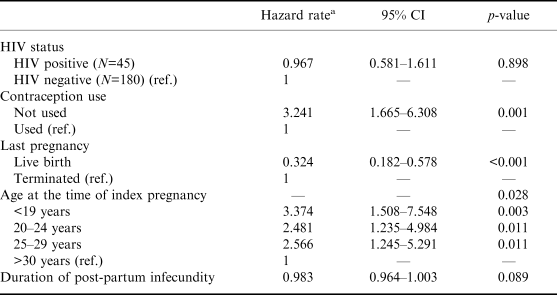
a A hazard rate of more than one indicates a reduction in the waiting time to conception, whereas a hazard rate of less than one suggests an increase in the waiting time to conception.
Discussion
In this paper the biological effect of HIV on fertility was assessed by separately examining the effect of HIV on fecundity and on pregnancy outcomes. Adverse pregnancy outcomes (stillbirth, spontaneous abortions or induced abortions) were found to be significantly higher among HIV-infected women as compared with HIV-non-infected women. However, fecundity, analysed by comparing the rate of occurrence of pregnancies and inter-pregnancy interval, seems unaltered due to HIV infection.
A number of previous studies have also found significantly greater risk of adverse pregnancy outcomes, especially spontaneous abortions, among HIV-infected women (Brocklehurst & French, Reference Brocklehurst and French1998; Carla et al., Reference Carla, Pezzotti, Rezza, Branca and Ippolito1998; Gray et al., Reference Gray, Wawer, Serwadda, Sewankambo, Li and Wabwire-Mangen1998). Increase in the risk of spontaneous abortions is estimated to be as high as 67% among HIV-infected women (Carla et al., Reference Carla, Pezzotti, Rezza, Branca and Ippolito1998). In the data used in this study there was no distinction made between spontaneous abortion and induced abortions, which limits the explanation of the impact of HIV infection on spontaneous abortions. However, considering the fact that HIV-infected women in the study were unaware of their HIV status, it is unlikely that the rates of induced abortions would be different in the two groups. Therefore, it appears that HIV infection might have a direct effect on the product of conception and lead to more stillbirths or spontaneous abortions after the pregnancy is recognized.
The pregnancy rate among HIV-infected women was not significantly different than that of non-infected women. In previous studies, statistically significant lower pregnancy rates in HIV-infected women were reported to be associated mainly when HIV disease was in the advanced stage (Gray et al., Reference Gray, Wawer, Serwadda, Sewankambo, Li and Wabwire-Mangen1998; Hunter et al., Reference Hunter, Isingo, Boerma, Urassa, Mwaluko and Zaba2003) and in the presence of other fertility-inhibiting factors such as infection with other STIs (Carpenter et al., Reference Carpenter, Nakiyingi, Ruberantwari, Malamba, Kamali and Whitworth1997). Since the NFHS-3 selected a household population (non-hospitalized) and there was no significant difference in the BMI of infected and non-infected women (data not shown), HIV-infected women in this study were less likely to be in the advanced stage of the disease. There was also no history of STIs in the 12-month period prior to the interview (data not shown). Therefore, it is likely that in an asymptomatic stage of the disease, the rate of conception is similar in HIV-infected and HIV-non-infected women.
However, certain assumptions made while analysing the data must be kept in mind while interpreting the results. All HIV-infected women were diagnosed at the time of survey and it was not possible to determine when they had acquired the infection. In India, approximately 90% of women acquire infection after marriage and are apparently monogamous (Gangakhedkar et al., Reference Gangakhedkar, Bentley, Divekar, Gadkari, Mehendale, Shepherd, Bollinger and Quinn1997). It was therefore assumed that all infected women who were married for less than 12 years were infected from the beginning of their marriage. However, it is likely that some of the women might not have been infected when they were pregnant. The two groups considered for comparison might therefore be too similar to one another, which might lead to an underestimation of the differences in fertility determinants, pregnancy rates and pregnancy outcomes. The analysis of the interval between last two pregnancies, however, is not biased by this as it is more likely that the HIV infection did occur before the last pregnancy. Because this latter analysis also showed no association between HIV and the pregnancy interval, the risk of underestimation of the above-mentioned differences seems to be rather small.
The analysis of pregnancy interval, also referred to as time to pregnancy analysis, covers a wide range of reproductive processes, from gametogenesis to survival of conception, including the process of fertilization (Spira, Reference Spira1998). In this study, HIV was not a significant predictor of interval between last two pregnancies suggesting that HIV does not alter these reproductive processes. The results are contrary to previous studies among clinic-based samples of HIV-infected women in Cote d'Ivoire (Desgrees du Lou et al., Reference Desgrees Du Lou, Msellati, Yao, Noba, Viho, Roman, Welffens-Ekra and Dabis1999) and Kenya (Van Eijk et al., Reference Van Eijk, De Cock, Ayisi, Rosen, Otieno, Nahlen and Steketee2004), which reported longer time to pregnancy among HIV-infected women. It was hypothesized that difficulty in conceiving or increased number of abortions before the pregnancy is recognized, might be the reason for the longer duration of conception wait. However, this study did not find any association to support this hypothesis. A possible explanation for the difference in the findings could be a lower prevalence of STIs such as syphilis, gonorrhoea and chlamydia in our sample. Unfortunately, the only data available on STIs in the NFHS-3 are self-reported STI symptoms, which are known to be unreliable (WHO, 2001). The general infection rates of STIs being lower in India as compared with Africa (George et al., Reference George, Thomas, Thyagarajan, Jeyaseelan, Peedicayil, Jeyaseelan and George2004; WHO, 2001, 2007), however, strengthens our hypothesis.
These two findings – similar pregnancy rate and similar interval between pregnancies among HIV-infected and HIV-non-infected women – suggest that HIV does not affect the physiological ability of women to become pregnant, at least not among apparently asymptomatic HIV-infected Indian women unaware of their HIV status. However, once pregnancy was recognized, the possibility that it might be terminated due to spontaneous/induced abortion or stillbirth is higher among HIV-infected women than HIV-non-infected women.
This finding might have implications for the estimation of the HIV epidemic in the country, which is currently largely based on the HIV prevalence estimated in ANC clinics (NACO, 2007a). When the fecundity of women is unaltered due to HIV, both HIV-infected and HIV-non-infected women are equally likely to get pregnant and would be represented in the ANC clinics. However, higher incidence of adverse pregnancy outcomes might affect the health-seeking behaviour of women. HIV-infected women, who otherwise may or may not go to ANC clinics in the hospitals, might be required to visit ANC clinics as a result of adverse pregnancy outcomes, which might result in higher attendance of HIV-infected women at ANC clinics as compared with HIV-non-infected women. This may overestimate HIV prevalence derived from ANC surveillance sites, especially in regions where health care during pregnancy is low and thus mainly accessed when there are any pregnancy-related complications.
The precise role of adverse pregnancy outcomes in affecting the health care seeking behaviour of women and its impact on estimation of HIV prevalence, especially in the states where health care is not routinely accessed during ANC, should be investigated further. Based on the findings of this study, it seems that the effect of HIV on fertility is unlikely to affect HIV estimation derived from ANC surveillance sites, at least in the states, for example all the southern states, where most women access ANC at least once. However, across India only 50% of women access ANC in hospitals and there are eight states in the country where these rates are less than 50%, and as low as 22 and 29% in states such as Uttar Pradesh and Bihar, respectively (IIPS & Macro International, 2007). The recent epidemiological estimation suggests that the HIV prevalence in these states is on the rise (NACO, 2008b). However, based on the findings of this study there appears to be a need to investigate whether the HIV prevalence estimates from ANC surveillance sites in these states may be overestimates.
It is recommended that the observed higher risk of adverse pregnancy outcomes among HIV-infected women should be considered during counselling and clinical management of HIV-infected women who are pregnant or who desire to become pregnant. Further, with the planned rapid scale-up of HIV-testing facilities and programmes for prevention of mother-to-child transmission in India, understanding fertility preferences and reproductive decision-making of HIV-infected couples who know their HIV status would be critical for providing appropriate counselling and care.
The observation of higher rates of marriage dissolution, especially widowhood, among HIV-infected women who are unaware of their HIV status is alarming. The study findings thus highlight the need for early detection and appropriate treatment of HIV-infected people.
Acknowledgments
This research was part of the Master Programme in Population Studies of the Faculty of Spatial Science, University of Groningen, The Netherlands. The authors thank the Eric Bleumink Fund (University of Groningen) for providing the scholarship to Shrinivas Darak for this Master's course. The authors also thank Professor Dr Leo van Wissen, Population Research Centre, University of Groningen, and Dr Sanjeevani Kulkarni and Dr Vinay Kulkarni, PRAYAS Health Group, Pune, for their guidance and support.