


Introduction
The Arabian Gulf coast in the northern United Arab Emirates (UAE) is characterized by numerous lagoons formed during the Holocene marine transgression in an interplay between oscillating sea level and influx of freshwater (and sediment) from fluvial activity or coastal aquifers (Bernier et al. Reference Bernier, Dalongeville, Dupuis and de Medwecki1995; Dalongeville and Sanlaville Reference Dalongeville and Sanlaville2005; Lambeck Reference Lambeck1996; Parker et al. Reference Parker, Armitage, Engel, Morley, Parton, Preston and Russ2018). In the past, lagoonal shores were often densely vegetated by mangroves forming highly productive habitats that played a significant role for mankind in the prevailing arid environment (Tengberg Reference Tengberg2005). However, they are subject to evolutionary processes caused by changing environmental conditions. Today this is reflected by countless shell middens and extensive areas covered by shells from local subsistence scattered along the coast (Händel Reference Händel, de Beauclair and Napierala2009, Reference Händel2014).
The archaeological site of Tell Abraq is located at the end of the Umm al-Quwain lagoon of the northern UAE and is today divided between the Emirates of Sharjah and Umm al-Quwain. Tell Abraq is marked by a prominent mound and represents a landmark in the coastal landscape of shallow dunes and shell middens. The mound and its surroundings are characterized by architectural remains and large amounts of archaeological and zooarchaeological materials reflecting a long settlement history that lasted from ca. 2500 BCE to 300 CE (Potts Reference Potts1991, Reference Potts1993, Reference Potts2000; Potts et al. Reference Potts, Dalongeville and Prieur1990). Tell Abraq has seen several research episodes, starting in the 1970s. Systematic excavations between 1989 and 1998 established the cultural-chronological frame of the site’s occupation and showed that the nucleus and earliest phase of the settlement was an early Bronze Age (Umm an-Nar-period) tower respectively elevated platform (Potts Reference Potts1991; Potts et al. Reference Potts, Dalongeville and Prieur1990). An Umm an-Nar tomb next to the tower provided substantial data regarding human demographics and health. Grave goods include objects imported from areas surrounding the Arabian Gulf, but also Mesopotamia, Baluchistan, the Indus valley, and Central Asia (Blau Reference Blau1996; Gregoricka Reference Gregoricka2014; Osterholz et al. Reference Osterholz, Baustian, Martin and Potts2014; Potts Reference Potts1993). The full extent and spatial layout of the settlement was understood during the 2007–2017 excavations conducted in the Sharjah part of the site including the mound’s surroundings (Magee et al. Reference Magee, Uerpmann, Uerpmann, Jasim, Händel, Barber, Fritz and Hammer2009, Reference Magee, Händel, Karacic, Uerpmann and Uerpmann2017, Reference Magee, Händel, Karacic, Brunet, Uerpmann, Uerpmann, Jameson and Silvia2018). In 2019, excavations resumed in the Umm al-Quwain part of the site (Degli Eposti et al. Reference Degli Eposti, Borgi, Pellegrino, Spano, Abric and Kannouma2022).
The 2nd millennium BCE saw a continuous expansion of the settlement’s size including a stepped system of four terraces whereby the initial ∼8 m high tower formed the core of the uppermost terrace 1 (Magee et al. Reference Magee, Händel, Karacic, Uerpmann and Uerpmann2017, Reference Magee, Händel, Karacic, Brunet, Uerpmann, Uerpmann, Jameson and Silvia2018). The retaining walls of terraces 3 and 4 were accompanied by ditches. Towards the exterior, the final construction displayed a massive roughly 4 m wide stone and mudbrick wall preserved ∼3 m high with a surrounding ∼3 m deep ditch. The (on-mound) terraces show sequences of plaster floors, bracketing occupation debris and providing well-stratified artifact and sample assemblages. Off-mound, the boundaries between occupation episodes are less sharp, but dug-out features such as hearths, pits and wells provide constrained sediment archives.
For this study, we collected shell and charcoal pairs from well-defined on- and off-mound contexts. This enabled investigating shells with respect to possible species-specific marine reservoir effects including temporal variation.
Marine shells usually result in ages older than their calendar age. The reason is uptake of radiocarbon depleted CO2 from marine environments. The deep sea can store carbon for over 1000 years during which 14C can decay (Lindauer Reference Lindauer2019). In regions where this 14C-depleted water is upwelling, such as the coast of Oman, it mixes with the surface water and is taken up by the organisms. Hence, the data needs to be corrected by considering a local marine reservoir effect ΔR, that is calculated as the difference between the marine radiocarbon age of the shell and the marine calibration curve that tries to account for a mean shift of the ocean waters. In addition, ΔR is species-specific, temporally variable due to changes in marine conditions such as upwelling, sea-level, freshwater input and depending on diet or habitat of the respective shell species (Culleton et al. Reference Culleton, Kennett, Ingram, Erlandson and Southon2006; Hadden and Cherkinsky Reference Hadden and Cherkinsky2016; Lindauer et al. Reference Lindauer, Santos, Steinhof, Yousif, Phillips, Jasim, Uerpmann and Hinderer2017, Reference Lindauer, Hadden, Macario and Guilderson2022). In areas with reduced upwelling, the reservoir age can be less than the marine global mean and the corresponding ΔR might show negative values, otherwise the values are positive.
Paired measurements of shells and terrestrial material such as charcoal are ideal to monitor these changes over time. This information can also be used to improve the chronology of archaeological sites. Monitoring the species-specific reservoir effects for adjacent locations over time can help to reconstruct changes in environmental conditions not only on a local scale, but in comparison with other sites and proxies even on a global scale.
Material and methods
Charcoal and shell samples were recovered from archaeological contexts. On-mound, the samples derive from deposits bracketed by plaster floors. Off-mound, well-defined features such as hearths, pits and wells were chosen.
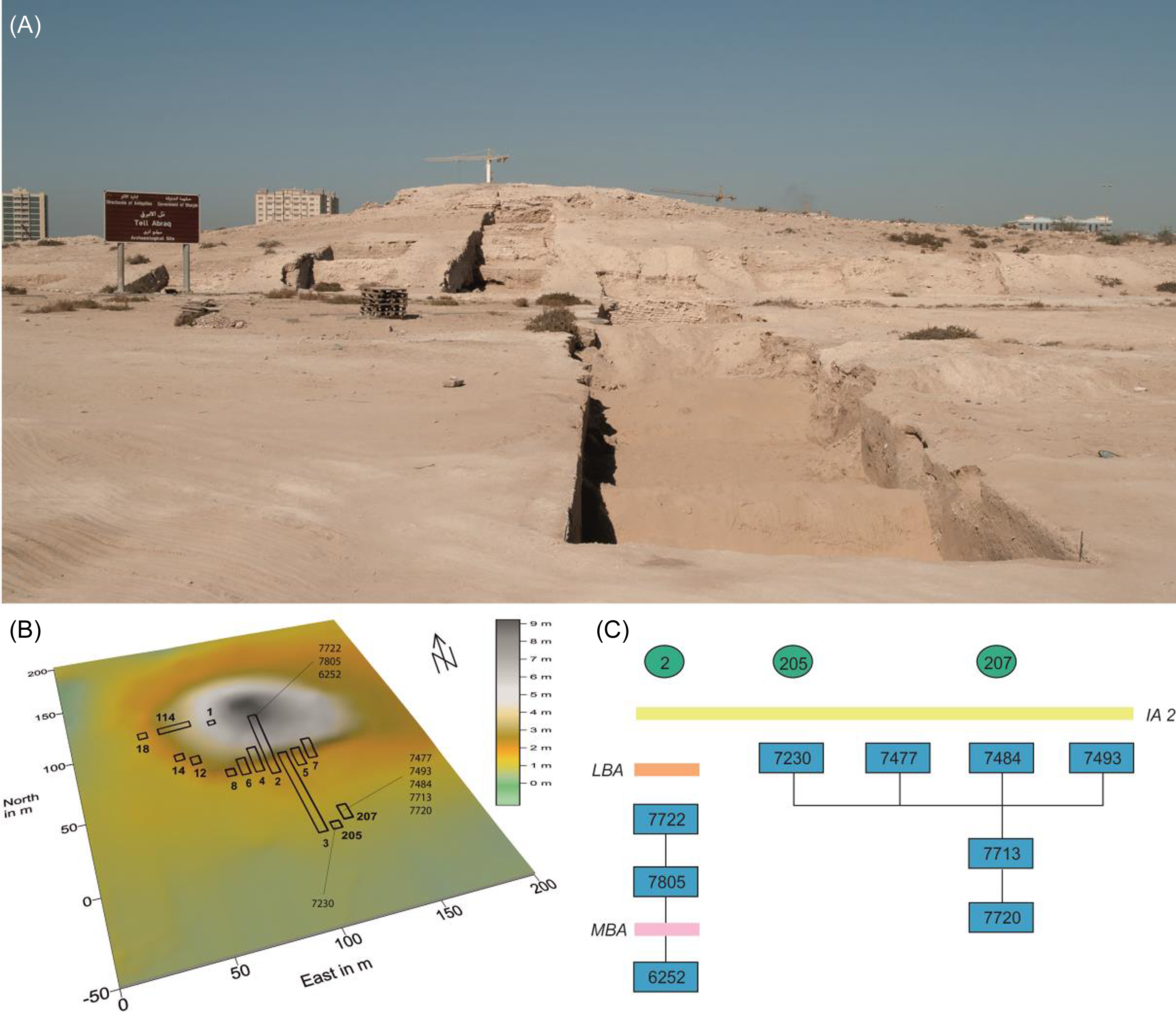
Sample locations are described by set and locus, whereby set refers to the anthropogenic feature, while locus specifies the locality within the excavation trench or set (Figure 1). All on-mound samples derive from trench 2. Loci 7722 and 7805 represent fills between plaster floors on terrace 2 consisting of compacted sand and archaeological materials (occupation debris). Ceramic typology and fabric of both fills attribute to the Middle Bronze Age (Wadi Suq). Locus 6252 is the fill of a hearth, located on terrace 3 and connected to Set 15 (Early to Middle Bronze Age ceramics), a group of hearths and ovens, stratigraphically situated beneath the sequence of plaster floors. It predates the creation of terrace 3 (Magee et al. Reference Magee, Händel, Karacic, Uerpmann and Uerpmann2017, Table 1). The stratigraphic sequence of the sampled on-mound loci is thus: 7722–7805–6252 (from younger to older).
(A) Photo of Tell Abraq mound, view to the north along trenches 3 and 2; (B) terrain model with excavation trenches (one to three digit numbers) and loci (four digit numbers); (C) stratigraphic matrix of archaeological contexts (loci) discussed with stratigraphic boundaries of main techno-cultural units (Photo and graphs: Marc Händel).
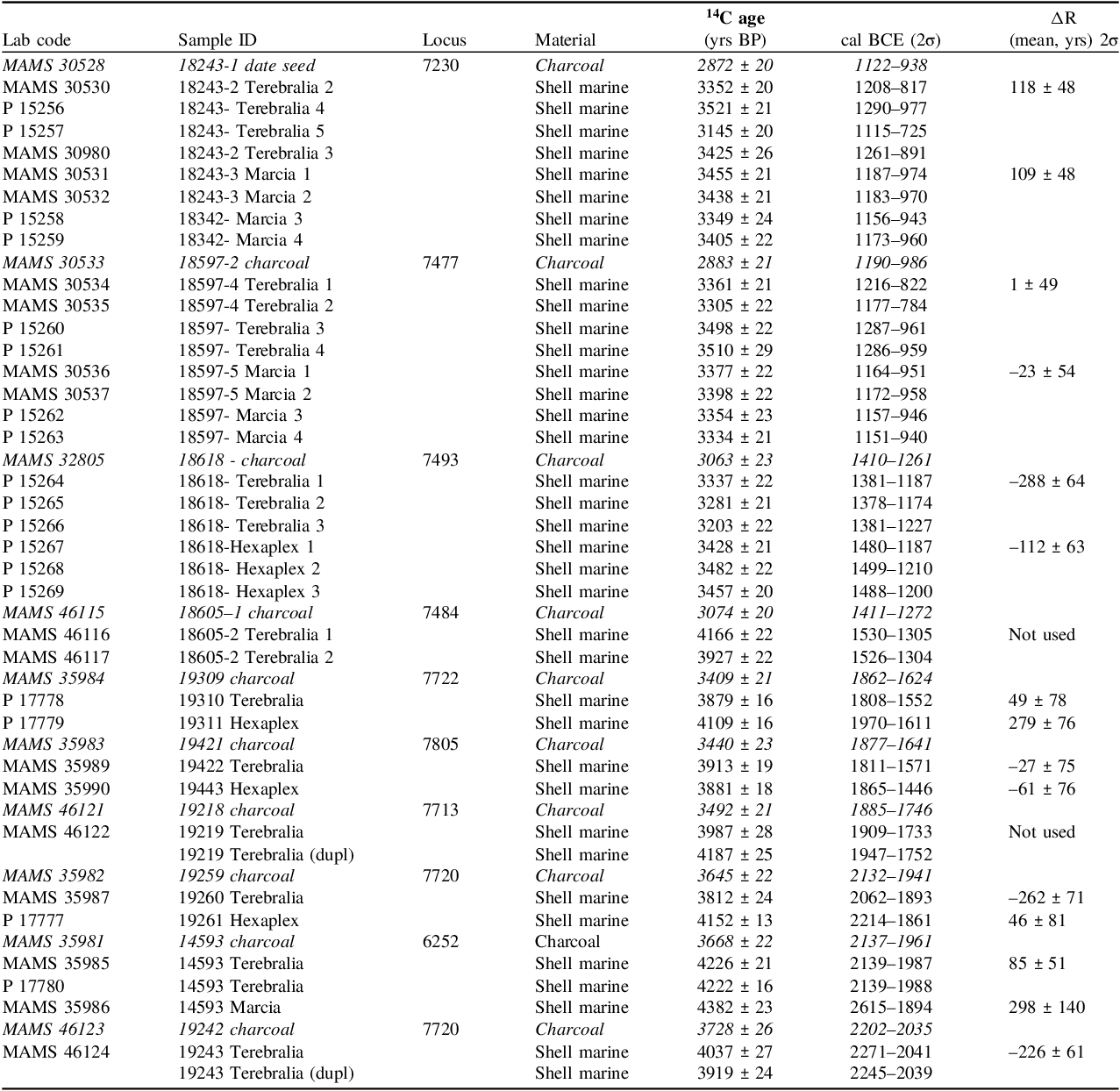
Radiocarbon dataset and results of reservoir effect modeling in Oxcal 4.4. using the IntCal20 and Marine20 datasets
The off-mound samples derive from trenches 205 and 207 with few architectural remains. Structures such as hearths, pits, and a deep well cut into the underlying archaeologically sterile sand provide suitable sampling locations predating Iron Age II (Magee et al. Reference Magee, Händel, Karacic, Uerpmann and Uerpmann2017). Locus 7230 is the fill of a pit (Set 67, trench 205) where morphology suggests rapid excavation and backfill. The loose fill showed a high density of shells. Ceramics indicate attribution to Late Bronze Age/Iron Age I. Locus 7477 (trench 207, Set 73) is the fill of a pit in comparable stratigraphic position and with similar size, morphology, and composition, but ceramics pinpointed to Iron Age I.
Locus 7493 (Set 73) is a pit mainly filled with shells, in this case Terebralia sp. fragments, but few other finds in a matrix of loose yellowish sand. The ceramic spectrum is classified as Late Bronze Age/Iron Age I.
Locus 7484 (Set 73) is the fill of a pit with >2 m diameter. The occurrence of red Barbar ware suggests Early to Middle Bronze Age, a fabric indicating import from Dilmun. The well is cut into the underlying petrified palaeodune sequence; excavation reached a depth of ∼4 m and didn’t reach its base. We sampled its upper (Locus 7713) and lower (Locus 7720) fills. Both suggest rapid backfill.
The shells investigated are the gastropod Terebralia palustris and the bivalve Marcia spp. For Terebralia palustris it was already demonstrated that it shows a mixture of marine and terrestrial radiocarbon, as it feeds on mangrove leaves which display an atmospheric radiocarbon content due to photosynthesis (Lindauer et al. Reference Lindauer, Marali, Schöne, Uerpmann, Kromer and Hinderer2016). In contrast, Marcia spp. (often flammea) is a so-called filter feeder, i.e. its diet is influenced by the marine environment only. In addition, dissolved inorganic carbon in the sea water contributes to the shell. If available, both species were used for the same archaeological context to allow for a better species-specific monitoring of temporal changes. Another species that can be found throughout the Gulf of Oman and the Arabian Gulf is Hexaplex kuesterianus. This species is a predator and feeds on other mollusks, therefore, ΔR strongly depends on the preferred prey species. In this study, H. kuesterianus is included in the sampling strategy, despite this shortcoming. Results may support trends of the other species depending on preferred species for diet.
The samples were prepared in the radiocarbon laboratory of CEZA, Mannheim, Germany (labcode MAMS) and at the Max-Planck-Institute for Biogeochemistry in Jena, Germany (labcode P) using the identical preparation steps. Shells were sampled at the ventral margin, resulting in a mean radiocarbon age of the last few years of the mollusk´s life. Shell samples were pretreated using 1% HCl for about 1–2 minutes at room temperature to remove contamination resulting in a mass loss of around 30%. Charcoal samples were pretreated using ABA (for details see Lindauer et al. Reference Lindauer, Santos, Steinhof, Yousif, Phillips, Jasim, Uerpmann and Hinderer2017). After pretreatment, the charcoal samples were combusted and catalytically converted to elemental carbon (“graphitization”) using iron as catalyst before being pressed into a target and measured in a MICADAS type AMS system (Kromer et al. Reference Kromer, Lindauer, Synal and Wacker2013; Lindauer Reference Lindauer2019). For shell samples the carbon was extracted as CO2 gas by adding phosphoric acid before graphitization (Lindauer Reference Lindauer2019; Lindauer et al. Reference Lindauer, Santos, Steinhof, Yousif, Phillips, Jasim, Uerpmann and Hinderer2017). Calendar ages and reservoir effects are modeled in Oxcal 4.4 using the IntCal20 and Marine20 datasets (Heaton et al. Reference Heaton, Köhler, Butzin, Bard, Reimer, Austin, Bronk Ramsey, Grootes, Hughen and Kromer2020; Ramsey Reference Ramsey1995; Reimer et al. Reference Reimer, Austin, Bard, Bayliss, Blackwell, Bronk Ramsey, Butzin, Cheng, Edwards and Friedrich2020) as described in (Lindauer et al. Reference Lindauer, Santos, Steinhof, Yousif, Phillips, Jasim, Uerpmann and Hinderer2017; Zazzo et al. Reference Zazzo, Munoz, Badel, Béguier, Genchi and Marcucci2016).
Results and discussion
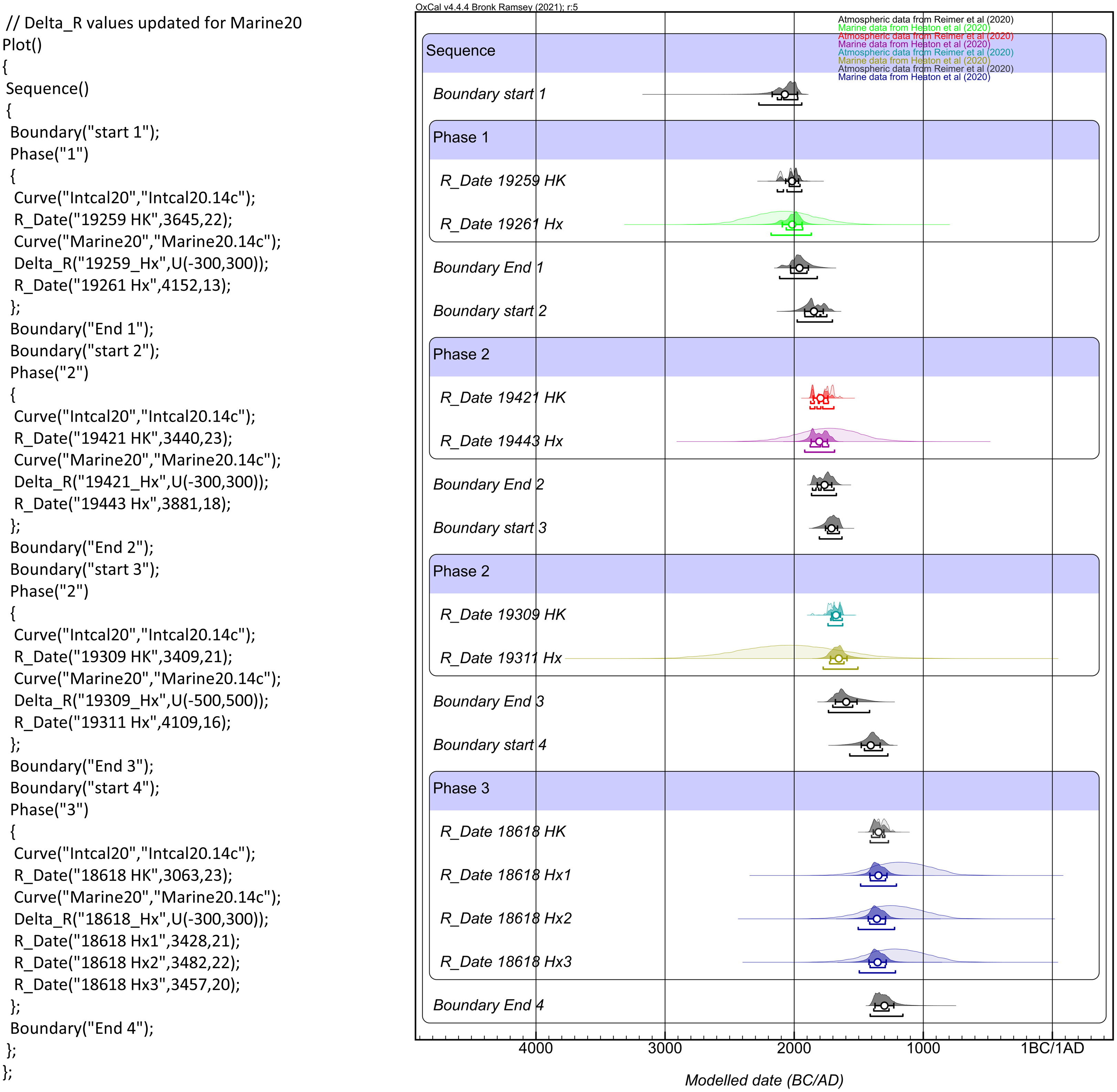
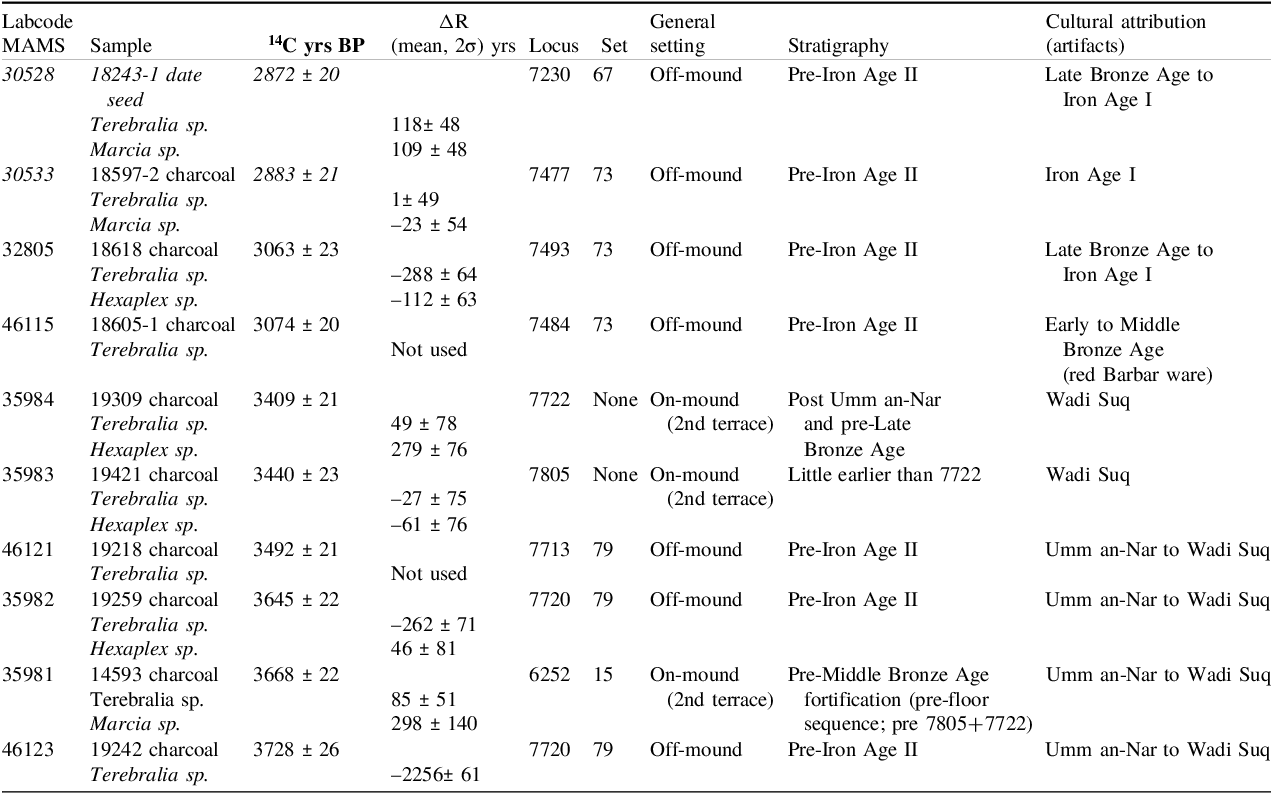
The uncalibrated, calibrated data and ΔR are presented in Table 1. ΔR for each species was modeled separately in Oxcal 4.4 using a phase model to help with the stratigraphical order of the loci (see Figure 2). During the modeling process we adjusted the prior probability U() of the respective phases until the model represented the best fit. The models for each species can be found in the supplement together with the representations of ΔR and the multiplots.
Oxcal code (left) for modeling the reservoir effect of Hexaplex kuesterianus found in different layers at Tell Abraq and the resulting multiplot of the data. The reservoir effects of the other species were modeled accordingly (see supplement).
Not all data was used for modeling ΔR. The repeat measurement of shell MAMS 46122 of locus 7713 did not reproduce well without reason. Hence, it was decided to present it but not include it in the model. Locus 7484 was excluded as Oxcal always found it to be an outlier. From the archaeology it seems that this pit does not contain pairs that are strictly contemporaneous. However, all data is presented for completeness and in case a solution can be found in the future.
Interestingly, in the younger samples from loci 7230 and 7477, ΔR of Terebralia palustris and Marcia spp. Overlap (see Figure 3). With respect to differing diet and habitat this is unexpected. Recent observations report the occurrence of Terebralia palustris in regions without mangrove forests (Feulner Reference Feulner2000). This suggests that Terebralia palustris can also adapt to other feeding strategies than mangrove leaves. In addition, the Arabian Gulf consists of carbonaceous sediment (Lindauer Reference Lindauer2019) which might cause ΔR for Terebralia palustris to be shifted towards older ages as well. Hence our result could mark the start of the local decline of mangrove forests possibly due to increased salinity and lack of freshwater input from rainfall. This is supported by the excavators’ observation that Marcia spp. dominates the shell assemblages of the later contexts, a pattern also observed at Hamriya (∼5 km south) possibly due to environmental causes (Händel Reference Händel, de Beauclair and Napierala2009, Reference Händel2014). To affirm this conclusion comparison to other environmental archives might help. During an earlier phase, represented in locus 6252, ΔR of these two species differ as expected with Terebralia palustris showing a lower ΔR than Marcia spp.
(A) Results of shells from Tell Abraq compared to reservoir effects from other sites in the UAE, Umm al-Quwain northeast of Tell Abraq and Kalba at the Gulf of Oman. (B) Extract of younger period from (A). The samples from UAQ are published in Mery et al. (2019) and the data from Kalba in Lindauer et al. (Reference Lindauer, Santos, Steinhof, Yousif, Phillips, Jasim, Uerpmann and Hinderer2017) as well as Lindauer (Reference Lindauer2019).
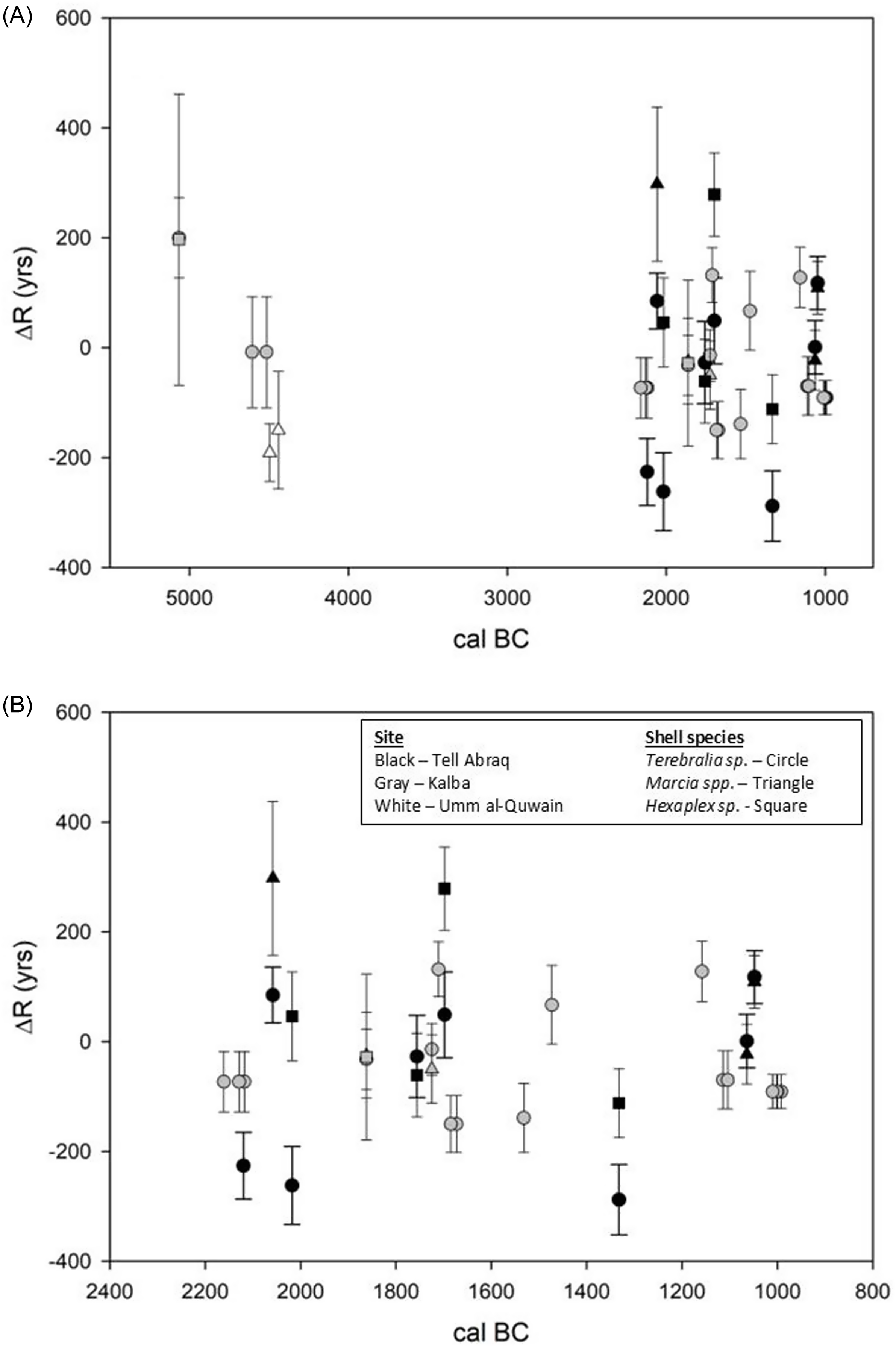
Throughout the data set, the internal scatter within the data for Terebralia palustris is larger than for the other species investigated. This might be due to a larger dependance of the respective shell regarding its position within the lagoon with respect to freshwater influx amount of limestone etc.
Mostly, Hexaplex kuesterianus points to a higher ΔR than Terebralia palustris but following similar pattern changes (see Figure 3B). Only at locus 7805 does ΔR overlap for both species with Hexaplex kuesterianus showing an even lower ΔR. This also suggests that Hexaplex kuesterianus does not primarily feed on Terebralia palustris when the data from locus 7805 can be explained by an increasingly divers influence on the ΔR of T. palustris as suggested above.
More charcoal fragments and shells per context can provide more reliable statistical models with the possibility to detect outliers. The loci with single pairs (7722, 7805 and 7720) might suffer from this and turn out to be challenging in their interpretation.
The results of this study confirm previous measurements on charcoal and charred date seeds (Magee et al. Reference Magee, Händel, Karacic, Uerpmann and Uerpmann2017, Table 1). They support chronological attribution of the artifactual material and field observations on stratigraphic relations (Table 2). Mixing or redeposition of single shells or charcoal fragment cannot be ruled out, even when trying to avoid sampling these layers as might be seen in locus 7484.
Radiocarbon data with archaeological context. Chronology of the mentioned cultural phases follows Magee (Magee Reference Magee2014): Umm an-Nar – 2700/2600-2000 BCE, Wadi Suq – 2000–1500 BCE, Late Bronze Age – 1500–1300 BCE, Iron Age I – 1300–1000 BCE, Iron Age II – 1000–600 BCE
Correlation of the reservoir effect results to ΔR from other sites or other environmental information may provide explanations for the temporal variations (cf. Figures 3 and 4).
Reservoir effects on shells from the UAE in the context of other paleoclimate data such as sea level in the Arabian Gulf (Parker et al. Reference Parker, Armitage, Engel, Morley, Parton, Preston and Russ2018): datapoints representing sea-level index points, rainfall taken from stalagmite records at Hoti and Qunf caves (both Oman; Fleitmann et al. Reference Fleitmann, Burns, Mangini, Mudelsee, Kramers, Villa, Neff, Al-Subbary, Buettner and Hippler2007; Fleitmann and Matter Reference Fleitmann and Matter2009) and strength of upwelling along the coast of Oman indicated by foraminifera Globigerina bulloides (Gupta et al. Reference Gupta, Anderson and Overpeck2003; Thamban et al. Reference Thamban, Kawahata and Rao2007). Note that the reservoir effect data on all shells from Tell Abraq, Umm al-Quwain and Kalba is presented separately to denote the differences between the two gulf areas.
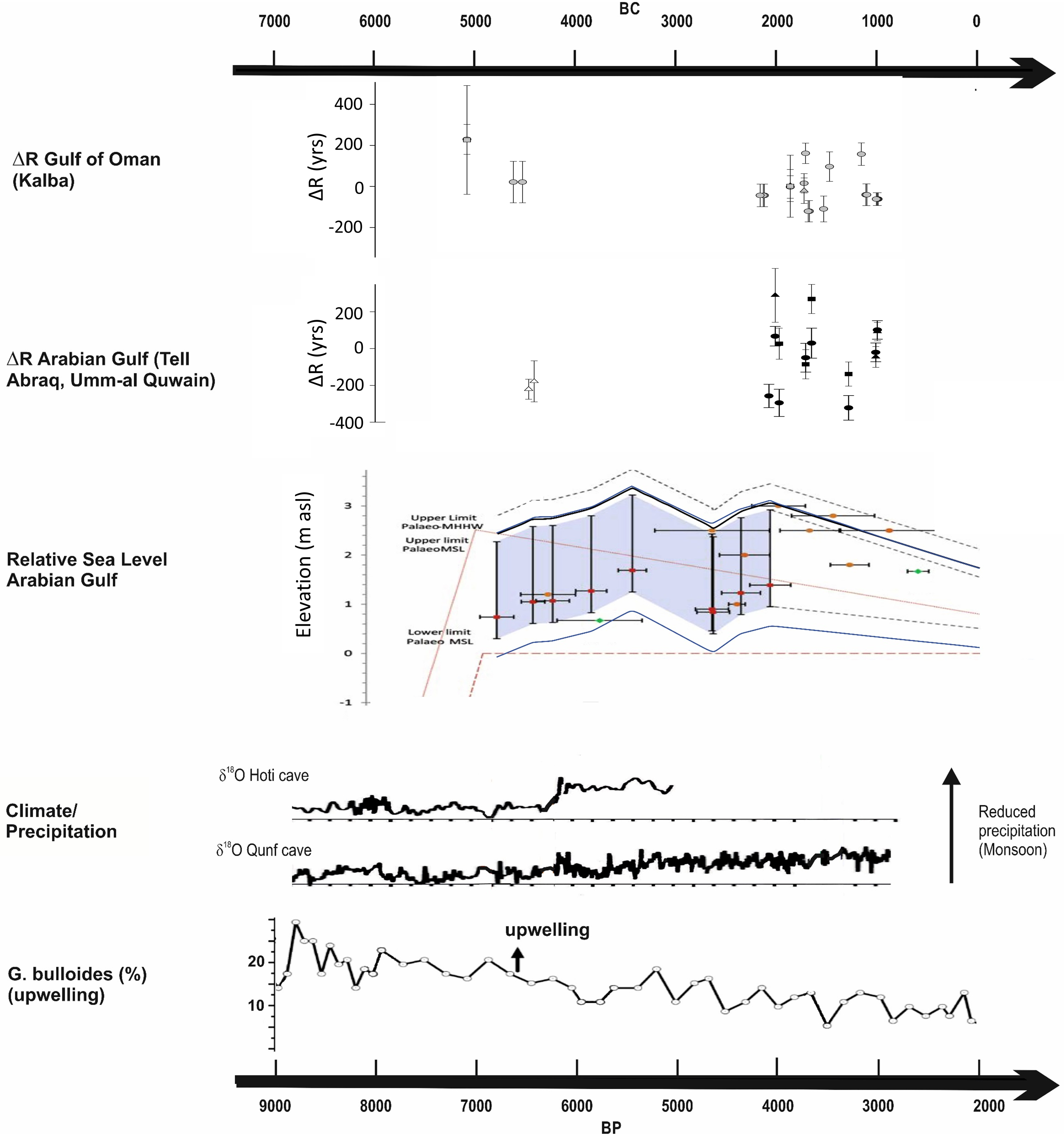
The gap to the older Umm al-Quwain–UAQ– (Méry et al. Reference Méry, Degli Eposti, Aoustin, Borgi, Gallou, Leroyer, Lidour, Lindauer, Preston and Parker2019) and Kalba ages is rather large and does not allow a conclusive interpretation. As the shells from Tell Abraq most probably originate from the Umm al-Quwain lagoon, changes in ΔR should be similar. Kalba on the Gulf of Oman first shows a decrease of ΔR over time before approaching a kind of wiggly plateau where it is difficult to derive a distinct trend (Figure 3A).
When comparing the results to sea-level data of the Arabian Gulf (Parker et al. Reference Parker, Armitage, Engel, Morley, Parton, Preston and Russ2018), there is no clear pattern in the phase younger than 2500 cal BCE (Figure 4). This is unexpected. The sea-level curve (Parker et al. Reference Parker, Armitage, Engel, Morley, Parton, Preston and Russ2018), shows a constant rise in the earlier phase and becomes increasingly variable towards younger ages, especially after 2500 cal BCE (Figure 4). The variation in ΔR during this period is larger than at Kalba which points to a larger variation between different locations within the lagoon maybe due to a reduced mixing as compared to Kalba. The shells at Tell Abraq hence reflect the combined influence of sea-level and lithology and location. The Tell Abraq data seems to swing around a plateau (Figure 3) which may be result of a combination of decreasing sea level, increasing salinity and high carbon content of the water smoothed slightly by exchange with atmospheric, hence fresh, 14C.
Sediments around the Arabian Gulf are rich in carbonate (Lindauer Reference Lindauer2019; Purser Reference Purser1973). These carbonate-rich sands, evaporites and gypsum crystals (Omer Reference Omer2010), can cause a rise in salinity when dissolved in the sea water and influence the radiocarbon signal depending on their respective 14C content. On the other hand, the Arabian Gulf is rather shallow (maximum depth ∼90 m). Even though this allows a thorough exchange with atmospheric 14C, measurements in UAQ yielded slightly depleted 14C water compared to Kalba (Lindauer Reference Lindauer2019). The circulation is characterized by a surface inflow of water from the Gulf of Oman through the Strait of Hormuz. It exits the Gulf along the sea floor (Kämpf and Sadrinasab Reference Kämpf and Sadrinasab2005) and travels south along the coast passing Khor Kalba. Khor Kalba is also influenced by the upwelling of old sea water from the Arabian Sea. Therefore, at Kalba, sea level, upwelling and outflow from the Arabian Gulf influence ΔR:
The data can further be compared to results from measurements on the foraminifera Globigerina bulloides, collected from sediment cores in the Arabian Sea (Gupta et al. Reference Gupta, Anderson and Overpeck2003; Thamban et al. Reference Thamban, Kawahata and Rao2007). This species is an indicator for the strength of upwelling of cold and nutrient-rich (and 14C-depleted) waters originating from the Southern Ocean. A reduced amount of G. bulloides is interpreted as reduced upwelling causing a reduction of ΔR in shells. Figure 4 shows a constant but oscillating decrease in G. bulloides throughout the Holocene. In Kalba, this is one reason for the drop in ΔR over time. For Tell Abraq, this might also be a reason for changes in ΔR, but with an oscillating ΔR; apparently other factors partly cancel this effect.
The occurrence of species is an indicator for changes in beneficial conditions for the respective species. Anadara sp can be found in Kalba since the early to mid-Holocene, in Umm al-Quwain during the mid-Holocene. At Tell Abraq, Anadara spp. is very rare. Marcia spp. is found in Umm al-Quwain, but it is not very abundant before the Late Bronze Age and becomes dominant only in the Iron Age. In Kalba it does not occur before the Bronze Age.
A hint towards altered climatic conditions can be read from the speleothems. Stalagmites record rainfall in high resolution via the retained δ18O composition. An increase in δ18O is usually interpreted as a reduction in rainfall. Before 3000 BCE, stalagmites in Hoti cave (Central Oman) and Qunf cave (South Oman) recorded rising δ18O values pointing to a reduction in rainfall over time with Hoti cave ceasing to grow around 3000 BCE (Fleitmann and Matter Reference Fleitmann and Matter2009; Fleitmann et al. Reference Fleitmann, Burns, Mangini, Mudelsee, Kramers, Villa, Neff, Al-Subbary, Buettner and Hippler2007). This is interpreted as a shift of the Intertropical Convergence Zone (ITCZ) southward, leaving the Westerlies from the Mediterranean as the main source for rain. The amount of rain available directly influences the amount of freshwater input to the lagoon. The more freshwater is available, the more it can contribute to the reservoir effect of the shells depending on the 14C content of the freshwater. A reduction leads to the ocean and underlying lithology as the dominant contribution to ΔR.
Conclusion
This study presents new radiocarbon data from the archaeological site Tell Abraq, UAE. Reservoir effects on species Terebralia palustris, Marcia spp., and Hexaplex kuesterianus, were determined for several settlement contexts at Tell Abraq ranging from Bronze Age to Iron Age. Apart from a detailed chronology of the site, the shell data points to changes in environmental conditions. No clear correlation of ΔR to the sea level curve for the Arabian Gulf could be shown. The data shows a rather wiggly appearance of ΔR towards younger ages. To provide a more profound interpretation requires more samples with larger datasets per phase that are definitely not mixed from same layers plus from other locations along the coast.
Supplementary material
To view supplementary material for this article, please visit https://doi.org/10.1017/RDC.2025.19
Acknowledgments
We would like to thank Sabah A. Jasim and Eisa Yousif from the Directorate of Antiquities, Sharjah, UAE, for their constant support and interest in our research. We are grateful to Axel Steinhof from MPI Biogeochemistry for supporting our study with measurements of samples. We thank the anonymous reviewers for their ideas and effort to help improve the manuscript.
Competing interests
The authors declare no competing interests.



