1. INTRODUCTION
The integration of GPS and Inertial Navigation System (INS) measurements is currently an active research field with many applications in navigation. Several approaches have been developed for data fusion including uncoupled integration, loosely coupled integration, tightly coupled integration and deeply coupled integration, see e.g. (Zhang and Gao, Reference Zhang and Gao2008). The Kalman Filter is commonly used to obtain the best estimation of navigational parameters, a strategy that yields precise results if both sources of data are available. However, GPS outages cause a fast degradation of precision that is difficult to avoid due to low INS accuracy in the mid and long term.
Several approaches have been proposed to enhance the final precision during GPS blockages, mainly the use of an Extended Kalman Filter (Agarwal et al, Reference Agarwal, Arya, Nayak and Saptarshi2008) or an adaptive Kalman Filter (Yang and Gao, Reference Yang and Gao2006), the use of Auto-Regressive models (Park and Gao, Reference Park and Gao2008) and the supply of user information on the movement dynamics (Godha and Lachapelle, Reference Godha and Lachapelle2008). However, the degradation of precision during GPS outages is only slightly diminished and one is tempted to think that perhaps something else could be done to the raw INS data before their integration with GPS in the Kalman Filter (or even without using a Kalman Filter as proposed in Vanicek, Reference Vanicek1999). Thus, in the present paper we will explore different data processing strategies, apply them to a set of experimental INS data with blocked GPS measurements and compare their results.
As we propose an alternative filtering technique to deal with integration of low-cost INS and GPS data, Section 2 briefly sketches some filtering-based data processing methods potentially useful for smoothing our particular experimental study for stop-and-go mobile mapping systems which is described in Section 3. Section 4 presents the results and a discussion and Section 5 concludes.
2. FILTERING METHODS
2.1. FIR Filters
Let us introduce some well-known data filtering techniques (see e.g. McClellan et al, Reference McClellan, Schafer and Yoder2003) before applying them to the raw INS signal in order to stabilize it. We can start with Linear Time Invariant (LTI) filters, i.e. those that besides linearity fulfil the condition that if the input is delayed by some amount then the output appears with the same delay. They respond to the general expression:

where x(n) and y(n) are respectively the input and output signals, the filter coefficients are the sets {a l} and {b k} – respectively called feedback coefficients and feed-forward coefficients – and N, M define the order of the filter. Since these filters have infinite duration impulse responses they are often referred to as Infinite Impulse Response (IIR) filters. In the case of GPS/INS integration no infinite impulses appear so a simplification is possible towards the so-called Finite Impulse Response (FIR) filters or recursive filters (McClellan et al, Reference McClellan, Schafer and Yoder2003), which respond to the following general expression:
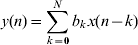
In the experimental application we found that, as expected, the use of (1) offers no improvement with respect to (2), therefore we will restrict this introduction to FIR filters.
The most commonly used FIR filter is the moving average or running average. Many fields of knowledge, such as financial data technical analysis, benefit from its behaviour as a low-pass filter. In the simplest case the coefficients b k in (2) are all equal to 1/(N+1), which is the normalization condition; other choices for b k define the different possible weighted moving averages.
Many other FIR filters have been developed and successfully used in other fields (e.g. the Butterworth filter, Chebyshev type I and II filters and the elliptic filter). However, the use of FIR filters has been very limited for the case at hand; indeed, there is only one work in which authors used a filter of this kind: the Butterworth filter (Guo et al, Reference Guo, Yu, Liu and Ning2004). We refer the reader to this paper for details on formulation. In that work the authors concluded that the use of this filter involved much less programming effort than the classic Kalman filter whereas the same degree of precision was attained.
2.2. Discrete Fourier Transform (DFT)
DFT belongs to the subject area named Fourier analysis that departs from the idea of representing a general function by sums of simpler trigonometric functions. It can be used as a filtering technique applicable mainly to discrete signals that show a somewhat periodic behaviour, which is the case with our particular GPS/INS integration.
With the use of the complex exponential, the defining expression for the DFT is:

where L is the length of the signal x(n), equal to the length of the output y(n). The DFT can be used as a low-pass filter by transforming the signal to the frequencies domain, thresholding and then transforming it back to the original domain (Stearns, Reference Stearns2002).
2.3. Wavelets filtering
While Fourier analysis decomposes a signal into several trigonometric waves, wavelet analysis decomposes the signal into scaled and shifted versions of a mother wave named wavelet (that need not be a sine or cosine). One of the biggest advantages of this technique is that signals with very sharp changes can be analyzed very successfully. Many wavelets have been designed for discrete analysis purposes: Haar wavelet, Daubechies wavelet (with different numbers of coefficients) and Coiflet wavelet (different coefficients) are some of the most commonly used. We refer the reader e.g. to (Daubechies, Reference Daubechies1992) for full theoretical details.
3. EXPERIMENTAL STUDY
3.1. Objective of the experiment
The aim of the experiment is to provide direct geo-referencing for mobile mapping. Our mobile mapping device contains one GPS, one low cost MEMS-INS and one photogrammetric camera integrated on a platform held by a walking operator. With successful direct geo-referencing, photogrammetric images can be used to update cartography. However, it strongly depends on the solutions achieved by means of GPS/INS integration. In particular, the present experiment addresses the question of degradation of positioning precision during GPS outages: GPS navigation results are compared with those obtained from MEMS-INS raw data and MEMS-INS filtered data.
3.2. Experimental setup
With respect to the measured magnitudes, MEMS-INS 3D linear accelerometers will be used to estimate the direction of gravity to obtain a reference for attitude (pitch and roll), whereas the heading will be determined by means of the embedded magnetic sensor. Some corrections are needed, however. First, rotations from the MEMS-INS coordinate system to the local tangent plane (the corresponding rotation matrix is provided by the MEMS as data output). Second, the correction due to magnetic declination, which can be obtained from the International Geomagnetic Reference Field 2005 (IGRF2005) model, and permits alignment of x and y axes with respect to the local geodetic system. And finally, the correction to obtain accurate accelerations free from the influence of the Earth's gravitational field (see e.g. Farrell and Barth, Reference Farrell and Barth1999):

where a n,meas, a e,meas and a u,meas represent accelerations measured respectively in the North-South, East-West and up-down directions, γ is the normal gravity at the point of interest, with latitude ϕ; ρ and ν are the main radii of curvature at this latitude, ω is Earth angular speed, and v n, v e and v u are the corresponding velocities of the mobile with respect to the Earth fixed reference system.
3.3. Experiment
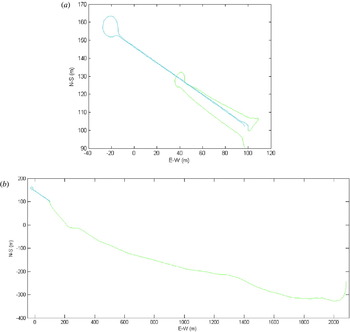
Figure 1 plots the trajectory of the mapping system obtained by a rover RTK-GPS with 1 s epochs and dual frequency Leica receivers. A local coordinate system was used for comparing results. During the itinerary, 22 stops of about 10 s each were made as representing photogrammetric shots. RTK-GPS data was also used to estimate velocities (every two consecutive positions) and accelerations (every three consecutive positions). It should be pointed out that RTK-GPS uncertainties in the order of 0·01 m in position yield uncertainties of 0·014 m/s in velocity and 0·02 m/s2 in acceleration. These high accuracy results will be used to validate the MEMS-INS derived data.
(a) GPS deduced trajectory (blue) and MEMS-INS deduced trajectory from raw accelerations and magnetometers (green). (b) GPS deduced trajectory (blue) and MEMS-INS deduced trajectory only from raw accelerations (green).

4. RESULTS AND DISCUSSION
4.1. Raw data
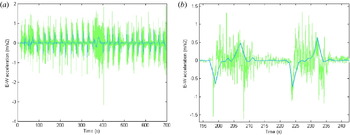
Raw MEMS-INS data from the XsensTM MTx every 1/85 s are used to form a trajectory that is represented in Figure 1a in green. As recommended in (Godha and Lachapelle, Reference Godha and Lachapelle2008), acceleration data are only used to obtain the velocity whereas the heading is taken from the 3D Earth-magnetic field sensor conveniently corrected for magnetic declination. If heading was determined from accelerations, the derived trajectory would be completely wrong (Figure 1b) since the data source is a low-cost INS. Errors in the MEMS-INS derived path exceed 70 m during the 300 m itinerary. A close look at INS accelerations reveals their large short-term instability compared with RTK-GPS. This situation is solved in the following section. Figure 2 shows MEMS-INS raw accelerations and RTK-GPS derived accelerations for the east-west component. The behaviour is similar to the north-south component and therefore will not be depicted.
(a) GPS deduced (blue) and raw INS (green) E-W accelerations. (b) Detail of 2(a).

The movement dynamics can easily be seen in Figure 2b: some 15 s of walk followed by a stop of some 10 s (in which low accelerations are the result of the normal unsteadiness of the operator holding the platform). Comparison with GPS derived accelerations shows not only the over-dimensioned response to reaction (at the moment one starts to walk, e.g. at seconds 198 and 223, or one starts to stop, seconds 206 and 231) but especially the exaggerated muffling (respectively seconds 199–202, 208–210, 224–227 and 233–235) that will imply reversal in the direction of movement if no additional sources are to be considered. Clearly this is the reason that justifies the large discrepancies in Figure 1.
The first problem to solve is the need to remove the very high accelerations appearing throughout the plots that spoil the deduced trajectory, and especially the exaggerated muffling or recovering after a large acceleration that provokes the appearance of fictional accelerations. This can be clearly checked in Figure 2b at intervals 199–202 and 224–227 for data above 0 m/s2, and at intervals 208–210 and 233–235 for data below 0 m/s2.
The second problem to fix is the stabilization of accelerations during the stop intervals so that no movement at all is deduced. This problem can be repaired e.g. forcing the velocity to be zero whenever two or more consecutive accelerations are below the noise level (0·02 m/s2).
4.2. Initial filtering
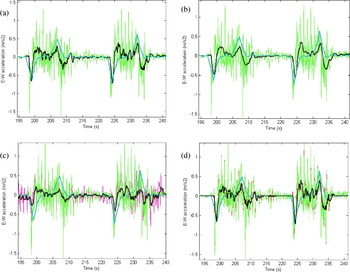
We applied the data processing strategies explained in Section 1 to raw INS data in order to obtain a pattern of accelerations as compatible as possible with the overall behaviour determined by GPS. Applying some of the aforementioned techniques, moving average, Butterworth filter, DFT and Coiflet 5 wavelet, we tried to solve the prime problem of high fictional accelerations. We used the corresponding existing implementations in Matlab™ software. We considered an average span of 50 data (which corresponds approximately to 0·6 s, or one step of a walking operator). First, the moving average filter was applied to the raw INS data with a window size of 50. Then, a second order Butterworth filter was applied with the same period of the MEMS-INS signal; higher orders did not produce significantly better results. Later, DFT was used as a low-pass filter with threshold 40 alone and in conjunction with the moving average. Finally Coiflet 5 wavelet up to level 3 alone and in conjunction with the moving average was applied to the raw signal. Figure 3 compares the raw MEMS-INS signal with all filtered signals.
Comparisons of raw INS data (green), GPS derived accelerations (blue) and different filtered data (black), detail: (a) Moving average, (b) Butterworth filter, (c) DFT (red) and DFT plus moving average (black), (d) Wavelet analysis (red) and wavelet analysis plus moving average (black).

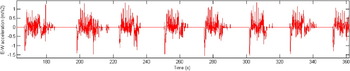
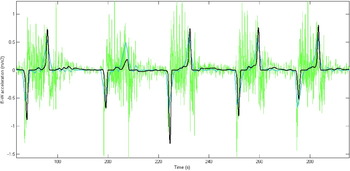
As can be seen, both the moving average and the Butterworth filter act successfully to remove high accelerations (the second providing steadier signal). However, there continue to be over-dimensioned responses compared to RTK-GPS derived accelerations, i.e. an exaggerated muffling or recovery, which can clearly be seen around seconds 201, 209, 226 and 234, and which we attempted to remedy later on. With respect to DFT and wavelet analysis results, one can see little improvement over the initial raw signal, unless a moving average or Butterworth filter is applied afterwards; the resulting signal is then similar or slightly better than the signal obtained with only the use of the moving average or the Butterworth filter. In the wavelet analyzed signal a very interesting feature can be observed: it filters low accelerations exceedingly well, i.e. accelerations measured when the operator was at rest and reflected only their unsteadiness in holding the pole. To clarify this, only the wavelet resulting signal over a longer period is represented in Figure 4; comparison with Figure 2b is eloquent in favour of the wavelet signal because it offers higher stability during static periods. The very high and unstable accelerations have been successfully removed by the aforementioned filtering techniques. Besides, the very low accelerations resulting from the unsteadiness of the operator holding the platform have also been removed either by the wavelet filtering or by forcing two consecutive accelerations below the noise level to represent the state at rest. There continues to be an over-dimensioned trend to recover from high accelerations that is peculiar to our MEMS-INS sensor. In fact, MEMS-INS sensors always tend to show some degree of laziness or overreaction after a high acceleration (Albarbar et al, Reference Albarbar, Mekid, Starr and Pietruszkiewicz2008).
Wavelet filtered signal for precise inspection of intervals at rest, detail.

4.3. Adaptive filtering
We remedy the aforementioned problem by adapting a new filtering strategy to the particular reaction pattern of our MEMS-INS sensor: we identify actions and reactions and apply a scaling factor to each of them as representing the particular dynamical response of our MEMS-INS. Following this procedure, the resulting signal will be more compatible with the RTK-GPS derived accelerations.
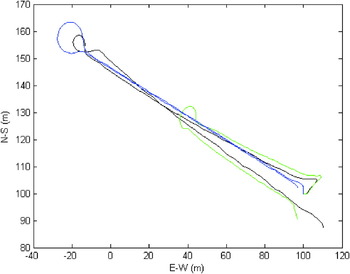
After setting an over-determined system of equations to determine these action and reaction factors using the first third of data as initialization step, the least-squares adjustment provided a factor of 1·04 for actions and a factor of 0·67 for reactions. These values will then be applied to the complete set of data. Figure 5 shows the resulting filtered signal after applying the Butterworth filter with action and reaction factors, and Figure 6 shows the corresponding path.
Comparisons of raw INS data (green), GPS derived accelerations (blue) and the final filtered signal (black), detail.

GPS deduced trajectory (blue), INS raw data deduced trajectory (green) and INS filtered data deduced trajectory (black).

4.4. DISCUSSION
MEMS-INS raw acceleration instability in the mid and long term provokes differences with the RTK-GPS deduced acceleration that amount to 0·224 m/s2 (RMS). If only these MEMS-INS raw data are used to deduce the trajectory then positioning errors amount to a maximum of 70 m in the 300 m itinerary as the result of the double integration of MEMS-INS accelerations that provides positions with increasing accuracy degradation.
The use of some filtering techniques applied to the raw signal permits the decrease of discrepancies between RTK-GPS derived data and MEMS-INS accelerations: 0·130 m/s2 with the moving average, 0·129 m/s2 with the Butterworth filter, 0·130 m/s2 with the DFT and moving average and 0·123 m/s2 with wavelets and the moving average. However, results are significantly enhanced by using an adaptive filter that accounts for the dynamical response of the MEMS-INS sensor: acceleration discrepancies are reduced to 0·085 m/s2. The improvement in RMS is 35% if compared with the previous filters and 62% with the MEMS-INS raw data. The derived path obtained is clearly better (Figure 6); or, in other words, the achieved precision is highly satisfactory: below 25 m during 700 s with no GPS signal instead of a maximum of 73 m for the same period with no filtering. These results are comparable and often better than those obtained for similar works that applied Kalman filtering or other strategies such as autoregressive models: 6 m for 100 s in (Godha and Lachapelle, Reference Godha and Lachapelle2008), 10 m for 20 s in (Brown and Lu, Reference Brown and Lu2004), about 100% of relative error (60 m in 10 s at a speed of some 20 km/h≅6 m/s) in (Park and Gao, Reference Park and Gao2008) or about 100% of relative error (150 m en 30 s at a speed of some 5 m/s) in (Godha, Reference Godha2006).
Despite significant improvements, it is possible to perceive some problems of heading, especially during the trajectory loop, perhaps occasioned by some magnetic anomalies due to the presence of nearby large metal frames. Further research on filtering magnetic anomalies needs to be conducted.
5. CONCLUSIONS
Some data filtering methods have been applied to raw MEMS-INS data before integration with RTK-GPS with the intention of providing an alternative response to rapid degradation of precision during GPS outages, a problem usually solved out by means of Kalman filtering. The proposed techniques proved to be very valuable for mitigating the large instability of raw MEMS-INS data during walking movements and were also capable of eliminating operator induced undesirable vibrations while at rest. A further improvement was obtained by using additional imposed corrections in actions and reactions adapted to the particular dynamical response of the MEMS-INS. The proposed technique provides accurate results, often better than those achieved in similar works with the use of Kalman filtering.