Introduction
Previous studies consistently report increased incidence of schizophrenia and non-affective psychotic disorders among immigrant populations, including first- and second-generation Caribbean immigrants to the UK (Harrison et al. Reference Harrison, Glazebrook, Brewin, Cantwell, Dalkin, Fox, Jones and Medley1997), first- and second-generation Surinamese immigrants to The Netherlands (Selten et al. Reference Selten, Slaets and Kahn1997; Selten et al. Reference Selten, Veen, Feller, Blom, Schols, Camoenie, Oolders, van der Velden, Hoek, Rivero, van der Graaf and Kahn2001), East African immigrants to Sweden (Zolkowska et al. Reference Zolkowska, Cantor-Graae and McNeil2001) and immigrants to Denmark (Cantor-Graae et al. Reference Cantor-Graae, Pedersen, McNeil and Mortensen2003). Selective immigration of persons with a genetic predisposition for psychotic disorders, perinatal complications, abuse of cannabis, urban dwelling, low socio-economic status (SES), misdiagnosis, and the hardships and stress related to cultural differences and to being a small minority within the host population are an incomplete list (Cantor-Graae & Selten, Reference Cantor-Graae and Selten2005) of reasons cited for this phenomenon.
These European studies essentially show that when individuals who are part of the non-discriminated majority ethnic group become part of a discriminated minority ethnic group in a host society to which they are not acculturated, there is an increase in the incidence of psychotic disorders. Immigration to Israel, in the broader social context, has been associated with ideological commitment (Shuval & Leshem, Reference Shuval, Leshem, Leshem and Shuval1998), and migration takes places in a context where individuals change from cultural minority to majority status. Hence the increase in rates of psychotic disorders might be expected to be more moderate, perhaps with a greater increase in risk in those immigrants whose physical appearance is most different from the host population.
The first purpose of this study was to confirm that immigration before the age of 17 is associated with increased risk for later schizophrenia, and to compare this increase in risk with immigrants in other countries. We then elaborated on this by investigating whether the degree of cultural and physical distinctiveness from the host population affected the risk for later schizophrenia among immigrants. This was done by taking advantage of the relatively large and diverse waves of immigration to Israel during the late 1980s and 1990s, principally involving 885 000 immigrants from the former Soviet Union and 43 000 immigrants from rural Ethiopia (CBS, 1985–1997). We hypothesized that these immigrants from Ethiopia, who are particularly different from the host population, would have the highest risk for schizophrenia (Boydell et al. Reference Boydell, van Os, McKenzie, Allardyce, Goel, McCreadie and Murray2001).
Method
Study population
From 776 407 adolescents consecutively screened by the Israeli Draft Board, we excluded adolescents with missing data on country of birth (n=185, 0.02%) or parental country of birth (n=108 332, 13.95%), adolescents with mental retardation or autism (n=475, 0.06%), and adolescents who were later hospitalized with psychiatric diagnoses other than schizophrenia (n=5643, 0.7% of the sample). Of these, adolescents hospitalized for major affective disorders and schizo-affective disorders (n=1078) were analyzed separately. Because of overlap between the excluded groups, the final analytic sample included 661 792 adolescents, of whom 1686 (0.3%) were later hospitalized with a diagnosis of schizophrenia (ICD-10 20.0–20.9). These prevalences are affected by the fact that not all of these adolescents had lived through the age of risk, and are compatible with the age-adjusted prevalence of schizophrenia in other studies carried out in Israel (Levav et al. Reference Levav, Kohn, Dohrenwend, Shrout, Skodol, Schwartz, Link and Naveh1993) and the USA (Kessler et al. Reference Kessler, McGonagle, Zhao, Nelson, Hughes, Eshleman, Wittchen and Kendler1994; Bromet et al. Reference Bromet, Dew, Eaton, Tsuang, Tohen and Zahner1995). The average follow-up period was 7.7±3.7 years. Of the 661 792 adolescents assessed, 557 154 were native-born Israelis and 104 638 were immigrants.
Draft Board assessment
Israeli law requires that all adolescents between the ages of 16 and 17 undergo a pre-induction assessment to determine their intellectual, medical and psychiatric eligibility for military service. This assessment is compulsory and is administered to the entire unselected population of Israeli adolescents through regional Draft Board centers located throughout the country. It includes individuals who are eligible for military service, as well as those who will be excused from service on the basis of medical, psychiatric or social reasons (Davidson et al. Reference Davidson, Reichenberg, Rabinowitz, Weiser, Kaplan and Mark1999; Rabinowitz et al. Reference Rabinowitz, Reichenberg, Weiser, Mark, Kaplan and Davidson2000; Weiser et al. Reference Weiser, Reichenberg, Rabinowitz, Kaplan, Mark, Bodner, Nahon and Davidson2001). The Draft Board Registry includes information about country of birth, which was used in this study.
Israeli Psychiatric Hospitalization Case Registry
The Israeli National Psychiatric Hospitalization Case Registry is a complete listing of all psychiatric hospitalizations in the country, including the diagnosis assigned and coded on admission and discharge by a board-certified psychiatrist at the facility. During the time-periods covered by this study, ICD-9 and ICD-10 diagnoses were used by the registry. All in-patient psychiatric facilities in the country, including psychiatric hospitals, day hospitals and psychiatric units in general hospitals, are required by law to report all admissions and discharges to the registry. Registry diagnoses of schizophrenia (ICD-10 F20.0–F20.9) have a sensitivity of 0.89 (Weiser et al. Reference Weiser, Kanyas, Malaspina, Harvey, Glick, Goetz, Karni, Yakir, Turetsky, Fennig, Nahon, Lerer and Davidson2005). For the purposes of this study, the last discharge diagnosis of patients was used.
Procedure
The association between being an immigrant by age 17 and hospitalization for schizophrenia was examined by linking data from the Israeli Draft Board with data from the National Psychiatric Hospitalization Case Registry. After receiving approval from the relevant local ethics committees, the Draft Board data were linked to the Israeli Psychiatric Hospitalization Case Registry, using the national identification number (equivalent to the US Social Security number) as the linking variable. For those subjects in the Draft Board file who appeared in the hospitalization registry, last discharge diagnoses were added to the file. Before the linked file was transferred to the investigators for analysis, the national identification number was removed to preserve patient confidentiality.
Statistical analyses
As individuals assessed by the Draft Board were followed-up to different ages, the association between immigration and hospitalization for schizophrenia was tested using Cox regression analysis. Age at first psychiatric admission was used to estimate the onset of illness. Data on individuals with no psychiatric hospitalization were censored on the last day of follow-up, which was the date when the Draft Board data were merged with the Psychiatric Case Registry.
Several sets of analyses were conducted: first, the risk for hospitalization for schizophrenia in both first- and second-generation immigrants was compared with risk in native-born Israelis. Second, we assessed risk for hospitalization for schizophrenia according to region of origin. For this purpose, countries of origin were grouped into eight categories: Israel, former Soviet Union, Europe, Ethiopia, North America, South America, Asia and Australia, and Africa. Third, the effect of migrant status on risk for hospitalization for major affective disorders and schizo-affective disorders was assessed. All analyses controlled for gender and SES, using a measure of SES derived from census data, based on the number of persons per room in the home, number of computers per household, number of motor vehicles per household, education and per capita income level (CBS, 1995).
All analyses were performed using SPSS version 14.0 (SPSS Inc., Chicago, IL, USA).
Results
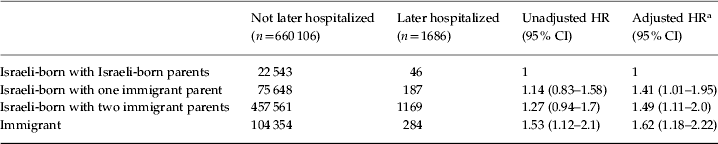
When assessing risk for schizophrenia among adolescent immigrants from all countries, the risk for hospitalization for schizophrenia was significantly increased (adjusted HR 1.62, 95% CI 1.18–2.22). Israeli-born children of immigrants (second-generation immigrants) were also at increased risk: for adolescents with one immigrant parent, the adjusted HR was 1.41 (95% CI 1.01–1.95); and for adolescents with two immigrant parents, the adjusted HR was 1.49 (95% CI 1.12–2.0) (Table 1).
Risk for hospitalization for schizophrenia among first- and second-generation immigrants compared to native-born Israelis
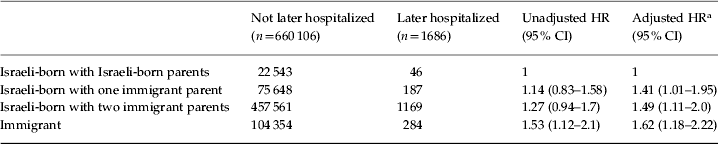
HR, Hazard ratio; CI, confidence interval.
a Adjusted for socio-economic status (SES) and gender.
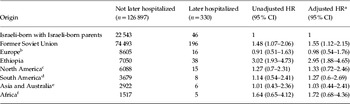
When comparing risk in immigrants from different regions of origin, immigrants from the former Soviet Union (adjusted HR 1.55) and Ethiopia (adjusted HR 2.95) were at greater risk for schizophrenia (Table 2).
Risk for hospitalization for schizophrenia among immigrants from different countries of origin compared to native-born Israelis

HR, Hazard ratio; CI, confidence interval.
a Adjusted for socio-economic status (SES) and gender.
b Austria, Italy, Ireland, Albania, Bulgaria, Belgium, Britain, Germany, Demark, Holland, Hungary, Yugoslavia, Greece, Spain, Poland, Portugal, Finland, France, Romania, Sweden, Switzerland, Gibraltar, Norway.
c USA, Canada, Jamaica, Haiti.
d Uruguay, Ecuador, Argentina, Bolivia, Brazil, Guatemala, Venezuela, Mexico, Panama, Paraguay, Peru, Chile, Cuba, Colombia, Costa Rica, El Salvador, Nicaragua, Puerto Rica.
e Afghanistan, Burma, India, Japan, Lebanon, Iraq, Syria, China, Philippines, Pakistan, Iran, Cyprus, Turkey, Yemen, Indonesia, Jordan, Mongolia, Moldavia, Singapore, Saudi Arabia, Korea, Cambodia, Laos, Thailand, Taiwan, Papua, Australia.
f Algeria, Ghana, South Africa, Tunisia, Libya, Morocco, Egypt, Sudan, Congo, Uganda, Burundi, Zaire, Zambia, Ivory Coast, Tanzania, Liberia, Nigeria, Senegal, Kenya, Zimbabwe.
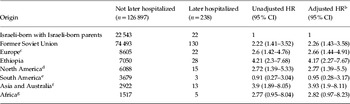
Being an immigrant also increased risk for hospitalization for major affective disorders, including schizo-affective disorders (adjusted HR 2.39, 95% CI 1.54–3.72; Table 3), with immigrants from Ethiopia also being at greatest risk for affective disorders (adjusted HR 4.17, 95% CI 2.27–7.67; Table 4).
Risk for hospitalization for affective disordersFootnote a among first- and second-generation immigrants compared to native-born Israelis

HR, Hazard ratio; CI, confidence interval.
a Including major affective and schizo-affective disorders.
b Adjusted for socio-economic status (SES) and gender.
Risk for hospitalization for affective disordersFootnote a among immigrants from different countries of origin compared to native-born Israelis

HR, Hazard ratio; CI, confidence interval.
a Including major affective and schizo-affective disorders.
b Adjusted for socio-economic status (SES) and gender.
c Austria, Italy, Ireland, Albania, Bulgaria, Belgium, Britain, Germany, Demark, Holland, Hungary, Yugoslavia, Greece, Spain, Poland, Portugal, Finland, France, Romania, Sweden, Switzerland, Gibraltar, Norway.
d USA, Canada, Jamaica, Haiti.
e Uruguay, Ecuador, Argentina, Bolivia, Brazil, Guatemala, Venezuela, Mexico, Panama, Paraguay, Peru, Chile, Cuba, Colombia, Costa Rica, El Salvador, Nicaragua, Puerto Rica.
f Afghanistan, Burma, India, Japan, Lebanon, Iraq, Syria, China, Philippines, Pakistan, Iran, Cyprus, Turkey, Yemen, Indonesia, Jordan, Mongolia, Moldavia, Singapore, Saudi Arabia, Korea, Cambodia, Laos, Thailand, Taiwan, Papua, Australia.
g Algeria, Ghana, South Africa, Tunisia, Libya, Morocco, Egypt, Sudan, Congo, Uganda, Burundi, Zaire, Zambia, Ivory Coast, Tanzania, Liberia, Nigeria, Senegal, Kenya, Zimbabwe.
To examine the possibility that adolescents with missing data on country of birth or parental country of birth were a source of bias, rates of hospitalization for schizophrenia were compared between those with missing data and those with valid data. The χ2 test showed a small but significant difference between the groups, with slightly higher hospitalization rates among those with missing data on country of birth or parental country of birth (0.4%) compared to those with valid data (0.3%, p<0.001), corresponding to an increased adjusted risk for schizophrenia of 1.39 (95% CI 0.1.02–1.89).
Discussion
Israel's heterogeneous demographic structure, shaped largely by waves of immigration, affords a unique opportunity to elaborate on the association between immigration and schizophrenia. A relatively large proportion of the population is composed of immigrants (at the end of 2005, 35% of the population in Israel were immigrants). In addition, during the late 1980s and 1990s, two relatively large groups immigrated to Israel, one from the former Soviet Union and the other from Ethiopia.
In line with previous studies (Schrier et al. Reference Schrier, van de Wetering, Mulder and Selton2001; Cantor-Graae et al. Reference Cantor-Graae, Pedersen, McNeil and Mortensen2003), our findings suggest that both first- and second-generation immigrants are at increased risk for hospitalization for schizophrenia relative to the native-born population. The increased risk of schizophrenia in immigrants is relatively small in this study (HR 1.6), compared to others. An exhaustive meta-analysis of the topic (Cantor-Graae & Selten, Reference Cantor-Graae and Selten2005) reported a mean increased risk for schizophrenia in immigrants at all ages of 2.7 (95% CI 2.3–3.2). This difference might be due to the sample tested in this present study, comprising adolescents who had immigrated to Israel before the age of 17, and it is conceivable that persons immigrating at a younger age might adapt better to the host country and thus have lower rates of immigration-related schizophrenia compared to older immigrants. Another possibility is that because some of the immigrants to Israel are minorities who flee discrimination or even persecution to become part of the majority cultural identity group in Israel, they are less prone to the hardships associated with migration, and hence are at lower risk for schizophrenia compared to immigrants in other countries. We looked at the relationship between age of immigration and risk for schizophrenia in our data set and did not find a significant association (data not shown). However, it is likely that if our sample had included older immigrants, we might have found increased risk in persons who immigrated at later ages.
Although the number of adolescents later hospitalized for major affective disorders, including schizo-affective disorders, was much smaller than for schizophrenia, being an immigrant was also associated with increased risk for these disorders. This is in line with previous findings by other groups (Swinnen & Selten, Reference Swinnen and Selten2007).
Risk for hospitalization for schizophrenia and major affective disorders, including schizo-affective disorders, was highest among immigrants from Ethiopia. The differences between immigrants from Ethiopia and both native-born Israelis and immigrants from other countries of origin are many, and include physical appearance, dress, family structure, education, employment, SES and other cultural aspects, all of which affect the adaptation of immigrants to the host country. In addition, cultural differences are known to have an impact on the diagnosis, and misdiagnosis, of schizophrenia (Littlewood & Lipsedge, Reference Littlewood and Lipsedge1981; Sashidharan, Reference Sashidharan1993; Hickling et al. Reference Hickling, McKenzie, Mullen and Murray1999). Young, white, middle-class patients are often diagnosed with psychotic depression or psychotic bipolar disorder, which is less stigmatizing, in the early stages of illness (Minsky et al. Reference Minsky, Vega, Miskimen, Gara and Escobar2003). However, the finding of increased risk for hospitalization for major affective disorders, including schizo-affective disorders, as well as for schizophrenia in immigrants indicates that the results reported here might not be due to misdiagnosis. Another possible cause of the higher rates of schizophrenia in the Ethiopian immigrants includes the possibility that they suffered from poorer prenatal care, obstetric complications or malnutrition in utero, all risk factors for psychotic illness (Hulshoff Pol et al. Reference Hulshoff Pol, Hoek, Susser, Brown, Dingemans, Schnack, van Haren, Pereira Ramos, Gispen-de Wied and Kahn2000; Cannon et al. Reference Cannon, Jones and Murray2002). The data available do not enable us to distinguish between the possible effects of these different factors on risk for schizophrenia.
Although risk for schizophrenia is numerically elevated in most immigrant groups, it is possible that the smaller number of subjects in some of the immigrant groups caused the analysis to lose power. In addition, risk for schizophrenia was increased when controlling for gender and SES. This may be explained by the fact that males are over-represented in the hospitalized group; although males comprise 60% of the cohort, 80% of those hospitalized are males, thus controlling for gender might be responsible for the increased risk shown in the adjusted HR.
Adolescents with missing data for country of origin or parental country of origin were at increased risk for schizophrenia. As second-generation immigrants are the largest group in this study, it is likely that most of these adolescents with missing data are second-generation immigrants themselves. Hence, it is not surprising that the increased risk for schizophrenia in adolescents with missing data for country of origin or paternal country of origin (HR 1.39, 95% CI 0.1.02–1.89) is similar to the increased risk in adolescents who are second-generation immigrants (HR 1.49, 95% CI 1.12–2.0).
Limitations
The interpretation of the findings reported here should be viewed in the light of the limitations imposed by the naturalistic design of this study. First, although interesting and relevant, it is impossible to determine to what extent immigration from various countries of origin was selective immigration, and which ideological or economic factors affected immigration to Israel. However, it appears that entire communities from rural Ethiopia immigrated to Israel, hence it was probably a non-selective immigration. Second, the case registry diagnoses are clinical, not research, diagnoses. However, these diagnoses were assigned by board-certified psychiatrists who had the benefit of observing the patients throughout one or more hospitalizations and had been trained and retrained in the use of the diagnostic criteria of the ICD and DSM. Moreover, studies that have compared clinical diagnoses of schizophrenia assigned in state hospitals (Pulver et al. Reference Pulver, Carpenter, Adler and McGrath1988) with research diagnoses have shown a high degree of concordance. Third, although we controlled for the potential confounding effect of SES, no correction was made for other possible confounders, such as history of schizophrenia in the family, data that unfortunately were not available to us. Fourth, previous studies have found that racial and ethnic minorities are underserved by the mental health services (Neighbors et al. Reference Neighbors, Bashshur, Price, Donavedian, Selig and Shannon1992; Takeuchi & Uehara, Reference Takeuchi, Uehara, Levin and Petrila1996), so that the numbers we have may be an underestimation of the real prevalence. Even though all Jewish individuals in the population are screened by the Draft Board, and although mental health care in Israel is provided free to all residents regardless of social class, ethnicity or country of origin, these potential biases might still apply to this dataset, although perhaps to a lesser extent than in other studies. Fifth, the data set includes immigrants from other areas of the world, in addition to Ethiopia, who might also have distinct skin color and/or physical characteristics. Unfortunately, the military data set does not include data on ethnicity, thus we could not address this issue.
Conclusions
Immigration is associated with increased risk for later hospitalization for schizophrenia. Cultural dissimilarity from the host country and having a different physical appearance might be associated with greater risk for schizophrenia. Clinicians treating immigrants with backgrounds different from their own should be aware that cultural and physical dissimilarity are risk factors for schizophrenia.
Acknowledgments
We acknowledge the Stanley Medical Research Institute for their funding of this study.
Declaration of Interest
None.