Mass gatherings unfortunately may develop into a stampede and/or crowd crush, resulting in a mass casualty incident (MCI). Such MCIs are most commonly associated with religious events in the Middle East, India, or developing countries. However, a variety of events across the globe—including sporting events, political rallies, and concerts—have resulted in an MCI. A stampede specifically refers to a situation when people run in the same direction and injuries occur due to trauma. Reference Hsieh, Ngai and Burkle1–Reference Alluri, Voskanyan and Sarin3 A crowd crush (which can be secondary to a stampede or happen independently) occurs when large masses are compressed in a confined area. Deaths usually occur due to compression asphyxia. The mechanism of death is due to compression of the chest, which impairs breathing or a decrease in venous return (and thereby decrease in cardiac output) secondary to sudden increases in intrathoracic pressure. Another mechanism may be smothering when a smaller individual such as a child is compressed between adults resulting in the occlusion of the nose and mouth. Traumatic deaths may also be seen. Reference Nolan, Soar and Cary4 Unlike a bomb blast, building collapse, mass shooting, or stampede, a crowd crush may lack a dramatic, noticeable trigger. This may be termed a “silent MCI” with the concern that it can result in a slower EMS response.
A robust and efficient emergency medical services (EMS) response can help reduce mortality rates if preparations to secure large crowds fail. Reference Yaron, Farfel and Lehavi5 MDA is Israel’s National Emergency Medical Services Organization and is staffed by paid and volunteer emergency medical technicians (EMTs) and paramedics who respond to over 2000 calls a day. Traditional MDA volunteers serve scheduled shifts on an ambulance. A pool from over 7000 on-call volunteer first responders (OCVFRs) with equipment may be activated by a sophisticated global positioning system (GPS)-guided smartphone application based on proximity to an emergency. Most OCVFRs are EMTs, and during MCIs, they have proven to be effective in treating, stabilizing, and evacuating victims. Reference Yafe, Walker and Amram6–Reference Alpert, Lipsky and Elie8
Beginning at approximately 1 am on Friday, April 30, 2021, a religious celebration (Lag B’omer) at Israel’s Mount Meron developed into a deadly crowd crush. Injuries began as people fell within a steep, narrow ramp enclosed by walls and metal handrails. A chain reaction occurred with more and more victims falling and suffocating one another. As a result of the MCI 45 died, ranging in age from 9 to 65 y old, and 112 were injured. The disaster at Mount Meron was a “silent MCI,” and at first, went largely unnoticed within the raucous festival. This case study examines MDA’s preparation for and response to the Mount Meron disaster and attempts to draw lessons for future EMS response to similar MCIs.
Narrative
MDA Preparations for the Religious Celebration at Mount Meron
MDA teams have medically secured Lag B’omer events at Mount Meron for more than 20 y. For the most recent event, MDA personnel began to deploy on April 28, 2021, the day before the holiday. Personnel toured and met at Mount Meron to familiarize themselves with the area.
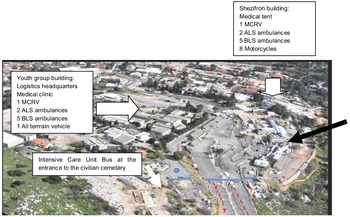
MDA prepared for the event by stationing over 50 vehicles, including 25 basic life support (BLS) ambulances, 4 advanced life support (ALS) ambulances, 2 multiple casualty response vehicles (MCRV = mobile vehicles stocked with additional trauma first aid equipment), 4 all-terrain vehicles mounted with stretchers, 12 medi-cycles stocked with first aid equipment, 1 evacuation intensive care unit bus (able to transport, monitor, and provide oxygen to 4 prone and 10 seated patients), 1 mobile clinic, and 1 command and control vehicle equipped with communication systems to monitor events and coordinate resources (Figure 1). MDA staffed Mount Meron with 30 paramedics, 220 EMTs, and 1 physician. Foot patrols divided the festival site into 12 zones, each of which contained 3 MDA staff. Other volunteer EMS organizations stationed an additional 17 ambulances at Mount Meron. An additional 180 OCVFRs—who were festival participants—were present at Mount Meron to reinforce medical personnel. In addition to the mobile clinic, 2 stationary clinics were established near the festival site.
Field map with medical spot arrangement.
Black arrow indicates area of crowd crush. White arrows indicate Magen David Adom Prehospital Forces. Abbreviations: ALS, advanced life support; BLS, basic life support; MCRV, multiple casualty response vehicle.

MDA designated 72 BLS ambulances and an additional 13 ALS ambulances in the surrounding region that could arrive at Mount Meron within 30 min in the event of an MCI. MDA ensured that these additional ambulances did not deprive local stations of EMS responders using a “rolling reinforcement” system. MDA planned to reinforce stations that sent ambulances to Mount Meron with ambulances from more distant stations. This system of transferring ambulances from distant stations allowed for nearby units to rapidly deliver units to Mount Meron while maintaining responses to routine calls.
In preparation for the festival, MDA conducted an MCI drill on April 29, the morning of the event. The drill—conducted in partnership with the police, fire department, and army—simulated dozens of injuries following the collapse of an audience stage. MDA volunteers practiced evacuating the wounded on ambulances and to a helicopter pad for aeromedical evacuation.
Response
At 00:50 on Friday, April 30, 2021, MDA foot patrols began to radio reports of multiple injuries at Mount Meron. It took several minutes for MDA personnel to realize the overwhelming number and extent of the severely injured, but foot patrols started to respond to and treat injuries, including by performing cardiopulmonary resuscitation (CPR).
Ground forces declared an MCI 11 min later at 01:01. The declaration alerted all stations throughout Israel and launched all available teams to the area. MDA staff and volunteers rapidly removed casualties from piles of victims, triaged those in need of life-saving care, performed CPR, and evacuated patients as more personnel arrived.
The isolated, mountainous terrain of Mount Meron slowed the arrival of some ambulances. Nevertheless, within 30 min of the declared MCI, 30 BLS ambulances and 9 ALS ambulances from the northern region of Israel arrived at the scene. Within an hour, an additional 25 BLS and 9 ALS ambulances from throughout Israel arrived by means of the “rolling reinforcement” system, culminating in a total reinforcement of 55 BLS and 18 ALS ambulances. Seven BLS ambulances were deployed to the Rambam Health Care Campus in Haifa (the tertiary medical center serving the north of Israel) to provide potential secondary transport. Six helicopters—2 from MDA and 4 from the military—responded to Mount Meron to provide aeromedical evacuation. One patient in critical condition underwent secondary transport by helicopter to the Hadassah Medical Center in Jerusalem.
MDA evacuated 112 patients from Meron. Six were evacuated in critical condition, 18 in severe condition, 8 in moderate condition, and 80 in mild condition (Table 1). All critically and severely injured patients were evacuated from Meron within 50 min of the first reported injuries, and all patients were evacuated within 3 h. Approximately 20 victims were transported by the other volunteer EMS agencies. Among the 45 patients who died in the Meron MCI, 38 were dead on scene, 6 died in the emergency department, and 1 died at the hospital in the days following the incident.
Evacuation status of patients

Discussion
The crowd crush at Mount Meron was essentially a “silent MCI,” without an initial audible or visible trigger. Nevertheless, MDA was able to declare an MCI within 11 min. Intense preparation and strategy were responsible for MDA’s effective identification of and response to the Mount Meron crowd crush. This included the distribution of personnel (including OCVFRs) throughout the festival site, the staging of vehicles at the scene, and the establishment of command centers. Practice drills prepared personnel to identify and respond to an MCI. The implementation of the ambulance “rolling reinforcement” system ensured that enough personnel were available to treat and evacuate patients yet still staff stations for routine calls.
At future mass gatherings, technology may allow EMS personnel to identify MCIs more quickly. Pressure detecting plates, radio-frequency identification tags given to participants, smartphone tracking apps, and sensor networks may identify when crowds are building to dangerous levels, alerting personnel of MCIs as they occur, and reducing the interval between the first reports of injuries and the declaration of an MCI. Reference Yamin9 Such technology could also indicate to personnel when to redirect crowd flow, preventing the formation of high-risk choke points. Witness reports from Meron suggest that some medics had difficulty making their way through the crowd; future EMS organizations could work with authorities to designate and maintain less crowded routes that allow for medical personnel to access injured patients within crowds.
A crowd crush MCI poses unique challenges for EMS agencies. Lessons from MDA’s response to Mount Meron can be applied to other EMS agencies securing mass gatherings. Crowd crushes continue to threaten lives throughout the world, and while their prevention is of paramount importance, injuries and deaths can be mitigated with an effective EMS preparation and response.
Conflicts of interest
None.