Introduction
While implicated in functional recovery, evident at first-episode psychosis and predicting conversion among people at ultra-high risk of psychosis, neither cognitive impairment nor negative symptoms have shown substantial improvement following antipsychotic treatment (Harvey et al. Reference Harvey, Koren, Reichenberg and Bowie2006; Perlick et al. Reference Perlick, Rosenheck, Kaczynski, Bingham and Collins2008; Fusar-Poli et al. Reference Fusar-Poli, Borgwardt, Bechdolf, Addington, Riecher-Rössler, Schultze-Lutter, Keshavan, Wood, Ruhrmann, Seidman, Valmaggia, Cannon, Velthorst, De Haan, Cornblatt, Bonoldi, Birchwood, McGlashan, Carpenter, McGorry, Klosterkötter, McGuire and Yung2013). Current treatments in ameliorating these symptoms of schizophrenia have been limited (Levkovitz et al. Reference Levkovitz, Mendlovich, Riwkes, Braw, Levkovitch-Verbin, Gal, Fennig, Treves and Kron2010). In light of their collective impact on outcome, the focus has been on clarifying the relationship between negative and cognitive symptom domains (Foussias & Remington, Reference Foussias and Remington2010). While some have suggested negative symptoms and cognition are related but separable domains, the underlying associations remain unclear (Harvey et al. Reference Harvey, Koren, Reichenberg and Bowie2006).
Currently, negative symptoms remain an unmet therapeutic need for schizophrenia (Kirkpatrick et al. Reference Kirkpatrick, Fenton, Carpenter and Marder2006). Negative symptoms have been shown to be distinct from other aspects of schizophrenia and are not merely secondary to psychotic symptoms, depression and anxiety (Keefe et al. Reference Keefe, Harvey, Lenzenweger, Davidson, Apter, Schmeidler, Mohs and Davis1992; Mueser et al. Reference Mueser, Sayers, Schooler, Mance and Haas1994; Peralta & Cuesta, Reference Peralta and Cuesta1995; Blanchard & Cohen, Reference Blanchard and Cohen2006; Strauss et al. Reference Strauss, Horan, Kirkpatrick, Fischer, Keller, Miski, Buchanan, Green and Carpenter2013). Prior reports asserted that negative symptoms do not represent a unitary construct but rather show evidence for two distinct factors: ‘diminished emotional expression’ (DEE), consisting of alogia and blunted affect, and ‘avolition’, including apathy, amotivation, asociality and anhedonia (Keefe et al. Reference Keefe, Harvey, Lenzenweger, Davidson, Apter, Schmeidler, Mohs and Davis1992; Blanchard & Cohen, Reference Blanchard and Cohen2006; Kimhy et al. Reference Kimhy, Yale, Goetz, McFarr and Malaspina2006; Nakaya & Ohmori, Reference Nakaya and Ohmori2008; Horan et al. Reference Horan, Kring, Gur, Reise and Blanchard2011; Kirkpatrick et al. Reference Kirkpatrick, Strauss, Nguyen, Fischer, Daniel, Cienfuegos and Marder2011; Strauss et al. Reference Strauss, Hong, Gold, Buchanan, McMahon, Keller, Fischer, Catalano, Culbreth, Carpenter and Kirkpatrick2012; Liemburg et al. Reference Liemburg, Castelein, Stewart, van der Gaag, Aleman and Knegtering2013; Fervaha et al. Reference Fervaha, Foussias, Agid and Remington2014a ), which has shown to be useful in identifying distinct subgroups of patients (Strauss et al. Reference Strauss, Horan, Kirkpatrick, Fischer, Keller, Miski, Buchanan, Green and Carpenter2013). There have been debates on whether to conceptualize negative symptoms as a whole or to delineate them into subdomains (Blanchard & Cohen, Reference Blanchard and Cohen2006; Strauss et al. Reference Strauss, Hong, Gold, Buchanan, McMahon, Keller, Fischer, Catalano, Culbreth, Carpenter and Kirkpatrick2012). Additionally, the diagnostic criteria in DSM-5 identifies these two negative symptom subdomains but still advocate considering negative symptoms as a whole (Messinger et al. Reference Messinger, Trémeau, Antonius, Mendelsohn, Prudent, Stanford and Malaspina2011; Tandon et al. Reference Tandon, Gaebel, Barch, Bustillo, Gur, Heckers, Malaspina, Owen, Schultz, Tsuang, Van Os and Carpenter2013).
As a whole, negative symptoms of schizophrenia have been consistently found to correlate with neuropsychological performance, with modest associations with executive function, verbal fluency, verbal memory and learning, attention/vigilance, working memory and processing speed (Addington, Reference Addington, Sharma and Harvey2000; Nieuwenstein et al. Reference Nieuwenstein, Aleman and de Haan2001; Harvey et al. Reference Harvey, Koren, Reichenberg and Bowie2006; Dibben et al. Reference Dibben, Rice, Laws and McKenna2009; Dominguez et al. Reference Dominguez, Viechtbauer, Simons, van Os and Krabbendam2009). Furthermore, DEE has been found to be associated with verbal fluency, memory, symbol coding and executive function (Cohen et al. Reference Cohen, Kim and Najolia2013; Chang et al. Reference Chang, Hui, Chan, Lee, Wong and Chen2014) while avolition was related to executive function, working memory, verbal fluency, visual information, verbal learning and memory and performance IQ (Roth et al. Reference Roth, Flashman, Saykin, McAllister and Vidaver2004; Faerden et al. Reference Faerden, Vaskinn, Finset, Agartz, Ann Barrett, Friis, Simonsen, Andreassen and Melle2009; Konstantakopoulos et al. Reference Konstantakopoulos, Ploumpidis, Oulis, Patrikelis, Soumani, Papadimitriou and Politis2011). While DEE and avolition appear to share overlapping cognitive domains, some studies found that DEE tended to be more strongly associated with cognition than social avolition (SA) (Liemburg et al. Reference Liemburg, Castelein, Stewart, van der Gaag, Aleman and Knegtering2013; Hartmann-Riemer et al. Reference Hartmann-Riemer, Hager, Kirschner, Bischof, Kluge, Seifritz and Kaiser2015) while another study demonstrated no significant associations between negative symptom subdomains and cognition (Kring et al. Reference Kring, Gur, Blanchard, Horan and Reise2013). Moreover, changes in negative symptoms do not predict changes in cognition, suggesting that negative symptoms do not directly cause cognitive impairment or vice versa (Bell & Mishara, Reference Bell and Mishara2006). Hence, the relationship between negative symptoms, particularly in subdomains, and cognition remain equivocal.
The Positive and Negative Syndrome Scale (PANSS) is among the most ubiquitous for psychopathology assessment in schizophrenia and includes negative symptoms as one of the domains measured (Kay et al. Reference Kay, Fiszbein and Opler1987). The negative symptom factor includes items from both the negative and general psychopathology subscales and can be separated into DEE and SA (Wallwork et al. Reference Wallwork, Fortgang, Hashimoto, Weinberger and Dickinson2012; Jiang et al. Reference Jiang, Sim and Lee2013), allowing for the examination of the validity of these two constructs.
The current study provides a unique opportunity to deconstruct negative symptoms, and further examine if the cognitive domains might be differentially associated with DEE and SA. In a previous study, our group reported on a model that included speed/vigilance, fluency/memory and executive function as the three main domains of cognitive impairment in schizophrenia (Lam et al. Reference Lam, Collinson, Eng, Rapisarda, Kraus, Lee, Chong and Keefe2014). Contrary to other studies that examined individual cognitive tests, the use of these empirically derived cognitive domains in this study reduces the methodological variance between cognitive tests and allows us to obtain a clearer picture of the relationship between negative symptoms and cognitive domains. Hence, the aims of the present study were (i) to examine if a one-factor or two-factor negative symptom model fitted our data; and (ii) to identify the pattern of associations between negative symptoms and the three domains of cognition. We hypothesized that a two-factor negative symptom subdomain model would be valid in our sample and that DEE and SA would have mild to moderate associations with different domains of cognition, with DEE having consistently higher associations.
Method
Study participants
A total of 707 participants with schizophrenia were recruited from 2008 to 2011. Participants were recruited from outpatient clinics and inpatient wards from the Institute of Mental Health in Singapore, and from various community care centers across the country. All participants were ethnic Chinese, between the ages of 21 and 55 years, had at least 6 years of primary school education and could converse in English. A diagnosis of schizophrenia was ascertained using the Structured Clinical Interview for DSM-IV-TR Axis I Disorder, Patient Edition (First et al. Reference First, Williams, Karg and Spitzer2015). Participants with history of mental retardation, substance abuse, neurological disease, head injury or color blindness were excluded from the study. The study was approved by the National Healthcare Group Domain Specific Review Board (DSRB). Written informed consent was obtained from all participants in the study.
Clinical measures
The severity of psychopathology was assessed using the PANSS which consists of 30 items across three dimensions: positive (seven items), negative (seven items), and general psychopathology (16 items). We utilized the negative factor items identified in Jiang et al.'s (Reference Jiang, Sim and Lee2013) model as it had been previously validated in our local population. In Jiang et al.'s (Reference Jiang, Sim and Lee2013) model, eight negative items were identified and these were separated into two factors based on past analyses (Liemburg et al. Reference Liemburg, Castelein, Stewart, van der Gaag, Aleman and Knegtering2013; Fervaha et al. Reference Fervaha, Foussias, Agid and Remington2014a ). The first factor corresponds to DEE and consists of blunted affect (N1), poor rapport (N3), lack of spontaneity and flow of conversation (N6), motor retardation (G7) and disturbance of volition (G13). The second factor corresponds to SA and consists of emotional withdrawal (N2), passive/apathetic social withdrawal (N4) and active social avoidance (G16).
Neurocognitive measures
Cognitive performance was assessed using the Brief Assessment of Cognition in Schizophrenia (BACS; Keefe et al. Reference Keefe, Goldberg, Harvey, Gold, Poe and Coughenour2004) consisting of Verbal Memory, Digit Sequencing, Token Motor, Semantic Fluency, Symbol Coding and Tower of London tasks; Benton Judgment of Line Orientation (JLO; Benton et al. Reference Benton, Hamsher, Varney and Spreen1983); Wechsler Abbreviated Scale of Intelligence (WASI) Matrix Reasoning (Wechsler, Reference Wechsler1999); Continuous Performance Test-Identical Pairs (CPT-IP; Cornblatt et al. Reference Cornblatt, Risch, Faris, Friedman and Erlenmeyer-Kimling1988); and Wisconsin Card Sorting Test (Heaton et al. Reference Heaton, Chelune, Talley, Kay and Curtiss1993). Using the age- and gender-adjusted scores from these tests, we previously published a cognitive model comprising three domains, namely executive function, fluency/memory and speed/vigilance (Lam et al. Reference Lam, Collinson, Eng, Rapisarda, Kraus, Lee, Chong and Keefe2014). The executive function domain consisted of JLO and WASI Matrix Reasoning items. The fluency/memory domain consisted of BACS Semantic Fluency and Verbal Memory items. The speed/vigilance domain consisted of CPT-IP, BACS Token Motor and Symbol Coding items. Cognitive scores for these three domains were generated from the model using regression.
Statistical analyses
Using confirmatory factor analysis (CFA), we examined whether a one-factor or two-factor negative symptom model would fit our data. Following which, we examined the relationship between negative symptoms and cognition using structural equation modeling where we regressed cognition on negative symptoms (model 1). If the two-factor negative symptom model fitted better, both negative symptom factors will be considered in tandem to determine the unique contributions of each factor. Given that duration of illness and antipsychotic dosage might influence the relationship between negative symptoms and cognition (Dominguez et al. Reference Dominguez, Viechtbauer, Simons, van Os and Krabbendam2009; Bagney et al. Reference Bagney, Rodriguez-Jimenez, Martinez-Gras, Sanchez-Morla, Santos, Jimenez-Arriero, Lobo, McGorry and Palomo2013), we then examined model 1 while controlling for these variables (model 2).
Similar to our previous PANSS CFA (Jiang et al. Reference Jiang, Sim and Lee2013), all PANSS items were treated as ordinal data. A good model fit was determined if the model demonstrated a Comparative Fit Index (CFI) >0.950, Tucker–Lewis Index (TLI) >0.960, Root Mean Square of Approximation (RMSEA) <0.080 and/or Weighted Root Mean Square Residual (WRMR) <0.900 (Schreiber et al. Reference Schreiber, Nora, Stage, Barlow and King2006). Data was analyzed using the lavaan package (Rosseel, Reference Rosseel2012) using R software v. 3.0.3 (R Core Team, 2014).
Ethical standards
The authors assert that all procedures contributing to this work comply with the ethical standards of the relevant national and institutional committees on human experimentation and with the Helsinki Declaration of 1975, as revised in 2008.
Results
Demographics
Of the 707 participants, 20 (2.8%) had missing scores on one or more of the nine selected PANSS items and were excluded from this study. The demographics of the remaining 687 participants are presented in Table 1.
Demographics of the study sample

PANSS, Positive and Negative Syndrome Scale.
a Z scores are reported.
Negative symptom subdomains model
First, we examined whether the one-factor or two-factor model would fit our data. The two-factor model [CFI = 0.978, TLI = 0.967, RMSEA = 0.077, 90% confidence interval (CI) 0.062–0.093, and WRMR = 0.928] fitted the data better than the one-factor model (CFI = 0.915, TLI = 0.880, RMSEA = 0.147, 90% CI 0.133–0.162, and WRMR = 1.782). All indicators had significant loadings more than 0.40 (all p < 0.001, Figs 1 and 2). Additionally, in the two-factor model, DEE and SA were moderately correlated.
This model demonstrates the results from the confirmatory factor analysis of the one-factor negative symptom model. The standardized regression coefficients between the variables are shown above each path. All paths are significant (p < 0.001).

This model demonstrates the results from the confirmatory factor analysis of diminished emotional expression and social avolition. The standardized regression coefficients between the variables are shown above each path. All paths are significant (p < 0.001).

Relationship between negative symptoms and cognition
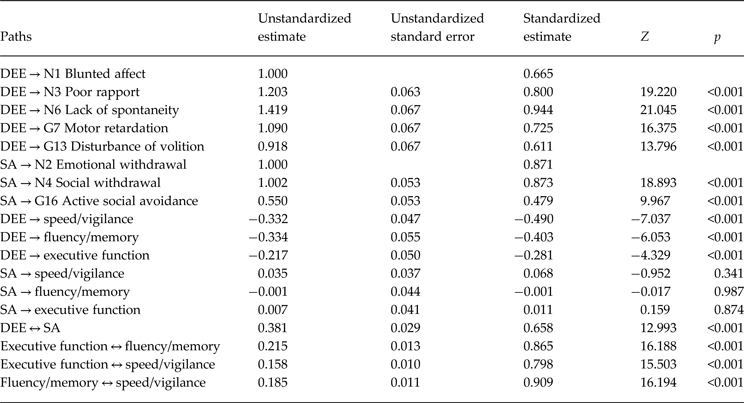
Subsequently, the relationships between the negative symptom subdomains and the cognitive domains were examined using two models. In all models, the cognitive domains were highly correlated with each other (Tables 2 and 3). In model 1 (Table 2), we examined the relationship between DEE and SA on the three cognitive domains through the regression of the three cognitive domains on DEE and SA. The model demonstrated good fit (CFI = 0.964, TLI = 0.946, RMSEA = 0.071, 90% CI 0.060–0.082, and WRMR = 1.057). DEE had significant associations with cognition but not SA. The variance accounted for executive function, fluency/memory and speed/vigilance by negative symptoms was 7.5%, 16.3% and 20.1%, respectively.
The relationship between diminished emotional expression and avolition on cognition

DEE, Diminished emotional expression; SA, social avolition.
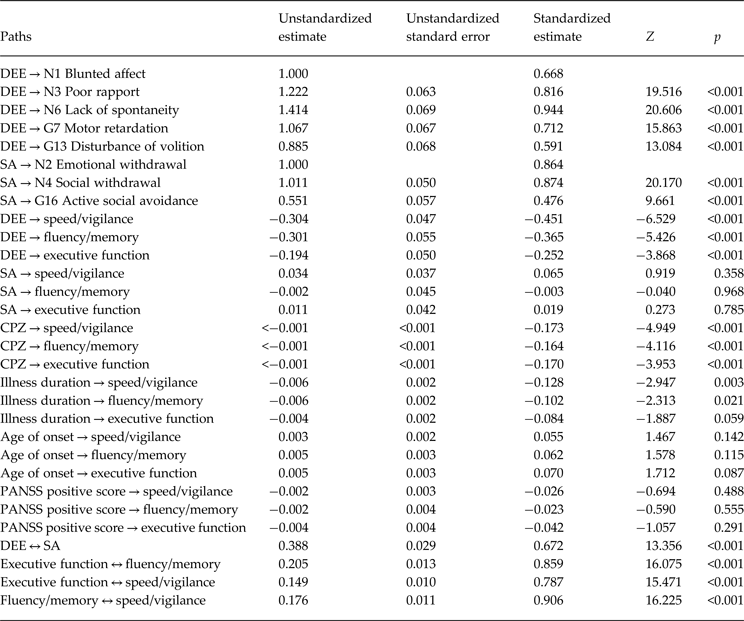
The relationship between cognition, DEE and avolition, controlling for duration of illness, daily dosage of antipsychotic medications in chlorpromazine equivalents, age of onset of illness and PANSS total score

DEE, Diminished emotional expression; PANSS, Positive and Negative Syndrome Scale; SA, social avolition; CPZ, daily dosage of antipsychotic medications in chlorpromazine equivalents in mg.
In model 2 (Table 3), we investigated the relationship between negative symptoms subdomains on cognition with duration of illness, daily dosage of antipsychotic medication in chlorpromazine equivalents, age of onset of illness and PANSS positive score as covariates. The models demonstrated good fit (CFI = 0.961, TLI = 0.944, RMSEA = 0.057, 90% CI 0.049–0.065, and WRMR = 1.237). A similar pattern was observed where DEE had significant associations with cognition but not SA. The variance accounted for executive function, fluency/memory and speed/vigilance was 11.7%, 19.3% and 23.8%, respectively.
Discussion
This study attempted to clarify the associations between negative symptoms and cognitive domains. First, our study validated the two widely accepted subdomains of negative symptoms, namely DEE and SA (Keefe et al. Reference Keefe, Harvey, Lenzenweger, Davidson, Apter, Schmeidler, Mohs and Davis1992; Blanchard & Cohen, Reference Blanchard and Cohen2006; Kimhy et al. Reference Kimhy, Yale, Goetz, McFarr and Malaspina2006; Nakaya & Ohmori, Reference Nakaya and Ohmori2008; Horan et al. Reference Horan, Kring, Gur, Reise and Blanchard2011; Kirkpatrick et al. Reference Kirkpatrick, Strauss, Nguyen, Fischer, Daniel, Cienfuegos and Marder2011; Strauss et al. Reference Strauss, Hong, Gold, Buchanan, McMahon, Keller, Fischer, Catalano, Culbreth, Carpenter and Kirkpatrick2012; Liemburg et al. Reference Liemburg, Castelein, Stewart, van der Gaag, Aleman and Knegtering2013; Fervaha et al. Reference Fervaha, Foussias, Agid and Remington2014a ). Previous studies that examined negative symptoms and cognition found small to moderate associations with executive function, verbal fluency, verbal memory, attention, vigilance, visual memory (Addington, Reference Addington, Sharma and Harvey2000; Nieuwenstein et al. Reference Nieuwenstein, Aleman and de Haan2001; Roth et al. Reference Roth, Flashman, Saykin, McAllister and Vidaver2004; Harvey et al. Reference Harvey, Koren, Reichenberg and Bowie2006; Keefe et al. Reference Keefe, Bilder, Harvey, Davis, Palmer, Gold, Meltzer, Green, Miller, Canive, Adler, Manschreck, Swartz, Rosenheck, Perkins, Walker, Stroup, McEvoy and Lieberman2006; Dibben et al. Reference Dibben, Rice, Laws and McKenna2009; Dominguez et al. Reference Dominguez, Viechtbauer, Simons, van Os and Krabbendam2009; Faerden et al. Reference Faerden, Vaskinn, Finset, Agartz, Ann Barrett, Friis, Simonsen, Andreassen and Melle2009; Konstantakopoulos et al. Reference Konstantakopoulos, Ploumpidis, Oulis, Patrikelis, Soumani, Papadimitriou and Politis2011; Chang et al. Reference Chang, Hui, Chan, Lee, Wong and Chen2014; Fervaha et al. Reference Fervaha, Zakzanis, Foussias, Graff-Guerrero, Agid and Remington2014b ; Millan et al. Reference Millan, Fone, Steckler and Horan2014; Hartmann-Riemer et al. Reference Hartmann-Riemer, Hager, Kirschner, Bischof, Kluge, Seifritz and Kaiser2015). Our study replicated and extended these findings by demonstrating that negative symptoms were consistently related to cognitive domains with stronger associations for speed/vigilance and fluency/memory compared to executive function. Additionally, by separating negative symptoms into DEE and SA, we found that these negative symptom subdomains had differential associations on cognition where DEE also showed unique associations with cognition. Although the impact of duration of illness, antipsychotic medication, age of onset of illness and level of positive symptoms were examined, they did not affect the relationship between negative symptoms and cognition, as was found in recent meta-analyses (Nieuwenstein et al. Reference Nieuwenstein, Aleman and de Haan2001; Dibben et al. Reference Dibben, Rice, Laws and McKenna2009; Dominguez et al. Reference Dominguez, Viechtbauer, Simons, van Os and Krabbendam2009).
Our study demonstrated that the two-factor negative symptoms model fitted the data well and DEE and SA were moderately correlated with one another. While some have argued that the use of a one-factor model is more parsimonious and have advocated for it (Blanchard & Cohen, Reference Blanchard and Cohen2006; Strauss et al. Reference Strauss, Hong, Gold, Buchanan, McMahon, Keller, Fischer, Catalano, Culbreth, Carpenter and Kirkpatrick2012), our study demonstrated the utility of separating negative symptoms into its corresponding subdomains as DEE had differential associations to cognition compared to SA, contributing to the validity of these constructs. Similar to prior reports (Liemburg et al. Reference Liemburg, Castelein, Stewart, van der Gaag, Aleman and Knegtering2013; Strauss et al. Reference Strauss, Horan, Kirkpatrick, Fischer, Keller, Miski, Buchanan, Green and Carpenter2013; Rocca et al. Reference Rocca, Montemagni, Zappia, Piterà, Sigaudo and Bogetto2014), we further emphasize the importance of differentiating the DEE and SA constructs.
To further refine the relationship between negative and cognitive variables, we also examined the unique associations between the negative symptom subdomains and three domains of cognition. Hartmann-Riemer et al. (Reference Hartmann-Riemer, Hager, Kirschner, Bischof, Kluge, Seifritz and Kaiser2015) found an association between DEE and verbal learning and memory, mental planning and composite cognitive score and failed to find any association between avolition and cognition. Likewise, we replicated the differential effects of DEE with cognition but had a different pattern; while DEE was significantly associated with all three domains, it had the highest association with speed/vigilance.
Harvey et al. (Reference Harvey, Koren, Reichenberg and Bowie2006) proposed that negative symptoms and cognition are separate yet dependent domains with shared concepts, etiologies, outcomes and measurements. Given that impairments in digit symbol coding are prominent in early psychosis and one of the most impaired cognitive domains in schizophrenia (Dickinson et al. Reference Dickinson, Ramsey and Gold2007), the high correlation between DEE and speed/vigilance in our sample could be reflective of underlying substrates that are common in the early phase of the disorder but longitudinal data in early episode schizophrenia is needed to confirm this. Possible common substrates include the overlaps in neural bases, level of cognitive resource and functional status. DEE is associated with impairments in ventromedial and dorsolateral prefrontal cortex (PFC), anterior cingulate gyrus, temporal cortex, amygdala, dorsal striatum and hippocampus (Gruber et al. Reference Gruber, Chadha Santuccione and Aach2014; Millan et al. Reference Millan, Fone, Steckler and Horan2014). Though further work is necessary to confirm candidate structures associated with DEE, apparent overlapping structures including PFC, hippocampus and left superior temporal gyrus are also associated with processing speed (Sanfilipo et al. Reference Sanfilipo, Lafargue, Rusinek, Arena, Loneragan, Lautin, Rotrosen and Wolkin2002). In contrast, avolition has been linked to abnormalities in the interaction between PFC and the ventral and dorsal striatum, mainly in the nucleus accumbens and caudate, which are more associated with reward and anticipatory mechanisms (Gruber et al. Reference Gruber, Chadha Santuccione and Aach2014; Millan et al. Reference Millan, Fone, Steckler and Horan2014). Hence, differing underlying neural substrates could be responsible for the differential associations between negative symptom domains and speed/vigilance and more research will be needed.
Cognitive resource limitation theory also posited that the lower level of cognition in schizophrenia decreases the amount of cognitive resources available for expression of emotions, leading to higher levels of diminished expression (Cohen et al. Reference Cohen, Morrison, Brown and Minor2012). Studies have also found that functional status had stronger associations with avolition compared to DEE (Foussias & Remington, Reference Foussias and Remington2010; Fervaha et al. Reference Fervaha, Foussias, Agid and Remington2014a ; Foussias et al. Reference Foussias, Agid, Fervaha and Remington2014; Rocca et al. Reference Rocca, Montemagni, Zappia, Piterà, Sigaudo and Bogetto2014). Hence, level of cognitive resources and functional status might be important extraneous variables to consider in the relationship between negative symptoms and cognition. Another possible explanation could be that DEE is more psychometrically stable as it consists of two more PANSS items and its indicators had higher loadings compared to SA, resulting in stronger associations with cognition. Therefore, the results seem to support the idea that both negative symptom subdomains and cognition are separate but related domains.
Clinically, the differential relationships of the negative symptom subdomains and cognition are promising and could inform prognosis and treatment planning and development. Our results offer a preliminary view that negative symptom subdomains and cognition are important features that could be capitalized upon to further elucidate biological substrates that underlie the illness and further research is needed to uncover these substrates. A further application is to utilize negative symptom domains to reduce heterogeneity and understand the variation within schizophrenia via subtyping approaches (Blanchard & Cohen, Reference Blanchard and Cohen2006; Strauss et al. Reference Strauss, Horan, Kirkpatrick, Fischer, Keller, Miski, Buchanan, Green and Carpenter2013). However, future studies would be needed to further refine these subtyping strategies.
Our study furthers the literature as we included a large sample and used cognitive domains that were derived through methodological reduction and the pooling of cognitive tests. Nonetheless, our study had several methodological limitations. First, the study utilized PANSS which does not assess other negative symptoms like anhedonia or non-SA, limiting the generalizability of our findings which future research could possibly address. The subdomains have also been criticized where DEE tended to include items that are observed while SA tended to include items that are questioned (Blanchard & Cohen, Reference Blanchard and Cohen2006; Harvey et al. Reference Harvey, Koren, Reichenberg and Bowie2006). Furthermore, PANSS G13 Disturbance of Volition might seem appropriate to be included in the SA factor but was included in the DEE factor instead. This item is rated based on observations of how the participant is able to initiate, sustain and control one's behavior in terms of actions and speech during the interview. Hence, it could be more reflective of alogia and blunted affect and was retained in the DEE factor. Therefore, the method of assessment reflects the nature of the items and limitations in the scope of the PANSS negative items. Additionally, potential confounders like general intelligence, social cognition and functional outcomes were also not measured in our study and might be of interest (Gold et al. Reference Gold, Arndt, Nopoulos, O'Leary and Andreasen1999; Dibben et al. Reference Dibben, Rice, Laws and McKenna2009). Last, this being a cross-sectional study, causality cannot be determined. Hence, we were unable to conclude on the independence of negative and cognitive domains as others have (Harvey et al. Reference Harvey, Koren, Reichenberg and Bowie2006; Foussias & Remington, Reference Foussias and Remington2010; Chang et al. Reference Chang, Hui, Chan, Lee, Wong and Chen2014).
In conclusion, our study highlights the importance of considering both diminished emotional expression and SA separately in examining the relationship between negative symptoms and cognition, as valuable information related to the individual subdomains might be masked when considered as a whole. Our findings provide a platform for future research looking at refining the complex relationship between negative symptoms and different aspects of cognition, especially in elucidating possible common substrates, and have potential clinical implications for the treatment and management of negative symptoms and cognition in schizophrenia.
Acknowledgements
This work was supported by the National Research Foundation Singapore under the National Medical Research Council Translational and Clinical Research Flagship Program (NMRC/TCR/003/2008) and the Singapore Ministry of Health's National Medical Research Council under its Transition Award (NMRC/TA/002/2012 to J. Lee).
Declaration of Interest
Richard Keefe has received investigator-initiated research funding support from the Department of Veterans Affairs, Feinstein Institute for Medical Research, GlaxoSmithKline, National Institute of Mental Health, Novartis, Psychogenics, Research Foundation for Mental Hygiene Inc., and the Singapore National Medical Research Council. He has received honoraria, served as a consultant, or advisory board member for Abbott, Abbvie, Akebia, Amgen, Astellas, Asubio, AviNeuro/ChemRar, Biogen Idec, BiolineRx, Biomarin, Boehringer-Ingelheim, Bristol-Myers Squibb, Eli Lilly, EnVivo, FORUM, GW Pharmaceuticals, Helicon, Lundbeck, Merck, Minerva Neurosciences Inc., Mitsubishi, Novartis, Otsuka, Pfizer, Roche, Shire, Sunovion, Takeda, Targacept. He receives royalties from the BACS testing battery, the MATRICS Battery (BACS Symbol Coding) and the Virtual Reality Functional Capacity Assessment Tool (VRFCAT), and is a shareholder in NeuroCog Trials and Sengenix Inc. Jimmy Lee has received an honorarium and served as a consultant for Roche in the past 3 years. All other authors declare that there are no conflicts of interest in relation to the subject of this study.