For over two years our Federal Government has experienced unprecedented deficits, in spite of increased taxes.… The first and most important and necessitous step in balancing our Federal budget is to reduce expense.… You cannot go very far with any real Federal economy, without a complete change of concept of what are the proper functions and limits of the Federal Government itself.… [The Hoover administration] is committed to the idea that we ought to center control of everything in Washington as rapidly as possible.… Ever since the days of Thomas Jefferson, that has been the exact reverse of the [D]emocratic concept, which is to permit Washington to take from the States nothing more than is necessary.… I regard reduction in Federal spending as one of the most important issues of this campaign. In my opinion it is the most direct and effective contribution that Government can make to business.
Franklin D. RooseveltFootnote 11. INTRODUCTION
In 1932, after three years of crippling economic depression in America, the Democratic Party was hoping to accomplish a rare feat: capturing the White House. Going back seventy-two years to Abraham Lincoln, eleven Republicans—but just two Democrats—had been elected President of the United States. In October of that year, the Democratic challenger, Governor Franklin D. Roosevelt of New York, gave a speech in Pittsburgh in which he did what Democratic presidential candidates had almost always done: criticized the Republican Party's policies of big government, too much economic intervention, excessive taxes, and reckless spending. Governor Roosevelt's rhetoric represented standard Democratic Party ideology about the proper role of government in domestic affairs: limited government, less centralization at the national level, less spending, and lower taxes. FDR claimed that the party's 1932 ideology, with its emphasis on a limited national government, was part of a long party tradition stretching back to “the days of Thomas Jefferson.” From our contemporary perspective, we know that FDR went on to repudiate these ideas during his New Deal presidency, durably changing the Democratic Party in the process.
The Republican Party likewise changed its ideas about economic intervention in response to the Democratic Party's New Deal. For seven decades after the Civil War, Republicans had almost always advocated for more national government power and more economic intervention than their Democratic opponents—including in the presidential campaign of 1932. However, once the New Deal increased government intervention in the economy to unprecedented levels, Republicans increasingly adopted the rhetoric of limited government and nonintervention. For those who lived through this transformation, the change in the parties’ positions, rhetoric, and ideology was striking. Looking back on the 1932 campaign, New Deal Federal Reserve Board Chairman Marriner Eccles remarked: “Given later developments, the campaign speeches often read like a giant misprint, in which Roosevelt and Hoover speak each other's lines.”Footnote 2
This transformation of Democratic Party ideology during the 1930s, from an advocacy of less government intervention to more, and the corresponding switch in the Republican Party, is just one of numerous instances in American political history of the two major parties changing their positions, rhetoric, and ideologies.Footnote 3 Given that the content and meaning of party ideologies are subject to evolution over time, what can explain these developments?
1.1. Previous Approaches
Different schools of thought have come up with different approaches to answering this question. However, those scholars who are concerned with party ideology development almost all focus on the socioeconomic determinants of party ideologies. Political historians writing in the early twentieth century emphasized how the economic class position of the two parties’ different constituencies determined the content of distinct party ideologies.Footnote 4 Political economists writing in the postwar era argued that, in a two-party system, party ideologies will move to the “center” on an ideological spatial spectrum in pursuit of the median voter.Footnote 5 Modern political scientists, following Sundquist,Footnote 6 theorize that party position change is the product of socioeconomic changes in the broader society interacting with the efforts of entrepreneurial political actors in group coalitions seeking to win elections and implement their policies. These works focus on how the demographic compositions of the two parties change as the parties respond to social and economic developments in the United States.Footnote 7
While these society-centered approaches are useful, they are insufficient. After reviewing the literature offering explanations for party ideologies in America, John Gerring concluded that there is “no general factor at work that might explain the development of American party ideologies.”Footnote 8 He faulted the previous “society-centered” attempts at explaining American party ideology development as misconceiving the role that the mass public has in shaping party ideologies, and as being unable to account for many of the changes observed in American party history. This article takes up Gerring's challenge to see if a “polity-centered” factor can help explain party ideologies in America and add to the understanding provided by earlier scholarship.Footnote 9 Recognizing that political outcomes are not simply the result of social forces, but of how those social forces interact with a particular institutional context, this article explicitly focuses on how dynamic state-society relations have influenced American party ideology development. Specifically, it shows how party control of government institutions influences change in party ideologies. In five empirical sections, I show how long-term changes in party control of unified government lead to relative changes in party theories of governance and party theories of economic intervention throughout American history.
2. THEORY: PARTY CONTROL OF GOVERNMENT AND PARTY IDEOLOGY DEVELOPMENT
Before getting to the empirical part of the article, this section will outline the political institutional theory of party ideology development that will be tested. It will define “party ideology” as an analytical concept, indicate the premises of the theory, identify the causal mechanisms at work, and explain how the independent and dependent variables will be measured.
2.1. Defining Party Ideology
It is important to distinguish between political parties and political ideologies because even though they do similar things—organize coalitions of individuals—they do so in different ways.Footnote 10 A political party is a “team of individuals,”Footnote 11 but a political ideology is a “configuration of ideas and attitudes.”Footnote 12 These ideas and attitudes are bound together by a “verbal image of the good society.”Footnote 13 In this conceptualization, ideology is “a shared body of reference—a configuration of more or less abstract ideas” that constrains the behavior of individuals.Footnote 14
Thus, a party ideology is a system of ideas shared by party members that shapes the way they think, talk, and act. As political structures, party ideologies are belief systems that shape and constrain the thinking, attitudes, decision making, and behavior of party members. Like party organizations,Footnote 15 party ideologies are created and transformed by political actors, and it is often elites who play a decisive role in determining the meaning and content of a party's ideology at any given time. As Philip Converse explained, “the shaping of belief systems of any range into apparently logical wholes that are credible to large numbers of people is an act of creative synthesis characteristic of only a miniscule proportion of any population.”Footnote 16
Political actors create, modify, and use party ideologies for the same reason that they create, modify, and use party organizations: They are useful. They are “economizing device[s]” that simplify decision making for individuals who identify with, or subscribe, to the ideology.Footnote 17 They provide “norms of cultural appropriateness” that help party members “cope with the cognitive constraints on their information-processing.”Footnote 18 They “provide the language in which groups debate and disagree.”Footnote 19 In this way, ideologies have both a limiting function and a rationalizing function.Footnote 20 They both shape, and are shaped by, the actions of individuals.
We should keep in mind that just because political actors can participate in the creation and transformation of political ideologies does not mean that they can do so exogenously or at-will. These political actors are embedded in a language community that limits the way that they even think about the activity of party ideology change. As Elkins and McKitrick explain, new “ascriptions of meaning, then, must in the most basic sense be fashioned out of what is already there. The clusters of ideas, the values attached to them, and the modes whereby they are put into words must be drawn from some common reservoir; otherwise, there can be no echoes, no recognition, no meaning.”Footnote 21
This linguistic character of ideology means that transformations of ideology are limited. Any radical changes in some part of an ideology must be paired with consistency in other parts of the ideology for it to make sense and remain relevant. For example, when Democratic Party ideology changed in the early twentieth century from advocating limited national power and limited economic intervention to advocating expansive national power and expansive economic intervention, other aspects of the party's ideology remained consistent, and familiar terms were put to new uses. Notably, Democrats refashioned the term “liberal” to no longer refer to laissez-faire, free-market policies, but to refer to expansive government power and intervention.Footnote 22
This article's treatment of the dependent variable (party ideology development) is based on the conceptualization of ideologies as composed of “idea-elements” in a hierarchy, with some parts more stable than others. The most stable idea-elements that anchor a party's ideology are “foundational ideas”Footnote 23 that explain the party's “fundamental principles,”Footnote 24 “fundamental beliefs,”Footnote 25 or “theory of ends.” These aspects of a party's ideology—like the current Democratic Party's rhetoric about social equality or the current Republican Party's rhetoric about economic liberty—are not immutable, but they rarely change. Another type of idea that helps constitute a party's ideology, less stable than the party's foundational ideas, are “theories of intervention” that “designate the areas and extent to which government should intervene” in society and the world.Footnote 26 A third type of idea within a party ideology, also more subject to change than the party's foundational ideas, are “theories of governance” that outline how governing powers should be distributed among various institutions.Footnote 27 Many observers of politics have noticed how Democrats and Republicans have frequently changed their attitudes toward, for example, executive power or judicial power over the years. Finally, a fourth type of idea in this hierarchy are specific issue positions. Thus, ideologies not only bundle issue positions together,Footnote 28 but they also bind issue positions to “more abstract or fundamental” idea-elements within the ideology.Footnote 29 While this article necessarily engages with all of these different parts of a party's ideology, it focuses specifically on the development of the two major parties’ theories of governance and theories of economic intervention.
2.2. Hypothesis
This article hypothesizes that a party in long-term control of unified government tends to develop its ideology in a way that advocates for, and justifies, relatively more national government power and economic intervention (changing its theory of governance and its theory of intervention). A more interventionist economic policy includes advocacy for more government spending, more economic regulation, more infrastructure projects, more redistribution of wealth and income, and more government social programs.Footnote 30 This position has taken on many different names and appeared in many different ideological forms over the past 230 years, including mercantilism, Federalism, National Republicanism, whiggery, the “American system,” conservatism, social democracy, progressivism, liberalism, and social justice. Similarly, this article hypothesizes that a party in opposition to unified government tends to develop its ideology in a way that advocates for, and supports, relatively less national government power and economic intervention. This includes advocacy for less government spending, lower taxes, less economic regulation, fewer infrastructure projects, less redistribution of wealth and income, and fewer government social programs. This position has also assumed many different names and forms, including whiggery, liberalism, Jeffersonian Republicanism, the “Principles of ’98,” constitutionalism, Democratic Republicanism, democracy, laissez-faire, stand-patism, conservatism, and libertarianism. It is important to note here that, in measuring party ideology development, I am not looking at absolute changes in party ideology as much as relative change in party ideology between the two major parties.
2.3. Theoretical Premises
There are two important premises underlying this article's theory. The first premise is that politicians usually want to expand and exercise the powers at their disposal, and directing the economy is one of the most important powers that government officials can exercise.Footnote 31 The desire to respond to events, exercise the powers at their disposal, and expand the powers at their disposal is a general disposition that characterizes most politicians—including presidents and members of Congress.Footnote 32 When parties with relatively noninterventionist theories of economic policy take control of unified government, their preexisting ideology will act as a constraint in making decisions to intervene in the economy. However, controlling the levers of power will prove tempting because of all the ways that they could intervene on behalf of other, more foundational, aspects of their ideology, and on behalf of themselves and the interests of their party members. Thus, as circumstances arise and as party entrepreneurs act over time, the party will tend to intervene in the economy despite their previous rhetoric.
This premise alone, however, is not sufficient to make us think that changing party control of government will lead to parties changing their ideologies. After all, politicians could simply act on their incentives to expand and exercise power without parties changing their ideologies. The second premise underlying this theory, however, is that partisans want to change their party ideology in ways that justify the actions of their co-partisans and vilify the actions of their opponents.Footnote 33 To justify and criticize the use of these powers, parties often change their theories of governance and theories of economic intervention accordingly.
2.4. Ideology versus Behavior
Although they are related, it is important here to distinguish between party ideology and the behavior of party members. Party ideology exists in language: in the rhetoric, discourses, mental frameworks, and narratives used among those who identify with the party. Ideology exists in “thinking, speech, and writing.”Footnote 34 The behavior of party members, on the other hand, exists in action. It is true, of course, that party ideology constrains the behavior of individual party members, but the nature and extent of this constraint depends on a variety of factors, including how embedded a given individual is in the mental frameworks and linguistic patterns of the party ideology; how committed the individual is, personally, to the party ideology; and what other circumstances are involved in their decision-making process. Thus, ideology and action may be aligned, but they also may be at odds. As a result, in measuring party ideology (the dependent variable of this article), it is more useful to examine language than action.
According to the political institutional theory of party ideology development tested here, members of a party exercising the powers of government institutions will often act in ways contrary to their party's ideology. Notably, when a new party takes control of unified government, the members of the party in government will often exercise the powers at their disposal by enacting interventionist economic policies—even if their party's ideology during the campaign and in the early years of their control of government calls for limited national government power and limited economic intervention.
Following up on the historical example cited above, this is what happened to the Democrats in the 1930s. With the national crisis of the Great Depression in full force—despite their previous critiques of Republican big government—the Democratic Party spent, regulated, and intervened beyond what their predecessors had attempted. President Franklin Roosevelt quickly used his party's control of unified government to pass New Deal legislation despite the party's preexisting theory of governance and theory of economic intervention.Footnote 35 The Democratic Party used the powers at its disposal to pursue other aspects of party ideology like equality, support for agriculture, and support for the urban poor, and to benefit the various groups that made up the burgeoning New Deal coalition.Footnote 36 To justify these interventions, the party rapidly changed its ideology during the 1930s to emphasize and promote progressive ideas while discarding their previous limited-government ideas.
2.5. Ripple Effects of Changes in Party Theories of Governance and Intervention
Despite these changes in party theories of economic intervention, differences in other, perhaps more fundamental, aspects of party ideology may cause the party to intervene in ways different from the ways the previous party intervened. Arguably, the Democratic Party's New Deal administration was directed at different ends, and undergirded by different ideological foundations, than the Republican Party's Square Deal administration. Nonetheless, these changes in party theories of economic intervention often have ripple effects on other aspects of party ideology. For example, when Democrats became increasingly interventionist on economic policy during the 1910s and the 1930s, this helped transform other aspects of the Democratic Party's ideology. As Gerring points out, the party shifted from a “populist” era to a “universalist” era in the mid-twentieth century.Footnote 37 The party's increasing emphasis on economic equality—articulated by Wilson and FDR—helped the party to become more concerned with humanitarianism. As Democrats evolved from being relatively laissez-faire to relatively interventionist on economic policy, they also evolved from being relatively nationalist to relatively internationalist on foreign policy.
2.6. Ingredients for Party Ideology Change
Why does this article hypothesize that long-term changes—but not short-term changes—in party control of government lead to party ideology evolution? The reason I focus on long-term changes is because the incentives that party actors face (to exercise power when in office and to justify co-partisans and criticize opponents) is not sufficient, on its own, to cause party ideology development. Ideologies, like institutions, are political structures that are not easily changed. First, party leaders face contrary incentives to maintain existing ideological positions: If ideologies are changed too often and too cavalierly, then they lose their usefulness as reputational signaling mechanisms to voters.Footnote 38 Second, because group ideologies are language discourses shared by millions of people, they typically cannot change their meaning for so many people all at once. It usually takes a long time for parties to stop using their previous rhetoric and for the new rhetoric to gain currency among politicians, interest groups, writers, activists, and party identifiers in the electorate. Finally, the longer the two parties have held divergent ideological positions, the more calcified these ideologies become and the more difficult they are to change.
Thus, several ingredients need to come together before we would expect this inertia to be overcome, and this typically takes several years. First, there must be a salient political issue (like the government's response to the Great Depression) for the parties to divide over. Second, there must be political leaders in Congress and the presidency willing to act in ways contrary to the party's previous ideological commitments. For the Democrats of the 1930s, this was President Franklin Roosevelt and his Democratic New Deal Congress. Third, once party leaders have acted contrary to party ideology and there is a new incentive to change party ideology to justify co-partisans and criticize opponents, there must be party entrepreneurs—often the leaders of a party faction—who can recognize opportunities, and assemble the necessary resources, to act on these new incentives.Footnote 39 This approach appropriates Terry Moe's “logic of institutional development”: on occasion, certain actors, operating in particular institutional settings, have the necessary incentives and resources to successfully change a party's ideology.Footnote 40 Fourth, when these party entrepreneurs are successful, different groups within the parties rise and fall in importance in accordance with the party's changing ideology. Finally, it is not enough for party elites to change a party's issue positions, talking points, and narratives in government. These new ideas, discourses, and rhetoric must be adopted by ordinary party identifiers in the electorate long enough to become durably entrenched in the public discourse and consciousness. It takes several years for all of these ingredients to come together.Footnote 41
To say that party ideologies evolve over time does not necessarily mean that the people who make up the two parties are constantly switching parties or changing their minds (although both do happen, and they are an important part of party ideology development).Footnote 42 It can also mean that certain strands of thought within the two parties become more vocal or muted depending on circumstances. For example, the libertarian Right has long been a part of the Republican Party: It was vocal during FDR's New Deal, subdued during Eisenhower's era of New Republicanism, received the party's presidential nomination for the first time in 1964 during the Democratic Party's Great Society, was subdued once again during the Nixon and Ford administrations, received the party's presidential nomination for only the second time in 1980 with the Reagan Revolution, gave way to “neoconservatives” and “religious conservatives” in the 1980s, became vocal again in the 1990s, gave way to “compassionate conservatives” during the Bush administration, and became vocal again with the Tea Party during the Obama administration. This shift in emphasis—some groups within the party becoming more influential in shaping party platforms, candidate selection, and party stances at some times more than others—is a key ingredient in party ideology evolution.Footnote 43
Given that so many ingredients need to come together, only a long-term (but not short-term) change in party control of government provides enough time for the dissonance between a party's institutional position and ideological position to be overcome—and for the necessary ingredients to be instantiated long enough to effect a durable change in party ideology. Because party ideologies are sticky equilibria, party ideology change typically lags behind change in party control of government. Thus, if a party takes control of a government institution, but then relinquishes power shortly afterwards, party ideologies are not durably changed during that short time period. For example, when Republicans took control of unified government from 1953 to 1955, Republican Party ideology moved somewhat in the direction of more government intervention in the economy, but the incentives for party ideology change lasted only two years, and the ideology change lagged long enough that there was no substantive ideological change by the time Democrats regained control of Congress. With Democrats back in control in the House and Senate, the dissonance between the Republican Party's institutional position and ideological position was resolved by a change in institutional control rather than a change in ideology.
All parties face incentives on Day 1 of unified control of government to expand the powers of the national government and intervene in the economy. However, it takes time for them to act on these incentives in opposition to their ideology, for the ideology to change in a way to justify these actions, and for any ideological changes to be instantiated long enough to be durable. As a result, the independent variable of this study is not simply a change in party control of unified government, but a long-term change in party control.
2.7. No Change in Party Control
Just as this article hypothesizes that change in long-term party control of government institutions leads to change in party theories of economic intervention, it also hypothesizes that the absence of change in long-term party control of unified government leads to relative stasis in party theories of economic intervention. This is due to the path-dependent nature of party ideologies. Absent external forces (like socioeconomic changes) and political entrepreneurs with incentives and resources, we expect that the meaning and content of ideologies will remain relatively static. The ideologies held and espoused by parties at Time 1 are likely to be held and espoused at Time 2, and the ideologies held and espoused by parties at Time 2 are likely to be held and espoused at Time 3, and so on. It is possible that the parties’ ideologies change as a result of historical contingencies or secular developments, but without a change in long-term control of unified government, the hypothesis predicts that the relative positions of the parties will remain the same.
Thus, even though American political history has had a dozen instances of the relatively less interventionist party taking control of unified government, because these are almost always short-term changes in control, they almost never lead to durable shifts in party ideology. In 1801, 1829, 1835, 1845, 1853, 1857, 1893, 1913, 1933, 1953, 2001, and 2003, the relatively less interventionist party took control of unified government, but only the changes in 1801 and 1933 led to durable changes in the relative ideological positions of the two parties with respect to national government power and economic intervention. The difference is that, in these two instances, the new party in power held on long enough to durably change the parties’ ideologies. In every other instance, the new party's control of government was quickly reversed. In these cases, there was not a long enough period for all of the ingredients necessary for ideological change to come together before the new party's unified control of government was disrupted, and the two parties lost their institutional incentives for ideological change. Only in 1801–1825, when the Republican Party had a stranglehold on unified government, and 1933–1945, when the Democratic Party dominated the national government, did the two parties’ ideologies durably change. In those instances, the changes in party ideologies became instantiated long enough to outlast the time when they lost unified control.
2.8. Other Factors that Influence Party Ideology Development
Having outlined the causal mechanisms of the theory, I recognize that changes in party control, and the resulting changes in party ideologies, are not the only factors that influence party ideology development. The most significant driver of party ideology development is public ideology development, which is the product of innumerable historical contingencies and factors including major events (like economic depressions) and major secular developments (like industrialization, immigration, and urbanization). For example, the United States, like other countries, has oscillated “between periods of greater and lesser government intervention in the economy.”Footnote 44 The parties change their positions and ideologies as the larger public changes its positions and ideologies. The study of American political culture and thought, which bears on public ideology change, has rightfully received a great deal of attention by historians and political scientists.
This article does not pretend to explain all of these broader movements in American public ideology over time. Instead, this article asks, more narrowly, what causes the ideologies of the two major parties to develop differently, in relation to each other, within this larger sphere of changes in public opinion and American political culture and thought.
2.9. Independent and Dependent Variables
As mentioned earlier, the dependent variable in this study is change in the relative movement of party ideology positions with regard to more or less national government power and economic intervention. For example, at the start of the Jeffersonian Era in 1801, Federalist Party ideology called for significantly more economic intervention than Republican Party ideology. Since the Republican Party took long-term control of unified government between 1801 and 1825, this article predicts that the Republican Party changed its ideological position to move farther in the direction of more economic intervention than their Federalist opponents did during that time period. The hypothesis is not necessarily that the two parties would actually switch positions in ideological space (although that is possible), but that the gap between the two parties would at least clearly narrow. Furthermore, it is possible that, due to secular shifts in American history, both parties moved in the direction of more economic intervention during this period. Within this general movement by society at large, however, this theory predicts that the Republican Party moved farther in that direction than the Federalist Party. Thus, it is the relative movement of the two parties’ ideologies that is being measured rather than their absolute positions.
Measuring ideological positions is inherently difficult because ideology exists in language, rhetoric, and ideas, which are not easily quantified. In his seminal study of political ideology, Philip Converse explained that the neglect of ideology as a subject of study by political scientists is a primary exhibit “for the doctrine that what is important to study cannot be measured and what can be measured is not important to study.”Footnote 45 This article attempts to measure ideology even though it is difficult. The empirical sections that follow rely on a variety measures of party ideology.
To measure party ideology, as it exists in the party organization, I have read every major party platform in American history and made note of every sentence that talks about party theories of governance and party theories of economic intervention. Party platforms are useful samples of the kinds of narratives that party members tell themselves at any given time, and they are useful records of the issue positions that party members take at any given time. Unfortunately, mass party organizations and platforms only emerged in the 1830s, so we have less consistent measures of party organization ideology at the turn of the nineteenth century.Footnote 46
To measure party ideology as it exists among the party in government, I rely on, in addition to party platforms, the writings and speeches of party leaders in government. Whether a particular presidential candidate or member of Congress truly believed what they were writing or speaking is largely irrelevant for the purposes of measuring party ideology, because we are interested in measuring not so much what any particular person believed about the role of government in society, but the kinds of things that party leaders, office seekers, and office holders told each other and their constituents about the proper role of government. This is where party ideology exists—in the narratives, mental frameworks, and discourses used by party members in discussing public policy.
I supplement these measures of ideology with an analysis of votes cast by members of Congress and the bills signed or vetoed by presidents. I do not subscribe to the assumption that roll call votes perfectly reveal ideology, but to the extent that mental frameworks and ideological narratives and belief systems constrain the behavior of a party's members of Congress, then their voting decisions can be a useful second-best proxy measurement of ideology. Using voting data, party platforms, and the speeches and writings of party leaders together can give us useful measurements of party ideology developments over the course of American history.
While it is difficult to measure party ideology, it is easy to measure party control of unified government, which is the independent variable in this model. Determining party control of Congress and the presidency is straightforward in American history, given that each of the forty-five presidencies has represented one of the two major parties, and each of the 115 Congresses has been controlled, or split between, the two major parties.Footnote 47
As mentioned before, this article focuses on changes in long-term party control of government, which is defined here as a change lasting for at least eight years. This time-span is chosen based on Skowronek's work on reconstructive politics.Footnote 48 In American politics, a one-term president is considered a blip or an aberration. A party that only captures the presidency for one term, and is then forced to relinquish power, is a party with only tenuous control of government, thus leaving a smaller mark on the course of American political development. “Reconstructive presidents” (and parties) are always at least two-term presidents, who then have successors from their same party continue their reconstructive work. Thus, in identifying periods of long-term party control, this article looks for control of unified government that lasts for at least eight years: two presidential terms and four sessions of Congress.Footnote 49
In identifying periods of change in long-term party control, this article looks at moments when the new institutional configuration is in tension with the existing party ideologies for a sustained period of time. Thus, a party's institutional position may shift from a long period of control of unified government, to divided government, to a short period of opposition, back to divided government, and back to another long period of control, but this would not represent a new party taking long-term control. This is what has happened since 1933.Footnote 50 Republicans have never taken long-term control of unified government since they lost it during the Great Depression. Thus, going back to the New Deal, the two parties have never experienced enough long-term dissonance between their ideological position and their institutional position to expect significant changes in party theories of economic intervention.
It is important to point out a potential circularity problem: It is possible that party ideology change could cause changes in long-term party control of unified government, and not vice versa. That is, it may be that the two variables coincide as predicted by the political institutional theory for a different reason: because, once in power, party ideology change toward more national government power and economic intervention causes parties to win more elections and establish long-term control of unified government. While theoretically plausible, the empirical findings in the following sections do not support this idea. For the causal relationship to work in this reverse direction, there would need to be a firm link between relative ideological position and electoral results. As it turns out, there is no substantive relationship between those two variables. All other things being equal, the party calling for relatively more government intervention in the economy has no significant electoral edge—in either the presidency or Congress—over the party calling for relatively less government intervention. While there is no significant correlation between party ideology and election outcomes—at the time of the election—there is a correlation between party ideology and party control of government in the years following a new party taking control. That is, the empirical sections of this article show that party ideologies do indeed change in the years after a new party takes control of unified government (but not before the election or at the time of the election).
2.10. Observations
This article presents data for the independent and dependent variables going back to the emergence of the two-party system in the 1790s. Narrowing the time frame to a particular era or slice of history has the added benefit of being able to do in-depth case study analysis, and broadening the time frame to all of U.S. history has the danger of treating each case too superficially. However, because there have been so few cases of change in long-term party control of unified government, in order to record enough observations to be able to draw conclusions about a trend, we must look at all of U.S. history going back to the first parties.
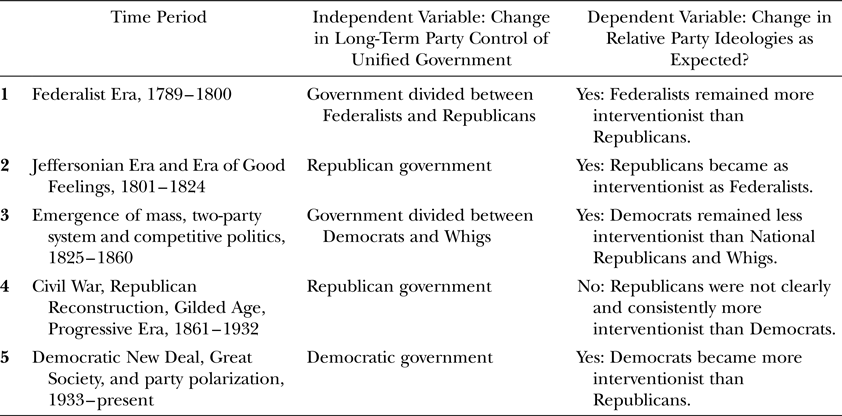
These twenty-three decades of U.S. history give us five eras of long-term party control of unified government to examine (see Table 1). The first time period consists of the infant years of the United States under the Constitution. The second time period is the quarter century after the Jeffersonian Republicans took control of unified government in the “Revolution of 1800.” The third time period is the antebellum period following the presidential election of 1824, which ended the one-party system as Republicans split between “national” Republicans and “democratic” Republicans. This period is distinguished as a separate era because two new parties emerged—Democrats and Whigs—and not because either party took long-term control of unified government.Footnote 51 The fourth time period contains the seven decades following the election of Abraham Lincoln in 1860 when his new Republican Party took control of unified government. The fifth time period comprises the eighty-five years that have followed the inauguration of Franklin Roosevelt in 1933 when his Democratic Party took long-term control. The rest of this article will analyze the development of the two major parties’ ideologies during each of these eras.
Party Control of Unified Government and Party Theories of Economic Intervention (Expectations)

3. FEDERALIST ERA, 1789–1800
During the 1790s, the first political parties emerged under the new Constitution, and the ideologies they developed matched their institutional positions. The two parties first divided over the “great principle”: determining “how strong and active the new federal government was to be.”Footnote 52 Under the umbrella of the “great principle,” the first Congresses debated issues such as the assumption of state debts, increased taxation, the creation of a national government mint, and the creation of a national bank. The party in power, the “Pro-Administration” or “Hamiltonian” Federalists, advocated for a stronger national government and more government intervention in the economy. The party out of power, the “Anti-Administration” or “Jeffersonian” Republicans, advocated for a less powerful national government and less government intervention in the economy. While many different factors contributed to the ideological positions these two parties first established, over the course of the 1790s, the party ideologies remained relatively stable, as predicted by the theory. There was no change in party control of unified government that would lead us to expect a change in the two parties’ relative ideological positions with regard to national government power and economic intervention.
The Federalist and Republican Parties were generally parties in government only, and not mass-based parties in the electorate.Footnote 53 The political entrepreneurs who played a critical role in shaping the new parties’ ideologies during this decade included Hamilton and John Adams for the Federalists and Jefferson and Madison for the Republicans. Hamilton outlined a bold economic plan for the new Congress to adopt that included more government intervention in the economy than his opponents wanted. Hamilton hoped his policies would help the fledgling republic to become a notable industrial and commercial empire. In addition to advocating the national government assumption of state debts and the creation of a Bank of the United States, Hamilton called for the national government to intervene in the economy through a system of tariffs, subsidies, and infrastructure spending. While Jefferson opposed Hamilton's policies in the administration, and Madison opposed his policies in Congress, the party battle spilled over into the public realm in 1798 when the Alien and Sedition Acts were passed by the Federalist Congress and signed by President Adams. The debates of partisan elites in Congress and in the administration became the subject of newspaper articles and popular discussion.
Given that their ideologies matched their institutional positions during most of this period, it is not surprising that the two parties’ ideologies did not change dramatically. The Federalists, following the British mercantilist school of thought, continued to advocate for more national government power and more economic intervention, while the Republicans, following the French physiocratic school of thought, advocated for less.Footnote 54 Given the Federalist Party's eight years of control of unified government, most of Hamilton's policies were passed by Congress and signed by the president, despite opposition from Jefferson, Madison, and the Republican Party they formed. The Republicans criticized Federalist interventions into the economy as unconstitutional and imperial.
Previous scholarship has rightfully pointed to the political economy of America at the turn of the nineteenth century to help us understand differences in the ideologies of the two parties. The first party divisions were, to some extent, regional divisions within the country: The Federalists in government largely came from the North, and the Republicans in government largely came from the South. Given their economic interests, Southern farmers generally called for less government intervention in the economy than Northern manufacturers.Footnote 55 These socioeconomic factors worked in concert with the institutional positions of the two parties to help the parties develop their different theories of economic intervention in the expected way.
4. JEFFERSONIAN REPUBLICAN ERA, 1801–1824
In 1801, the Republican Party took long-term control of unified government that lasted until 1824, and the relative ideological positions of the parties changed as expected. The Republicans began the period advocating much less national government power and much less intervention in the economy than the Federalists. However, over the course of the Jeffersonian Era, Republicans began to change their party's ideas, and they closed the gap between the two parties. Over the course of their time in power, the Republicans eventually adopted almost all of the policies that the Hamiltonian Federalists had previously recommended, and that the Republicans had previously excoriated. As Republican ideology adopted Federalist ideas, the Federalist Party dissolved and left a one-party system. While the Republicans changed their theory of governance and theory of economic intervention, some of the more foundational aspects of their party ideology remained largely intact.
4.1. Historical Context of the Jeffersonian Era
In the early nineteenth century, the American people, including both major parties, moved to embrace more national government power and more intervention in the economy than was generally acceptable following the first war for independence. The second war for independence, the War of 1812, exposed many of the weaknesses of the American state, and in “the first few years following the war … the spirit of nationalism was in vogue.”Footnote 56 This resulted in greater support by both parties for a stronger army, a national bank, and more national infrastructure. The expansion of American settlers beyond the Appalachian Mountains also resulted in a call for more national infrastructure projects to unify the expanding republic. Since the Republican Party ran the U.S. government, it was responsible for most of the nationalist legislation of this period, and its ideology changed to catch up with its institutional and policy positions. While the nation, as a whole, generally moved in a direction welcoming more national government power and more economic intervention, the two parties moved differently, in relation to each other, as predicted by the political institutional theory of party ideology development: The party in power moved farther in the direction of government intervention than the party out of power.
4.2. Party Control of Unified Government and Party Ideology Development
In his first Inaugural Address, Jefferson articulated his party's ideas about limited government, which were formulated during the campaigns and elections of the 1790s:
What more is necessary to make us a happy and a prosperous people? Still one thing more, fellow citizens, a wise and frugal government, which shall restrain men from injuring one another, shall leave them otherwise free to regulate their own pursuits of industry and improvement, and shall not take from the mouth of labor the bread it has earned. This is the sum of good government; and this is necessary to close the circle of our felicities.Footnote 57
In the early years of the Republican regime, Jefferson's party acted in accordance with this ideology.Footnote 58 The first Republican Congress repealed the Whiskey Tax of 1791 and the direct tax of 1798, along with the naturalization laws of 1798. In addition to signing these repeals, Jefferson pardoned prisoners who had been prosecuted under the Sedition Act. The new government reduced the size of the military, decreased the national government's debt, and decided not to renew the charter on Hamilton's Bank of the United States. However, the longer Republicans remained in control of government, the more they began to adopt the policies and ideas of their Federalist predecessors.Footnote 59
Between 1801 and 1824, the originally antinationalist Republican Party gradually moved away from its roots in anti-Federalism toward National Republicanism. One of the first ways that Republicans acted in opposition to the party's theory of governance was by purchasing the Louisiana Territory. The acquisition was justified as a way to serve the party's theory of ends because it would make possible the ideal of an agrarian republic of egalitarian yeoman farmers spread out over the vast continent. However, territorial expansion by executive agreement would violate the party's ideology because, to act quickly on the deal, Jefferson would have to exercise more national government power, in general, and more executive power, in particular, than Republicans had previously believed was proper. Given this tension between the party's theory of ends and the party's theories of governance and intervention, the more foundational theory of ends won out, and Jefferson went ahead with the executive action.Footnote 60
However, it is not as though the theories of governance and intervention were irrelevant in shaping Republican behavior. These parts of the party's ideology acted as a powerful constraint, and Jefferson's “strict-constructionist scruples” caused him much trepidation and anxiety about going forward with the purchase to more than double the size of the United States.Footnote 61 As Stephen Skowronek explained:
The leader of the party that had blasted executive usurpation under John Adams had no illusions about the fact that he lacked explicit constitutional authority to acquire the new territory, let alone an acquisition as large as the nation itself.… For a moment, as Jefferson contemplated proposing a constitutional amendment that would provide a clear ground for this sweeping exercise of power, it appeared that he might actually force a debate over the legitimacy of the action when everyone else seemed anxiously eager to accept it on its face. With hints of second thoughts in France, the prospect of a delay that might jeopardize the purchase agreements became unbearable, and Jefferson decided not to let the question of propriety get in the way of the achievement.Footnote 62
Ultimately, the more foundational aspects of Republican Party ideology held slightly more weight in shaping Jefferson's behavior than the less foundational aspects of party ideology. Thus, Jefferson decided to exercise and increase the powers at his disposal despite his party's previous rhetoric condemning the Federalist Party's expansion of national government and executive power.
After more actions like these going forward, Republicans eventually modified their theories of governance and intervention to justify these kinds of actions, but the party's more foundational ideals—like popular rule and agrarian republicanism—did not change during this time. In 1806, with a majority of Federalists and a minority of Republicans, Jefferson signed into law the bill creating the Cumberland Road: the first internal improvement of its kind. In 1807, Jefferson's concerns about foreign affairs led him to push through the Republican Congress an embargo act that restricted trade. This embargo represented an unprecedented use of government power to intervene in the economy. In 1808, Jefferson's Republican Secretary of the Treasury, Albert Gallatin, offered a report that called for $20 million in internal improvements. Commenting on this about-face, Herbert Croly explained:
Jefferson, who had been a lion in opposition, was transformed by the assumption of power into a lamb. Inasmuch as he had been denouncing every act of the Federalists since the consummation of the Union as dangerous to American liberties or as inimical to the public welfare, it was to be anticipated, when he and his party assumed office, that they would seek both to tear down the Federalist structure and rear in its place a temple of the true Republican faith. Not only did nothing of the kind follow, but nothing of the kind was even attempted.Footnote 63
Because of the dissonance between the party's preexisting ideology and the party's actions in government, Republicans faced incentives to modify their theories of governance and intervention to justify their behavior.
However, the party's ideology did not change without a fight between different factions. Jefferson's betrayal of the “Revolution of 1800” caused a split within the Republican Party between “moderate and ardent republicanism.”Footnote 64 Ultimately, though, the “nationalists” calling for more government intervention in the economy won out over those calling for less.
As the historian Henry Adams has noted, when Republicans took control of unified government, they changed their minds on a variety of issue positions, including the national debt, the size of the navy, and the national bank.
Four years had not passed since Jefferson and his party had clamored against attempts to give energy to government; and no one could ever forget that they claimed and received power from the people in order to defend State-rights, restrict Executive influence, and correct strained constructions of the Constitution. Who upheld State-rights in 1804, and complained of Executive influence and strained constructions? Certainly not Jefferson or his friends.… Whenever Jefferson had occasion to discuss the aims and opinions of the two parties, he did not allude to the principles set forth in 1798.Footnote 65
Although Adams was correct to point out the hypocrisy, Jefferson was not entirely a man of political expediency. As a principled ideologue, the transformation of the Republican Party caused Jefferson pangs of conscience, and he blamed the Hamiltonian policies of the 1790s as the original sin responsible for the mercantilist policies of his own administration: “It mortifies me to be strengthening principles which I deem radically vicious, but the vice is entailed by the first error.”Footnote 66
Despite the remorse he expressed, it is clear that Jefferson behaved “differently as President than his earlier utterances would have suggested,” and the Republican Party largely followed suit.Footnote 67 During Jefferson's second term in office, a faction of Republicans, led by John Randolph, broke with the president over what they perceived as Federalist policies being promoted by the Republican administration. These Republicans became known as “Quids” to distinguish themselves from the main body of the party, and they opposed Jefferson's administration on the Yazoo land fraud compromise, the attempt to purchase West Florida from Spain, and the trade restrictions with England.Footnote 68
Madison's succession to the presidency in 1809 moved the party in an increasingly centrist direction on the question of nationalism. In 1810, Republican “war hawks” like Henry Clay and John Calhoun from the backcountry were elected to Congress, and they called for an even stronger national government that would bind the separate states together and provide a powerful military force in international affairs. The rise of these young Republican nationalists was opposed by the previous generation of antinationalist Republicans, including the Quids, who became known as “Old Republicans.”Footnote 69 The difference between these two factions was not only a difference in issue positions but also a difference in the bundle of ideas they articulated (a difference in ideology).
The Federalist and Republican ideological positions became closer during this period mostly because of changes in Republican, rather than Federalist, Party ideology: The Republican theory of governance became significantly more nationalist, and the Republican theory of economic intervention became significantly more interventionist. While there were some Federalists who moved in a less nationalist direction in the early 1810s, the party largely maintained its earlier principles as the country as a whole moved toward Federalist ideas about national power and economic intervention.Footnote 70 However, Federalist opposition to the War of 1812 soon doomed the party to irrelevance.
By the early 1820s, former Federalists had joined the majority Republican Party, but they were not required to change their principles concerning the role of the national government. Although the Old Republicans blamed Jefferson for starting the party down the path of nationalism and interventionism, after his presidency, he, too, worried that the party was going too far. In 1822, Jefferson wrote to Henry Dearborn that the Federalists, discredited as a national party, now promoted “consolidated government” from within Republican ranks like foxes hiding “in the midst of the sheep.” As a result, Jefferson explained, “you see so many of these new republicans maintaining in Congress the rankest doctrines of the old federalists.”Footnote 71 Jefferson was concerned not simply with changes in Republican Party issue positions but also with changes in Republican Party doctrines (or ideology). The accession of John Quincy Adams, the son of the old Republican nemesis, to the presidency in 1825 symbolized the party's newly developed nationalist theory of governance.Footnote 72
Although Republican ideology continued to embrace economic intervention as more and more Republican nationalists joined Congress, the old party ideology still worked as a partial constraint on the behavior of party members, and, of course, political actors still exercised agency in opposition to the general forces at work. For example, in two different instances, Madison the constitutionalist vetoed legislation passed by a more interventionist Republican Congress. First, in 1814, Congress chartered the Second Bank of the United States, but President Madison, given his background in the ideology of the original Republican Party, worried about its constitutionality and vetoed it.Footnote 73 Second, in 1817, Madison vetoed the Bonus Bill, explaining that although he supported congressional funds being spent on internal improvements, such an authorization required a constitutional amendment before he could sign it.Footnote 74
Despite occasional vetoes by presidents from the Virginia Dynasty, Republican nationalists like Henry Clay, John Calhoun, and John Quincy Adams “dominated the party after the War of 1812.”Footnote 75 They moved the party's ideology toward more national government power as they pursued an “American System” of economic interventions—including tariffs, subsidies, and internal improvements—that echoed the mercantilist policies of the Hamiltonian Federalists but were aimed at benefiting different constituencies and used toward different ends.Footnote 76 These party entrepreneurs, acting with resources in Congress and the administration, took advantage of opportunities to change their party's ideology in accordance with the incentives they faced.Footnote 77
While the Republicans changed their party's theory of economic intervention, the Federalists, such as they were, mostly maintained their old theory of government intervention in the economy. Although some New England Federalists changed their minds about the government's power to regulate international trade, in general, they continued to advocate for mercantilist policies like a national bank, tariffs, and internal improvements. As the Republican Party expanded its dominance of American politics and adopted the Federalist theory of economic intervention, the Federalist Party dissolved.
In retirement, Jefferson followed the political events unfolding in the “Jeffersonian Era,” and he criticized the new Republican Party's adoption of Federalists and Federalism:
An opinion prevails that there is no longer any distinction, that the republicans & Federalists are compleatly amalgamated but it is not so. The amalgamation is of name only, not of principle. All indeed call themselves by the name of Republicans, because that of Federalists was extinguished in the battle of New Orleans. But the truth is that finding that monarchy is a desperate wish in this country, they rally to the point which they think next best, a consolidated government. Their aim is now therefore to break down the rights reserved by the constitution to the states as a bulwark against that consolidation, the fear of which produced the whole of the opposition to the constitution at its birth. Hence new Republicans in Congress, preaching the doctrines of the old Federalists, and the new nick-names of Ultras and Radicals.Footnote 78
This factional division within the Republican Party would set the stage for the revival of two-party politics in the antebellum period.
4.3. Other Factors that Explain Party Ideology Development in the Jeffersonian Era
Economic factors, of course, also help explain the relative shifts of the two parties during this time. Most of the American pioneers who moved west into and beyond Appalachia in the first quarter of the nineteenth century were Republicans.Footnote 79 These Westerners “needed good roads and canals to communicate and conduct their business with other parts of the country and abroad,” and so they supported a change in party ideology that justified a program of internal improvements paid for by the national government.Footnote 80 Southerners, on the other hand, were skeptical of a national system of tariffs, internal improvements, and national finance that seemed to disproportionately benefit the North and West. Thus, “Old Republicans” in the South resisted the ideological changes pushed by new Republicans in the West.
Historical contingencies, most visibly the War of 1812, also explain much of the party ideology development observed during this time. The Anglophilic Federalist Party in the North generally opposed the War of 1812, while the Republican Party in the West pressed for it. Once the war was underway, the Federalist opposition to war was seen as unpatriotic and un-American, and this opposition to war helped cause their demise.Footnote 81 Perhaps more importantly, the War of 1812 made Republicans realize the need for the development of a stronger national state.Footnote 82 For example, the transportation problems the American military faced during the war caused Republicans to reconsider their opposition to national infrastructure projects.Footnote 83 These society-centered factors and historical contingencies, along with party control of institutions, help us understand the party ideology developments we observe during this period. While it is debatable whether or not the Republican Party became as nationalist and as interventionist as the Federalist Party during this time period, it is clear that the gap between the parties that existed in the 1790s had narrowed considerably during the first quarter of the nineteenth century.
During that period, all of the necessary ingredients came together for Republican Party ideology to dramatically change. First, a variety of salient political issues emerged, including the opportunity to purchase the Louisiana Territory, the call for more internal improvements and trade protection, a growing national debt, the call for a national bank, and war with England. Second, at certain times—and to varying degrees—Jefferson, Madison, Monroe, and Republicans in Congress were willing to act in ways contrary to previous party orthodoxy on those issues. Third, seeking to justify these actions, important party entrepreneurs like Clay and John Quincy Adams changed the party's ideology by putting familiar terms to new uses. “Republicanism” became associated with nationalism, and defenders of the original faith adopted the label “Old Republican” to distinguish themselves from the new ideology that had emerged. Fourth, these new nationalists in the party—many of them “war hawks” elected from the frontier—rose in importance within the party as the Old Republicans became less influential. Finally, ordinary Republicans in the electorate began using the new narratives, rhetoric, and ideas despite the dissenting opinions of Republicans like John Taylor and an aging Jefferson, who complained that Federalists now hid like foxes in the midst of the Republican fold. This represented a durable shift in Republican Party ideology between 1801 and 1824 that would last largely unchanged through the succeeding National Republican, Whig, and Republican Parties for over a century until the New Deal.
5. EMERGENCE OF A MASS TWO-PARTY SYSTEM AND COMPETITIVE POLITICS, 1825–1860
The ideological divide within the Republican Party, described above, led to the creation of a new party system consisting of Democrats and Whigs between 1825 and 1860: Democrats generally criticized government intervention in the economy, while Whigs defended it.Footnote 84 During this time period, neither party took long-term control of unified government, and the original ideological divisions of 1825 remained largely intact throughout. The relative stasis in party ideologies observed in the antebellum period is predicted by the political institutional theory of party ideology development. While Democrats and Whigs argued over spending, taxes, internal improvements, tariffs, and a national bank, neither party could satisfy the demands of an emerging abolitionist movement in the North. This period of mass, two-party competition was punctuated by the arrival of the Republican Party, Abraham Lincoln, and Civil War.
5.1. Historical Context of the Antebellum Party System
The circumstances of the presidential election of 1824 led to the creation of the second party system. As Monroe ended his second term, it was clear that, in a one-party regime, whichever politician the Republican Party supported would run unopposed and become the next president. Thus, the party was unable to unify behind a single candidate, and four major candidates emerged instead. John Quincy Adams and Henry Clay, ardent nationalists, were the most clearly in favor of the “American system” of tariffs, internal improvements, and a national bank. William Crawford, the least nationalist of the candidates, received the support of the “Old Republicans” and an endorsement from Jefferson.Footnote 85 Crawford also received the support of a first-term radical Republican senator from New York, Martin Van Buren, who saw the presidential election of 1824 as “the proper moment to commence the work of a general resuscitation of the old democratic party.”Footnote 86 Finally, Andrew Jackson was a moderate nationalist, but more popular for his military heroics, and anti-establishment symbolism, than for any ideological issue positions.Footnote 87 Contrary to common belief,Footnote 88 Jackson did not campaign in 1824 on a noninterventionist platform. Up until this time, Jackson had been a moderate nationalist. “Jacksonian ideology,” understood as opposition to the “American System,” did not develop until after the election of 1824.Footnote 89
After Adams won election in the House of Representatives, the Republican Party quickly divided between, on the one hand, Adams and Clay supporters and, on the other hand, supporters of Jackson, Crawford, and Calhoun.Footnote 90 The residue of Federalists in New England, led by Daniel Webster, joined in support of the Adams administration. Denied the presidency despite receiving the most votes in the general election, Jackson immediately began planning to oust Adams in 1828, and Van Buren once again hoped to use the election to establish a national two-party system.Footnote 91 Van Buren successfully orchestrated the support of the radical Republicans and Old Republicans, and this coalition became known as “Democratic Republicans,” or “Jackson men,” in opposition to the “National Republicans,” or “Adams men.” Combining his own supporters, who gave him a plurality of the vote in 1824, with Crawford's supporters, Calhoun's supporters, and Van Buren's political machine, Jackson easily won the election of 1828. Jackson's reelection in 1832 caused the National Republicans to join in coalition with a variety of smaller groups opposed to the Jackson administration, and this new party—after considering a return to the “Republican” label—adopted the name “Whig.”Footnote 92 By 1836, the Democrats and Whigs had emerged as the two major parties.
Between the 1830s and the 1850s, the American public, in general, and both parties, in particular, changed their ideas slightly concerning national government intervention in the economy. Like many public policy issues, the debate over national government intervention in the economy acted like a pendulum, and by the early 1830s, the pendulum had swung back somewhat against national government power.Footnote 93 Jackson successfully campaigned against renewing the charter of the Second Bank of the United States and used his antibank campaign to secure reelection in 1832. The “Tariff of Abominations”Footnote 94 led to the Nullification Crisis of 1832–33 and helped precipitate a backlash against nationalist economic policies during the antebellum period that were tied up with the sectional crisis regarding slavery.
5.2. Party Control of Unified Government and Party Ideology Development
Once the two-party system of Whigs and Democrats was in place, neither party took long-term control of unified government. As expected, the original ideological divisions remained largely intact through the 1850s. The Jackson coalition decided to campaign against John Quincy Adams, in 1828, on the same principles that Jefferson had articulated when he opposed the incumbent's father in 1796 and 1800. Jackson's “neo-Jeffersonian” program leaned toward “the economics of laissez-faire.”Footnote 95 Of course, this coalition of Republicans opposed to Adams included a diverse group of ideological commitments, and the campaign of 1828 would not be all about the “Principles of ’98.” Indeed, Jackson's vague ideological commitments, but personal popularity, made him the ideal candidate to lead this new heterogeneous party.Footnote 96 Still, Van Buren assured his political allies back in New York that “we will support no man who does not come forward on the principles & in the form in which Jefferson & Madison were brought forward & this they will in the end all assent.”Footnote 97
The Jacksonian Democratic Party, formed in opposition to Adams and the National Republicans, generally called for less national government intervention in the economy: no federal government role in banking, lower tariffs, fewer internal improvements, and less spending. The 1840 Democratic Party platform articulated Democratic ideology by emphasizing the party's commitment to old Jeffersonian Republican theories of limited national government power and limited government intervention in the economy:
Resolved, That the federal government is one of limited powers, derived solely from the constitution, and the grants of power shown therein, ought to be strictly construed.… That the constitution does not confer upon the general government the power to commence and carry on, a general system of internal improvements.… That it is the duty of every branch of the government, to enforce and practice the most rigid economy, in conducting our public affairs, and that no more revenue ought to be raised, than is required to defray the necessary expenses of the government.… That congress has no power to charter a national bank.… That the liberal principles embodied by Jefferson in the Declaration of Independence, and sanctioned in the constitution, which makes ours the land of liberty, and the asylum of the oppressed of every nation, have ever been cardinal principles in the democratic faith.Footnote 98
The four succeeding party platforms of 1844–1856 essentially reprinted the planks of the 1840 platform verbatim. In this way, the ideology articulated in party platforms tied together the different parts of the party's ideology: foundational ideas, theories of governance, theories of intervention, and issue positions. Throughout this period, the Democratic Party typically campaigned on limited national government power, strict construction of the Constitution, opposition to internal improvements, opposition to tariffs, limited government spending, lower taxes, opposition to a national bank, and the foundational “classical liberal” ideas of Jefferson. The period from 1825 to 1860 is part of the Democratic Party's “Jeffersonian Epoch,” which was characterized by “limited government, … antistatism, and civic republicanism.”Footnote 99
The Whig Party, likewise, generally remained true to the economic ideology of the National Republicans that preceded them.Footnote 100 Throughout the antebellum period, the Whigs called for more national government intervention in the economy: for a federal government role in banking, higher tariffs, more internal improvements, and more spending. The 1844 platform indicated that the party's “principles may be summed as comprising, a well-regulated currency; a tariff for revenue to defray the necessary expenses of the government, and discriminating with special reference to the protection of the domestic labor of the country; [and] the distribution of the proceeds of the sales of the public lands.”Footnote 101 The 1852 platform specifically endorsed the idea that “the Constitution vests in Congress the power to open and repair harbors, and remove obstructions from navigable rivers.”Footnote 102 The period from 1825 to 1860 is part of the National Republican and Whig Parties’ “National Epoch,” in which party members were “mercantilists” and “statists.”Footnote 103
These party ideologies were not simply rhetoric, and they were not simply instrumental; they often actually worked to constrain the behavior of political actors. For example, in response to the Panic of 1837, even pragmatic President Van Buren “was sufficiently wedded to Jacksonian principles to resist government-sponsored solutions to the economic crisis.”Footnote 104 This inaction led to Van Buren's defeat in 1840. Political actors are not free to change their party's ideology every time it might suit them. Party ideology change requires several different ingredients, and it typically take several years for all of those ingredients to emerge. The stasis in party theories of economic intervention between 1825 and 1860 is partly explained by the absence of change in long-term party control of unified government.
For example, during his first term in office, from 1829 to 1833, Jackson enjoyed unified Democratic control of government, but not all of the necessary ingredients showed up during that short time period, and the Democrats did not become durably more interventionist relative to the National Republicans. During that time, the rechartering of the Second Bank of the United States emerged as an important political issue, but Jackson followed his and Van Buren's neo-Jeffersonian Democratic Party ideology by calling for an end to the national bank. In so doing, he resisted the temptation to simply use the power of the bank to serve his own party's purposes.
However, Jackson was not entirely a principled defender of Democratic Party ideology. During his administration, infrastructure spending increased dramatically.Footnote 105 Furthermore, Jackson enforced the Tariff of Abominations in the name of nationalism and in opposition to the states’ rights faction of his party. Despite these deviations from party ideology, no party entrepreneur emerged among the Democrats to change the party in a way that would justify this nationalism and economic interventionism. Although former National Republicans seized on the issue of executive power—naming their new party Whigs during “King Andrew's” second term in office—they did not significantly change their ideas about national government power or economic intervention. After just four years of unified Democratic control of government, the National Republicans won control of the Senate in the election of 1832, and the incentives for party ideology change were lost. Similarly, in 1845, 1853, and 1857, Democrats once again took control of unified government, but in each case government control was short-lived, and it was not enough time for all of the necessary ingredients to come together to expect party ideology change.
5.3. Other Factors that Explain Party Ideology Development in the Jacksonian Era
That the two parties maintained their theories of economic intervention is not, of course, entirely attributable to the path-dependent character of party ideologies—that is, the tendency of party ideologies to maintain their preexisting structure unless acted on by other forces. It is also a product of the political economy of the period. Although founded as a national party, uniting Southern antinationalists and Northern Federalists opposed to Jackson, the Whig Party became increasingly sectional and based in the Northeast over the course of the 1840s and 1850s.Footnote 106 As such, the Whigs had incentives to push for a national bank, high tariffs, and internal improvements that would disproportionately benefit the manufacturing and mercantile class. In this sense, the explanation offered by previous historians—focusing on the class interests of capital as opposed to agriculture—also helps make sense of this era.
The factor that underlies the entire antebellum period, however, is the issue of slavery, which holds enormous explanatory power. The Democratic Party, based in the South, was generally more supportive of slavery and its extension into the West than was the Whig Party. The Democrats feared what the national government could do if abolitionists, or opponents of slavery, came to power. As such, Democratic ideology throughout the period emphasized limited national government power and state sovereignty. In each party platform they resolved:
That Congress has no power, under the Constitution, to interfere with or control the domestic institutions of the several States; and that such States are the sole and proper judges of everything pertaining to their own affairs, not prohibited by the Constitution; that all efforts, by abolitionists or others, made to induce Congress to interfere with questions of slavery, or to take incipient steps in relation thereto, are calculated to lead to the most alarming and dangerous consequences, and that all such efforts have an inevitable tendency to diminish the happiness of the people and endanger the stability and permanency of the Union, and ought not to be countenanced by any friend to our Political Institutions.Footnote 107
The Democratic Party's strict construction of the Constitution was not only about preventing Congress from passing tariff or internal improvements legislation that disproportionately benefitted the North (as noted earlier, Democrats themselves sometimes supported such legislation), but it was also about preventing Congress from interfering with slavery. The election of a president in 1860 from a third party that was opposed to the expansion of slavery was the impetus for Southern slaveholders’ secession from the Union.
6. Civil War, Republican Reconstruction, and the Progressive Era, 1861–1932
In 1854, opponents of the Kansas-Nebraska Act, unhappy with the Democratic and Whig Parties’ willingness to allow the expansion of slavery into the Western territories, formed a new party that replaced the Whigs as the major opposition to the Democrats. These Northerners chose the name “Republican” to recall the party founded by the author of the Declaration of IndependenceFootnote 108—the party from which both Democrats and Whigs had first emerged. In the 1860s, Republicans took control of unified government, and over the next seven decades, they generally remained more supportive of national government power and economic intervention than the Democratic Party, which was out of power. While the two parties developed their ideologies mostly in accordance with what we would expect, there are two exceptions during this period.
The first exception, the 1890s, was largely the product of a demographic development and a historical contingency. The emergence of agrarian revolt, along with the political entrepreneurship of William Jennings Bryan, led the Democratic Party to adopt the Populist Party and to become more interventionist relative to the Republican Party. However, this was not a durable change in the party's theory of economic intervention, and by 1904 the Democratic Party had returned to the practice of criticizing the Republicans for high taxes, high tariffs, profligate spending, protectionism, economic regulation, and subsidies.
The second exception, the 1910s, was the product of Democrats taking short-term control of unified government—for six years during the administration of Woodrow Wilson. During their control of the national government, Democrats acted in accordance with the political institutional theory by exercising the power at their disposal, and the two parties’ theories of economic intervention changed accordingly. Once again, though, this was not a durable change in the party's ideology, and by the mid-1920s Democrats had returned to their neo-Jeffersonian ideology by criticizing Republican interventions in the economy. It was not until the New Deal that the Democratic Party shifted permanently in favor of more economic intervention than the Republican Party.Footnote 109
6.1. Historical Context
Party ideology in the 1850s and 1860s was dominated by the issue of slavery. The new Republican Party's theory of governance argued that the national government should have the power to outlaw slavery in its territories—as it did in the Missouri Compromise of 1820. The Democratic Party's theory of governance, in contrast, argued that the decision about slavery in the territories should be made through local referenda. In addition to its relatively nationalist theory of governance, the Republican Party's theory of economic intervention closely followed the relatively interventionist ideas articulated by the Whigs—many of whom became Republicans.Footnote 110
Following the Civil War, the United States experienced dramatic industrialization, immigration, and urbanization. In response to the socioeconomic inequality caused by these forces, several social democratic and progressive reform movements emerged in American politics. These insurgent reform movements represented a move by the American public, in general, and the two major parties, in particular, toward an increasing acceptance of greater national government power and intervention in the economy. The two parties’ ideologies moved in this direction at different times and in different ways, and these differences can partly be understood through the political institutional theory of American party ideology development.
6.2. Party Control of Unified Government and Party Ideology Development
With the Democratic South out of the Union, the Republican Party dominated the U.S. government starting in 1861. Republicans won six straight presidential contests between 1860 and 1880, controlled the House from 1859 to 1874, and controlled the Senate from 1861 to 1878. After Reconstruction, Democrats began winning the House in the 1870s and 1880s, but they would not gain control of unified government until 1893—and even then, it only lasted two years. During this period of Republican Party control, the GOP had incentives to develop its ideology in a way that justified relatively more economic intervention. Likewise, the postbellum Democratic Party had incentives to develop its ideology in a way that criticized Republican intervention in the economy.
6.2.1. Party Ideology Development, 1861–1892
During the Civil War and Reconstruction, Republicans, opposed by Democrats, increased the powers of the national government to prosecute the war and reconstruct the South. Notably, Republicans used their power in service of pursuing their preexisting antislavery objectives. They used the expanded power of the national government to abolish slavery; force the Confederate secessionists to surrender; pass the Civil Rights Amendments mandating manumission, citizenship, and voting rights for former slaves; establish the Freedmen's Bureau; and pass a series of Force Acts (Civil Rights or Ku Klux Klan Acts) aimed at ensuring civil and political rights for African Americans. Republicans also used the expansion of national government powers to intervene in the economy in ways that exceeded even the previous interventionist regimes of the Federalists and National Republicans.Footnote 111 The GOP pursued its policies “in a startlingly programmatic fashion, implementing fundamental coercive and redistributive measures.”Footnote 112 The Republican program was supported by a party ideology that emphasized the importance of national union and power.
Republican interventions into the economy during this period can be categorized in three ways. First, Republicans intervened by imposing and increasing taxes. They imposed the nation's first graduated income tax, established the Internal Revenue Bureau, imposed real estate taxes, and raised tariff levels to record highs.Footnote 113 Second, Republicans pursued national government infrastructure projects on an unprecedented scale. For example, the Pacific Railroad and Northern Pacific Railroad Acts provided land and financing to build railroads and telegraph lines connecting the West Coast with the Midwest. The National Currency Act of 1863 and the National Bank Act of 1864 reestablished a national bank system, which had dissolved under Jackson in 1836. Third, Republicans began to enact social democratic reforms in the wake of industrialization. For example, in 1868, the Republican Congress passed a law mandating an eight-hour work day for federal laborers, over a veto by President Andrew Johnson, and which was affirmed by President Grant's presidential proclamation after taking office in 1869.
The ideological push for economic reforms like the eight-hour work day came from social movements that responded to the socioeconomic inequalities produced by industrial capitalism. Typically, the policy proposals of these reform movements would be adopted, first, by a minor third party; second, by the more interventionist Republican Party; and finally, by the less interventionist Democratic Party. For example, the labor movement's call for an eight-hour work day was first adopted as a plank in the platforms of the Labor Reform Party in 1872, the Greenback Party in 1880, the Anti-Monopoly and Republican Parties in 1884, and the Democratic Party in 1904. The call for railroad rate regulation was first adopted as a plank in the platforms of the Labor Reform and Prohibition Parties in 1872, the Greenback Party in 1880, the Anti-Monopoly and Republican Parties in 1884, and the Democratic Party in 1896. The call for regulation ensuring workplace safety was first adopted as a plank in the platforms of the Greenback Party in 1880, United Labor Party in 1888, and the Socialist Labor, Republican, and Democratic Parties in 1892.
Party ideology development between 1861 and 1892 makes sense in light of the political institutional theory. As Republicans dominated the national government in the 1860s and early 1870s, Republican Party ideology advocated more national government power and more economic intervention than the Democratic Party. The period from 1861 to 1892 was part of the Republican Party's National Epoch, in which party members were mercantilists and statists, and part of the Democratic Party's Jeffersonian Epoch, which was characterized by limited government and antistatism.Footnote 114 “The major parties … projected contrasting stances toward the proper role of government in society and the economy.… Republicans projected activist stances for government, including the federal government.… Democrats championed state and local freedoms from federal intrusions [and] attacked economic interventions.”Footnote 115
As the two parties became competitive again, these stark differences moderated. With the readmission of Southern states after the Civil War, the Democratic Party began to win elections: The party took the House of Representatives in 1874 and even controlled the Senate in 1879–81. As Democrats increasingly exercised power in Congress, they moderated their antinationalist rhetoric and began following the Republicans in advocating for progressive legislation and social democratic reforms. The Republican penchant for economic intervention also moderated during this period. “Once the southern states rejoined the Union and shook off most Reconstruction controls, the Democratic Party again became closely competitive for national offices. The Republican Party outlived its heroic phase and settled into the normal distributive routines of patronage democracy.”Footnote 116 While the political institutional theory helps us understand party ideology developments between 1861 and 1892, it is less useful in explaining the 1890s and 1910s.
6.2.2. Party Ideology Development, 1892–1908
The developments of the 1890s are due more to a society-centered factor—the emergence of agrarian revolt—than party control of government institutions. In the first decades following the Civil War, the GOP created the foundations of the American welfare state through pensions for Civil War veterans,Footnote 117 but the one-party system of the 1860s and early 1870s also led to corruptions of power and abuses of patronage. The Republicans feared no competition from the Democrats during this period, and so they often used the suddenly large national government to provide spoils for party machines and corporate interests. By the early 1880s, Republicans had joined Democrats in “politics as usual,” and reformers did not see either party advocating their cause.Footnote 118 At the same time that the Republican Party's “heroic phase” was ending, reformers within the party grew restless, and many third parties emerged to take over the GOP's reform legacy.
The Populist Party's remarkable showing in the presidential election of 1892 and its capture of 10 percent of the vote in the midterm elections of 1894 made the two major parties take notice. As an agrarian movement based in the South and West, it especially caught the attention of the Democratic Party, which took control of unified government in 1893 for the first time since before the Civil War. Up until the 1890s, the Democratic Party in opposition had mostly ignored the populist movement, and party ideology had continuously affirmed its commitment to Jeffersonian ideas of limited government. The Democratic President, Grover Cleveland, was a laissez-faire Bourbon Democrat, who had vetoed veterans’ pensions and drought relief bills while advocating for lower taxes and less spending. Thus, despite having unified control of government in 1893–1894, the Democrats did not have a president willing to take advantage of the power at his disposal as Cleveland—like Madison before him—resisted the incentives he faced to expand his presidential powers.
Although Cleveland, personally, was constrained by party ideology, the Democratic Party did have members of Congress willing to respond to the demands of its party base of populist farmers in the South and West. In 1894, the Wilson-Gorman Tariff Bill lowered the rates of the 1890 McKinley Tariff—a perfectly predictable move by a Democratic Congress—but to make up for lost revenue, the bill also included a tax of 2 percent on income over $4,000. The bill became law without Cleveland's signature. After passing that bill, Democrats lost control of Congress to the Republicans for the next sixteen years, and they had no other interventionist economic legislation that they needed to defend. Thus, there was no clear settlement between the two parties’ factions.
The events of the party convention of 1896 illustrate the Democratic Party's newly ambiguous ideology. Heading into the convention, the party was torn between the “Gold Democrats,” who opposed monetizing silver and who were less interventionist on economic policy, and the “Silver Democrats,” who favored monetizing silver and who were more populist and interventionist. However, “a speech by William Jennings Bryan, delivered in defense of the silver plank in the majority platform, played a critical role shaping the preferences of delegates” at the 1896 convention.Footnote 119 Bryan's nomination brought the Populist Party into the Democratic fold and alienated the Cleveland Democrats. This historical contingency of political entrepreneurship helps us understand how Democratic ideology became relatively more interventionist in the late 1890s without a long-term change in party control of unified government.
This ideological evolution, however, was not a durable shift in the Democratic Party's theory of intervention, and the Republicans quickly reestablished themselves as more interventionist. An analysis of party platforms from that period shows how the Democratic Party did not become completely committed to national government power and economic intervention. The 1896 platform, nominating Bryan the populist, still opened with neo-Jeffersonian and neo-Jacksonian ideas about limited national government power:
We, the Democrats of the United States in National Convention assembled, do reaffirm our allegiance to those great essential principles of justice and liberty, upon which our institutions are founded, and which the Democratic Party has advocated from Jefferson's time to our own—freedom of speech, freedom of the press, freedom of conscience, the preservation of personal rights, the equality of all citizens before the law, and the faithful observance of constitutional limitations. During all these years the Democratic Party has resisted the tendency of selfish interests to the centralization of governmental power, and steadfastly maintained the integrity of the dual scheme of government established by the founders of this Republic of republics. Under its guidance and teachings the great principle of local self-government has found its best expression in the maintenance of the rights of the States and in its assertion of the necessity of confining the general government to the exercise of the powers granted by the Constitution of the United States.
The next three sections describe the Democratic Party platform calls for bimetallism, opposition to “interest-bearing bonds,” and opposition to national banks. The platform included some interventionist language advocating for enlarging the powers of the Interstate Commerce Commission to regulate trusts and railroads. However, the platform then moved back to traditional Democratic language criticizing tax-and-spend Republicans: “We denounce the profligate waste of the money wrung from the people by oppressive taxation and the lavish appropriations of recent Republican Congresses, which have kept taxes high.… We demand a return to that simplicity and economy which befits a Democratic Government, and a reduction in the number of useless offices, the salaries of which drain the substance of the people.”
After the unusual campaign of 1896, in which the Democrats for the first time seemed to be relatively more interventionist than the Republicans, the two parties soon returned to their standard positions. In 1900, the GOP platform called for, among other things, antimonopoly legislation, national labor insurance, stricter child labor laws, the creation of a national highway system, and rural free postal delivery service. The presidential campaign of 1904, between progressive Republican incumbent Theodore Roosevelt and conservative Bourbon Democratic challenger Alton B. Parker, marked the GOP as once again significantly more interventionist than the Democrats. As TR explained in his autobiography, the ideological developments of the 1890s were an interruption in the general trend of Republicans being more progressive, nationalistic, and interventionist than the Democrats:
The Republican party, which in the days of Abraham Lincoln was founded as the radical progressive party of the Nation, had been obliged during the last decade of the nineteenth century to uphold the interests of popular government against a foolish and ill judged mock-radicalism.… The men who … claimed to be the radicals, and their allies among the sentimentalists, were utterly and hopelessly wrong. This had, regrettably but perhaps inevitably, tended to throw the party into the hands not merely of the conservatives but of the reactionaries; of men who … distrusted anything that was progressive and dreaded radicalism. These men still from force of habit applauded what Lincoln had done in the way of radical dealing with the abuses of his day; but they did not apply the spirit in which Lincoln worked to the abuses of their own day. Both houses of Congress were controlled by these men.… I achieved results only by appealing over the heads of the Senate and House leaders to the people, who were the masters of both of us. I continued in this way to get results until almost the close of my term; and the Republican party became once more the progressive and indeed the fairly radical progressive party of the Nation.Footnote 120
During the 1890s, the adoption of Bryanism within the Democratic Party and the corresponding adoption of “conservatism” in the Republican Party was the product of a society-centered factor —the emergence of agrarian revolt in the regions dominated by the Democratic Party—and Bryan's political entrepreneurship.
While the Democrats continued to advocate populist measures in the early twentieth century, they still retained their Jeffersonian rhetoric about limited government. Despite support for progressive legislation by many Democrats in Congress, the party's ideological heterogeneity prevented it from becoming the programmatic reform party that it later became under FDR and LBJ. Although both parties had more and less interventionist factions within their heterogeneous coalitions, Republican Party ideology included a theory of governance that called for more national government power than Democratic Party ideology. Thus, Republican economic ideology was more interventionist than Democratic ideology. Herbert Croly noticed this difference in the parties when he described the differences between William Jennings Bryan and Theodore Roosevelt:
The whole tendency of [TR's] programme is to give a democratic meaning and purpose to the Hamiltonian tradition and method. He proposes to use the power and the resources of the Federal government for the purpose of making his countrymen a more complete democracy in organization and practice; but he does not make these proposals, as Mr. Bryan does, gingerly and with a bad conscience. He makes them with a frank and full confidence in an efficient national organization as the necessary agent of the national interest and purpose. He has completely abandoned that part of the traditional democratic creed which tends to regard the assumption by the government of responsibility, and its endowment with power adequate to the responsibility as inherently dangerous and undemocratic.Footnote 121
Because the country as a whole moved in favor of social democratic reforms and government regulation of the economy from the 1890s through the 1910s, both major parties moved in this direction. However, the Republicans’ theory of governance facilitated TR's bold advocacy in this direction.
6.2.3. Party Ideology Development, 1908–1932
While the GOP had returned to being more interventionist than the Democrats during the Roosevelt administration, the presidential election of 1912—like the election of 1896—would interrupt this normal development of party ideologies. When TR chose not to run for reelection in 1908, he turned the presidency over to his protégé William Howard Taft, who agreed with TR's approach “in all essentials of policy” and who TR hoped would have better success in putting their “principles into practice.”Footnote 122 In some respects, Taft was even more receptive to the progressive factions of the party than Roosevelt.Footnote 123 However, when Taft pressed the antitrust case against U.S. Steel, after TR had declined to do so for particular reasons that he took great pains to articulate, the former president took this as a personal insult to his progressive credentials. Furthermore, when the Republican coalition of Old Guard conservatives and progressive reformers began coming apart during the Taft administration, TR decided to seek the party's 1912 nomination to reunify the party. At the contested Republican Party convention in Chicago, chairman Elihu Root—“the dominant force” and a Taft supporter—articulated interventionist and progressive principles that characterized the party's ideology during the previous decade of GOP governance: When “the conditions of modern industrial life require that government shall intervene in the name of social justice for the protection of the wage earner, the Republican national administrations … have done their full, enlightened and progressive duty.”Footnote 124 Root specifically praised Republican regulation of the railroads, antitrust laws, the Pure Food law, natural resource conservation, and the income tax amendment.
When the party renominated Taft in 1912, TR bolted from the GOP, and a new Progressive Party formed around his “Bull Moose” campaign. By taking the insurgent wing of the GOP with him to the Progressive Party, TR made the Republican Party much less interventionist than it was and no more interventionist than the Democratic Party. Thus, the 1912 election featured a radically progressive candidate in the Progressive Party, a moderately progressive candidate in the Republican Party, and a moderately progressive candidate in the Democratic Party.Footnote 125
Although the Democratic Party had adopted many populist and progressive issue positions into its party ideology since the 1890s, they still celebrated the principles of Thomas Jefferson, and they still criticized Republican extravagance in taxing and spending during the Democratic National Convention of 1912. The Republican Party, on the other hand, not only continued to fill its platform with planks about labor laws and infrastructure projects but also articulated the “progressive” ideology that supported those positions: “[The GOP] has been genuinely and always a party of progress; it has never been either stationary or reactionary. It has gone from the fulfillment of one great pledge to the fulfillment of another in response to the public need and to the popular will.… It is prepared to go forward with the solution of those new questions, which social, economic, and political development have brought into the forefront of the nation's interest” (Republican National Convention 1912). Nonetheless, to show its opposition to the emerging socialist and radically progressive movements, the 1912 platform was the first in party history to voice limitations on government power. Specifically, the platform defended the freedom of the individual to control “his own justly acquired property.”
Although we remember the Wilson administration for its leadership in passing progressive legislation to intervene in the economy, Wilson—like many presidents before him—governed as an interventionist much more than he campaigned as one. The 1912 Democratic Party platform was not very interventionist in comparison with the platforms of the Progressive Party and Republican Party. However, Wilson, “whose New Freedom Campaign was far more sympathetic to the decentralized state of courts and parties than TR's, felt compelled—or saw the opportunity—as president, to govern as a New Nationalist Progressive.”Footnote 126 After three years in office, in 1916, Wilson and a Democratic Congress began to pass the “New Nationalist” policies called for by TR in 1912 and by the progressive New Republic magazine during Wilson's first term in office. This change caused many progressives to support Wilson's reelection bid rather than support the progressive Republican challenger Charles Evans Hughes.Footnote 127
During Wilson's administration, the Democratic Party changed its ideology to justify the interventionist legislation passed by the unified Democratic government. Similarly, the Republican Party changed its ideology to become less interventionist on economic policy and to criticize the legislation passed by a unified Democratic government. While Wilson could have chosen to govern as a progressive outside of the party, he chose instead to make the Democratic Party progressive.Footnote 128 During the Wilson administration, the Democrats came around to the positions of the GOP on defense spending, merchant marine subsidies, women's suffrage, federal funding for education, government subsidies, and internal improvements, despite having criticized Republicans on these very issues in earlier platforms.
In contrast, the 1916 GOP platform was the first in party history to include free-market language (the Democrats, in contrast, had used this discourse going back to the 1830s):
The Republican party believes that all who violate the laws in regulation of business, should be individually punished. But prosecution is very different from persecution, and business success, no matter how honestly attained, is apparently regarded by the Democratic party as in itself a crime. Such doctrines and beliefs choke enterprise and stifle prosperity. The Republican party believes in encouraging American business as it believes in and will seek to advance all American interests.Footnote 129
The 1916 platform criticized the Democrats for wasteful spending in national budgeting and for proposing government ownership of the merchant marine instead of just subsidies. In 1919–20, the Republican Congress repealed Democratic wartime legislation by privatizing the railroads and telegraph and telephone lines. The 1920 platform was the first in Republican Party history to criticize the expansion of the national government. Reminiscent of Democratic rhetoric during Reconstruction, the GOP platform specifically criticized the Democrats for continuing wartime measures after the end of World War I.
Just as in the 1890s, however, these changes in party theories of economic intervention were not permanent. Although Democratic ideology changed during the party's six years of unified government, they did not maintain control of government long enough for those ideological changes to be made durable in the party at large. Republicans took back control of Congress in 1919 and the presidency in 1921. For the next dozen years, Democrats returned to being a party in opposition to unified GOP government. During the 1920s, Republicans returned to the economic interventions they had pursued before the Wilson administration, and their party ideology followed suit—but this return took longer than we might otherwise have expected. The succession to the presidency of Calvin Coolidge, upon the death of Warren Harding, helped stall the party's ideological development. Like Madison, Cleveland, and Taft before him, Coolidge's singular commitment to constitutional government caused him to act with more trepidation toward national government power than we would otherwise expect given his party's institutional position.Footnote 130 By the time the party nominated progressive politician Herbert Hoover to the presidency, however, the GOP had returned to being more interventionist than the Democrats.Footnote 131
A content analysis of party platforms going back to 1920 demonstrates this point. To measure how interventionist the Republican and Democratic Party platforms have been on economic policy, I created a novel index of “economic intervention scores” for each platform using the Manifesto Project Dataset's (MPD's) coding of platform sentences.Footnote 132 Each platform's score represents the net percentage of the platform's quasi-sentences advocating economic intervention. To calculate this score, the total percentage of sentences calling for less intervention (based on six MPD categories) was subtracted from the total percentage of sentences calling for more intervention (based on 14 MPD categories). In 1920 and 1924, the Democratic Party platforms advocated more economic intervention than the Republican Party platforms, but in 1928 and 1932, the Republicans advocated for more intervention. In every presidential campaign since 1936, the Democratic Party platform has advocated for more intervention than the GOP platform (see Appendix 1).
The 1924 GOP platform modestly listed a few of its many economic interventions, but the 1928 platform boasted of the party's interventions. Specifically, the GOP emphasized the Republican government's tariff protections of American labor, reclamation of arid lands, the expenditure of $325 million “for the construction of flood control works,” the expansion of the Department of Agriculture, the expansion of Rural Free Delivery routes by the Post Office, and emergency relief administered by Secretary of Commerce Herbert Hoover in the wake of the Mississippi Valley flood. In the 1932 platform, the GOP peaked in its justification and celebration of economic intervention.Footnote 133 Echoing Croly's celebration of Progressive interventions in the economy to solve the problems of the industrial age, and foreshadowing LBJ's rhetoric concerning a war on poverty, the Republican Party announced: “Republicans, collectively and individually, in nation and State, hereby enlist in a war which will not end until the promise of American life is once more fulfilled.” The platform listed as its accomplishments, among other programs, stimulus spending toward private and governmental construction, the creation of the National Credit Association, the creation of the Railroad Credit Corporation, the increased injection of capital to federal land banks, the creation of the Reconstruction Finance Corporation, the enlarged powers of the Federal Reserve System, the coordination of public and private relief agencies, government aid to agriculture, aid to veterans, and labor reforms. The platform then concluded with a long list of calls for more intervention in bank regulation, monetary policy, home loans, labor legislation, transportation, and internal improvements, among others.
Many Democrats, like many Republicans, also moved toward their pre-Wilsonian ideology in the 1920s. The platforms of the 1920s repeatedly criticized the Republicans for not repealing during peace time the high taxes that the Democrats had “devised under pressure of imperative necessity to produce a revenue for war purposes.” The 1928 Democratic platform criticized high Republican tax rates not only because of the costs to individuals, but because of the disincentive it provides to business and because of the extravagance it leads to in government expense:
The taxing function of governments, free or despotic, has for centuries been regarded as the power above all others which requires vigilant scrutiny to the end that it be not exercised for purposes of favor or oppression … tax burdens which, if not unendurable, do in fact check initiative in enterprise and progress in business. Taxes levied beyond the actual requirements of the legally established sinking fund are but an added burden upon the American people, and the surplus thus accumulated in the federal treasury is an incentive to the increasingly extravagant expenditures which have characterized Republican administrations. We, therefore, favor a further reduction of the internal taxes of the people.Footnote 134
Democrats not only criticized Republicans for taxing, but also for too much regulation and spending. Although they proposed some government interventions to help farmers, they criticized Coolidge for proposing relief to agriculture “through a reduction of American farm production”—a policy that the party itself would advocate during the New Deal.Footnote 135 After the onset of the Depression, Democrats blamed the GOP's big government policies and called for “an immediate and drastic reduction of governmental expenditures” and “the removal of government from all fields of private enterprise.”Footnote 136 Thus, it is no surprise that candidate Franklin Roosevelt, on the campaign trail, “argued that Hoover had given the nation too much government and his program was busting the budget.”Footnote 137
Despite his own ideological predispositions as a member of the New York aristocracy and a cousin of famous Progressive president Theodore Roosevelt, when speaking as the Democratic Party's candidate for president in 1932, Roosevelt mostly articulated standard Democratic ideology. As noted at the beginning of this article, FDR worried in his speeches about the extravagance of federal spending under Republican control and argued that “the first and most important and necessitous step … is to reduce expense.” He criticized the GOP for being “committed to the idea that we ought to center control of everything in Washington as rapidly as possible.” He recommended, instead, the Democratic Party's idea, consistently articulated “since the days of Thomas Jefferson,” to “permit Washington to take from the States nothing more than is necessary.” FDR regarded “reduction in Federal spending as one of the most important issues of this campaign” and “the most direct and effective contribution that Government can make to business” in the battle to pull the economy out of the Great Depression.
Even when he spoke less as a representative of Democratic Party ideology and more from his own personal views, FDR did not stray far from the party's mainstream. In his “Forgotten Man” speech, which he explicitly prefaced as not representative of Democratic Party ideology, FDR made some progressive arguments for government intervention, but he ultimately justified it as simply directing existing government policies away from corporations and big business and toward small farmers. In terms of articulating a theory of economic intervention, FDR criticized the Republican Party's attempts to solve the Great Depression through government spending (what later became known as Keynesianism):
It is the habit of the unthinking to turn in times like this to the illusions of economic magic. People suggest that a huge expenditure of public funds by the Federal Government and by State and local governments will completely solve the unemployment problem. But it is clear that even if we could raise many billions of dollars and find definitely useful public works to spend these billions on, even all that money would not give employment to the seven million or ten million people who are out of work. Let us admit frankly that it would be only a stopgap.Footnote 138
Although he left his suggestions for positive government policy vague, in this speech his one concrete proposal was to decrease government intervention in the economy by decreasing taxes on imported goods. These kinds of proposals were consistent with Democratic Party rhetoric in the years prior to 1932.
By nominating Herbert Hoover as their candidate in 1928 and 1932, the Republican Party demonstrated its progressive bona fides. Contrary to the myth of Hoover as a laissez-faire, stand-pat of the Old Guard, he was an energetic, progressive administrator. Hoover followed TR into the Progressive Party in 1912, served as a progressive in the Wilson administration in 1917–18, and became “The Great Progressive Hope” in the 1920 presidential election cycle.Footnote 139 In 1920, Louis Brandeis and the New Republic—among many other progressives—attempted to get him to run for president. In one of the ironies of history, on January 2, 1920, FDR wrote to their mutual friend, Hugh Gibson: “[Hoover] is certainly a wonder, and I wish we could make him President of the United States. There could not be a better one.”Footnote 140 Not only did Hoover campaign as a progressive, he governed as one, too:
Far from ignoring the severity of the situation, he employed the metaphors of wartime to combat it and became the first American president to meet a downturn in the business cycle with massive governmental interventions. Far from being shocked into paralysis, he secured virtually all his major proposals, including some critical departures from past practice. Far from standing fast against innovation, his administration anticipated much of what would occur during the early years of the New Deal.Footnote 141
During the 1920s and early 1930s, the Republican and Democratic Parties developed their theories of governance and economic intervention in accordance with their institutional positions. The two parties’ ideologies were not only reflected in their distinct issue positions but also in the distinct ideas they articulated.
6.3. Coding the Republican Era of Civil War, Reconstruction, and Progressivism
Over the course of seven decades, from the Civil War to the Great Depression, the parties largely developed their ideologies as predicted by the political institutional theory. During most of this time, Republicans in control of government argued for greater national government power and economic intervention, while Democrats in opposition argued for less. The two exceptions were associated with Democrats taking short-term control of unified government.
In 1893, the Democratic Party took control of unified government for the first time since before the Civil War, and in the 1890s Democratic ideology became as interventionist as Republican ideology. First, a salient political issue—“the absorption of wealth by the few, the consolidation of our leading railroad systems, and the formation of trusts and pools”—provided an opportunity for the two parties to debate and disagree.Footnote 142 Second, Democratic leaders in Congress (but not in the presidency) were willing to vote in ways contrary to previous party ideology. Third, the political entrepreneurship of William Jennings Bryan at the 1896 Democratic National Convention provided a new set of narratives, ideas, and discourses to be used by party members. And, fourth, the influence of the Bourbon Democrats waned as the influence of the Populists waxed. However, these new ways of speaking and thinking did not become entrenched in the party, and by the 1900s, Democrats had returned to being less nationalist and less interventionist than the Republicans as the GOP took back control of unified government after only a short period of time.
In 1913, thanks to the Progressive Party split from the GOP, Democrats once again took control of unified government, and in the 1910s Democratic ideology once again became just as interventionist—if not more so—than GOP ideology. First, the social, economic, and political causes promoted by progressive reformers provided a variety of issues over which the parties could disagree and debate. Second, after a few years in office, President Wilson and his Democratic Congress were willing to act in opposition to previous Democratic Party ideology. Third, the political entrepreneurship of President Wilson provided a new set of narratives, ideas, and discourses to be used by party members. And, fourth, the influence of traditional Democrats waned as the influence of progressive Democrats waxed. However, these new ways of speaking and thinking did not have enough time to become entrenched in the ordinary party membership, and by the late 1920s, Democrats had returned to being less nationalist and less interventionist than the Republicans as the GOP took back control of unified government.
Although the developments of the 1890s and 1910s were not durable, they were still significant. Therefore, I do not code this era's ideological changes as developing in accordance with the hypothesis. While one could argue that, overall, the parties developed as expected, I only code an era as following the logic of the political institutional theory if the ideologies clearly and consistently developed as expected. There is enough ambiguity during this era that it does not meet the exacting standards of this test.
7. DEMOCRATIC NEW DEAL, GREAT SOCIETY, AND PARTY POLARIZATION, 1933–PRESENT
The history of American party ideology development since 1933 is known well enough that it does not need to be recited in detail here. The relative positions that the two parties staked out on economic intervention in the mid-1930s are the relative positions that the parties have held for the past eighty-five years. During FDR's New Deal, the Democratic Party intervened in the economy more than either party had ever before advocated. In doing so, the Democrats repudiated their previous theory of governance, opposed to national government power, and their previous theory of economic intervention. Likewise, the Republicans moved away from their previous commitment to national government power and criticized the New Deal in language that was similar to the rhetoric used by Democrats during the Hoover administration and throughout the nineteenth century.
The Democrats took control of unified government in 1933 and held onto unified control through 1946. Since that time, the parties have alternated between divided government, short-term control for the Republicans and Democrats, and long-term control for the Democrats. Without a change in long-term party control of unified government since the New Deal, the political institutional theory of party ideology development predicts that the two parties will maintain their relative ideological positions on national government power and economic intervention. This is exactly what we have observed. The GOP has taken control of unified government twice, for brief periods of time, since 1933. Both instances showed Republicans governing more as nationalists and interventionists than we would have expected from the party's previous rhetoric, but the party's control of unified government never lasted long enough to expect changes in the theory of economic intervention.
In 1954 a Republican Congress passed, and President Eisenhower signed, an expansion of Social Security that increased benefits and covered 10 million more people. The Republicans also passed the St. Lawrence Seaway and the Housing Acts of 1954. We would not have expected these legislative landmarksFootnote 143 given the party's theory of economic intervention in the late 1940s and early 1950s. Although Republicans and Democrats had political issues to debate, and Republicans had party leaders willing to act in opposition to the reigning party ideology, there was not enough time for party entrepreneurs to develop new ideology, for party factions to rise and fall, and for new ideological discourses to become instantiated among ordinary party identifiers.
Similarly, in 2003, a Republican Congress passed, and President George W. Bush signed, a significant expansion of Medicare. The Republicans also passed legislation appropriating $286 billion for transportation infrastructure and $29 billion for Hurricane Katrina relief. Once again, we would not have expected these bills given the party's ideology and rhetoric in the years leading up to Republicans taking control of unified government. Just as in the 1950s, although Republicans and Democrats had political issues to debate, and Republicans had party leaders willing to act in opposition to the reigning party ideology, there was not enough time for party entrepreneurs to develop new ideology, for party factions to rise and fall, and for new ideological discourses to become instantiated among ordinary party identifiers.
In both cases, after Republicans gained short-term control of unified government, they passed interventionist economic policies, but they did not durably change their party ideologies to have a more nationalist theory of governance or more interventionist theory of economic intervention. This is exactly what the political institutional theory of party ideology development predicts: When a party takes control of unified government, they tend to exercise the powers at their disposal to intervene in the economy (even if they campaigned on noninterventionist ideas and with noninterventionist rhetoric). Exercising the powers of government gives parties an incentive to change their theory of governance and theory of intervention, but this incentive alone is not sufficient for party ideologies to change. Several other ingredients are necessary for change, and parties often lose control of unified government before all of those ingredients for change come together, and before the changing ideology becomes instantiated.
It is worth noting that, just as in all historical eras, there have been instances in the past eight decades when certain Democratic and Republican politicians have acted contrary to their party's overall ideology with regard to theories of governance and economic intervention, but the ideologies themselves have remained fairly consistent on these points. For example, in the 1970s, Republican President Richard Nixon signed many bills (party behavior) passed by Democratic Congresses that expanded the power of the national government and expanded the government's intervention into the economy. Nonetheless, the ideas, rhetoric, and narratives articulated by Republicans (party ideology) throughout the 1970s remained relatively opposed to national government power and economic intervention. Thus, despite the relatively nationalist and interventionist actions of the Nixon and Ford administrations, according to the MPD, the 1976 GOP platform was one of the least interventionist platforms in party history (see Appendix 1). This is a good example of how party behavior and party ideology can sometimes diverge.
In an era where divided government is the norm, party ideologies have remained relatively unchanged with regard to economic policy. As a result, American politics has been characterized by ideological stasis, calcification, and polarization as seen in the rhetoric used by two warring parties (regardless of how similar their actions may be). We are currently witnessing the longest period in American history without a change in long-term party control of unified government, and we are also witnessing deeply polarized ideology and rhetoric. It will be interesting to see what happens to party control of government in the coming years. In 2017, for just the third time since 1933, Republicans took short-term control of unified government. The political institutional theory of party ideology development indicates that the GOP now faces incentives to expand and exercise the powers at their disposal—the same incentives they faced in 1953–54 and 2003–06. If this develops into long-term control of unified government, we would have another test of the political institutional theory.
8. CONCLUSION
Based on the track record of the past 230 years of U.S. political history, if the GOP's current control of unified government lasts longer than just one or two sessions of Congress, then we should expect the party to start acting in ways contrary to the party's previous and current limited-government, noninterventionist ideology. Under a potential second term for President Trump, Republicans might start expanding the size and scope of the national government to promote other, more fundamental, aspects of the party's ideology. For example, in this future scenario, the party might increase the powers of the federal government to go after illegal immigrants or to increase government surveillance of U.S. citizens in the name of national security—despite the party's continued rhetoric about shrinking the size of the national government and executive bureaucracy. If they control unified government long enough, perhaps Trump and a Republican Congress might begin intervening in the economy with policies like increased taxes on trade, increased taxes on U.S. companies operating overseas, and increased spending on infrastructure—despite continued Republican rhetoric about free-market economics and the importance of not intervening in the private sector. With each additional expansion and exercise of government power, the parties would face incentives to change their ideologies: Republicans would face incentives to change their ideology in ways that justify these interventions, and Democrats would face incentives to change their ideology in ways that criticize these interventions.
If this unified GOP control lasts longer than one presidential term, then this might provide enough time for other necessary ingredients to come together for ideological change—in the same way that the two parties’ relative ideological positions changed in 1913–1918. A reelected President Trump might provide the political entrepreneurship necessary for Republican Party ideology to move in a relatively populist, nationalist, and interventionist direction—just as the Democratic Party did in the early twentieth century. If the unified control lasts longer than eight years, then we should expect the two parties’ ideologies to change in durable ways—as they did in 1801–1824 and 1933–1946. However, if Democrats take back one of the houses of Congress, or take back the presidency, in 2018, 2020, or 2022, then we should not be surprised if the old theories of governance and the old theories of economic intervention continue on into the foreseeable future.
In sum, American history can be divided up into five eras based on long-term party control of unified government, and this gives us five predictions about party ideology development. In every period but one, the parties’ theories of governance and theories of economic intervention clearly developed as expected (see Table 2). The five cases briefly examined here lend support to the idea that changes in party control of unified government lead to changes in party theories of economic intervention. Further research should examine whether changes in party control of other government institutions (e.g., the Supreme Court and the presidency) lead to change in other aspects of party ideologies. This scholarship adds to our previous understanding of party ideologies by helping political scientists recognize how a political factor can help explain party ideology development.
Party Control of Unified Government and Party Theories of Economic Intervention (Results)

APPENDIX 1. LEVEL OF ECONOMIC INTERVENTIONISM IN MAJOR PARTY PLATFORMS, 1920–2016