Social policy as an academic practice
The charm of social policy compared with longer established academic practices is threefold: it is a field of study, not a discipline, it is heavily concerned with empirical enquiry and the practical testing of ideas, and it is value centred. Academic disciplines are typically defined in terms of an object of study and a distinctive theoretical framework and associated methodology (Alcock, Reference Alcock1996: 3). A disciplinary approach is helpful in defining the central questions and in establishing a tradition in which progress can be made in studying them, but carries the penalty that it diverts attention from issues of less importance within the paradigm. Social policy has the advantage of being a broad field of study in which various disciplines, including economics, history, law, political science, psychology, public administration and sociology are deployed, and in which there is a considerable amount of multi-disciplinary and some interdisciplinary work. Its disadvantage is that those whose assumptive worlds are framed within a particular discipline may find difficulty in engaging with the assumptive worlds of other disciplines. This problem is exacerbated when a disciplinary approach that sets stringent parameters to the issues it considers relevant, rational actor economics, becomes powerful in defining the intellectual framework within which problems are understood and policies developed at the level of government.
Various definitions of social policy centre on social welfare (Manning in Alcock et al., Reference Alcock, Erskine and May2003: 35), social need (Langan, Reference Langan1998; Spicker, Reference Spicker1995) or a range of areas of concern (Baldock et al., Reference Baldock, Manning and Vickerstaff2007: 6–8). In these debates, the concept of need occupies a central place as the object of social policy. It is often suggested that need is a normative concept: specification of need implies judgement about what ought to be provided to meet the need (Doyal and Gough, Reference Doyal and Gough1991; Goodin and Ware, Reference Goodin and Ware1991; Plant et al., Reference Plant, Lesser and Taylor-Gooby1980).
A further complication is that, since autonomy is a defining characteristic of being human, the specification of human needs beyond a basic and general level of survival requires provision for people to develop and flourish, for their pursuit of individual plans of life. Thus, welfare embraces the meeting of physical needs (shelter, food, health care) and the provision for a measure of autonomy (basic security and education: Plant, Reference Plant1991). Doyal and Gough expand this to include social needs for communication, social organisation and political liberation (1991, section II). Sen and Nussbaum point out that, for reasons of cultural deprivation, constrained education, lack of access to opportunities or limited imagination, some groups may not be able to conceive, let alone aspire to, the life-plans available to others. They expand the concept of positive freedom to include not just the support to realise one's existing plans, but also an equal capacity to form such plans across society (Sen, Reference Sen1985; Nussbaum, Reference Nussbaum2000; Burkhardt, Reference Burkhardt2007: 14–15).
Following the increased emphasis on autonomy and the individual capacity to choose, needs-based analysis of welfare has tended to shift from a top–down to a more bottom–up approach, from prescriptive to agent-centred accounts. It becomes increasingly difficult to discuss the object of academic social policy without taking into account the plans, desires and aspirations of ordinary citizens and the barriers and opportunities that circumscribe their social world. Interest in the choices people make and the courses of action they follow is further strengthened by the fact that agency in response to opportunities is becoming increasingly important in current social policy practice as well as in theory. Here a problem arises. The disciplines deployed in social policy analysis typically tackle agency in radically different ways.
Individual rational actor accounts of agency have become increasingly prominent in social policy-making. The idea that people make deliberative rational choices as individuals underpins the claim that incentives will encourage suppliers and users of services to deploy resources to achieve welfare ends efficiently. These incentives are provided by the combination of target systems and competitive markets and quasi-markets that constitute a major element in the contemporary ‘revolution’ in social policy-making (Bartlett et al., Reference Bartlett, Roberts and Le Grand1998). The individualisation and privacy of goals is central to one of the most influential positions in these debates. These are conceived of as external to the process and context of choosing and as entirely private matters established according to the taste of the individual actor. Welfare systems ‘should be designed . . . to be robust . . . so that the same action appeals to both the knight and the knave’ (Le Grand, Reference Le Grand2003: 168). Both are grist to the quasi-market mill.
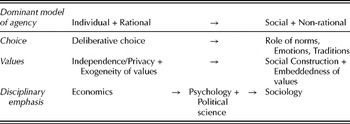
Social science disciplines may be ranged along a spectrum according to the importance attached to individual rational action. To simplify, this approach dominates neo-classical economics (Hargreaves-Heap et al. Reference Hargreaves-Heap, Hollis, Lyons, Sugden and Weale1992: 9–11; Loomes, Reference Loomes and Mehta2007), is less influential in political science and psychology and enters analysis alongside other approaches in sociology (Table 1). Weber, for example, distinguishes more traditional, emotional and value-driven rationalities from the formal rationality of deliberative judgement (Weber, Reference Weber, Henderson and Parsons1947: 130).
A simplified spectrum of agency

Rational actor approaches, coupled with targeted increases in resources, have been associated by their advocates with improvements in outcomes in a number of areas (Lee, Reference Lee2006). However, the approach may lead to problems, since relevant issues may not be recognised in the framework. One issue is the extent to which the behaviour of service-users may contradict the expectations of policy-makers because embedded social values conflict with the interests generated by the incentives the policy manipulates. Another is the role of values as against deliberative assessment of likely developments in building the social trust necessary to secure social cohesion and longer-term support for an inclusive welfare state, especially when outcomes are uncertain.
Individual goals and social values
The rational actor approach posits that the goals of action are individual and exogenous to the model. Positions closer to the sociological end of the spectrum of paradigms of agency challenge both assumptions. They argue that normative systems shared across social groups exert considerable influence on the values that define people's goals, and that the values that inform social institutions influence people's understanding of the right way to behave. One question immediately arises: if society influences the values of its members, how far are people simply ‘cultural dupes’, and how far are they active and creative in the construction of their society (Berger and Luckman, Reference Berger and Luckman1966: 51–5)?
An important contribution to this debate is Gidden's theory of structuration. Giddens claims that ‘social structure only exists in and through the activities of human agents’ (Reference Giddens, Held and Thompson1989: 256; see Hoggett, Reference Hoggett2001, 38 for a fuller discussion). He goes on to develop an account of people as reflexive agents, always able to give reasons for what they do. Those reasons include social values. Thus people choose values and make their society, but do so in the context of their life within and their reflection on social structures.
This approach has been much discussed. Important critiques by social policy writers stress the significance of real constraints of ethnicity, sexuality, age, gender, class and social exclusion in relation to agency (Lister, Reference Lister2004; Deacon and Mann, Reference Deacon and Mann1999). Lister emphasises social processes of ‘othering’, which deny recognition and respect as well as resources to the poor. Hoggett points to the additional role of emotions, including shame and stigma, particularly relevant to understanding the damaging impact of victim-blaming policies (2001: 52–4). Williams and other colleagues argue for the complexity of the ‘relational and social dynamics of moral agency’: ‘when people act they do not do so simply with reference to themselves, but in and through their relationships and commitments to others’ (Deacon and Williams, Reference Deacon and Williams2004: 387).
From this perspective, individual rational choice can only be a partial account of agency. People are active in the way they construe and negotiate moral values, but they are constrained in their opportunities to act in ways that are not always conscious, explicit and subject to deliberation. In addition, their notions of what is ‘the proper thing to do’ are embedded in their social relationships. For example, shared values about obligations to provide social care for kin (Ungerson, Reference Ungerson1987), to prepare for and pursue paid work (Dey, Reference Dey2006: 685; Dean and Taylor-Gooby, Reference Dean and Taylor-Gooby1992) or the authority of law (Hobbs, Reference Hobbs2001) may shape the life-course and influence choices.
Duncan and Edwards argue that values that stress the primacy of mother care over paid work are more common among particular social and ethnic groups and exert a substantial influence on responses to the incentives offered to encourage single parents into paid work in diverse ‘gendered moral rationalities’ (Duncan and Edwards, Reference Duncan and Edwards1999; see also Duncan and Irwin, Reference Duncan and Irwin2004). A corresponding logic may be applied to social care practice more generally (Deacon and Williams, Reference Deacon and Williams2004).
Using Bellah et al.'s approach to embedded values as ‘habits of the heart’ (Reference Bellah, Madsen, Sullivan, Swidler and Tipton1986), Baldock and Ungerson analyse the range of responses to new policies designed to promote informed individual choice among those experiencing heart disease who are allocated resources to purchase individual community care packages (1996). Only a minority (typically those with high levels of cultural capital) successfully took on the role of empowered discriminating consumers. Many maintained passive clientelist roles, confused by the expectation that they should take on the status of active welfare market consumer (see also Smith, Reference Smith2001). Dean and Taylor-Gooby found that many benefit recipients experienced the intrusion of more stringent work tests as demoralising because people whose values are bound up with a work ethic were treated as if they were driven by immediate self-interest. One claimant referred to ‘a sullen type of what you call passive resistance . . . if we are all scroungers . . . we might as well act like ones’ (1992: 121–2).
Other studies analyse the motivations and value identities of social sector workers. A number of studies show that motivations in the public sector often differ from those in the private sector. For example, in a survey of 400 managers in the public, private and voluntary sectors, Steele found that a ‘desire to benefit the community’ was the strongest motivation among the first group, while the ‘prosperity of the organisation’ ranked highest among the second (Reference Steele1999: 13; see also Buelens and Broeck, Reference Buelens and Broeck, Van Den2007; Public Services Productivity Panel, 2002). The approach that understands such values as nourished or eroded in social contexts rather than simply private and independent stresses the significance of the social setting in shaping values and hence motivations. Hoggett and colleagues stress the significance of inter-subjective and discursive processes in the persistence or evolution of social values. They argue that ‘workers bring their values and identities to this environment to engage in complex negotiations about commitment and motivation’ (2006: 770, see also Hebson et al., Reference Hebson, Grimshaw and Marchington2003). An individualist approach to motivation ignores the social processes through which such values are sustained and negotiated, and risks undermining the ‘discursive space’ (Hoggett et al., Reference Hoggett, Mayo and Miller2006: 769) which is central to such identities.
For these and other reasons, policies suggested by the rational action paradigm may produce disappointing results. Many people do not share the values of the assumptive world of policy-makers and when faced with policies that assume rational deliberative behaviour become ‘increasingly puzzled, embittered and, in some case, frightened’ (Baldock and Ungerson, Reference Baldock, Ungerson, Edgell, Hetherington and Warde1996: 31).
Reason, values and social cohesion
Successful welfare states depend on a measure of social trust. Rational deliberation may lead citizens to the view that social insurance is a good way to provide for various contingencies, or that collective health care is efficient, but support for major tax-financed services requires two further assumptions:
• that you can trust other citizens, especially those who anticipate a different likelihood of needing provision, to contribute their share, and
• that you can trust the service not just to be generally competent and efficient but also to meet your individual needs when these are urgent.
Different social science disciplines approach trust differently. At the economic end of the spectrum of agency and among many economists and some political scientists and psychologists, mutual trust and cooperation are seen as based on the alignment of incentives (Dasgupta, Reference Dasgupta and Gambetta2000; Gambetta, Reference Gambetta2000; Hardin, Reference Hardin2002). Rational agents will tend to follow individual incentives and, when these correspond, cooperation will be achieved. Trust in this view is the belief that incentives correspond and that the other will recognise and follow the incentives, that the interests of the trustee ‘encapsulate’ those of the truster.
Mainstream discussion of trust in psychology typically combines both individual rational action and social value paradigms in what is sometimes referred to as the ‘dual process’ approach (Weyman and Kelly, Reference Weyman and Kelly1999: 28–9). A substantial quantity of empirical work from this perspective in a wide variety of contexts indicates that trust is based on both reasoned judgements and social values (for example, Cvetovich and Lofstedt, Reference Cvetkovich and Löfstedt1999). Towards the sociological end of the spectrum of agency, the role of social values is emphasised even more strongly (Luhmann, Reference Luhmann1979; Sztompka, Reference Sztompka1999). These values are seen as central to the sustenance of social cohesion and inclusion in an increasingly diverse society, in which it may be more difficult to secure alignment of incentives between more or less privileged groups.
The leading economic and sociological traditions differ on the status of the values that provide the goals for action. Individual rational actor theory understands such goals as exogenous to the model, as solely a private and personal concern. Theories that emphasise socialisation see the institutional frameworks in which people live their lives as influencing, but not determining, their values. Thus values are not comprehended independently from such frameworks, but are better understood as ‘embedded’ within them (Polanyi, Reference Polanyi1944; Smelser and Swedberg, Reference Smelser and Swedberg1994; Granovetter, Reference Granovetter1985). From this perspective, shifts in institutions may influence social values and thus behaviour.
From a rational actor perspective that treats such values as exogenous to the model, the point is irrelevant. Whatever their overall impact on social values, incentives will still supply motives. The problem is to devise institutions that direct behaviour appropriately. Such institutions will be more useful to the extent that they can robustly accommodate different values to produce the desired outcomes, as suggested by Le Grand (Reference Le Grand2003). Problems arise if the values that inform the new institutions created by welfare reforms themselves impact on social values outside the model of individual rational action in a way that undermines general support for state welfare.
The positions adopted towards the sociological end of the spectrum of agency tend to see social trust and social cohesion as substantially based on shared values; at the economic end rational judgements about the coincidence of individual motives are much more important. The outcome is that sociologists are likely to see the introduction of rational actor policies within the welfare state as potentially damaging to frameworks of social trust, which are of central importance in maintaining support for the welfare state, because they weaken cohesive social values, while economists are much less likely to recognise this as an issue.
Incentives and trust: practical issues
The view that securing trust is primarily about the alignment of incentives often leads to interest in the detail of how incentives operate and in modifying targets to achieve the appropriate response, for example through the use of ‘smart contracts’ (Le Grand, Reference Le Grand2003: 58–60; Dixit, Reference Dixit2002). This approach can lead to real improvement in provision. A careful review of research on competition in health care concludes ‘at best, the literature suggests that greater competition between hospitals can improve outcomes, but the institutional design is critical’ (Propper et al., Reference Propper, Wilson and Burgess2006: 554). However, it also requires continual attention to the development of incentive systems to outflank game-playing by service providers. The example of a number of NHS managers who vitiated accident and emergent waiting time targets by keeping patients waiting off-site in ambulances or by counting an initial non-professional greeting encounter as ending the wait for treatment is well-known (Bevan and Hood, Reference Bevan and Hood2006).
Here the issues of social values discussed above return. There is considerable dissatisfaction with the assumptions implicit in the micro-management of incentives among the professionals and managers directly affected (Hoggett et al., Reference Hoggett, Mayo and Miller2006: 761). From the rational action perspective, the concerns stem from a conflict between private and public interest and provide evidence of the impact of the new approach. From a perspective that includes values in its account of trust, they indicate tension between the extent that policies designed to modify behaviour indicate limited official confidence in the capacity of those delivering policy to promote public interest and professional identities and commitments (Power, Reference Power2004: 13; O'Neil, Reference O'Neill2002). Recognition of the value aspects of trust helps to explain why workers who believe themselves to be conscientious and committed express repugnance at the detailed management of accountability through targets and incentives, which leave no place for the recognition of a public service ethos.
From the viewpoint of service users, the value account suggests that confidence that NHS staff share values with and are committed to treating patients as people rather than simply responding to the incentives set by targets is important. The perception that the NHS is increasingly driven by competition for resources within a quasi-market and by pursuit of targets rather than patient interests may lead to a decline in confidence (Calnan and Rowe Reference Calnan and Rowe2005: 14; Appleby and Alvarez-Rosete, Reference Appleby, Alvarez-Rosete and Park2005: 132–3; Taylor-Gooby, 2007). Similar policies elsewhere may generalise the erosion of public trust across the welfare state.
The current context of social policy-making
Academic approaches to social policy increasingly refer to agency. They do so within a changing context. Considerable attention has been paid to the challenges confronting welfare states as a result of the transition to post-industrial and post-Keynesian societies. An influential view is that the climate for those wishing to improve provision is ‘harsh’ (Pierson, Reference Pierson2001: 456).
Modern welfare states were established in most developed countries during the period of stable growth following the Second World War. Recent challenges to the stability of these systems include: pressures on budgets from fiscal globalisation; on labour costs (including social insurance) from the globalisation of commerce; on security of employment and unionisation from labour market shifts, including the growth of the service sector; on dependency from population ageing; on social care from shifts in family structure; and on policy as national governments are constrained in their use of exchange and interest rates to promote employment and regulate economic activity. These are reinforced by the shifts in citizen expectations and assumptions as people become less deferential and better educated (for summaries see Pierson, Reference Pierson2001: Chapter 3 or Jessop, Reference Jessop2002).
Two further issues are particularly relevant to the future potential for sustaining cohesive social policies in the UK: the increase in ‘pinnacle’ inequality as a result of the substantial rise in the incomes and wealth of small privileged minorities, although incomes for most groups at the bottom end of the distribution are also improving (ONS, Reference ONS2005; Rowntree Foundation, 2006); and the indications that equality of opportunity is declining for many groups, although it has improved for well-educated women (Blanden et al., Reference Blanden, Gregg and Machin2005; Breen, Reference Breen2004: Chapter 8). Some uncertainty attaches to the findings on equality of opportunity since data are limited and the analyses refer to long-run social processes. Pinnacle inequality and constrained opportunities put additional pressures on social cohesion.
The response of government
Governments face two broad problems in the changed context of policy-making. Firstly, they must find ways of meeting both long-standing and newly emerging needs cost effectively. This leads to policies designed to constrain spending, promote efficiency and enhance productivity. Secondly, they must achieve these goals in a way that retains enthusiasm for the system among voters. This is increasingly difficult as society becomes more diverse and as top-end inequalities extend. It requires not only efficient use of resources but also attention to responsiveness and to the tailoring of services to divergent needs within an accepted overall legitimatory framework.
A number of writers have discussed the development of a distinctive New Labour approach to social policy (for example, Powell and Hewitt, Reference Powell and Hewitt2002; Driver and Martel, Reference Driver and Martel2006). The new policies place great stress on individual responsibility and pro-activity, whether in make work pay and welfare-to-work policies, designed to ‘activate’ those who are not in paid employment, in quasi-market policies intended to make managers and professionals in health care, education and other services more cost efficient and responsive to service users, or in the emphasis on individual consumer choice in regulated private pensions, ‘choose and book’ and choice of school.
Targeting and regulation are increasingly intrusive in relation to welfare-to-work and work–life balance (especially for groups like single parents) and in the micro-management of state sector professionals, linked by some to the authoritarian strand in New Labour communitarianism (Deacon and Mann, Reference Deacon and Mann1999: 425–30). These approaches underpin an ideology of equality for active citizen-consumers, contributing to society through work, the improvement of their social capital and care for dependents at particular life stages, and choosing in quasi-markets, between regulated and responsive service-providers.
This approach has proved enormously successful in permitting the Labour party to gain a series of electoral victories and in expanding Labour's middle-class vote (Butler and Kavanagh, Reference Butler and Kavanagh1997). Whether it will remain attractive against a continuing decline in equality of opportunities and increase in top-end inequality is uncertain.
The final feature of the change concerns the link between the intellectual frameworks and the mechanisms for delivering policy. The expansion of market systems and more stringent targeting has been extensively discussed (Taylor-Gooby et al., Reference Taylor-Gooby, Larsen and Kananen2004). The intellectual framework here is again based on an individualised rational actor logic, both in relation to the citizens who use welfare state services and the managers and professionals who provide them. On the one hand, an emphasis on choice and the provision of information on service quality requires individual citizens to exercise agency rationally and equips them to do so. On the other, service-providers in more decentralised budget-holding agencies are expected to respond to the incentives of target systems and of market competition to provide what users want cost effectively.
The Treasury has attained a distinctive position in UK policy reform as the natural home in government of the rational actor paradigm, as the agency responsible for devising the quasi-market systems and as the central provider of the framework within which targets are set and monitored.
The role of the Treasury
While the new policy framework has been extensively discussed, the procedures for putting it into practice and particularly the role of the Treasury in the design, implementation and operation of the new policies has received less attention (Deakin and Parry, Reference Deakin and Parry2000, is a notable exception). As economic policy has traditionally dominated social policy, so the Treasury has always set limits for social spending and developed a series of measures to extend its control (Baldock et al., Reference Baldock, Manning and Vickerstaff2007: 278–83). The striking features of the system developed under Gordon Brown, a particularly powerful chancellor and one who was unusually engaged in social policy, are:
• Many of the new and most important policy developments take place within the direct control of the Treasury rather than the spending departments. This applies particularly to non-state pensions (tax-subsidised and fiscally regulated), the tax-credit system, which plays the leading role in welfare for the working population and for low-income pensioners, and in the new child care strategy.
• The Treasury has replaced previous systems for monitoring and regulating departmental spending with the Comprehensive Spending Review. The distinctive features of the new approach are that it deals not only with budgetary allocation and spending constraint but also specifies in considerable detail through Public Service Agreements the framework in which individual departmental programmes will operate and the targets they are expected to meet, and is firmly under the control of the Treasury. The Agreements break down what the department is expected to achieve in terms of objectives and performance targets, which makes possible a rigorous and public system of monitoring against published targets for each sub-area of departmental activity. The Treasury is now able to intervene in directing activities within departments on a precise and co-ordinated basis. This represents a ‘step change’ (Treasury, 2006) in policy implementation. It has involved a major expansion of Treasury staff to supply the expertise to enable realistic supervision to be delivered (see Talbot, Reference Talbot2006). There are some indications that the framework will be less detailed from 2008, giving a stronger role to consumer pressures in quasi-market competition.
• Many new policy departures have been implemented following policy reviews carried out by experts appointed by the Treasury to Treasury terms of reference. The process of building consensus around policy initiatives and promoting them is pursued very much under Treasury auspices. The intellectual frameworks shaping the proposals produced by this method tend to reflect the individual rational actor approach dominant among economists. For example, the Gershon review of public service efficiency (Reference Gershon2004) stresses the importance of achieving efficiency savings by requiring departments to submit detailed plans specifying targets and then ensuring that the success with which those targets are met is monitored; the Wanless report (Reference Wanless2002) makes the case for extra NHS spending, and links this to further managerial reforms and an emphasis on ‘setting national standards’ and ‘ensuring the right incentives and targets’ (Chapter 6, paras 6.23–6.37, Summary); Barker (Reference Barker2004), on housing, is primarily concerned with encouraging individual rational actors to participate in ‘a more flexible housing market’ (Summary, para 10); Stern (Reference Stern2006) addresses climate change through carbon-trading and additional fiscal and regulatory measures, mainly Treasury-led (Summary, ix).
The peculiar salience of the Treasury in devising, managing and monitoring reform enables policies informed by a rational actor approach to be stringently and vigorously formulated and implemented. This framework of ideas is translated into the target and market programmes involving particular assumptions about incentives and agency. The discussion in the first section indicates that these approaches have both strengths and limitations. The various disciplines that contribute to academic social policy offer a range of paradigms of agency. The accounts, which point to difficulties in the rational action perspective, tend to be strongest in those disciplines that are least well represented in the Treasury approach. As a result, they are unlikely to receive appropriate weight in policy discussion.
Conclusion: assumptive worlds and social policy
Social policy as an academic practice has particular strengths: its central commitment to values, its interest in empirical exploration and testing and the disciplinary flexibility that comes from its status as a field of study. This paper argues that an individual rational actor logic is becoming increasingly influential in policy-making. This logic has arguably achieved positive outcomes in improved cost efficiency in some areas of welfare. However, the way in which it directs attention to the rational aspects of agency and away from the role of social values and emotions generates real problems. These include difficulties in understanding the possibility that the values held by some groups may lead them to act against the expectations of policy-makers, even when the policies define their interests in ways that should produce the expected behaviour, and declining public trust in services even though these are seen to be competent and efficient, because the new approach compels staff commitment upwards, to targets, rather than outwards, through a caring service ethos that embraces and respects the needs of users.
From the individual rational stance that is dominant in much current economic thinking and influential in policy-making, these issues are hard to recognise. Values are personal, private and exogenous to the model, so value differences are of secondary importance to the structure of incentives. Trust is primarily a matter of rational deliberation about interest, so value commitments again become tangential. All these issues are likely to become more pressing as a result of cultural diversity, pressures on social integration and the growth of pinnacle inequality, all connected in different ways with globalisation. The capacity of the social policy tradition to combine a range of disciplinary viewpoints offers a distinctive contribution and one that merits greater recognition in an increasingly mono-disciplinary policy-making world. Wright Mills and others have charged social scientists with the responsibility embraced in the tradition of the Society of Friends: to ‘speak truth to power’ (see Wildavsky, Reference Wildavsky1987). It is not easy to do so when the conceptual frameworks and the languages of power-holders and their constructive critics differ.
Acknowledgements
This paper benefited from discussion with Alice Lakeman, Rose Martin, Robert Page, Jan Pahl, Fiona Williams and anonymous referees.