Are apex courts always political? Contemporary studies of the effect of ideology on judicial voting behavior suggest that the relationship is strong and consistent in cases involving civil, political, or economic rights (Segal and Cover Reference Segal and Cover1989; Segal and Spaeth Reference Segal and Spaeth2002; Ostberg and Wetstein Reference Ostberg and Wetstein2007; Weinshall, Sommer, and Ritov Reference Weinshall, Sommer and Ritov2018). However, there is less evidence of the comparative strength of the relationship between judicial ideology and voting behavior in cases that do not involve civil, political, or economic rights (Segal and Cover Reference Segal and Cover1989; Epstein and Mershon Reference Epstein and Mershon1996; Segal and Spaeth Reference Segal and Spaeth2002; Ostberg and Wetstein Reference Ostberg and Wetstein2007; Sag, Jacobi, and Sytch Reference Sag, Jacobi and Sytch2009; Weinshall-Margel Reference Weinshall-Margel2011; Epstein et al. Reference Epstein, Martin, Quinn, Segal and Hanson2012; Weinshall et al. Reference Weinshall, Sommer and Ritov2018). This is not to claim that no studies have examined ideology and judicial behavior outside of the context of rights. Indeed, in both the US and comparative judicial behavior literatures scholars have examined the relationship between ideology and voting behavior on apex courts in either non-rights-based cases or in a sample that includes both rights and nonrights cases (Staudt, Epstein, and Weidenbeck Reference Staudt, Epstein and Weidenbeck2006; Hönnige Reference Hönnige2009; Sag et al. Reference Sag, Jacobi and Sytch2009; Alaire and Green Reference Alaire and Green2017; Hanretty Reference Hanretty2020). However, where research has focused on—or included substantial numbers of—nonrights cases, these studies measure ideology as a latent artifact of judicial votes (using item response modeling) rather than as a temporally prior predictor of votes. Thus while it finds that ideology and voting are related in nonrights cases on apex courts, it says little about the predictive effect of judicial ideology on voting behavior (Smyth Reference Smyth2005; Staudt et al. Reference Staudt, Epstein and Weidenbeck2006; Hönnige Reference Hönnige2009; Popelier and Bielen Reference Popelier and Bielen2019; Hanretty Reference Hanretty2020).
In this article we address this gap. The key argument of this article is that judicial ideology measured before appointment is predictive of postappointment voting behavior in both rights-based and non-rights-based cases. We examine the relationship between a judge’s reported ideology and their subsequent voting behavior using the High Court of Australia as our case study and disaggregating judicial voting behavior across rights-based and non-rights-based cases. Australia presents an ideal context in which to study this question. It remains the only liberal democracy without a bill of rights, and, consequently, the High Court—Australia’s apex court—generally hears issues involving questions of rights only when raised by ordinary statutes or common law (Robinson Reference Robinson2011). Yet, the Court has many institutional features that should encourage judicial ideological expression: tenured judges, control of its own agenda, and lack of electoral accountability (Segal and Spaeth Reference Segal and Spaeth2002). Further, despite the absence of an entrenched rights-based docket, the Court is an extremely powerful political institution, vested with American-style decentralized judicial review and final jurisdiction over all federal and state law. The High Court Justices, then, are particularly powerful political actors, with a demonstrated capacity to affect both state and federal public policy (Galligan Reference Galligan1987).
In this study we create an ex ante measure of perceived ideology of all Justices of the High Court of Australia sitting on the Court between 1995 and 2019 by analyzing and coding the content of 7,900 paragraphs of all media coverage of each Justice across eight Australian newspapers (Segal and Cover Reference Segal and Cover1989; Ostberg and Wetstein Reference Ostberg and Wetstein2007). Further, we create a novel data set comprising every decision of the High Court between 1995 and 2019. Using a series of cross-nested multilevel models, we find that Australian High Court justices do have distinct ideological preferences and that those preferences can reliably predict voting behavior in all policy areas, net of other salient factors.
Our findings make four key contributions to the literature on comparative judicial behavior. First, we show that judicial policy maximization occurs even in an entrenched democracy without a national bill of rights, suggesting that judicial ideology will find expression wherever institutional design permits. Second, we develop and extend reliable measures for judicial ideology, establishing important foundations for future studies. Third, by examining an example of the family of common law apex courts beyond the US Supreme Court and Canadian Supreme Court, our findings contribute to mapping the landscape of comparative judicial institutions. Finally, by isolating an ex ante measure of judicial ideology and determining its relationship with postappointment behavior, we show that judicial nominators have a keenly important role in subsequent judicial outcomes, even in parliamentary systems with limited legislative involvement in the appointment process, and that this has important consequences for governance and policy outcomes.
The Attitudinal Context
Judges are motivated not merely by the law but also by political factors, even after appointment and in conditions of strong judicial independence (Segal and Spaeth Reference Segal and Spaeth2002). Among these factors, individual ideology features heavily, with the attitudinal model proposing that judges draw exclusively on their ideological predilections to make decisions that maximize their policy preferences (Segal and Spaeth Reference Segal and Spaeth2002; Hönnige Reference Hönnige2009) and the strategic model positing that judges maximize a variety considerations, including ideology (Epstein and Knight Reference Epstein and Knight2013; Epstein, Landes, and Posner Reference Epstein, Landes and Posner2013). Both of these theories, then, contend that judges behave like any other political elite, and, like the legislator or executive actor, the judicial actor makes decisions that maximize (at least) their ideological or policy preferences.
However, outside of what can broadly be labeled civil, political, or economic rights issues, the evidence that judges are policy maximizers is far less consistent. US studies examining the effect of ideology on federalism, property law, intellectual property, securities law, and taxation, to name a few, have generally found that ideology is not a strong predictor of outcomes (Staudt et al. Reference Staudt, Epstein and Weidenbeck2006; Sag et al. Reference Sag, Jacobi and Sytch2009). Similarly, while studies of non-American courts with American-style judicial review—including Canada, Israel, and the United Kingdom—have demonstrated that ex ante ideology predicts judicial voting behavior in rights cases (Ostberg and Wetstein Reference Ostberg and Wetstein2007; Weinshall-Margel Reference Weinshall-Margel2011; Grendstad, Shaffer, and Waltenburg Reference Grendstad, Shaffer and Waltenburg2015; Skiple et al. Reference Skiple, Grendstad, Shaffer and Waltenburg2016; Weinshall et al. Reference Weinshall, Sommer and Ritov2018), there is little evidence of the salience of ideology in non-rights-based cases. Some comparative scholars have found evidence that individual judges’ voting behaviors reveal latent ideological positions in both rights and nonrights cases, but they do not make claims about the relationship between preappointment ideology and postappointment behavior (Garoupa, Gomez-Pomar, and Grembi Reference Garoupa, Gomez-Pomar and Grembi2013; Bertomeu, Pellegrina, and Garoupa Reference Bertomeu, Pellegrina and Garoupa2017; Su, Ho, and Lin Reference Su, Ho and Lin2018; Hanretty Reference Hanretty2020). Further, in the small number of studies that deploy ex ante measures of ideology to examine the ideological propensities of judges in plausibly nonrights policy areas, such as federalism, ideology is typically used to explain dissenting behavior rather than voting behavior more broadly (Tiede Reference Tiede2016; Bagashka and Tiede Reference Bagashka and Tiede2018).
Existing Australian studies almost exclusively examine ideology (measured by party of appointing prime minister) as a determinant of dissent (Schubert Reference Schubert1968, Reference Schubert, Grossman and Tanenhaus1969; Smyth Reference Smyth2001, Reference Smyth2005; Narayan and Smyth Reference Narayan and Smyth2007; Weinshall et al. Reference Weinshall, Sommer and Ritov2018; Myers Reference Myers2020). The conclusion of this literature generally is that “from a political science perspective … there [is] little support for the attitudinal model” (Smyth Reference Smyth2005, 520). This argument has gained significant purchase and perpetuated an assumption that the “High Court is not considered to be highly politicized” and “is seen to have a strong tradition of legalism” (Alaire and Green Reference Alaire and Green2017, 22). However, as Hanretty (Reference Hanretty2013) notes, some judges simply have a propensity to dissent, whatever the direction, and so dissent is not necessarily measuring ideological preference. Relatedly, the handful of studies that deploy scaling methods based on the votes of the judges incur the same endogeneity problem as described above (Wood Reference Wood2002).Footnote 1
Consequently, we are left with a substantial gap in our understanding of preappointment ideology and postappointment judicial voting behavior, and the attitudinal model remains largely unexamined in the absence of rights. Here we proceed on the premise that ideology can predict judicial behavior in non-rights-based issue areas. We do so in the context of Australia, the only liberal democracy without either a constitutional or statutory national bill of rights (Law and Versteeg Reference Law and Versteeg2012), removing the “overhang” of rights-based issues as the driver of ideological decision-making. Indeed, as we discuss below, with the exception of the absence of a bill of rights, the Australian High Court largely replicates the institutional conditions of the US Supreme Court, making it an ideal forum for examining the veracity of ideology in the absence of rights.
The Institutional Context
The absence of an entrenched rights docket underpins a widely held perception that the ideological preferences of individual judges are inconsequential in Australia (Smyth Reference Smyth2005; Narayan and Smyth Reference Narayan and Smyth2007; Alaire and Green Reference Alaire and Green2017): “The sense in which the High Court might be described as ‘political’ cannot be understood without also appreciating that relative to the US Supreme Court, at least, there is an important sense in which the High Court is understood by its Justices and society more generally, and is expected, to be ‘apolitical’” (Cane Reference Cane, Sheehan, Gill and Randazzo2012, 121). This is not to say that the High Court never encounters rights-based issues; while Australia lacks a national bill of rights, the Court presides over the limited number of rights contained in the Australian Constitution as well as several federal statutes that prohibit discrimination on the basis of race, sex, and disability. Further, the Court sits on matters that are conceivably “rights-based” issues, including matters relating to Indigenous Australians and refugees.
There are sound institutional reasons to expect that Australian judges are ideological actors. Established by the Constitution of 1901, the High Court is a court of general jurisdiction that sits at the apex of Australia’s judiciary on matters of both state and federal law, with the power of judicial review. Further, since the formal abolition of appeals from the High Court to the UK Privy Council in 1986, the Court has been the final word in the country’s jurisdictional hierarchy.Footnote 2 Relatedly, since 1984 the Court has had control over which appellate cases it hears, through a special leave process overseen by the chief justice. Each of the seven justices that sit on the Court, including the chief justice, is appointed by the prime minister at the time of the vacancy, without any constitutional requirement for consultation on appointments, and sits until the age of mandatory constitutional retirement (70 years old) without any electoral accountability or oversight. Indeed, some commentators have recognized the propensity of High Court justices to make decisions pursuant to their own policy values, and as recently as February 2020, they have highlighted the importance of who sits on the High Court for policy entrenchment (Galligan Reference Galligan1987; Allan Reference Allan2020).
Without electoral accountability and ambition for higher office, and with judicial control of the Court’s agenda, there is, then, good reason to believe that the justices of the High Court engage in some form of policy-maximizing behavior (Segal and Spaeth Reference Segal and Spaeth2002; Hanretty Reference Hanretty2013). To that end, we assume that Australia’s apex judges are rational policy maximizers who exhibit ideologically distinct characteristics both before their appointment and while on the bench. In the following section we outline the data collection and methodology employed to examine whether Australian judges are indeed exceptional in exhibiting nonideological behavior or whether they resemble the ideological nature of judges in comparable jurisdictions.
Data and Method
One of the most difficult aspects of empirically examining judicial voting behavior is the absence of existing reliable and valid measures of judicial ideology, particularly where the question requires an ex ante measure of judicial ideology. With judges not commonly willing to divulge that they are ideological, let alone the direction or strength of their ideology, most previous studies, particularly outside the United States, use the ideological direction of the party in government at the time of each judicial appointment as a proxy for judicial ideology. While party of appointing government fulfils the time-order condition of our research question and has high external reliability, it conflates partisanship and ideology (Lloyd Reference Lloyd1995; Fischman and Law Reference Fischman and Law2009; Epstein et al. Reference Epstein, Martin, Quinn, Segal and Hanson2012). It also ignores institutional constraints that might prevent judicial selectors from maximizing their ideological preference outside of that binary measure. For this reason, we follow Segal and Cover and create an ex ante proxy measure of ideology independent of party for all High Court justices sitting from 1995 to 2019 from content reported in major newspapers reporting on potential appointees (Segal and Cover Reference Segal and Cover1989, 560).Footnote 3
Extending Segal and Cover (Reference Segal and Cover1989), we code all coverage from eight newspapers that mentions an eventual nominee in the 6 months before their appointment. While Segal and Cover’s judicial ideology scores are limited to newspaper editorials, we capture all coverage of a nominee. The primary rationale for this is that Australian media coverage of judicial appointments is less voluminous than in the United States, requiring us to include the additional news content to create a substantive corpus. However, this only varies the type of content included in analysis, providing additional validity. In addition, including all coverage of a nominee captures the tenor, if not the full extent, of information available to the judicial selector at the time of nomination.Footnote 4 Further, while Segal and Cover’s judicial ideology scores are limited to newspaper editorials relating to civil rights and liberties issues, our scores include all issues of law and policy (Segal and Cover Reference Segal and Cover1989; Ostberg and Wetstein Reference Ostberg and Wetstein2007). This is crucial in the Australian context given the lack of a bill of rights and the importance placed on other policy and legal issues as salient to a judicial nominee to the High Court (Epstein et al. Reference Epstein, Martin, Quinn, Segal and Hanson2012).
We take newspaper coverage of the nominees from eight Australian newspapers, capturing the major broadsheet in each Australian state: the Advertiser, the Age, the Australian, the Australian Financial Review, the Canberra Times, the Courier Mail, the Sydney Morning Herald, and the West Australian. The large number of newspapers ensures geographic diversity as well as equal coverage of the two primary media ownership of print newspapers in Australia, Fairfax (broadly center-left ideologically) and News Corp (broadly center-right). To ensure temporal comparability, we study only newspapers that appear in print (although all now also have an online presence) and exclude online-only news sources such as the Guardian (Australian edition). We collect all articles on each High Court justice for a 6-month period, with the end of the period being the day the nominee was sworn in as a justice of the High Court. This wide range was deliberate; Australia has a mandatory retirement age of 70, and in the months before the mandated retirement, speculation as to the replacement begins to appear in the media.
Each paragraph in each article was hand coded by two different coders as either liberal, conservative, moderate, or not applicable (i.e., no ideological content). Following Segal and Cover’s coding rules, an ideologically liberal position includes prodefendant in criminal cases, prorights, prominorities, prounion, pro–federal government in federal and state disputes, and proeconomic underdog, among others. Conservative statements are those with the opposite direction, and moderate statements include those that explicitly ascribe moderation to the nominee or that ascribe both liberal and conservative views in the same paragraph. The ideology score for each justice (JI) is measured by the formula
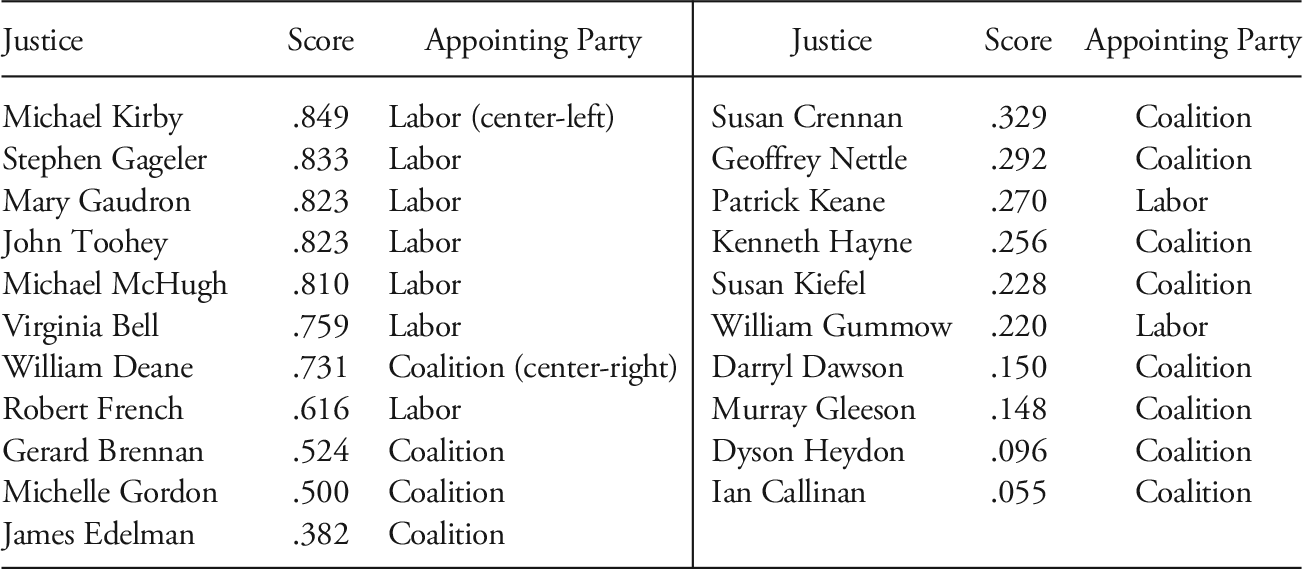
 , producing an ideology score ranging from 0 (most conservative) to 1 (most liberal), distributed relatively continuously within that range. The final ideology scores for all justices are reported in table 1. The mean ideology score is .46, and the scores range between .06 to .85, with a standard deviation of .28. The scores are internally reliable at 96.5% (Cohen’s Kappa 0.72,
 ).Footnote 5
Ideology Scores for Australian High Court Justices, Ranked from Most to Least Liberal

To test the impact of judicial ideology on outcomes, we code new data on the High Court of Australia’s decisions in all cases between 1995 and 2019.Footnote 6 We locate the cases by primarily relying on the High Court of Australia’s own online judgments database (High Court of Australia 2020). As the information published on the Court website relating to decisions before 2000 is often incomplete, we cross-reference the decisions on the Court’s website with two respected online repositories, Jade and Austlii. For the purposes of our analysis, we consider only nonunanimous decisions, where at least one justice dissents from the majority of the panel’s determination as to the disposition of the case. This is a common analytic strategy (Segal and Spaeth Reference Segal and Spaeth2002; Hanretty Reference Hanretty2020), and we provide further justification and analysis in the appendix.
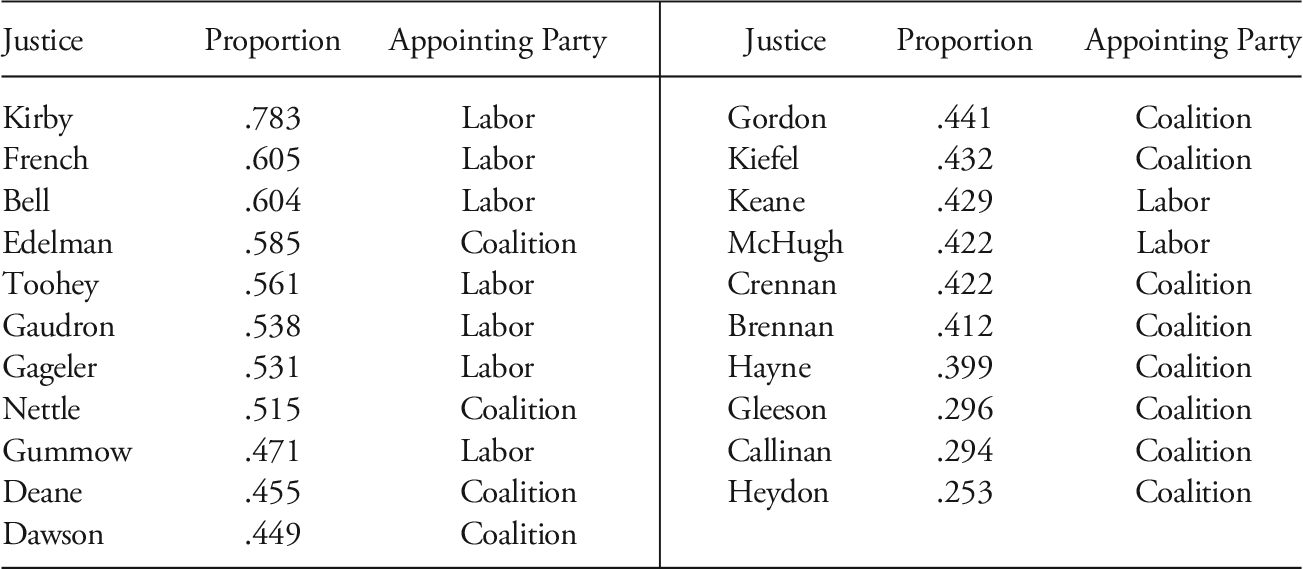
In total, we identify 1,758 cases decided by the High Court in the specified period, accounting for 12,306 individual justice votes. For the purposes of analysis, where multiple cases are heard and decided together we include only the primary case to exclude the possibility of duplication bias. This results in a total of 1,379 cases and 7,677 individual justice votes. Nonunanimous cases account for 36% of cases, with 84% of these nonunanimous cases being cases resulting from an appeal from a lower court.Footnote 7 The final number of nonunanimous cases in the data set accounts for a total of 2,937 individual votes. We code these votes as either ideologically liberal or ideologically conservative, using the same rules as for the newspaper content analysis to determine ideological direction.Footnote 8 The result is a liberal voting rate for each justice sitting on the High Court between 1995 and 2019 that serves as the dependent variable, where 1.0 equals “most liberal” and 0.0 “least liberal.” Table 2 presents the results.
Proportion of Liberal Votes by Justice in All Nonunanimous Decisions, Most Liberal to Least Liberal

Both the ideology and voting scores have strong face validity. Reflecting on their reputations both before and after appointment to the Court, Gleeson, Heydon, and Callinan expectedly have extremely conservative ideology scores and voting records, whereas Kirby, Bell, Toohey, and Gaudron expectedly have very liberal ideology scores and voting records. At the same time, the ideology scores for Deane, Keane, and Gummow seem not to comport with expectations; Deane’s ideology score denotes him as an ideologically liberal appointee, despite being appointed by the conservative-Coalition government, and the scores of both Gummow and Keane indicate conservatism, despite being appointed by the generally center-left Labor Party. However, several of these appointments were widely considered as strategically poor choices by the executive, and contemporaneous media reports suggest the Gummow appointment was influenced by the Labor Party’s desire for respect within the legal establishment, rather than just ideological fit (Merritt Reference Merritt1995).
To explore whether one or more subset of policy issues drives a justice’s proportion of liberal votes, we create a taxonomy of the corpus of decisions (Hanretty Reference Hanretty2020). We take as our starting point the High Court’s own categorization of the issue of the case via the “catchwords” that appear at the outset of every decision issued by the Court (Smyth Reference Smyth2005; Myers Reference Myers2020; Stewart and Stuhmcke Reference Stewart and Stuhmcke2020).Footnote 9 These catchwords are approved by the justices before the opinion is issued. At the broadest level, the Court categorizes each case as involving either civil law or criminal law, while at the granular level the Court sorts cases into one of numerous legal practice areas (e.g., in 2014 the Court sorted the cases into one of 41 categories; Stewart and Stuhmcke Reference Stewart and Stuhmcke2020). Given we are concerned with the public policy perspective of a case—the social or political context—rather than its doctrinal context, we chose to code for the legal issues involved in each case, before sorting those legal issues into categories of general policy areas that reflect the underlying subject matter—or policy issue—of each controversy.Footnote 10
The result is a six-category taxonomy of broad policy areas (Epstein et al. Reference Epstein, Landes and Posner2013): (1) economic issues, (2) criminal law and procedure, (3) public law, (4) traditional common law, (5) civil rights and vulnerable persons, and (6) civil procedure and ethics. Cases are assigned to categories based on their primary policy area; where secondary and tertiary areas are relevant to the case, we create secondary and tertiary variables, but our analysis involves only primary policy area variables. Categories 1 through 4 are relatively self-explanatory: category 1 captures economic issues, including corporate and business issues, as well as bankruptcy, property (real and intellectual), consumer and competition law, taxation, and succession. Category 2 is criminal law and procedure, and it includes all issues relating to state or federal substantive criminal law or matters of criminal procedure such as evidence. Category 3 is public law and includes all matters of state and federal constitutional and administrative law; and category 4 contains matters relating to traditional common law, namely, tort, contracts, equity, and trusts.
Categories 5 and 6 require some further explanation. Category 5 is identified as “civil rights and vulnerable persons.” Although Australia does not have a national bill of rights, it does maintain a limited number of statutory antidiscrimination statutes, including racial, age, and disability discrimination legislation. This category captures cases relating to those statutory regimes, as well as the limited cases relating to common law rights and the two state-level statutory bills of rights. The category also includes decisions relating to otherwise vulnerable persons, specifically Indigenous Australians, immigrants, claims relating to the environment, and family law issues (e.g., child protection). Category 6 (civil procedure and ethics) includes issues relating to evidence and procedures in civil litigation, issues relating to the legal profession and ethics, and inherent power of the court to oversee lower courts in civil cases. The category, then, largely captures decisions in civil proceedings to allow or disallow certain actions or evidence, as well as decisions relating to the legal profession itself.
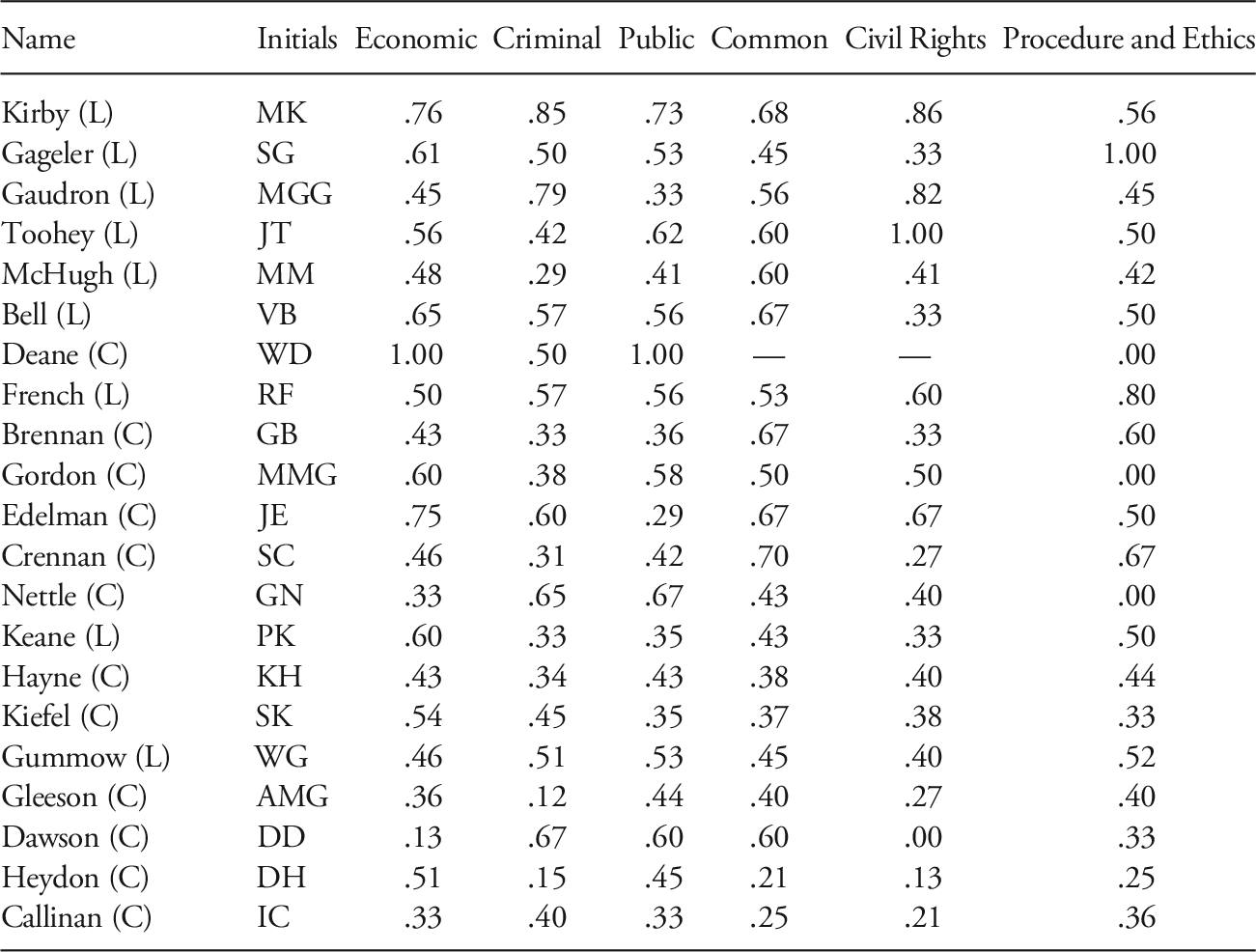
Table 3 presents voting behavior by justice in each of the policy areas. The results demonstrate relative consistency across policy areas for most justices: for instance, Kirby is reliably liberal across each domain, while Callinan is reliably conservative. Other justices demonstrate variance across domains, with Dawson notably liberal on criminal cases but conservative on civil rights, and Heydon particularly liberal on economic cases. This is almost certainly due to variation in the number of cases heard by each justice across policy areas: for example, Gageler has a range of .67 across policy areas and Gordon a range of .60, but each heard only two cases in the procedure and ethics category.
Liberal Voting by Policy Issue, in Nonunanimous Cases

Note.—Dashes indicate the justice did not sit on a nonunanimous case in the specific issue area. Initials are reproduced in figure 1.
Analysis: Ideology and Voting Behavior on the High Court
The analysis is divided into three stages. First, we examine the link between ideology and voting behavior by undertaking a simple association test between ideology and voting behavior to ascertain the baseline validity of our hypotheses. Second, we test our main hypothesis that ex ante ideology is predictive of voting behavior using nonnested multilevel models. Third, we estimate the predictive effect of ideology on voting behavior in discrete areas of law and policy that aims to determine whether ideology is isolated to specific issue areas or, rather, is evident across the body of the High Court’s decisions. First, to establish the existence of a bivariate relationship, we conduct a simple test of association between newspaper ideology score and liberal voting using a weighted Pearson correlation.Footnote 11 We find a strong positive correlation between ideology and voting behavior in both all nonunanimous cases (
 ) and all nonunanimous cases that originate in a lower court (
 ). The following section builds a multivariate model to further examine this relationship.
Multilevel Logistic Regression Models
We estimate a series of multilevel regression models to demonstrate the effect of our key ideological explanatory variable at the justice level (Newspaper Ideology Score). Our models predict the likelihood of a liberal vote by a judge in an Australian High Court case between 1995 and 2019, taking into account the “crossed” multilevel data structure, where each case is seen by several justices, the justices sit on many cases across different areas of law, and the Court is presided over by different chief justices (Gelman and Hill Reference Gelman and Hill2006). This nonnested multilevel data structure is modeled with random intercepts across four levels: the justice (
 ), area of law (
 ), chief justice (
 ), and the case itself (
 ).Footnote 12 The subsequent incorporation of a justice-level measure of ideology should increase the precision with which we estimate a given judge’s probability of making a liberal decision on any given case.
Our model specification may be summarized as follows:

where α j , γ k , δ l , and φ m are random intercepts for justices, cases, issue area, and chief justice, respectively. Each set of intercepts is normally distributed with group-level explanatory variables specified at each level. For example, justice-level intercepts are the result of a justice-level regression:

The intuition for this model specification is that the justice-level ideology variable will improve our estimation of each justice’s likelihood of voting liberally in two ways. First, it adds information to the model through the pooled “fixed effect” coefficient. Second, it accounts for the clustering of decision-making at the justice level and enables an improved estimation of the justice-level intercepts (when compared with models without justice-level predictors).
In building our model, we make three simplifying assumptions on case selection, covariate inclusion, and specification of random intercepts. First, as indicated above, we analyze nonunanimous cases only. In the appendix we discuss this reasoning further and provide supplementary analysis showing that there is no substantive change to the relationship between ideology and vote direction when including unanimous cases in the analysis. Second, we make an inclusive choice in considering the potentially different dynamics of cases with varying numbers of justices hearing each case. In contrast with the US Supreme Court, the Australian High Court sits in a variety of panel combinations when hearing cases. In fact, only 194 of 504 nonunanimous cases were heard by a full seven-justice panel of the Court, the others being heard by combinations of three, four, five, and six justices. Given the large number of cases heard by subsets of the Court rather than en banc, we included the entire corpus of High Court merits decisions in order to provide a robust analysis of High Court decision-making.Footnote 13 Third, for the sake of parsimony, our models contain a limited number of coexplanatory variables at both the individual justice level and case level that have been shown to influence voting behavior in apex courts and that do not introduce potential posttreatment bias.Footnote 14
The justice-level control variables we include are justice specialization, lower court experience, and gender. Specialization refers to the justices’ areas of legal specialization, for example, criminal law. Multiple studies have demonstrated that a judge’s issue-area expertise is a “primary determinant” of ideologically consistent behavior and that issue-specific expertise amplifies an individual justice’s ideological propensities (Judd and Downing Reference Judd and Downing1990; Miller and Curry Reference Miller and Curry2009). Further, specialization may lead to a direct effect on voting patterns if specialists see proportionally more cases in their area of specialization than other justices (Hanretty Reference Hanretty2020).
While specialization is generally measured after the appointment, based on a proportion of cases heard or opinions written in a specific area of law in the court being studied (Brenner Reference Brenner1984; Maltzman and Wahlbeck Reference Maltzman and Wahlbeck2004), to avoid posttreatment effects we measure specialization as preappointment, that is, an indicator of specialization before the justice takes a seat on the High Court (Hanretty Reference Hanretty2020). We propose a new measure of specialization, a justice’s legal practice area before any judicial appointment, and triangulate this with an existing measure, lower court specialization, which allocates specialization based on the proportion of cases each justice sat on in specific areas of law before the justice’s apex court appointment (Hanretty Reference Hanretty2020). To capture a justice’s legal practice specialization, we examine the records of each justice’s legal practice as a barrister to capture up to three areas of specialization and map these onto our six-category taxonomy of broad policy areas. We measure a justice’s lower court specialization by coding the legal issues for each justice’s 30 most recent cases on a lower court and again mapping these legal issues onto our six-category taxonomy. Both forms of specialization are measured as binary scores of whether a justice has above-average experience in each field, with a maximum three specializations for each justice. Given that four of the justices in our data set did not sit on appellate lower courts, legal practice specialization provides a more comprehensive measure than lower court specialization, and thus we present the results from legal practice specialization only.Footnote 15
We also include preappointment experience as an independent variable. Studies indicate that apex court judges who have served on lower courts before their apex court appointment are more likely to be socialized into their judicial role and consequently more deferential to precedent and less inclined to vote ideologically (Epstein et al. Reference Epstein, Landes and Posner2013). We account for this potential preappointment confounder and measure experience by the number of years the justice sat on any lower court before their appointment to the High Court. Justices with no prior appellate experience are included in the analyses and scored as 0.Footnote 16 As a final justice-level control, we include gender in light of a recent Australian study evidencing the impact of attorney gender on judicial voting behavior, as well as the various studies demonstrating that holding all else equal, female justices are more likely to vote in a liberal direction than male justices (Peresie Reference Peresie2005; Boyd, Epstein, and Martin Reference Boyd, Epstein and Martin2010; Smyth and Mishra Reference Smyth and Mishra2014).
In addition to justice-level confounders, we include two case-level control variables that studies have demonstrated affect judicial voting behavior in the US Supreme Court, namely, lower court direction and lower court dissent (Cross and Nelson Reference Cross and Nelson2001; Epstein et al. Reference Epstein, Landes and Posner2013). Both variables measure details about the decision of the court from which the case was appealed to the High Court. Lower court direction measures the ideological direction of each case in the court below. Prior studies have suggested that ideological distance between the lower court decision and the justice’s ideology increases the propensity to vote to overturn the lower court decision (Epstein et al. Reference Epstein, Landes and Posner2013). The ideological direction of the lower court decision was determined by the outcome in the High Court. If the High Court allowed the appeal, the lower court’s decision direction is the opposite of the Court’s, and if the Court dismissed the appeal, the lower court’s decision direction is the same as the High Court’s. Lower court dissent measures whether the decision of the court below the High Court was unanimous or nonunanimous. Prior studies have shown that the presence of a lower court dissent not only increases the probability of apex court review, but it also increases the probability of a unanimous apex court decision (Epstein et al. Reference Epstein, Landes and Posner2013; Beim and Kastellec Reference Beim and Kastellec2014). Further, the presence of a lower court dissent indicates that case is highly ideologically salient, given the propensity for lower court dissent aversion (Beim and Kastellec Reference Beim and Kastellec2014). Lower court dissent, then, is a binary variable that denotes the presence or absence of a dissent in the decision of the court from which the case in the High Court was appealed.
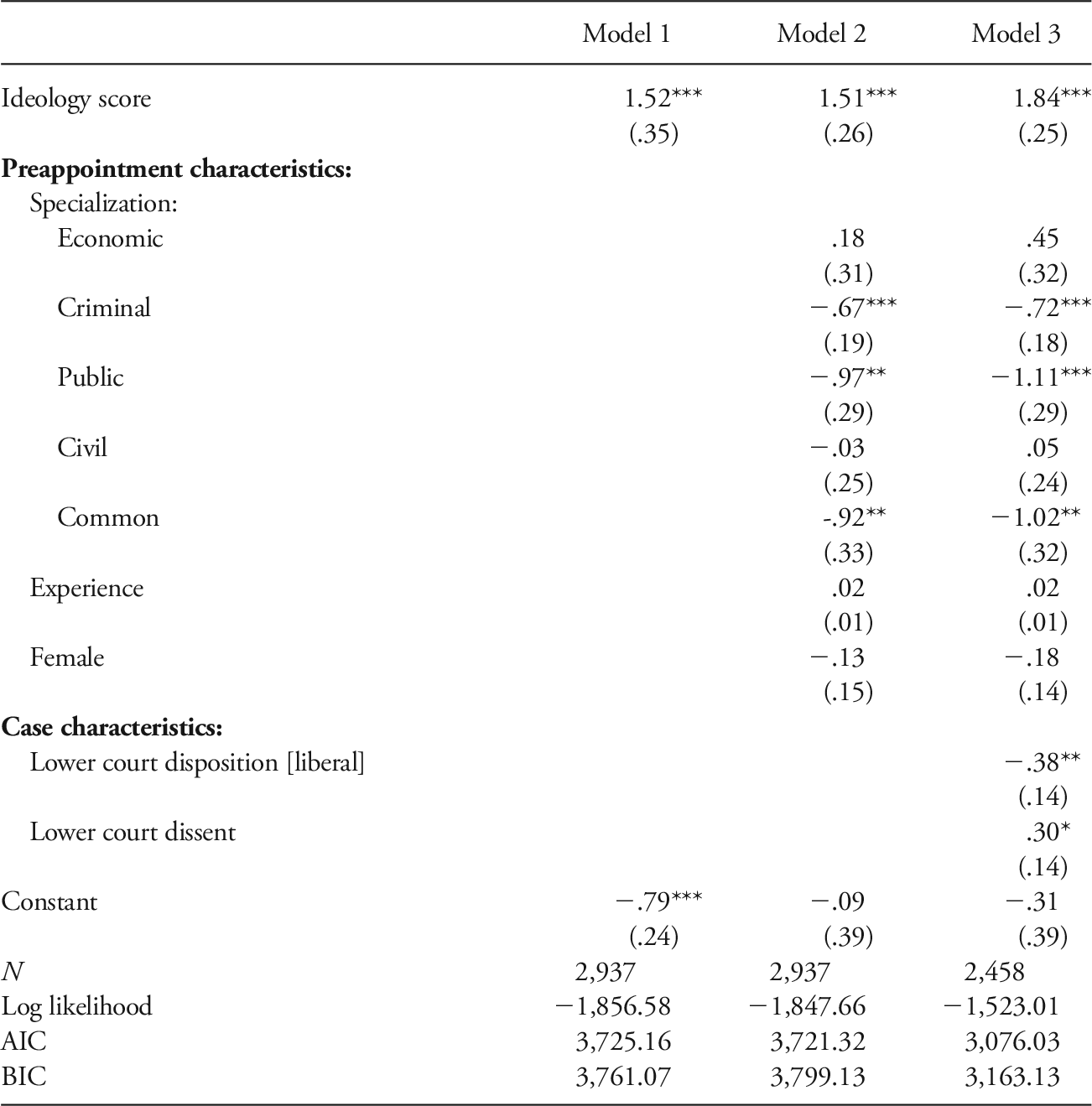
Table 4 presents three models of liberal voting in the High Court. Model 1 includes random intercepts and newspaper ideology scores only. Given the random effects, this foundational model incorporates a substantial amount of information about the likely direction of voting from a given justice, and, along with the newspaper ideology score, this model provides a robust estimate of any given justice’s probability of casting a liberal vote in any given case. Model 2 expands model 1 by incorporating multiple preappointment justice-level measures that may confound the relationship between ideology and voting. Model 3 additionally incorporates case-level variables and is the most comprehensive model, including both case-level and justice-level variables.Footnote 17
Nonnested Multilevel Models with Random Intercepts: Determinants of Liberal Votes

Note.—Significance presents estimates from nonnested multilevel models. Random intercepts specified are Case Number (n = 501 in models 1 and 2; n = 429 in model 3), Primary Issue Sub Area (n = 33), Chief Justice Reign (n = 4), and Justice (n = 21). AIC = Akaike information criterion. BIC = Bayesian information criterion.
* p < .05.
** p < .01.
*** p < .001.
In both models 2 and 3, ideology remains positive and a statistically significant predictor of voting behavior, even in the presence of numerous possible confounders. Gender has no observable effect on rates of liberal voting in model 2, and although the standard errors are too large to achieve statistical significance, the coefficients for gender are negatively signed and suggest that female justices do not disproportionately cast liberal votes. While the effects of specialization in specific fields are not easily interpretable, as specializations are measured as dummy variables and are not mutually exclusive, justice specialization in preappointment legal practice does not affect the relationship between ideology and voting, with the coefficient for ideology remaining strong and positive in both models 2 and 3. However, they do suggest that, net of judicial ideology and other justice-level factors, voting in criminal, public law, and common law cases is disproportionately conservative. Similarly, there is no relationship between lower court experience and the probability that a justice will vote liberally in either model 2 or 3. Liberal lower court decisions have a negative effect on liberal voting at the justice level, while nonunanimous decisions in lower courts positively predict liberal voting at the justice level.
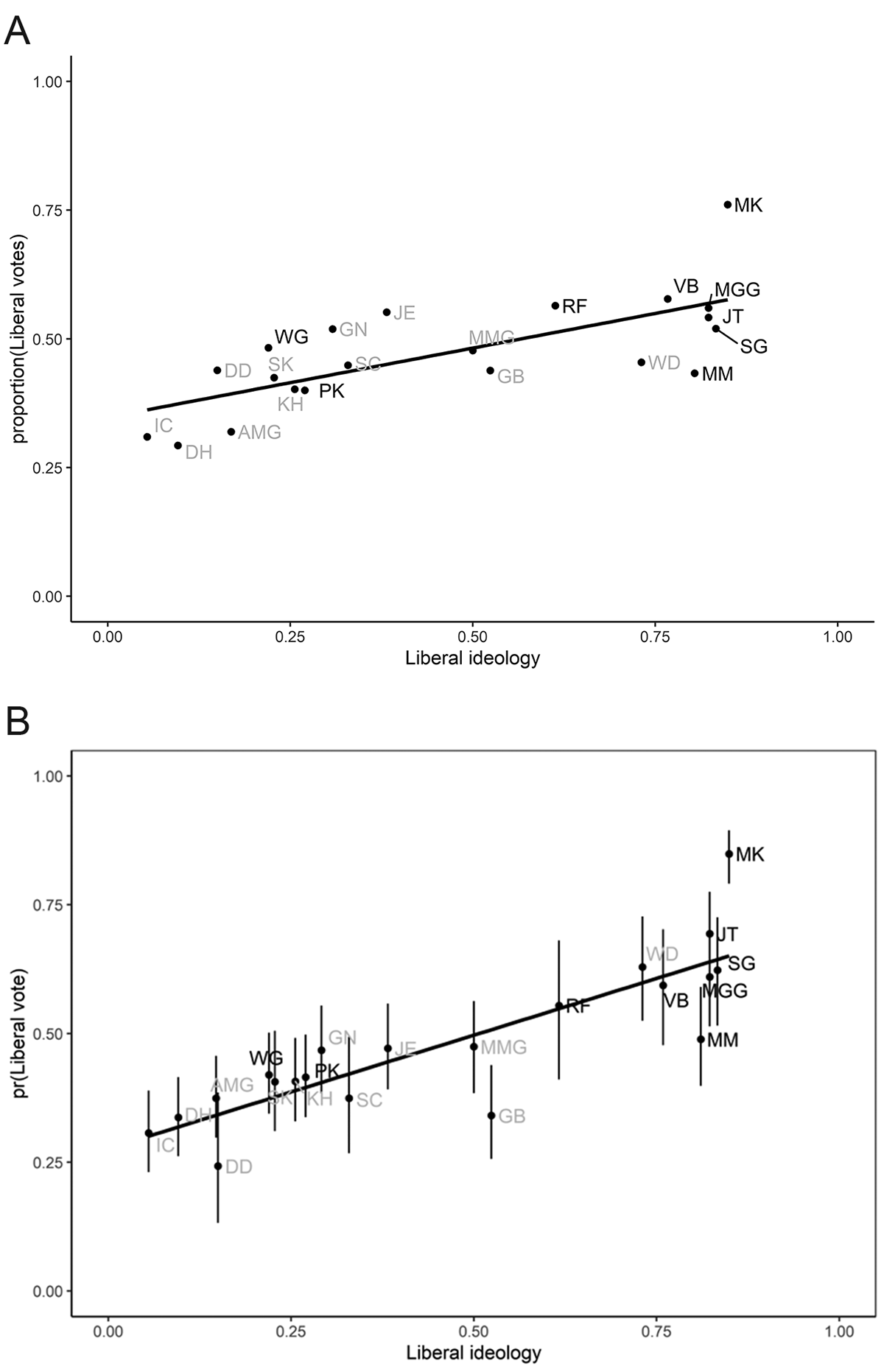
Figure 1B provides substantive meaning to our regression results by plotting predicted probabilities at the justice level (using output from model 3), with whiskers indicating upper and lower 95% confidence intervals. Postestimation simulation gives the probability of a justice voting for a liberal outcome, conditional on a linear combination of coefficient effects, including justice ideology. Figure 1A gives a simple scatter diagram for comparison. It aggregates justice votes to the proportion of liberal votes over the course of each justice’s High Court career on the y-axis, with justice level ideology on the x-axis. The following section explores the relationship between ideology and specific types of cases.
Predicted probabilities with judge-level ideology score, all nonunanimous cases. A, Scatter plot of justice ideological position and aggregate proportion of liberal votes by that justice. Black initials, Labor (left-wing) appointees; gray initials, Coalition appointees (right-wing). B, Predicted probabilities of a liberal vote for 21 justices of the High Court of Australia (model 3), conditional on their preappointment ideology. Initials, individual justices (see table 3). Black initials, Labor (left-wing) appointees; gray initials, Coalition appointees (right-wing).

Estimating the Relationship within Specific Policy Areas
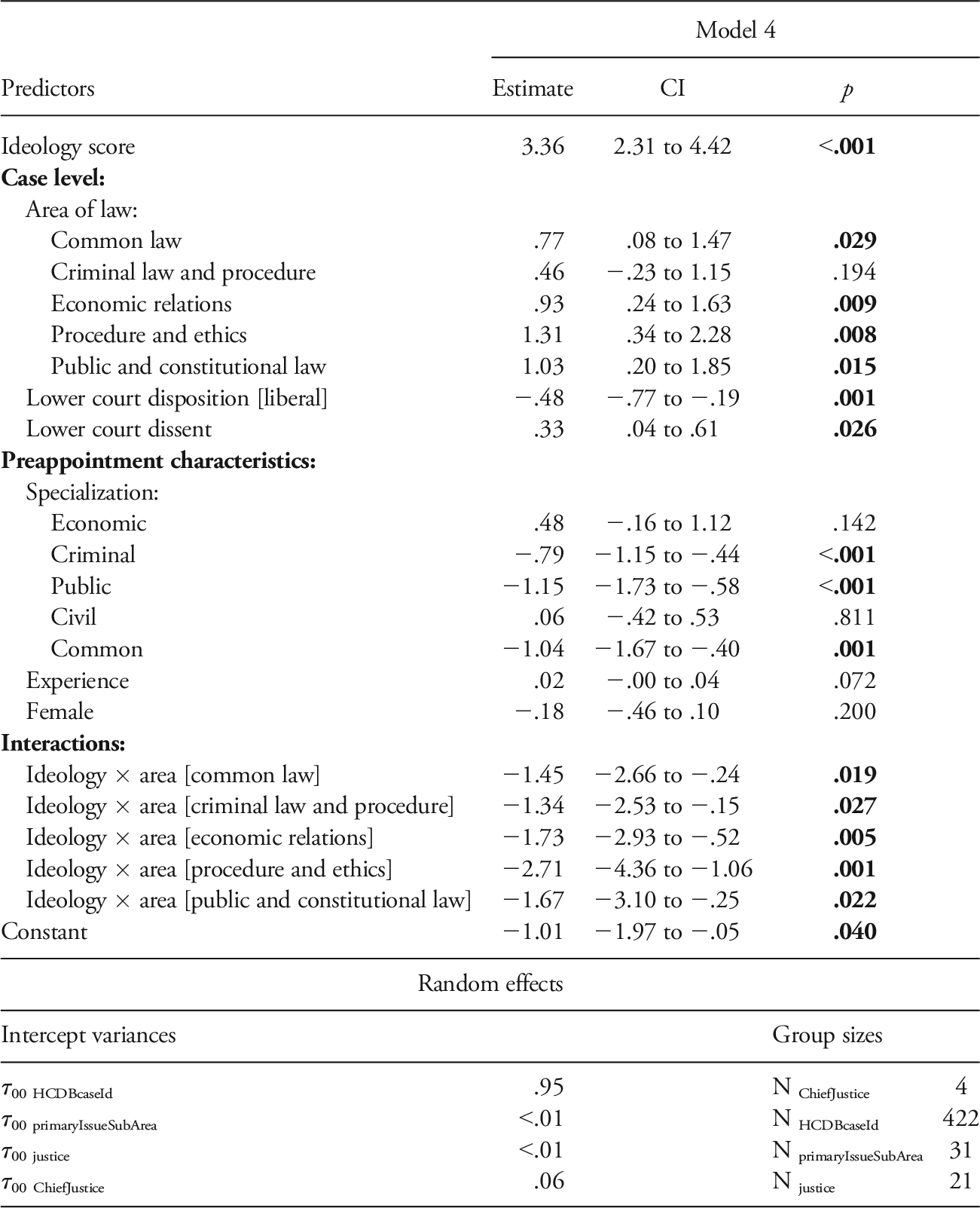
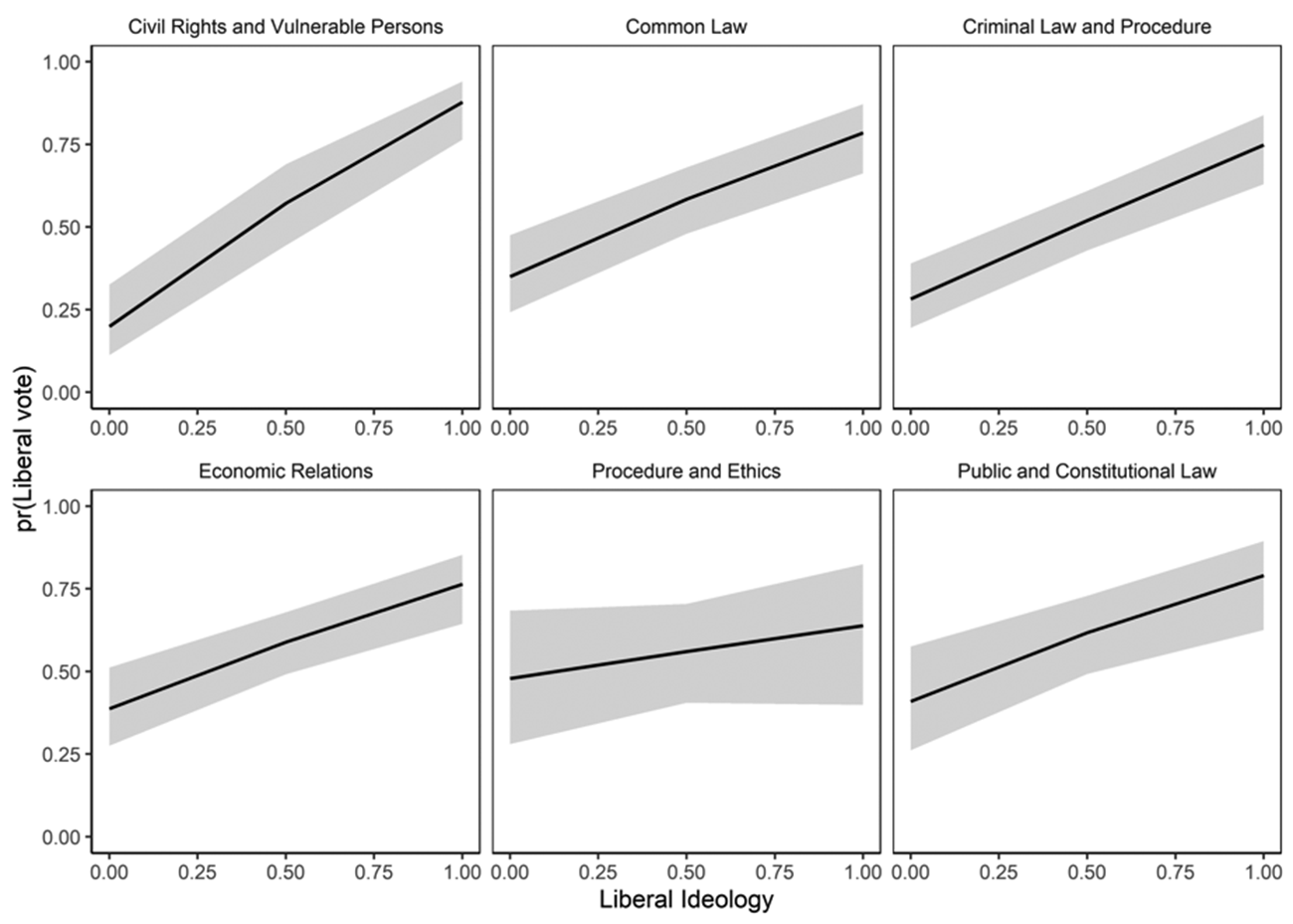
We expect that ideology will find expression in each subset of the law, not simply in areas that are analogous to civil-rights-based cases in other legal systems. To explore this claim, we use the same specifications from model 3 and estimate the effect of ideology conditional on policy area. Table 5 presents the estimates from a varying slopes nonnested multilevel model. With civil rights cases as the reference category, we find significant reductions in the gradient of the slope for each non-civil-rights category, indicating that ideological voting is strongest in the civil rights category. Yet, while ideology appears to be strongest in the area of civil rights and vulnerable persons, figure 2 (with conditional predicted probabilities derived from model 4) indicates that a strong ideology effect is also present in other areas of law, indicating that ideological behavior is not conditional on an entrenched bill of rights or a strong rights culture. Common law cases (which include traditional common law issues such as tort, contract, equity, and trusts) also show strong ideological effects. This is largely unsurprising: traditional common law issues frequently involve claims reflective of rights-based claims, with a strong party versus an “underdog.” In addition, these common law categories involve “judge-made law,” in which the judiciary itself develops the law through its own decisions, rather than legislation creating those causes of action. The result is judicial decision-making free of legislative constraints and open to ideological persuasion.
Ideology and Liberal Voting, by Policy Issue: Logit Mixed Model with Random Intercepts

Note.—n = 2,416. σ2 = 3.29. p-values < .05 in bold. CI = credible intervals.
Predicted probabilities for the probability of a liberal vote in a nonunanimous case, by policy area. Gray shading, 95% confidence intervals.

Similarly, public law cases involve few formal constraints on judicial actors; the High Court has the power of judicial review and supremacy in matters of constitutional interpretation, and the political branches cannot overturn the Court’s decisions except by passage of a constitutional amendment (Australian Communist Party v. The Commonwealth [1951] HCA 5, [1951] 83 CLR 1 [March 9, 1951]). Conversely, numerous studies have examined the extent to which judicial voting behavior is affected by informal constraints imposed by the legislative or executive branches in public law matters (Segal Reference Segal1997; Jacobi Reference Jacobi2006; Segal, Westerland, and Lindquist Reference Segal, Westerland and Lindquist2011). While we cannot state whether the Court is responsive to various informal constraints of the political branches or not, our analysis suggests that matters of constitutional law are inherently ideological.
Similar results are evident in criminal law and procedure cases: ideology is a strong and positive predictor of voting behavior. This is unsurprising, as criminal cases are often comparable to civil rights ones, involving decisions on the rights of defendants, challenges to jury decisions, sentencing decisions and procedures, pretrial conduct of judges and police, and admittance of evidence. It is intuitive, then, that liberal ideology generally would predict liberal voting on criminal cases.
Economic relations involves issues such as corporate law, taxation, bankruptcy, and property law. Comparatively, US and Canadian studies find mixed results in economic cases (Segal and Spaeth Reference Segal and Spaeth2002; Staudt et al. Reference Staudt, Epstein and Weidenbeck2006; Ostberg and Wetstein Reference Ostberg and Wetstein2007). Nevertheless, in the Australian context, we find evidence of a strong relationship between judicial ideology and voting behavior in economic policy cases. This finding is consistent with Myers (Reference Myers2020), who examined High Court voting behavior in the context of economic cases involving the federal government. Myers found that justices behave differently toward the federal government as a litigant in economic cases depending on the strength of the economy, concluding that the “results present evidence that challenges the … assumption that judges are motivated by economic factors and innocent of political or ideological considerations” (Myers Reference Myers2020, 48).
Finally, the coefficient for the ideology score in procedure and ethics cases is positive but significantly lower than in civil rights cases (and the lowest among the six policy categories). This category of cases largely involves civil procedure and evidence cases—those issues that are constrained by technical rules of procedure and evidence. This suggests that in cases in which justices are ex ante constrained by technical rules, and the issues do not directly involve the substantive allocation of benefits and burdens, justices are less willing (or able) to act ideologically.
Ultimately, while prior studies have demonstrated that evidence of ideological voting is most likely in rights-based claims (Segal and Spaeth Reference Segal and Spaeth2002; Epstein et al. Reference Epstein, Martin, Quinn, Segal and Hanson2012), our results show that ideological behavior is not conditional on an entrenched bill of rights or a strong rights culture. Instead, we largely replicate findings from the United States and other countries where protection of the underdog is a classic predictor of liberal voting behavior in rights-based claims across the corpus of decisions. Even more significant is the fact that these results occurred with a very general ex ante measure of ideology—a measure that includes a justice’s ideological predispositions on issues including, but not limited to, rights—whereas equivalent US studies measure ideology based entirely on rights-focused newspaper reports.
Accounting for Uncertainty in Measuring Judicial Ideology
Thus far our modeling strategy assumes perfect measurement of preappointment justice ideology when estimating its effect on voting behavior. To our knowledge, this is true of virtually all tests of the attitudinal model using newspaper measures of ideology (cf. Zorn and Caldeira Reference Zorn and Caldeira2008), despite the acknowledged need to account for measurement error in explanatory variables (Treier and Jackman Reference Treier and Jackman2008) and the explicit incorporation of measurement uncertainty into endogenous votes-based models of judicial ideology (Martin and Quinn Reference Martin and Quinn2002). Given considerable variability exists between justices in terms of the number of newspaper articles and ideologically relevant paragraphs that contribute to each justice’s ideology score, measurement uncertainty is a serious issue that may undermine the reliability of our ideology scores.
To this end, we propagate the uncertainty around the measurement of ideology by deploying a two-step strategy: first, we obtain simple estimates of uncertainty for each justice’s ideology score; second, we incorporate those uncertainty estimates into a justice-level Bayesian estimation of the effect of ideology on voting with a measurement model component.
First, we provide estimates of uncertainty of the measurement of judicial ideology. Since our ideology measures for each justice are bound between 0 and 1, a simple approach to provide a reasonable source of measurement error might be the standard deviation for a proportion,
 , where i is the estimate of the ideology score for each justice and n is the number of ideological paragraphs coded for each justice. However, given the presence of moderate paragraphs in each ideology score, the standard error for the proportion would overestimate the variance in an ideology score where there is a large proportion of moderate paragraphs for each justice. For example, in simple numeric terms, the standard error for an ideology score with 10 moderate paragraphs (score: 0.5), 0 liberal paragraphs (score: 1), and 0 conservative paragraphs (score: 0.5) would be 0, since there is no variance from 0.5 in the sample. However, when applying the standard error for a proportion, the estimate of the standard error would be 0.16.
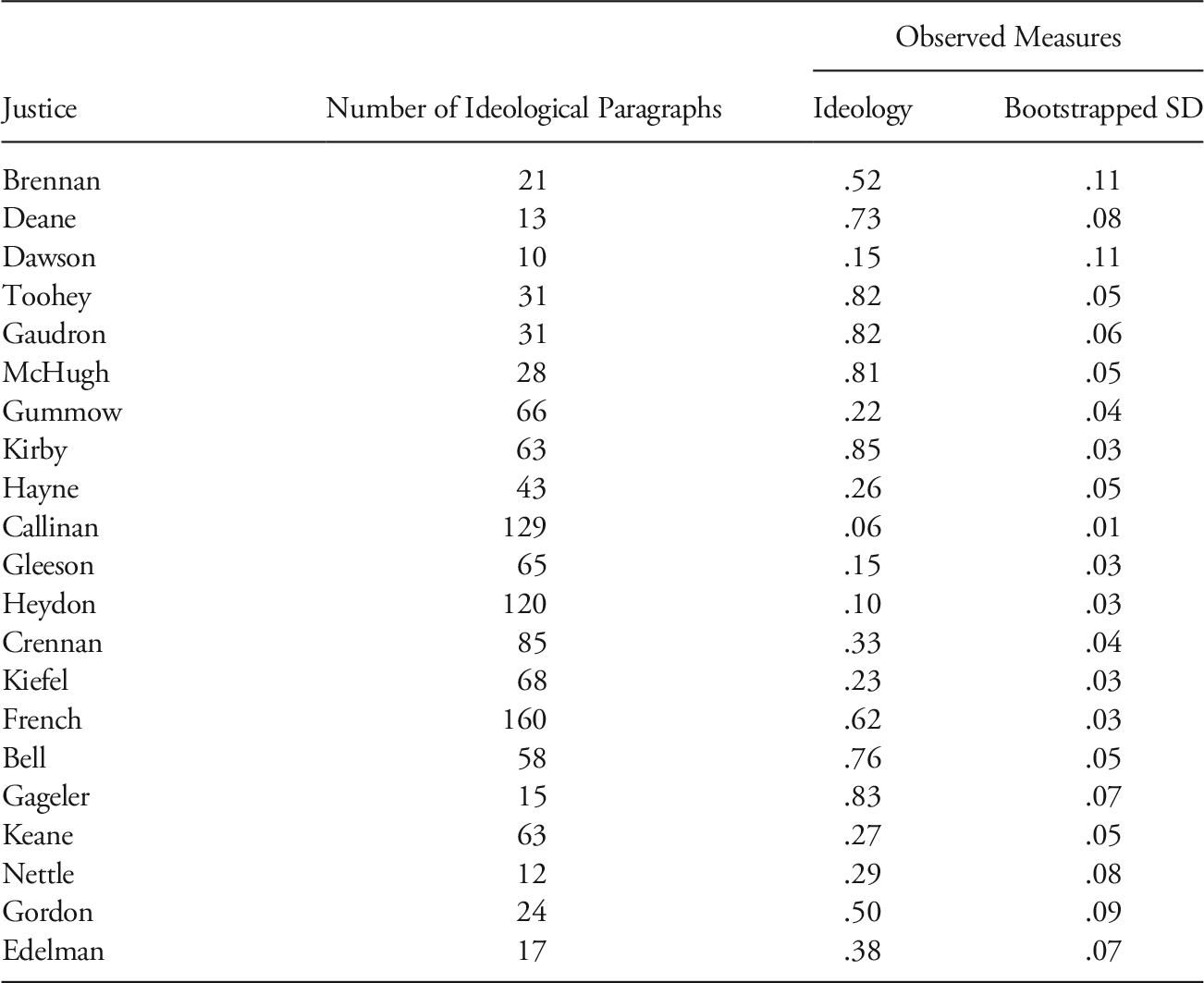
We account for the impact of moderate paragraphs on ideological variability with resampling, estimating standard deviations with 10,000 bootstrapped ideology estimates for each justice. Table 6 shows how our estimates of standard deviation increase because of both smaller sample size (see Dawson, for whom there were only 10 ideological paragraphs available) and ideological inconsistency. For example, Chief Justice Brennan had 9 conservative paragraphs, 2 moderate paragraphs, and 10 liberal paragraphs. His standard deviation is similar in size to Dawson’s, despite having more than twice the number of ideological paragraphs.
Uncertainty in Measurement of Judicial Ideology, by Justice, with Bayesian Estimates

Second, we estimate a Bayesian model, similar to model 3, correcting for the measurement error in the independent variable by including a measurement model of the observed ideological positions, varying according to the estimates of their standard deviations from the bootstrapping procedure. The model was implemented using the measurement error option within the brms package in R (Bürkner Reference Bürkner2017). In the appendix, we provide a simple alternative specification with explicit parameterization, showing substantively similar results.
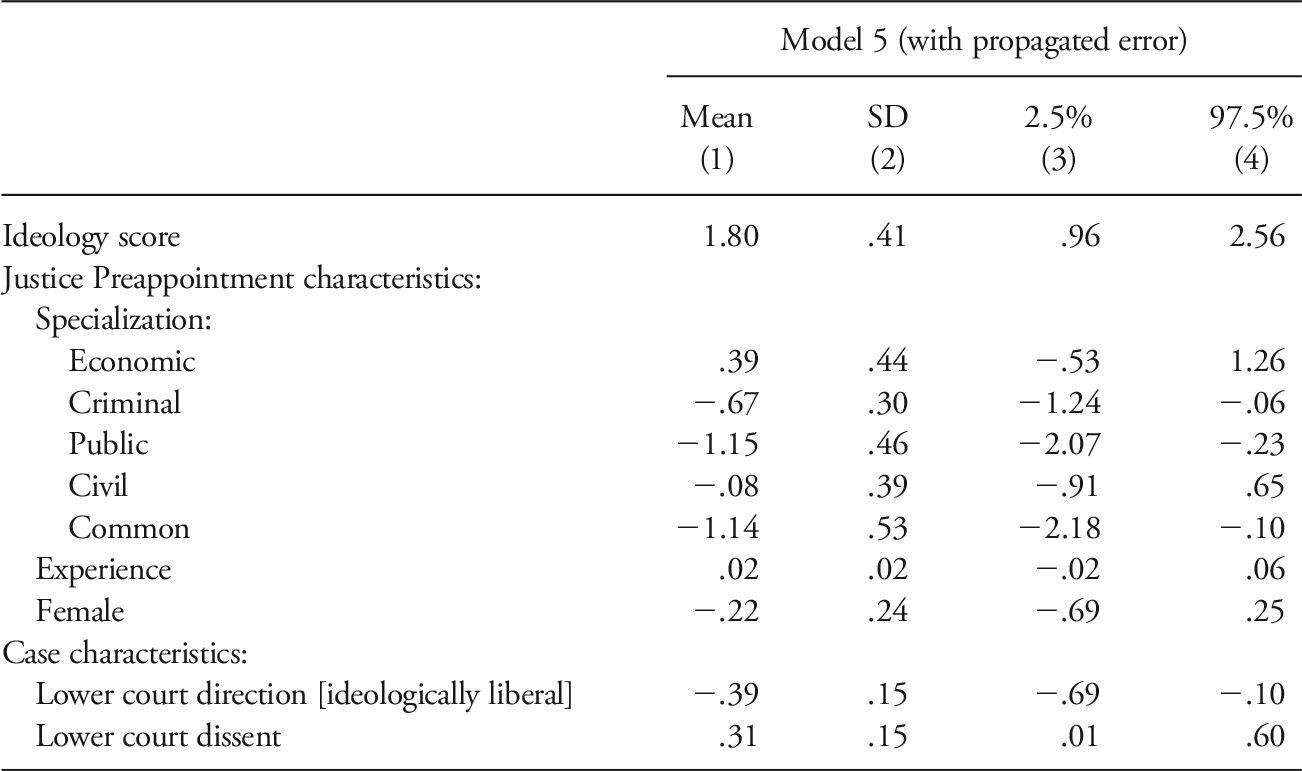
The results are presented in table 7. We find that model 5 is comparable to model 3, with similar sign, magnitude, and significance for each coefficient. However, when accounting for the error in measuring ideology, we find that the estimation of the standard error increases from .25 to .41, a factor of approximately two-thirds. Despite this increase in the standard error, we do not find evidence for an attenuation of effect size or an estimate of the coefficient indistinguishable from 0.
Bayesian Estimates of Justice-Level Liberal Voting Rates

Note.—N = 2,458. The model was run using Hamiltonian Monte Carlo (with 4,000 iterations reserved for burn in) and contained four MCMC chains run for 1,000 iterations each after burn in. Columns 3 and 4 display the 95% credible intervals for each regression coefficient.
Conclusion
The relationship between judges’ preappointment ideology and their subsequent behavior on the bench has long been central to judicial behavior research. We contribute to this literature by examining whether the strong predictive effects of ex ante judicial ideology on judicial voting behavior extends beyond rights-based cases. The findings of this study can be grouped under two broad themes and one important implication for further study. First, judicial ideology matters beyond rights-based cases. Our empirical results suggest that judges’ ex ante ideology predicts their voting behavior on the apex court in Australia, the High Court, in both rights-based and non-rights-based cases. These findings make a distinct contribution to a small but growing field of judicial politics that examines the behavior of judges outside the United States and demonstrates the need to develop distinct and contextually appropriate theories and measures for judicial preferences and voting behavior. Our findings highlight the importance of mapping judicial policy preferences in both rights-based and non-rights-based cases, and they provide valuable insights for scholars interested in judicial voting behavior in countries where public policy not directly touching on civil, political, and economic rights is as equally, or more, salient than policies that implicate those rights.
Second, our study emphasizes the continuing relevance and importance of ex ante measures of judicial ideology for improving our understanding of judicial selection outside the United States. While ideology measures based on judicial voting—item response scores and the like—can tell us about judicial behavior on the bench, ex ante measures are critical to understanding who gets selected to the judiciary and why. That is, the temporal distinction is important not only for determining the association between a judge’s ideological predisposition and their subsequent voting behavior but also for what information it reveals about selectors’ motivations. The ex ante ideological measure, then, reflects a precise temporal moment: when judicial nominators are finalizing their short list of nominees and deciding on a final candidate. Postappointment item-response scales of ideology serve a particular purpose in the literature, but ex ante measures should not be forgotten. Moreover, future research might compare ex ante and ex post expressions of ideology to examine possible effects of appointment on ostensible ideology.
These findings also have direct implications for the selection of apex court judges outside the United States. While the overtly politicized selection process for US Supreme Court judges has meant that we understand deeply the incentives and motivations involved in that process, the opacity of executive-only appointments—and potentially other selection mechanisms—has meant that the political nature of judicial selection outside the US context is underappreciated. We demonstrate that regardless of the selection mechanism, knowledge of a judge’s ideological predisposition necessarily means that ideology affects the selection process. This is perhaps even more so when the process is opaque. Consequently, our findings highlight the significant role of judicial selectors for subsequent judicial outcomes and the longevity of government policy, even in parliamentary systems with limited legislative involvement in the appointment process.
Our research sheds new light on the predictive role of judicial ideology in voting, which highlights avenues for future research. We focus specifically on delineating ideological effects on voting in both rights-based and non-rights-based cases. In demonstrating the effects of judicial ideology across the corpus of decisions, we show that, in order to ensure the longevity of their policies, governments will select ideologically homogenous judges across all core policy issues, not just rights-based ones. We hope our work will encourage future research exploring the impact of ideology on judicial votes in all issues of public policy, not just rights-based issues, as well as research that examines the importance of the relationship between the ideological preferences of the judicial selector and judicial outcomes in systems in which the selection of judges is less overtly politicized than in the United States.