Introduction
Dementia is common among long-term care (LTC) residents and has implications for their quality of life (QOL). The prevalence of dementia in LTC is approximately 58 per cent and among those residents, approximately 78 per cent present with behaviours of concern (Seitz, Purandare and Conn Reference Seitz, Purandare and Conn2010). Such behaviours include aggression, agitation, restlessness, wandering, ‘disruptive’ vocalisations and resistance to care. Aggressive behaviour specifically is of primary interest in this study. Zeller et al. (Reference Zeller, Hahn, Needham, Kok, Dassen and Halfens2009: 175) define aggression as ‘a nonaccidental overt act involving the delivery of noxious stimuli to (but not necessarily aimed at) an object or toward the self or others'. Both physical and verbal aggression among LTC residents with dementia tend to be common, but often go unreported for reasons such as staff feelings of failure, or beliefs that aggression is normal among residents with dementia (Zeller et al. Reference Zeller, Hahn, Needham, Kok, Dassen and Halfens2009).
Researchers have focused on understanding why aggressive behaviours often accompany dementia. These reasons relate to the person with dementia, persons involved with care and/or the general care environment (Mitty and Flores Reference Mitty and Flores2007). Physiologically, aggressive behaviours are associated with severity of brain deterioration, with some investigators finding more severe impairment to be predictive of aggressive behaviours, but some others finding moderate impairment to be most related (Hall and O'Connor Reference Hall and O'Connor2004). Type of dementia, sensory decline due to disease, poor health status, demographic characteristics and personality traits prior to diagnosis also relate to aggressive behaviour (Mitty and Flores Reference Mitty and Flores2007).
Disease-based factors, however, are only partially responsible for aggressive and other behaviours of concern. Theorists consider residents' behaviours to be attempts to communicate in light of declining verbal and cognitive abilities (e.g. Keady and Jones Reference Keady and Jones2010; Mitty and Flores Reference Mitty and Flores2007). These behaviours are ‘responsive’, in that they occur in response to something external or internal (Dupuis, Wiersma and Loiselle Reference Dupuis, Wiersma and Loiselle2004; Whall et al. Reference Whall, Colling, Kolanowski, Kim, Hong, DeCicco and Beck2008). Fisher et al. (Reference Fisher, Drossel, Ferguson, Cherup, Sylvester, Gallagher-Thompson, Steffen and Thompson2008), in their Functional Analytic (FA) model, suggest that behaviours are influenced by the interaction of an individual's physiological and psychological history with the social and physical context. Since the care-giver is part of the environment, the relationship between the care-giver and resident may have a profound effect on such behaviours. For instance, in their review, Zeller et al. (Reference Zeller, Hahn, Needham, Kok, Dassen and Halfens2009) found that entering the personal space of a resident during direct care to be most predictive of aggression. However, they further note that aggression may be triggered by, ‘disregarding residents’ preferences … being short staffed or rushed; lack of communication about specific resident needs … lack of work ethic and responsibility’ (Zeller et al. Reference Zeller, Hahn, Needham, Kok, Dassen and Halfens2009: 177).
Closely related to the FA model, the Need-driven Dementia-compromised Behaviour model (NDB; Algase et al. Reference Algase, Beck, Kolanowski, Whall, Berent, Richards and Beattie1996) posits that aggression is a response to unmet physical and psycho-social needs, such as attachment or comfort (e.g. pain management) and becomes a way of communicating these needs (Kong Reference Kong2005). In fact, antecedents of agitation include discomfort, boredom and certain types of social interaction (e.g. large gatherings) (Mitty and Flores Reference Mitty and Flores2007). Nevertheless, although aggressive behaviour may signal pain, social isolation, boredom or untreated medical conditions, care-givers often have difficulty interpreting the meaning of non-verbal behaviours (e.g. Eritz and Hadjistavropoulos Reference Eritz and Hadjistavropoulos2011).
Given the communicative aspect of residents' aggression, along with the importance of the care environment, we conceptualised this study within a model of person-centred care (e.g. Kitwood Reference Kitwood1993; Rosemond et al. Reference Rosemond, Hanson, Ennett, Schenck and Weiner2012; White, Newton-Curtis and Lyons Reference White, Newton-Curtis and Lyons2008). Person-centred care is holistic care provision wherein those providing care attend to the personhood (i.e. the standing of being a person, which is inherent to all human beings; Kitwood Reference Kitwood1993) of those receiving care, especially residents with advanced dementia. Residents are understood in terms of their unique needs, preferences, abilities and life experiences. Person-centred philosophies form the foundation of many LTC programmes, ranging in breadth from those aimed at total transformation of the LTC environment including organisational/managerial aspects, to those focused on establishing a higher quality of care, empowering staff, lessening aggression and nurturing relationships (Koren Reference Koren2010; Rosemond et al. Reference Rosemond, Hanson, Ennett, Schenck and Weiner2012).
Life story work (e.g. McKeowen et al. Reference McKeown, Clarke, Ingleton, Ryan and Repper2010, Reference McKeown, Ryan, Clarke and Ingleton2013; Moos and Björn Reference Moos and Björn2006) is consistent with principles of person-centred care whereby researchers (or LTC facility staff) work with the resident and/or his or her family to gather and summarise biographical details about the resident's life. Information from life stories might be displayed in various formats including photographic books or written summaries, or webpage design (McKeowen et al. Reference McKeown, Clarke, Ingleton, Ryan and Repper2010). This information is generally used to enhance care practices and improve the QOL of the resident.
Life story work has been demonstrated to enhance person-centred care practices and QOL for residents in a number of case-series investigations (e.g. Egan et al. Reference Egan, Munroe, Hubert, Rossiter, Gauthier, Eisner and Rodrigue2007; McKeowen et al. Reference McKeown, Clarke, Ingleton, Ryan and Repper2010, Reference McKeown, Ryan, Clarke and Ingleton2013; Subramaniam, Woods and Whitaker Reference Subramaniam, Woods and Whitaker2014). For example, Egan et al. (Reference Egan, Munroe, Hubert, Rossiter, Gauthier, Eisner and Rodrigue2007) piloted a life history intervention on four LTC residents to determine whether aggressive behaviours decreased. They constructed (with informants) and shared residents' life histories with staff members, to evaluate the intervention including behavioural tracking and qualitative analysis of staff interviews. They found moderately positive results including a trend towards reduced aggressive behaviours; staff reported behavioural changes for two of the four participants. Moreover, half the staff reported a change in care practices as a result of the life history information. Although promising, these results are limited due to the small sample size (N = 4) and lack of a control group. Moreover, a concerning limitation in this research area is lack of large, controlled investigations, especially using longitudinal designs. One exception is Buron (Reference Buron2010) who examined the effect of life history collages in a longitudinal study. Although Buron found that the life history collages increased nursing staff knowledge about the residents, this did not translate into improved care practices. Nevertheless, a very small sample of resident participants (N = 3 residents and 18 staff in the control group; N = 2 residents and 18 staff in the intervention group) limit the generalisability of their results.
Purpose, approach and hypotheses
Within a person-centred care model (e.g. White, Newton-Curtis and Lyons Reference White, Newton-Curtis and Lyons2008), the purpose of this study was to examine whether an initiative designed to familiarise nursing staff with residents' life histories would be effective in improving nurse perceptions of resident personhood and their levels of empathy. We expected that these positive changes would improve resident care thereby reducing their aggressive behaviour, improving QOL and reducing over-reliance on psychotropic medication to manage behaviour. We considered staff empathy about residents and staff perceptions of resident personhood as potential mediators in the relationship between the life history intervention and outcomes.
Our research relies upon a mixed-methods design. Mixed-methods research combines quantitative and qualitative approaches in a single study or series of closely related studies. Combining such methods allows for a more nuanced understanding of the construct under investigation and the strengths in one method may compensate for the limitations in the other (Mengshoel Reference Mengshoel2012).
We consider these issues within the lens of pragmatic philosophy, which often reconciles the paradigms comprising mixed-methods research (e.g. Johnson and Onwuegbuzie Reference Johnson and Onwuegbuzie2004). As described by Johnson and Onwuegbuzie (Reference Johnson and Onwuegbuzie2004), pragmatism is aimed to move past dualistic tendencies and debates surrounding the ontological and epistemological differences between qualitative and qualitative research and instead focuses on the practical effects of hypotheses. We further consider our approach to be consistent with the use of triangulation as methodological metaphor, as outlined by Ostlund et al. (Reference Ostlund, Kidd, Wengström and Rowa-Dewar2011) who note that the points of a metaphorical triangle may represent different methodological approaches to a concept and the sides represent the logical relationships among them.
Ostlund et al. (Reference Ostlund, Kidd, Wengström and Rowa-Dewar2011) describe the different approaches to conducting mixed-methods research depending upon the timing of data collection for qualitative and quantitative components, as well as the relative emphasis placed on each. Depending on how the researcher has conceptualised the study, the types of questions asked, data collected, analysis of these data and ultimately results obtained will differ. In this study, the questionnaires included structured and open-ended questions and thus data for both qualitative and quantitative analyses were collected at the same time. However, the quantitative portion of this research is stressed to a greater degree; we analysed the data using statistical methods first and then used qualitative analyses to clarify these results. The lead author was primarily responsible for overseeing and interpreting results of all analyses and was primarily involved in conducting the qualitative analyses and quantitative analyses, with the exception of the mixed-effects models. Two other authors (KK and LL) were also primarily involved in the quantitative analysis while JW and TH contributed to the interpretation of the qualitative findings.
We expected the groups to be equivalent at baseline. Following the intervention, we expected that residents in the life history condition would elicit increased empathy ratings from nursing staff, higher staff ratings on personhood, higher QOL ratings, would have fewer administrations of pro re nata (PRN or ‘as needed’) antipsychotic medication (which is often used to control aggressive behaviour) and would exhibit significantly fewer acts of aggressive behaviour. We did not expect residents in the control condition to change on these dimensions. We further hypothesised that empathy and perception of resident personhood would mediate the relationship between the intervention and aggressive behaviours and QOL.
Method
We aimed for the reporting of this randomised controlled trial to be consistent with the recommendations set forward by the CONSORT group (Schulz, Altman and Moher Reference Schulz, Altman and Moher2010).
Trial design
This was a controlled, parallel randomised groups design [Life History (intervention) versus Medical History (control)] wherein we expected superiority of the life history intervention.
Participants
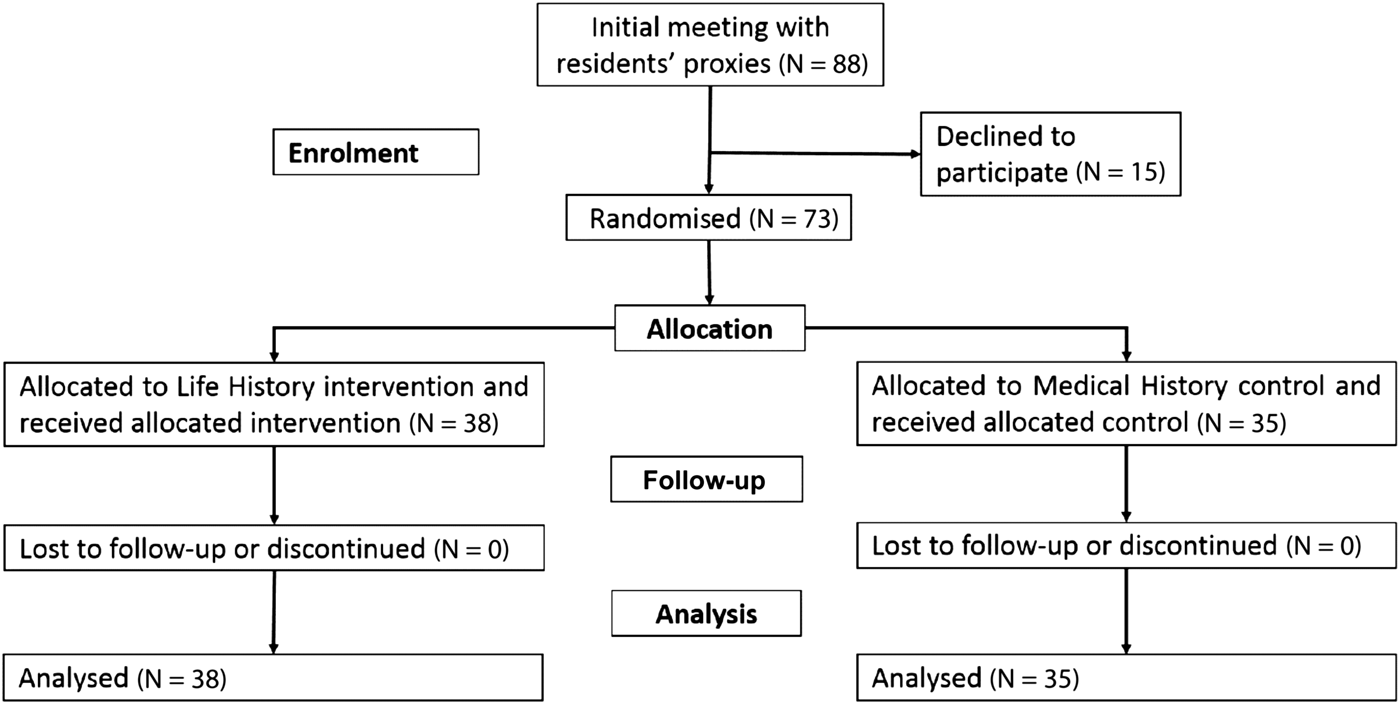
A total of 73 resident participants completed the study. Participant flow is outlined in Figure 1. In addition, a total of 99 staff members participated, including 70 Special Care Aides (SCAs; 70.7%), 22 Registered Nurses (RNs; 22.2%), three Licensed Practical Nurses (LPNs; 3.0%), three Registered Psychiatric Nurses (RPNs; 3.0%), and one Resident Care Coordinator (RCC; 1.0%). See the Procedures and Results sections for further descriptive and comparison information about resident and staff participants.
Participant flow through the study.

Procedure
Following all necessary ethics clearances from both our university (number 172R1112) and the local health region (number REB-11-40), resident participants over the age of 65 who were identified by senior nursing staff familiar with the residents (i.e. the RCC) as having symptoms consistent with a diagnosis of dementia, were recruited from six LTC facilities in a mid-sized metropolitan area. The RCC initially identified residents whom they believed appropriate and letters were sent by the facility to the next of kin describing the project and requesting consent. The letter stressed the voluntary nature of participation. Letters were followed up with a call by the researcher if no response (positive or negative) was received.
Due to the high degree of dementia in LTC facility residents (see below), we obtained both proxy consent and resident assent in the case of patients capable of communicating verbally. We are acutely sensitive of the ethical concerns involved when conducting research with residents who are unable to provide consent due to the presence of dementia. We were careful in all instances to ensure that family members had full information regarding the research to make an informed choice on behalf of their relative. The majority of proxies were children (N = 49, 67.1%) and spouses (N = 16, 21.9%) of the residents, while the remaining were grandchildren, nieces or nephews, siblings and others. Proxies were primarily female (N = 50, 68.5%). Resident participants were randomly assigned by coin toss (after consent was obtained) to either a Life History (LH) group (N = 38, 51.4%) or a Medical History (MH) group (N = 35, 47.3%). Participants' proxies were present during allocation to study condition.
Following this initial meeting which involved consent/assent, in-person proxy interviews were arranged for both conditions (i.e. LH and MH groups). All interviews used a semi-structured interview guide and were audio recorded for later review. These interviews were used to derive our life histories and medical histories. For the life histories, we asked questions regarding the residents’ childhood, family and friends, personality, contributions and important life events. Family members were encouraged to submit photographs of the resident from the past to be included in the life history as well as artefacts or copies from the resident's life (e.g. war medals, handwritten notes, hand-made crafts) to be presented to the LTC staff (originals were returned to the family following the intervention). Each history was approximately two pages, including one page of photographs. This length was chosen so that care staff could both read the information in a short amount of time and have an opportunity to thoroughly view the photographs (under five minutes). All life histories could have been substantially longer. We operated under the assumption that nursing staff would be less likely to review a long history. We aimed for a balance between each history being unique in content but also containing the same type of information (e.g. past accomplishments) as other histories. We included information about the resident's past life events, personality characteristics and preferences. For the medical histories, the semi-structured interview included questions of medical and health history. For consistency of methodology, we chose to gather the medical history via proxy interview rather than chart review. The residents' life histories or medical histories were written by the primary researcher or a trained research assistant. Once the life or medical histories were complete, they were presented to the family members for review, and any changes or corrections requested were made.
We invited at least five staff members (on recommendation of the facility's RCC or Director of Care) per resident to participate. Staff were regular or casually employed, but we requested that all work regularly with the resident. We left it to the discretion of the Director of Care to determine who would be suitable to participate. All staff members confirmed informally to researchers during consent procedures that they knew and worked with the resident participant(s). No other inclusion/exclusion criteria were considered except that staff members needed to have strong enough English to complete the questionnaires. The voluntary nature of participation was stressed, and participating staff members provided written consent. Measures were completed by staff members during each of three time-points: (a) a baseline period; (b) the intervention period; and (c) a follow-up period for both groups.
The baseline period was the date the first staff member questionnaires were completed to the date before the first staff intervention was completed (an average of 38.63 days, standard deviation (SD) = 12.97). The post-intervention period was considered to start on the date that the first staff member intervention and questionnaires were completed to the date the last staff member intervention and questionnaires were completed (an average of 19.62 days, SD = 18.42). The follow-up period began approximately 30 days after the post-intervention period and was considered to start on the date the first staff member completed the measures to the date the final staff member questionnaires were completed (an average of 46.17 days, SD = 20.91).
During the intervention period, staff members were presented with either the medical histories or the life histories of the resident participants with whom they worked. All histories were presented to staff members verbally, in an interactive format by the primary researcher or a research assistant, allowing for questions and discussion between the staff member and the researcher. All histories were also placed in the residents' rooms and on the residents' charts, and staff participants were encouraged to refer to the histories and to speak with other staff members about what they had learned and direct other staff to the histories as posted.
At each time-point for each resident participant (baseline, post-intervention and follow-up), nurses (RN, LPN, RPN) completed measures of resident aggression and resident QOL. We did not have all staff members complete these measures to avoid overburdening our participants; nursing staff have a higher level of education and generally are more practised with regards to completing paperwork for the residents and thus they completed more measures. All staff members (including RN, LPN, RPN, SCA and RCC) completed measures of empathy and attitudes regarding resident personhood. Immediately following the presentation of a resident's life history (i.e. for residents in the LH group), staff members were asked to respond to open-ended questions regarding their intention to change behaviour in response to the life histories and points of similarity between themselves and the resident. We conceptualised these questions as part of the life history intervention (i.e. they were expected to focus staff members on changing behaviour based on the life histories). At follow-up (also for the LH group only), staff members were asked to complete open-ended questions regarding their experiences with the life histories. At the conclusion of the study, all staff participants were asked to comment in writing on their understanding of the study and were encouraged to provide general feedback about participating in the study. Each resident had on average 4.92 (SD = 0.98) staff members completing the first phase of questionnaires, and an average of 4.60 (SD = 1.06) staff members completing all of the phases of the study. Results from an independent t-test indicated that there was no statistically significant difference between the LH and MH groups in terms of average number of staff members completing the study. Although practical considerations led our design to introduce non-independence of ratings, this was controlled for through mixed-effects modelling.
Information was obtained from the residents' charts including demographics (date of birth, marital status, level of education, diagnoses) and psychotropic medications at baseline and for 30 days following the intervention (prescribed on a PRN schedule). Psychotropic medications were quantified using the Medication Quantification Scale (III; Harden et al. Reference Harden, Weinland, Remble, Houle, Colio, Steedman and Kee2005 with therapeutic/sub-therapeutic levels determined as per Semla, Beizer and Higbee Reference Semla, Beizer and Higbee2011). They were specifically examined in the analysis, as they are often considered and used as forms of chemical restraint. Our goal was to determine whether use of such PRN psychotropic medications would be affected by our intervention. We also obtained the residents' most recent score on the Cognitive Performance Scale (CPS; see Materials for more information; Morris et al. Reference Morris, Fries, Mehr, Hawes, Philips, Mor and Lipsitz1994) via chart review in order to describe our sample in terms of dementia severity.
Materials
The Personhood in Dementia Questionnaire
The Personhood in Dementia Questionnaire (PDQ; Hunter and Hadjistavropoulos Reference Hunter and Hadjistavropoulos2011; Hunter et al. Reference Hunter, Hadjistavropoulos, Smythe, Malloy, Kaasalainen and Williams2013). was developed to reflect staff perceptions of the personhood of LTC residents with dementia. We adapted the PDQ for use in this study in order to minimise staff burden. The version of the questionnaire from which we adapted our measure contains 64 items, with responses ranging from 0 (disagree extremely) to 6 (agree extremely) (Hunter and Hadjistavropoulos Reference Hunter and Hadjistavropoulos2011). Reliability of this version of the PDQ is good, with Cronbach's alpha at 0.92 (P. Hunter, personal communication, 9 September 2014); the current version of the PDQ also demonstrates excellent psychometric properties (Hunter et al. Reference Hunter, Hadjistavropoulos, Smythe, Malloy, Kaasalainen and Williams2013). We selected our items based on the available item–total correlations (Hunter and Hadjistavropoulos Reference Hunter and Hadjistavropoulos2011). We selected the ten items with the highest item–total correlations which were all greater than 0.59 (a value greater than the minimum recommended in the literature; Kline Reference Kline2005). The items were personalised for each individual resident (‘resident’ replaced with, for example ‘Mr A’). For the adapted measure, Cronbach's alpha was 0.82 at baseline, 0.85 immediately following the intervention and 0.86 at follow -up.
Aggression Behaviour Scale
The Aggression Behaviour Scale (ABS; Perlman and Hirdes Reference Perlman and Hirdes2008) is a four-item measure of aggressive behaviour. The ABS results in a total score ranging from 0 to 12, with higher scores indicating greater frequency of aggressive behaviours. Items include verbal abusive (e.g. screaming at others), physical abusive (e.g. hitting others), socially inappropriate or disruptive behaviour (e.g. throwing food) and resisting care (e.g. pushing care-giver during care provision). These items are coded by frequency over a seven-day period; not exhibited (0), behaviour occurred on one to three days in past seven days (1), behaviour occurred on four to six days in past seven days but less than daily (2), or behaviour occurred daily (3). Scores on the ABS have been found to be highly correlated with the Cohen-Mansfield Agitation Inventory (CMAI; Cohen-Mansfield, Marx and Rosenthal Reference Cohen-Mansfield, Marx and Rosenthal1989) aggression sub-scale. Cronbach's alpha for the ABS has been found to be acceptable (0.80; Perlman and Hirdes Reference Perlman and Hirdes2008). The ABS was completed by nurses at baseline, intervention and follow-up. Cronbach's alpha statistics were also found to be satisfactory: 0.78 at baseline, 0.70 immediately following the intervention and 0.80 at follow-up.
Cohen-Mansfield Agitation Inventory
The CMAI (Cohen-Mansfield, Marx and Rosenthal Reference Cohen-Mansfield, Marx and Rosenthal1989) is a valid and reliable measure (Devanand et al. Reference Devanand, Brockington, Moody, Brown, Mayeux, Endicott and Sackeim1992; Finkel, Lyons and Anderson Reference Finkel, Lyons and Anderson1992; Reisberg et al. Reference Reisberg, Bornstein, Salob, Ferris, Franssen and Gerogotas1987) developed to assess agitated behaviours in older adults with cognitive impairment. It consists of 29 behaviours which are rated by nurses from 1 (never engages in behaviour) to 7 (engages in the behaviour several times per hour). Examples of behaviours include cursing, hitting, pushing, scratching, repetitive sentences or questions, and screaming. At each time-point, nurses were asked to complete the CMAI by recalling the frequency of occurrence over the past two weeks. In previous research, reliability and validity for the CMAI have been found to be good, with Cronbach's alpha ranging from 0.86, 0.91 and 0.87, for day, evening and night staff, respectively (Cohen-Mansfield, Marx and Rosenthal Reference Cohen-Mansfield, Marx and Rosenthal1989). The Cronbach's alpha statistic in our study was 0.91 at baseline, 0.89 immediately following the intervention and 0.90 at follow-up.
Alzheimer's Disease-Related Quality of Life – Revised)
The Alzheimer's Disease-Related Quality of Life – Revised (ADRQL-R; Kasper et al. Reference Kasper, Black, Shore and Rabins2009) is a valid and reliable measure (consisting of 40 observable behaviours, designed to be completed by care-givers). Items are intended to measure health-related QOL in individuals with Alzheimer's disease. The ADRQL consists of items on five different domains: social interaction, awareness of self, feelings and mood, enjoyment of activities, and response to surroundings, and these domains remain in the revised version. The version used in this study was revised from the original version to include fewer items and to reassign items to different domains based on findings from a factor analysis (Kasper et al. Reference Kasper, Black, Shore and Rabins2009). The ADRQL-R was found to have improved psychometric properties when compared to the ADRQL and has been recommended for use in future studies (Kasper et al. Reference Kasper, Black, Shore and Rabins2009). Cronbach's alpha statistics in this study were excellent: 0.90 at baseline, 0.90 immediately following the intervention and 0.92 at follow-up. These are higher than the Cronbach's alpha of 0.86 reported by Kasper et al. (Reference Kasper, Black, Shore and Rabins2009) for the full scale.
The Jefferson Scale of Physician Empathy – Health Professional Version
Hojat et al.'s (2001) measure of health professional empathy is unique to the care-giver–resident relationship defining care-giver empathy as an understanding of the resident's inner feelings and experiences. The Jefferson Scale of Physician Empathy – Health Professional Version (JSPE-HP; Hojat et al. Reference Hojat, Gonnella, Nasca, Mangione, Veloksi and Magee2002) is a 20-item scale scored from 1 (strongly disagree) to 7 (strongly agree), which has acceptable psychometric properties including high internal consistency among physicians, students and nurses, and expected levels of convergent and divergent validity (Davis Reference Davis1980; Fields et al. Reference Fields, Hojat, Gonnella, Mangione, Kane and Magee2004; Hojat et al. Reference Hojat, Gonnella, Nasca, Mangione, Veloksi and Magee2002). The measure was revised with some wording changes to be more applicable to all health-care professionals (e.g. ‘physician’ was changed to ‘LTC staff member’) and to refer to each specific resident participant (e.g. ‘the patient’ was changed to ‘Mr A’, for instance). Cronbach's alphas in previous research using physicians, students and nurses have been good, ranging from 0.87 to 0.89 (Davis Reference Davis1980; Fields et al. Reference Fields, Hojat, Gonnella, Mangione, Kane and Magee2004). The resulting Cronbach's alpha statistics for the JSPE-HP in the current study (which included SCAs) were low: 0.30 at baseline, 0.52 immediately following the intervention and 0.27 at follow-up.
Cognitive Performance Scale
The Cognitive Performance Scale (CPS; Morris et al. Reference Morris, Fries, Mehr, Hawes, Philips, Mor and Lipsitz1994) is a reliable and valid five-item instrument routinely administered in LTC to measure memory, decision-making skills, communication and independence in eating (Hartmaier et al. Reference Hartmaier, Sloane, Guess, Koch, Mitchell and Phillips1995; Morris et al. Reference Morris, Fries, Mehr, Hawes, Philips, Mor and Lipsitz1994; Paquay et al. Reference Paquay, De Lepeleire, Schoenmakers, Ylieff, Fontaine and Buntinx2007). Scores range from 0 to 6 with anything above 2 indicating moderate or severe impairment. For this study, total CPS scores were obtained from the residents' charts.
Analysis
Mixed-effects multiple regression models (e.g. Hox Reference Hox2010) were used to test our expectations that the LH group would demonstrate better outcomes than the MH group after the intervention on measures of: aggression/agitation (using both the ABS and the CMAI); nurse empathy and personhood (using the JSPE-HP and the PDQ); medications (i.e. fewer PRN medications after the intervention); and QOL (ADRQL). Mixed-effects modelling allowed testing of both fixed and random effects, the latter of which were used to account for clustering effects of residents within nurses. Model fit was evaluated using the Akaike Information Criterion (AIC) and the Bayesian–Schwarz Information Criterion (BIC). When the model was significant, we conducted independent t-tests to determine whether the change was also significant. Maas and Hox (Reference Maas and Hox2004) suggest a sample size of at least N = 50 at level two (i.e. the resident participants) to obtain adequate power (α = 0.80) for multi-level modelling. Our sample of 73 exceeded this.
We tested the effectiveness of our LH intervention on changes in scores on the ABS, the CMAI, the JSPE, the PDQ, the ADQRL-R and PRN medications between: (a) baseline and post-intervention; and (b) post-intervention and follow-up. We tested models with and without the following covariates: baseline scores when applicable (i.e. when examining the change from post-intervention to follow-up), and for the analyses of the personhood and empathy measures, ‘nurse group’ (NG; i.e. nurses who provided responses for participants in the LH group and others in the MH group; we expected these two measures specifically to be susceptible to the effect of NG). In this manner, we tested 22 models. We followed up the best fitting models with an additional examination of cognitive status (i.e. CPS scores used categorically, 0–2 = not severe, 3–4 = moderately severe, 5–6 = severe) as a covariate. An additional seven models were run. For each model, in addition to assessing the fit of the model using the fit statistics described earlier, we conducted tests of significance, examining the difference between the LH group and the MH group on each change score and also testing whether these changes were significantly different from zero for each group. In models using the CPS score category as a covariate, we further examined whether CPS scores explained significant variance in the model overall and for each CPS group specifically (i.e. whether each category differed from zero). For all models, a random intercept was included to account for potential clustering.
Based on the results of the mixed-effects models, two mediation models were derived and tested using methods outlined by Bauer, Preacher and Gil (Reference Bauer, Preacher and Gil2006). In this method, three separate models are tested and compared to determine whether the mediator contributes to the effect of the independent variable on the dependent variable. We tested an additional mixed-effects model to determine the fixed-effects estimates and their variances and covariances as well as the variances and covariances for the random effects, while accounting for potential clustering because the data cannot be assumed to be independent. Once the models were fitted to the data, the average indirect effect and the average total effect and their standard errors are calculated (Bauer, Preacher and Gil Reference Bauer, Preacher and Gil2006). The average indirect effect, if statistically significant, provides evidence for a mediation relationship between the variables. Bauer, Preacher and Gil (Reference Bauer, Preacher and Gil2006) note that the resulting test statistic of the direct and indirect effect approximates a standard normal distribution (i.e. a z-distribution).
Pearson correlation coefficients were used to examine whether there were significant relationships between level of cognitive impairment of the resident and nurse-reported outcomes, expecting higher levels of cognitive impairment as measured by the CPS (regardless of life history versus MH group) to be related to poor outcomes.
After the quantitative analyses were completed, we conducted qualitative analysis of the handwritten responses to the open-ended questions in order to determine reasons for the changes indicated by the results of the quantitative analyses. Data were organised using NVivo 8. We used thematic analysis (e.g. Braun and Clarke Reference Braun and Clarke2006), beginning deductively with questions/hypotheses about the data and initial frameworks from the literature (i.e. coding structures/organisational frameworks based around personhood (Hunter et al. Reference Hunter, Hadjistavropoulos, Smythe, Malloy, Kaasalainen and Williams2013) and empathy (Hojat et al. Reference Hojat, Mangione, Nasca, Cohen, Gonnella, Erdmann and Magee2001). Additional information about these frameworks is provided in the Results section. Deriving initial information from the literature allows the data to add to current conceptualisations by using the same language and a level of shared understanding (Tuckett Reference Tuckett2005). The first step of organising our data into coding structures served two purposes: (a) it enabled us to search with ease when asking questions based on the quantitative results; (b) it enabled a subsequent inductive approach whereby insights arising from the data informed changes in the initial coding framework, to elucidate potential themes. Trustworthiness of the work was established in several ways, in accordance with Elo et al. (Reference Elo, Kääriäinen, Kanste, Pölkki, Utriainen and Kyngäs2014), including use of literature-derived categories as well as a code book outlining coding parameters. Moreover, two of the authors completed these analyses together, discussing emerging concepts and frameworks throughout with each other and also with the research team. An audit trail was kept in two ways: (a) through handwritten notes of all meetings between researchers regarding the qualitative analysis specifically, qualitative analysis decisions and working through of the iterative readings of text; and (b) digital records including the NVivo files and working documents with notes and tabulations. Coding structures and themes are described in the Results section.
Results
Participants' characteristics
Residents' characteristics
Resident participants (N = 73) had an average age of 85.98 years (SD = 7.49) and most were female (N = 56, 75.7%). The majority of residents were either widowed or married (widowed N = 37, 50.0%; married N = 19, 25.7%) and had an average of 10.87 years of education (N = 39, SD = 3.254). Eighty-one per cent (N = 59) of residents had a diagnosis of a dementia on their chart, with an average CPS score of 4.17 (N = 71, SD = 1.57), which is indicative of moderate to severe cognitive impairment. Over the entire study period, there were an average of 0.82 (SD = 2.92) (median = 0) aggressive incidents per resident. Residents in our two study conditions (see Procedure below for details) were compared on each of the aforementioned demographic variables (i.e. age, sex, marital status, education, CPS score, aggressive incidents) using an independent samples t-test for continuous variables or a chi-square test for categorical variables. No significant differences were found.
Staff characteristics
The staff participants (N = 99) consisted of 91 females (92.9%) and seven males (7.1%), with an average age of 45.13 (SD = 10.45). The average number of years of experience was 15.12 years (SD = 10.54), and the average number of years at the facility was 10.74 (SD = 9.12).
Staff members were recruited from each facility and completed measures about resident participants that they worked with regularly. By design, each resident participant had measures completed by both SCAs and nurses (RNs, RPNs, LPNs). Staff members completed measures for an average of 3.46 (SD = 2.41) (median = 3.00) residents each. The majority of staff members completed measures for residents in both conditions (N = 60, 60.6%). The other staff members completed measures for residents in just one condition (i.e. in either the LH or MH condition). All data were organised according to resident participants (i.e. residents, not staff members, comprised the unit of analysis).
Mixed-effects models
Descriptive statistics for all measures are presented in Table 1. Results from the best fitting models are presented. Except when noted otherwise below, the interclass correlation was calculated to be near zero, indicating a lack of correlation between nurse responses (i.e. that each nurse responded independently when answering questions about the same resident).
Means (and standard deviations) of measures

Notes: LH: Life History group. MH: Medical History group. ABS: Aggression Behaviour Scale. CMAI: Cohen-Mansfield Agitation Inventory. JSPE-HP: Jefferson Scale of Physician Empathy – Health Professional Version. PDQ: Personhood in Dementia Questionnaire. PRN: pro re nata or ‘as needed’. ADRQL: Alzheimer's Disease-Related Quality of Life Scale – Revised.
Aggression/agitation (ABS and CMAI)
For the analysis of ABS change scores from baseline to post-intervention, the model using CPS as a covariate was a better fit than without. The changes in the LH group, t(39) = −4.11, p < 0.01 and the MH group, t(39) = −3.12, p < 0.01 were both significantly different from zero. One of the CPS categories (i.e. CPS score 3 or 4, moderately severe) was significant also, t(39) = 2.31, p < 0.05. Overall, however, the two groups did not have a statistically different change over the two time-points when CPS was controlled for. For the analysis of ABS change scores from post-intervention to follow-up, the model without the covariate, baseline scores was a better fit but did not yield significant follow-up comparisons. For the CMAI, the models did not yield significant follow-up comparisons.
Empathy and personhood (JSPE and PDQ)
For the analysis of JSPE change scores from baseline to post-intervention, the model without the NG covariate represented a better fit. For this analysis, use of the CPS covariate did not explain additional variance in the model (i.e. the results were consistent with the model that did not use CPS score as a covariate), nor did it result in a better-fitting model. Thus, we report the model without the CPS covariate here. The test of the difference between the LH group and MH group was statistically significant, F(2, 221) = 5.76, p < 0.01, with JSPE scores decreasing at a greater rate for the MH group post-intervention. The LH group was found to not be significantly different from zero, while the MH group was, t(221) = −2.97, p < 0.01. When considering the data examining the change between post-intervention and follow-up, the model using all covariates (i.e. NG, CPS scores and JSPE scores at baseline) represented the best fit but did not yield significant follow-up comparisons.
For the PDQ change scores from baseline to post-intervention, the model with CPS score as a covariate represented the best fit. The test of the difference between the LH group and MH group was statistically significant, F(1, 223) = 10.59, p < 0.01, with PDQ scores increasing at post-intervention for the LH group and decreasing for the MH group. The LH group was found to be significantly different from zero, t(223) = 2.85, p < 0.01, while the MH group was not. No effects involving CPS score category were significant. For the PDQ change scores from post-intervention to follow-up, results from the model with the CPS score covariate were the best fit, resulting in a statistically significant difference between the LH group and MH group, F(1, 211) = 6.44, p < 0.05, with PDQ scores decreasing at follow-up for the LH group and increasing for the MH group. t-Tests indicated that this change in scores was significantly different from zero for the LH group, t (211) = −2.62, p < 0.05, but not for the MH group. No effects involving CPS score category were significant.
PRN medication
General linear models were used to test the difference in medications between baseline and post-intervention, between post-intervention and follow-up, and between post-intervention and follow-up controlling for baseline medications. In each instance, the amount of variance explained was negligible (non-adjusted R 2 < 0.02) and no follow-up comparisons were significant.
Quality of Life (ADQRL-R)
For the analysis of ADRQL change scores from baseline to post-intervention, the model using CPS score category as a covariate was the better fit. The test of the difference between the LH group and MH group was statistically significant, F(1, 35) = 9.52, p < 0.01. Scores on the ADRQL increased at post-intervention for both the LH and MH groups, but at a greater rate for the LH group. The change in the LH group's ADRQL scores was found to be significantly different from zero, t(35) = 2.71, p < 0.05, while the MH group's was not. No effect involving CPS score category was significant.
For the analysis of the ADRQL change scores from post-intervention to follow-up, the model which included the baseline covariate scores provided a better fit, but did not yield significant follow-up comparisons. The interclass correlation for this model was calculated to be 0.12, indicating that the nurse responses were moderately independent.
Mediational models
The first mediation model examined the difference between the LH and MH groups on the change in QOL (ADRQL) from baseline to post-intervention including the mediator, change in personhood perception (PDQ), from baseline to post-intervention. The test of the indirect effect was found to be statistically significant, with a test statistic of −2.91, p < 0.01, indicating a mediated relationship. The estimate of the total effect was also found to be statistically significant, with a test statistic of −3.54, p < 0.001.
The second mediation model examined the difference between the LH and MH groups on the change in aggressive behaviours (ABS) from baseline to post-intervention including the mediator of the change in personhood perception (PDQ) from baseline to post-intervention. The test of the indirect effect was not found to be statistically significant, indicating an unmediated relationship. The estimate of the total effect was found to be statistically significant, with a test statistic of −2.57, p < 0.05.
Additional correlations
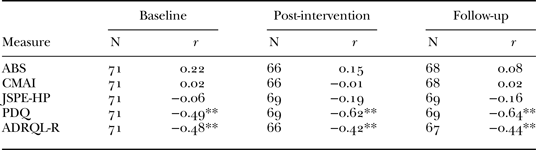
Relationships were expected between the level of cognitive impairment of the resident and nurse-reported outcomes, with higher levels of cognitive impairment as measured by the CPS related to poor outcomes. Significant negative correlations were found between the CPS and the ADRQL at baseline, r(71) = −0.48, p < 0.01, intervention, r(66) = −0.42, p < 0.01, and follow-up, r(67) = −0.44, p < 0.01, indicating that with increased cognitive impairment, QOL declines. This pattern of significance was repeated when the CPS was correlated with the PDQ at baseline, r(71) = −0.49, p < 0.01, intervention, r(69) = −0.62, p < 0.01, and follow-up, r(69) = −0.64, p < 0.01, indicating that with increased cognitive impairment, staff perception of that resident's personhood decreases. All correlations with CPS scores are presented in Table 2.
Cognitive Performance Scale score correlations
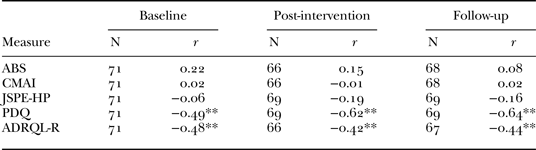
Notes: ABS: Aggression Behaviour Scale. CMAI: Cohen-Mansfield Agitation Inventory. JSPE-HP: Jefferson Scale of Physician Empathy – Health Professional Version. PDQ: Personhood in Dementia Questionnaire. ADRQL: Alzheimer's Disease-Related Quality of Life Scale – Revised.
Significance level: ** p < 0.01.
Results of qualitative analysis
Our thematic analyses involved two narrative data-sets. The first (Data-set A) consisted of two open-ended questions about staff members' understanding of the study and general feedback about participating in the study. These data were available for residents in the LH group and those in the MH group. We used this information to compare staff who completed measures for participants in the LH group only, those who completed measures for residents in the MH group only and staff who completed measures for residents in both conditions. The second dataset (Data-set B) was available only for residents in the LH group. All staff members answering for a resident in the LH group completed open-ended questions regarding their intention to change their behaviour in response to the life histories and points of similarity between themselves and the resident.
Based on the results of the quantitative analyses, we sought to explore further the staff members' understanding of the concepts of personhood and empathy with an aim of elucidating the mechanisms of change (i.e. how, experientially, did our intervention impact upon staff empathy and their perceived personhood of the resident to result in behaviour change?). We therefore derived two coding structures relying on concepts from the literature, for each personhood (Hunter et al. Reference Hunter, Hadjistavropoulos, Smythe, Malloy, Kaasalainen and Williams2013) and empathy (Hojat et al. Reference Hojat, Mangione, Nasca, Cohen, Gonnella, Erdmann and Magee2001). Personhood was conceptualised as consisting of four primary categories: Biological (having bodily continuity and being a physical human being), Moral (having the status of being a person and being treated as such), Psychological (having agency, cognitive capacity, emotional capacity, personality and psychological continuity) and Social (having a social identity). A further component, Improved Care, was added later following initial readings of the data. Empathy was separated into four components, including viewing the world from the resident's perspective (Resident Perspective), understanding the resident's experiences, feelings and behaviours (Understanding), thinking like the resident (Cognitive) and feeling like the resident (Sympathy). Data were initially coded into these structures for Data-set A (i.e. responses to general study questions), and for this data-set we organised further by staff category (i.e. whether staff answered for residents in the LH group, MH group or both). For our primary data-set (Data-set B), we similarly coded the responses into the Personhood and Empathy frameworks and further decided to organise the data based on dementia severity of the resident. We anticipated differences in the responses of nurses depending on dementia severity of the resident because, theoretically, perception of personhood deteriorates as cognitive impairment increases (Buron Reference Buron2008). Findings from our correlational analyses also support this supposition.
Data-set A: Questions about study purpose and general comment
Overall, almost all staff members responded positively to the study, stating that it was ‘interesting’, ‘helpful’, ‘beneficial’, ‘enjoyable’ or ‘important’, and were able to articulate the purpose. Staff members commented that they learned a lot from the study, that it made a difference and thought that similar programmes should be implemented in their facility. For the most part, staff members had some degree of understanding of the purpose of the study, with approximately 80 per cent of respondents' written descriptions referencing at least one of five key elements of the study's purpose, as described in the consent form provided to staff participants.
When we compared staff groups (i.e. the ‘LH only’, the ‘MH only’ and the ‘both’ group) for the Empathy framework, we found that the staff who provided responses for the ‘MH only’ group spoke more frequently in ways that referenced empathy (40% of their total responses were coded into the Empathy framework), followed by the ‘both’ group (33.6%) and the ‘LH only’ group (19.2%). However, the content of staff members' responses within the Empathy framework was consistent across all three groups, with approximately 80 per cent of all respondents' statements referencing Understanding in some way. A similar pattern was found for the Personhood framework, with the ‘MH only’ group of staff most frequently referencing personhood concepts (20% of their total statements), followed by the ‘both’ group (15%) and the ‘LH only’ group (11.5%). Within the Personhood framework, the responses were similarly coded for the ‘MH only’ group and the ‘both’ group wherein respondents referenced Morality the most frequently. Staff members in the ‘LH only’ group referenced Personality and Morality at the same frequency.
Data-set B: Questions about changes in care based on the intervention
Approximately 60 per cent of nurses who completed these questions (i.e. those responding for residents in the LH condition) reported changing their care based on the intervention. Of those who responded affirmatively, most described changes in verbal interactions with residents, specifically being able to converse with residents more about past interests and experiences. For example, one staff member stated, ‘it [the LH intervention] improves communication and opens up dialogue so we can share common interests and I can make her feel more at home’. Also important were statements that were reflective of a deeper change in attitude, often made in conjunction with changes in communication. These were noted to be generally positive, with staff commenting on increased understanding of the resident and improved relations. As noted by one staff member, ‘I began relating to her in a personal way and interpreting her histories in our conversation. She barely probably remembers, but she seemed to agree with the conversations.’ Another staff member writes, ‘I tried slowly to interact with her by giving her time. She can know me and I can know her. Knowing that she is a shy individual, I gave time to allow her to know me. Now we have amazing rapport. I can make her laugh and talk.’
Interestingly, 12 per cent of staff members, who answered affirmatively, described changes in ways that could not easily be attributable to the intervention. For example, one staff member noted, ‘He [the resident] is very nice person. He is very quiet but he smile when you work with him and talk to him even he don't answer. But you can tell he listen to you.’ Another stated, ‘Resident has dementia so I keep conversations clear, short because of short attention span.’ Of those staff members who answered ‘no’ to whether they changed their care based on the intervention (40 staff members), they noted reasons including always having performed adequate care to every resident, already knowing the information presented in the life history or they did not provide a reason. For example, one staff member stated, ‘I try to treat everyone with respect compassion and understanding. They are individuals but a human being with feelings, emotions, etc.’ Another stated, ‘I knew most of the history. I always try to treat residents with respect and caring, and encourage involvement in anything which may be familiar from the past.’
Quantitative findings indicated significant correlations between increased level of resident dementia and poorer QOL, and decreased staff perception of personhood. To further explore these findings, we utilised the data coded into the Personhood framework (approximately 75% of the total coded statements), which had been sub-categorised based on resident level of dementia (Mild, Moderate or Severe). Within the framework, no systematic differences among the groups were identified based on frequency of responses within the Personhood framework. Staff members commenting on each group of residents with Mild, Moderate or Severe dementia referenced Psychological aspects of personhood most frequently (Mild 31%, Moderate 38%, Severe 34%), consisting mostly of comments about personality (Mild 24%, Moderate 30%, Severe 22%). Social aspects of personhood were also commonly described by nurses responding for each resident group (Mild 27%, Moderate 27%, Severe 32%).
A closer textual examination of staff statements within the Personhood framework revealed differences in staff members' use of language for residents with Severe dementia, compared to those with Mild or Moderate dementia, in ways that indicated lessened personhood perception for those with Severe dementia. Staff members tended to describe residents with Severe dementia in the past tense, whereas they described those in the Mild dementia group in the present tense. They seemed not to know the residents in the Severe dementia category as well as other residents. For example, staff members responding for residents in the Severe dementia group stated, ‘when I learned about her history I gained more respect for who she was as a person’, ‘she was a very nice lady’, ‘it gives me more ideas about the type of person I am looking after’ and ‘I never knew his yearning to farm and unable to do so’. This is in contrast to those responding for residents in the Mild dementia group who responded as though they were already familiar with the resident and regarded their character as individuals. Staff members responding for residents with Mild dementia made comments such as, ‘she is a spiritual person’, ‘she shows interest in staff’ and ‘she shows a genuine interest in others' wellbeing’.
Discussion
Results from this research make several important contributions to the literature on person-centred approaches to dementia care for LTC residents. In the first instance, we used a strong research design involving evaluation across three time-points over a four-month period, along with a control group. Such research designs are uncommon in LTC due to a number of practicalities, including the advanced age of participants, attrition due to death and high staff turnover rates (Murfield et al. Reference Murfield, Cooke, Moyle, Shum and Harrison2011; Tilden et al. Reference Tilden, Thompson, Gajewski, Buescher and Bott2013). Through our research design, we were able to demonstrate the benefits of the life history intervention on resident QOL and improvements in staff perception of the resident's personhood, although not on aggressive behaviours.
Interestingly, despite the significant post-intervention results, we did not find significance in the quantitative analyses involving changes in staff ratings during a follow-up period, indicating that our intervention may not have been potent enough to have sustained effects over the longer term. However, findings from qualitative analyses indicated that 60 per cent of staff members changed their interactions with residents, mostly through verbal communications. Attitude changes were also noted, with staff members emphasising better understanding of the residents' behaviour and greater ability to relate to the residents' perspectives. This latter finding, in particular, is consistent with the FA and NDB models in which aggressive behaviours are considered responsive to internal or external stimuli including unmet needs (Fisher et al. Reference Fisher, Drossel, Ferguson, Cherup, Sylvester, Gallagher-Thompson, Steffen and Thompson2008; Mitty and Flores Reference Mitty and Flores2007). Staff members reported better understanding of the reasons behind the behaviour, including the communicative aspect of aggression for the individual residents. Given the promising findings regarding the immediate changes reported by staff about themselves and the residents, as well as qualitative findings regarding changes in staff behaviour resulting from the intervention, this intervention has potential for longer-lasting changes. Future research could focus on increasing the intensity of the intervention (e.g. booster meetings with staff to ensure continuing consideration of a resident's history) for maintaining changes past the initial intervention period. As it was found in this study, both our Life History intervention and Medical History control groups decreased their levels of aggressive behaviours as indicated by one measure to a similar degree (a positive finding), but a significant group by time interaction was not found.
A major contribution of our findings is theoretical. Although a great deal has been written about personhood, there is a dearth of empirical research involving this construct. To our knowledge, this is the first clinical investigation which involved measurements of personhood perception in a LTC setting. Our findings confirm prior analogue results underscoring the potential importance of perceptions of resident personhood in clinical decisions (Hunter et al. Reference Hunter, Hadjistavropoulos, Smythe, Malloy, Kaasalainen and Williams2013). We found that changes in staff personhood perception served as a mediator in the relationship between resident group (LH or MH) and changes in resident QOL from baseline to after the intervention, which is an important benefit.
We did not find significant changes in empathy for the LH group from baseline to post-intervention, but the MH group's scores decreased for this time period. Measurement error regarding empathy cannot be ruled out, given the low levels of internal consistency of our empathy questionnaires. Reasons for these low levels may have been a sample that included SCAs, who have not been included in validation studies of the JSPE. Moreover, English is not the first language of many care aides which could have also affected the psychometric properties of the empathy tool. It is possible that an internally consistent tool would have yielded different results. However, other possible reasons for non-significance also cannot be ruled out, including the intervention working differently on different staff. It is also possible that a more intensive intervention would have yielded positive effects. Qualitative findings support this. We found that staff members whose residents received the LH intervention reported a number of ideas related to empathy, including having a greater understanding of the resident and being able to relate better to him or her after the intervention. A more intensive intervention might have yielded effects with regards to resident aggression as well. These issues should be explored further in future research.
Among residents in both conditions, we found a significant negative relationship between resident cognitive impairment and: (a) staff personhood perception; and (b) resident QOL; between baseline and post-intervention, and post-intervention and follow-up. Empirical research examining personhood is not extensive, but prior research has related cognitive impairment to lower expectations for QOL and health-related QOL (Gessert et al. Reference Gessert, Hyer, Kane, Rockwood, Brassard, Desjardins and Kane2005; Gonzalez-Salvador et al. Reference Gonzalez-Salvador, Lyketsos, Baker, Hovanec, Roques, Brandt and Steele2000). Consistent with the literature (e.g. Malloy and Hadjistavropoulos Reference Malloy and Hadjistavropoulos2004), the staff members' comments indicated that they viewed residents with the most severe dementia differently than those with mild dementia, in ways that indicate reduced personhood perceptions. Staff members were more likely to refer to those with severe dementia in the past tense and knew less about them as individuals and about their histories. These results suggest that staff members are aware of their limited knowledge about the residents with more severe impairments and that providing information about residents' histories, interests and personalities is especially important when residents are experiencing severe cognitive impairments.
Person-centred care is a topic of increasing importance in LTC (White, Newton-Curtis and Lyons Reference White, Newton-Curtis and Lyons2008). As awareness of the importance of personhood perception increases, policy makers have begun to initiate programming that focuses on increasing person-centred care, and several models to promote person-centred care have been implemented in LTC facilities around the world (Li and Porock Reference Li and Porock2014). Overall, the results of this study support the idea that interventions designed to increase personhood perception may benefit the QOL of residents residing in LTC facilities, despite the complexities associated with clinical decision-making involving frail senior residents (e.g. Kaasalainen et al. Reference Kaasalainen, Coker, Dolovich, Papaioannou, Hadjistavropoulos, Emili and Ploeg2007). The results of this study are generalisable to residents diagnosed with dementia, especially severe dementia, residing in a LTC facility that has not initiated prior life history work. These interventions are likely of the greatest benefit to those residents who suffer from severe cognitive impairments. Our results support the potential importance of engaging in life history construction. Exposing staff members to residents' past experiences in a more intensive/interactive manner may facilitate sustainable changes further support staff–resident interactions as the underlying mechanism. This is subject to future research.
Logistically, our research presented a host of challenges which we encourage other researchers to prepare for prior to embarking on large-scale, longitudinal research in LTC. The work in general was resource-intensive, requiring a large team that could respond flexibly to the needs of participants at different facilities at the same time. Timing was essential, especially when needing to work around unexpected incidents, such as unit quarantines due to influenza outbreaks. Having sufficient replacement nursing (paid with research funds) staff was critical in ensuring completion of the work. We tried to mitigate some of the practical challenges by staggering the start date of facilities, but staggering did not always have the desired effect because of interruptions to facility data collections due to unexpected reasons. Moreover, recruiting the necessary sample size to include both nurses and patients was not easy (due, in part, to high nurse workloads, proxy time constraints and availability, etc). Clearly, building strong working relationships with facility management, health-care staff, patients and families is critical for the success of logistically complicated research.
Acknowledgements
This research was approved by the Research Ethics Board of our university and by the Research Ethics Board of the local health region. This study was supported, in part, through a grant from the Saskatchewan Health Research Foundation. Heather Eritz was supported through a Doctoral Fellowship from the Alzheimer Society of Canada. The funders had no involvement in the execution and conceptualisation of this work. The authors have no relevant conflicts of interest to declare.