Since the 2000s, the spread of multidrug-resistant organisms (MDROs) including methicillin-resistant Staphylococcus aureus (MRSA) and extended-spectrum β-lactamase–producing Enterobacteriaceae (ESBLE) has become a serious threat worldwide and represents a major public health challenge. 1 MDRO infections are associated with higher mortality rates, longer hospital stays, reduced rates of clinical and microbiological response to treatment, and higher costs.Reference Lautenbach, Patel, Bilker, Edelstein and Fishman 2
To control MDRO transmission, contact precautions (CP) are recommended for colonized or infected patients, in addition to standard precautions (SP).Reference Siegel, Rhinehart, Jackson and Chiarello 3 Contact precautions include single-room isolation, use of designated medical equipment, informing healthcare professionals (HCPs), and systematic use of personal protective equipment (PPE).
Guidelines are based on sparse studies with a high level of evidence. In a literature review concerning the effectiveness of CP for MRSA, Cooper et alReference Cooper, Stone and Kibbler 4 showed a global failure in methodology: studies included many biases, no evaluation of the compliance with hygiene measures, and no possibility of differentiating the effect of CP from other simultaneous measures. Most studies investigating the effectiveness of CP have been either observational or without a comparative group. Thus, they do not consider the multifactorial nature of cross transmission and the main confounding factors.Reference Landelle, Pagani and Harbarth 5
Since 2004, the value of CP has been questioned in several studies. The systematic use of gloves, recommended in the United States, is currently debated.Reference Girou, Chai and Oppein 6 , Reference Kirkland 7 Gloves are associated with low observance of hand hygiene (HH) and frequent misuse, which hamper the effectiveness of precaution measures. Furthermore, several studies have shown that discontinuing CP is not associated with an increased rate of MDRO in hospital settings.Reference Almyroudis, Osawa and Samonis 8 – Reference Tschudin-Sutter, Frei and Schwahn 10 However, most of these studies were observational, involved a single center, reported only a specific context, or had major methodological or statistical biases (eg, main confounding factors were not studied such as antibiotic consumption and the admission-carriage MDRO rate or infections were studied but not colonization, which is an important MDRO reservoir indicator). Thus, it is difficult to clearly define the necessary attitude regarding the prevention of MDRO transmission.
Moreover, several studies have shown adverse consequences associated with CP,Reference Abad, Fearday and Safdar 11 including delays in care,Reference McLemore, Bearman and Edmond 12 reduced visits, less direct contact by HCP, and higher levels of depression and anxiety in isolated patients.Reference Landelle, Pagani and Harbarth 5 , Reference Harris, Pineles and Belton 13 , Reference Stelfox, Bates and Redelmeier 14
In France, recommendations have been reviewed in 2009. 15 Strict application of SP and discontinuation of CP can comprise a valid strategy for prevention of MDRO transmission if appropriate conditions are met: (1) availability of alcohol-based hand-rub (ABHR) solution closer to care, (2) a high level of compliance with HH protocols measured in a large number of observations, (3) a high level of ABRH solution consumption, (4) experienced infection control unit, and (5) solid knowledge of local microbial epidemiology.
Since 2014, in the intensive care unit (ICU) of the Metz-Thionville regional hospital center, CP have been discontinued for MDRO-infected or -colonized patients.
Therefore, we conducted prospective surveillance to assess whether discontinuation of CP increased the incidence density of MRSA or ESBLE ICU acquisition. Antibiotic consumption, MRSA or ESBLE carriage at admission, and SP compliance were also studied.
METHODS
Patients and Settings
This prospective observational before-and-after study was performed in the ICU of a regional hospital center in Metz, France. In January 2014, CP for MDRO-infected or -colonized patients were discontinued. We compared 2 periods of 25 months: January 1, 2012, to January 31, 2014 (the CP period) and February 1, 2014, to February 29, 2016 (the SP period). All patients admitted to the ICU during these periods were included. The Ethics Committee (Commission nationale de l’informatique et des libertés) gave approval for this monitoring (N°588909 v1), and all patients were informed.
The ICU consisted of 16 beds divided into 2 areas admitting 750 patients on average, corresponding to 5,300 patient days per year. All rooms were single-bed rooms with individual washing basins. Rooms were cleaned twice daily and after discharge with a bactericidal detergent disinfectant. Equipment and reusable medical devices were individualized and dedicated to each room and each patient. The nurseto-patient ratio was 2 nurses per 5 patients. The ICU’s nosocomial infection surveillance was integrated with the French network.Reference Desenclos and Group 16 The infection control unit participated weekly in the medical meetings. The infection control policy consisted of nasal and rectal swabs for MRSA and ESBLE, respectively, which was performed for all patients upon admission and every 7 days thereafter until discharge. During the SP period, only medical staff knew the results of surveillance cultures.
During the CP period, indications for isolation precautions were applied according to the French guidelines, 15 which are the same as the US Centers for Disease Control and Prevention (CDC) guidelines.Reference Siegel, Rhinehart, Jackson and Chiarello 3 Isolation practices were applied according the French guidelines. 15 Standard precautions involved (1) HH with ABHR before and after contact with the patient or his/her immediate environment, (2) wearing PPE (gloves with or without gowns) if contact with blood or body fluids was a risk, and (3) disinfecting contaminated medical devices and cleaning the patient rooms daily and after discharge. For CP, the following measures were added to SP: (1) performing HH prior to leaving the room, (2) wearing gowns if direct contact was made with the patient or his/her immediate environment, (3) notification of the patient status for all HCP supporting the patient.
During the SP period, from February 1, 2014, onward, CP were discontinued for patients colonized or infected with MRSA or ESBLE, and strict application of SPs was encouraged and reinforced for all patients admitted to the ICU. Contact precautions, airborne precautions, and droplet precautions were maintained for patients with other emerging MDROs or when required according to CDC guidelines.Reference Siegel, Rhinehart, Jackson and Chiarello 3 In addition, reinforced collaboration with the infection control unit was undertaken: (1) HCP and newcomers were trained relative to SP by training in actual situations with immediate corrective actions (action training) and (2) compliance of HH according to WHO recommendationsReference Sax, Allegranzi, Chraiti, Boyce, Larson and Pittet 17 and compliance to selection and removal of PPE according to the methods described by Mitchell et alReference Mitchell, Roth and Gravel 18 were assessed by a trained infection control nurse.
Data Collection
During the 2 study periods, individual data were recorded from all patients as part of the usual ICU monitoring. Demographic and clinical data were collected from the patients’ electronic records. Clinical and surveillance cultures of MRSA or ESBLE were prospectively reported by the laboratory. Strains were detected in selective chromogenic media (ChromID ESBLE [bioMèrieux, Marcy-l'Étoile, France] with additional antibiotics and ChromID MRSA [bioMèrieux]) and were identified using matrix-assisted laser desorption/ionization time-of-flight mass spectroscopy (MALDI-TOF MS).Reference Dingle and Butler-Wu 19 Antibiotic susceptibility was determined by the automated zone reader (Sirscan, i2a Diagnostics, Montpellier, France). The definition of a positive case of MRSA or ESBLE was 1 or more positive clinical or surveillance culture(s) for MRSA or ESBLE, respectively. An ICU-acquired MRSA or ESBLE case was defined if the first positive culture occurred 48 hours after admission in the ICU. If it occurred within 48 hours, the MRSA or ESBLE case was considered as carriage at admission.
Aggregate data regarding the ICU level were collected for the 2 study periods: (1) antibiotic consumption, (2) ABHR use for hand disinfection, (3) consistent observations with respect to SP rate, and (4) nasal and rectal swab completeness. Quarterly data on antibiotics consumption were provided from the pharmacy database and were expressed as the number of defined daily dose (DDD) per 1,000 patient days. 20 In general, ABHR use is reported in liters per 1,000 patient days and by the index of consumption according to French guidelines: the ratio between ICU consumption (obtained from the pharmacy database) divided by personalized objective (ICSHA2). 21 , Reference Grammatico-Guillon, Thiolet, Bernillon, Coignard, Khoshnood and Desenclos 22
Swab completeness was assessed by the number of performed swabs (provided by the laboratory) divided by the number of expected swabs. The number of trained agents and trainings was reported during the CP period.
Outcomes
The primary outcome was the incidence density of ICU-acquired MRSA or ESBLE per 1,000 patient days. Other factors were (1) patient characteristics, (2) length of stay (LOS), (3) the incidence density of MRSA or ESBLE carriage at admission, and (4) antibiotic consumption. Compliance rates to HH and to selection or removal of PPE and ICSHA2 were expected to be greater than to 80%.
Statistical Analysis
Patient characteristics are reported as means (±SD) for continuous variables and as percentages for categorical variables. Values were compared using the Student or Wilcoxon tests and χ2 tests, respectively.
A noninferiority analysis was used to evaluate the nonsuperiority of the incidence density of ICU-acquired MRSA or ESBLE during the SP period compared to the CP period. The incidence densities were compared following Schuirmann’s 2 one-sided test (TOST) procedure.Reference Schuirmann 23 A nonsuperior incidence density of ICU-acquisition was expected during the SP period compared to the CP period. A margin of nonsuperiority was fixed at 1 MDRO per 1,000 patient days. A noninferior incidence density of admission-carriage was expected during the SP period compared to the CP period. A margin of nonsuperiority was fixed at 1 MDRO per 1,000 patient days. All analyses were performed with the SAS 9.3 software package (SAS Institute, Cary, NC).
RESULTS
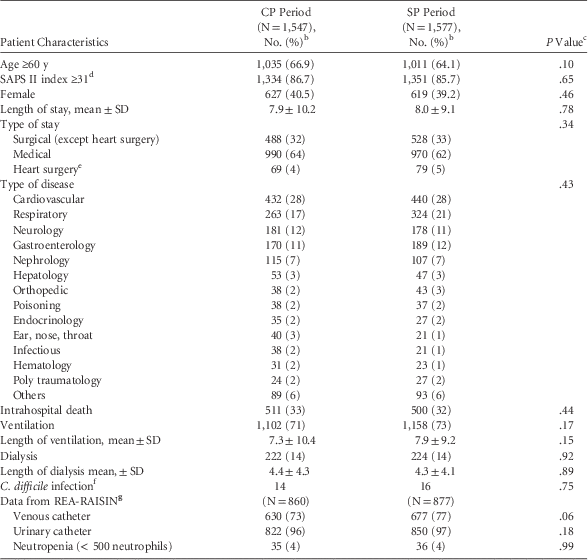
In total, 1,547 patients (mean age 65.3±16 years, 40.5% female), corresponding to 12,212 patient days, and 1,577 patients (mean age, 62.9±16.1 years; 39.2% female), corresponding to 12,601 patient days, were admitted in the ICU during the CP and SP periods, respectively. Patient characteristics are summarized in Table 1.
Patient Characteristics During the 2 Study PeriodsFootnote a

NOTE. CP, contact precautions; SP, standard precautions, SASP II, new simplified acute physiology score.
a January 1, 2012, to January 31, 2014 (CP period) and February 1, 2014, to February 29, 2016 (SP period).
b Unless otherwise specified.
c The Student test was used for continuous variables; the χ2 test was used for categorical variables.
d New simplified acute physiology score (SAPS II).Reference Le Gall, Lemeshow and Saulnier 24 The prognosis is better when SAPS II score is ≥31.Reference Bein, Hackner and Zou 25
e There is another reanimation for cardiac surgery in our establishment.
f Patients with positive stool toxin test results for A and/or B toxin.
g Data from national surveillance of nosocomial infection in reanimation (REA-RAISIN), which include patients with stay superior to 48 h.
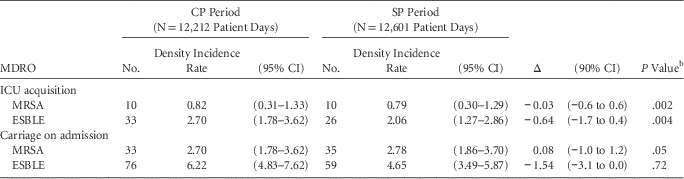
Acquisition of MRSA in the ICU was identified in 10 patients during the CP period and in 10 patients during the SP period (Table 2). The incidence density was significantly nonsuperior during the SP period compared to the CP period, with a margin of 1 per 1,000 patient days (P=.002).
Incidence Rates of MRSA or ESBLE ICU Acquisition and Carriage at Admission per 1,000 Patient Days During the 2 Study PeriodsFootnote a

NOTE. MRSA, methicillin-resistant Staphylococcus aureus, ESBLE, extended-spectrum β-lactamase-producing Enterobacteriaceae; CP, contact precautions; SP, standard precautions, CI, confidence interval; ICU, intensive care unit.
a January 1, 2012, to January 31, 2014 (CP period) and February 1, 2014, to February 29, 2016 (SP period).
b Schuirmann’s 2 one-sided tests (TOST) procedure; superior margin test for incidence rates of acquired MDROs and inferior margin test for incidence rates of imported MDROs.
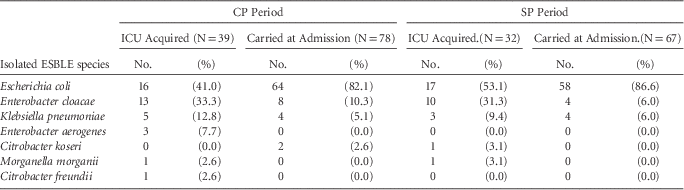
Acquisition of ESBLE in the ICU was identified in 33 patients (39 isolated strains) during the CP period and in 26 patients (32 isolated strains) during the SP period (including 1 patient under droplet precautions for influenza virus). The incidence density was significantly nonsuperior during the SP period compared to the CP period, with a margin of 1 per 1,000 patient days (P=.004).
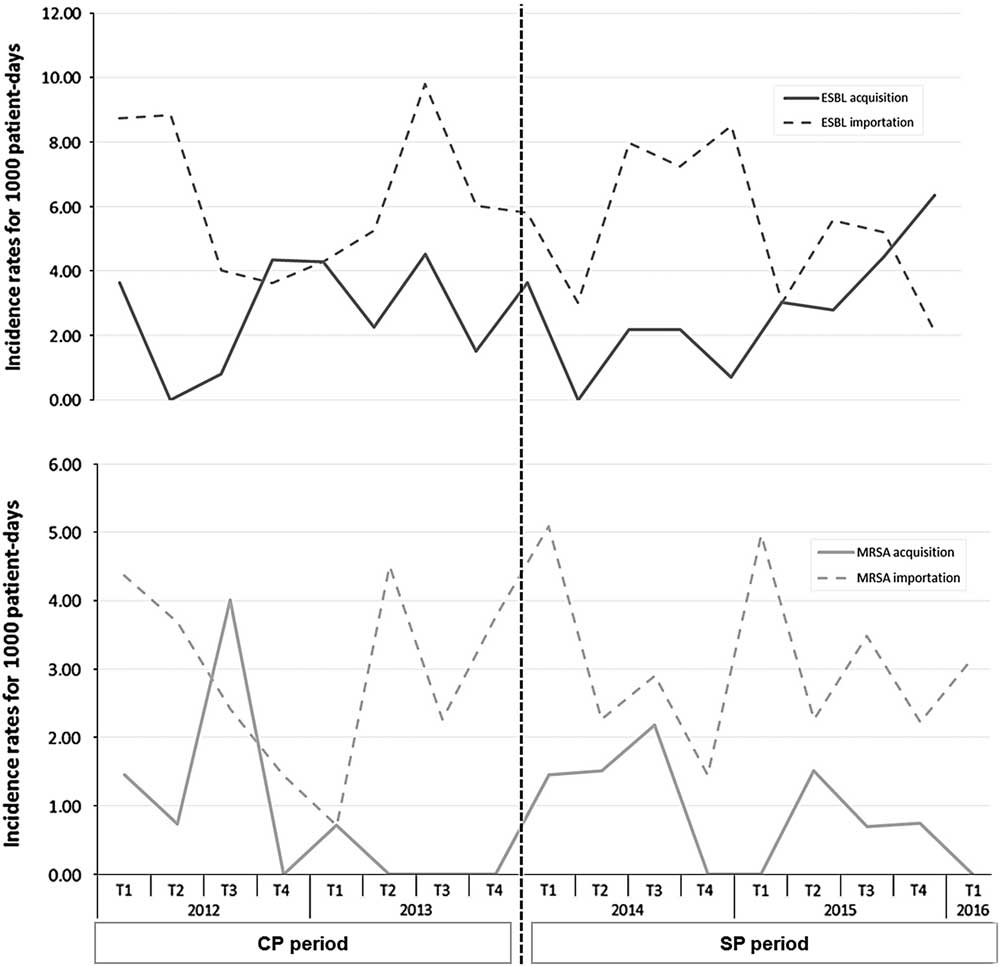
The incidence density of MRSA carriage at admission was significantly noninferior during the SP period compared to the CP period with a margin of 1 per 1,000 patient days (P=.05) (Table 2). The incidence density of ESLBE carriage at admission was inferior in the SP period compared to the CP period (P=.72). The isolated ESBL strains are described in Table 3. The respective evolutions of the incidence densities of carriage at admission and ICU-acquired MRSA or ESBLE are presented in Figure 1.
Quarterly incidence rates for ESBL acquired and carried at admission (top panel) and MRSA acquired and carried at admission (bottom panel) during the 2 study periods: January 1, 2012, to January 31, 2014 (CP period) and February 1, 2014, to February 29, 2016 (SP period). CP, contact precautions; SP, standard precautions; MRSA, methicillin-resistant Staphylococcus aureus; ESBLE, extended-spectrum β-lactamase–producing Enterobacteriaceae.

Description of Isolated ESBLE Strains in ICU (ICU Ecology) During the 2 Study PeriodsFootnote a

NOTE. CP, contact precautions; SP, standard precautions; ESBLE, extended-spectrum β-lactamase-producing Enterobacteriaceae, ICU, intensive care unit.
a January 1, 2012, to January 31, 2014 (CP period) and February 1, 2014, to February 29, 2016 (SP period).
During the CP period, 2,296 (91.5%) nasal surveillance and 2,292 (91.3%) rectal surveillance cultures were performed out of the 2,509 expected ones. Overall, MRSA strains were isolated in 65 nasal surveillance cultures and 36 clinical cultures; ESBLE strains were isolated in 143 rectal surveillance cultures and 34 clinical cultures. During the SP period, of 2,581 expected surveillance cultures, 2,386 (92.4%) nasal surveillance cultures, and 2,370 (91.8%) rectal surveillance cultures were performed. MRSA strains were isolated in 45 nasal surveillance cultures and 22 clinical cultures. ESBLE strains were isolated in 109 surveillance cultures and 23 clinical cultures.
Moreover, 16 trainings sessions relative to SP and CP were conducted by the infection control unit between 2013 and 2015: 3 theoretical training sessions and 13 action training sessions. In total, 95 healthcare workers (HCWs) were trained: 41 junior physicians, 6 senior physicians, 30 nurses, and 18 nurse assistants.
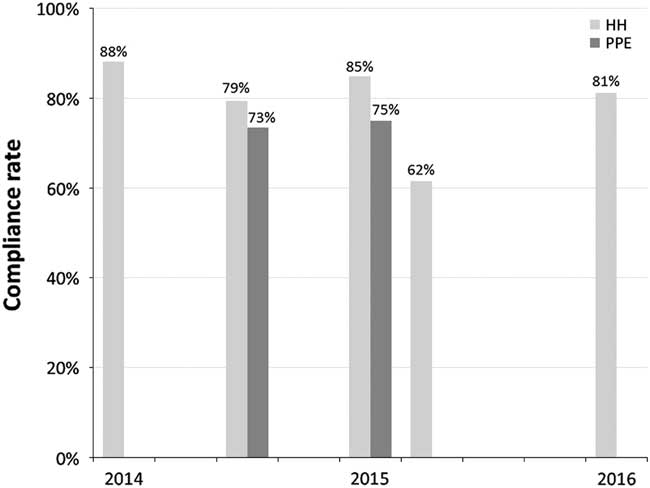
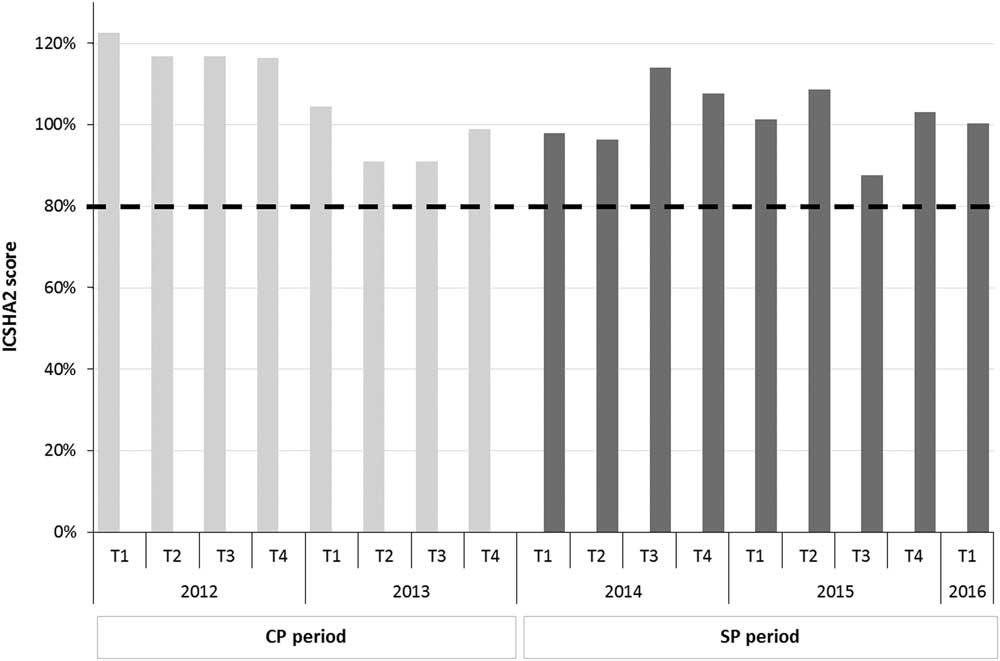
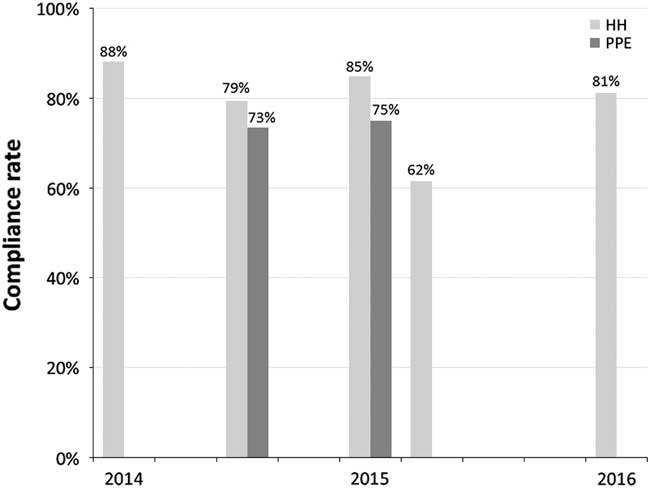
During the SP period, 801 HH opportunities and 255 selections and/or removals of PPE were observed. The overall compliance rates were 81% and 75%, respectively (Figure 2). The causes of noncompliance were related to gloves in 46% of cases for HH and to nonremoval of the PPE after care in 41% of PPE observations. In total, 1,529 liters of ABHR (125 liters per 1,000 patient days) and 1,744 liters of ABHR (138 liters per 1,000 patient days) were used during the CP and SP periods, respectively. The quarterly ICSHA2 was consistently >80% (Figure 3).
Compliance rate with hand hygiene and personal protective equipment selection and removal during the second period: February 1, 2014, to February 29, 2016 (SP period). HH, hand hygiene; PPE, personal protective equipment; SP, standard precautions.
Quarterly ICSHA2 during the 2 study periods: January 1, 2012, to January 31, 2014 (CP period) and February 1, 2014, to February 29, 2016 (SP period). standard precautions. ICSHA2 is an indirect index of the effective application of HH. This indicator is defined as the ratio between the volume of ABHR solution in liters ordered at the pharmacy divided by the personalized objective. The personalized objective was calculated par specialty by considering the number of annual patient days and a volume of 3 mL for each ABHR. In ICUs, 40 ABHR per patient per day were expected. ABHR, alcohol-based hand rub; HH, hand hygiene; ICSHA2, index of consumption of ABHR solution; ICU, intensive care unit; CP, contact precautions; SP, standard precautions. 21 , Reference Grammatico-Guillon, Thiolet, Bernillon, Coignard, Khoshnood and Desenclos 22

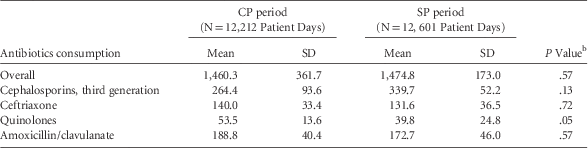
There was no significant difference between antibiotic consumption during the SP period and the CP period except for quinolone consumption; less quinolone was used during the SP period (P=.05) (Table 4). During the CP and SP periods, the conformity of room disinfection was observed in 8 (89%) and 10 (100%) evaluations performed, respectively (P=.47).
Antibiotic Consumption (DDD per 1,000 patient days) in the ICU During the 2 Study PeriodsFootnote a

NOTE. CP, contact precautions; SD, standard deviation; SP, standard precautions; DDD, daily dose defined; ICU, intensive care unit.
a January 1, 2012, to January 31, 2014 (CP period) and February 1, 2014, to February 29, 2016 (SP period).
b Mean comparisons with the Wilcoxon nonparametric test.
DISCUSSION
In the present before-and-after study performed in our ICU, noninferiority of the discontinuing CP strategy was observed compared to the CP strategy with regard to the ID of ICU-acquired MDRO. For MRSA, 0.82 and 0.79 cases per 1,000 patient days were observed during the CP and SP periods, respectively. In a study involving 13 ICUs in Europe, acquired MRSA rates reported in the 3 French ICUs ranged from 0.8 to 2.3 cases per 1,000 patient days.Reference Hetem, Derde and Empel 26 In the present study, 2.70 cases and 2.06 cases per 1,000 patient days of ESBLE were observed during the CP and SP periods, respectively. Acquired ESBLE rates reported by Boyer et alReference Boyer, Couallier and Clouzeau 27 ranged from 1.0 to 10.5 cases per 1,000 patient days, with higher rates corresponding to endemic situations in which the environment was involved. Altogether, our rates were comparable to those found in the literature. The mean age (5-year increments, 60 years) and the new simplified acute physiology score, SASP II (55 years), reported in our study were also relatively similar to those described by Boyer et alReference Tabah, Koulenti and Laupland 28 (mean age, 58 years; SASP II, 55 years) or Tabah et alReference Boyer, Couallier and Clouzeau 27 (mean age, 59.5 years; SASP II 50 years).
For MRSA, we observed an average of 2.7 cases per 1,000 patient days of carriage at admission during the 2 periods, comparable to a European study where the prevalence density ranged from 0.4 to 4 cases per 1,000 patient days.Reference Dulon, Haamann, Peters, Schablon and Nienhaus 29 For ESBLE, 6 and 4.5 cases per 1,000 patient days were observed in this study during the CP and SP periods, respectively. Seemingly higher rates were found in other ICU studies, with 8%Reference Alves, Lemire and Decre 30 or 2.3% to 8.6%Reference Boyer, Couallier and Clouzeau 27 patients admitted with ESBLE. In our study, the number of ESBLE cases of carriage at admission was inferior during the SP period compared to the CP period. This discrepancy cannot be explained by a lack of performed rectal swabs considering the high level of completeness (>90%). This discrepancy could hide an increase in ICU-acquired ESBLE rate during the SP period. Indeed, the number of patients admitted with MDRO constitutes a considerable colonization pressure determinant that represents a reservoir for the spread of MDRO.
A high level of compliance with SP was observed during the 2 periods of the study. During the SP period, the HH compliance rate was 81%; the misuse of gloves being responsible for half of the noncompliance causes, as has already been described in the literature.Reference Girou, Chai and Oppein 6 , Reference Kirkland 7 Selection or removal of the PPE compliance rate was <80%, but according to our observations it was high enough to be counterbalanced by the other measures (in the bundle) set up to limit the cross transmission. Standard precaution compliance was not observed during the CP period, but quarterly ICSHA2 was consistently >80% during the 2 periods. This indirect indicator of the effective application of HH may reflect a high level of ABHR use.Reference Grammatico-Guillon, Thiolet, Bernillon, Coignard, Khoshnood and Desenclos 22 The volume of ABHR (130 liters per 1,000 patient days) was higher than the basal volume reported in the Boyer study (89 liters per 1,000 patient days).Reference Boyer, Couallier and Clouzeau 27 We believe that strict application of SP is a fundamental condition when discontinuing CP.
The average LOS of 8.0 days during the 2 periods was comparable and aligned with another study performed in ICU in which LOS ranged from 8.2 to 9.6.Reference Boyer, Couallier and Clouzeau 27 LOS has a double impact on cross transmission.Reference Tabah, Koulenti and Laupland 28 , Reference Schoevaerdts, Bogaerts and Grimmelprez 31 First, there is a link between mean LOS and colonization pressure: the number of simultaneously admitted MDRO patients increases with mean LOS. Secondly, there is a greater risk of acquiring MDRO for patients with longer LOS,Reference Alves, Lemire and Decre 30 as shown by Alves et alReference Alves, Lemire and Decre 30 in which EBLSE acquisition was related with an ICU stay ≥12 days. In our study, LOS was shorter than that reported in the Alves study, which suggests a lower risk of MDRO transmission. It is not known, however, whether the acquisition rate observed herein would have been maintained with a longer LOS.
Antibiotic consumptions were identical during the 2 periods except for the quinolone use, which was lower during the SP period. Exposure to antimicrobial treatment plays a major role in the selection and emergence of MDRO (selective pressure)Reference Schoevaerdts, Bogaerts and Grimmelprez 31 , Reference Lucet, Decre and Fichelle 32 and can have an impact on MDRO acquisition rate. This result could hide an increase in the ICU-acquired MRSA rate. Antibiotic consumption in our ICU was similar to that of other French ICUs participating in the national surveillance program, 33 except for a seemingly greater use of ceftriaxone in our center. Previous studies have highlighted the independent impact of the use of cephalosporins on the emergence of ESBLE.Reference Schoevaerdts, Bogaerts and Grimmelprez 31 The antibiotic stewardship in our ICU involved the weekly interaction of staff with an infectious disease specialist and the systematic reevaluation of antimicrobial treatment at 48 hours. This process guarantees the sound management of antibiotics. Ceftriaxone consumption likely did not impact the incidence of MDRO during the 2 periods.
Other limitations of our study should be acknowledged. First, this was a single-center study, comprised of only 1 ICU. Our results may therefore not be applicable to units without the same level of equipment and organization. Moreover, the presence of medical and paramedical support and the quality of their collaboration was another promoting factor identified in our study. This management helps establish a safety climate,Reference Hessels, Genovese-Schek, Agarwal, Wurmser and Larson 34 which encourages the respect of good practices.Reference Hugonnet, Harbarth, Sax, Duncan and Pittet 35 , Reference Needleman, Buerhaus, Pankratz, Leibson, Stevens and Harris 36 This important factor should be considered for the extrapolation of the present results. Second, the observational design represents an inherent limitation. It may be difficult to determine the causality between discontinuing CP strategy and the impact on the acquisition rate of MDRO. It is also difficult to isolate the effect of the studied strategy among other hygiene measures implemented in the ICU. Nevertheless, the presence of hygiene support before the study and the absence of major modifications in practices limit the effect of this bias. The control of confounding factors is difficult without a randomized control group. We endeavored to account for the following risk factors of cross-transmission already described in the literature: (1) patient characteristics, (2) compliance to SP, and (3) selective pressure of antibiotics. We did not accurately consider 2 risk factors in our study: the number of entries in the patient’s room and the colonization pressure. The cross-transmission risk may have increased with these 2 factors, but several studies have proven that patients in CP have less visits by HCP than patients without CP.Reference Landelle, Pagani and Harbarth 5 In our study, the number of entries was potentially superior during the SP period (when CP were discontinued), than during the CP period. Despite this excess risk, the MDRO acquisition was not higher during the SP period. The colonization pressure was approached with the rate of MRDO carriage at admission, but some individual data were missing for accurate calculation (ie, admission and discharge dates). Another limitation with an observational study is the poor quality of collected data. However, the current data were reported prospectively as part of the usual surveillance of the ICU, which participates in the national monitoring and surveillance program.
Other studies have also questioned the value of CP in the ICU.Reference Almyroudis, Osawa and Samonis 8 , Reference Zahar, Poirel, Dupont, Fortineau, Nassif and Nordmann 9 Arguments in favor of discontinuing CP not only target HCP, because of less constraints, but also patients themselves. Indeed, several studies found an increased risk for adverse events in patients placed on CP,Reference Morgan, Diekema, Sepkowitz and Perencevich 37 , Reference Zahar, Garrouste-Orgeas and Vesin 38 including increased anxiety and depression scores,Reference Abad, Fearday and Safdar 11 , Reference Day, Perencevich and Harris 39 dissatisfaction with their treatment, less visits and less direct contact by HCP.Reference Landelle, Pagani and Harbarth 5 When placing patients in CP, a lower adherence of SP by HCP was reported for other patients due to overinvestment of CP. Therefore, discontinuing CP could present both individual and collective advantages and notably could allow greater focus on the application of SP, which is the fundamental measure to control the risk of microorganism cross transmission.
In summary, discontinuing CP in our ICU did not increase the number of acquired MDROs. We firmly believe that the following promoting factors should be targeted: (1) favorable organization (single room with washing basin, dedicated medical material and human resources), (2) strict application of SP closer to care, (3) medical and paramedical leadership, and (4) good antibiotic stewardship. Such action, in our opinion, could be generalized to other units if the aforementioned conditions are met.
ACKNOWLEDGMENTS
Financial support: No financial support was provided relevant to this article.
Potential conflicts of interest: All authors report no conflicts of interest relevant to this article.