Implications
This study investigated effects of extending the interval from prostaglandin F2α (PGF2α) to gonadotropin-releasing hormone (GnRH) during presynchronization and adding a second PGF2α treatment before artificial insemination (AI) on ovarian response, progesterone (P4) concentrations and pregnancy per AI (P/AI) in lactating dairy cows subjected to a G6G protocol. Extending the interval from PGF2α to GnRH during presynchronization increased response to first GnRH of Ovsynch and P4 concentrations during Ovsynch, whereas adding a second PGF2α treatment before AI, enhanced luteal regression. Therefore, both modifications of the G6G protocol improved P/AI.
Introduction
Most controlled breeding protocols for timed AI (TAI) currently available for dairy producers in USA and Canada are based on GnRH and PGF2α treatments (Colazo and Mapletoft, Reference Colazo and Mapletoft2014). Optimization of the GnRH/PGF2α-based protocol (Ovsynch: Pursley et al., Reference Pursley, Mee and Wiltbank1995) has been achieved by a presynchronization with two PGF2α treatments, 14 days apart (Presynch/Ovsynch: Moreira et al., Reference Moreira, Orlandi, Risco, Mattos, Lopes and Thatcher2001) or a combination of PGF2α and GnRH (G6G: Bello et al., Reference Bello, Steibel and Pursley2006; Double-Ovsynch: Souza et al., Reference Souza, Gumen, Silva, Cunha, Guenther, Peto, Caraviello and Wiltbank2008).
The G6G protocol consists of a single administration of PGF2α and GnRH 2 days later, followed by Ovsynch initiated 6 days after GnRH (Bello et al., Reference Bello, Steibel and Pursley2006). Administration of GnRH during presynchronization increases percentage of cows with a functional corpus luteum (CL) at initiation of Ovsynch (Gümen et al., Reference Gümen, Souza, Cunha, Silva, Guenther and Wiltbank2005; Dirandeh et al., Reference Dirandeh, Rezaei Roodbari and Colazo2015b). Therefore, a presynchronization protocol based on PGF2α and GnRH has the advantage of being potentially effective in both cyclic and acyclic cows. However, the interval to estrus and ovulation following PGF2α in cyclic cattle is dependent on the stage of development of the dominant follicle at treatment. In this regard, a single injection of PGF2α given to heifers during the growing or static phase of the dominant follicle of the first follicular wave resulted in ovulation 4.2 and 6.3 days after treatment, respectively (Kastelic and Ginther, Reference Kastelic and Ginther1991). In addition, the majority of lactating cows displayed estrus between 2 and 8 days after PGF2α treatment (Chebel et al., Reference Chebel, Santos, Cerri, Rutigliano and Bruno2006), suggesting that the interval to estrus is more variable in cows than heifers. Therefore, administration of GnRH 2 days after a single PGF2α given at random stages of the estrous cycle might not be the optimum interval to maximize responses to GnRH during presynchronization in cyclic dairy cows. Conversely, an interval of 4 days between PGF2α and GnRH would allow for further follicle growth and potentially increase the proportion of cows responding to the GnRH of presynchronization, with the Ovsynch protocol being initiated during a more appropriate stage of the estrous cycle, thereby resulting in a greater proportion of cows responding to the first GnRH of Ovsynch and an increased concentration of circulating P4 before AI.
Incomplete CL regression, defined as plasma or serum P4 concentrations ⩾0.5 ng/ml at TAI, resulted in reduced P/AI in cows subjected to GnRH-based protocols (Souza et al., Reference Souza, Ayres, Ferreira and Wiltbank2007; Brusveen et al., Reference Brusveen, Souza and Wiltbank2009; Behrouzi et al., Reference Behrouzi, López-Helguera, Mapletoft, Ambrose and Colazo2016). In this regard, incomplete luteolysis following a single PGF2α administration was reported in 10% to 27% of cows subjected to GnRH-based protocols (Martins et al., Reference Martins, Policelli, Neuder, Raphael and Pursley2011; Colazo et al., Reference Colazo, Behrouzi, Ambrose and Mapletoft2013b; Dirandeh et al., Reference Dirandeh, Rezaei Roodbari, Gholizadeh, Deldar, Masoumi, Kazemifard and Colazo2015a). Recently, Wiltbank et al. (Reference Wiltbank, Baez, Cochrane, Barletta, Trayford and Joseph2015) reported that cows receiving two PGF2α treatments during a Double-Ovsynch protocol had increased luteal regression (97% v. 83%) compared with cows receiving only one PGF2α treatment. Based on these observations, a second PGF2α before TAI should decrease the proportion of cows with incomplete luteolysis and improve P/AI in cows subjected to a G6G protocol.
The objectives of this study were to determine effects of (1) extending the interval from PGF2α to GnRH during presynchronization and (2) adding a second PGF2α treatment before AI, on ovarian response, plasma P4 concentrations and P/AI in lactating dairy cows subjected to a G6G protocol. Our hypotheses were that: (1) a presynchronization interval of 4 days from PGF2α to GnRH during presynchronization increases the proportion of cows responding to first GnRH of Ovsynch and circulating P4 concentrations during Ovsynch; and (2) addition of a second PGF2α treatment before AI decreases the proportion of cows with incomplete luteal regression. Both modifications to the standard G6G protocol were expected to increase fertility of lactating dairy cows.
Material and methods
All animal experimental procedures were approved by the Iranian Ministry of Agriculture (experimental permission no. 1828). This study was conducted from October 2015 to March 2016 on a commercial, 5600-cow dairy herd located in the north of Iran.
Animals and management
Lactating Holstein cows (n=593; parity 1 to 6) enrolled in the study were monitored daily for signs of disease. If any health issue occurred, affected cows were moved to hospital pens and appropriate treatments were performed (following standard treatment protocols) and those cows were removed from the remainder of study. Cows were housed in free-stall barns bedded with sand and equipped with fans. Cows received twice daily a total mixed ration formulated for a lactating dairy cow of 650 kg BW, producing 45 kg of milk/day, according to National Research Council (NRC, 2001) guidelines and had free access to water. Main ingredients of the diet were silage (corn and alfalfa), corn and soybean meal-based concentrate, hay (alfalfa or grass) and mineral supplements. Cows were milked three times daily at 0600, 1400 and 2200 h and milk yield was recorded daily using electronic milk meters (BouMatic, Madison, WI, USA). Body condition of all cows was scored (1=emaciated, 5=obese) on day of enrollment.
Experimental design
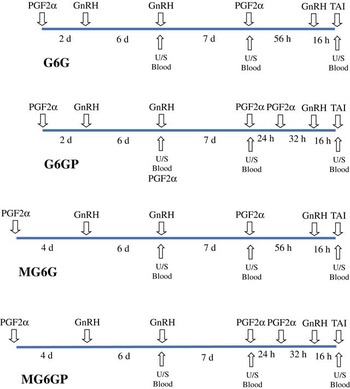
Every week, a cohort of cows (28±3 days in milk) blocked by parity, in a 2×2 factorial design was randomly assigned to receive one of four TAI protocols: G6G (n=149), G6GP (n=144), MG6G (n=146) or MG6GP (n=154). Cows in the G6G group received PGF2α (500 µg cloprostenol, i.m.; Parnell Technologies Ltd, Alexandria, Australia) 2 days later GnRH (100 µg gonadorelin acetate, i.m.; Parnell Technologies) followed 6 days later by a modified Ovsynch (Ovsynch56; Brusveen et al., Reference Brusveen, Cunha, Silva, Cunha, Sterry, Silva, Guenther and Wiltbank2008) that consisted of GnRH followed by PGF2α 7 days later and a second GnRH treatment administered 56 h after PGF2α. Cows in the G6GP received the same treatments as the previous group with an additional PGF2α treatment (24 h after the first) during Ovsynch. Cows in the MG6G and MG6GP groups received same treatments as G6G and G6GP, respectively, except the GnRH treatment of presynchronization was given 4 days after PGF2α but the interval from GnRH of presynchronization and initiation of Ovsynch was the same as in G6G and G6GP groups (Figure 1). For all cows, TAI was done ~16 h after the second GnRH of Ovsynch. Two technicians performed all TAI, using semen from four commercially available sires equally balanced among the four TAI protocols.
Illustration of activities and treatments during the study. Lactating Holstein cows (n=593) were randomly assigned to one of four timed artificial insemination (TAI) protocols: G6G, G6GP, MG6G or MG6GP. Transrectal ultrasonography (U/S) was performed in 406 cows during the Ovsynch to determine ovarian response to treatments. Blood samples (Blood) from a subset of 200 cows were collected during the Ovsynch to determine plasma progesterone concentrations. PGF2α=prostaglandin F2α; GnRH=gonadotropin-releasing hormone.

Ultrasonographic examinations
Ovarian examinations were performed in a subset of 406 cows by transrectal ultrasonography with a B-mode scanner equipped with a 6 to 8-MHz linear transducer (Easy Scan; BCF Technology, Livingston, UK). Ovarian maps were drawn for each cow, which included the diameter and location of follicles and CL, as described (Dirandeh et al., Reference Dirandeh2009). The proportion of cows ovulating to first GnRH of Ovsynch was determined as described (Dirandeh, Reference Dirandeh, Kohram and Zare Shahneh2014). Pregnancy status was determined by transrectal ultrasonography at 32 days after TAI. Presence of a viable embryo (positive heart beat) was used as a determinant of pregnancy. Cows diagnosed pregnant at the first examination were re-examined at 60 days after TAI to confirm pregnancy. Pregnancy loss was considered to have occurred when a cow was diagnosed pregnant at 32 days after TAI but not pregnant at 60 days.
Blood sampling and progesterone assay
Blood samples from a subset of 200 cows were collected by coccygeal venipuncture concurrent with the first GnRH and PGF2α treatments of Ovsynch and TAI. Blood samples were collected into evacuated tubes containing 10.5 mg, ethylene diamine tetra acetic acid (Monoject; Sherwood Medical, St. Louis, MO, USA), immediately placed on ice, and centrifuged within 1h at 1600×g for 15 min at 4°C. Plasma was harvested and stored at −20°C until assayed. Plasma concentrations of P4 were determined using an ELISA kit (Diaplus, North York, ON, Canada). Sensitivity of the assay was 0.4 ng/ml and inter- and intra-assay CV were 3.7% and 7.5%, respectively. Luteal regression was defined to occur when plasma P4 concentration was ⩾1 ng/ml immediately before first PGF2α treatment of Ovsynch and had decreased to <1 ng/ml at TAI.
Statistical analyses
All data were analyzed using SAS software (version 9.3 for Windows; SAS Institute Inc., Cary, NC, USA). Pregnancy status at 32 and 60 days after TAI and pregnancy loss between 32 and 60 days were analyzed in all cows by logistic regression (GLIMMIX procedure). Fixed effects included in the initial model were length of interval between PGF2α and GnRH treatments of presynchronization (Length; 2 v. 4 days), administration of second PGF2α during Ovsynch protocol (PGF2α; yes v. no), parity (primiparous v. multiparous), body condition score (BCS) (⩽2.75 v. >2.75) and interactions among these variables. Selection of the variables and interactions remaining in the final model at P<0.10 was performed by finding the model with the lowest value for the Akaike information criterion. For pregnancy status at 32 and 60 days, the final model included the variables Length, PGF2α and their interaction with the variable parity also included in the final model for pregnancy loss.
Ovulatory response to first GnRH of Ovsynch, proportion of cows with a follicle ⩾10 mm in diameter at first GnRH of Ovsynch, and proportion of cows with a CL at first GnRH and PGF2α of Ovsynch were analyzed in 406 cows (GLIMMIX). Percentage of cows with P4 ⩾1 ng/ml at first GnRH and PGF2α treatment of Ovsynch and those that underwent luteal regression was analyzed in a subset of 200 cows (GLIMMIX). The final model included the variables Length, PGF2α and their interaction.
Continuous variables as plasma P4 concentrations, CL and follicle diameter were analyzed by ANOVA using the MIXED procedure. The model contained as fixed effects Length, PGF2α and their interaction. Differences between means were tested by the PDIFF option and adjusted using the Tukey procedure.
Milk production (average during the first 3 months postpartum and during the week before TAI), BCS and parity were analyzed among the four TAI protocols (G6G, G6GP, MG6G and MG6GP) by ANOVA using the MIXED procedure.
A probability of 0.05 or less was considered statistically significant, and a probability between 0.051 and 0.1 was considered a tendency. Data were presented as arithmetic means (±SEM), obtained using the MEANS procedure of SAS.
Results
Milk production, parity and body condition score
Average milk production during the first 3 months postpartum and during the week before TAI did not differ (P>0.1) among TAI protocols and averaged 39.1±0.7 and 44.2±0.8 kg (mean±SEM), respectively. Similarly, parity and BCS on the day of enrollment did not differ among TAI protocols (2.6±0.03 and 3.0±0.01, respectively).
Follicle and corpus luteum diameter, presence of corpus luteum at various times during the timed artificial insemination protocol, and ovulatory response to first gonadotropin-releasing hormone of Ovsynch
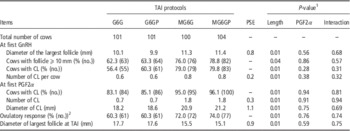
Diameters of the largest follicle at first and at second GnRH of Ovsynch were affected by extending the interval from PGF2α to GnRH during presynchronization (Table 1). The mean diameter of the largest follicle was larger (P<0.01) at first GnRH and smaller (P<0.01) at second GnRH in cows given GnRH 4 days after PGF2α during presynchronization (i.e. MG6G and M6GP protocols). Similarly, the proportion of cows with a CL at first GnRH and PGF2α treatment of Ovsynch was affected by extending the interval from PGF2α to GnRH during presynchronization (Table 1). In this regard, cows receiving GnRH 4 days after PGF2α (i.e. MG6G and M6GP protocols) were more (P<0.01) likely to have a CL at first GnRH and PGF2α treatment of Ovsynch. Moreover, cows in the MG6G and M6GP protocols had, on average, larger (P<0.01) CL at first PGF2α of Ovsynch. Ovulatory response to first GnRH of Ovsynch was also affected by extending the interval from PGF2α to GnRH during presynchronization, and it was greater (P<0.01) in cows given GnRH 4 days after PGF2α of presynchronization (i.e. MG6G and M6GP protocols).
Effects of timed artificial insemination (TAI) protocols on follicle and corpus luteum (CL) diameter, and CL number at various times during Ovsynch, and ovulatory response following first gonadotropin-releasing hormone (GnRH) of Ovsynch

PSE=pooled standard error; PGF2α=prostaglandin F2α.
1 The main effects were length of the interval between PGF2α and GnRH during presynchronization (2 v. 4 days) and addition of a second PGF2α treatment before artificial insemination (yes v. not).
2 Ovulation was determined retrospectively by recording the location, number, and size of follicles and CL at first GnRH, and comparing those with ovarian structures on the day of first PGF2α of Ovsynch.
Progesterone concentrations at different times during the Ovsynch protocol and luteal regression
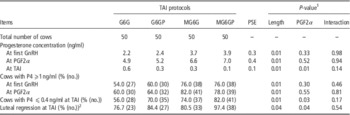
At first GnRH and PGF2α of the Ovsynch protocol, plasma P4 concentrations were greater (P<0.01) in cows given GnRH 4 days after PGF2α of presynchronization (i.e. MG6G and M6GP protocols; Table 2). Similarly, proportion of cows with plasma P4 concentrations ⩾1 ng/ml at first GnRH and PGF2α of Ovsynch was affected by extending the interval from PGF2α to GnRH during presynchronization, and it was also greater (P<0.01) in cows given GnRH 4 days after PGF2α (i.e. MG6G and M6GP protocols; Table 2). Although extending the interval from PGF2α to GnRH during presynchronization and adding a second PGF2α before AI reduced (P<0.01) plasma P4 concentrations at TAI and, hence, increased proportion of cows with plasma P4 concentrations ⩽0.4 ng/ml at TAI, there was no interaction (P>0.1) on plasma P4 concentrations at TAI (Table 2).
Effects of timed artificial insemination (TAI) protocols on mean (+SEM) plasma progesterone (P4) concentrations (ng/ml) at different times during Ovsynch and percentage of cows with luteal regression at TAI
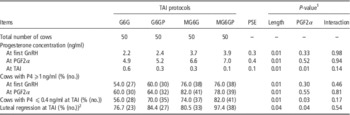
PSE=pooled standard error; PGF2α=prostaglandin F2α; GnRH=gonadotropin-releasing hormone.
1 The main effects were length of the interval between PGF2α and GnRH during presynchronization (2 v. 4 days) and addition of a second PGF2α treatment before AI (yes v. not).
2 Luteal regression was defined to have occurred when plasma P4 concentration was ⩾1 ng/ml immediately before first PGF2α treatment and decreased to <1 ng/ml at TAI.
Pregnancy per artificial insemination and pregnancy loss.
Pregnancy per artificial insemination at 32 days after AI was affected by extending the interval from PGF2α to GnRH during presynchronization; it was greater (P<0.001) for cows subjected to the MG6G and M6GP protocols (Table 3). Similarly, P/AI at 60 days after AI was affected by extending the interval from PGF2α to GnRH during presynchronization (P<0.01), but also by adding a second PGF2α before AI (P<0.05). However, the interaction between both modifications of the G6G protocol was not significant (P>0.1) on P/AI at 60 days after AI. The proportion of cows that experienced pregnancy loss between 32 and 60 days after AI was reduced (P=0.04) in cows given a second PGF2α before AI (i.e. G6GP and MG6GP protocols) and tended (P=0.09) to be reduced in those receiving GnRH 4 days after PGF2α of presynchronization (i.e. MG6G and M6GP protocols; Table 3).
Effects of timed artificial insemination (TAI) protocols on pregnancy per artificial insemination (P/AI) at 32 and 60 days after TAI and pregnancy loss in lactating Holstein cows

PGF2α=prostaglandin F2α.
1 The main effects were length of the interval between PGF2α and gonadotropin-releasing hormone during presynchronization (2 v. 4 days) and addition of a second PGF2α treatment before AI (yes v. no).
2 Pregnancy loss was considered to have occurred when a cow was diagnosed pregnant at 32 days after TAI and not pregnant at 60 days.
Discussion
This study was designed to explore modifications of the G6G TAI protocol to optimize responses to treatments, increase circulating P4 during Ovsynch and decrease P4 at AI, with the ultimate goal of improving fertility in lactating dairy cows. Although extending the interval from PGF2α to GnRH during presynchronization and addition of a second PGF2α treatment before AI improved fertility of the G6G protocol, both modifications did so by different mechanisms and their effects were not additive.
Extending the interval between PGF2α and GnRH during presynchronization of the G6G protocol from 2 to 4 days increased the average diameter of the largest follicle and the percentage of cows with follicles ⩾10 mm at first GnRH of Ovsynch. As a consequence, ovulatory response to administration of GnRH was 12 and 14 percentage points greater in cows in the MG6G and MG6GP protocols compared with those in the G6G and G6GP protocols. The 60.3% ovulation response observed in cows subjected to G6G and G6GP protocols seemed lower than the 84.6% reported by Bello et al. (Reference Bello, Steibel and Pursley2006) but comparable with the 69.2% reported by Dirandeh et al. (Reference Dirandeh, Rezaei Roodbari, Gholizadeh, Deldar, Masoumi, Kazemifard and Colazo2015a). The ability of a dominant follicle to ovulate is associated with acquisition of LH receptors on granulosa cells (Xu et al., Reference Xu, Garverick, Smith, Smith, Hamilton and Youngquist1995) that occur on average 2.8 days after follicular wave emergence in heifers, when its diameter is ~8.5 mm (Ginther et al., Reference Ginther, Wiltbank, Fricke, Gibbons and Kot1996). However, it has been reported that the dominant follicle in dairy cows acquires the capacity to ovulate at ~11 mm in diameter, corresponding to ~1 day after acquisition of LH receptors (Sartori et al., Reference Sartori, Fricke, Ferreira, Ginther and Wiltbank2001; Colazo et al., Reference Colazo, Ponce-Barajas and Ambrose2015). Therefore, the presence of a follicle ⩾10 mm in diameter is a good indicator for predicting ovulatory response, but it does not ensure that ovulation will occur after treatment with GnRH. In this regard, it has been reported that day of the estrous cycle (Martinez et al., Reference Martinez, Adams, Bergfelt, Kastelic and Mapletoft1999; Moreira et al., Reference Moreira, de la Sota, Diaz and Thatcher2000) and circulating P4 concentrations (Colazo et al., Reference Colazo, Dourey, Rajamahendran and Ambrose2013a) are also important factors that determine whether ovulation occurs in response to GnRH treatment. In addition to larger follicle size, stage of the estrous cycle at initiation of Ovsynch appeared to be more synchronous in cows subjected to MG6G and MG6GP protocols, with the majority of cows likely to be in early diestrus, when administration of GnRH would be more effective in inducing ovulation (Moreira et al., Reference Moreira, de la Sota, Diaz and Thatcher2000). In support of this, cows in the MG6G and MG6GP groups were more likely to have a CL at initiation of Ovsynch. Therefore, we inferred that extending the interval between PGF2α and GnRH of presynchronization from 2 to 4 days increased the number of cows ovulating after GnRH of presynchronization and, hence, more cows were at the appropriate stage of the estrous cycle at initiation of Ovsynch.
Ovulation of a dominant follicle following the first GnRH treatment of an Ovsynch protocol results in formation of an accessory CL that usually increases plasma P4 concentrations (Bello et al., Reference Bello, Steibel and Pursley2006; Colazo et al., Reference Colazo, Dourey, Rajamahendran and Ambrose2013a). Therefore, it was not surprising that circulating P4 concentrations at PGF2α of Ovsynch were increased in MG6G and MG6GP cows, as they had greater ovulation rate following GnRH compared with cows subjected to G6G and G6GP protocols. Furthermore, the percentage of cows with low P4 concentrations at first GnRH of Ovsynch was fewer in MG6G and MG6GP cows, also indicating that extending the interval from PGF2α to GnRH during presynchronization optimized P4 concentrations during ovulatory follicle development.
Both modifications to the standard G6G protocol enhanced luteal regression following PGF2α and reduced the proportion of cows with P4 concentrations ⩾0.5 ng/ml at TAI. However, there was no significant interaction effect on plasma P4 concentrations at TAI by extending the interval from PGF2α to GnRH during presynchronization and adding a second PGF2α treatment. The percentage of cows with incomplete luteal regression was 16% to 24% in cows given a single PGF2α treatment (i.e. MG6G and G6G protocols, respectively). The incomplete luteal regression, attained with the G6G protocol in our study, seemed considerably greater than the 4% reported by Bello et al. (Reference Bello, Steibel and Pursley2006) but similar to the 20% reported by Martins et al. (Reference Martins, Policelli, Neuder, Raphael and Pursley2011). Differences in luteal regression might be due to the fact that Bello et al. (Reference Bello, Steibel and Pursley2006) included all cows in the analysis, whereas in Martins et al. (Reference Martins, Policelli, Neuder, Raphael and Pursley2011) and the present study only cows with circulating P4⩾1 ng/ml at PGF2α treatment were included in the analysis. Nonetheless, other studies have reported from 10% to 27% incomplete luteolysis (based on P4 concentrations ⩾0.5 ng/ml at second GnRH or TAI) following a single PGF2α administration in cows subjected to GnRH-based protocols (Martins et al., Reference Martins, Policelli, Neuder, Raphael and Pursley2011; Colazo et al., Reference Colazo, Behrouzi, Ambrose and Mapletoft2013b; Dirandeh et al., Reference Dirandeh, Rezaei Roodbari, Gholizadeh, Deldar, Masoumi, Kazemifard and Colazo2015a; Behrouzi et al., Reference Behrouzi, López-Helguera, Mapletoft, Ambrose and Colazo2016). Lack of complete luteal regression in response to a single PGF2α treatment occurred more frequently during early than late diestrus (Momont and Seguin, Reference Momont and Seguin1982), suggesting that the early CL is less sensitive to PGF2α administration. Cows in which ovulation is induced by GnRH will have a newly formed accessory CL 7 days later, suggesting that their CLs could be less sensitive to PGF2α administration. However, accessory CL responsiveness to exogenous PGF2α seems to be dependent on P4 exposure during development. Howard and Britt (Reference Howard and Britt1990) concluded that accessory CL induced during high P4 concentrations were able to respond to a single injection of PGF2α at earlier stages of luteal development. In our study, extending the interval from PGF2α to GnRH during presynchronization, increased P4 concentrations during Ovsynch; therefore, we speculated that the greater luteal regression observed in MG6G and MG6GP cows was at least partially due to an accessory CL that was more responsive to PGF2α.
The number of PGF2α signals rather than the strength of the signal are critical for the induction of luteolysis, as 2 to 5 mg doses of PGF2α, 3 h apart were as effective as a single 15 mg dose in sheep (Wade and Lewis, Reference Wade and Lewis1996). Therefore, it is plausible that more cows bearing a newly formed CL would undergo luteal regression following a second PGF2α treatment. In the present study, luteal regression was accomplished in 84.4% and 97.4% of cows subjected to G6GP and MG6GP protocols, respectively. Our findings were in agreement with Brusveen et al. (Reference Brusveen, Souza and Wiltbank2009), who reported that adding a second PGF2α to an Ovsynch protocol increased the percentage of cows with complete CL regression from 86% to 98% at first AI and from 82% to 93% at subsequent AI. Similarly, Wiltbank et al. (Reference Wiltbank, Baez, Cochrane, Barletta, Trayford and Joseph2015) recently reported that cows receiving two PGF2α treatments during a Double-Ovsynch protocol had increased luteal regression (97% v. 83%) than cows receiving only one PGF2α treatment.
Several studies have highlighted the negative effects of subluteal P4 concentrations on ovulatory follicle development and subsequent fertility in cattle (Savio et al., Reference Savio, Thatcher, Morris, Entwistle, Drost and Mattiacci1993; Kinder et al., Reference Kinder, Kojima, Bergfeld, Wehrman and Fike1996; Revah and Butler, Reference Revah and Butler1996). Other studies have emphasized the importance of a positive ovulatory response following the first GnRH treatment of Ovsynch, which has been associated with more synchronous follicular wave emergence (Martinez et al., Reference Martinez, Adams, Bergfelt, Kastelic and Mapletoft1999) and increased P/AI in cattle (Bello et al., Reference Bello, Steibel and Pursley2006). Moreover, elevated P4 concentrations at the AI due to inadequate CL regression are being recognized as an important issue in cows subjected to GnRH-based TAI protocols. Elevated P4 concentrations near the time of AI may interfere with semen transport and fertilization (Graham and Clarke, Reference Graham and Clarke1997) and also impair the normal ovulation process by an indirect negative effect on estradiol-17β production and LH pulsatility (Bridges and Fortune, Reference Bridges and Fortune2003) resulting in reduced fertility (Brusveen et al., Reference Brusveen, Souza and Wiltbank2009; Behrouzi et al., Reference Behrouzi, López-Helguera, Mapletoft, Ambrose and Colazo2016). As discussed above, extending the interval from PGF2α to GnRH during presynchronization of the G6G protocol increased ovulatory response to first GnRH of Ovsynch, P4 concentration during Ovsynch and luteal regression. Thus, it was not surprising that cows subjected to the MG6G and MG6GP protocols had increased P/AI at 32 and 60 days after TAI. We attributed the greater fertility observed in cows subjected to the MG6G and MG6GP protocols to an overall better ovarian response to treatments.
Surprisingly, P/AI at 32 days after TAI did not differ statistically between cows receiving one v. two PGF2α treatments. However, an improvement in fertility was detectable at 60 days after TAI in cows receiving two PGF2α treatments (i.e. G6GP and MG6GP), because they had fewer pregnancy losses. A few studies have compared the fertility in cows given one v. two PGF2α treatments during a 7-day GnRH-based TAI protocol (Brusveen et al., Reference Brusveen, Souza and Wiltbank2009; Carvalho et al., Reference Carvalho, Fuenzalida, Ricci, Souza, Barletta, Wiltbank and Fricke2015; Wiltbank et al., Reference Wiltbank, Baez, Cochrane, Barletta, Trayford and Joseph2015). In this regard, Brusveen et al. (Reference Brusveen, Souza and Wiltbank2009) investigated, in a 2×2 factorial design, effects of an additional PGF2α treatment and estradiol-17β on P/AI 39 days after AI in cows subjected to an Ovsynch protocol. In agreement with our finding, Brusveen et al. (Reference Brusveen, Souza and Wiltbank2009) reported no significant improvement in fertility, with P/AI of 44.7% and 41.5% for cows receiving or not receiving an additional PGF2α treatment. More recently, Carvalho et al. (Reference Carvalho, Fuenzalida, Ricci, Souza, Barletta, Wiltbank and Fricke2015) and Wiltbank et al. (Reference Wiltbank, Baez, Cochrane, Barletta, Trayford and Joseph2015) reported that cows receiving two PGF2α treatments during a 7-day Ovsynch protocol had a tendency for increased P/AI at 31 to 43 days after AI (32.5% v. 38.6% and 36.1% v. 33.3%) compared with cows receiving only one PGF2α treatment. It is noteworthy that the P/AI at 32 days after TAI between cows receiving one v. two PGF2α treatments was 40.3% v. 45.3% in our study. Taken together, we inferred that the expected improvement in fertility in cows given an additional PGF2α treatment during a 7-day GnRH-based TAI protocol would be moderate (~8% to 19%).
An interesting observation, in the present study, was that pregnancy loss between 32 and 60 days after AI was significantly reduced in cows given an additional PGF2α before AI (i.e. G6GP and MG6GP protocols). Ghanem et al. (Reference Ghanem, Nakao, Nakatani, Akita and Suzuki2006) reported that elevated concentrations of P4 in skimmed milk at the time of AI were associated with decreased fertility as well as greater embryonic losses in repeat-breeder lactating cows. In that study, late embryonic death (based on P4 concentrations from 25 to 45 days after AI), in cows with P4 concentrations >0.5 ng/ml at AI, was 48.3% compared with 27.3% in cows with P4 concentrations <0.5 ng/ml. Similar findings were reported by Motavalli et al. (Reference Motavalli, Dirandeh, Deldar and Colazo2017), who detected higher pregnancy losses between 32 and 60 days after TAI in lactating dairy cows with elevated concentrations of P4 in plasma at TAI. Because adding a second PGF2α before AI reduced plasma P4 concentrations at TAI and increased the proportion of cows with plasma P4 concentrations ⩽0.4 ng/ml at TAI, circulating P4 at TAI may have contributed to differences in pregnancy loss in the present study. Further research is needed to confirm this relationship.
In conclusion, extending the interval from PGF2α to GnRH during presynchronization increased ovulatory response to first GnRH of Ovsynch and circulating P4 concentrations during Ovsynch, and reduced the proportion of cows with incomplete luteal regression. Furthermore, adding a second PGF2α treatment before AI enhanced luteal regression and reduced pregnancy losses. Modifications of the G6G TAI protocol, examined in this study improved fertility of lactating dairy cows.
Acknowledgments
The authors thank owners and personnel of Mahdasht Meat & Milk Company (Northern Iran) for allowing us access to their cows and facilities to conduct this research and for covering the cost of hormonal treatments. The authors also thank Dr John Kastelic (University of Calgary) for critical review of the manuscript.