By the end of 2019, the number of forcibly displaced persons globally approached 80 million (UNHCR, 2020). The psychological impact of exposure to war, persecution, and displacement is significant, with elevated rates of psychological disorders such as posttraumatic stress disorder (PTSD) being documented in refugees and asylum-seekers (Charlson et al., Reference Charlson, van Ommeren, Flaxman, Cornett, Whiteford and Saxena2019; Steel et al., Reference Steel, Chey, Silove, Marnane, Bryant and van Ommeren2009). While the field has been dominated by the investigation of fear reactions following trauma exposure (as reflected by a focus on PTSD), there is evidence that the psychological effects of persecution and displacement are diverse and complex. For example, studies have reported that refugees experience a variety of negative emotional responses including anger, shame, guilt, and sadness, which have been associated with negative functional outcomes such as interpersonal difficulties, low self-worth, and aggression (Agger, Reference Agger1989; Ekblad, Prochazka, & Roth, Reference Ekblad, Prochazka and Roth2002; Hinton, Rasmussen, Nou, Pollack, & Good, Reference Hinton, Rasmussen, Nou, Pollack and Good2009; Miller, Reference Miller2009; Stotz, Elbert, Muller, & Schauer, Reference Stotz, Elbert, Muller and Schauer2015). However, the relationship between refugee experiences (i.e. trauma exposure and displacement) and these non-fear-related emotional reactions is poorly understood. Furthermore, little research has investigated specific psychological mechanisms that may underpin the association between refugee experiences and these less-studied psychological outcomes in refugees.
One potential mechanism that has been implicated in psychological responses of trauma survivors is cognitive appraisals. Theoretical models and empirical evidence converge to demonstrate that the way in which an individual thinks about a traumatic event has important consequences for their subsequent psychological functioning, over and above the characteristics of the event itself (Dunmore, Clark, & Ehlers, Reference Dunmore, Clark and Ehlers1999; Ehlers & Clark, Reference Ehlers and Clark2000; O'Donnell, Elliott, Wolfgang, & Creamer, Reference O'Donnell, Elliott, Wolfgang and Creamer2007; Resick & Schnicke, Reference Resick and Schnicke1992). In contrast, relatively few studies have investigated cognitive appraisals in refugee samples (cf. Basoglu et al. Reference Basoglu, Livanou, Crnobaric, Franciskovic, Suljic, Duric and Vranesic2005; Hinton, Hinton, Um, Chea, & Sak, Reference Hinton, Hinton, Um, Chea and Sak2002; Le et al. Reference Le, Morina, Schnyder, Schick, Bryant and Nickerson2018). Understanding key mechanistic factors that underlie refugee psychopathology is of critical importance for informing the development of tailored, evidence-based interventions for individuals exposed to persecution and displacement. One framework that may be useful when considering cognitive appraisals in the refugee context is moral injury. Litz et al. (Reference Litz, Stein, Delaney, Lebowitz, Nash, Silva and Maguen2009) defined moral injury as ‘the lasting psychological, biological, spiritual, behavioral, and social impact of perpetrating, failing to prevent, or bearing witness to acts that transgress deeply held moral beliefs and expectations’ (p. 697). Recent theoretical and empirical work has conceptualized moral injury in terms of appraisals, or the extent to which an individual perceives that important moral rules have been transgressed during an adverse event (Farnsworth, Reference Farnsworth2019; Kopacz et al., Reference Kopacz, Connery, Bishop, Bryan, Drescher, Currier and Pigeon2016). These appraisals have been found to be important in predicting psychological distress over and above the impact of trauma exposure (Lancaster & Erbes, Reference Lancaster and Erbes2017). Consistent with the broader moral injury literature (Currier et al., Reference Currier, Farnsworth, Drescher, McDermott, Sims and Albright2018; Jordan, Eisen, Bolton, Nash, & Litz, Reference Jordan, Eisen, Bolton, Nash and Litz2017; Nash & Litz, Reference Nash and Litz2013), there are two types of moral injury appraisals: (1) moral injury-self (MI-self) or the appraisal that an individual has transgressed his/her own morals, and (2) moral injury-other (MI-other) or the appraisal that someone else has transgressed one's morals. MI-self and MI-other appraisals have been predominantly investigated in military samples, with evidence emerging that they are differentially associated with psychological outcomes. For example, research has consistently found an association between others having transgressed one's morals (i.e. MI-other) and feelings of anger (Jordan et al., Reference Jordan, Eisen, Bolton, Nash and Litz2017; Lancaster, Reference Lancaster2018; Stein et al., Reference Stein, Mills, Arditte, Mendoza, Borah, Resick and Consortium2012) and PTSD symptoms (Bryan et al., Reference Bryan, Bryan, Anestis, Anestis, Green, Etienne and Ray-Sannerud2015; Zerach & Levi-Belz, Reference Zerach and Levi-Belz2018). In contrast, the perception that an individual has transgressed his/her own morals (i.e. MI-self) has been associated with shame and guilt (Currier et al., Reference Currier, Farnsworth, Drescher, McDermott, Sims and Albright2018; Frankfurt, Anders, James, Engdahl, & Winskowski, Reference Frankfurt, Anders, James, Engdahl and Winskowski2015; Jordan et al., Reference Jordan, Eisen, Bolton, Nash and Litz2017). Understanding how specific moral injury appraisals differentially predict psychological outcomes has important implications for advancing knowledge regarding the psychological consequences of exposure to morally injurious events.
While the moral injury was initially studied to understand the consequences of exposure to moral and ethical dilemmas in warfare, this construct is also relevant to the refugee context. Refugees are, by definition, persecuted on the basis of an important aspect of their identity (UNHCR, 1951, 1967) which frequently involves exposure to potentially traumatic events (PTEs) that involve moral transgressions, such as torture and witnessing the murder of loved ones (Haldane & Nickerson, Reference Haldane and Nickerson2016; Mollica et al., Reference Mollica, Caspi-Yavin, Bollini, Truong, Tor and Lavelle1992). Furthermore, refugees may also experience events where they perceive that they have transgressed their own morals – for example, providing information during torture (Silove, Tarn, Bowles, & Reid, Reference Silove, Tarn, Bowles and Reid1991) or being unable to protect loved ones from harm (Kuong, Reference Kuong and Miserez1988). Emerging evidence suggests that exposure to both trauma and ongoing stressors is associated with increased MI-other and MI-self appraisals in refugees, and these appraisals are linked to specific outcomes (Hoffman, Liddell, Bryant, & Nickerson, Reference Hoffman, Liddell, Bryant and Nickerson2018, Reference Hoffman, Liddell, Bryant and Nickerson2019; Nickerson et al., Reference Nickerson, Schnyder, Bryant, Schick, Mueller and Morina2015, Reference Nickerson, Hoffman, Schick, Schnyder, Bryant and Morina2018). For example, in a community sample of refugees, greater MI-other appraisals were associated with higher PTSD symptoms, depression symptoms, and feelings of anger (Hoffman et al., Reference Hoffman, Liddell, Bryant and Nickerson2018). MI-self appraisals were also associated with greater depression symptoms and anger, but negatively related to re-experiencing symptoms. These findings provide evidence that MI-other and MI-self appraisals are differentially associated with psychological outcomes in refugees.
To date, however, the predominant use of cross-sectional designs in moral injury research has precluded the testing of the mechanistic role of moral injury appraisals in the relationship between adverse experiences and psychological outcomes. It may be the case, for example, that moral injury appraisals play a causal role in the development of psychological responses, or, conversely, that moral injury appraisals arise following initial negative psychological responses following adverse experiences. It is important to elucidate the temporal directionality of moral injury appraisals and key psychological outcomes to provide clear direction on intervention targets for individuals who have been exposed to morally transgressive traumatic events. One longitudinal study conducted with military veterans found that MI-self reactions (i.e. shame, self-punishment) predicted greater PTSD symptoms 6 months later, while MI-other reactions (i.e. anger, resentment) were not associated with subsequent PTSD symptoms. Furthermore, negative alterations in cognitions and mood were associated with greater MI-self reactions 6 months later (Currier, McDermott, Farnsworth, & Borges, Reference Currier, McDermott, Farnsworth and Borges2019). Another study undertaken with a small sample of treatment-seeking refugees found that greater depression at Time 1 was associated with higher MI-self appraisals two to four years later, and vice versa (Nickerson et al., Reference Nickerson, Hoffman, Schick, Schnyder, Bryant and Morina2018). The limited research to date highlights the need to understand the mechanistic role of MI-other and MI-self appraisals in the association between refugee experiences and psychological outcomes to advance knowledge regarding mechanisms underlying the psychological impact of trauma and displacement.
This study aimed to investigate the longitudinal association between moral injury appraisals and psychological symptoms in a large community sample of refugees. In particular, we were interested in investigating the association between MI appraisals and fear-related symptoms (i.e. intrusive memories, hyperarousal), and other psychological responses (feelings of anger, sadness and shame) over time. Based on theoretical models and evidence from the refugee and military literature to date, it was hypothesized that MI appraisals would represent a mechanism linking refugee experiences and psychological outcomes. Specifically, it was hypothesized that MI-other appraisals would be associated with increased re-experiencing symptoms, arousal symptoms, anger and sadness, 6 months later. It was hypothesized that MI-self appraisals would be associated with decreased re-experiencing symptoms, and increased feelings of anger, shame, and sadness, 6 months later.
Method
Participants
Participants at Time 1 comprised 1085 individuals from Arabic, Farsi, Tamil, or English-speaking refugee backgrounds residing in Australia. Of these, 1011 completed the second time-point (93.2%) 6 months later. These language groups were selected as they represented over 50% of individuals granted refugee status in Australia between 2012 and 2015 (DIBP, 2014a; DIBP, 2014b; DIBP, 2013). Participants were recruited via advertisements at refugee support services across Australia, advertising on social media platforms (i.e. Facebook) and snowball sampling where participants nominated friends and family members who were interested in participating. This recruitment method has been found to be effective for difficult-to-access populations (Sadler, Lee, Lim, & Fullerton, Reference Sadler, Lee, Lim and Fullerton2010).
Measures
Study measures were translated and blind back-translated according to gold-standard procedures by accredited interpreters (World Health Organization, n.d.), with differences being reconciled by the research team and interpreters with experience in working with mental health-related material. Translated measures were then pilot-tested with individuals from each language group with varying education levels to ensure that they were easy to understand regardless of educational background.
Exposure to potentially traumatic events
PTE exposure was measured using the Harvard Trauma Questionnaire (Mollica et al., Reference Mollica, Caspi-Yavin, Bollini, Truong, Tor and Lavelle1992), a 16-item measure indexing traumatic events commonly experienced by refugees. Participants indicated whether they had experienced, witnessed, or learned about each of the events. A total count of the diversity of PTE exposure was derived from this scale, which represented the number of types of PTE events the individual had experienced and/or witnessed.
Ongoing stressors
Stressors experienced in the post-migration environment were indexed using an adapted version of the Post-Migration Living Difficulties Checklist (Steel, Silove, Bird, McGorry, & Mohan, Reference Steel, Silove, Bird, McGorry and Mohan1999). This version of the checklist included 25 items developed to index stressors commonly encountered in the Australian context, including social and economic difficulties, fear for the future, immigration-related problems, family separation, and language difficulties. Participants rated each living difficulty on a scale on a 5-point scale (1 = was not a problem/did not happen, 5 = a very serious problem). A stressor was considered to be present if the individual rated it as at least 3 (i.e. a moderately serious problem). A total count of ongoing stressors was computed.
Moral injury appraisals
MI-other and MI-self appraisals were indexed using an 18-item adapted version of the Moral Injury Appraisals Scale (Hoffman et al., Reference Hoffman, Liddell, Bryant and Nickerson2018). The original version of this scale comprised nine items, with four of these items measuring the extent to which the individual was distressed by others having committed acts that transgressed his/her morals (e.g. ‘I am troubled by morally wrong things done by other people’). Five items measured the extent to which the individual was distressed by having committed acts that transgressed his/her morals (e.g. ‘I am troubled by morally wrong things I have done’). As betrayal has been conceptualized as a key aspect of moral injury in the military literature (Litz et al., Reference Litz, Stein, Delaney, Lebowitz, Nash, Silva and Maguen2009), we included five additional items to index MI-other betrayal (e.g. ‘I am troubled because others betrayed me’), and four additional items to index MI-self betrayal (e.g. ‘I am troubled because I betrayed others’). Items were measured on a four-point Likert scale indexing the extent to which the participant agreed with each statement (1 = not at all to 4 = very much).
Re-experiencing symptoms
Re-experiencing symptoms were measured using five items from the Posttraumatic Diagnostic Scale for DSM-IV (Foa, Reference Foa1996), indexing intrusive memories, nightmares, flashbacks, and psychological and physiological distress to reminders. Participants indicated on a 4-point scale (0 = not at all or only once, 3 = 5 or more times a week/almost always) how often each symptom bothered them in the past month. A mean score for re-experiencing symptoms was calculated (T1 α = 0.92, T2 α = 0.94).
Arousal symptoms
Arousal symptoms were measured using four items from the Posttraumatic Diagnostic Scale for DSM-IV (Foa, Reference Foa1996), indexing sleep and concentration difficulties, startle response, and hypervigilance. The item relating to anger/irritability was omitted to avoid overlapping with the conceptualization of anger (as described below). Participants indicated on a 4-point scale (0 = not at all or only once, 3 = 5 or more times a week/ almost always) how often each symptom bothered them in the past month. A mean score for arousal symptoms was calculated (T1 α = 0.87, T2 α = 0.87).
Anger
Feelings of anger were measured using the five-item Dimensions of Anger Reactions (DAR-5) Scale (Forbes et al., Reference Forbes, Alkemade, Hopcraft, Hawthorne, O'Halloran, Elhai and Lewis2014). This scale indexes anger responses and negative anger-related consequences (e.g. intensity, feeling like hitting others, interpersonal difficulties). Items are rated on a five-point scale in terms of how much time participants felt this way (1 = none or almost none of the time, 5 = all or almost all of the time). A mean score for feelings of anger was calculated (T1 α = 0.87, T2 α = 0.90).
Shame
Shame was measured using the Personal Feelings Questionnaire (PFQ-2) (Harder & Zalma, Reference Harder and Zalma1990). This scale indexes both guilt and shame, with only the shame subscale being used in this study. This subscale comprises ten items (e.g. embarrassment, feeling ridiculous, feeling helpless, feeling disgusting), which are rated on a five-point scale (1 = you never experience the feeling, 5 = you experience this feeling continuously or almost continuously). A mean shame score was calculated (T1 α = 0.91, T2 α = 0.92).
Sadness
Sadness was measured using a single item from the Patient Health Questionnaire-9 (Kroenke, Spitzer, & Williams, Reference Kroenke, Spitzer and Williams2002): ‘Feeling down, depressed or hopeless’. Participants are asked to indicate on a four-point scale how often they had been bothered by this symptom in the past 2 weeks (0 = not at all, 3 = nearly every day).
Methods
Data collection for Time 1 was completed between April 2015 and January 2018, and Time 2 surveys were completed 6 months later. Participants were first screened to assess eligibility (refugee or asylum-seeking background living in the Australian community, arrival in Australia in or after January 2011, aged 18 + , able to read in Arabic, Farsi, Tamil, or English). For eligible participants, measures were administered online via the KeySurvey platform, and took ~45 min to complete. Participants without internet access completed paper versions of the survey, which were returned by post. Six months after the first time-point, participants were sent a link to or hard copy of the second survey. An $AUD25 shopping voucher was provided at each time-point. All procedures were approved by the UNSW Human Research Ethics Committee, HC14106. The authors assert that all procedures contributing to this work comply with the ethical standards of the relevant national and institutional committees on human experimentation and with the Helsinki Declaration of 1975, as revised in 2008.
Data analysis
Statistical analyses were all undertaken in Mplus Version 8 (Muthen & Muthen, Reference Muthen and Muthen1998–2019). A confirmatory factor analysis was first conducted to examine the factor structure of the Moral Injury Appraisals Scale. Specifically, we tested whether a two-factor structure or a two-factor higher-order structure better fit the data. The two-factor structure consisted of a Moral Injury-Other factor (comprising all nine MI-other items) and a Moral Injury-Self factor (comprising all nine MI-self items). The two-factor higher-order structure consisted of (1) a higher-order Moral Injury-Other factor (comprising a Moral Injury-Other Appraisals factor and a Moral Injury-Other Betrayal Appraisals factor) and (2) a higher-order Moral Injury-Self factor (comprising a Moral Injury-Self Appraisals factor and a Moral Injury-Self Betrayal Appraisals factor). Consistent with recommendations in the field for working with ordinal data, a mean and variance-adjusted weighted least squares (WLSMV) estimator was used (Flora & Curran, Reference Flora and Curran2004).
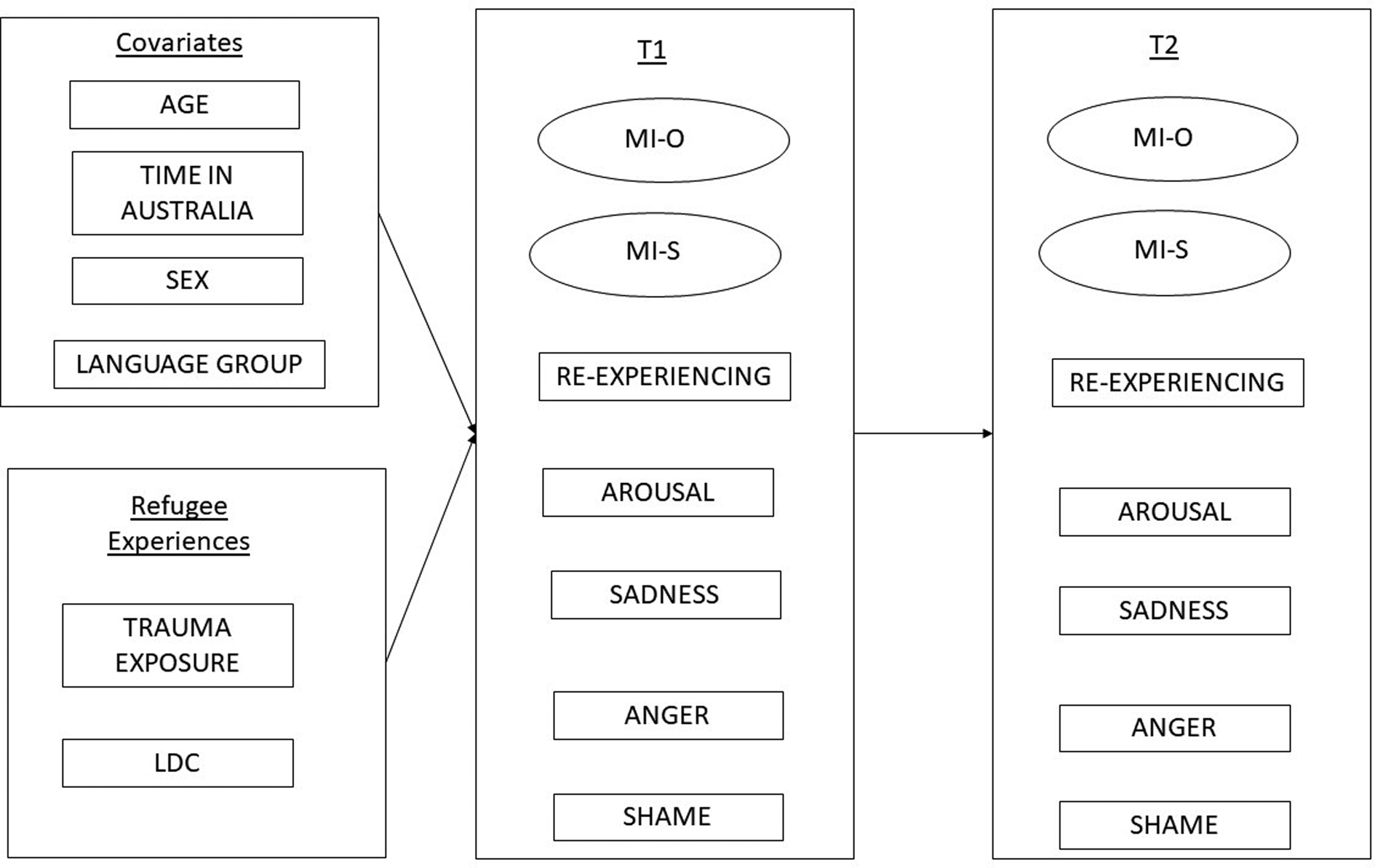
Next, a structural equation model was tested to examine the relationship between refugee experiences, moral injury appraisals, and psychological symptoms. As there was missing data at Time 1, multiple imputation was used to impute data for all exogenous variables, with 20 datasets being imputed. Full information maximum likelihood methods were used to account for missing data at Time 2, adjusting model parameters on the basis of available information. PTE exposure and ongoing stressors were specified early in the model, predicting MI appraisals and psychological symptoms measured at Time 1. A cross-lagged model was then specified where MI appraisals and psychological symptoms at Time 1 predicted MI appraisals and psychological symptoms at Time 2. Demographic variables comprising age, time in Australia, sex, and language group were included in the model as covariates, with T1 MI appraisals and psychological symptoms being regressed on each of these variables. Language group was dummy-coded with Arabic language being the reference category. A schematic model showing the variables specified in the SEM model is presented in Fig. 1.
Schematic representation of variables in structural equation model. T1 = Time 1, T2 = Time 2, LDC = ongoing stressors, MI-O = moral injury-other appraisals, MI-S = moral injury-self appraisals.

To facilitate model parsimony, all variables except for the moral injury appraisal variables were treated as observed variables (i.e. represented by mean scores or counts). Given we found that the two-factor higher-order structure for moral injury appraisals was optimal (see Results section), the moral injury appraisal variables (MI-Other and MI-Self) were treated as latent variables. The higher-order MI-Other latent variable comprised two indicators, namely the mean of MI-Other Appraisal items and the mean of MI-Other Betrayal Appraisals items. The higher-order MI-Self latent variable also comprised two indicators, namely mean MI-Self Appraisals and mean MI-Self Betrayal Appraisals.
Model fit for the CFA and SEM models was evaluated using the comparative fit index (CFI > 0.95), Tucker–Lewis index (TLI > 0.95), and root mean squared error of approximation (RMSEA < 0.06) (Hu & Bentler, Reference Hu and Bentler1999).
Results
Participant characteristics
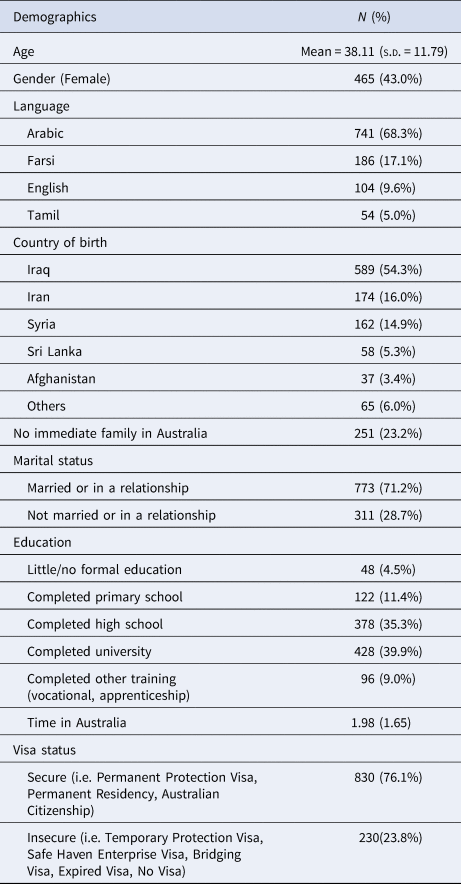
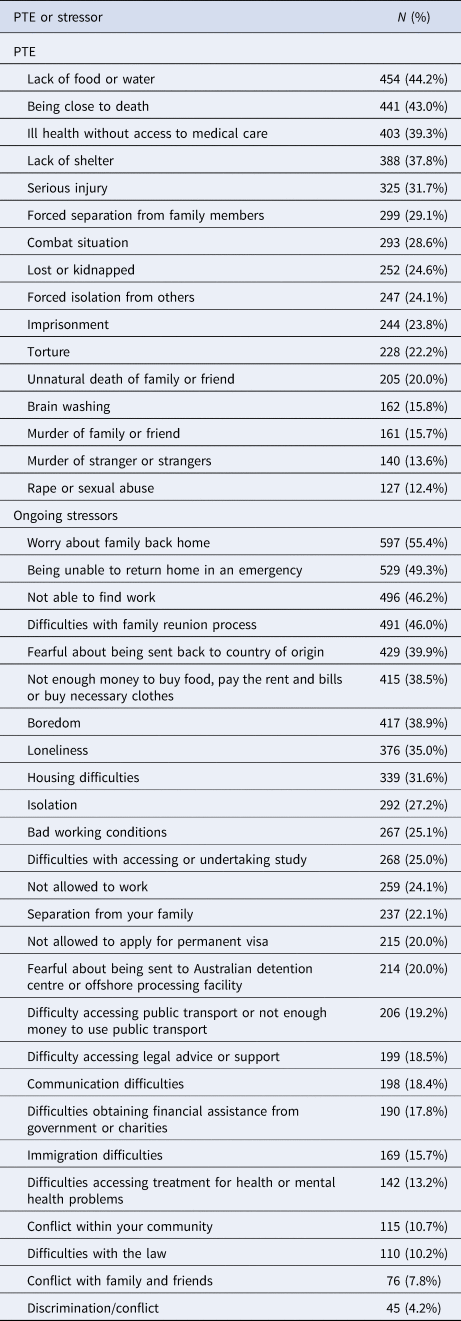
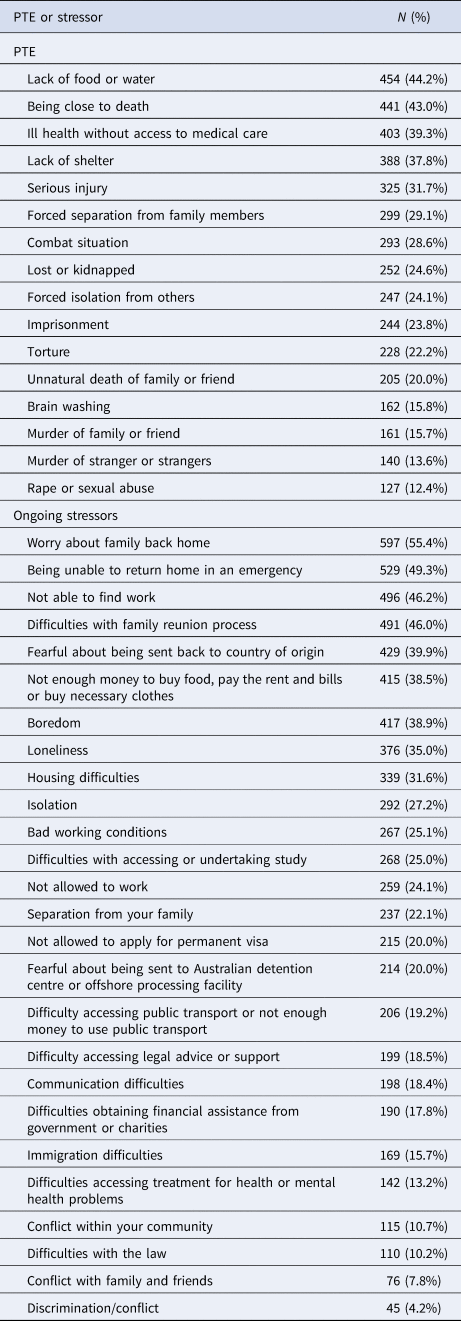
Over half of the participants were male, with a mean age of 38.11 (s.d. = 11.79) years (see Table 1). Over two-thirds of the participants completed the survey in Arabic. Participants had been in Australia for a mean of 1.98 years (s.d. = 1.65). The frequency of exposure to PTEs and ongoing stressors at Time 1 are presented in Table 2.
Participant characteristics

Potentially traumatic events and ongoing stressors
Confirmatory factor analysis
The two-factor higher-order model showed a good model fit: CFI = 1.00, TLI = 0.99, RMSEA = 0.052. The two-factor model showed worse model fit: CFI = 0.96, TLI = 0.96, RMSEA = 0.14, accordingly the two-factor higher-order model was retained. Standardized and unstandardized factor loadings of the two-factor higher-order solution are presented in online Supplementary Table A.
Structural equation model
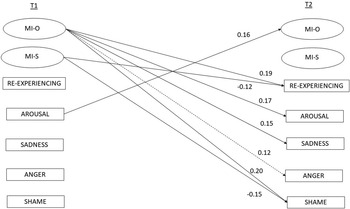
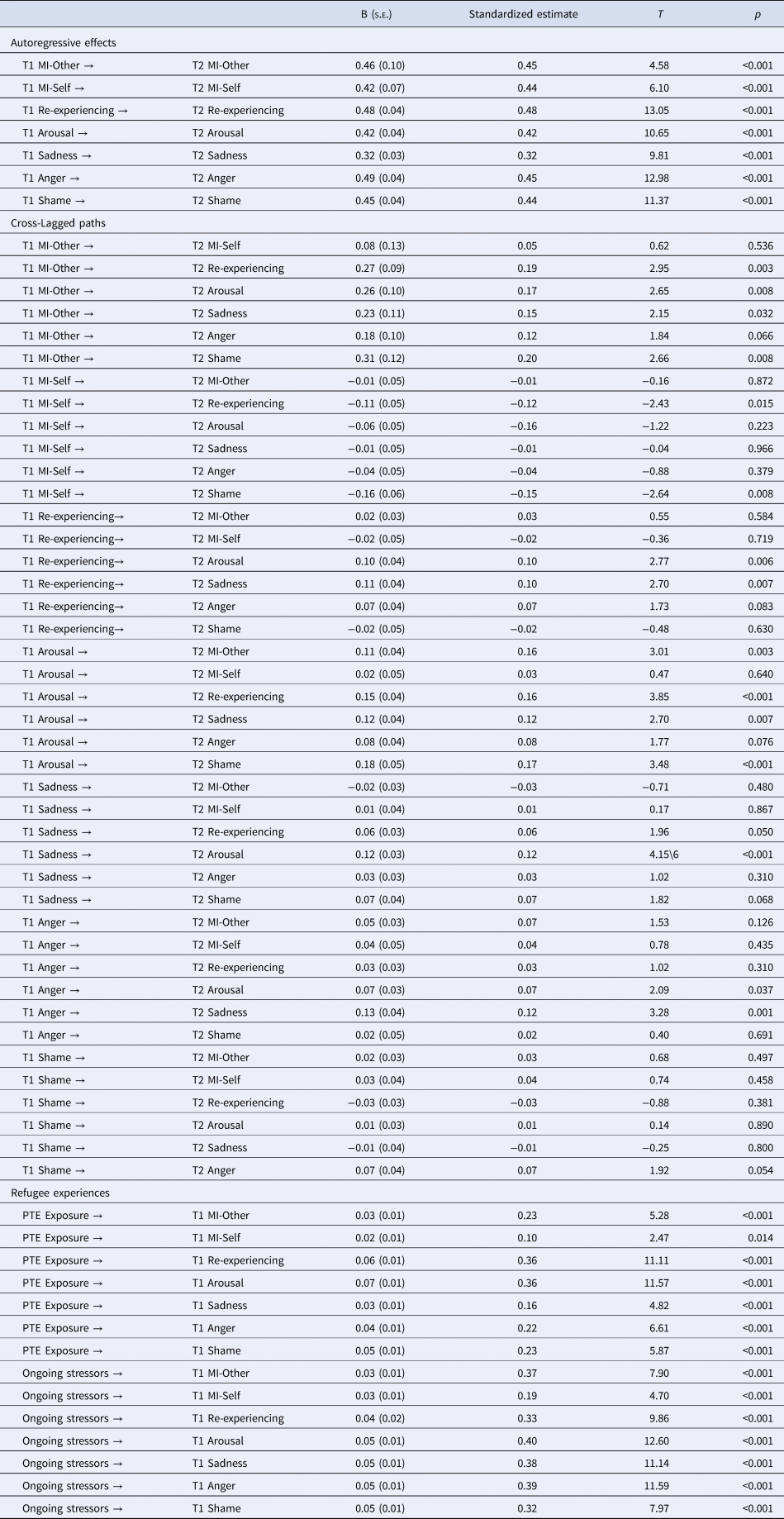
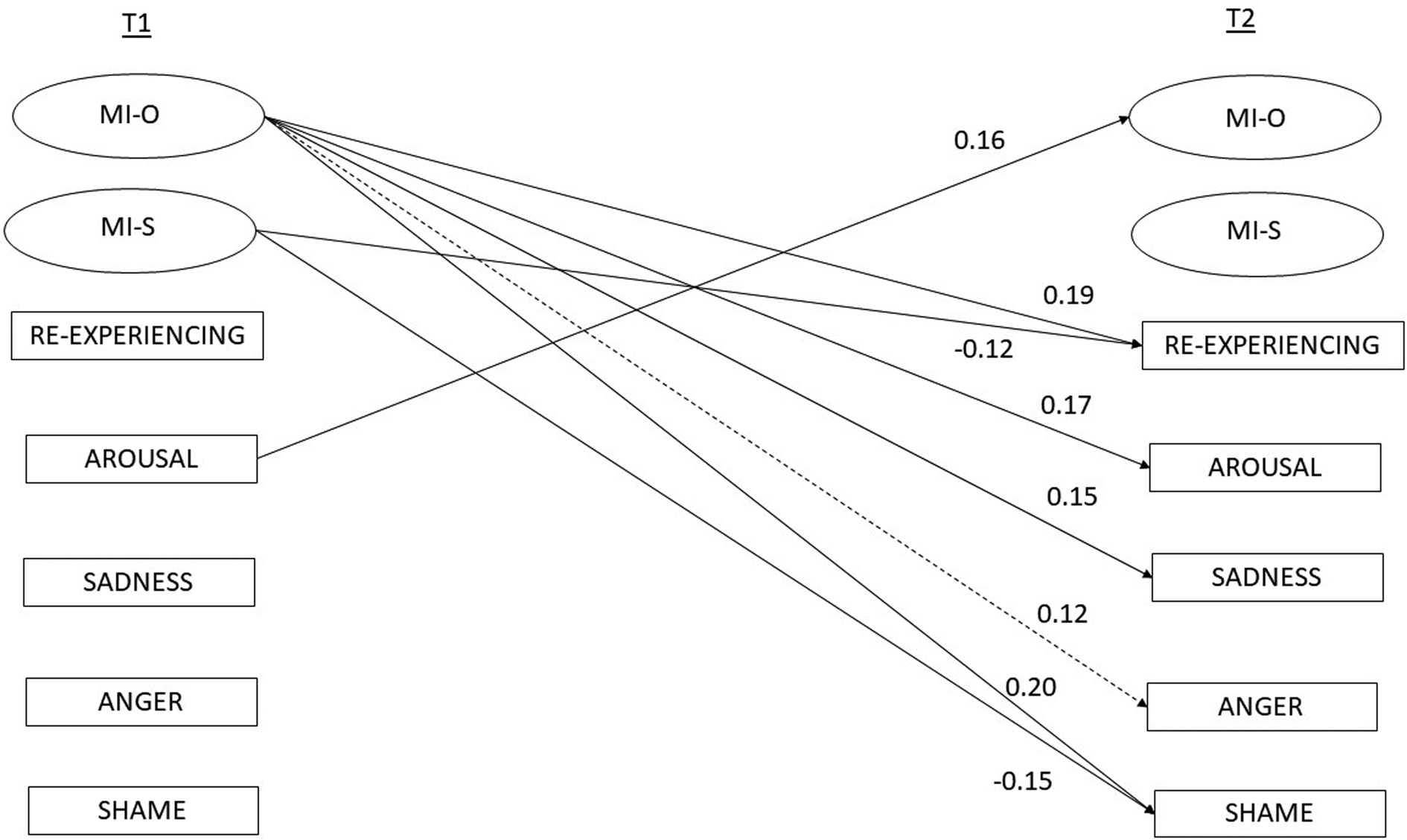
The structural equation model evidenced good model fit: CFI = 0.97, TLI = 0.94, RMSEA = 0.05, SRMR = 0.03. Model parameters are presented in Table 3 (see online Supplementary Table B for associations between covariates and variables at Time 1). Statistically significant cross-lagged paths between MI appraisals at T1 and psychological outcomes at T2, and psychological outcomes at T1 and MI appraisals at T2 are presented in Fig. 2.
Standardized estimates for statistically significant cross-lagged paths between moral injury-other and moral injury-self appraisals at T1 and psychological symptoms at T2, and vice versa. T1 = Time 1, T2 = Time 2, LDC = ongoing stressors, MI-O = moral injury-other appraisals, MI-S = moral injury-self appraisals; Solid lines significant at α < 0.05, broken line p = 0.066.
Structural equation model
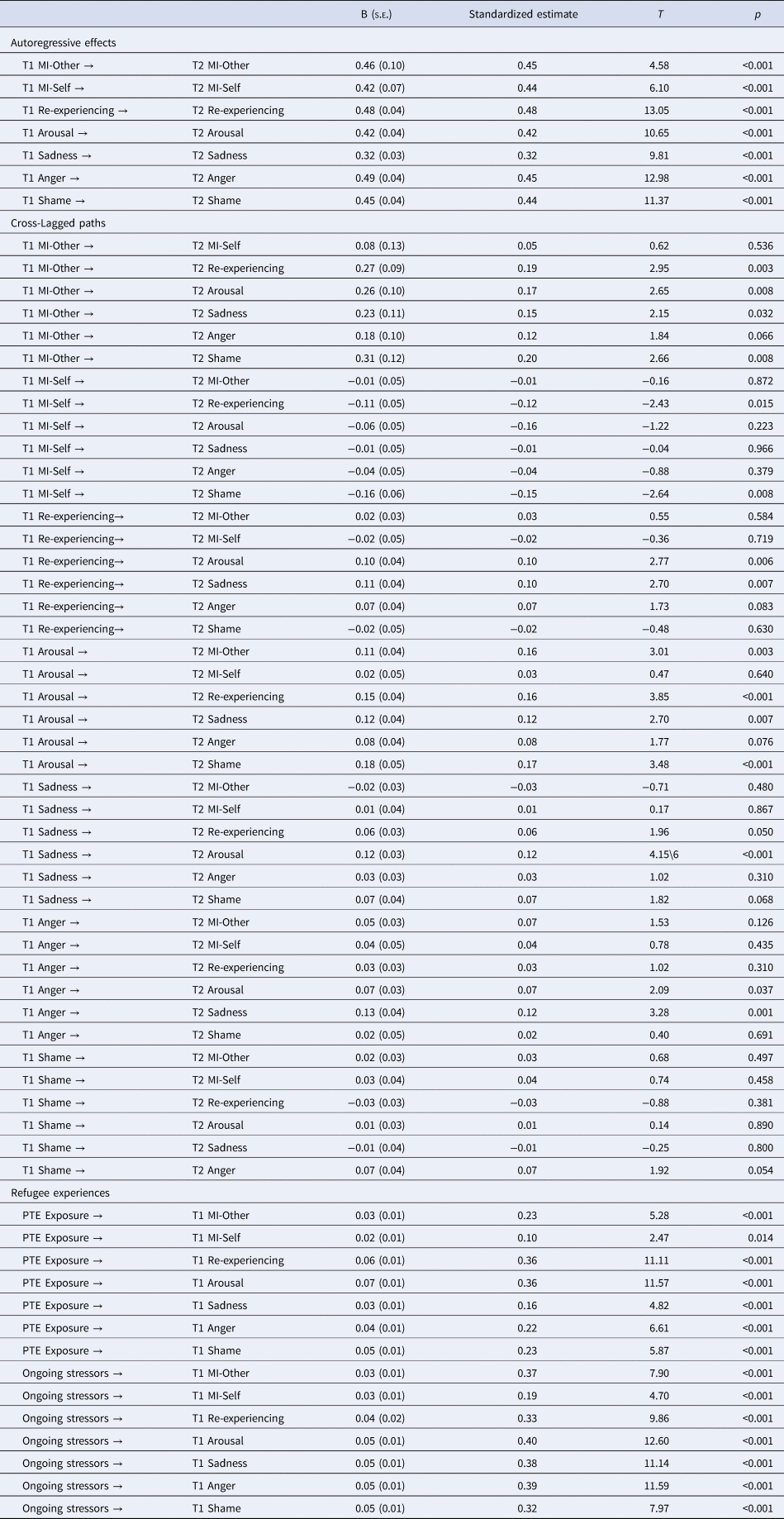
Greater MI-other appraisals at T1 were associated with greater re-experiencing and arousal symptoms, and greater shame and sadness responses at T2. There was a marginally significant association between MI-other appraisals at T1 and anger at T2 (p = 0.066). Greater MI-self appraisals at T1 were associated with lower re-experiencing symptoms and lower shame at T2.
Greater arousal symptoms at T1 were associated with greater MI-other appraisals at T2. There were no associations between re-experiencing symptoms, feelings of shame, anger, or sadness at T1 and MI-appraisals (self or other) at T2.
Discussion
This study investigated the temporal association between moral injury appraisals and psychological outcomes in a community sample of refugees. The finding that moral injury appraisals predicted subsequent changes in psychological symptoms (and not, for the most part, vice versa) indicates that the way in which an individual thinks about their experiences, and specifically whether these experiences represent moral transgressions, is important in influencing their subsequent psychological functioning. This is consistent with theoretical models and empirical evidence that highlight the central role of trauma appraisals in impacting on post-trauma responses (Dunmore et al., Reference Dunmore, Clark and Ehlers1999; Ehlers & Clark, Reference Ehlers and Clark2000; LoSavio, Dillon, & Resick, Reference LoSavio, Dillon and Resick2017; O'Donnell et al., Reference O'Donnell, Elliott, Wolfgang and Creamer2007; Resick & Schnicke, Reference Resick and Schnicke1992). Furthermore, these findings have important implications for models of moral injury. Theorists vary in their conceptualization of moral injury, with some proposing that specific events or transgressions are, by definition, morally injurious (Litz & Kerig, Reference Litz and Kerig2019; Nash & Litz, Reference Nash and Litz2013), while others have considered a moral injury to represent a constellation of outcomes including fear, anger, shame, guilt etc. (Jinkerson, Reference Jinkerson2016). The findings from this study provide empirical support for recent theoretical frameworks that propose that it is the appraisal of an event as morally injurious that is critical in influencing subsequent outcomes rather than the nature of the event itself (e.g. Farnsworth, Reference Farnsworth2019; Kopacz et al., Reference Kopacz, Connery, Bishop, Bryan, Drescher, Currier and Pigeon2016).
In this study, we found that MI-Other and MI-Self appraisals were differentially related to psychological symptoms over time. Consistent with our hypotheses, MI-Other appraisals were associated with subsequent increases in re-experiencing and arousal symptoms, feelings of sadness, and feelings of anger (although the association with anger was marginally significant, p = 0.066). These findings are in accordance with studies that have observed associations between MI-Other appraisals and anger responses, depression and PTSD in both military (Bryan et al., Reference Bryan, Bryan, Anestis, Anestis, Green, Etienne and Ray-Sannerud2015; Jordan et al., Reference Jordan, Eisen, Bolton, Nash and Litz2017; Lancaster, Reference Lancaster2018; Stein et al., Reference Stein, Mills, Arditte, Mendoza, Borah, Resick and Consortium2012) and refugee (Hoffman et al., Reference Hoffman, Liddell, Bryant and Nickerson2018) samples. In contrast, these findings were inconsistent with previous longitudinal studies that found no association between MI-Other appraisals and PTSD, depression and/or anger in a treatment-seeking refugee sample (Nickerson et al., Reference Nickerson, Hoffman, Schick, Schnyder, Bryant and Morina2018) and military veterans (Currier et al., Reference Currier, McDermott, Farnsworth and Borges2019). It is important to note, however, that there were significant methodological differences between these other longitudinal studies and our study that make it difficult to compare the results. Specifically, the Nickerson et al. (Reference Nickerson, Hoffman, Schick, Schnyder, Bryant and Morina2018) study was limited by small sample size, restricted measurement of MI appraisals and focus on treatment-seeking refugees. Furthermore, the Currier et al., study (Currier et al., Reference Currier, McDermott, Farnsworth and Borges2019) conceptualized of MI-self and MI-other as a constellation of outcomes (i.e. shame, anger, resentment) instead of appraisals, and controlled for depression symptoms rather than investigating their association with MI over time. The results from the current study can be understood in the context of theoretical models that implicate perceptions of control in posttraumatic mental health (Ehlers & Clark, Reference Ehlers and Clark2000; Foa, Zinbarg, & Rothbaum, Reference Foa, Zinbarg and Rothbaum1992). Specifically, the appraisal that someone has transgressed important moral rules suggests that the individual did not have personal control over the event, but instead observed morally transgressive acts. Empirical research has indicated that perceived lack of control is associated with the development of heightened fear reactions and intrusive memories in trauma survivors (Frazier, Reference Frazier2003; Frazier, Bergman, & Steward, Reference Frazier, Bergman and Steward2002; Kushner, Riggs, Foa, & Miller, Reference Kushner, Riggs, Foa and Miller1993), including those exposed to torture (Basoglu et al., Reference Basoglu, Livanou, Crnobaric, Franciskovic, Suljic, Duric and Vranesic2005; Basoglu & Mineka, Reference Basoglu, Mineka and Basoglu1992; Le et al., Reference Le, Morina, Schnyder, Schick, Bryant and Nickerson2018). Taken together, these findings suggest that exposure to events that give rise to MI-other appraisals may lead to increases in arousal, resulting in greater fear (i.e. re-experiencing and arousal symptoms) and anger responses. Further research is needed, however, to determine whether perceptions of control acts as a mechanism that underlies the association between exposure to a PMIE, MI-other appraisals, and subsequent psychological responses.
The pattern of association between MI-self appraisals and subsequent psychological responses was markedly different from that of MI-Other appraisals. Notably, we found that MI-Self appraisals at baseline were associated with decreases in re-experiencing symptoms 6 months later. This is consistent with a previously-found negative cross-sectional association between MI-self appraisals and re-experiencing symptoms in a refugee sample (Hoffman et al., Reference Hoffman, Liddell, Bryant and Nickerson2018). One possible explanation for this finding relates to the potential for differential processing of adverse experiences in the presence and absence of significant fear responses. Models of posttraumatic mental health have proposed that elevated arousal reactions at the time of trauma exposure disrupts memory encoding, giving rise to re-experiencing symptoms such as intrusive memories, nightmares, and distress to reminders of the event (Brewin, Dagleish, & Joseph, Reference Brewin, Dagleish and Joseph1996; Ehlers & Clark, Reference Ehlers and Clark2000; Foa et al., Reference Foa, Zinbarg and Rothbaum1992; Foa & Rothbaum, Reference Foa and Rothbaum1998; Resick & Schnicke, Reference Resick and Schnicke1992). In contrast to MI-other appraisals, events that give rise to MI-self appraisals are likely to involve a sense of agency, as the individual believes they have acted in a way that transgresses their own moral rules. This agency may lead to lower levels of fear as a function of heightened perceptions of control (Basoglu & Mineka, Reference Basoglu, Mineka and Basoglu1992; Ehlers & Clark, Reference Ehlers and Clark2000; Foa et al., Reference Foa, Zinbarg and Rothbaum1992; Frazier et al., Reference Frazier, Bergman and Steward2002; Kushner et al., Reference Kushner, Riggs, Foa and Miller1993), with this absence of fear potentially facilitating more complete memory processing. This may then lead to decreased intrusive memories over time as the individual continues to process the event. This hypothesis is supported by the finding in the current study that MI-self appraisals were not associated with subsequent increases in arousal symptoms. It is important to note, however, that findings regarding the relationship between MI-self and re-experiencing symptoms in the moral injury literature have been mixed, with some studies finding a positive relationship between MI-self and re-experiencing symptoms (Litz et al., Reference Litz, Contractor, Rhodes, Dondanville, Jordan, Resick and Consortium2018; Stein et al., Reference Stein, Mills, Arditte, Mendoza, Borah, Resick and Consortium2012), while others have failed to find a relationship between these two constructs (Bryan et al., Reference Bryan, Bryan, Anestis, Anestis, Green, Etienne and Ray-Sannerud2015). Methodological differences may account for these discrepancies. Studies that have found positive associations between MI-self and re-experiencing symptoms have generally considered the association between psychological outcomes and specific events that have pre-categorized by the researchers as either representing MI-self or MI-other events (Litz et al., Reference Litz, Contractor, Rhodes, Dondanville, Jordan, Resick and Consortium2018; Stein et al., Reference Stein, Mills, Arditte, Mendoza, Borah, Resick and Consortium2012). Given that there is evidence from both refugee and military populations that (i) individuals can hold both MI-self and MI-other appraisals concurrently and (ii) different individuals can interpret the same event as representing another- or self-transgression (Hoffman, Liddell, Bryant, & Nickerson, Reference Hoffman, Liddell, Bryant and Nickerson2019; Schorr et al., Reference Schorr, Stein, Maguen, Barnes, Bosch and Litz2018), it may be that the focus on pre-categorized event type rather than subjective appraisals led to inconsistent results across studies. In contrast, in this study, we investigated the association between MI-Self and MI-Other appraisals (which were not linked to specific events) and changes in psychological outcomes. Taken together, these findings suggest that it is the appraisal of an event as representing a self-transgression that is associated with reduced re-experiencing symptoms over time, irrespective of the event type. Nevertheless, further research should be conducted to elucidate the temporal relationship between MI appraisals and re-experiencing symptoms across a variety of contexts. For example, the use of experimental paradigms to investigate these causal relationships between MI-self appraisals and intrusive memories represents a promising future avenue of enquiry.
One surprising finding in this study was the association between MI appraisals and shame. Consistent with research that has linked MI-Self with shame and guilt in US military veterans and active-duty Marines, we hypothesized that MI-Self appraisals at T1 would be associated with increased shame over the subsequent 6 months. We did not predict an association between MI-Other appraisals and shame. Contrary to our hypotheses, we found that MI-Self appraisals at T1 predicted decreases in shame over the following 6 months, while MI-Other appraisals at T1 predicted subsequent increases in shame. To our knowledge, this is the first longitudinal study to investigate the temporal associations between specific MI appraisals and shame over time. There are several potential explanations for these findings, which highlight the complex interplay of MI appraisals and emotional responses in the refugee context. The finding that higher levels of MI-Self appraisals predicted subsequent decreases in shame may indicate that higher MI-Self appraisals at baseline were associated with greater awareness of one's own role in a moral transgression, potentially allowing for greater cognitive processing of the experience and subsequent decreases in feelings of personal responsibility. This is consistent with our finding that greater MI-Self appraisals at baseline were associated with subsequent decreases in re-experiencing symptoms which points to the continued processing of PMIE-related memories over time. This hypothesis is highly speculative, however, and further investigation of the temporal associations between specific emotional responses, MI appraisals and other cognitive factors (e.g. perceptions of control, self-blame, personal responsibility) is necessary to draw firm conclusions. In contrast, our finding that greater MI-Other appraisals at T1 were associated with subsequent increases in shame is consistent with the association between MI-Other appraisals and other negative emotional responses measured in this study (i.e. fear, anger, sadness). This suggests that MI-Other appraisals are associated with pervasive, rather than specific, negative emotional responses. Given that ‘negative alterations in cognition and mood’ is one of the key DSM-5 criteria for PTSD (APA, Reference American Psychiatric Association2013), this finding also further underscores the robust relationship between MI-Other appraisals and PTSD symptoms.
This study has important implications for the conceptualization and measurement of moral injury. The approach of conceptualizing moral injury in terms of appraisals [while increasingly common (Farnsworth, Reference Farnsworth2019; Kopacz et al., Reference Kopacz, Connery, Bishop, Bryan, Drescher, Currier and Pigeon2016; Lancaster & Erbes, Reference Lancaster and Erbes2017)] differs substantially from other approaches which have examined the direct association between PMIEs and psychological outcomes (Currier, Holland, Drescher, & Foy, Reference Currier, Holland, Drescher and Foy2015; Nazarov, Fikretoglu, Liu, Thompson, & Zamorski, Reference Nazarov, Fikretoglu, Liu, Thompson and Zamorski2018). While the latter approach has the advantage of separating event exposure and associated distress, this has key disadvantages as it requires a presupposition on the part of the researcher regarding whether specific events are potentially morally injurious. As noted above, there is growing evidence that individuals differ substantially in (a) whether they consider particular event types to be morally injurious and (b) whether these represent moral transgressions related to the self, the other, or both (Hoffman et al., Reference Hoffman, Liddell, Bryant and Nickerson2019; Schorr et al., Reference Schorr, Stein, Maguen, Barnes, Bosch and Litz2018). Accordingly, measuring moral injury in terms of appraisals allows the individual to determine for themselves whether their experiences represent moral transgressions and give rise to associated distress, and whether these relate to others or the self. This is particularly important when working in a cross-cultural context as moral frameworks may vary markedly across (and within) cultural groups (Graham, Meindl, Beall, Johnson, & Zhang, Reference Graham, Meindl, Beall, Johnson and Zhang2016). Nevertheless, it may be important to consider whether particular types of events are more likely to give rise to moral injury appraisals; accordingly, future research could investigate the association between specific PMIEs or traumatic events, and MI-other and MI-self appraisals.
A second measurement issue arising from this study relates to the incorporation of distress in the MIAS items (e.g. ‘I am troubled because I did things that were morally wrong), and the use of these items to predict psychological outcomes. To a certain extent, this approach involves predicting distress from distress, which warrants further consideration from a conceptual perspective. This approach was implemented in the MIAS scale to capture both (i) whether an individual perceived that he/she had experienced a moral transgression, and (ii) whether this transgression continued to trouble the individual. The finding that MI-other and MI-self appraisals differentially predicted specific psychological symptoms suggests that this approach was useful in linking PMIEs, appraisals and psychological outcomes. Nevertheless, it is important to acknowledge that there is a level of conceptual overlap in simultaneously assessing perceived moral transgressions and distress, and to consider ways in which this could be disentangled in the future. One possible approach would be to remove reference to distress in the MIAS items. In fact, the MIAs included three items that did not directly reference distress (e.g. ‘I violated my own morals by failing to do something I should have done’). The two factor-higher order CFA model presented in this paper fit the data well, and these items loaded onto the relevant factors (online Supplementary Table A). This is perhaps not surprising as it could be argued that endorsing an item relating to violating one's morals or having one's morals violated implies a level of distress. It should be noted, however, that these three items evidenced the lowest standardized factor loadings (0.88, 0.79, and 0.73), although these were still relatively strong. Accordingly, it may be useful to investigate whether altering the MIAS items to remove reference to distress results in a ‘purer’ measure of appraisals, and yields different results when testing the association between moral injury appraisals and psychological outcomes. This approach was recently taken in a study conducted by Chaplo, Kerig, and Wainryb (Reference Chaplo, Kerig and Wainryb2019) who found that where a measure indexing perceived moral violations (without associated distress) in youth yielded significant correlations with the Moral Injury Events Scale, which assesses both violations and distress (Chaplo et al., Reference Chaplo, Kerig and Wainryb2019). Further investigation of the association between perceived violations and distress would elucidate the association between these constructs, PMIEs and psychological outcomes.
This study had a number of limitations. First, sampling was undertaken using convenience and snowball methods. While this is an effective way to recruit difficult-to-access populations (Sadler et al., Reference Sadler, Lee, Lim and Fullerton2010), this may mean that findings are not representative across refugees in Australia. Second, participants were limited to those who were literate in Arabic, Farsi, Tamil, or English. The online nature of this study afforded high levels of confidentiality and privacy, possibly enhancing accurate reporting of sensitive experiences (i.e. moral injury-self appraisals). However, this may have resulted in a cohort with relatively high education levels, again limiting generalizability of findings. Third, we did not ask participants to identify specific events that may have given rise to moral injury appraisals, and thus it is difficult to ascertain exactly which types of experiences are linked to specific moral injury appraisals; future research should investigate this. Related to this, as noted above, the measure employed in this study (the MIAS) focused on examining the association between appraisals of PMIEs and psychological outcomes. We note that there is likely to be conceptual overlap between these constructs, and future research should disentangle the association between these variables. Fourth, there are a number of key cognitive constructs implicated in posttraumatic mental health, such as posttraumatic cognitions, perceptions of control and attributions of responsibility (Delahanty et al., Reference Delahanty, Herberman, Craig, Hayward, Fullerton, Ursano and Baum1997; Foa, Ehlers, Clark, Tolin, & Orsillo, Reference Foa, Ehlers, Clark, Tolin and Orsillo1999; Hassija & Gray, Reference Hassija and Gray2013; Hickling, Blanchard, Buckley, & Taylor, Reference Hickling, Blanchard, Buckley and Taylor1999), that are likely to be associated with moral injury appraisals, and were not examined in this study. Investigation of whether these represent distinct or overlapping concepts represents an important future line of enquiry. Fifth, this study focused on investigating the association between moral injury appraisals and specific state emotional responses such as anger and shame. There are likely to be other important state emotional responses that are associated with moral injury appraisals, such as guilt and disgust, that were not examined in this study. Future research could investigate how moral injury appraisals are differentially associated with a wider range of emotional responses. Furthermore, theorists have highlighted the potential relationship between moral injury and trait emotions, such as shame proneness (Zalta & Held, Reference Zalta and Held2020). Shame proneness refers to the tendency an individual might have to attribute events to their own negative traits (Zalta & Held, Reference Zalta and Held2020). Accordingly, it may be the case that such stable characterological variables might influence the way in which an individual appraises a PMIE, and the extent to which this then leads to subsequent psychological distress. Further research should investigate the role that trait emotions and attributional styles play in this association. A final limitation of this study is that it examined perceptions of moral transgressions and how these related to psychological symptoms longitudinally without considering the stability of an individual's framework over time. There is evidence from the field of moral psychology that morals and values can change over time, with these changes being influenced by a number of factors (Lindstrom, Jangard, Selbing, & Olsson, Reference Lindstrom, Jangard, Selbing and Olsson2017; Myyry, Juujarvi, & Pesso, Reference Myyry, Juujarvi and Pesso2013; Young, Reference Young2015). The DSM-5 has recognized the important impact that exposure to traumatic events can have on beliefs about the self, the world and others (APA, Reference American Psychiatric Association2013). Furthermore, in the moral injury literature, Farnsworth, Drescher, Nieuwsma, Walser, and Currier (Reference Farnsworth, Drescher, Nieuwsma, Walser and Currier2014) assert that the function of moral emotions can change over time with changes in context; such that emotions that may be considered appropriate in one context (e.g. aggression in situations of danger) may not be appropriate in an alternative context (e.g. daily life in the resettlement country). Accordingly, the change in context can make the functional impairment associated with the emotion more salient. It may well be the case that exposure to PMIEs fundamentally alter the moral framework of the individual, which may have important consequences for subsequent distress and functioning. Accordingly, future research could investigate the way in which moral injury appraisals map onto an individual's moral framework, whether these change over time, and how this is associated with emotional and psychological responses.
This study has important potential clinical implications. First, the finding that moral injury appraisals influence subsequent psychological responses highlight them as a promising potential intervention target. This raises the question as to the appropriateness of current best-practice interventions for trauma-affected populations for moral injury appraisals. There is evidence that changes in trauma-related appraisals mediate reductions in PTSD symptoms in intervention studies (Holliday, Holder, & Suris, Reference Holliday, Holder and Suris2018; McLean et al., Reference McLean, Zang, Gallagher, Suzuki, Yarvis, Litz and Consortium2019; Schumm, Dickstein, Walter, Owens, & Chard, Reference Schumm, Dickstein, Walter, Owens and Chard2015; Wiedemann et al., Reference Wiedemann, Stott, Nickless, Beierl, Wild, Warnock-Parkes and Ehlers2020). However, Farnsworth (Reference Farnsworth2019); Farnsworth, Drescher, Evans, & Walser (Reference Farnsworth, Drescher, Evans and Walser2017) notes that descriptive appraisals (which often involve factual inaccuracies; e.g. If I leave my house, I am certain to be assaulted) may be more amenable to traditional cognitive interventions than moral injury cognitions which are often prescriptive in nature (i.e. I shouldn't have left family behind). Nevertheless, evidence-based trauma-focused interventions that specifically target cognitions that give rise to feelings of anger and shame (Ehlers & Clark, Reference Ehlers and Clark2000; Resick & Schnicke, Reference Resick and Schnicke1992) and specific interventions developed to target moral injury (Gray et al., Reference Gray, Schorr, Nash, Lebowitz, Amidon, Lansing and Litz2012; Litz, Lebowitz, Gray, & Nash, Reference Litz, Lebowitz, Gray and Nash2017) may be beneficial in reducing distress related to MI-other and MI-self appraisals in refugee groups. Taken together, these findings point to a potentially important treatment direction for moral injury-related psychological distress, namely the targeting of moral injury appraisals.
Overall, findings from this study highlight the temporal impact of moral injury appraisals on emotional and psychological responses in individuals from a refugee background. These results underscore the importance of considering cognitive responses to adverse experiences to best understand the nature and extent of subsequent psychopathology. Furthermore, findings suggest that clinical interventions should take into account moral injury appraisals when seeking to alleviate the mental health burden of experiences of trauma and displacement in refugees.
Supplementary material
The supplementary material for this article can be found at https://doi.org/10.1017/S0033291720004262.
Acknowledgements
The authors acknowledge the contribution of the Australian Red Cross and Settlement Services International to this study. Funding Statement: This work was supported by an Australian Research Council Linkage Grant (AN, BL, MOD, VM; LP160100670). The authors also like to acknowledge the contributions of Rosanna Pajak and Susan Li to study conception and data collection, Zachary Steel and David Berle to study conception, and Stephanie Murphy, Candy Liu, Amber Hamilton, Savannah Minihan, Joel Hoffman, Lillian Le, Shraddha Kashyap, Philippa Specker, Ola Ahmed, Jessica Cheung, Miriam Den and Emma Doolan to data collection in this study. They also gratefully acknowledge the assistance of refugee casework and counselling services in Australia in study recruitment.
Conflict of interest
None.