Iran has been rated as 1 of nations most at risk of extreme weather and geophysical events according to a study ranking 229 countries on their vulnerability to disasters. Reference McGeown1 The total population of Iran was estimated at 82 million people in 2019. The statistics demonstrated that in the last 40 years, more than 109,000 people died and 150,000 people got injured because of natural disasters in Iran. 2 Human-related consequences of disasters and their impact on health service delivery bring health to the top agenda of disaster management. Reference Ardalan, Masoomi and Goya3 Natural and man-made disasters have the potential to result in significant economic loss and human casualties. Reference Yi, George and Paul4 The Sendai Framework for Disaster Risk Reduction 2015-2030 outlines clear targets and priorities for action to prevent new and reduce existing disaster risks. One of the priorities in the Sendai framework is reducing casualties due to disasters by mitigating damage to basic health infrastructures and service-delivery facilities. 5
Iran is committed to the international community’s decision to adopt Primary Health Care (PHC) to achieve community justice in terms of access to basic health services. According to the structure of the PHC system, health-care facilities (HCFs) such as health house, rural, and urban health centers as well as district health centers, have been established in Iranian governmental health sector to achieve this aim since 1985. Reference Park and Park6,Reference Asadi-Lari, Sayyari and Akbari7 Health houses are the first level of contact between families and the health-care system in small village(s). They are staffed by a trained health-care provider, named Behvarz, who is a multi-purpose health-care worker. Each health house covers the health care of 1200 inhabitants. Rural health centers in the big villages are staffed by a qualified physician together with a team of up to 10 health workers that cover almost 7000 inhabitants. Urban health centers provide similar health services as health houses and rural health centers in the urban areas, and this network is managed by a district health center under the supervision of at least 1 university in each province. Reference Naeli and Mogimi8,Reference Tabrizi, Pourasghar and Gholamzadeh Nikjoo9 This integrated structure of the PHC system is implemented across the country.
According to estimations, these governmental health facilities deliver health-care services to 96% of the population across the country and the majority of people can only afford the costs of HCFs. Reference Damari and Riazi-Isfahani10 These HCFs play an essential role in providing life-saving services in Iran during disasters and emergencies. Reference Top, Gider and Tas11 In this study, some rural areas are as far as 120 kilometers from city or some of these areas may be inaccessible due to road damage and landslides after disasters. Thus, well-prepared prepared HCFs in these areas are vital for delivering primary health-care services to the affected people at least in the first few hours after the occurrence of a natural disaster until such time that the relief personnel and equipment reach these areas. Reference Achour and Price12,Reference DeFraites, Hickey, Sharp, Ryan, Hill, Solomon, Aronson and Endy13
In previous studies examining the natural disasters in Iran, due to numerous faults and high seismicity in the country, earthquake is considered as the top hazard in the country. 2,Reference Peyravi, Marzaleh and Khorram-Manesh14 In August 2012, Varzaghan-Ahar twin earthquakes in the northwest of Iran or in November 2017, earthquake in Ezgele, Kermanshah, in the west side of Iran, many HCFs even the newly built ones were not able to continue their services to the affected people because of severe damages occurring their structural components, such as columns, beams, and walls during the earthquake. Reference Pouraghaei, Jannati and Moharamzadeh15,Reference Khankeh, Kolivand and Beyrami Jam16 One of the important lessons from these earthquakes was that particular attention had to be paid to the rate of compliance with the national safety (building) code during the construction of HCFs. Reference Ochi, Kato and Kobayashi17
Furthermore, since 2013, an office of the management of disaster risk reduction has been established in both the urban HCFs as well as the higher levels of health-care services. This is an important step for disaster risk reduction in the health-care system, but it needs to be strengthened and supported more from the disaster-related programs and activities. The studies indicated that it is important to have a comprehensive plan to measure and promote the preparedness of HCFs against disasters and emergencies. Reference Drenkard, Rigotti and Hanfling18,Reference Heidaranlu, Ebadi and Khankeh19 Also, several studies provided evidences about usefulness and use of the safety assessment of health-care facilities in improving the decision-making process during disasters and emergencies in European countries. Reference Ingrassia, Mangini and Azzaretto20–Reference Goniewicz, Misztal-Okońska and Pawłowski23 The total preparedness of HCFs should be strengthened due to structural, nonstructural, and functional components in Iran. Each of the mentioned preparedness components include financial and human resources, as well as facilities and standard operating procedures (SOPs) that should be regularly evaluated and improved. Reference Chartoff, Kropp and Roman24 Unfortunately, a majority of HCFs have poorly integrated disaster plans to cope with the harmful consequences of natural and human-induced disasters in Iran. Reference Ardalan, Kandi Keleh and Saberinia25
Damghan County is located in the Semnan Province, the sixth largest province in Iran situated on the Quaternary plain. Four active faults are located in this region where the most dangerous fault, called Astaneh in the north west of Damghan, has been known as a likely source of sixth deadliest earthquake in the world. Meanwhile, Damghan is faced with the heavy winds and extreme weather in most days of a year as it is surrounded by the Alborz mountain range from the north. Given the geographical location of Damghan, exposure to risk of a variety of natural and man-made disasters, social vulnerability, and lack of appropriate infrastructures, it is expected that a large population would refer to rural and urban HCFs at the time of disasters and emergencies in this county. Reference Ramzi and Jalili26 So, the attempts have to focus on the vulnerability reduction of HCFs by enhancing the functional, structural, and nonstructural preparedness. Reference Fuady, Pakasi and Mansyur27 The aim of this study is to evaluate the preparedness of HCFs in Damghan County to disasters and emergencies
Methods
Design and Setting
A cross-sectional study was conducted at HCFs in Damghan that were affiliated with Semnan University of Medical Sciences. The HCFs under assessment manage health service-delivery to population throughout the county. The sampling method was census and all existing HCFs were included in this study in 2019.
Collecting Data Instrument
The research team applied a checklist for collecting data in this study. This checklist was developed based on the Hospital Safety Index (HSI) checklist 28 and the disaster risk assessment checklist in Iranian primary health-care facilities Reference Ardalan, Shariati and Kandi29 Both of these tools have been confirmed by specialists and applied in studies previously for assessing the safety and preparedness of hospitals and HCFs. Reference Ardalan, Kandi Keleh and Saberinia25,Reference Ardalan, Kandi and Talebian30–Reference Djalali, Ardalan and Ohlen32 The applied checklist consisted of three first items to determine the characteristics of HCFs about location, building age and material construction. The 272 other questions of checklist divided into four sections to evaluate the preparedness of HCFs against disasters and emergencies. The details of each section have been described as follows:
Section A: Understanding Threatening Hazards
This section is composed of 45 hazards in five categories and refers to the hazards in the surroundings or the events for which the HCFs should be prepared to respond. The domains of assessing hazards are divided into geological, hydro-meteorological, societal, biological, and technological/man-made (Table 2).
Section B: Functional Components
This section includes 173 questions in 29 domains and considers the levels of personnel preparedness in HCFs in response to disasters and emergencies. Several domains under assessment include the organization and structure, preparedness programs, risk assessment, insurance, risk reduction measures, firefighting, as well as practice and maneuver.
Section C: Structural Components
This section is designed based on five questions to addresses the structural elements such as columns, beams, walls, and floors to form part of the load-bearing system of the building.
Section D: Nonstructural Components
The last section of the checklist consists of 49 questions in seven7 domains and assesses the nonstructural elements of HCFs. The domains under assessment are related to electrical/ communication/ air conditioning systems, water/fuel supplies, medical gases, architectural elements, and office furniture. Table 3 presents the preparedness domains of sections B, C, and D in the checklist.
The observations in the field were used for completing the checklist in accordance with the ratings established for each domain. The research team completed this process by investigating the geographical maps and the backgrounds of incidents, as well as visiting the physical location of HCFs. When the research team was faced with missing data, they referred to the manager or the experienced staff of HCFs for assistance to complete data.
Data Analysis
Each hazard in section A of the checklist was completed by 2 questions: determine the existence of hazard, and if the hazard exists, identify the hazard probability. The probability of risk occurrence categorizes the risk level into 4 groups: 0 or below 1 (improbable occurrence); number 1 (low probability of occurrence); number 2 (moderate probability of occurrence); number 3 (high probability of occurrence). The functional, structural, and nonstructural preparedness level was assessed by 3 scores including 1 (low), 2 (moderate), and 3 (high) in the sections B, C, and D of the checklist, respectively. The score range for preparedness domains was not the same because the number of questions for each domain was different with the other domains. An equal weight was given to all assessed questions in the sections B, C, and D. Then, a normalized scoring scheme on a 100-point scale was developed for analysis of total preparedness. HCFs were classified into 3 preparedness categories according to their normalized total score: low (<34), average (34-66), and high (>66). The data were analyzed by SPSS software, version 21.
Results
From March to May 2019, the preparedness of all HCFs to disasters and emergencies in Damghan was assessed. Table 1 presents the characteristics of the HCFs under assessment in this study.
Characteristic of HCFs under study, Damghan, 2019

The result of evidence based review including geographical maps, backgrounds of incidents, field visiting, and interview about the most important and threatening natural and man-made hazards and their probability have been indicated in Table 2.
Recognition and occurrence probability of threatening hazards in HCFs, Damghan, 2019

a Numbers ≥ 1 indicate the risk occurrence probability values in the assessed location of the HCF (Refer to the method, data analysis section).
b Numbers = 0 indicate the lack of risk occurrence probability because the hazard type does not exist in the assessed location of HCF.
In general, urban and rural HCFs are at a high probability risk of earthquake among the geologic hazards. The probability of landslides following an earthquake is also estimated high to HCFs in this region. Among the hydro-metrological hazards, urban and rural of HCFs are at high risk of hurricane too. The probability of flash floods occurrence has been assessed at low and moderate level in urban and rural HCFs, respectively. Additionally, the all assessed HCFs are at moderate risk level of cyber-attack in comparison to other societal hazards.
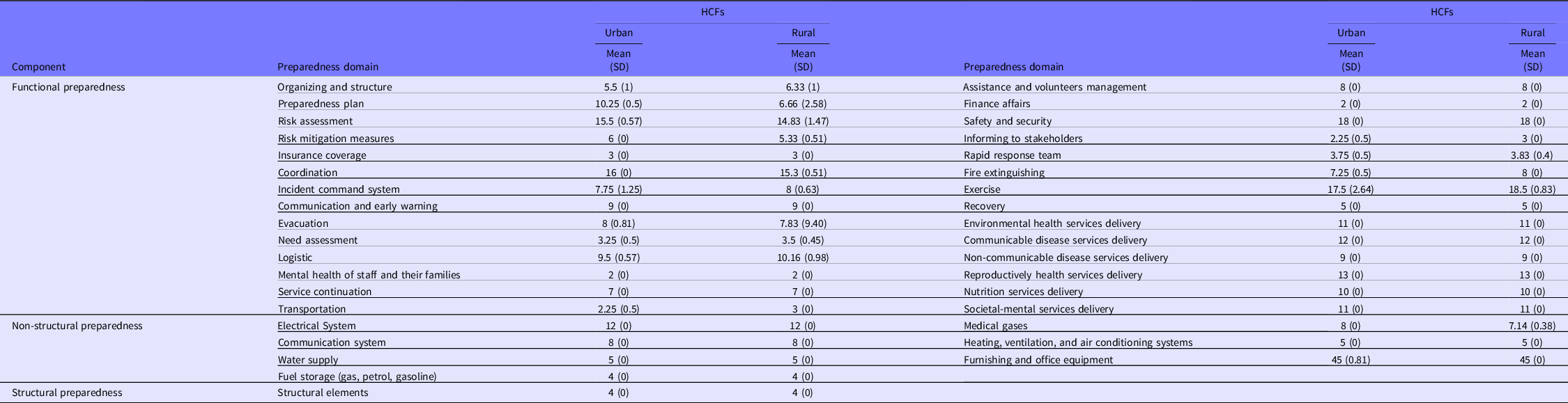
Some evidence indicates that endemic diseases such as cutaneous leishmaniasis have a high potential to spread quickly and convert to epidemics in the area understudy, particularly in the rural HCFs. Also, water- and food-borne diseases are more probable in the rural areas than in urban areas. The risk of vermin attacks can be classified at moderate level in both urban and rural areas. Furthermore, man-made hazards such as fire, chemical threats, power outage, and water outage have been assessed at the moderate risk level in both urban and rural HCFs understudy. Table 3 reports the descriptive analysis of functional, structural, and nonstructural preparedness in the HCFs under assessment.
The mean and SD of functional, structural, and non-structural preparedness in HCFs, Damghan, 2019

Abberviation: SD, standard deviation.
According to Table 3, organizing and structure (5.5 ± 1), needs assessment (3.25 ± 0.5), informing the stakeholders (9.5 ± 0.57), transportation (2.25 ± 0.5), and exercise (17.5 ± 2.64) scored below the expected average among the elements of functional preparedness in urban HFCs. These elements in rural HCFs included preparedness plan (6.66 ± 2.58), coordination (15.3 ± 0.51), evacuation (7.83 ± 9.4). The mean score of disaster logistic factor was less than the expected average in both urban and rural HCFs. Additionally, the situation of water supply and fuel storage scored 5, which was less than 6 as the expected average among the assessment of nonstructural elements. A similar result was obtained in the assessment of structural elements (4 ± 0), where the obtained mean score was less than the expected average in both urban and rural HCFs.
Scoring normalization of total preparedness indicated that 6 HCFs (58%) were classified as low preparedness, 2 HCFs (18%) were categorized as moderate preparedness, and the other 3 HCFs (24%) had high preparedness to emergencies and disasters. The average preparedness level of HCFs understudy was equal to 45.8%. The highest level of preparedness was related to nonstructural section with 56.4%, while the lowest preparedness belonged to the structural section with 31.6%. Furthermore, functional preparedness was equal to 49.3% in this study.
Discussion
The present study indicated that, among the geological hazards, earthquake is the most likely to occur in Damghan County, and health-care centers are most highly affected by this natural disaster. Reviewing the documents showed that there are 4 active faults passing underneath Damghan. One of these faults, called Astaneh, on the northwest of Damghan, accounted for the sixth largest earthquake in the world, measuring 7.6 M and killing 200,000. Reference Ramzi and Jalili26 This result corresponds with the study conducted by Dargahi et al., in the preparedness evaluation of health units of Kermanshah, 2017. Reference Dargahi, Farrokhi and Poursadeghiyan33 Additionally, in the present study, the probability of landslides following an earthquake is also higher in the mountainous regions of 3 rural HCFs.
Among the weather hazards, storms and floods were the most likely to occur, which could be due to the geography of the region, the town’s confinement by the Alborz mountains to the north, difference in the elevation of the various districts, and the land slope. Reference Mohammadi, Nokandeh and Khorsandi34 Also, the occurrence probability of blizzard and heavy winds are predicted higher in the mountainous areas of the county in comparison to the plain regions that include more than 60% (7 of 11) of assessed HCFs.
Among man-made disasters, fires are very likely due to noncompliance with safety requirements, lack of fire prevention systems such as automatic fire detecting or extinguishing systems. Cyber-attacks are also highly likely due to the lack of well-established computer infrastructures in the health-care centers. In addition, Damghan is a biologically vulnerable area in terms of cutaneous leishmaniasis as it is home to the major sources of the disease such as rodents. Reference Pourmohammadi and Mohammadi-Azni35 Also, the evidence indicates occurrence of cutaneous leishmaniasis epidemic in rural areas of Damghan in 2009, where more than 100 new cases occur annually. Reference Pourmohammadi, Mohammadi-Azni and Kalantari36 One study demonstrated that the incidence of the disease is higher in the plain rural areas than in urban areas, Reference Almasi-Hashiani, Shirdare and Emadi37 where 43% of health centers studied was located in such areas in the present study. In addition, in some cases the inadequate environmental health and potential problems in water chlorination in these areas have been associated with outbreaks of water- and food-borne diseases. Reference Angoua, Dongo and Templeton38
The results of this study revealed that the level of total preparedness in the HCFs is approximately 46%. A similar study in Kermanshah also showed that this figure is approximately 35% in existing HCFs, Reference Dargahi, Farrokhi and Poursadeghiyan33 while similar surveys on preparedness in Tabriz and Qazvin hospitals indicated that these hospitals are only moderately prepared for the disasters. Reference Vali, Masoud and JabariBeyrami39,Reference Khazaei, Jamaly and Safi40 The difference in readiness between HCFs and hospitals in Iran can be attributed to their success in attracting more funds. The rural population accounts for more than 26% of the total population of the country and the rural residents could access to HCFs only for the necessary health-care services. In general, the unequal delivery and access to medical services are implicated in disasters. In recent years, disasters have posed greater threats to communities lacking the enough resources and timely access to health-care services by the disaster-affected people. Reference Davis, Wilson and Brock-Martin41 Currently, Iran has developed its capacities to reduce disaster risk and increase preparedness at international, national, and local levels, but due to limited resources and some inappropriate practices in the past, it is still insufficient. Reference Owens, Buffington and Frost42,43
An important finding of this study is that all factors evaluated in the structural section of urban and rural health centers have a lower score than the expected average. In case such conditions persist and without retrofitting of existing buildings, seismic vulnerability of these HCFs increases. Reference Muñoz, Quiun and Tinman44 In the case of earthquake occurrence, they are highly likely to collapse, leading to disruption of health-care services, exacerbation of the injuries, and a higher mortality rate of vulnerable groups such as pregnant women, children, and the elderly. This situation is similar to what happened in the Bam earthquake, 2003, Iran, where 90% of HCFs were damaged or in Sumatra earthquake in western Indonesia in 2009, where 8 of the 9 primary health-care centers collapsed by the earthquake. Reference Fuady, Pakasi and Mansyur27,Reference Kalantar, Sagafinia and Ebrahimi45 Thus, intactness of HCFs during disasters is crucial to responding to health needs and preventing further mortality.
In the case of functional preparedness, the most effective factors in the reduction of the preparedness level against disasters and emergencies in HCFs include organization and structure, coordination, exercise, informing stakeholders, and risk reduction plans, including risk assessment and emergency evacuation and logistics. Similar results were obtained in the study of disaster preparedness of HCFs in Kermanshah. Insufficient water and electricity resources were other factors in the reduction of nonstructural preparedness in urban and rural HCFs in this study. According to the preparedness principles of hospitals and HCFs for disasters, it is recommended that these critical centers are provided with adequate water and electricity resources up to 72 h after the disaster, so that over time, the organization is able to be self-sufficient and continue operating and delivering health-care services to disaster-affected people in an independent manner. 46,Reference Ciottone, Biddinger and Darling47
Regarding the moderate percentage of HCFs preparedness (47%), it is necessary to enhance the overall disaster preparedness level according to functional, structural, and nonstructural assessments. The measures for promoting preparedness in HCFs should focus on structural, functional, and nonstructural preparedness, respectively. Furthermore, the individual framework is necessary for health-care accessibility post disaster in rural and urban settings. 48 Planning and implementing the disaster management programs are essential in increasing the overall hospital disaster preparedness level. Reference Pengfei, Santhosh and Jomon49 As the World Health Organization (WHO) worked seriously on disaster preparedness programs in 2008-2009 as part of a global campaign, Reference Ardalan, Kandi Keleh and Saberinia25,Reference Rajaei-Ghafouri, Mirzahosseini and Pouraghaei50 there may be a need to attract the support of international organizations, such as WHO and United Nations International Strategy for Disaster Reduction (UNISDR), to enhance the preparedness level of HCFs to deal with these disasters.
Conclusions
Regarding the high proneness of Damghan County to natural disasters, the prepared HCFs have a main role in reducing the vulnerability to the harmful impacts of disasters. This study indicated that the average level of preparedness of HCFs was less than 50%, and it is not very reliable to assure the continuity of delivery of health services to the affected people at times of emergencies and disasters.
Thus, required resources should be allocated to the health system for promoting the preparedness level of HCFs. Due to the low preparedness in the structural component, it is essential to invest in this area for improving the structural preparedness. Constructing new buildings for HCFs in accordance with seismic safety codes or retrofitting the existing buildings would be recommended to enhance the level of structural preparedness. Also, continuous training courses and conducting periodic exercises are necessary for increasing the level of functional preparedness. Despite an appropriate level of nonstructural preparedness in assessment of HCFs, providing enough power and water backup for 72 h after disasters is suggested for maintaining the delivery of health services to the affected population in the acute phase of disasters and emergencies.
Author Contributions
F.F. and B.P. conceptualized and designed the study and A.M. collected data. A.H. and F.F. analyzed data, and F.F. and B.P. wrote and edited the manuscript. All authors read and approved the final manuscript.
Declaration of Conflicting Interests
The authors declare that they have no competing interest.
Ethical Standards
The Ethics Committee of Semnan University of Medical Sciences approved this study (IR.SEMUMS.REC.1397.108).