Introduction
Genetic characterization in forest species is essential to elucidate information about the genetic variability available to breeders and geneticists, aimed at the conservation and improvement of germplasm. DNA polymorphisms are important markers in genetic analyses, supporting to understand the molecular basis of inheritance, also providing knowledge about the different biological and ecological aspects of the species (Hoban et al., Reference Hoban, Archer, Bertola, Bragg, Breed, Bruford, Coleman, Ekblom, Funk, Grueber, Hand, Jaffé, Jensen, Johnson, Kershaw, Liggins, MacDonald, Mergeay, Miller, Muller-Karger, O'Brien, Paz-Vinas, Potter, Razgour, Vernesi and Hunter2022).
The choice of a molecular marker as an effective genomic resource for population genetic studies stems from its effectiveness in identifying polymorphisms, genotyping yield, cost, ease of use, consistency and laboratory reproducibility (Nadeem et al., Reference Nadeem, Nawaz, Shahid, Doğan, Comertpay, Yıldız, Hatipoğlu, Ahmad, Alsaleh, Labhane, Özkan, Chung and Baloch2018). Among the markers, Inter Simple Sequence Repeat (ISSR) is widely used due to its low cost of analysis, multilocus nature and universal character, making it applicable to non-model species. Moreover, ISSRs are considered highly reproducible when consistent concentrations of primers, reagents and additives, PCR settings and scorer criteria are maintained (Ng and Tan, Reference Ng and Tan2015).
The application of ISSR markers has supported knowledge about variability, diversity and genetic structure in populations of forest species. Emphasis on Brazil and its native forest species, such as Astronium concinnum (Vieira et al., Reference Vieira, Souza, Silva Júnior, Alves, Miranda, Moreira and Caldeira2022), Dalbergia nigra (Silva Júnior et al., Reference Silva Júnior, Cabral, Sartori, Miranda, Caldeira, Moreira, Godinho and Oliveira2022), Eremanthus erythropappus (Pádua et al., Reference Pádua, Rocha, Brandão, Vieira and Carvalho2021), Freziera atlantica (Zorzanelli et al., Reference Zorzanelli, Kunz, Carrijo, Miranda, Souza and Silva Júnior2022), Plathymenia reticulata (Souza et al., Reference Souza, Silva, Souza, Kunz and Miranda2017), among others.
As previously described, the quality and standard of results in genetic studies can only be achieved with well-defined and standardized methodologies, with the preliminary selection of functional primers being an indispensable requirement for the use of those with the best amplification profile (Silva et al., Reference Silva, Santos, Marques and Andrade2015). Thus, primer prospection studies can guarantee cost and time reduction to obtain the results and, greater efficiency in the detection of genetic variability.
The species Paratecoma peroba (Record) Kuhlm. popularly known as peroba-do-campo, it is a tree of the Bignoniaceae family, endemic to Brazil, which has ecological and economic potential, and can be used in forest restoration projects and in timber industry (CNCFlora, 2022). Currently, the species is threatened with extinction due to its history of exploitation by selective cutting (Martinelli and Moraes, Reference Martinelli and Moraes2013; Fraga et al., Reference Fraga, Formigoni and Chaves2019), which characterizes it as a potential species for conservation and improvement programmes.
Furthermore, studies of genetic characterizations with P. peroba are scarce (França et al., Reference França, Tavares, Silva Júnior, Miranda, Vargas, Abreu and Caldeira2022) and there are still no specific molecular markers for the species, which justifies the previous selection of arbitrary and informative markers, such as the ISSR. Thus, the aim is to prospect ISSR primers and subsequent genetic characterization of a natural population of the P. peroba species. With this study, we hope to optimize the use of molecular tools and their associated methods, so that they can be efficiently applied in future work with this species. In addition, we seek to obtain the necessary information for the maintenance and proper management of the in situ population.
Materials and methods
Sampling and study location
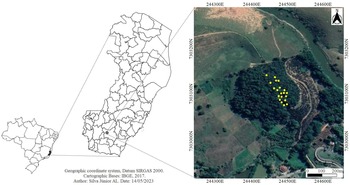
Leaf samples of 20 individuals of P. peroba were collected in a forest fragment of approximately 5.9 ha, located in a particular area, close to the Instituto Federal de Educação, Ciência e Tecnologia do Espírito Santo, Campus de Alegre, ES (IFES, Campus Alegre), district of Rive, Alegre, ES/Brazil, between the coordinates 20°45′14″ South latitude and 41°27′18″ West longitude (Fig. 1). The local climate, according to the Köppen classification, falls into the Cfa type (subtropical, with hot summer), with an average annual temperature of 20°C and annual precipitation around 1200 mm (Alvares et al., Reference Alvares, Stape, Sentelhas, Moraes Gonçalves and Sparovek2013). In addition, the forest fragment has Seasonal Forest type vegetation, surrounded by areas of pastures and coffee plantations.
Location map of the study area and selection of individuals of the species Paratecoma peroba (in yellow).

DNA extraction
Genomic DNA extraction was performed from leaf tissue of all sampled individuals, submitted to the CTAB method (Doyle and Doyle, Reference Doyle and Doyle1987), adjusting the concentrations to 1% polyvinylpyrrolidone (PVP) and 2% cetyltrimethylammonium bromide (CTAB). The concentration and purity of the extracted DNA were determined by spectrophotometry using the NanoDrop 2000C equipment (Thermo Scientific), analysing the A260/A280 ratio, satisfactory within the range of 1.8–2.0 as it indicates no contamination by proteins or phenolic compounds (Aguilar et al., Reference Aguilar, López, Aceitun, Ávila, Guerreiro and Quesada2016).
Amplification by polymerase chain reaction (PCR) and electrophoresis
Initially, four individuals of the P. peroba species were randomly selected to compose the amplification tests, which used 43 ISSR primers (UBC's 802, 807, 808, 809, 810, 811, 812, 813, 814, 815, 816, 818, 822, 824, 825, 827, 829, 833, 834, 836, 840, 842, 849, 852, 855, 856, 861, 862, 864, 865, 866, 867, 868, 870, 874, 876, 877, 878, 880, 884, 886, 887 and 891) developed by the University of British Columbia, Vancouver, Canada. The total reaction volume was 20 μl, containing 1× buffer (10 mM Tris-HCl pH 8.5 and 50 mM KCl), 2.5 mM MgCl2, 0.25 mM of each dNTP, 0.2 μM of primer, 1 unit of Taq DNA polymerase and about 50 ng of genomic DNA.
The following amplification conditions were used: initial denaturation at 94°C for 5 min, followed by 35 cycles of denaturation (94°C for 45 s), annealing (52°C for 45 s) and elongation (72°C for 90 s), with a final extension of 72°C, for 7 min. The amplification products were separated by electrophoresis on 2% agarose gel in 1× TBE solution (Tris – Boric acid – EDTA), at a voltage of 100 V for approximately 4 h. Finally, the gels were stained by immersion in ethidium bromide solution (0.50 μg/ml) and photographed under UV light in a photodocumentator (ChemiDoc MP Imaging System – Bio Rad). The estimation of the size of the amplified fragments was obtained by using the molecular weight marker (Ladder) of 100 base pairs.
Data analysis
From the photodocumentation of the gels and based on the amplification profile, the selection of primers with the best bands sharpness patterns was performed. Subsequently, a binary matrix was generated, considering the presence (1) and absence (0) of amplified fragments, for which the following descriptive analyses were performed: Total number of bands (TNBs), number of polymorphic bands (NPBs), percentage of polymorphic bands (PPBs) per primer and the range of variation of bands (BVR). Thus, the selection of the ISSR primers for the study with the P. peroba species was carried out based on the sharpness of the bands and the identification of polymorphism. In addition to the descriptive analyses, the primers were also evaluated based on the polymorphic information content (PIC), calculated using the Genes program (Cruz, Reference Cruz2016).
To evaluate the genetic diversity contained in the population, the parameters called number of observed alleles (AO), number of effective alleles (AE), Nei genetic diversity index (H*) (Nei, Reference Nei1978) and Shannon index (I*) (Shannon and Weaver, Reference Shannon and Weaver1949) were calculated using the Popgene program (Yeh and Boyle, Reference Yeh and Boyle1997). The genetic dissimilarity was evaluated based on the estimated values between the individuals pair by pair through the arithmetic complement of the Jaccard coefficient, resulting in a numerical matrix, used in the development of a dendrogram by the method of grouping unweighted arithmetic means (UPGMA), with an estimated cut-off point according to Mojena (Reference Mojena1977), with the coefficient k = 1.25. To confirm the consistency between the dissimilarity values and the representation in the dendrogram, the cophenetic correlation coefficient (CCC) was calculated. All analyses were performed using the Genes program (Cruz, Reference Cruz2016).
Based on the dissimilarity matrix, principal coordinate analysis (PCoA) was performed using the Genes software (Cruz, Reference Cruz2016), to determine the relative position of the sample in a multidimensional space, graphically demonstrating the genetic structure of individuals within the population. In addition, the genetic structure was also evaluated using a Bayesian approach performed using the Structure 2.3 software (Falush et al., Reference Falush, Stephens and Pritchard2007), establishing 20 runs for each K value, with the number of groups (K) varying between K = 1 and K = 4, totalling 10,000 Monte Carlo interactions via Markov Chains (MCMC). The number of genetic groups was determined by the ad hoc ΔK method proposed by Evanno et al. (Reference Evanno, Regnaut and Goudet2005) using Structure Harvester software (Earl and Vonholdt, Reference Earl and Vonholdt2012).
Results
Selection and efficiency of ISSR primers
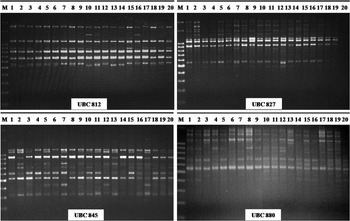
Tests performed for the 43 ISSR primers allowed the identification of different amplification patterns, ranging from clear to no amplification. Therefore, only primers with clear amplification were selected (Fig. 2), and only the bands visible to the naked eye were counted, so that the analysis could be reproduced in future studies.
Amplification sharp profile for 20 individuals of the Paratecoma peroba species via ISSR primers (UBC's 812, 827, 845 and 880).

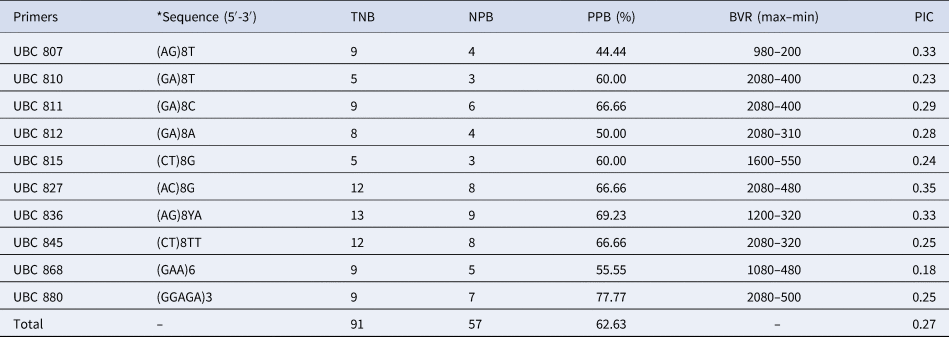
Among the total number of primers evaluated, 10 were selected to compose the genetic-population analyses. A total of 91 bands were identified, of which 58 were polymorphic, resulting in 62.63% polymorphism. The UBC 836 primer presented the highest total number of bands (TNB), while the UBC's 810 and 815 primers showed the lowest TNB values. The primer that presented the highest percentage of polymorphic bands (PPB) was UBC 880, with the lowest percentage observed for the primer UBC 807. The values for the polymorphic information content (PIC) ranged from 0.18 to 0.35 for the primers UBC 868 and UBC 827, respectively. The PIC value considering the total set resulted in a value of 0.27 (Table 1).
Descriptive analyses of the ISSR primers selected for evaluation in a population of the species Paratecoma peroba

TNB, total number of bands; NPB, number of polymorphic bands; PPB, percentage of polymorphic bands; BVR, range of variation of bands determined by molecular weight marker of 100 bp; PIC, polymorphic information content. *H = (A, T or C); R = (A or G); V = (A, C or G) and Y = (C or T).
Genetic diversity
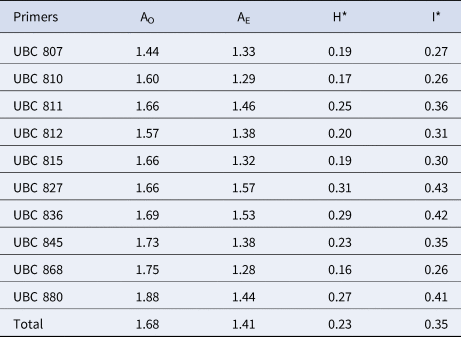
Regarding the individually evaluated loci, the values for AO ranged from 1.44 (UBC 807) to 1.88 (UBC 880), while the AE values ranged between 1.28 (UBC 868) and 1.57 (UBC 827). The genetic diversity indices of Nei (H*) and Shannon (I*) ranged from 0.16 (UBC 868) to 0.31 (UBC 827) and 0.26 (UBC's 810 and 868) to 0.43 (UBC 827), respectively. Considering all the primers used in the characterization of the genetic diversity of P. peroba, the values for AO, AE, H* and I* were 1.68, 1.41, 0.23 and 0.35, respectively, confirming low genetic diversity for the evaluated population (Table 2).
Parameters of genetic diversity estimated, by loci and for the population of the species Paratecoma peroba, using ISSR markers

AO, number of alleles observed; AE, number of effective alleles; H*, Nei genetic diversity index; I*, Shannon index.
Genetic dissimilarity
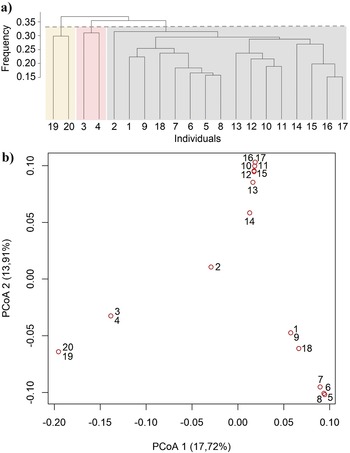
The dendrogram showed the formation of three genetic groups, with one group with 16 individuals and two groups containing 2 individuals, respectively (Fig. 3(a)). The CCC was 0.77, showing consistency between the dissimilarity matrix and the dendrogram obtained.
Analysis of dissimilarity and genetic structure for individuals in a population of the species Paratecoma peroba. (a) Dendrogram of genetic dissimilarity, obtained by the UPGMA method with cut-off point (PC): 0.33. (b) Principal coordinate analysis (PCoA) for the total sample of individuals.

Genetic structure
PCoA revealed the structuring of individuals within the population, making it possible to spatially identify the genetic proximity and distance between them. It is possible to observe, by PCoA, the genetic proximity of the pairs of 3 × 4 and 19 × 20 individuals. In addition, there is a greater genetic divergence of individual 2, as it is more isolated from the others (Fig. 3(b)).
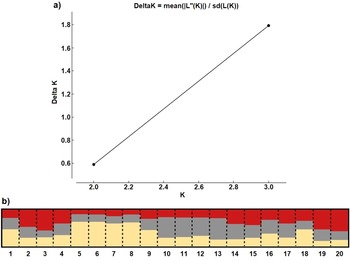
Through the Bayesian approach, three genetic groups were identified (K = 3) (Fig. 4(a)), distributed among the individuals of the population (Fig. 4(b)).
Bayesian approach performed for a population with 20 individuals of the species Paratecoma peroba. (a) Most likely number of K clusters in three (K = 3). (b) Distribution of genetic groups in each sampled individual.

Discussion
Selection of molecular markers based on band visualization capacity and amplification pattern is commonly used in plant species studies to avoid the use of poorly informative or false-positive primers (Silva et al., Reference Silva, Santos, Marques and Andrade2015). In the case of P. peroba, there is a lack of developed molecular markers, making the utilization of universal markers like ISSR beneficial for conservation and improvement studies of the species.
A study on Plathymenia reticulata showed that 10 ISSR primers resulted in a 64.74% polymorphism rate (Souza et al., Reference Souza, Silva, Souza, Kunz and Miranda2017), which is similar to the findings of the current study. Similarly, another study on Jacaranda mimosifolia found an 83.02% polymorphism rate (Liu et al., Reference Liu, Liu, Li, Zhang, Huang, Gao, Fang and Zhang2022). Both studies employed ISSR primers, with the primers UBC 868 and UBC 836 identified a higher percentage of polymorphism in P. peroba (55.55 and 69.23%) compared to P. reticulata (40%) and J. mimosifolia (50%), respectively.
The difference between the percentage of amplification is expected to occur between different species, as previously demonstrated, and also between populations of the same species, since in the latter case different ecological and evolutionary factors act to shape the genetic variability among individuals. However, we emphasize the reproducibility of ISSR markers when applied to the same species, as long as the concentrations of primers, reagents and additives, PCR settings and scoring criteria are maintained (Ng and Tan, Reference Ng and Tan2015).
Individually, the evaluated primers were classified as having low to moderate informativeness. However, when considering the collective PIC value for the entire set of primers, they demonstrated moderate informativeness (Tatikonda et al., Reference Tatikonda, Wani, Kannan, Beerelli, Sreedevi, Hoisington, Devi and Varshney2009). Therefore, these primers are efficient for genetic characterization studies involving P. peroba.
Most Bignoniaceae species are diploid with up to two distinct alleles per locus (Gentry, Reference Gentry1980). The observed number of alleles (AO = 1.68) may be influenced by loci with similar alleles, while the number of effective alleles (AE = 1.41) suggests the presence of alleles that do not contribute effectively, indicating loci with homozygosity.
Homozygosity in the evaluated population of P. peroba, where open pollination occurs (Lins and Nascimento, Reference Lins and Nascimento2010), can result from the inbreeding or self-pollination. Inbreeding refers to the natural or artificial crossing of related individuals, leading to reduced fitness due to increased homozygosity, known as inbreeding depression, primarily caused by the expression of deleterious alleles (Howard et al., Reference Howard, Pryce, Baes and Maltecca2017). Consequently, inbreeding depression effects can limit the maintenance of the P. peroba population as generations progress.
The values for Nei's genetic diversity (H* = 0.23) and Shannon's index (I* = 0.35) indicate low genetic diversity contained in the population. According to Lewontin (Reference Lewontin1972), the values for the Shannon index range from 0 to 1, indicating a variation from low (0) to high (1) genetic diversity. The small size of the population in a fragmented forest, along with factors like genetic drift, contributes to the low genetic diversity (Basey et al., Reference Basey, Fant and Kramer2015).
The low genetic diversity can also be attributed to the population's geographic isolation and ecological factors such as insect pollination (Gentry, Reference Gentry1974) and anemochory-mediated seed dispersal (Lins and Nascimento, Reference Lins and Nascimento2010). Insect pollination limits pollen and allele exchange in forest fragments located at greater distances, while anemochory tends to disperse seeds closer to the parent tree (Warneke et al., Reference Warneke, Caughlin, Damschen, Haddad, Levey and Brudvig2021).
To expand the genetic diversity of the P. peroba population, strategic actions such as creating ecological corridors to connect neighbouring fragments, potentially harbouring P. peroba representatives and introducing individuals from other sources are essential. Genetic diversity encompasses the sum of loci and alleles influencing trait expression in a population, so it is correct to say that higher levels of genetic diversity represent a greater probability of maintaining the population.
The formation of a majority group in the dendrogram (Fig. 3(a)) corroborates the low genetic diversity evaluated in the population. However, this analysis allows the development of another strategic action to be used to expand the genetic base, as individuals located in different groups can be used in the production of seedlings from controlled pollination, being later implanted in the place.
Although controlled pollination can be used to expand the genetic base for population conservation, its main use is in forest improvement, due to the possibility of gene introgression, hybrid formation and increased genetic gains (Ortega-Ramirez et al., Reference Ortega-Ramirez, Mendez-Arcos, Torres-Lamas and Sanchez-Mendez2021). Thus, it is noteworthy that the evaluation of genetic dissimilarity in the population of P. peroba also allows the use of individuals as possible matrices in breeding programmes for the species.
To assess the structure and dispersion of individuals, PCoA has the advantage of allowing the use of matrices of genetic distances obtained from qualitative data, such as those generated for ISSR markers (Prado et al., Reference Prado, Lewinsohn, Carmo and Hogan2002). Therefore, it was observed that PCoA (Fig. 3(b)) corroborated the results of the dendrogram (Fig. 3(a)), demonstrating pairs of individuals that were genetically closer, while others were more distant.
The pairs of individuals 3 × 4 and 19 × 20 remained genetically related for the two analyses, being also geographically close (~50 m) in the forest fragment where they were selected. This observation between genetic and geographic relationship has already been confirmed by several genetic-population studies involving forest species (Silva et al., Reference Silva, Moraes and Sebbenn2004; Silva Júnior et al., Reference Silva Júnior, Cabral, Sartori, Miranda, Caldeira, Moreira, Godinho and Oliveira2022; Vieira et al., Reference Vieira, Souza, Silva Júnior, Alves, Miranda, Moreira and Caldeira2022) and are directly associated with ecological factors of the species such as reproductive system, mechanisms of dispersion and pollination, population size, among others (Santo-Silva et al., Reference Santo-Silva, Almeida, Tabarelli and Peres2016). In P. peroba, insect pollination and anemochoric fruit dispersal (Lins and Nascimento, Reference Lins and Nascimento2010) allow related individuals to establish themselves geographically close. According to Motta et al. (Reference Silva, Moraes and Sebbenn2004), tree species tend to form groups with homogeneous allele frequencies, due to seed dispersal close to the parent tree.
Regarding the analysis performed by the Bayesian approach, the number of genetic groups found indicates the non-structuring of the population (Fig. 4(a)), however, the distribution of the three colours in all individuals infers (Fig. 4(b)), once again, on the occurrence of loci in homozygosity. Therefore, the vulnerability of the population with the advancement of generations is highlighted, mainly due to factors such as genetic drift and inbreeding depression.
Conclusion
The selected ISSR primers were efficient in revealing polymorphisms between individuals, being able to be applied in strategic actions of conservation and improvement programmes that demand the knowledge of the variability, diversity and genetic structure of the P. peroba species or its populations. However, the evaluated population is vulnerable, confirming the presence of homozygous loci and low genetic diversity. To reverse this situation of vulnerability and expand the genetic base of the population, an increase in the connectivity of neighbouring forest fragments and the establishment of genetically divergent individuals originating from other populations are indicated.
Acknowledgements
The authors would like to thank the Coordenação de Aperfeiçoamento de Pessoal de Nível Superior (CAPES) – Finance Code 001, the Conselho Nacional de Desenvolvimento Científico e Tecnológico (CNPq)/Fundação de Amparo à Pesquisa do Espírito Santo (FAPES) (process N° 84532041) and the Universidade Federal do Espírito Santo (UFES) for research support.