Introduction
Gastrointestinal nematode infections are an important cause of economic losses in the ruminant industry. These infections cause reductions in weight gain and occasionally cause mortality. The most important nematode parasite in small ruminants that are raised in warm climates is Haemonchus contortus (Giudici et al., Reference Giudici, Aumont, Mahieu, Saulai and Cabaret1999; Amarante, Reference Amarante2014; Wilmsen et al., Reference Wilmsen, Silva, Bassetto and Amarante2014), which is also important in countries with a temperate climate, such as Sweden and Canada (Waller et al., Reference Waller, Rudby-Martin, Ljungström and Rydzik2004; Mederos et al., Reference Mederos, Fernández, VanLeeuwen, Peregrine, Kelton, Menzies, LeBoeuf and Martin2010). Meanwhile in cattle raised in tropical areas, mixed infections with several species, including Haemonchus placei, Haemonchus similis, Cooperia spp. and Oesophagostomum radiatum, are common (Keyyu et al., Reference Keyyu, Kassuku, Kyvsgaard and Willingham2003; Bassetto et al., Reference Bassetto, Silva, Newlands, Smith, Ratti Júnior, Martins and Amarante2014a; Felippelli et al., Reference Felippelli, Lopes, Cruz, Teixeira, Maciel, Fávero, Buzzulini, Sakamoto, Soares, Gomes, de Oliveira and da Costa2014).
Prophylaxis against gastrointestinal nematode infections relies heavily on the use of anthelmintics. However, their efficacy has been decreasing due to the emergence of resistant populations of worms. This is a global problem that affects both small ruminants (Torres-Acosta et al., Reference Torres-Acosta, Mendoza-de-Gives, Aguilar-Caballero and Cuéllar-Ordaz2012; Falzon et al., Reference Falzon, Menzies, Shakya, Jones-Bitton, Vanleeuwen, Avula, Stewart, Jansen, Taylor, Learmount and Peregrine2013; Martínez-Valladares et al., Reference Martínez-Valladares, Martínez-Pérez, Robles-Pérez, Cordero-Pérez, Famularo, Fernández-Pato, Castañón-Ordóñez and Rojo-Vázquez2013; McMahon et al., Reference McMahon, Bartley, Edgar, Ellison, Barley, Malone, Hanna, Brennan and Fairweather2013) and cattle (Anziani et al., Reference Anziani, Suarez, Guglielmone, Warnke, Grande and Coles2004; Soutello et al., Reference Soutello, Seno and Amarante2007; Condi et al., Reference Condi, Soutello and Amarante2009; Gasbarre et al., Reference Gasbarre, Smith, Lichtenfels and Pilitt2009; Bartley et al., Reference Bartley, McArthur, Devin, Sutra, Morrison, Lespine and Matthews2012; Leathwick and Miller, Reference Leathwick and Miller2013; Neves et al., 2014; Cotter et al., Reference Cotter, Van Burgel and Besier2015).
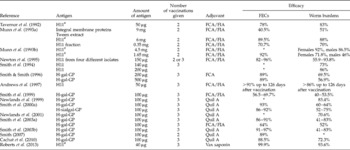
One possible option for the control of parasitic gastroenteritis is the use of vaccines against nematodes. In the 1960s, it was discovered that infective larvae of the lungworm Dictyocaulus viviparus that were attenuated by irradiation could stimulate a high degree of protection against challenge with normal infective larvae in calves (Smith, Reference Smith1999). This observation resulted in the first commercial vaccine for a nematode parasite of ruminants (Bovilis® Huskvac). Each vaccine dose contains 1000–2000 irradiated third-stage larvae (http://www.msd-animal-health.co.uk/). After this success the same technique was applied to gastrointestinal nematodes; it was found to work well enough in mature sheep, but unfortunately, the protective effect was too weak in lambs (Smith, Reference Smith1999). This approach was abandoned, and efforts towards vaccines for gastrointestinal nematodes have focused on finding protective excretory/secretory or gut-membrane antigens with a view to producing recombinant vaccines. Many of these studies are summarized in tables 1 and 2.
Protective immunities induced in sheep by vaccinations with Haemonchus contortus excretory/secretory (E/S) or somatic antigens.

FEC, faecal egg counts; DDA, dimethyl dioctadecyl ammonium bromide; Al(OH)3, aluminium hydroxide gel; Bacterial, lipopolysaccharide of Escherichia coli + Propionibacterium acnes; *, data not shown.
Immunization against Haemonchus contortus infection in sheep by vaccination with native parasite gut-membrane proteins. In all trials, naïve lambs received two or three doses of the vaccine and were then challenged with H. contortus infective larvae. The efficacies are based on reductions in faecal egg counts (FECs) and/or worm burdens.

FCA, Freund's complete adjuvant; FIA, Freund's incomplete adjuvant; H11#, integral membrane proteins H11 enriched preparation; H-gal-GP, Haemonchus galactose-containing glycoprotein complex; H-sialgal-GP, Haemonchus sialylated galactosamine-containing glycoprotein complex; Quil A, extracted product of saponin; Vax saponin, saponin adjuvant (Guinnes Chemical Products Ltd.); *, data not shown.
Vaccination with natural antigens
Nematode antigens that are naturally liberated and consequently are in contact with the host tissue during the infection process, such as excretory/secretory (E/S) products, are called ‘natural’ antigens. In the case of helminths, E/S products have been considered candidates for use as vaccines because they induce immune responses during the infection.
Strong humoral and cellular responses against H. contortus E/S products, especially the 15 and 24 kDa components, have been observed in sheep (Schallig et al., Reference Schallig, van Leeuwen and Hendrikx1994). Purified preparations of these antigens (EF15/24) induced a protective immune response in lambs, although there was a strong age effect (Schallig & van Leeuwen, Reference Schallig and van Leeuwen1997; Schallig et al., Reference Schallig, van Leeuwen and Cornelissen1997).
A substantial proportion of the protective antibody response of lambs immunized with E/S is directed against glycan epitopes. Glycans are abundant on the surfaces and in the secretory products of helminths. Therefore, parasite glycan antigens might also be potentially useful for the development of glycoconjugate vaccines. Lambs vaccinated with E/S in Alhydrogel exhibit significant increases in antibody levels against a GalNAcβ1,4 (Fucα1,3) GlcNAc (fucosylated LacdiNAc, LDNF) glycan antigen, which is a carbohydrate antigen that is abundant on secreted glycoproteins of H. contortus and which also appears to be involved in the host defence against the human parasite Schistosoma mansoni (Vervelde et al., Reference Vervelde, Bakker, Kooyman, Cornelissen, Bank, Nyame, Cummings and van Die2003).
A glycan-array containing more than 250 different glycan antigens indicated that the vaccination of lambs with E/S antigens elicits multiple anti-glycan antibodies that vary depending on the adjuvant used. In addition to anti-LDNF IgG, high levels of anti-Galα1–3GalNAc have only been observed in the sera of protected lambs that have been vaccinated with E/S antigens in Alhydrogel (van Stijn et al., Reference van Stijn, van den Broek, Vervelde, Alvarez, Cummings, Tefsen and van Die2010).
Proteases are important components of the E/S products of H. contortus, among which cysteine proteases are the most active. Partial protection has been observed in sheep vaccinated with a dithiothreitol-eluted (DTT) fraction extracted from E/S products of adult H. contortus and successively eluted from a Thiol Sepharose column using cysteine (Bakker et al., Reference Bakker, Vervelde, Kanobana, Knox, Cornelissen, De Vries and Yatsuda2004). Vaccination of sheep with cystatin-binding proteins has been shown to produce 36% and 32% reductions in mean worm burden and faecal egg counts (FECs), respectively (De Vries et al., Reference De Vries, Bakker, Krijgsveld, Knox, Heck and Yatsuda2009).
Small amounts of two somatic peptides (p26/23) obtained from a soluble extract of adult H. contortus elicit partially protective responses against H. contortus challenge in lambs (Domínguez-Toraño et al., Reference Domínguez-Toraño, Cuquerella, Gómez-Muñoz, Méndez, Fernández-Pérez and Alunda2000). In a subsequent study, the native somatic protein Hc23 was purified from the p26/23 fraction. Immunization of lambs with Hc23 in either aluminium hydroxide (Al(OH)3) or bacterial immune modulator preparation adjuvants elicited significant reductions in FECs and abomasal worm counts (Fawzi et al., Reference Fawzi, González-Sánchez, Corral, Cuquerella and Alunda2014).
Vaccination with hidden antigens
Blood-sucking parasites ingest all the components of blood, which obviously include immunoglobulins. If a vaccine contains proteins from the gut membrane of a parasite, an antibody response will be mounted against those proteins. When the parasite ingests blood, the antibodies will bind to their intestinal membrane surface, causing damage to, or interfering with, the correct functioning of the membrane. Because these antigens are from an internal organ of the parasite, they are not in contact with the host tissue, i.e. they are not exposed to the host's immune system during infection. For this reason, these antigens are called ‘hidden’.
A good example of a vaccine that is made with hidden antigens is that for the cattle tick Rhipicephalus microplus, which is based on the Bm86 intestinal molecule. This was the first recombinant vaccine to be used successfully against a parasite. The research project began in 1981, but the registered vaccine was not delivered to the market until 1994. This vaccine was released in Australia under the trade name TickGARD and subsequently TickGARD Plus, while the same antigen formed the basis of vaccines manufactured in Cuba and called Gavac and Gavac Plus (Willadsen, Reference Willadsen2004).
Hidden antigen-induced immunity against H. contortus was first demonstrated using a preparation from Haemonchus called ‘contortin’. Contortin is present in the intestinal brush border of fourth-stage larvae (L4) and adult H. contortus worms as a helical polymeric structure attached to the luminal surface of the intestinal cells. Contortin isolated in partially pure form (Munn, Reference Munn1977) was protective for lambs, reducing worm burdens by 75% (Munn et al., Reference Munn, Greenwood and Coadwell1987).
Contortin comprises two major proteins, Hc-PCP1 and Hc-PCP2, which share homology with prolyl-carboxypeptidases. The addition of contortin to a fibrinogen solution significantly inhibits blood coagulation in a dose-dependent manner, suggesting that it functions as an intestinal anticoagulant which prevents the blood meal from clotting (Geldhof & Knox, Reference Geldhof and Knox2008). Eight additional proteins were found in a contortin-enriched protein fraction, including a myosin, the aminopeptidase H11, glutamate dehydrogenase, apical gut membrane protein, metallopeptidase 3, galectin and cysteine proteinases (Geldhof & Knox, Reference Geldhof and Knox2008).
Cysteine proteinases are expressed at the microvillar surfaces of the parasite intestinal cells. Immunization of lambs with integral membrane protein extracts from adult H. contortus enriched for cysteine protease activity reduced faecal egg outputs and worm burdens by 77% and 47%, respectively. Serum antibodies bound almost exclusively to the surface of the parasite gut, indicating that protection might be mediated by the inhibition of parasite digestion (Knox et al., Reference Knox, Smith and Smith1999). An interesting observation was that a fraction containing less than 3 μg of this cysteine proteinase preparation was found to confer substantial and repeatable protection, reducing FECs by 48 and 28% and worm burdens by 44 and 46%, respectively, in two trials (Redmond & Knox, Reference Redmond and Knox2004).
However, H11 and the Haemonchus galactose-containing glycoprotein (H-gal-GP) complex have been the most consistent and highly protective antigens isolated from H. contortus and are the best characterized of the gut membrane proteins. These are described in more detail below.
Aminopeptidase H11 glycoprotein
H11 is an integral membrane protein from Haemonchus spp. located on the intestinal microvilli. An extract of adult H. contortus enriched with H11 and other integral membrane proteins, and free of the protein contortin, was as protective as contortin-enriched preparations but required much smaller amounts of protein (Munn et al., Reference Munn, Smith, Graham, Greenwood, Tavernor and Coetzee1993a, b). In an approximately 95% pure form, H11 produced a mean 94.6% reduction in H. contortus egg output and reduced male and female worm numbers by 86.5% and 93.5%, respectively (Smith et al., Reference Smith, Munn, Graham, Tavernor and Greenwood1993). The protective effect begins as soon as the worms begin to ingest blood (Smith & Smith, Reference Smith and Smith1993). Female worms are more susceptible to immunization than males, and the level of protection correlated with the H11 serum antibody titre (Munn et al., Reference Munn, Smith, Graham, Greenwood, Tavernor and Coetzee1993a, b; Smith et al., Reference Smith, Munn, Graham, Tavernor and Greenwood1993).
Haemonchus galactose-containing glycoprotein complex
The H-gal-GP complex was first described by (Smith et al., Reference Smith, Smith and Murray1994). It is a 1000 kDa glycoprotein complex that can be extracted from the brush border of the intestinal cells of H. contortus. This fraction is glycosylated and selectively binds to lectins with a preference for N-acetylgalactosamine (Smith et al., Reference Smith, Smith and Murray1994, Reference Smith, Pettit, Newlands, Redmond, Skuce, Knox and Smith1999). Biochemical analyses of H-gal-GP have indicated that it contains aspartyl, metallo- and cysteine proteinases (Smith et al., Reference Smith, Pettit, Newlands, Redmond, Skuce, Knox and Smith1999). The major component of the H-gal-GP complex is a family of four zinc metallo-endopeptidases, designated MEPs 1–4. MEP3 appears to be the most abundant member of this metallo-endopeptidase family. No significant protection was observed when sheep were immunized with fully reduced and denatured H-gal-GP, with bacterially expressed recombinant forms of MEP1 or with the principal domains of MEP3, which suggests that the conformational epitopes on the MEPs are required for immunity (Smith et al., Reference Smith, Newlands, Smith, Pettit and Skuce2003a). Similarly, two pepsin-like aspartyl proteases, designated HcPEP1 and 2, were identified as components of H-gal-GP. Fractions containing these significantly reduced H. contortus FECs and worm numbers, but lower molecular-weight components were not significantly protective. However, the HcPEP1 and HcPEP2 fraction did not protect if it was electro-eluted from sodium dodecyl sulphate (SDS)-dissociated H-gal-GP, and bacterially expressed recombinant HcPEP1 also failed to protect, suggesting that conformational epitopes are important for inducing immunity (Smith et al., Reference Smith, Skuce, Newlands, Smith and Pettit2003b).
There is another highly protective fraction of Haemonchus integral membrane proteins that, unlike H-gal-GP, does not bind to peanut lectin but does bind to jacalin lectin. This jacalin-binding fraction can be separated by ion-exchange and gel-filtration chromatography into components that are designated as p46, p52 and Haemonchus sialylated galactosamine-containing glycoprotein complex, or H-sialgal-GP. H-sialgal-GP and H-gal-GP are equally protective and can reduce egg and worm counts by between 86 and 93% and 52 and 75%, respectively. The immunization of sheep with p46 and p52 elicited some protection (78% for eggs and 33% for worms) but were significantly less effective than either H-gal-GP or H-sialgal-GP (Smith et al., Reference Smith, Smith, Pettit, Newlands and Skuce2000a). A galectin called Hco-gal-2 is also a constituent of the H-gal-GP complex, though not protective (Newlands et al., Reference Newlands, Skuce, Knox, Smith and Smith1999).
Haemonchus intestinal glycoproteins are geographically conserved
Due to the genetic diversity of H. contortus, some level of variation in the intestinal glycoprotein structure might be expected. This variation might mean that a vaccine produced with antigens from one particular isolate would only be effective against the same isolate. All the evidence to date suggests that is not the case; for example, H11 or H-gal-GP prepared from drug-susceptible worms were just as effective against drug-resistant ones (Newton et al., Reference Newton, Morrish, Martin, Montague and Rolph1995; Smith, Reference Smith2007). Moreover, vaccination with H11 purified from either Australian or UK isolates was equally effective in protecting against subsequent challenge with Australian larvae (Newton et al., Reference Newton, Morrish, Martin, Montague and Rolph1995). A vaccine containing intestinal glycoproteins from UK H. contortus also protected calves against H. placei in Brazil (Bassetto et al., Reference Bassetto, Silva, Newlands, Smith and Amarante2011, Reference Bassetto, Silva, Newlands, Smith, Ratti Júnior, Martins and Amarante2014a). Furthermore, the equivalent preparation from Ostertagia ostertagi appeared identical by sodium dodecyl sulphate-polyacrylamide gel electrophoresis (SDS-PAGE) and protected sheep against H. contortus (Smith et al., Reference Smith, Smith and Pettit2000b).
Recombinant vaccines
Many largely unpublished attempts have been made in several laboratories to produce protective recombinant versions of the protective antigens just described, but without success. Roberts et al. (Reference Roberts, Antonopoulos, Haslam, Dicker, McNeilly, Johnston, Dell, Knox and Britton2013) suggested that this failure might be due to differences in the glycosylation and/or conformation between the native and recombinant proteins. These authors were able to show that H. contortus H11 expressed in Caenorhabditis elegans was enzymatically active, and matrix-assisted laser desorption/ionization (MALDI) mass spectrometry identified di- and tri-fucosylated structures that were similar to those on native H11. Some glycan structural differences were observed, such as lack of LDNF. Serum antibodies raised against native H11 bind to C. elegans recombinant H11, and most of the antibodies to recombinant H11 or native H11 are directed to glycan moieties. Despite these similarities, no reductions in worm burdens or FECs were observed following the immunization of sheep with C. elegans-expressed recombinant H11 protein. These findings suggest that the di- and tri-fucosylated N-glycans expressed on recombinant H11 do not contribute to the protective effect of H11, and that additional components that are present in native H11-enriched extract are likely required to enhance the antibody response that is necessary for protection (Roberts et al., Reference Roberts, Antonopoulos, Haslam, Dicker, McNeilly, Johnston, Dell, Knox and Britton2013).
Cystatin is a potent cysteine protease inhibitor from the gut of H. contortus. Immunolocalization studies using antisera raised against recombinant H. contortus cystatin have shown that the inhibitor was expressed predominantly in the cytoplasm of intestinal cells. A vaccine with recombinant cystatin (Cys-1) did not confer any protection against a challenge infection with H. contortus in lambs (Newlands et al., Reference Newlands, Skuce, Knox and Smith2001).
An antigen cocktail containing recombinant versions of most of the protective proteases of H-gal-GP (i.e. MEP1, MEP3 and MEP4 metallo-endopeptidases) was expressed as soluble recombinant proteins in insect cells, and the aspartyl protease PEP1 was expressed in Escherichia coli and refolded. Groups of sheep were immunized three times with either native H-gal-GP or a cocktail of expressed recombinant proteins (i.e. rMEP1, rMEP3, rMEP4 and rPEP1). High levels of serum antibodies that recognized H-gal-GP were detected in both the native antigen and recombinant cocktail-immunized groups at the time of challenge, but protective immunity was only observed in the group that was immunized with native H-gal-GP (Cachat et al., Reference Cachat, Newlands, Ekoja, McAllister and Smith2010).
In a recent study, promising results were obtained with a vaccine against Teladorsagia circumcincta. A multi-component recombinant vaccine with versions of eight molecules that were identified by immunoproteomics, and/or had potential immunoregulatory activities, reduced FECs and adult parasite burdens by >70% (Nisbet et al., Reference Nisbet, McNeilly, Wildblood, Morrison, Bartley, Bartley, Longhi, McKendrick, Palarea-Albaladejo and Matthews2013).
Field trials with sheep
The previous sections of this review have shown that when worm-free sheep are immunized with gut-membrane glycoproteins, they are substantially protected and typically display >70% decreases in worm burdens and >90% decreases in FECs following an artificial single-challenge dose of H. contortus larvae (table 2).
Three field trials were performed in different countries (USA, South Africa and Australia) to determine whether vaccination with 100 μg native H11 and 100 μg native H-gal-GP in 5 mg Quil A adjuvant could provide similar protection against natural H. contortus infections in grazing sheep (Kabagambe et al., Reference Kabagambe, Barras, Li, Peña, Smith and Miller2000; Smith et al., Reference Smith, van Wyk and van Strijp2001; LeJambre et al., Reference LeJambre, Windon and Smith2008). One of the trials was conducted during summer in Louisiana, USA, where the warm, humid climate is highly favourable for the development and survival of H. contortus. Suffolk ewes (>2 years old), categorized as ‘susceptible’ or ‘relatively resistant’, received two doses of the vaccine. The ‘susceptible’ vaccinated ewes shed 65% fewer worm eggs during the period when the vaccine could have had an effect, but the difference was only significant 6 weeks after vaccination (Kabagambe et al., Reference Kabagambe, Barras, Li, Peña, Smith and Miller2000). In South Africa, 12- to 18-month-old Dorper sheep were vaccinated five times. These vaccinations reduced egg output, anaemia and deaths during the course of the trial (Smith et al., Reference Smith, van Wyk and van Strijp2001). In Australia, grazing Merino lambs were assessed following four doses of vaccine. FECs and anaemia were significantly reduced in the vaccinated animals and, in contrast to the vaccinated sheep, all of the control sheep required salvage treatment with anthelmintics to avoid deaths. Additionally, by the final 2 months of the trial, the pastures that had been grazed by the vaccinated animals exhibited significantly lower levels of contamination with H. contortus larvae (LeJambre et al., Reference LeJambre, Windon and Smith2008).
In Brazil, the vaccine containing intestinal glycoproteins was evaluated at 5 or 50 μg/dose and given at 3-week intervals. Periparturient ewes exhibited modest circulating antibody responses but no protection, as judged by FECs compared to those of control ewes. In contrast, vaccination of their lambs resulted in tenfold higher antibody titres that were associated with significantly reduced anaemia and 78% reduction in Haemonchus eggs. Worm counts performed at the end of the trial were significantly lower in the vaccinated animals. These results indicate that the heavily pregnant or lactating ewes did not have sufficient physiological reserves to mount a protective response in the high-challenge conditions that prevailed. Nevertheless, the vaccine afforded useful protection for lambs against H. contortus (Bassetto et al., Reference Bassetto, Picharillo, Newlands, Smith, Fernandes, Siqueira and Amarante2014b). Interestingly, in this trial, both the 5 μg and the 50 μg vaccine doses produced similar results.
Better results in periparturient ewes were observed in the UK following vaccination with H11. The ewes exhibited 98–99% reduction in FECs; additionally, high anti-H11 antibody levels in the sera of the lambs indicated that maternally derived antibodies were transferred from ewe to lamb via the colostrum (Andrews et al., Reference Andrews, Rolph, Munn and Taylor1995). The difference observed between the periparturient ewes in Brazil and the UK is most likely to have been due to different degrees of challenge. Andrews et al. (Reference Andrews, Rolph, Munn and Taylor1995) artificially challenged their ewes once with 10,000 L3, but Bassetto et al. (Reference Bassetto, Picharillo, Newlands, Smith, Fernandes, Siqueira and Amarante2014b) worked in an environment with high levels of larval contamination.
Although the trials described above with native antigen vaccines were encouraging, it was considered that only recombinant vaccines could be commercially viable. However, with the discovery that the dose of native antigen required for protection was low (5 μg), it was then realized that a native antigen vaccine could be economically feasible provided methods could be found for collecting large quantities of adult worms cost-effectively. Methods for doing this were devised and after some 5 years of development work ‘Barbervax’ was launched in Australia in 2014 (barbevax.com.au). Details of the safety, stability and efficacy (both observed and predicted from computer modelling) will be published elsewhere in due course (W.D. Smith, pers. comm.).
Vaccination of cattle against haemonchosis
Despite the importance of Haemonchus in cattle raised in tropical and subtropical areas of the world, few attempts have been made to vaccinate bovines against this parasite. There are only two published studies that have used H. placei intestinal extracts as vaccine antigens. In both of these, reasonable reductions in egg production were observed but reductions in worm burden were relatively modest (15–39%) (Siefker & Rickard, Reference Siefker and Rickard2000; Jensen & Vieira-Bressan, Reference Jensen and Vieira-Bressan2008) and lower than those observed in sheep trials with H. contortus. Differences in the vaccine production protocols and/or the adjuvant might explain the relatively low efficacies of such vaccines in cattle studies.
The same vaccine used in sheep against H. contortus was tested in cattle. Young calves received three shots of the H. contortus vaccine and were then challenged with either H. placei or H. contortus. They exhibited significant reductions in FECs and worm burdens of both Haemonchus species (Bassetto et al., Reference Bassetto, Silva, Newlands, Smith and Amarante2011). Based on these promising results, a field trial was conducted to evaluate the protection afforded by the H. contortus vaccine against H. placei and H. similis in calves that were naturally infected with gastrointestinal nematodes. Significant reductions in Haemonchus spp. FECs and the numbers of H. placei males were observed. A reduction in the worm burden of H. similis was also observed but was not statistically significant (Bassetto et al., Reference Bassetto, Silva, Newlands, Smith, Ratti Júnior, Martins and Amarante2014a). No efficacy of this vaccine was observed against other nematode species that had also infected the cattle (Bassetto et al., Reference Bassetto, Silva, Newlands, Smith, Ratti Júnior, Martins and Amarante2014a).
Final remarks
Experimental vaccines containing native H. contortus intestinal glycoproteins have afforded significant protection to lambs and calves in both pen and field trials, but so far recombinant vaccines have failed. This has cumulated in the launch of Barbervax, the first subunit vaccine for a nematode parasite.
Acknowledgements
The authors gratefully acknowledge Dr W. David Smith, who critically read the manuscript and gave valuable advice for improvements.
Financial support
This study was funded by the European Commission, Seventh Framework–PARAVAC Project (Grant Number 265862). C.C.B. received financial support from São Paulo Research Foundation (FAPESP; Project 2010/18678-5) and A.F.T.A. from Conselho Nacional de Desenvolvimento Científico e Tecnológico (CNPq), Brazil.
Conflict of interest
None.