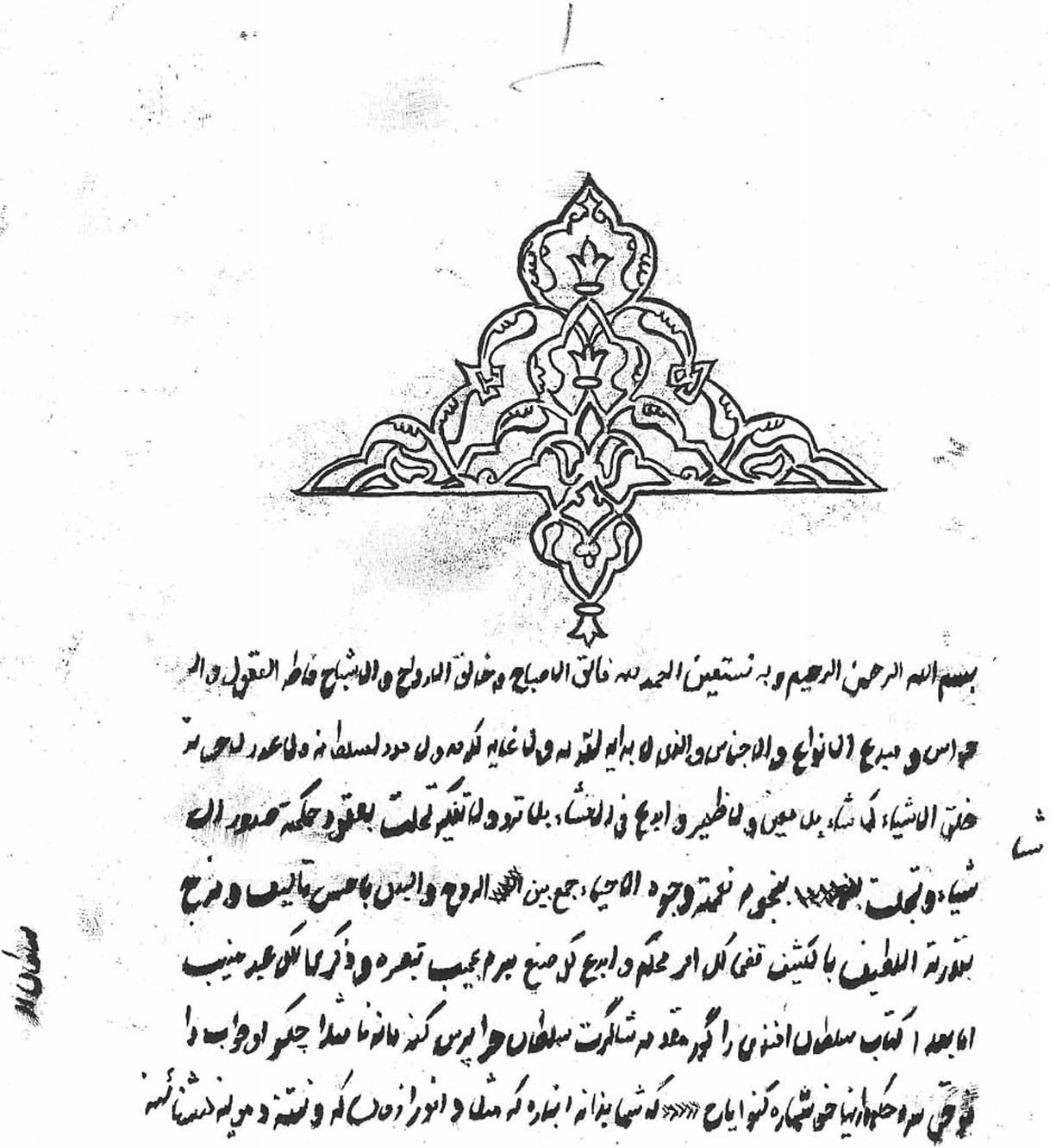
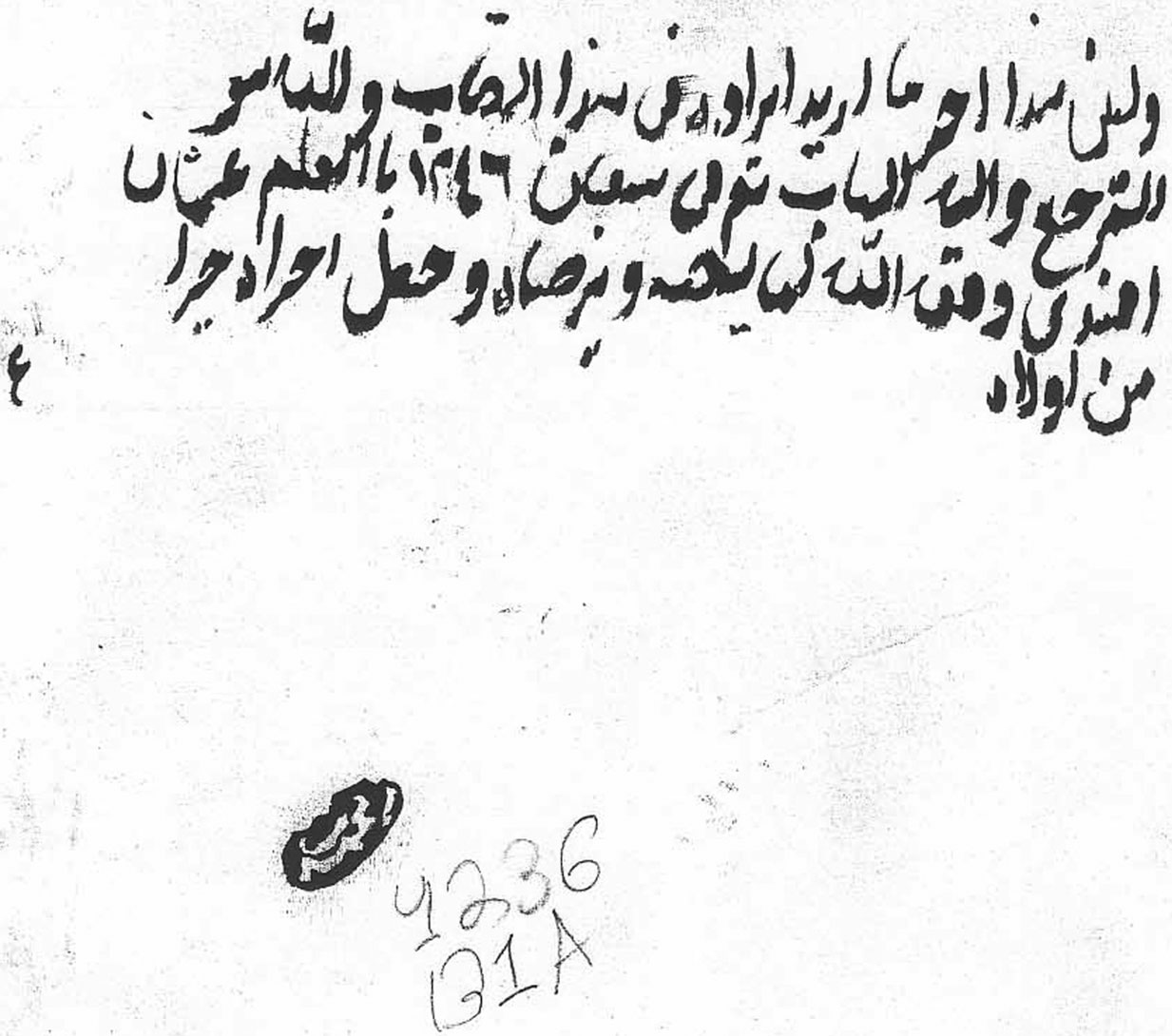
That Alevism must have been an important factor in Kurdistan's history in the Zazaki-speaking area is reflected in the fact that the literary heritage of the Zaza community has preserved valuable, and sometimes unique, evidence of its most formidable opponent's history and doctrine. The nature and weight of Zazaki and related sources deserve a special investigation that refers to the local history of the Alevi sect and which may shed some light on the much-disputed character of that religion and its followers. This article, however, does not pretend to give another account of Zazaki language and literatureFootnote 1, nor does it intend to deal with the problem of Alevi doctrines and their history.Footnote 2 Rather, its main aim is to present a newly-found Zazaki manuscript in which the Alevis and their religion are briefly described. Of course the difficulties of such a manuscript and its contents should not be underestimated; I have been confronted with so many questions and problems that it would probably have been more appropriate to insert a question-mark after the title of this article. Let me, therefore, only describe the manuscript and some of those theological problems in order to give an impression of the specific subjects involved in the study of the present Zazaki text that originated in the Zazaki-speaking area of Eastern Anatolia.
Manuscript
The Alevi treatise described in this article is one of the many unstudied texts in the tradition of Zazaki religious literature. It is described by the author as his ‘Book on ‘Alī, the important incarnation of God, and the doctrines of writer's ancestors, the great Qizilbāshs (i.e. Alevis)’.Footnote 3
The present work is, to my knowledge, known in only one Zazaki manuscript that I located in the possession of Mehmet Yildiz, a Kurdish uneducated bookbinder, in Diyarbekir. The provenance of the manuscript is not entirely clear. Mehmet claimed that the manuscript was previously in the possession of a Dersimi Zaza who migrated to Diyarbekir, and when he died it was sold to Faruk Efendi, a Turkish dealer whose shop in Istanbul was for years the meeting place for collectors. Faruk expected to sell it to Istanbul University, but his death in Diyarbekir brought that project to an end. Finally the manuscript was purchased by the cousin of Faruk from whom Mehmet bought the manuscript.
The manuscript is written in the Arabic script in the Zazaki language by a non-professional scribe, and begins with the basmala. It is written in a type of naskh, and does not have a title page with the name of the work. On the last folio of the first section of the manuscript, the scribe gives the date 1212 ah (1798), and on the last folio another piece of handwriting gives the date 1246 ah (1831). There are some other later, dates in the text. According to its palaeographic features, the scribe and the text both suggest the same dates for the production of the manuscript: end of eighteenth-beginning of nineteenth century. The treatise consists of 32 folios. The size of the folio is 22 × 18.5 cm; the text takes up both sides of the folio, with 14 lines on each side; the size of the text is 16 × 12 cm. The pagination is late and oriental. The paper is of European manufacture (London) with a watermark. The watermark reads “W. Lemoine”. The date of manufacture of the paper is 1784 (watermark). The whole manuscript is written in black ink; there is no shanjarf word. The binding is somewhat later and of brown leather. The author was Isa Beg b. ‘Alī, who held the title Sultan Efendi and was also known as Sultan. Although born in Diyarbekir, he had lived in Istanbul from his early years. We know nothing more about him except that he was the author of an Islamic History (Ta'rīkh), which comprised at least three volumes.Footnote 4
From the characteristics of the manuscript it is important to note several graphic features. Judging from the handwriting and the dates, the copy of this work was made by several scribes. The principles of writing several words are different not only for different scribes, but sometimes they are not even consistent for the same scribe. The letter wāw, for example, is frequently written as lām, for example in the word vate, and ḥā is written instead of the letter jīm, for example in the word cüab. There are many crossed-out words, and letters written above the lines, which were omitted or did not fit in the line. There are also many Turkisms in the text; that is, Turkish words, sentences, phrases, and lines of verse.
As for the place of origin, the main scribe was evidently of Zazaki background and training, even if living in non-Zazaki regions.Footnote 5 There are some mistakes in the Turkish sentences, and sometimes in the Zazaki sentences, within the manuscript and the scribe seems not to have been perfectly educated in Turkish. Possibly the scribe did not care about his Turkish reputation, which could indicate that his priority in producing this manuscript was more commercial than aesthetic, and he wanted to carry out his work as quickly as possible. The fact that this manuscript was written by someone who was self-confessedly not a professional scribe raises the possibility that the Zazaki text of the manuscript may also have been poorly copied. Such an expectation proves fully justified, and a number of corrections need to be made in the Zazaki text.
Arguments
Sultan Efendi's treatise on the Alevism is in two parts (maqāla); the first on the Alevi community and the second on the Alevi doctrines. For convenience these will be designated I and II respectively, the Arabic numeral following being the number of the chapter (bāb). At the beginning of the treatise, the two chapters of the first maqāla are announced (jew and düdiy [sic]), but the text itself is not divided accordingly into numbered chapters. At the head of the second maqāla, two chapters are announced and the text is so divided. But in no extant folio does the numbering of the chapters run smoothly – some folios have an extra title “al-faṣl” and two folios are out of phase. It is reasonable, therefore, to suppose that the chapter numbers, folio numbers, and some headings were added after the text was written.
The first maqāla includes subjects that were written over a period of some two months, and which reflect the principal Alevi areas of Eastern Anatolia in which the author has taken an interest. The first folios deal with the Shiite terms, ghālī and ghulāt, which, generally speaking, were not given a satisfactory explanation in the Islamic period; in this discussion, the author attempts to prove that the terms originally bore the meaning of “Alevi”, as a true follower of ‘Alī [sic]. Some folios deal with the historical background of the Alevis. The author discloses information with regard to the Alevi position in the Ottoman Empire, both at the time of Sultan Selīm III (1789–1807)Footnote 6 and after that. He also presents the origins of the Alevi tribes, Ottoman legal traditions concerning Alevi tributes to the Ottomans, and their economic situation. The following folios are devoted to the Alevi community in Dersim. After a precise analysis of the Alevi tribes and families settled in that region, the author arrives at the conclusion that the Alevi community comprised a considerably larger population than is generally ascribed to it the Ottoman official records. Some members of the Alevi congregation were merchants, since Dersim was a main station on the business road to Europe. They were therefore, men of wealth who commanded a certain position in society. But a considerable number of Alevis must have belonged to the rank and file of the Dersimi population. The final folios of the first part of the manuscript deal with the history of Alevis during the years in which the author lived and worked. The most important section of the final folios of the first section is a discussion of the statistical information regarding the social situation of the Alevis gathered by Sultan Efendi: Alevi sanctuaries, Alevi warriors in the Ottoman army, Alevi traders, and Alevi villages and their population.
The focus of the second chapter of the first maqāla is on ‘Alī and his role within Alevism. At the outset it is necessary to recall that Efendi's work is essentially a history of the Alevi community within the bounds of the Ottoman Empire. Since, for Efendi, the Muslim Ottoman Empire served as a place from which a “deadly message” came (he was referring to the Ḥanaf ī teaching of the Ottoman muftīs), the role of ‘Alī was certainly not already well established there. The all-pervasive influence of Efendi has meant that the existence of a second religious tradition, represented by ‘Alī, has consistently been neglected or marginalised by Ottoman muftīs, both medieval and modern. First of all, he gives a general account of ‘Alī's life including many legendary tales. Efendi names as his source for all this a Turkish document kept in the religious archives of the Alevis. From this account he then provides a Turkish verse translation of a legend in which ‘Alī is the unique God. There are also verse texts which provide descriptions of ‘Alī's life, wars, pious acts, travels, etc. The origins of these stanzaic poems with formalised dialogues go back to the precedence contests of Alevi literature in Turkish.
It is interesting that the author has also translated some parts of the ‘Alī's Nahj al-Bilāgha into Zazaki. On the evidence of the manuscript, Sultan Efendi translated no less than nine sentences of ‘Alī's advice from Arabic into Zazaki, and seven into Turkish.
The first and the second sections of the second maqāla are both dedicated to the Alevi doctrine in general. However, special emphasis is placed on the çirax-sônduran Footnote 7, pîrs, dedes, and seyîdsFootnote 8, uxwet (‘holy brotherhood’)Footnote 9, ‘Alī bayrami (the feast of ‘Alī) and Xizir bayrami (the feast of Khiḍr)Footnote 10, and on Usman Farali, an Alevi priest, and his prominent role in the development and structure of Alevi asceticism and forms of Alevi sainthood. There are passages in the first and the second part of the second maqāla that seem to indicate that the author lent towards pursuing a sectarian religious purpose. This is best illustrated by the almost programmatic Fol. 28.v.:
Relations between Qizilbāshs, YezidisFootnote 11, Shamsis [the followers of sun],Footnote 12 pagans, and Christians have been studied by the Ottoman muftīs. Since they have so much in common in a shared culture, there rose the particular need for Qizilbāsh leaders and priests to draw strict demarcation lines to serve the self-definition of the various groups. The understanding of this process will certainly disturb the incorrect view of Qizilbāsh doctrine as a form of heretical Islam, the origins of which go directly back to Arabia and its Arab community.
The author, thus, defends the credibility of the Alevi religion by comparing it with the other contemporary religions, especially those religions to be found in Kurdistan, and highlights what he considers to be the superior qualities of Alevism. In this manner, it seems that he hopes to demonstrate that the Alevi religion alone has an unimpeachable, notably heterodox, claim on ‘Alī and human religious allegiance. The working out of this apologetic argument is built on the philosophical premise that human reason can discover the existence of the creator God,Footnote 13 and then concludes that mankind was the highest expression of created values. The perfection present in human beings has in some way to be reflective of the qualities of the God who created them. Accordingly, one should be able to discern the true religion, and the true messenger of God, by determining which one of the many claimants to this role credibly described God and his requirements for his creatures.
This process of discernment has two complementary phases. On the positive side, it is necessary to test the doctrines of the several religions against what we may know of our own perfections by the rigorous use of our minds. On the negative side, one should determine that there are no unworthy, imperfect traits in any specific faith-system that may be alleged as factors to motivate a person to profess that particular religion independently of divine endorsement. Needless to say, the Alevi intellectual with whom we are concerned here, attempts to demonstrate that Alevism alone of the contemporary religions – i.e. Sunni Ḥanafism, Christianity, Yezidism, and Shamsism – is worthy of credence from these perspectives.
In their own times, both this author and other thinkers who annexed their religious poems to the treatise defended the Alevi faith against non-Alevis who had earlier written attacks against the Alevis (Qizilbāshs or Ghālīs).Footnote 14 Relying on the achievements of earlier generations, the author here constructs his own treatise in terms of the theodicy that had already been elaborated. But he also adapts the arguments to suit the requirements of his own controversy with the non-Alevis. In the process, for example, differences between non-Alevi and Alevi approaches to religious questions become apparent. Nowhere is this more evident than in the discussion about how one may discern the true religion.
According to the controversial passages of this author, Muslims and Yezidis were very influential groups in “Qizilbāsh regions”. Alevis, who (unlike Yezidis and some other Gnostic groups) wanted to keep ‘Alī and the Alevi doctrines as part of their own religion, were obliged to reinterpret the role of ‘Alī and the other Alevi doctrines in such a way that Ottoman muftīs and Alevi priests formed a real unity. In other words, the author claims that Alevi religious leaders had to come to terms with the official Islamic tradition and heritage through fitting Alevism into an Islamic context. This idea is expressed in more detail in Fol. 26 r., where he issues the following warning in his farewell discourse to his flock:
If Qizilbāsh's religion preserved a great many Islamic traditions in its literature, this is not a proof of a substantial Islamic part in the formation of the Qizilbāsh doctrine, but only of a Qizilbāsh urge to adapt and assimilate Islamic traditions to its own ideological concepts. Beware, therefore, of the Ottomans and Yezidis and do not be friends of them, lest thou be responsible with those whose hands are full of the blood of the ‘Alī.
The treatise contains also a considerable amount of other polemical material. For instance, the author attacks a number of Yezidi interpretations by demonstrating Yezidi corruption of the Islamic texts or the Satanism.Footnote 15 He inveighs frequently against the allegorical mode of Muslim interpreters. Certain basic questions in the Sunni-Shiite controversy, chief among which is the identity of the “imāmat”, are frequently raised.Footnote 16
There are some phrases where it seems that the author has been strongly influenced by Islamic philosophy. He frequently alludes to philosophical matters as an aid to exegesis on the one hand and in an attempt to popularise such studies on the other. He was no original philosopher however, and his phrases are adaptations of those of his predecessors.
In summary, it can be stated that the essential and central aim of the author (described allusively and tendentiously in II. 21r.-32r.) as an Alevi intellectual is to provide “an answer to the critics”. Hence, he advises his readers to study Alevi original doctrines and to conceal their “true religion” from the Sunni Muslims. He argues that ‘Alī always casts down the arrogant and impious; that ‘Alī had ordained the defeat of Ottomans, and had revealed his intention to do so in the Alevi prayers that predicted the outcome of the impending war; and that the Alevi community would exist until the end of time. Again he gives a polemical twist to his words by adding that ‘Alī, “the most complete sign of God”, would put the apostates to shame:
And he [i.e. ‘Alī] will restore to the sanctuaries the treasures which Ottoman muftī, the wicked, had taken from them. He will purify the kingdom of the Ottomans from the stink of the sacrifices of Ḥanafism, and he will overthrew their tables and will destroy their mosques, he will banish their erroneous doctrines, will destroy their houses of assembly, and will remove their treasures to the treasures of the Qizilbāsh community.Footnote 17
In the present Zazaki treatise, along with the Zazaki and Turkish poems that it inspired, the apocalyptic sections are an important feature and they occupy a prominent space in the text. The prominence of the apocalyptic genre, however, is not surprising given the fact that within Shiite heterodox communities apocalypse was an important literary reaction to the challenge of Sunni Islam.Footnote 18 In these sections the accent is on the ex eventu prophecy of the conditions of life for Alevis under the Ottoman Empire until the projected coming of the Mahdī, who is said to be the “manifestation of ‘Alī”. The author's discussion of the doctrine of the Incarnation (“naskh”) is a brief single section in the treatise. He does not attempt to prove the doctrine here. Rather, he assumes that it is the evident teaching of the Alevi scripture that in ‘Alī God has manifested himself to His creatures in a human form. Sultan Efendi devotes some sentences to ridiculing those who believe less noble things about ‘Alī as a God, but who, at the same time, declare that there is no difference between ‘Alī and God. He also explains away differences among Alevis themselves over the various manifestations of the divine Incarnation or “those who differ with us”.Footnote 19
Finally, the author protests that, since the times are evil, Alevis have to speak in symbols. Alevism is different from “Ottoman religion”, and Alevis must be able to adopt different policies with different groups, even though these may well cause them many severe problems. It is clear that the structure of the author's symbolism owes much to the usages that were cultivated in the Shiite school system. One can trace the development of this symbolism to the taqiyya, “action of covering”, that denotes dispensing with the ordinances of religion in cases of constraint and when there is a possibility of harm, in which the doctrines regarding ‘Alī would have been transmitted to the next generation.Footnote 20 According to the author, belief is expressed by the “symbol of heart” and the “symbol of tongue”. Observing the first symbol is always necessary. But if someone is certain that an injury will befall him, his property or one of his co-religionists, then he is released from the obligation to fight for the faith with the tongue.
Authorship
It is well-known that there is a large amount of forgery in the religious writings of Kurdistan, and that even authentic works by Kurdish sheikhs have attracted interpolations and additions by other hands. Although the treatise presently under scrutiny is a very important text, it should still be classified as a specimen of this kind of literature rather than as an authentic Alevi work.Footnote 21 The key to its oddity, in any case, seems to lie in the fact that it was both an Alevi and a non-Alevi answer to the Ottomans. Since there is a clear distinction between two sections of the treatise, we only may be able to categorise the first section as an Alevi authentic work. But did Sultan Efendi write the whole of the text, both the Alevi and non-Alevi sections?
There are two accounts of how Efendi came to write it. The first unambiguously envisages his contribution as consisting of the first maqāla alone, while the second apparently regards it as consisting of both the first and the second maqālas. In fact, it is clear from the contents of the two parts that they cannot have originated together, and, while both are ascribed to Sultan Efendi as separate works, the attribution to him of the second part must be rejected.
From the manuscript itself, it is plain that the first section was written by a professional Alevi intellectual with a considerable gift for presenting his subject to laymen, and there is no reason to believe that the intellectual in question was not Sultan Efendi. His style is certainly an Alevi style including Alevi terms and items. Much of the work is based on other Alevi writings; the first maqāla could in fact be characterised as a selection of passages from Zazaki oral literature. And what it has to say about Alevi scripture and society is almost always precisely what one would expect to find. The ideal to which Alevis should seek to conform is entirely Alevi in conception and illustrated with reference to Alevi figures and subjects alone, no non-Alevi discussions being invoked in this part. The first maqāla, in the other words, is a treatise written in the Alevi style and spirit on the basis of Alevi works by someone who can be identified as the author of this work.
In contrast to the conciseness of the first maqāla, the discussion of the second maqāla is diffuse and aphoristic. Here much use is made of Shiite theology and so it is not exactly Alevi. In fact, it seems to be a work written for a different set of readers in a somewhat different style and spirit. On turning to the second maqāla, one is struck by the fact that author and addressee alike are suddenly referred to in a manner different to that of first maqāla. There is no mention of Sultan Efendi. One would have expected at least some expression of good wishes for his success at the end of the treatise, on a par with those that come at the end of the first maqāla; but the second simply peters out with a defective poem. It is, thus, clear that the first and the second maqālas cannot have been conceived as parts of the same work. In principle, of course, both could still be authentic works by Sultan Efendi or another Alevi intellectual, but this possibility can be ruled out on other grounds.
The stylistic contrast between the two maqālas of the treatise is glaring. Where the first is a very simple text including legends, anecdotes, aphorisms and poetry loosely strung together in no particular order, the second is a well-organised text including many theological problems and some sophisticated discussions. For another thing, the discussions and poems of the second maqāla are almost always not the Alevi fundamental points, such as the apocalyptic notes regarding the Mahdī who is absent in the Alevi doctrines, and they display no interest in the Alevi community. In fact, the author of the second part voices a wide variety of opinions that are completely at odds with those of Sultan Efendi. He does, it is true, share some views with him, such as in relation to Incarnation, but it is expressive of an altogether different ethos. It fails to reflect the preoccupations of Alevis because its author, it would seem, has preoccupations of his own, and these preoccupations are sometimes as thoroughly non-Alevi as those of Efendi are Alevi.
What then can we say about the author? He was certainly a Shiite, more precisely a Shiite who was under influence of imāmī and Ghālī sects. The first part of the work has come to be attributed to Sultan Efendi, as an Alevi intellectual, but there is nothing to give clues to the authorship of the second part.
Conclusion
Our Zazaki Alevi treatise, in any case, turns out to be a source for Alevi sociological and theological history, and one may conclude by asking whether this discovery warrants any reconsideration of previous, often harsh, judgments on the subject. As has been seen, much depends on whether or not one accepts the writer's claims and, especially, the date of the treatise, which is the earliest Zazaki text that we have. If one accepts this – and to me there seems to be no valid reason why one should reject it – then the treatise represents a source of great importance for early events of Alevi religion and community. But, even if the writer's arguments are not accepted at face value, the treatise is no late compilation, for it is found in a manuscript that has been dated to the eighteenth–nineteenth century, and so it should be placed at least on a par with the panegyric we have for other Zazaki texts.
Needless to say, by no means all the issues raised by this new text have been discussed here, but it is hoped that enough has been said to demonstrate its considerable interest and (I believe) importance. This would seem to be the best that one can do in the way of guesswork. Going beyond guesswork would be preferable of course, but it is only in connection with the author's life that the sources afford us a glimpse of a real personality at work, and they only show us enough to make us realise how little information was transmitted.
Appendix: A Selection of Zazaki Words
The following section contains examples of Zazaki words where the written style and the language of the present text are used in somewhat different ways. There are glossary entries for each of the Zazaki words listed in Latin alphabet, though not in accordance with the order in which they occur in Arabic script of the manuscript. Because the list is concerned with actual written usage, the words are given in both Latin transliteration and Arabic script. The list only includes those Zazaki words that the author used in a different sense or pronunciation in the manuscript.
In order to achieve a uniform style and standard the Bedir Khan system is used to transliterate the Zazaki words included in this glossary.Footnote 22
aka/ak
 1. egg, the hard-shelled reproductive body produced by a bird and not exclusively by the common domestic chicken, 2. person, sort
aqül
wiseasîn
ironaskar
1. soldier, 2. troopbeqî/beqîçe
gardenbirader/bira
brotherbôl/bûl
very, very muchböq-
1. to sleep, 2. to neglectcami‘/came
mosquecüab/cüap
answer, replyçarûş
bazaarçene
why?çiçî
what, used as an interrogative expressing inquiry about the identity, nature, or value of an object or matterçîyendo
somewhatdarûk/dar
treediz/doz
thiefdîk/dîyek
cockdôst
friend, one that is of the same nation, group, or communitydüjmin
enemy, one seeking to injure, overthrow, or confound an opponentecemî
Persianewrû
1. now, 2. todayezin
like, one that is similarfa'ide
importancefeqir
little, small in importance or interestgül
1. flower, 2. religious speech of ‘Alīhaz
love, strong affection for another arising out of kinship or personal tieshekîm
philosopher, wiseher/hera
all, completeheywan
humanhir-
to buyita/ite
herekeynî
girlkô/kûc
where?kêy/kêya
1. house, 2. the building or chamber where an Alevi assembly meetskir
1. deaf, 2. deaf-mutekô/kû
mountainkötik
doglacî
boymardim
man, someonemasîk
fishmişt
morning, the time from sunrise to noonmûs-
to learnmirtal/mirtar
shield, a broad piece of defensive armour carried on the armnasîn
knowledgenôbinô
possibilitynônibinô
impossibilityniwazîl
1. illness, 2. stupidity, a stupid idea or actpawin-
to wait, to look forward expectantlypî/pîy
fatherpîl
strong, having moral or intellectual powerrôçîn
light, something that makes vision possibleserd
darknessse'at
timesira
where?stor
horseşarab
wineşew
1. night, 2. darknessşimşêr
1. sword, 2. pentine/tinya
unique, being the only onetize
newvazir
yesterdayver
before, sooner or quicker thanwaya
sisterwaz-
to like, to wantwac
there, in or at that placexoca
master, having chief authorityxebir/xabir
knowledgexêr
goodnessyazmîş
handwritingza'if
poor, inferior in quality or valuezing
rich, having abundant possessions and especially material wealthzir
gold
 1. egg, the hard-shelled reproductive body produced by a bird and not exclusively by the common domestic chicken, 2. person, sort
 wise
 iron
 1. soldier, 2. troop
 garden
 brother
 very, very much
 1. to sleep, 2. to neglect
 mosque
 answer, reply
 bazaar
 why?
 what, used as an interrogative expressing inquiry about the identity, nature, or value of an object or matter
 somewhat
 tree
 thief
 cock
 friend, one that is of the same nation, group, or community
 enemy, one seeking to injure, overthrow, or confound an opponent
 Persian
 1. now, 2. today
 like, one that is similar
 importance
 little, small in importance or interest
 1. flower, 2. religious speech of ‘Alī
 love, strong affection for another arising out of kinship or personal ties
 philosopher, wise
 all, complete
 human
 to buy
 here
 girl
 where?
 1. house, 2. the building or chamber where an Alevi assembly meets
 1. deaf, 2. deaf-mute
 mountain
 dog
 boy
 man, someone
 fish
 morning, the time from sunrise to noon
 to learn
 shield, a broad piece of defensive armour carried on the arm
 knowledge
 possibility
 impossibility
 1. illness, 2. stupidity, a stupid idea or act
 to wait, to look forward expectantly
 father
 strong, having moral or intellectual power
 light, something that makes vision possible
 darkness
 time
 where?
 horse
 wine
 1. night, 2. darkness
 1. sword, 2. pen
 unique, being the only one
 new
 yesterday
 before, sooner or quicker than
 sister
 to like, to want
 there, in or at that place
 master, having chief authority
 knowledge
 goodness
 handwriting
 poor, inferior in quality or value
 rich, having abundant possessions and especially material wealth
 gold
Fol. 1r.

Fol. 32v.