Introduction
This study explores the statistical associations between social status, psycho-social resources (social capital, social network, and sense of control), and individual health, and compares them with associations between health and material resources (income, education, occupation), within the theoretical framework of the production function of health developed by Evans et al. (Reference Evans, Barer and Marmor1994).
The production function of health approach distinguishes three broad categories of determinants of health: genetic, physical environment, and social environment. Within the latter category of social environment, material and psycho-social effects can be distinguished (Stoddart, Reference Stoddart1995). The former includes the material effects of housing, health care, nutrition, and work environment on the health of individuals; the latter includes the impact on health of the level and quality of social support (network an individual can mobilize), social capital (trust in the community, civic involvement), and the sense of control individuals have on their life at home or at work (measured directly or as the perceived position of the individual in her/his reference group). Both material and psycho-social resources influence health directly (so-called biological pathway) or indirectly, through their impact on health-related behaviours (Evans et al., 1994). For example, it has been demonstrated that a lower sense of control increases stress and, as a result, the risk of coronary heart disease (Marmot, Reference Marmot2004) or that community social capital is a potentially powerful inhibitor of smoking behaviour (Brown et al., Reference Brown, Scheffler, Seo and Reed2006). In this exploratory study we do not attempt to separate these pathways and we are content with comparing the impact of material and psycho-social resources on health. As detailed below, this first step will allow us to focus our analyses on the correlation between health status and a restricted set of psycho-social resources, future research being centered on testing various causal pathways.
Whereas material resources were seen as the main determinant of individual health and its unequal distribution across social strata, two observed facts have cast doubt on this conception (Stoddart, 1995). First, social inequalities in health still exist in welfare states, where access to health care is independent from ability to pay. Second, social inequalities in health follow a gradient rather than a two-tier divide and material resources cannot fully explain why upper-middle-class individuals are in better health than lower-middle-class ones, since most live in proper houses and are not subject to detrimental working conditions. Even though this latter point is disputed in Pearce and Davey Smith (Reference Pearce and Davey Smith2003), based on the idea that early childhood living conditions have a lasting impact on adult health and that current lower-middle-class individuals likely spent their childhood in working-class families, the idea that material determinants may not explain all social health inequalities, and, as a result, that other important determinants of unequal health distribution across social strata exist, is now largely admitted (Marmot and Wilkinson, Reference Marmot and Wilkinson2005; Berkman and Kawachi, Reference Berkman and Kawachi2000). One avenue of research is therefore to test for psycho-social resources as candidates in explaining social health inequalities, that is to test the relationship between psycho-social factors and health, controlling for other determinants of health, and then to measure social inequalities in access to these psycho-social resources. We follow a well-established methodology in this literature on the association between utilization of psycho-social resources and health and social health inequalities (see e.g. Lavis and Stoddart, Reference Lavis, Stoddard and Osberg2003): using a general population survey, we measure the correlation between perceived access to psycho-social resources and health at the individual level, controlling for gender, age, income, education, and socio-economic status (SES, in French, CSP, standing for catégorie socio-professionnelle). In this framework, age and gender account for biological determinants of health, and occupation, income, and education account for ‘material’ factors of health, even though it could be argued that education incorporates some psycho-social effects as well. Behaviours per se (smoking, drinking, diet, and exercise) are not entered as controls in the regression, since psycho-social factors are conceived of as determinants of health-related behaviours (poorer access to social capital could lead to smoking or poor diet). As mentioned above, this first analysis is concerned with the relative magnitudes in the association between health and various measures of material and psycho-social resources. The causal pathways, including the effect of psycho-social resources on health-related behaviours, will be tested in a further step.
Therefore, our research question is: Does individual access to psycho-social resources (support, social capital, sense of control) explain an important part of the variation in health across individuals and socio-economic statuses?
We add to the literature in the following ways: To the best of our knowledge, this is the first time a study is conducted on this issue based on a general population survey representative of the French population. Lavis and Stoddart (2003), using data from the World Values Survey including France show that the impact of psycho-social factors on health varies with national context. Moreover, the World Values Survey (2007) indicates that the average level of access to psycho-social resources (measured as generalized trust and sense of control over one’s life in the 1999–2004 wave) is much lower in France (22% trust others and the level of sense of control over life is at 6.5 on a 10-degree scale) than in Great Britain (30% and 7.2), the US (36% and 8.0), or Sweden (66% and 7.4). Last, Mackenbach et al. (Reference Mackenbach1997) have shown that France has the highest level of social inequalities in mortality among 11 European countries.
Second, we use a unique dataset, representative of the general population living in France, comprising a descriptor of individual self-perceived health as well as a complete set of measures of psycho-social factors at the individual level. Besides civic engagement, trust, and social support we add measures of the sense of control and the sense the individual has of his/her position in the social hierarchy. We are therefore in a position to assess the respective impacts of access to these different types of psycho-social resources, whereas most previous studies focused on one (social support, social capital, or position in the social hierarchy) only.
The study is organised as follows: we start with a brief review of previous studies. Section 3 describes our data and methods, Section 4 provides the results and Section 5 discusses and concludes.
Previous literature
A recent literature review of the link between social capital (one measure of psycho-social resources) and health (Islam et al., Reference Islam, Merlo, Kawachi, Lindstrom and Gerdtham2006) identifies two main approaches: the first one posits that what matters for health are the level and quality of psycho-social resources (e.g. civic engagement, trust, public services) available at the aggregate level; in such a conceptual framework social inequalities in health stem from the uneven distribution of socio-economic statuses across geographic areas (Kawachi and Berkman, Reference Kawachi and Berkman2003, Veenstra et al., Reference Veenstra, Luginaah, Wakefield, Birch, Eyles and Elliott2005). The alternative view, to which this study belongs, is interested in the compositional effect and measures access to psycho-social resources at the individual level rather than the availability of these resources at the aggregate level.Footnote 1
Islam et al. (2006) identified nine published articles on the link between individual access to social capital and individual health. After this literature review was published, Dunn et al. (2006) published a study analyzing self-assessed position in the reference group and self-assessed health based on individual-level Canadian data. We also identified Lavis and Stoddart (2003), not mentioned in Islam et al. (2006), and two studies linking social support and job-related demand to health in France (Paterniti et al. Reference Paterniti, Niedhammer, Lang and Consoli2002, Melchior et al. Reference Melchior, Niedhammer, Berkman and Goldberg2003, both based on a longitudinal survey of employees of the state-owned power company, EDF). We present briefly the main findings of these 13 studies (studies are summarized in Table 1 according to country of observation, the variables used to measure health, and the type of psycho-social resources entered in the model).
Previous studies – main characteristics

First, psycho-social resources are measured and defined in a variety of ways across these studies, reflecting the lack of consensus among social scientists (even among economists) on what social capital really is (Scheffler, this issue). Second, all studies show at least one significant positive relationship between access to psycho-social resources and current health. However, there is no general agreement about which type of psycho-social resource (social support, social capital, or sense of control and perceived position in the social hierarchy) is more strongly associated with health. Only one study (Rose, Reference Rose2000) finds a negative impact of access to social support on health: searching information from friends increases the likelihood of being in poor health in Russia, whereas trust and sense of control have the expected positive impact on health. Interestingly, this is also the only study attempting to measure all three types of psycho-social resources. Lavis and Stoddart (2003) compare trust and civic engagement and find the former dimension of social capital to be strongly correlated with health, but not the latter. They also show that France is one of the seven countries included in their study where the correlation is the weakest. Causal relationship is suggested in three longitudinal studies. The risk of coronary heart disease remains significantly higher in a ten-year follow-up among individuals with low participation in Sweden (Sundquist et al., Reference Sundquist, Lindström, Malmström, Johansson and Sundquist2004). In France, depressive symptoms and the probability of being on sick leave are higher in a three-year follow up among employees with perceived high job demands, low social support, and, for male workers only, low sense of control at work, controlling for occupation and personality traits (Paterniti et al. 2002, Melchior et al. 2003). One study (Liukkonen et al., Reference Liukkonen, Virtanen, Kivimaki, Pentti and Vahtera2004) cannot find any causal impact of perceived security of employment and the level of expected support from co-workers on self-assessed health and psychological distress in a four-year follow-up study of public employees in Finland.
Data and method
Data
The analysis is based on a population survey, representative of the French population, the Health, Health Care and Insurance Survey (ESPS: ‘Enquête sur la santé et la protection sociale’), coordinated by the Institute for Research and Information in Health Economics (IRDES). We use the 2004 wave, which included a set of questions on psycho-social resources.
The survey sample, comprised of 8,141 households, is based on a random draw from administrative files of the main sickness funds to which over 90% of the population living in France belong (Allonier et al., Reference Allison2006). Individuals drawn at random from the administrative files are used to identify households. The socio-economic questionnaire is answered by one key informant in each household (aged at least 18), who needs not be the individual selected at random and self-selects voluntarily. Questions on health status are collected through a self-administered questionnaire completed individually by each household member. Questions on psycho-social resources are answered by the key informant for him or herself only. All key informants were asked questions on civic engagement, trust, and social support, but only employed key informants were asked questions on sense of control at work and comparisons within the reference group, since these dimensions make sense for this population only.
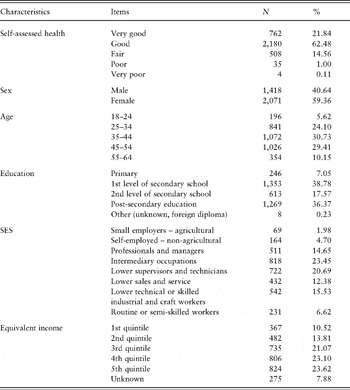
Since our main objective is to assess the respective roles of a variety of psycho-social resources on health status, we restrict our analysis to the population of employed individuals aged 18 to 64, who reported their health status: 3,489 individuals (1,418 males and 2,071 females).Footnote 2 This sample is representative of the population of employed key informants, aged 18 to 64, and not of the general population living in France. Table 2 below shows the main characteristics of the sample and it appears that women are over-represented as well as individuals from higher socio-economic status. These biases are controlled for in our analyses and there is no strong reason to suspect that unobserved response biases could affect the associations between psycho-social resources and health.
Descriptive statistics: socio-demographic characteristics of the sample

Health and socio-economic variables
We use the question on self-assessed health, the first one of three standardized questions suggested by the WHO European Office to measure individual health in surveys, to construct a binary health descriptor opposing people reporting a ‘very good’ or ‘good’ general health status to people reporting a ‘fair’, ‘bad’, or ‘very bad’ general health status. We use the dichotomous health measure as our dependent variable in a series of logistic regressions with socio-economic factors and psycho-social resources as the independent factors.
Income is measured as household income (from all sources of income), divided by the OECD equivalence scale (1 for the first household member, 0.5 for the second one, and 0.3 for the following ones). We create a series of categorical variables based on the income quintile of the distribution of income in the French population (rather than the studied population, as a result we don’t necessarily have 20% of the study population in each quintile), as well as one category for those who did not provide income information. Educational level is measured as: primary (age 11 in France), first level of secondary school (age 15), second level of secondary school (baccalaureate, age 18), some post-secondary education, with a supplementary category for foreign diploma and missing value. The French socio-economic status classification is comparable to the European Socio-economic Categories (ESeC) rather than to the International Labour Organization International Standardized Classification of Occupations (ISCO) because it is a measure of status in a social hierarchy as well as of occupation per se (see INSEE, 20050).Footnote 3 In ESeC equivalents, we define SES as follows: Small employers–agricultural (ESeC category ‘5’); self-employed – non-agricultural (ESeC categories ‘1’ and ‘4’); professionals, and managers (used as the reference, ESeC category ‘2’, includes secondary and post-secondary teachers, but not primary school teachers); intermediary occupations (ESeC category ‘3’); lower supervisors and technicians (ESeC ‘6’, French equivalent ‘employés administratifs’ in our survey); lower sales and service (ESeC ‘7’, French equivalent ‘employés de commerce’); lower technical or skilled industrial and craft workers (ESeC, French equivalent ‘Ouvriers qualifiés’); routine or semi-skilled workers (ESeC ‘9’, French equivalent ‘Ouvriers non qualifiés’). Age is entered as a continuous variable.Footnote 4
Psycho-social resources measures
Our main objective was to assess the respective roles of a variety of psycho-social resources in the variations of health across individuals. Most studies pick one dimension (social capital, social support, or sense of control) and measure its association with health, but we wanted to compare all these three dimensions with each other in their effect on health. The objective was therefore to capture as many psycho-social resources as possible, subject to the constraint that the survey already includes many questions and cannot exceed a reasonable length. As a result, we chose to assess our three dimensions (social capital, social support, and position in the social order) with two or three questions each (hence six to nine questions added to the survey overall). We present the relevant section of the questionnaire in Appendix 1.
To help us in this endeavour we invited a group of international experts in the field to a series of workshops organized around three issues: how to ask about access to social capital and social support, and about sense of control over one’s life?
Social capital is often measured at the individual level through civic engagement (participation to collective endeavours) and/or level of trust in the community, following Putnam’s (Reference Putnam1993) definition that social capital ‘refers to features of social organization, such as trust, norms and networks that can improve the efficiency of society by facilitating coordinated actions’. We asked two questions on civic engagement and one on trust.
For civic engagement, we use one question on participation (including political groups) plus one to distinguish participation as member and participation as person in charge to measure the degree of involvement of the individual in collective activities. The rationale for including political groups or unions is that in France participation in religious associations is not as common as in North America. These are standard questions in questionnaires on social capital, validated in terms of reliability and internal consistency (Blaxter et al., Reference Blaxter, Poland and Curran2001; Putnam, Reference Putnam2001).
Trust is measured in surveys through a mind experiment (would you trust your neighbours to look after your children?) or as a broad assessment of how trustworthy are others in general (Scheffler, this issue).Footnote 3 We opted for a mind experiment that is not restricted to parents of young children and involves institutions as well as other individuals (La Porta et al., Reference La Porta, Lopez-de-Silanes and Shleifer1997 and Rothstein, Reference Rothstein2000 show that trust in institutions is an important component of psycho-social resources): what to do in case of losing a wallet? Moreover we wanted to measure the level of reliance on institutions as they exist, where the individual thinks they are relevant (be it where s/he works or lives) and not only in the residence area. There is no validation for this variable so far.
For social and emotional support, we used a series of standard questions, adapted from the GAZEL survey in France (Melchior et al., 2003) and the GLOBE study in the Netherlands. A first question investigates the number of contacts and a second one asks about emotional support and the reasons for the lack of it (Berkman and Glass, 2000).
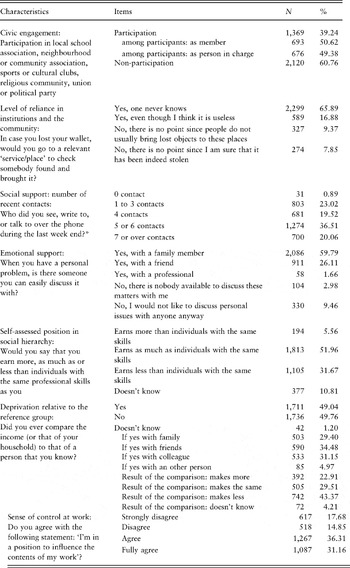
Sense of control is less often measured in general population surveys. We wanted to measure the sense the individual has of his/her position in the social hierarchy, and whether he/she can control his/her life. The first dimension can be measured as relative deprivation, compared to an objective group of reference (similar individuals). The underlying reasoning here is that feelings of under-achievement can be the individual pathway through which income or social inequalities affect health and explain why in more unequal societies individuals at the lower end of social hierarchy end up in poorer health, even if they are above the absolute material poverty threshold. In the literature, such groups are comprised of people of the same age and educational level (Eibner and Evans, Reference Eibner and Evans2005), and we summarized these characteristics by asking about people with the same skills; therefore, we measure here a sense of being treated fairly or of discrepancies between effort and reward and we expect that perceived discrepancies signal a sense that the individual does not control his/her life. We also wanted to measure the impact of confrontations with social hierarchies on health, as stated in Marmot and Wilkinson, (2005) (see also Ellaway et al., Reference Ellaway, McKay, Macintyre, Kearns and Hiscock2004, for social comparisons of homes and psycho-social health): a perception of being dominated rather than dominant can diminish the sense of control and autonomy and be detrimental for health. Therefore we asked respondents whether they compared their income with other people (self-selected group of reference) and what was the outcome of the comparison – the reliability and internal consistency of the question was not tested. A third question adapted from the GAZEL survey (Melchior et al., 2003) asked about the sense of control at work. Descriptive statistics on these measures are presented in Table 3.
Descriptive statistics: psycho-social determinants of health

Note: (*) Interviewers suggested possible contacts from a list including parents, parents in law, children, siblings, grand-parents, other relatives, friends, neighbours, work-mates, others, and respondents answered yes or no.
Analytic strategy
The unique character of this study is our ability to use all different types of psycho-social resources, including sense of control and self-assessed position in social hierarchy, simultaneously with explaining self-assessed health as well as studying the relation between socio-economic status (education, income, and education) and psycho-social resources.
First, we checked that the different types of psycho-social resources (social support, social capital, and sense of control) are not linearly correlated and that it is feasible to enter all as independent variables (results not presented here).
Second, we ran a baseline logit analysis with health as the dependent variable and entered age, sex, income, education, and SES only. We use the baseline to assess the share of inequalities in health that is explained by biological and material factors. All psycho-social resources were then entered simultaneously in a second model to analyze the association ceteris paribus between self-assessed health and each psycho-social resource. This latter analysis was also replicated separately for men and women to test the hypothesis of differential influence of psycho-social resources according to gender.
This methodology does not attempt to prove a causal relationship between psycho-social resources and health. Our measures of association can indicate a true causal impact, but also if individuals build their own psycho-social resources as much as these are given to them (Bolin et al., 2003) result from reciprocal causality (poor health limits access to resources) and/or unobserved heterogeneity (the same unobserved skills or preferences explain a higher level of resources and of health capital). The main goal of our study is exploratory: is there any association between health and access to psycho-social resources? Second, among indicators of psycho-social resources, which ones are most significantly associated with health?
To test further that psycho-social resources can explain a substantial part of social health inequalities, we analyze the socio-economic determinants of the number of contacts (OLS regression) and of the probability of lacking each of the other psycho-social resources (no collective participation, no community trust, no emotional support, the feeling to make lessFootnote * than individuals with the same skills, the feeling to make less than his reference group, no sense of control at work).
Findings
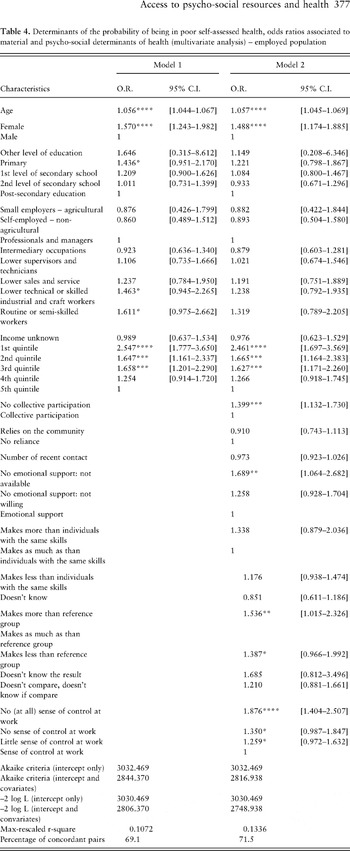
The findings of the baseline analysis of the material and biological determinants of health (model 1, Table 4) show that the probability of reporting poor or bad health increases with age and is higher for females; all socio-economic variables have a significant effect of expected sign. The only socio-economic variable that is significant at the 5% level is income, less well-off individuals being more likely to be in the poorer health category. Some educational and SES categories are significant at the 10% level: individuals with primary educational level report poorer health status compared to individuals with post-secondary education level and skilled and unskilled blue-collar workers compared to professionals, managers, and intellectual professions.
Determinants of the probability of being in poor self-assessed health, odds ratios associated to material and psycho-social determinants of health (multivariate analysis) – employed population

Notes: Significance levels: *10%, ** 5%, *** 1%, ****0.1%.
The second column of Table 4 gives the results of the second analysis where all psycho-social resources are entered simultaneously in the regression of self-assessed health, controlling for age, sex, SES, education level, and household income among employed individuals. Compared to our baseline analysis where only socio-economic determinants (SES, education, and income) are entered, only income remains significant once psycho-social resources are introduced. Introducing psycho-social resources into the model substantially improves the fit: the likelihood ratio test confirms that the two models are significantly different at 0.001 % and the max-rescaled R-square increases by 24.6%. A test of multicollinearity in the set of independent variables has been performed (tolerance and variance inflation factor, see Allison, 1999) and concludes that the correlation structure is not such that it may affect the robustness of our findings, despite the clear correlation across variables describing access to material and psycho-social resources.
Within psycho-social resources, the strongest and most precisely estimated effect is that of the sense of control on work: individuals who strongly disagree that they have autonomy in their work have a much higher relative risk of being in the poorer health category (with an odds ratio equal to 1.9 and significantly different from 0 at the 0.1% level). This effect can partly explain the absence of any significant effect of SES.
Second to sense of control is social support: lacking emotional support is strongly associated with the probability of being in the poorer health category (with an odds ratio greater than 1.5 but at the 5% level only). The lack of civic engagement is also associated with poorer health category with an odds ratio of 1.4 (at the 0.1% level). Findings for the influence of the sense of one’s position in social hierarchy are less intuitive: making more or less than one’s reference group are both associated with a higher probability of being in the poorer health category (with odds ratios around 1.5, but at the 10% level of significance only for making less). On the contrary, perceived relative deprivation (making less than individuals with the same skills) and reliance on the community (believing that it is useful to go to the lost and found for a lost wallet) don’t have any significant association with self-assessed health.
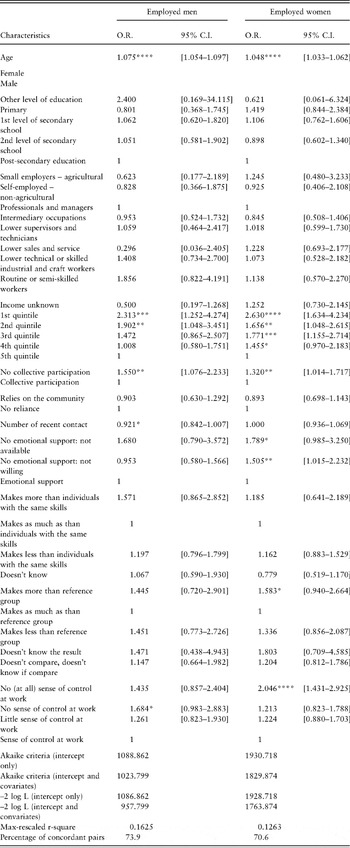
Conducting separate analyses for both sexes we found associations of the same sign and magnitude (Table 5). The only difference is that social support does not work identically for men and women: we are able to measure an influence of the number of contacts on health for men (more contacts decrease the probability of declaring poorer health) but emotional support influences health for women only.
Determinants of the probability of being in poor self-assessed health, odds ratios associated to material and psycho-social determinants of health (multivariate analysis) – Employed population – men and women separately

Notes: Significance levels: *10%, ** 5%, *** 1%, ****0.1%.
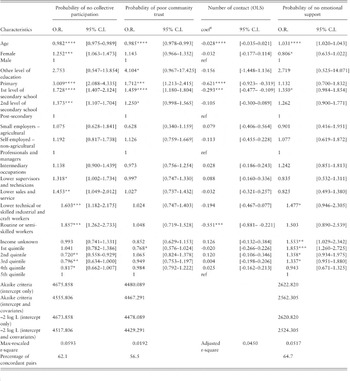
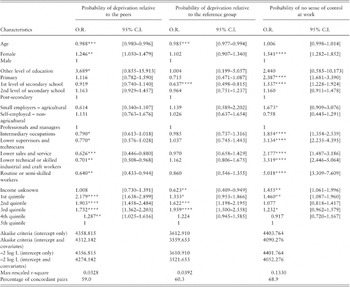
The analysis of the determinants of poor access to psycho-social resources (Tables 6a and 6b) confirms that individuals with higher levels of education, SES or income also benefit on average from access to significantly better psycho-social resources: They participate significantly more often, rely significantly more on their community, have more emotional support and have a significantly better sense of control at work. The main exceptions are comparisons with peers or within the reference group for which intermediary groups (2nd level of secondary school or quintiles 3 and 4 of income) are at a disadvantage compared to extreme groups.
Determinants of access to psycho-social resources (employed population, 18–64)

Notes: Significance levels: *10%, ** 5%, *** 1%, ****0.1%.
Determinants of access to psycho-social resources (employed population, 18–64)

Notes: Significance levels: *10%, ** 5%, *** 1%, ****0.1%.
Discussion
Using a unique set of measures of psycho-social factors at the individual level this study provides empirical evidence of the link between the subjective perception of some psycho-social resources and health in France, controlling for other, more material, factors of health, such as income, age, gender, education, and SES. Since we also show that access to these resources is uneven across the population and strongly influenced by social status, those factors can partly explain the high level of social health inequalities in France.
Our results are consistent with several previous studies. As suggested by Putnam (1993), social capital, assessed by civic engagement, seems to have a protective effect on health, even though community trust is not associated with self-assessed health. Consistent with the findings of Berkman and Glass (Reference Berkman, Glass, Berkman and Kawachi2000), health status is positively associated with access to emotional support, rather than with the size of social networks. We find a weak association between self-assessed health and relative deprivation, whatever the reference group considered (peers, family, or friends) contrary to the conclusions of Dunn et al. (Reference Dunn, Veenstra and Ross2006), Deaton (Reference Deaton2001), Eibner and Evans (2005), and Elstad et al. (Reference Elstad, Dahl and Hofoss2006), but similar to Miller and Paxson (Reference Miller and Paxson2006). Finally, our main finding is that, controlling for all other resources, the lack of sense of control at work is strongly associated with a higher probability of being in poor or bad health and seems to be the most important psycho-social resource to be studied in a causal analysis of social inequalities in health, in accord with the model proposed by Karasek (Karasek, Reference Karasek1979, Karasek and Theorell, Reference Karasek and Theorell1990).
If the associations we measure indicate a causal pathway from psycho-social resources to health (which, to repeat again, we do not claim we have demonstrated), public health policies aimed at reducing social inequalities of health in France should work on reducing the sense of disenfranchising (lack of sense of control over one’s life and lack of civic engagement) as well as at reducing income inequalities, rather than enhancing the level of institutional trust. As recently and dramatically demonstrated by the riots in the fall of 2005, localized in a small number of urban areas, and less dramatically by the ILO survey on discrimination by employers in France (Cediey and Foroni, Reference Cediey and Foroni2006), the unequal distribution of rights and blatant discrimination based on ethnicity and immigrant status are important factors of unequal access to psycho-social resources in France. Thus, public policies should seek to address unequal access to psycho-social resources and this could, in turn, help to reduce health inequalities.
However, the causal nature of the association is a big if: based on currently available evidence we cannot go beyond associations and the next steps in our research agenda will be to overcome biases precluding the causal interpretation of our findings. First, using a variety of less subjective measures of health (chronic conditions, risk factors, clinicians’ assessments, and health-related behaviours) we will test that the association between health and the lack of psycho-social resources is not due to a ‘pessimistic bias’ (the same individuals tend to pessimistically assess both their health status and their capacity to muster social resources). Second, we will use subsequent waves of the data to exploit the longitudinal nature of the sample: if we can show that changes in health (controlling for baseline health) are linked to the initial level psycho-social resources, this will provide further evidence of a causal impact of social capital on health. Third, we will use aggregate level measures of psycho-social resources as instruments (likely not influenced by individual health) to further limit the simultaneity bias between individual health and individual access to social capital.
In case these further investigations prove the causal pathway behind our observed associations, we will conduct a partial effects analysis in order to assess to what extent social inequalities in health can be explained by social inequalities in access to psycho-social resources.
Last, we will investigate the determinants of access to psycho-social resources, more specifically those based on residence, race-ethnicity, immigrant status, language, and religion, which are seen as major social markers in contemporary France.
Appendix 1 : Set of questions on subjective perception of psycho-social resources included in the 2004 SPS Survey
Community trust
In case you lost your wallet, would you go to a relevant ‘service/place’ to check somebody found and brought it?
Yes, one never knows
Yes, even though I think it is useless
No, there is no point since people do not usually bring lost objects to these places
No, there is no point since I am sure that it has been indeed stolen
Civic engagement
Do you participate regularly in a collective activity such as a local school association, neighbourhood or community associations, sport or cultural clubs, religious community, union or political party?
1: Yes, as member
2: Yes, as an person in charge of the organization/direction
3: No
Recent social contact
During last week-end, did you see, write to, or talk over the phone with one of the following persons:
List including parents, parents in law, children, siblings, grand-parents, other relatives, friends, neighbours, work-mates, others (Yes or no for each type of person)
Emotional support
When you have a personal problem (a quarrel with your spouse or a family member) is there someone you can easily discuss it with?
Yes, with a family member
Yes, with a friend
Yes, with a professional
No, there is nobody that I can discuss with these matters easily
No, I would not like to discuss personal issues with anyone anyway
Deprivation relative to peers
Would you say that you earn more, as much as, or less, than individuals with the same professional skills as you?
You earn more
You earn the same
You earn less
You do not know
Deprivation relative to the reference group
Did you ever compare your income (or that of your household) to that of a person that you know?
Yes
No
You do not know
If yes, with whom?
List including parents, parents in law, children, siblings, grand-parents, other relatives, friends, neighbours, work-mates, others
What was the result?
You make more
You make the same
You make less
You do not know
Sense of control at work
Do you fully agree, agree, disagree, strongly disagree with the following statement?
I am in a position to influence the contents of my work.
Fully agree
Agree
Disagree
Strongly disagree