It is living, animated Nature, that the Sculptor is to express, in marble, in bronze, or in stone.Footnote 1
This view, expressed by the mid-eighteenth-century French sculptor Étienne-Maurice Falconet (1716–91), highlights the contemporary view that sculpture should be naturalistic and produce a convincing illusion of life. Naturalistic detail, particularly in matters of bodily surface, along with a clear impression of living movement, were characteristic of the long-established Baroque tradition.
In the late eighteenth century, and into the nineteenth, even as this naturalistic tradition continued to exert its influence, the growing fashion for neoclassicism might be said to have challenged the prevailing emphasis on naturalistic detail and movement. The focus shifted to idealized, perfect forms (often expressed in still or “frozen” poses) and, further, to the intangible “idea” or essence that such forms expressed. Another way of putting this is that sculpture was turned “inside out”. It is tempting to see this neoclassical turn in sculpture and the Romanticism that succeeded it as two phases of the same long-term development, linked by the view that natural representation should be completely subservient to an immaterial idea or spiritual entity.Footnote 2 This essay argues that that is not the case. On the level of aesthetic theory about sculpture, neoclassicism went much further in accommodating naturalistic detail than has generally been recognized. In contrast German Idealism—the key philosophical inspiration for Romanticism in Germany and elsewhere—was uncompromising in its rejection of practising sculptors' aim to express simultaneously outward realism and inner essence. Beneath an apparent continuity, then, there is a break in theory. It points us to a difference in theory on three issues: the relationship between the viewing subject and the object, what constituted the “inner” essence of a natural form, and what constituted the modernity to which sculpture should (or could not) adapt.
This theoretical break between neoclassicism and German Idealism becomes all the more striking when we consider the relationship between theory and sculptural practice. In the period under consideration the aristocratic and bourgeois market for various kinds of sculpture expanded and became more diverse. In its simultaneous preference for idealized forms and accommodation to naturalistic detail, neoclassical theory adapted to the new market. The estimation of sculpture in German Idealism did not adapt. On the contrary; the rejection of sculptural practice was so radical as to deny the legitimacy of sculpture as a mode of representation in the modern world. Even as Idealism argued for the need to represent distinctly modern forms of the universal, it closed the door to any theoretical negotiation in the face of the persistent eclecticism of modern consumer taste for sculpture. Not surprisingly, nineteenth-century sculptural practice bypassed this closed door.
I. THE BAROQUE AND ENLIGHTENMENT NATURALISM: MARBLE AS FLESH
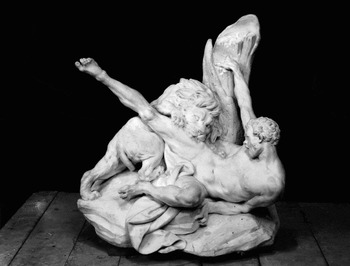
Baroque and Rococo sculptural traditions accustomed the eighteenth-century public to the notion of “living” sculpture in which marble seemed to breathe and move. The influence of Gianlorenzo Bernini (1598–1680) lasted well into and beyond the final decades of the eighteenth century and continued to influence some Romantic works. The influence is detectable for example in some of the works of Louis-François Roubiliac (1705?–62), Falconet, Antonio Canova (1757–1822) and François Rude (1784–1855). To its many eighteenth-century artistic descendants Baroque sculpture, with its emphasis on movement, presupposed “real” blood flowing through the veins of its subjects. Drama; diagonal thrusts; arched, running, flying, combative or dying bodies; heavy, deep-folded, swirling or flying draperies; ecstatic or terrified expressions and hand gestures; and swooning or contrapposto poses were common elements of the Baroque sculptural style (Figure 1). International communities of sculptors based in Paris, Rome and London perpetuated this highly rhetorical style.Footnote 3
Étienne-Maurice Falconet, Milo of Crotona, 1754, marble, h. 66.8 cm, w. 64.9 cm, d. 51.2 cm, the Louvre, Paris. RMN/© Droits réservés.

The Rococo style, at its height in the mid-eighteenth century, softened Baroque conventions while retaining a clear impression of bodies engaged in three-dimensional movement. This sense of movement was adapted to (more feminine) drawing-room and boudoir contexts and achieved effects more graceful and private in nature. Falconet's techniques catered for this vogue, as can be seen in his Pygmalion, discussed below. Rococo figures, evocative of dreams or fantasies, often lacked the realistic effects of hair and skin more common in Baroque sculpture. The exception here was the Rococo portrait bust, where surface naturalism and transitory (“living”) effects of facial expression were seen as desirable.
This interest in sculptural naturalism was facilitated, in part, by the Enlightenment trope of “living” marble, nurtured, in turn, by the growing importance of philosophical materialism. Key mid-century works celebrated and popularized the idea of the body as composed entirely of physical matter and as lacking the presence of a non-material soul. These included the Treatise on Sensations (Traité des sensations, 1754) by Étienne Bonnot, Abbé de Condillac (1715–80), Man Machine (L'Homme-machine, 1747) by Julien Offroy de la Mettrie (1709–51) and On the Mind (De l'Esprit, 1758) by Claude Audrien Helvétius (1715–71). Condillac used the metaphor of a sculpture acquiring (mental) life in order to demonstrate the empirical development of a non-material memory, imagination and consciousness.Footnote 4 To these thinkers, the origins of thought and consciousness lay in the physical sensations experienced by the body, even if more complex thought processes transcended the registering of these “mere” sensations. Living matter was, in this world view, the source of all human life and activity, both physical and mental.Footnote 5
The theoretician and art critic Denis Diderot (1713–84), concerned to establish the foundations of a secular morality postulated on a materialist basis, built on Condillac's trope of “living” marble. His D'Alembert's Dream (1769) opens with a conversation about the way in which physical matter may acquire a capacity for feeling. The discussion proceeds by deploying the example of a statue “made flesh”: “You can make marble out of flesh and flesh out of marble”.Footnote 6 The way to transform the “latent” sensibility or capacity for feeling of marble is to grind, eat and digest it:
I take this statue you can see, put it into a mortar . . . When the marble block is reduced to the finest powder I mix this powder with humus or compost, work them well together, water the mixture, let it rot for a year, two years, a century, for I am not concerned with time . . . there is one way of uniting that humus with myself, of appropriating it, a latus, as the chemists would call it . . . plant life . . . I sow peas, beans, cabbages and other leguminous plants in the humus. The plants feed on the earth and I feed on the plants . . . so I can make flesh, or soul . . . an active sensitive substance.Footnote 7
This concern with bringing matter to life is not, on the face of it, directly connected with the issue of aesthetic naturalism. And yet Diderot himself made this connection, in his work as art critic. In an essay on sculpture included in his Salon of 1765 he remained preoccupied by the problem of transforming marble into “flesh”:
the material it [sculpture] uses is so cold, so recalcitrant, so impenetrable; but above all . . . its principal difficulty resides in the secret of softening this hard and cold material, of making it into soft, pliant flesh, of capturing the contours of the human body, of vividly yet accurately rendering its veins, its muscles, its articulations, its obtrusions, its indentations, its inflections, its sinuosities . . .Footnote 8
The idea of the “living statue” was in fact widespread in eighteenth-century painting, sculpture and popular culture.Footnote 9
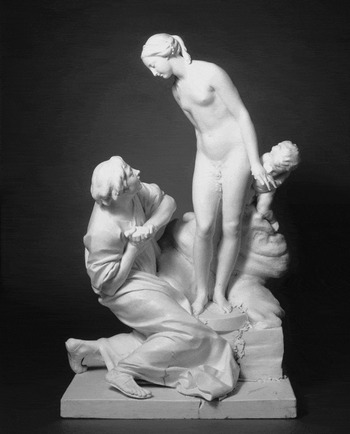
The idea that sculpture might appear to live and breathe was closely accompanied by a growing interest, especially from the 1760s, in a sense of psychological “movement” or inner life that constituted yet another adaptation of the Baroque. Baroque theatre was often translated in the visual arts into a more “sentimental” (in the sense of “full of sentiment”) idiom aimed at expressing the feeling subject. This resonated with the contemporary interest in human sensibility, expressed in Rousseau's La nouvelle Héloïse (1761) and in the paintings of Jean-Baptiste Greuze (1725–1805). The expression of human sentiment was also a major concern in some of Falconet's works, such as his Pygmalion and Galatea, which relates the story of the legendary sculptor–king who created, fell in love with and was allowed to bring to life a statue of a beautiful woman (Figure 2).Footnote 10 Falconet, having discussed the “studies” required to be undertaken by any successful sculptor, summed up this transformation of sculpture into a quasi-human feeling subject:
as Sculpture is not exercised for the sake of those who practise the art, or such as have acquired intelligence in it; the Sculptor, that he may catch the applause of others, must join to these necessary studies still one talent superior to them all. This talent, so essential and so uncommon, and which nevertheless appears to be within the comprehension of every artist, is Sentiment. It must be inseparable from all his productions. It is that which gives life to them: if other studies be the basis of Statuary, it is Sentiment alone which is the soul of it.Footnote 11
Étienne-Maurice Falconet (after), Pygmalion and Galatea, ceramic reproduction (original sculpture c. 1763), Sèvres, Musée national de céramique. RMN/© Martine Beck-Coppola.

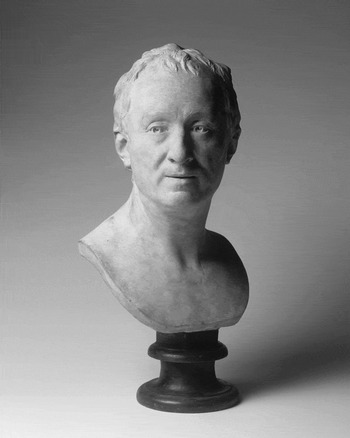
Portrait busts and statues were fertile ground for psychological and physical realism, notably in the work of Jean-Antoine Houdon (1741–1828), often hailed as eighteenth-century France's most famous and successful sculptor. This realism embraced both the surface effects of the “real” body and signs of transitory, human emotion. Houdon won in the 1760s a prestigious competition allowing him to study in Rome, and this success was capped by his election, in 1777, to the Royal Academy in Paris. Volatile expressions, lively eyes (often captured in Houdon's works by means of incised pupils, a practice identified as a departure from antique precedent), wrinkles, open mouths, tilted heads and necks, trailing strands of hair: all of these were skilfully deployed in the expression of emotion and character (Figure 3).
Jean-Antoine Houdon, Denis Diderot, Salon of 1771, terracotta, h. 46 cm, w. 26 cm, d. 22 cm, Paris, Musée du Louvre. RMN/© Hervé Lewandowski.

The quest for a “vivifying naturalism”Footnote 12 pervaded eighteenth-century views on sculpture, then, in relation to both physical and psychological aspects of representation. A number of factors were involved: the popularity of the northern realist tradition (Dutch and Flemish painted portraits and genre subjects were treasured by an expanding bourgeois market for art), a Rousseauan belief in the moral virtue of following nature and an emphasis on empiricism all played their part. So did a concern with the inappropriate dominance of classical models. Diderot summed this up: “Anyone who's neglected nature in favour of the antique will risk being cold, lifeless, devoid of the hidden, secret truths which can be perceived only in nature itself.”Footnote 13
“Cold”, “lifeless”, “insipid” and “mute” were the antithesis of the Enlightenment thinker's credo of naturalism that would allow the breathing, feeling subject to see him- or herself reflected in the productions of art. Classical idealism was valued, but only in its place (for example, in mythological subjects) and as long as it did not become too mannered. While critical commentators made more concessions to sculpture than to painting in this regard (sculpture being considered naturally closer to the austere “antique”), the emphasis on the viewer's imaginative engagement with a work of art meant that “breath, blood and character” criteria were increasingly asserted. The convergence of Baroque and Enlightenment naturalistic values is made explicit in Falconet's tribute to his seventeenth-century predecessor, Pierre Puget (1620–94):
In what piece of Grecian sculpture do we perceive the implications of the skin, the softness of the carnations, or the fluidity of the blood, so well expressed as in the works of this celebrated modern Sculptor?—It is impossible not to perceive the blood circulate in the veins of the Milo at Versailles.Footnote 14
The materials used by sculptors were also exploited in order to “create life”. It was generally acknowledged that the hard, resistant qualities of marble were little suited to the capturing of transitory effects. Furthermore, the association of marble with the “eternal” qualities embedded in antique sculpture seemed to disqualify it (except in the hands of genius) as a medium in which to represent more lowly or temporal subjects, or “men of mud”.Footnote 15 Fortunately, eighteenth-century sculptors were not restricted to marble. Bronze had been exploited since the Renaissance for its capacity to suggest fluid, graceful bodies; it had often been used to produce small-scale replicas of a range of works, from antique statues and mythological groups to some of Houdon's busts. However, its uniform sheen had limitations in the capturing of more detailed surface effects of “vivacity”. The medium most noted in the eighteenth century for animated and naturalistic effects, principally in the realm of preliminary studies, was terracotta. Clay models (sometimes exhibited publicly, in advance of the finished version) facilitated the creation of a textured surface that was capable, as it flickered in the light, of capturing the wrinkles and unevenness of flesh, as well as the finer details of facial features. Accomplished examples of the genre included the terracotta version of a bust of Oliver Cromwell by Joseph Wilton (1722–1803), so realistic that it showed a vein in the left temple. The discovery in Rome of ancient terracottas helped the medium to acquire a modicum of dignity: it certainly became acceptable to make small-scale terracotta copies of marble originals as portable, domestic, decorative features. They became collectors' items by the late eighteenth century.
Naturalism was rarely regarded as self-sufficient, however, in eighteenth-century high culture. Houdon pushed the trend as far as it was possible to do so, in the domain of sculpted portraits—already a step down, in terms of cultural and aesthetic status, from mythological, funerary or public monuments. In the interests of a very scientific naturalism, he used calipers to take head measurements of his sitters; he also used life and death masks and closely observed corpses in order to make his écorchés (anatomical sculptural studies in which the skin was peeled away to reveal muscles, tendons, arteries and veins). He used small chisel strokes in order to convey surface detail and variations in drapery, flesh and rock. This concern with naturalism was, however, tempered by the dictates of a classicizing ideal of beauty, even within the “lower” genres of portraiture or anatomical studies:
For a simple copy, as of a head, a foot, an ear, the model I use is the object itself that I have decided to copy. But when it is a question of a beautiful statue, I must review all of the models of the age that I am to represent without focusing on any one of them, and at the same time imitate and unite them into one whole, that, Monsieur, is the spirit in which I have made my Écorchés, my skulls, and the other pieces that I have the honour of sending to you.Footnote 16
Where appropriate Houdon combined direct observation of nature with reference to antique and Renaissance precedent. The eighteenth century was not ready for any brutal realism, as was demonstrated by the adverse criticism attracted by the pockmarked face of Houdon's bust, Christoph Willibrand Gluck, at the salon of 1775. Eighteenth-century naturalism very often coexisted in a creative tension with a competing aesthetic. Classical idealism, based on a selective or “cleaned-up” version of nature, remained influential in sculptural theory and practice throughout the century. Falconet and Diderot, for example, were champions of “nature” at the same time as they defended the ennobling grandeur of classicism: the precise balance of each depended to an extent on the genre of work produced. Such stylistic melanges sum up the tensions (resolved very successfully by some sculptors, less so by others) surrounding concurrent aesthetic codes. The solution devised by Falconet, of a graceful decorativeness combined with the dignified classical, remained common for many years. Towards the end of the century a desire (particularly in France) to counter what the art establishment regarded as a trivializing vogue for portraiture and Rococo frivolity reinforced the need to assert classical idealism and grandeur. This culminated in a particularly austere neoclassicism that challenged more directly the progression of naturalism and the illusion of the “living body” in sculptural practice.
II. NEOCLASSICISM AND THE BLOODLESS BODY
Within the neoclassical aesthetic that gained momentum from the mid-eighteenth century, the naturalistic sculptural “shell” was increasingly perceived as (potentially, at least) a distraction from both idealized form and the evocation of inwardness. For these latter purposes, the antique was regarded as the most reliable model. The pervasive influence in eighteenth-century society of “antique-mania” has been well documented by Francis Haskell and Nicholas Penny.Footnote 17 To some extent sculpture had served, from the Renaissance, as a synecdoche of antiquity itself. It was regarded as a distillation of all the ancients had learned about nature and beauty. Antique sculpture was also seen as an embodiment of the Eternal, universal Forms theorized by Plato. In The Republic Plato had postulated an ultimate reality of Eternal Forms or prototypes of which actual, earthly objects are merely specific examples or particular manifestations. If such objects are at one remove from the eternal or absolute, then art, which imitates and holds up a mirror to them, is at two removes. It becomes a potential mine of illusion and deception.
Plato's philosophy stimulated a strain of idealism in the arts that aimed to penetrate beyond mere appearances to their ultimate blueprints or Eternal Forms. The search was characterized as primarily mental or intellectual and had nothing to do with more superficial appeals to the senses, with particular material forms, with verisimiltude or with transitory emotion. Eternal Forms were in essence unseeable and unrepresentable and yet were felt to penetrate and inform the work of the experienced, gifted artist working with visible form. When seeking the essence of things, all forms of the ephemeral—movement, drama, narrative, physical characteristics—were perceived as troubling distractions. These distractions included the kind of naturalistic surface or expressive effects that might characterize “realistic” sculpture. The reassertion of Platonism in the middle and later decades of the eighteenth century promoted a desire to emulate the still, calm dignity of antique sculpture perceived as an embodiment of ideal beauty and perfect form.
Wrongly assumed to be lacking in colour (they had originally been coloured, but this colour had worn off), antique sculptures were seen as less suited than painting to the representation or expression of the sensuous, the temporal or the detail of flesh and blood. Due to its quintessential embodiment of eternal beauty, sculpture was also seen as less fertile ground for change, innovation or modernity.Footnote 18 The canon of antique sculpture that eighteenth-century artists were invited to emulate was well established and included the Apollo Belvedere, the Medici Venus, the Laocoön, the Farnese Hercules, Antinous, Diana, the Dancing Faun, the Discus Thrower, the Wrestlers and the Belvedere Torso. These works, originally thought to be Greek but subsequently identified as Roman copies, were regarded as a canonical repertoire of forms and subjects sometimes studied at first hand and at other times through Renaissance interpretations, or through casts. The grand tour, academies, sculpture galleries and libraries disseminated knowledge of the desirable prototypes.Footnote 19
If we were to take the position of Gotthold Ephraim Lessing (1729–81) as representative of neoclassicism, we would conclude that neoclassical theorists saw an incompatibility between naturalism and the antique ideal. In his Laocoön or the Limits of Painting (1766) Lessing includes sculpture in his broad category “painting”. He echoes Winckelmann's admiration for the restrained emotional expression of the Laocoön as well as his dislike for the explicit, the concrete or the momentary—for the very stuff of naturalism in relation to the physical body. Equally distasteful is the Baroque's favouring of psychological drama: both the distinctive and the specific are found wanting,Footnote 20 as the evocative, with its appeal to the free play of the imagination, is prioritized. In the case of Lessing, this distrust of specific naturalistic detail or overt expressivity creates a hierarchy of the arts in which the visual (doomed to dwell on the specific and on surface appearance, at least in his own experience) and the material are placed below poetry.Footnote 21 Only in the latter are more subtle, complex and open meanings possible. To Lessing, the visual arts reduce the divine to mortal proportions:Footnote 22 better suited to the representation of physical bodies than to that of an invisible spirit,Footnote 23 they can never attain a perfectly whole expression of what it means to be human. This purist disillusionment with the visual as a vehicle for the expression of the “inner” human was later taken up and developed, as we shall see, by Hegel.
But Lessing was not typical of neoclassicism; Johann Joachim Winckelmann (1717–68), Johann Gottfried Herder (1744–1803) and Immanuel Kant (1724–1804) all adopted, for a range of social and cultural reasons, a more accommodating attitude to naturalism. The German neoclassicism of Winckelmann drew inspiration from a concern with both spirituality and cultural nationalism: a challenge to French and Rococo hegemony in the arts. The neoclassicism that flourished in late eighteenth-century France was related to political and cultural reform, for example as a remedy for court laxity; while in England it functioned often as a (conservative) expression of the social status, national pride and learning of the ruling classes. There is not space here to explore these social and political dimensions in any greater detail;Footnote 24 it is clear, however, that neoclassicism provided an aesthetic against which sculptors could test and define their individuality and cultural allegiances, while deploying an internationally recognized formal language. That formal language continued, into the nineteenth century, to accommodate a concern with naturalism and with the physical materiality of the medium of sculpture.
The seminal texts of Winckelmann, Reflections on the Imitation of Greek Works in Painting and Sculpture (1755) and History of the Art of Antiquity (sometimes known as History of Ancient Art) (1764) contributed significantly to the nature and force of the taste for neoclassicism that swept through Europe. Winckelmann's theories ostensibly challenged the flesh-and-blood forces of naturalism and the Baroque (which he saw as both disordered and politically corrupt)Footnote 25 in order to locate sculpture's highest achievement in the expression of an ideal, non-material (and quasi-divine) spirit.Footnote 26 His aesthetic was founded on a rejection of the particular in favour of the general or universal.Footnote 27 Nourished by extensive reading on European Platonic aesthetics,Footnote 28 Winckelmann's conception of beauty is derived from a judicious selection, or transcendence, of natural elements, rather than from the closer copying of specific natural models often indicated by a naturalist aesthetic. Based on notions of harmony, balance and proportion, it is achieved by using the ancients as guides:
These frequent occasions of observing nature, taught the Greeks to go on still farther. They began to form certain general ideas of beauty, with regard to the proportions of the inferior parts, as well as of the whole frame: these they raised above the reach of mortality, according to the superior model of some ideal nature.Footnote 29
From the perspective of this Neoplatonic aesthetic, naturalism appears a fundamentally flawed project, since it has the potential to disrupt the focus on the ideal. Even Winckelmann's conception of ideal beauty, however, is not without its tensions or (at times uneasy) naturalist–neoclassical accommodations. Strongly rooted in notions of physical form, and fuelled by a homoerotic charge, there are frequent indications in his writing of a concern with the detail of the surface of the human body.
In true neoclassical spirit, Winckelmann states a preference for a generalized, antique treatment of the skin, as opposed to the prominent veins, “little smart wrinkles” and “plaits distinct from flesh” of more naturalistic sculpture.Footnote 30 He considers white marble, with its connotations of the universal, best suited to the youthful bodies of Greek gods and heroes, relatively unscathed by mortal cares or afflictions.Footnote 31 Smooth skin connotes, for Winckelmann, an androgynous ideal, “set apart from the natural world, above it, floating above time”.Footnote 32 Life, feeling and emotion are to be represented in the most discreet, understated way, as exemplified in the Medici Venus;Footnote 33 or the divine restraint of Niobe,Footnote 34 the Belvedere Torso,Footnote 35 or the Belvedere Apollo (“there is nothing mortal here, nothing which human necessities require”Footnote 36); or the gentle emotions of the Antinous (“without an indication of a single passion which could possibly disturb the concord of the parts and the youthful stillness of the soul”Footnote 37). This smoothing out of the skin has been related to Winckelmann's awareness yet “editing out” of opposing discourses of bodily pain and violenceFootnote 38 and to his vision of the eunuch as exemplary of beauty.Footnote 39
Most clearly, however, he responds overtly to the erotic attraction of the Belvedere Apollo's velvety skin and lithe contours. Informed by his subjectivity, his response to sculpture cannot eliminate the appeal of the naturalistic or the human, even if the “mix” of the natural and the ideal inverts the priorities previously identified in Falconet's works and writings. Winckelmann's homoerotic tendencies were widely recognized at the time he wrote and continue to be so.Footnote 40 Possibly driven by his fear of openly expressing them,Footnote 41 he envisaged in art the safe, distancing “perfect synthesis of abstract form with sensuous immediacy”Footnote 42 as central to the beauty of classical Greek statuary.Footnote 43 Winckelmann's writings were widely influential, particularly in countries outside Germany.Footnote 44 His History was translated into French in 1766 and into Italian in 1779, although a complete English translation had to wait until 1880.
The theoretical stance on sculpture expressed by Herder in his Sculpture: Some Observations on Shape and Form from Pygmalion's Creative Dream (1778) saw representation of the “body” as valid only in so far as this body expressed an inner spirit or soul:
What sculpture should create, and what it has succeeded in creating, is forms in which the living soul animates the entire body, forms in which art can compete in the task of representing the embodied soul—that is to say, gods, human beings, and noble animals.Footnote 45
Here there is obviously some faith in sculpture's ability to suggest the union of the physical and the spiritual or mental: a notion that both Lessing and Hegel found problematic. Herder's faith in sculptural expression arose in part from his view that sculpture, with its reliance on touch and on three-dimensionality, was less concerned than painting with the “superficial” aspect of things. Indulging less in the charms of optical illusion, colour and “dreams” (like many others, Herder misjudged antique sculpture as originally uncoloured), sculpture could draw the human observer into a more meaningful and universal affective response that united the tangible with the eternal.Footnote 46
Kant theorized aesthetic experience, in his Critique of Judgment (1790), as something reaching beyond the sensory world and yet firmly rooted within it. His thinking is clearly indebted to Platonic notions of ideal form. He defines the “standard idea”, a supra-sensible notion derived from sense experience, as
the image for the entire kind, hovering between all the singular and multiply varied intuitions of the individuals, the image that nature used as the archetype on which it based its productions within any one species, but which it does not seem to have attained completely in any individual.Footnote 47
Kant sees sculpture specifically as an art that exhibits its ideas corporeally. Rightly concerned with imitating nature, it must still look like art, however—that is, something beyond nature must be intuited, if not understood: “Sculpture is the art that exhibits concepts of things corporeally, as they might exist in nature (though, as a fine art, it does so with a concern for aesthetic purposiveness).”Footnote 48 In this regard beautiful art is symbolic: it presents sensory expression of the non-sensory.Footnote 49 It may also hint at the moral.Footnote 50 Here too, then, lies a possibility of fusion of matter and the ideal, although, like Lessing, Kant saw poetry as the best means of reaching and stretching the supra-sensible powers of the mind.Footnote 51 In much neoclassical theory there is a recognition that, while the “ideal” is the most valuable aspect of antique art, the modern age requires something less perfect.Footnote 52
Neoclassical sculptural practice reflected this ambivalence. A more austere neoclassical style established towards the end of the eighteenth century seemed determined to rise above a flesh-and-blood realism in order to emphasize the ideal and downplay the human, flawed in both physical and moral senses. The technical armoury of this school of sculpture included waxy, frosty or lard-like renderings in marble of human skin, which smoothed out (or “generalized”) the messy irregularities of real flesh;Footnote 53 a generalized or idealized approach to facial features and expressions, especially in allegorical works; a clearly and correctly drawn, elegant outline or contour (reminiscent of graceful, antique low relief or decorative vase effects) designed normally with a fixed viewpoint in mind; a fine, smooth, surface finish;Footnote 54 idealized, harmonious anatomical proportions; references to classical architecture; and the use of carefully ordered, chiton-like draperies. As neoclassicism evolved, however, it accommodated in many works a concern with naturalistic form.
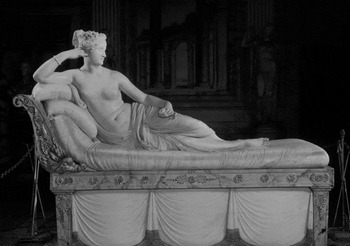
The case of Antonio Canova (1757–1822) vividly illustrates the turn-of-century uneasy but creative coexistence of the terrestrially realistic and the other-worldly. Canova had established his own studio in Venice by 1774 and was “converted” to a neoclassical style by the early 1780s, especially after visits to Rome and Naples. He later played a part both in creating sculptural representations of the Napoleonic dynasty and, later still, in recapturing for Italy many of the artistic spoils removed by Napoleon himself. Towards the end of his career (in 1820) he made a sculpture of George Washington (now destroyed) for North Carolina. In 1817 or 1818 Canova made a series of “ideal heads” or universal archetypes of an imagined, ideal beauty, which he then modified for the purposes of individual portrait-bust commissions.Footnote 55 This synthesis of the ideal and the real, mixed in a wide range of proportions according to genre and commission, informed a great deal of his output. Most often he seemed drawn to a treatment of the human subject that prioritized autonomous aesthetic effects derived from a careful arrangement of light, shade, contour and volumes. Such formalist concerns are dominant even in works that aimed at a specific likeness. Works such as his Paolina Borghese as Venus Victrix (1804–8) (Figure 4) emphasized his attraction to an ideal, atemporal conception of beauty.
Antonio Canova, Pauline Bonaparte as Venus Triumphant, c. 1805–8, marble, b. 200 cm, Galleria Borghese, Rome, Italy/Lauros/Giraudon/The Bridgeman Art Library, Italian/out of copyright.

At the same time, sculptures such as the Paolina convey a sensuousness, illusionism or sense of movement that appeal to more mortal, material sensibilities: Paolina was, after all, disguised as Venus.Footnote 56 This is Winckelmann's “sensuous divine” revisited. The precise degree of the mortal or the divine varied with the nature of the commission or market Canova had in mind. Papal tombs evoked a tranquil neoclassical grandeur while private commissions (particularly those following his observation in London of the more “natural” Elgin marbles) offered more scope for the fleshly and the erotic.Footnote 57 In spite of his frequent replacement of the sensuous, organic forms of the Baroque by a more geometric neoclassicism, Canova never completely abandoned the influence of the former style, particularly its emphasis on movement. Sculptures such as the Paolina were intended to be viewed in dramatic torch- or candlelight so that their surfaces flickered into life. Others, such as his Penitent Magdalen, presented an intense expression of recognizably human emotion.Footnote 58 Canova also experimented with tinting some of his works with a yellow wash aimed at producing a more lifelike representation of human flesh.Footnote 59
The eruption of naturalistic techniques into even the purest sculptural productions of neoclassicism is explained in part by a reaction against the “mania” for Winckelmann and the antique which had gripped turn-of-the century culture. There was a sense that something better-adapted to modern times was required and a disillusionment with the “authentic” antique, especially as “Greek originals” were increasingly recognized as Roman copies. Herder, in his Sculpture: Some Observations on Shape and Form from Pygmalion's Creative Dream, had expressed the view that sculptors working in Rome were slaves to antique precedent.Footnote 60 Canova refused to take part in the thriving enterprise in Rome of the restoration of antique sculpture. He proclaimed that, in addition to steeping oneself in ancient Greek example, one must study nature for oneself and develop one's own style. The increasingly important notion of individual creativity challenged at this time (as it had earlier) the levelling effect of the neoclassical ideal. For Herder, Canova and other neoclassicists, the modernity of sculpture lay in its explicit union of the physical or material with the spiritual as well as in its adaptation of antique forms to contemporary culture. For the German Idealists, modernity made quite different and exclusive demands.
Neoclassicism in its purer form tended to drain the (Baroque) sculptural body of its blood, reflecting the anti-naturalist view that “art” was constituted as a conscious enjoyment of the contrast between the resistant medium of marble and the representation of pliable flesh: art is to be enjoyed as conscious artifice. The balance of naturalism and the ideal mutated according to context, but was often achieved. Such an accommodation was to prove highly problematic, however, for the apostles of Romantic Idealism.
III. THE BOUNDLESS BODY: HEGEL AND THE GERMAN ROMANTIC IDEALISTS
In some respects the Romantic Idealism of nineteenth-century thinkers seems to be a natural extension of the neoclassical aesthetic. To Canova sculpture, with its capacity for perfect form, had provided an effective medium for “eternal beauty”:
When nudity is pure and adorned with exquisite beauty, it deflects us from mortal preoccupations and transports us to those early times of blessed innocence—all the more so if nudity approaches us as spiritual and wise, elevating us to the contemplation of things divine. These latter, since they cannot be manifested to the senses because of their spirituality, can only be indicated to us by their excellence of form so that they inflame us with their eternal beauty.Footnote 61
Canova's statement asserts what he sees as the strength of the neoclassical aesthetic, while pointing to what was subsequently perceived as a problem: form provides a means of “indicating” divine beauty, which is, by definition, supra-sensible. “Indicating”, alluding to, suggesting: these all fall short of full expression. There was a limit to the extent to which sculpture could overcome the naturalistic propensities of its solid materiality and three-dimensionality, even in the purer neoclassical productions of, for example, the Danish sculptor Bertel Thorvaldsen (1770–1844), whose works often attempted a two-dimensional, highly abstracted low-relief effect. Not only was sculpture susceptible to naturalism; its materiality brought it closer, potentially, to the actual shape and size of the human form. Sculptural form itself, with the combined appeals to sight and touch, made sculpture more humanly “real”.
Friedrich Schelling (1775–1854), scholar and member of the Jena Romantics, placed a particular interpretation on Canova's notion of form “indicating” the eternal: “Plastik art . . . manifestly occupies the position of an active link between the soul and nature, and can only be comprehended in the living centre between the two of them.”Footnote 62 Like Lessing, he saw the ultimate aesthetic experience as one in which we transcend the (necessarily) physical, material aspects of art: “How can we, so to speak, spiritually melt this apparently hard form, so that the unadulterated energy of these things fuses with the energy of our spirits, forming a single cast?”Footnote 63
To the Romantic Idealists, fixed visual (and particularly concrete) form, central to neoclassicism's linear aesthetic (which emphasizes the boundaries of all things), is a barrier to the viewer's spiritual fusion with the real essence of the work. It traps the viewer's imagination rather than inviting it to roam freely. The Platonic “essences” sought by the neoclassicists were too wedded to the idea of identifiable, perfectible and ultimately definable form. To Schelling and the German Idealists, the essence of a work of art is fluid, vitalistic and ever-changing; it is therefore inimical to any notions of fixed or bounded form. The ideal forms of art must be embodied in an understanding of nature and its external appearances that is “living and creating”, that connects with and is brought to life by the living soul of the viewer, rather than being “dead for dead observers”.Footnote 64 To Idealists such as Schelling neoclassical conceptions of beauty presented an array of static, lifeless forms abstracted and distanced from his own view of an ever-becoming, creative power of nature at one with, rather than merely expressive of, a divine or spiritual presence. Even when allowing some natural fluidity, the dignified, fixed forms of neoclassical sculptures were the opposite of those sought by the Romantic imagination (as defined by the Idealists) which attempted to connect with a markedly non-static oneness.
Too often, Schelling felt, artists in search of ideal beauty were concerned with a superficial imitation of antiquity and with a conception of beauty too narrowly restricted by a concern with bounded form:
The place of nature was taken by the exalted works of antiquity, whose outward form the pupils were at pains to appropriate, but without the spirit which imbued it. However, these works are just as unapproachable, indeed even more unapproachable than those of nature, they leave you yet colder than the latter if you do not bring to bear upon them the spiritual eye that penetrates their husk and feels the force at work within them.Footnote 65
“Shell”, “husk”: the argument here is with a preoccupation with form for its own sake, divorced from a link with the living, boundless force that created it. From this point of view, Canova's neoclassical “indication” of the eternal was an ideal too fragile for most derivative “antique” sculpture to achieve.
The problem of reconciling natural and artistic forms with a living, creating divine spirit also engaged the attention of Georg Wilhelm Friedrich Hegel (1770–1831), who delivered lectures on aesthetics at the University of Berlin in the 1820s. To Hegel the history of the human spirit was a journey away from the sensuous and particular and towards the spiritual and universal; away from the (necessarily) concrete, material form of the visual arts towards the abstract, ethereal realms of religion and philosophy. There are shades here of Lessing's views on the evocative powers of poetry, privileging the verbal over the visual or concrete. The “absolute” or Ideal that originated in a self-reflexive awareness of human freedom and self-determination and for which art initially served as one form or manifestation has, for Hegel, been artificially constrained by the clearly defined linear boundaries or contours of neoclassicism.Footnote 66 The sensuous forms of art lie beyond the “shadowland of the idea”,Footnote 67 which should, in theory, consist of a constantly evolving (rather than fixed, clearly defined) fusion of nature (or flesh) and spirit.Footnote 68
Ancient Greek sculpture provided the ultimate means of expressing its own contemporaries' view of the “divine”, which very much foregrounded gods in human form—the perfect union of flesh and spirit. The Christianity of Hegel's era, however, was predicated on a different flesh–spirit relationship. It therefore required a different mode of expression that would set free the spirit of both art and viewing subject. Hegel wanted to liberate religion from the bodily specifics of a (too human) pain, ugliness and suffering.Footnote 69 In some ways, then, his project both extended and transcended the aesthetic ambitions of Lessing as he contemplated the Laocoön. For Hegel the essence of Christianity and the divine lay in an inwardness characteristic of German Romantic priorities. The sensuous concreteness and naturalism of sculpture was perceived as inimical to this inwardness.Footnote 70 The medium provided too much physicality for the spiritual “melting” involved in a totally free contemplation of art. Sculpture faces more acutely the problems of art in general: it must appeal to the specifically human or natural but in doing so it sacrifices its potential to express the absolute.
While Hegel conceded the importance to art of naturalism, he also felt this should not be its chief aim.Footnote 71 Art must raise men above their immediate and conflicting desiresFootnote 72 and above a “mere sunkenness in nature”,Footnote 73 even while representing them. For Hegel this desirable distancing of sign and symbol is more easily attained in poetry,Footnote 74 the closest art could reach to the even more reflexively aware articulations (or conceptual language) of religion and philosophy. The “inward”, “private” realm of Christian spirituality and the theoretical nature of Christian doctrine are not, in Hegel's view, adequately expressed in visual form. The proliferation of semi-sacred, temple-like museum spaces in which to view sculpture did little to ease Hegel's mind.Footnote 75 Nor was he willing to contemplate the secular/sacred compromises so evident in the work of German Romantic painters such as Caspar David Friedrich (1774–1840). In the same way, the forms of freedom characteristic of modern society—the legalistic system of rights in modern states; the institution of private property; and the modern principle of the autonomous, self-determining subject functioning within an emergent capitalism—depended on abstract laws and principles that could not, for Hegel, be easily articulated through art. We are a long way here from the Christian sculptural visions of the Baroque. Too concrete and specific, sculpture can no longer express, for Hegel, the flux and boundlessness of the modern “life of the mind”.Footnote 76 For Herder, Winckelmann and the neoclassicists, modernity incorporated an accommodation with the physical, natural forms characteristic of contemporary life, accepted as shorthand for eternal essences or achievable forms. For Hegel and the Idealists, intellectual and social forms of modernity required a form of ceaseless or striving “becoming”, acknowledged (unlike the Platonic form of the neoclassicists) as having neither boundary not terminus.
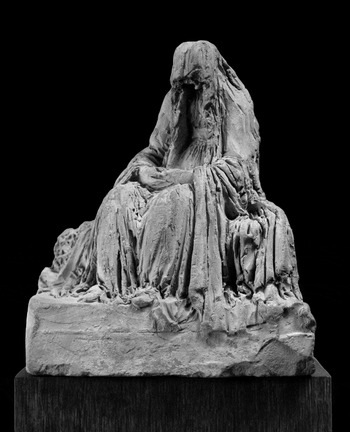
If sculpture was perceived as problematic with regard to modern forms of freedom and spirituality, unease about the medium also arose in connection with the Romantics' conception of the imagination. Forms that were too complete, finished or concrete were felt to leave too little to the imagination. As in painting, the Romantic imagination thrived increasingly on the loosely executed, with a suggestion of incompleteness. It was difficult to achieve this in finished marble commissions, but possible in the making of preparatory clay models. These were felt to be closer to the primal processes of creative genius.Footnote 77 Such models were rarely, in the eighteenth century, extreme in their loose sketchiness, but became both freer and more common with the advent of Romanticism in, for example, the initial compositional sketches in clay by Canova which differed dramatically from the precise finish of his completed works (Figure 5). Quatremère de Quincy allied such bozzetti with the appeal of the infinite and the unfinished:
Antonio Canova, Bozzetto for Meekness for Tomb of Clement XIV, 1783, terracotta, h. 13, w. 11, d. 9 cm. © Museo Gipsoteca Antonio Canova—Possagno, Italy.

This kind of improvisation in art, offers, as you might well imagine, nothing complete; but the power of the imagination is so boldly imprinted, and with such a vivacious way of working, that one might be tempted to prefer to the very perfection of finished marble this lively, rapid glow of genius, which overwhelms the spectator. Such is, in fact, the acknowledged privilege of sketches by all the great masters. It is because they give or present to the mind, by their very lack of finished workmanship, a kind of infinity, as opposed to a finished work, which allows nothing beyond what one sees.Footnote 78
Clay or terracotta models were associated increasingly with a primal creativity. They were linked with the mythical origins of sculpture itself: God's creation of man from the dust of the earth and His gift of the breath of life.Footnote 79 This rough earthiness was potentially, for many Romantics, a gift for the transformative, transcendent powers of the viewer's imagination: a variation of the freedom and subjectivity so intensely sought by Hegel. For Hegel himself, however, such advantages were sullied by their association with the sensuous. His views on the materiality of sculpture perhaps owed something to the age-old prejudice, expressed by Alberti, Leonardo and others, that sculpture was a physical craft involving sweat and dust:Footnote 80 hardly the best medium for expressing our union with universal spirit. As we have seen, Hegel's views were far removed from those of Herder, who saw sculpture's tactility and physical presence as an important means of accessing the truth, envisaged as more material in kind.Footnote 81
In its concern with naturalism and with definite, bounded form, sculpture had, for Idealists like Schelling and Hegel, become too limited and outdated for the expression of modern truths and self-understanding. It lacked the capacity to refer adequately to the increasingly self-determining, autonomous qualities of modern human existence which had been sensitized by recent political events to notions of “freedom”. This applied especially to a formulaic neoclassical form. Sculpture's material form was too divorced from the higher imperative, primal essence or divine creative principle needed to express the vision of the “indwelling spirit” and the stamp of “unfathomable manifoldness”Footnote 82 of modern religion or society. Hegel was consistently concerned with moral, social, educational, constitutional and legal reform, but his Romanticism was not of a secular kind. He sought greater purity, inwardness and austerity in all things and did not see sculpture as the best means of achieving this in his own age. He tended to see contemporary sculpture as either too complex or too meaningless for his purposes.Footnote 83 His solution was to transcend both Enlightenment naturalism and neoclassical spirit–matter fusions by liberating spirit from visual form. Natural–Ideal “reconciliations” were found severely wanting.
IV. ROMANTIC SCULPTURE: ACCOMMODATING “HUSK” AND SPIRIT
Ironically, while Hegel adhered to a non-material modernity, contemporary nineteenth-century sculptors conceived of more commercial, eclectic projects for the modern world. They discovered their own ways of reconciling a Romantic, idealist aesthetic with the material “husk” of the medium in which they worked. Neoclassicism (sometimes modified by a concern with drama, sentiment and naturalism) remained an important sculptural idiom until the mid-nineteenth century.Footnote 84 Genuinely innovative styles became more prevalent from the 1830s. “Romanticism” proper is generally thought to have begun to exert a significant influence on sculpture in that decade.Footnote 85 Both within and outside the neoclassical tradition Romantic elements in sculpture were increasingly evident from the turn of the century. Sculptors found a number of ways in which to accommodate a Romantic concern with non-material spirit, derived in part from earlier Neoplatonic values, within the physical matter and naturalistic possibilities of their art. An increasing repertoire of methods was deployed in the service of hinting at (Canova's “indicating”) the supra-sensible, even in this most tangible of media. These methods included relatively secular suggestions of individual or heroic character fitting the notion of self-determining subjects; the expression of sentiments of political or national feeling; pronounced expressivity that took the form of violence, animation and drama. They also included the evocation of spirituality and meditative inwardness. Naturalism began to be seen as less of a problem in Romantic neoclassical sculpture, as sculptors negotiated proficiently this difficult territory between the tangible and the intangible. Complexity of form and texture were welcomed rather than shunned as a barrier to the expression of the ideal. Such accommodations were often more worldly than Hegel's uncompromising Idealism; they nevertheless served directly the needs of contemporary, commercially driven societies wedded to the visual expression of their (more secular) ideals and values.
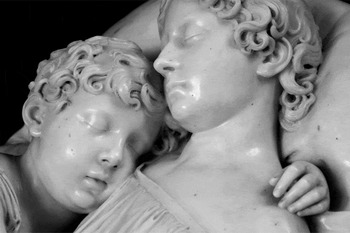
Late eighteenth- and early nineteenth-century neoclassicists who assimilated a Romantic aesthetic were widespread throughout Europe and reflected changing taste. In 1817 the Academy exhibition of the model of The Sleeping Children, designed by Sir Francis Chantrey (1781–1841) as a memorial to two sisters who had died in a fire, upstaged the “less relevant”, more purely neoclassical works of Canova (Figure 6). This work reflected a fashion for sentimentalism that was to influence funerary sculpture well into the nineteenth century. Lord Holland wrote,
So great was the throng wishing to see the children . . . that people could not get near them. Mothers stood with tears in their eyes, went away and came back. Meanwhile Canova's now far-famed figures of Hebe and Terpsichore stood alongside almost unnoticed.Footnote 86
Such developments signalled a return of the mid-eighteenth-century vogue for natural sentiment. Naturalism was clearly acceptable, even desirable, in such sentimental works: one of the children's faces was based on a death mask. Neoclassical sculptors themselves modified their approach in response to changing taste. Canova, whose work had already progressed from the Baroque to the neoclassical ideal style advocated by Winckelmann, later turned to greater experimentation with the naturalistic surface effects and complexity encouraged within a Romantic aesthetic. Due to his success in attracting clients he broke through the normal patterns of patronage in order to create his own subjects. He first worked these up as plaster models in order to interest buyers for whom he subsequently produced finished versions. Mass production of popular subjects then became possible, with workshop assistants making copies to which Canova would add finishing touches. Such commercial independence from public, royal and aristocratic commissions was rare at this time but was later to add to sculpture's status as individualized creativity and to its capacity for stylistic variety, as opposed to stylistic vogue.
Sir Francis Chantrey, The Sleeping Children (detail), 1817, marble, life size, Lichfield Cathedral, Staffordshire. © Lichfield Cathedral, photograph Tom Allwood.

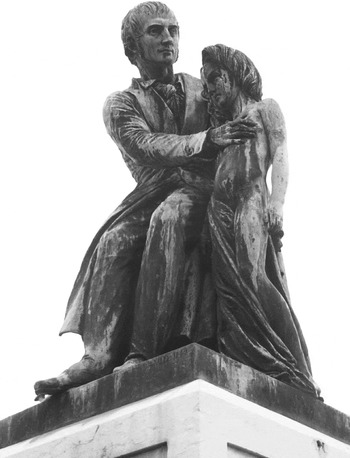
In the first half of the nineteenth century, then, neoclassical subjects and styles were duly modified by varying Romantic and social concerns with naturalism, drama and sentiment. Practising Romantic sculptors became bolder in their attempts to unify the physical matter of sculpture with the evocation of inwardness or spirituality. Particularly innovative in this respect was the work of the French sculptor Pierre-Jean David d'Angers (1788–1856), whose sculptures combined an interest in the metaphorical, universal and spiritual with concrete, contemporary social concerns. In a letter of 1842 to Victor Pavie, David d'Angers comments on the pedestal and statue of his monument to the medical and physiology expert and scientist Xavier Marie François Bichat (1842) (Figure 7). David d'Angers received many similar state and civic commissions for statues of “great men”: modern Romantic “heroes” of recognized patriotic and national worth. Although David d'Angers's work was often informed by a strong religious impulse, his interest in the here and now (his heroes were often in modern dress) permitted the expression of a more secular humanitarianism that celebrated the fusion of body and spirit. This monument represents Bichat (an expert in physiological aspects of life and death) medically examining a child, while placing a hand on his heart. David d'Angers sees the sculpture as expressive of human emotion as well as being a kind of sublime meditation on the “mysterious secrets of creation”, life and mortality, thus demonstrating his interest in the interface of the fleshly human with the divine:
In the Bichat group I have sought to raise a monument to the science of physiology. Three kinds of existence are presented in this work: one dreamy, vegetative, pure as the dawn of a cloudless day; the other occupies the middle section, the most elevated part of this human pyramid. The first of these is passionate, devoured by emotions; it thinks to the point of self-annihilation; it tries to raise a corner of the veil concealing the mysterious secrets of Creation. Finally, at the base of this pyramid is death, another kind of existence, obscure, hieroglyphic . . . If I have placed [in the central part of the group] Bichat's hand on the child's heart, it is because that is where we find the most ardent centre of life itself . . . Is it not true that a doctor takes a man from the cradle, supports him right to the grave, and while saving his subject's skin, seeks knowledge from him in order to illuminate the sublime, miraculous manifestations of life?Footnote 87
Pierre-Jean David d'Angers, Monument to Bichat, c. 1843, bronze, Bourg-en-Bresse. © Ville de Bourg-en-Bresse/Serge Buathier.

To David d'Angers life and death, the mortal and the immortal, are intimately linked, in this case by means of a medical metaphor. To German Idealists like Hegel such a union is highly problematic. Schelling's “spiritual melting” of the “hard form” of sculpture is fraught with difficulties: its physicality and lifelikeness are barriers to a higher world. The views of Hegel, a professor of philosophy keen to purify state and religion, were perhaps bound to conflict with the commercial and social realities of sculptural practice, in which drama, materiality and “passion” were desirable commodities. To the Idealist, sculpture had become too distanced from the divine, too much an expression of a humanistic materialism, too close to human flesh and altogether too much of this earth. David d'Angers, by contrast, was closely guided by the more earthbound aspects of contemporary public taste.
Market forces had an inevitable effect on sculptural practice. In the second half of the eighteenth century, French bankers, actresses, society hostesses, tax farmers and others commissioned art on an unprecedented scale, thus providing a powerful private, bourgeois market distinct from the grander formality of public commissions. Those who made money from the Revolution (ex-Jacobins, army generals, ambitious administrators) subsequently swelled the ranks of such patrons, who preferred their neoclassicism to be modified by realism and sensuality.Footnote 88 In Britain wealthy collectors of sculpture expressed their taste either by commissioning works (including some from Canova) or (more modestly) by buying, while on the grand tour, small-scale reproductions of larger works.Footnote 89 The growing taste among such purchasers for narrative reliefs often implied a requirement for painterly realism. In Germany the sculptural and architectural production of Karl Friedrich Schinkel evolved in response to the taste of a dominant social and political elite whose interests ranged from the Gothic to the Christian and the theatrical (including stage sets and panoramas). Although Schinkel was notably influenced by the thinking of German Idealists such as Schelling, his sculptural output had to accommodate much more diverse elements.Footnote 90 The widely varying interests of European societies ensured that the “sacred” or pure neoclassicism considered appropriate for temple-like museum spacesFootnote 91 achieved dramatic transformation in other contexts.
The pragmatic, eclectic accommodation of naturalist, idealist/Romantic and neoclassical aesthetics and practices that was unpalatable to the German Idealists persisted in characterizing much sculptural theory and practice in the eighteenth and early nineteenth centuries. To many theorists and creative sculptors visual, naturalistic and tactile form offered a welcome embodiment of, rather than a restriction upon, a free imagination and spirit. While Hegel and Schelling saw the “hard form” or material fixedness of sculpture as a barrier to expressing modern forms of freedom, especially when limited to the natural or familiar, sculptors themselves increasingly welcomed references to the outward, naturalistic forms of modern life (in, for example, the use of modern dress). For sculptors, external appearance and verisimilitude formed valuable bridges with the mind (and soul) of the viewer. Fixing and perfecting form, a project at the heart both of the Enlightenment and of neoclassicism, remained valuable to artistic practitioners less swayed by the Idealists' quest for the unlimited freedom of the formally inexpressible.