Introduction
One has to go back to the 1960s to find the first mention of phase-change materials (PCMs). In 1968, S. Ovshinsky proposed that these materials had the potential for the development of information storage devices. These materials were characterized by a series of interesting nonconventional properties. Unlike most semiconductors, the crystalline and amorphous forms of PCMs possess different optical and electrical properties. They also have the ability to switch between the two states rapidly (with nanosecond switching speeds) and in a reversible way when an energetic stimulus is applied.
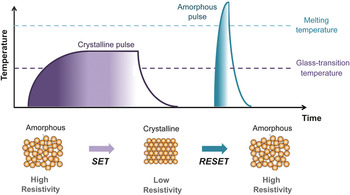
Most PCMs are telluride materials, with the most well-known compositions being Ge2Sb2Te5, Ge1Sb2Te4, and GeTe. Reference Wuttig1,Reference Yamada2 PCMs used as nanometric layers were extremely successful as the active materials of several devices for optical data storage, such as CD-RW (compact-disc rewriteable), DVD-RW (digital versatile disc-rewriteable) and BD (Blu-ray disc). Intense investigations into these materials are ongoing with the aim to develop new types of electrical memories such as PC-RAM (phase-change-random access memory) with improved performance compared to current flash memory devices. Expectations for improvements concern the speed, energy efficiency, and toughness of the devices. The principle of operation of a PC-RAM memory, similar to that used for optical memory, is shown in Figure 1 . Reference Pradel, Neuville, Cormier, Caurant and Montagne3 Improvements in PC-RAM memory performance rely on understanding the link between structure, dynamics, and more subtle properties such as drift and aging in PCMs. It will be shown how rigidity theory can help in this respect.
Principle of operation of a phase-change-random access memory (PC-RAM) using phase-change materials (PCMs). It exploits the large-resistance contrast between the low-resistive crystalline and the high-resistive amorphous states in PCMs. A PC-RAM cell is “SET” to its low-resistance state by applying an electrical pulse, the amplitude of which is large enough to heat the PCM just above the glass-transition temperature, T g, (typically 150°C) and long enough to allow PCM crystallization. The PC-RAM cell is “RESET” in its high-resistance state by applying an intense and short electrical pulse that melts the material, which is quenched into the amorphous phase. The difference in resistance between the two phases is large enough to be “READ” easily by measuring the device resistance at low voltage, so that the device state is not perturbed. Reference Pradel, Neuville, Cormier, Caurant and Montagne3

PCMs and rigidity
The combined ability of an amorphous phase to crystallize rapidly and to yield a strong improvement in electrical properties upon crystallization raises a number of questions. High among these is the relationship between the amorphous and crystalline structures, which have to be distinct enough to ensure the stability of the amorphous phase and have good data retention at operational temperatures in memory applications, and at the same time, be topologically close enough to ensure crystallization on a nanosecond time scale.
Rigidity theory first proposed by Phillips Reference Phillips4 provides a useful tool to understand these unique properties of PCMs (see the Introductory article in this issue). It classifies amorphous networks into flexible or rigid glasses. In this concept, strong covalent forces are expected to act as mechanical Lagrangian constraints defining the local atomic structure of the disordered solid. Covalent solids demonstrate two different types of bonding constraints. The bond-stretching constraints, n BS, are defined by the bond between two neighboring atoms, whereas the bond-bending constraints, n ΒΒ, correspond to the bonding angle between an atom and two of its neighbors.
In flexible glasses, the total number of internal constraints n c = n BS + n BB is lower than the degrees of freedom per atom (i.e., n c < 3 in three-dimensional systems). In contrast, rigid glasses are overcoordinated, having a total number of Lagrangian constraints n c > 3 per atom. Hence flexible glasses allow local deformations, whereas deformations in stressed-rigid glasses are blocked by bond connectivity. Generally, the coordination number r determines the average number of bond-stretching and bond-bending constraints to n BS = r/2 and n ΒΒ = 2r – 3, respectively.
In PCMs, especially those containing Te atoms, this definition, based on the average coordination number, does not hold. Based on the atomistic structures and the molecular dynamics trajectory that are usually generated using ab initio methods, it was actually possible to directly quantify the number of mechanical constraints for each atom of the structure. Reference Micoulaut, Raty, Otjacques and Bichara5
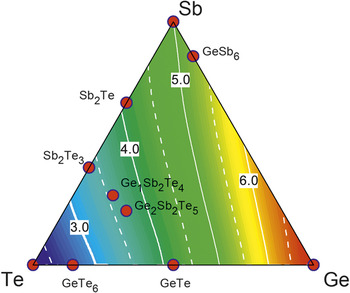
Using this method, a map of the number of constraints for compounds in the ternary Ge-Sb-Te diagram can be drawn (see Figure 2 ).
Average number of constraints in amorphous Ge-Sb-Te alloys. The number of constraints is the sum of angular (in number n BB, the number of rigid angles) and radial (n BS, half the coordination number) constraints for each atom. The isostatic line, n c = 3 crosses the Ge-Te axis at ∼22% Ge. All common phase-change materials are found in the stressed-rigid part of the map, which corresponds to n c > 3. Reference Micoulaut, Raty, Otjacques and Bichara5

Interestingly, most, if not all, PCMs are stressed-rigid materials. The compounds that are the closest to the isostatic line are Sb2Te3 and GeTe6; the stiffness threshold for GexTe100–x is found at x ∼ 22. While the conclusion is drawn from structures modeled using ab initio methods, a structural investigation of coevaporated or cosputtered GexTe100–x films (10 ≤ x ≤ 50) based upon x-ray diffraction and extended x-ray absorption fine structure data sets simultaneously fitted by the reverse Monte Carlo technique points to the same conclusion. Reference Piarristeguy, Micoulaut, Escalier, Jóvári, Kaban, van Eik, Luckas, Ravindren, Boolchand and Pradel6
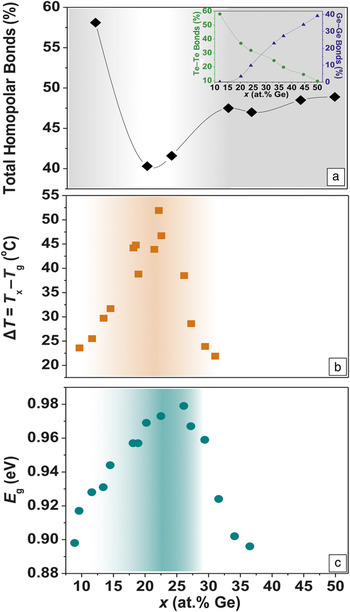
A structural singularity in a composition region comprising 22–25 at.% Ge was identified by analysis of (1) partial structure factors S ij(k), (2) Bhatia–Thornton concentration–concentration structure factors Scc(k), (3) partial pair correlation functions g ij(r) (widths and heights of the first peak in g ij(r)), and (4) distribution of heteropolar Ge–Te and homopolar Ge–Ge and Te–Te bonds. Reference Piarristeguy, Micoulaut, Escalier, Jóvári, Kaban, van Eik, Luckas, Ravindren, Boolchand and Pradel6 The singularity’s signature included a minimum in the bond variability, and a minimum in the fraction of homopolar bonds as shown in Figure 3a. Therefore, it points toward the highest structural organization for compositions lying in this region. These characteristics are compatible with the flexible/rigid transition identified in the rigidity theory.
Evidence of a singularity in the evolution of structural and physicochemical properties of GexTe100–x films with Ge content. (a) Simulated reverse Monte Carlo fraction of total homopolar bonds with the inset showing the contribution of Ge–Ge (blue) and Te–Te bonds (green). (b) Thermal stability ΔT = T x – T g, where T x is the temperature of crystallization onset and T g the glass-transition temperature, measured by differential scanning calorimetry. (c) Optical bandgap E g obtained from UV-visible-near-IR transmission measurements. These data are compatible with the singularity being the flexible/rigid transition identified in rigidity theory. Reference Piarristeguy, Micoulaut, Escalier, Jóvári, Kaban, van Eik, Luckas, Ravindren, Boolchand and Pradel6–Reference Vigreux, Piarristeguy, Escalier, Ménard, Barillot and Pradel8

Other experimental data exhibit a singularity consistent with this proposal for compositions around 22 at.% Ge. Reference Jóvári, Piarristeguy, Escalier, Kaban, Bednarcik and Pradel7,Reference Vigreux, Piarristeguy, Escalier, Ménard, Barillot and Pradel8 For example, the thermal stability ΔT (ΔT = T x – T g, where T x is the temperature of crystallization onset and T g the glass-transition temperature), which reflects the ability of the material to vitrify, is maximum in this region, as shown in Figure 3b. A maximum for the optical gap E g is also observed in the same composition region, as shown in Figure 3c.
PCM aging and rigidity
Storage density is a key issue in information storage. Storage densities in PC-RAM memories could be drastically increased if the PCMs used could offer the possibility to realize multilevel cells. In this concept, the cell resistance could be systematically altered by changing its amorphized volume. This, however, requires a stable amorphous state (i.e., a material with a time-independent resistance). Unfortunately, the amorphous state resistivity in amorphous tellurides such as GeTe or Ge15Te85 is observed to increase with increasing sample age. This effect, commonly denoted as resistance drift, may cause severe data corruption over time and thus hamper the realization of multilevel phase-change memory.
The impact of the Maxwell rigidity transition on resistance drift phenomena in GexTe100–x amorphous films and, therefore, on their aging, has been investigated. Reference Luckas, Olk, Jost, Volker, Alvarez, Jaffré, Zalden, Piarristeguy, Pradel, Longeaud and Wuttig9
The drift of the resistivity of an amorphous film over time is generally described by a power law of the form:
 $$\rm rho \left( t \right) = {\rm rho _{\rm{o}}}{\left( {{t \over {{t_{\rm{o}}}}}} \right)^{\rm{\alpha }}},$$
where ρo is the resistivity at the initial time t o (i.e., ρ(t o) = ρo). The α drift coefficient quantifies the drift of resistivity; the higher the value of α, the larger the resistance increase with time.
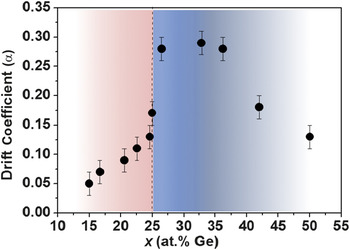
Measurement of the evolution of resistivity with time in amorphous GexTe100–x (10 ≤ x ≤ 50) films elaborated by cosputtering allowed for the calculation of the drift coefficient values (see Figure 4 ). Reference Luckas, Olk, Jost, Volker, Alvarez, Jaffré, Zalden, Piarristeguy, Pradel, Longeaud and Wuttig9 Two domains of compositions corresponding to different evolutions of the α coefficient with a sudden change at the rigidity threshold are observed. All stressed-rigid glasses demonstrate high values for α ranging from α = 0.13 for GeTe up to α ∼ 0.29 for compositions near the stiffness threshold. On the contrary, the drift coefficient tends to decrease with decreasing Ge content x in flexible glasses. Therefore, the Maxwell rigidity transition has a pronounced impact on resistance drift phenomena in GexTe100–x glasses.
Drift coefficients measured at the beginning of the drift experiment at 50°C over 24 h in amorphous GexTe100–x films obtained by the cosputtering technique. Two composition regions are observed: (1) For x < 25 at.% Ge, the drift coefficient exhibits low values (0.05–0.12), indicating a low tendency to aging; it increases monotonically with the Ge content; (2) for x > 25 at.% Ge, the α coefficient suddenly jumps to higher values (typically α = 0.29 for compositions between 25–35 at.% Ge), then it decreases for Ge-richer compositions. The boundary between the two regions occurs at the rigidity threshold indicating that the Maxwell rigidity transition has a pronounced impact on resistance drift phenomena in GexTe100–x glasses. Reference Luckas, Olk, Jost, Volker, Alvarez, Jaffré, Zalden, Piarristeguy, Pradel, Longeaud and Wuttig9

Moreover, the sharp increase in the drift coefficient resistivity α at the rigidity threshold, which reflects a higher tendency to aging for Ge-rich layers in the rigid region, is concurrent with the appearance of the first homopolar Ge–Ge bonds (inset Figure 3a). This phenomenon was confirmed in further studies. Reference Mitrofanov, Kolobov, Fons, Wang, Tominaga, Tamenori, Uruga, Ciocchini and Ielmini10,Reference Kolobov, Fons and Tominaga11
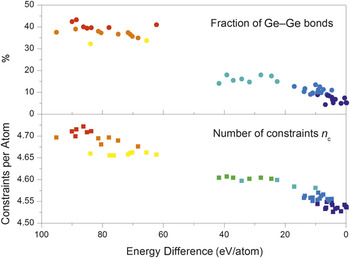
In recent work on GeTe, it was shown that aging, together with electronic drift, is linked to the vanishing of Ge–Ge bonds with time and to the progressive disappearance of tetrahedral Ge ( Figure 5 ). Interestingly, rigidity theory applied to the many models from Reference Reference Raty, Zhang, Luckas, Chen, Mazzarello, Bichara and Wuttig12 shows that the average number of mechanical constraints decreases during aging, therefore making the glass less stressed-rigid. However, even in its “ideal” lowest energy, the glass structure in this compound never reaches isostaticity. Interestingly, this decrease in internal rigidity has an indirect macroscopic manifestation, namely, the release of mechanical stress in the film, which contracts during aging.
Evolution of the average number of constraints during aging in amorphous GeTe. Reference Micoulaut, Raty, Otjacques and Bichara5,Reference Raty, Zhang, Luckas, Chen, Mazzarello, Bichara and Wuttig12 The reference energy is taken as the lowest energy among models. A variety of amorphous GeTe models were analyzed, showing the direct correlation between fraction of homopolar Ge–Ge bonds (top panel), fraction of tetrahedral Ge, and energy (not shown here). Rigidity theory applied to these models shows a global decrease of n c along with a decrease in energy upon aging (bottom panel). Reference Raty, Zhang, Luckas, Chen, Mazzarello, Bichara and Wuttig12

PCM stability and rigidity
Drift is not the only issue in the development of efficient phase-change memories; improving data retention at high temperature is another challenge for experimentalists. Fast switching or recrystallization implies low-activation energies. One of the ways to improve the stability of the amorphous phase in cases for which switching speed is not a crucial criterion is to dope the PCM with selected elements. For GeTe, strong doping with nitrogen or better, with carbon, increases the activation energy from a value of 2 eV in Ge52Te48 to 4.5 eV with 16 at.% C doping. Again, rigidity theory applied to these systems shows that doping with 10 at.% nitrogen adds about 0.3 constraints per atom and doping with 16 at.% carbon adds 0.5 constraints per atom with respect to the undoped case. Reference Raty, Noé, Ghezzi, Maîtrejean, Bichara and Hippert13
There is no direct link between the number of constraints and activation energy. However, there is a link between n c and vibrational properties. A larger value of n c leads to a smaller Boson peak at low frequency. Reference Florez-Ruiz, Naumis and Phillips14 This reduced number of “floppy” vibrational modes was measured experimentally and accounts for the much improved stability of the glass. The crystallization temperature reaches more than 300°C with 16 at.% C doping as compared to 180°C for the undoped case.
Conclusion
It is clear that rigidity theory is an extraordinary tool to understand glasses. In the particular case of PCMs, it allows further understanding of the link between structure, dynamics, and subtler properties such as drift and aging.
Acknowledgments
Support from the Agence Nationale de la Recherche (Grant No. ANR-11-BS08–0012) is greatly acknowledged. J.-Y.R. acknowledges support from CÉCI funded by the Fund for Scientific Research–Fonds de la Recherche Scientifique (Grant No. 2.5020.11) and from the Tier-1 Project funded by the Walloon Region (Grant Agreement No. 1117545).

Andrea Piarristeguy is an assistant professor at the Polytech Engineering School and the Institut Charles Gerhardt, Université de Montpellier, France. She received her PhD degree in materials science from the University of Buenos Aires, Argentina, in 2005. She was a postdoctoral fellow at the Charles Gerhardt Institute, Montpellier University, from 2005 to 2008 and in the Institute of Physics at the RWTH Aachen University, Germany, in 2009. Her research interests include the synthesis, structure, microstructure, and electrical properties of chalcogenide glasses for potential applications in information storage and energy storage. Piarristeguy can be reached by email at andrea.piarristeguy@umontpellier.fr.

Annie Pradel is a senior scientist at the Centre National de la Recherche Scientifique, France. She is currently a scientist at the Institut Charles Gerhardt, Université de Montpellier, France, where she directs a research group involved in the investigation of chalcogenide glasses with applications in solid-state ionics, information storage, and infrared integrated optics. She obtained her PhD degree in solid-state chemistry from the University of Montpellier in 1988. She received the Ovshinsky Award for excellence in chalcogenides in 2007. Pradel can be reached by phone at +33 4 67 14 33 79 or by email at annie.pradel@umontpellier.fr.

Jean-Yves Raty is a senior research associate at the Institut de Physique, Université de Liège, Belgium. He obtained his PhD degree from the Université de Liège in 1999 before joining the Quantum Simulation Group of the Lawrence Livermore National Laboratory as a postdoctoral researcher in 2001. His current research focuses on the properties of disordered systems, including high-pressure liquids and glasses, and combines ab initio methods with experimental methods such as extended x-ray absorption fine structure and diffraction. Raty can be reached by email at jyraty@ulg.ac.be.