1. INTRODUCTION
Driven by unprecedented demographic changes in population structure and by a cultural revolution in the form of living arrangements, living alone is now a key feature of contemporary Western populations. The explosion of one-person households is the extreme consequence of a long process of family simplification triggered by aging populations and a cultural change in attitudes towards marriage and life as a couple. The percentage of one-person households across Europe in 2011 was 31.4 per cent, with the highest proportions in the Nordic countries such as Finland, Denmark, and Norway.Footnote 1 Even in Italy, the home of strong family ties and large and interrelated kinship networks, the number of people living alone increased rapidly over the twentieth century,Footnote 2 from 8.8 per cent of total households in 1901 to 31.2 per cent in 2011,Footnote 3 around the European mean. The magnitude of the process and its social significance in contemporary societies explains why in recent years many studies have focused on one-person households.
Much less attention has been paid to people living alone in pretransitional populations.Footnote 4 Historical demographers, but also sociologists and family historians, have focused on social categories and family roles associated with celibacy rather than specifically with living alone. Such studies have mainly concerned people excluded, temporarily or permanently, from the marriage process (especially spinsters), but also widowed people and servants.Footnote 5 In societies characterised by individualism, nuclear households and life-course service, living alone has been studied mostly as a phase on the road to adulthood and family formation, or just as one element in the simplification of family forms over time, especially among the elderly.Footnote 6 On the other hand, in rural societies dominated by strong family ties and patrilocality, such as large areas of northern and central nineteenth-century Italy, the lack of interest has often been justified on the grounds of the limited number of one-person households.
Our study focuses precisely on Italian populations where a patrilocal family formation system and complex households dominated – a coresidential pattern that was typical of rural communities, though not the only one found there. The study has two main aims: first, demonstrating that the low incidence of solitaries in such areas was the consequence of the economic and social impossibility of remaining living alone in such communities. Unable to find an occupation or to run a farm on account of the necessities and characteristics of rural economy and the local labour market, solitaries living in the countryside were more at risk of suffering from extremely poor socioeconomic conditions. Our hypothesis is that such socioeconomic conditions might press solitaries to escape their status by facing the alternatives of finding a spouse, joining another household,Footnote 7 or emigrating. This urgency might explain, in our opinion, the low numbers of solitaries in the studied rural parishes.
Second, we investigate the reasons and determinants behind the different strategies for escaping such a solitary condition, with the belief that emigration may represent only the last resort among the possible options, typical of poor solitaries lacking a solid network of kin and social connections in the village.
To test those hypotheses, we have reconstructed the life-histories of solitaries in two sharecropping (mezzadria, in Italian)Footnote 8 communities of mid-nineteenth-century Italy – Madregolo and Casalguidi. After an aggregate analysis of the rural/urban differential in the incidence of solitaries, we will move to highlight the sociodemographic characteristics of solitaries in the two parishes studied. Then, we will proceed to study the origin and causes of solitariness, and, finally, an in-depth analysis of the strategies adopted by solitaries in their struggle for escaping solitude will be carried out.
2. SOLITARIES – A MATTER OF DEFINITION
Before entering in depth in the analysis of solitaries, it is necessary to stress the concept of solitariness. Solitaries did not represent a unique and homogeneous category, but rather a very differentiated group. In a strict sense, solitaries were people living entirely on their own, not even with a domestic or servant. However, a broader concept and definition of solitariness might be applied to unrelated people living together. Non-kin servants, for instance, did not formally live on their own. Nevertheless, they usually participated only marginally either in the allocation of resources within the household or in the family decision-making process.Footnote 9 The same applies to lodgers or other people living with non-kin only. Beyond the feelings and the bond between those unrelated individuals, the likely temporariness of that coresidential patternFootnote 10 and the possibility that non-kin might have a spouse or a family elsewhere might induce one to extend the concept of solitariness also to unrelated individuals living together. However, given the impossibility of knowing the nature and depth of such relationships, in this article the term ‘solitary’ will be used to indicate only people living on their own, namely households of size one, while the term ‘solitariness’ will be used to describe the condition of living alone. Such a definition will not take into account priests and clerics in general.
The city and the countryside
As previously mentioned, many studies have focused on celibacy and the absence of an exclusive relationship with another person, rather than on living alone per se, drawing attention to specific conditions and occupations more closely associated with such a condition, such as female domestic servants.Footnote 11 This explains why many of those essays concerned mostly urban societies. In historic Europe, in fact, towns and cities have been often regarded as communities where the presence of individuals characterised by weaker family ties, such as lodgers, servants, working men or clerics, was much more common than in the countryside. That was the case, for instance, in England during the early modern period, for which Allan Sharlin reported data showing a lower incidence of servants in rural communities (13.5 per cent between 1574 and 1821) compared to urban societies, where they accounted for over one fifth of the total population in a sample of 40 London parishes in 1695.Footnote 12
Thus, solitariness and the absence of a solid network of kin and relations were elements typical of many urban societies. Towns and cities had intrinsic characteristics that made them likely to be inhabited by a proportionally larger number of solitary people, namely a skewed marriage market in which females usually outnumbered males,Footnote 13 higher opportunities of employment and larger housing availability, which may represent good alternatives to marriage, and, finally, the presence of elite groups for which remaining single and living alone was not viewed in a negative light.Footnote 14 Along with those features, external motives concurred to make solitariness more likely in towns than in the countryside, and one of the most important ones was the existence of rural-to-urban immigration flows. As noted by Isabelle Caubet, who studied households and family groups in the city of Toulouse in 1695, towns attracted ‘une importante population de ruraux misérables venus chercher une situation meilleure. Ils arrivent seuls et viennent grossir les rangs des ménages pauvres’ (‘a mass of indigent rural dwellers came in search of better opportunities. They arrived alone and joined the ranks of the poor’).Footnote 15 Therefore, they basically moved to town in search of working opportunities,Footnote 16 as suggested by Litchfield for the city of Pisa and its countryside.Footnote 17 They could be rural dwellers, especially women,Footnote 18 moving to town to be employed as servants or domestics in wealthy urban families,Footnote 19 young men working for the early factories during the industrialisation process,Footnote 20 or poor elderly people coming to town only to find help and assistance in charitable institutions. As mentioned above, once they arrived in town many went to live as servants or resident employees, others lived with unrelated people in order to share the high costs of housing in the urban area, and only a portion of them lived on their own.
The above considerations explain why, despite many towns having generally higher proportions of solitaries than the countryside,Footnote 21 this was not a golden rule as there were cases in which the incidence was similar in both social contexts. According to Michael Anderson, for instance, the proportion of households of size one in mid-nineteenth-century England was low both in cities (5 per cent in York, 1 per cent in Preston) and in the countryside, where the proportion was around 3 per cent.Footnote 22 Figures not significantly different were provided by Peter Laslett in his study of one hundred preindustrial communities between 1574 and 1821, where the incidence of solitaries was around 6 per cent on average.Footnote 23 Alternatively, there were contexts in which rural populations had high proportions of solitaries, more or less in line with urban societies. This is the case of the contado of Florence in the fourteenth century and Southern France in the eighteenth and nineteenth centuries, where the incidence of solitaries was around 10 per cent,Footnote 24 or some rural areas of Spain, in which a marked productive specialisation associated with proto-industrial activities caused a strong simplification of household structures, increasing the proportion of one-person households to almost 16 per cent.Footnote 25
Our idea is that the magnitude of the urban/rural differential in the incidence of solitaries in pretransitional and transitional populations was higher in those areas where a neolocal family formation system typical of urban societies contrasted with a rural society dominated by large family groups of farmers (smallholders, sharecroppers, or tenants) and characterised by a family-based production system. In such areas, such as the rural areas of central Italy, only a patrilocal family formation system could guarantee sharecroppers and tenants the necessary workforce to till the land profitably. Consequently, in the very same areas, living alone was usually economically unsustainable and often impracticable, to such a point that even day labourers and agricultural wage earners did not usually live alone with the purpose of putting together a decent family income and having guaranteed some sort of family protection in hard times or in old age. Thus, solitaries tried hard to escape their condition, especially if poor and without their own house. The most obvious solution, especially if widowed, was to manage to join one of their children's households, thereby forming multigenerational family groups in a process called ‘nuclear reincorporation’.Footnote 26 Those who lacked a local network of kin or close friends may have been forced to leave the village to move elsewhere, likely to the closest city.
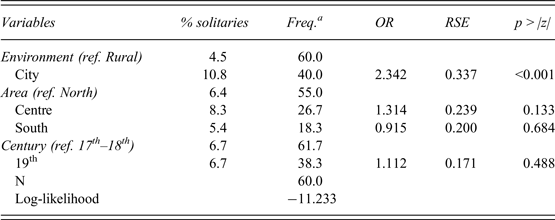
To test our hypothesis, we used about 60 published studies reporting and analysing census (or census-like) data of Italian populations, drawn from both religious and civil sources and recorded between 1385 and 1895.Footnote 27 Such studies were not chosen because specifically focused on solitaries, but because they used Laslett's household classification to describe the coresidential pattern in the population studied, reporting also the proportion of solitaries. Despite the intrinsic differences of the sources used, they provided a reliable picture of the incidence of one-person households across Italy and over time. Urban/rural differentials in the incidence of solitaries were checked controlling for both geographical localisation (North, Centre, and South) and census year (up to the eighteenth and nineteenth centuries). As the incidence was expressed as the ratio of solitaries to total households, a fractional logit regression was used.Footnote 28 This regression model allows not only for the use of proportions as the dependent variable but it is also able to handle zeros and ones at the extremes of the distribution. It is based on the logit link function (that is, the logit transformation of the response variable) and on the binomial distribution, which may be a good choice of family distributions even if the outcome variable is continuous, as it is in this case with the percentages of solitaries.Footnote 29 Table 1 reports the results.
Fractional logit regression of the proportion of one-person households drawn from censuses of Italian populations recorded between 1385 and 1895 (odds ratios)

a Freq. = % of observations in each category; OR = Odds Ratio; RSE = Robust Standard Error.
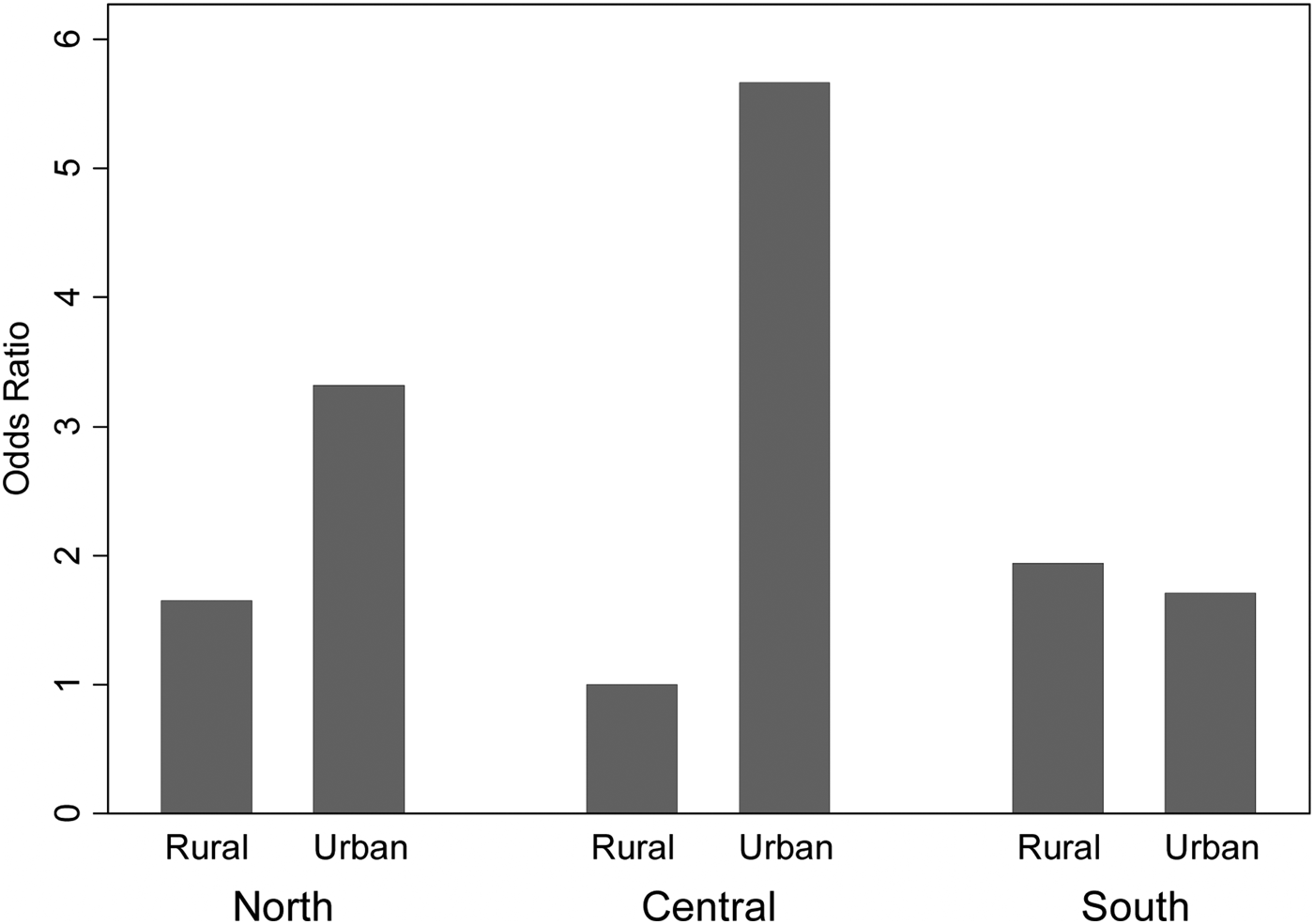
The analysis shows that the proportion of one-person households changed neither over time nor across the different regions of Italy, and was generally around 6–7 per cent of total households on average. As expected, significant differences were detected only between cities and the countryside, with the urban environment showing an incidence of one-person households significantly higher than rural populations (p < 0.001). In the cities, almost 11 per cent of total households, on average, were formed by only one person, which is more than twice the incidence of solitaries living in rural environments. This finding also confirms the limited presence of one-person households in preindustrial Italy in the rural populations of the plains and of the mountains. In a further model, an interaction between geographical localisation and the environment was added to the previous set of covariates (data not shown, see Figure 1). Figure 1 reports the odds ratios for all the categories of the variables involved in the interaction, using the populations in rural areas of central Italy as the reference category. The results in Figure 1 allow recognition that the largest urban/rural differential in the incidence of solitaries concerned central Italy, precisely those regions (Tuscany, Umbria, etc.) where sharecropping was widespread. This evidence seems to provide indirect support to the hypothesis of a net migration of solitaries from the sharecropping areas to the surrounding cities.
Fractional logit regression: interaction between geographical localisation and environment (odds ratios: reference category Rural populations in central Italy).

3. THE SHARECROPPING COMMUNITIES OF CASALGUIDI (1819–1859) AND MADREGOLO (1800–1883)
Casalguidi is a parish located in the present-day province of Pistoia, not far from Florence (Tuscany). In the period under study (1819–1859), it belonged to the Grand Duchy of Tuscany and numbered about 2,400 inhabitants and 460 households on average per year. Madregolo is a small rural village located 15 km west of Parma (Emilia-Romagna). It was part of the Duchy of Parma until 1861, the year of Italian unification. Its population numbered about 600 residents per year on average in the period studied (1800–1883), forming about 100 households. In those two populations, agriculture was by far the most important productive and economic sector. About 80 per cent of households were involved in farming, resulting in generally low living standards and economic conditions.Footnote 30 However, compared to the Emilian parish, where the very large majority of activities, artisanal included, revolved around agriculture and cattle production, the Tuscan village had a more complex social and occupational stratification. This was due to the presence of some forms of proto-industrial activities, especially in the textile field (embroidery and silk industries), in the production of earthenware and in the manufacturing of straw hats.Footnote 31
The demographic system was that typical of pretransitional Italy, with low levels of life expectancy at birth for both males and females – around 35 years – and high levels of marital fertility, with a TMFR20 of around eight children per married woman.Footnote 32
Two distinct family systems characterised the two sharecropping communities, tailored to the demands and interests of two different occupational groups, namely sharecroppers and farm day labourers.Footnote 33 Sharecropping was the most common form of land tenure in these villages, and it was based on an equal share of farm produce between the landlord and the sharecropping family. In addition, the sharecropping contract bound the entire household to the farm,Footnote 34 which made both the economic conditions of the sharecropping family and the landlord's economic return strictly dependent on the size and structure of the sharecropping family workforce. The presence of males was thus fundamental and an adult male was discouraged from leaving the parental household, so as not to deprive the family group not only of an important component of the current working force but also of future members (through reproduction). Failing this, the sharecropping household could run the risk of being evicted from the farm, which was the main reason why sharecroppers followed a patrilocal form of living arrangement after marriage.
Although the day labourers were landless like the sharecroppers, they did not have direct access to land and lived in the village. Since they did not constitute a production unit, their household structure was not a decisive factor in order to find work or to have the contract renewed, and each member of a day labourer's household had to do his/her best to find work in order to contribute to the meagre family income. A patrilocal living arrangement after marriage would have profoundly worsened the balance between household size and resources, and this explains why day labourers followed a neolocal system of family formation. In the end, in Madregolo, about 53 per cent of the population lived in complex households, a percentage slightly higher than in Casalguidi, where it was over 48 per cent on account of the smaller size of farms.
In this system, solitaries were obviously at a disadvantage, especially from an economic and occupational point of view. Their possibilities of signing a contract with a landowner to run a farm were practically nil, and the structure of the local labour market allowed them to be employed only as (poor) artisans, agricultural wage workers or day labourers. This condition made solitaries living in sharecropping societies at very high risk of poverty. In Casalguidi, the only population for which information on socioeconomic status and occupation is available, 79 per cent of solitaries were so poor they were exempted from taxation for manifest indigence against a value of about 33 per cent among the other household typologies. The position and condition of solitaries in such a productive system could be, however, disadvantaged and segregated well beyond economic motivations, especially if they were females. When lacking a solid network of relations in the village (that is, recent immigrants), spinsters and widows living alone may turn out to be socially marginalised. Not living under the authority of a man, as provided by legal and social norms in nineteenth-century Italy, they could be either pitied for being without any economic support from males or ‘regarded with suspicion because they were not subjected to what was viewed as normal family supervision and were therefore constantly exposed to the danger of violating social norms, particularly those concerning honor’.Footnote 35 The concern over unmarried women living alone was especially typical of patrilineal societies, in which the reproductive role of women, on the one hand, and the male control over it, on the other handFootnote 36 were necessary elements in order to secure the social and biological continuity of the family group.Footnote 37 Singleness was definitely accepted when it was the consequence of a family decision, a condition imposed on a household member within a broader family strategy. Sharecropping households, in fact, needed to control family size in order to avoid eviction from the farm, which led them to take preventive measures aimed at discouraging some family members from marrying. Thus, never-married people who stayed within the parental household were socially justified in the eyes of the community, just like priests, monks, and nuns were.Footnote 38
4. DATA AND METHOD
Data on one-person households were retrieved from Stati Animarum. These parish registers were a sort of census recorded by the parish priest each year at Easter. He listed all the members of each household residing in the village reporting their name, surname, age, sex, relationship to the household head, and each household head's occupation.Footnote 39 What is exceptional for Casalguidi and Madregolo is the continuity of Stati Animarum over time: there is only one year missing between 1819 and 1859 for the Tuscan village, and four missing between 1800 and 1883 for the Emilian parish. Exploitation of this source allowed us to trace the annual presence of each individual, and also to determine the composition of the household in which he/she lived, as well as to reconstruct his/her possible movements between different households.
Finally, a nominative linkage between Stati Animarum and parish registers of baptism, marriage, and burial enabled individual life-histories to be reconstructed for the years each dweller spent in Casalguidi. A total of 8,759 individuals were recorded in the parish registers of Casalguidi, accounting for 98,317 person-years, while 7,149 individuals, accounting for 45,930 person-years, were recorded in the registers of Madregolo. Only for Casalguidi were individual life-histories further linked to nominative information on the Tax Register. This was a civil source that recorded the tax each household had to pay year after year. This thus made it possible to assess the economic conditions (SES) of each family group over time. In this study, three SES categories were considered, namely indigent (exempt from taxation), low-tax, and medium- and high-tax families.Footnote 40
Longitudinal data and the reconstruction of life-histories enable not only the characteristics of solitaries to be investigated but also their origin and their fate, which is rarely addressed in historical studies. Along with classic demographic rates, such a data structure allows also for the analysis of the causes that led to solitariness, whether and how solitaries managed to change their condition, and which factors were important for such a change. Event history techniques were used, adopting the discrete-time approach, with yearly time-units, which is based on logistic regression models.Footnote 41 Event history models were used first to check for the existence of possible differential risks of death, emigration, and marriage between solitaries and the rest of the population once controlling; for obvious confounding factors. Secondly, competing risk models were estimated in order to assess which factors at the beginning of each year were the determinants of the different possible events through which solitaries escaped their condition (that is, marriage, emigration, or joining another household).Footnote 42 In all the analyses, the population at risk includes all the individuals aged 10+ years, except for nuptiality, which includes all the individuals aged 15+ years who were unmarried or widowed. Ten years is a threshold that allows one to take into consideration also young orphans moving into another family, sometimes even as servants, or into urban institutions. On the other hand, the choice of 15 years as the lower age limit for nuptiality analysis is due to the fact that in 1803 the canon law of the Catholic Church established that the minimum age at marriage for females was 14 years.
5. INDIVIDUAL LIFE-HISTORIES OF SOLITARIES
In this section, we shift from the aggregate analysis of solitaries to an individual approach. The individual life-histories of the solitaries of Madregolo and Casalguidi will be investigated in order not only to enter into much detail in the description of trends and characteristics of one-person households but also to shed some light on the causes of solitariness and on the determinants of escaping this condition.
5.1 Trends and characteristics of solitariness in Madregolo and Casalguidi
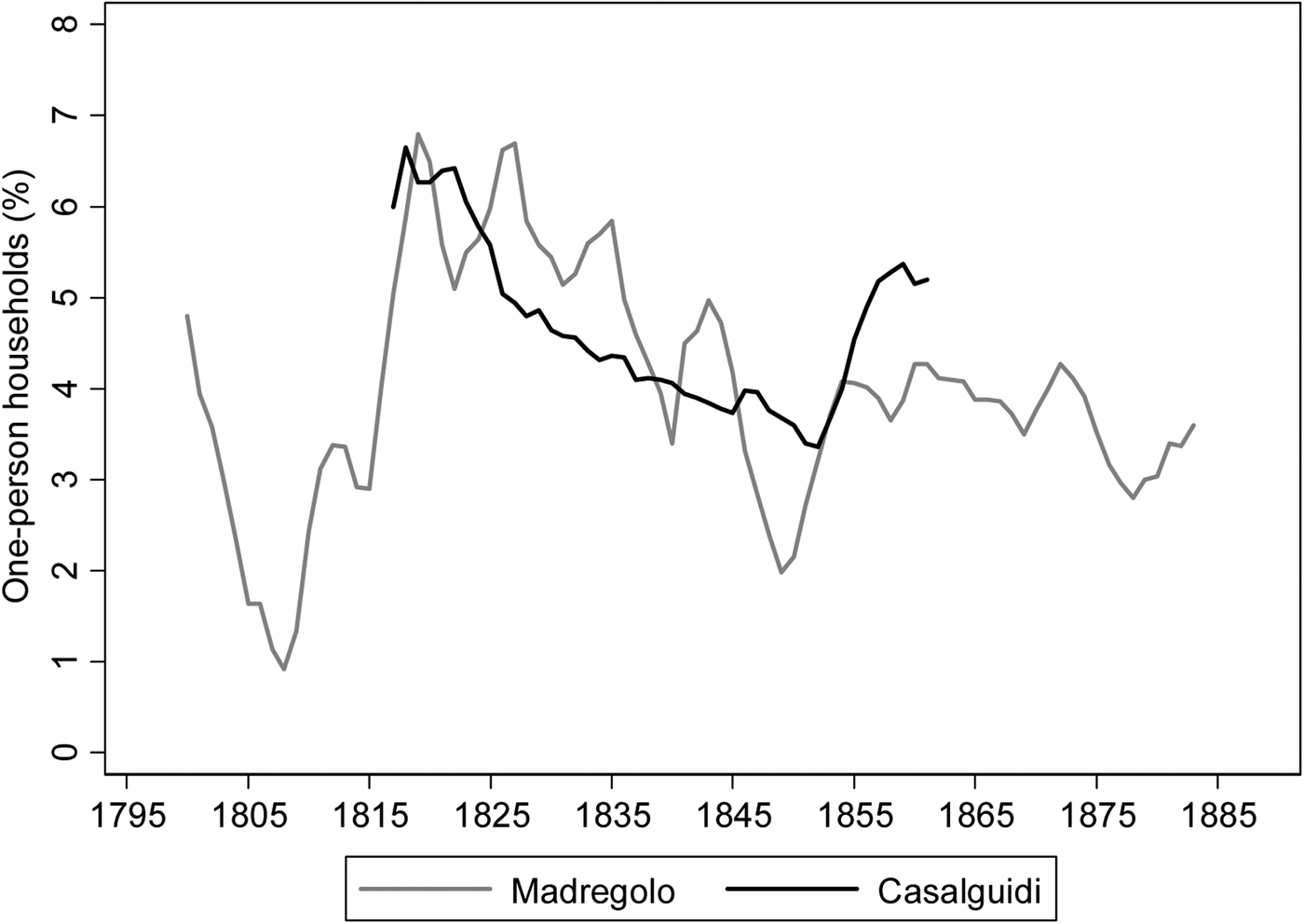
Figure 2 shows the proportion of solitaries among total households in both populations. Two similar patterns emerge, with the highest levels of solitariness (6–7 percent) just after Napoleon's campaigns in the early years of the nineteenth century and the great typhus epidemic that hit both villages in 1816–1817.Footnote 43 After that period, the number of one-person households declined up to 1854–1855, when the outbreak of another epidemic, this time cholera, led to a temporary increase in the proportion of one-person households, which was more marked in the Tuscan than in the Emilian population.Footnote 44
Proportion of one-person households to total households: five year moving average. Casalguidi, 1819–1859; Madregolo, 1800–1883.

This evidence supports the idea that increases in the proportion of people living alone were more likely to occur just after mortality crises when epidemics or social conflicts decimated the population, dissolved marriages and unions, and in so doing, profoundly transformed the size and composition of many households.Footnote 45 Higher mortality, marriage dissolution, postponed marriages, and family disruption all contributed to the increase in one-person households in those times of turmoil, socioeconomic crisis, and health emergencies.
Figure 2 is obviously a cross-sectional analysis based on the annual Stati Animarum. Shifting from cross-sectional to individual longitudinal data makes it possible to identify 216 solitaries in Casalguidi and 103 in Madregolo contributing to the trend shown earlier. These solitaries accounted for 836 person-years in Casalguidi and 332 in Madregolo, which means that they spent on average 3.9 and 3.2 years, respectively, on their own during the period studied. The majority of solitaries had lived alone for only a few years, while only a minority had been living alone for many years. In fact, the median number of years of solitariness was two in both populations. This highlights that the impact of solitaries on the two rural populations was definitely similar. For this reason and due to the low number of observations, the two populations will be analysed together as far as individual characteristics are concerned.
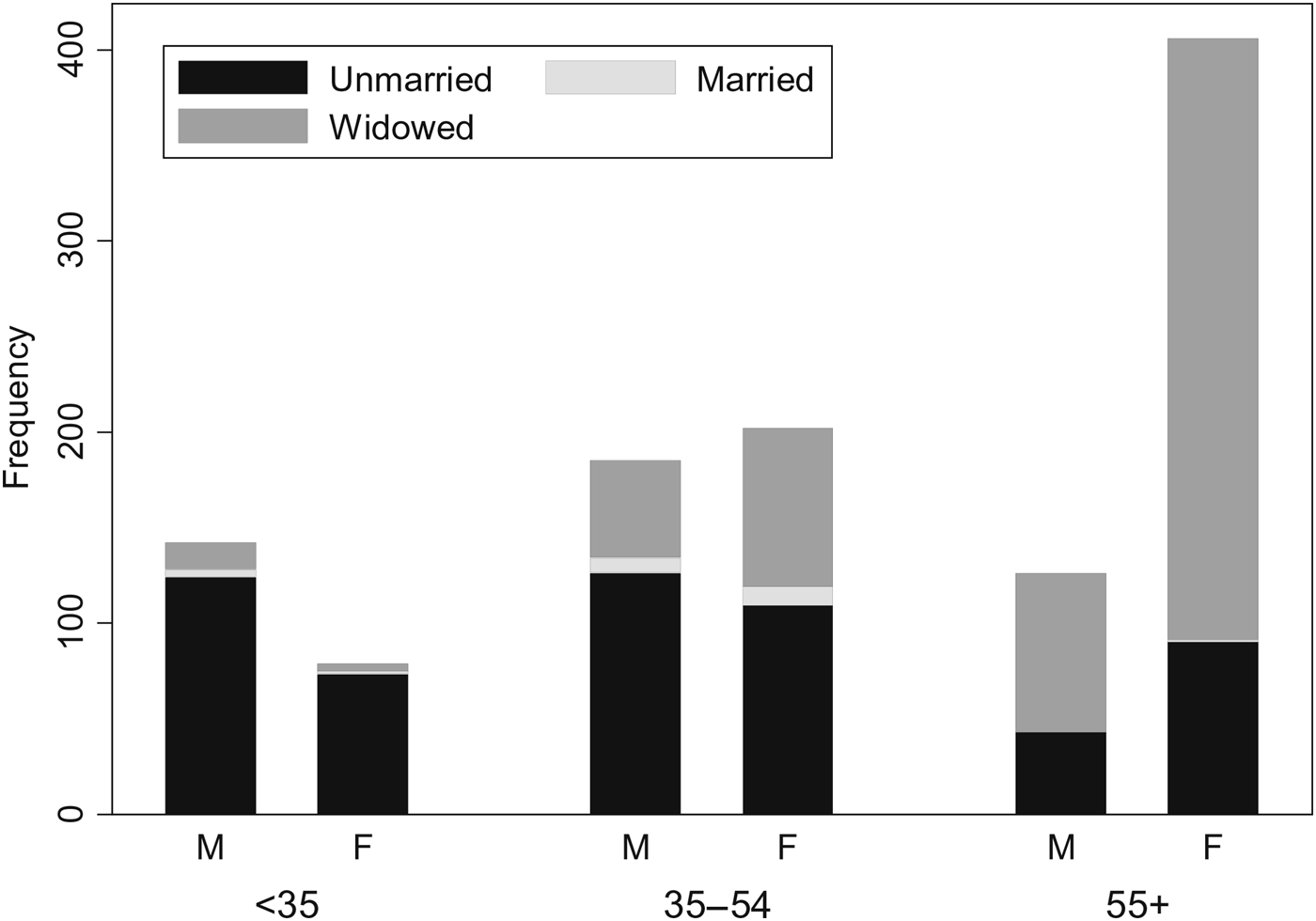
People living alone were mostly women (60.3 per cent), elderly (46.7 per cent), and with a balanced composition by marital status (49.6 per cent unmarried and 48.3 per cent widowed), although with different weights across age groups (Figure 3).
Number of observed person-years of solitaries by age, gender, and marital status. Casalguidi, 1819–1859; Madregolo, 1800–1883.

As expected, never-married individuals dominated at a younger age (<35 years), while the widowed were the largest majority among the elderly (55+). The oldest group of solitaries also has a skewed sex ratio, numbering many more females than males. Rather than a different life expectancy by gender, which was on average around 35 years for both sexes, this marked imbalance is likely the consequence of a different propensity to remarry between genders, which was much more common among widowers.Footnote 46
Analysis of the socioeconomic conditions was only possible for Casalguidi. As previously described, people living on their own were definitely poor. In fact, more than 79 per cent of the solitaries living in Casalguidi were so poor as to be considered indigent, thereby exempt from taxation. Only 2.1 per cent of them were vice versa classified as wealthy, generally representing rich unmarried landowners. Poverty and tax exemption were much more common among female (94.0 per cent) than male solitaries (68.7 per cent).
5.2 Reasons and determinants of living alone
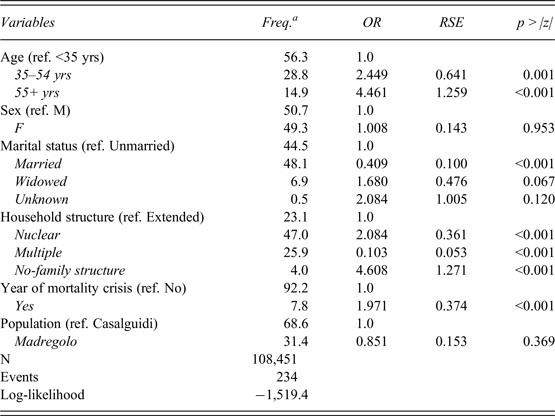
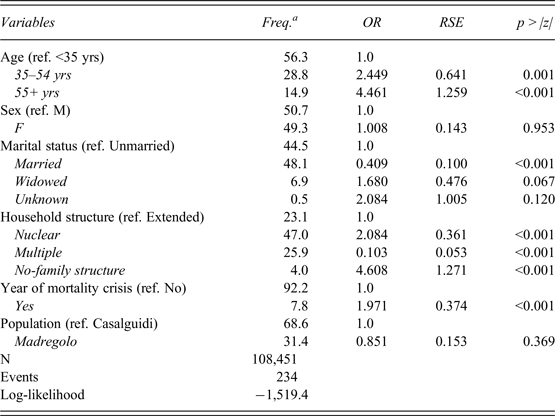
The characteristics of solitaries depicted above represent either the result of the causes that led to living alone or the determinants favouring or hindering the exit from such a solitary condition. In this section, we will provide an analysis for the most important risk factors of living alone. Table 2 shows the results of an event history analysis conducted on all the inhabitants of the two parishes with at least ten years of age. Age and gender are two demographic variables theoretically associated with solitariness, as descriptive analysis as already shown. Old age, in particular, represents the phase of life in which, for bio-demographic reasons, it is more likely to live alone. Individuals living in simple and small family groups, such as nuclear households, were obviously at higher risk of experiencing such living conditions. Laslett theorised the concept of ‘nuclear hardship’ to explain the weakness and fragility of nuclear households, especially in terms of care and support for elderly people. Talking of the English nuclear family system of living arrangements after marriage, he explicitly defined solitaries as ‘victims of nuclear hardship, in whose favour no exception to family formation rules had been made’.Footnote 47 Although Italian sharecropping areas were more likely characterised by a patrilocal family formation system, rural solitaries could be as well defined as victims – people unable to find a family able to support them. The likelihood of remaining alone was therefore strictly associated with family size and the strength of social connections of each parishioner of the communities studied. Thus, two variables concerning different aspects of social connection and social inclusion, namely household structure and marital status, were included in the model. The first variable was coded using a simplified Laslett scheme of household classification, which uses extended households as the reference category, and nuclear,Footnote 48 multiple, and non-family households as contrast categories. This latter category includes either households without a conjugal unit or households whose classification was impossible or uncertain. On the other hand, marital status considers unmarried individuals as the reference category, against married and widowed people as contrast categories.
Logistic regression of the risk of living alone: population 10+ years (odds ratios). Casalguidi, 1819–1859 and Madregolo, 1800–1883
a Freq. = % of observations in each category; OR = Odds Ratio; RSE = Robust Standard Error.
As emerged from the descriptive analysis, the number of solitaries increased after periods of serious mortality crisis, such as the epidemics of typhus in 1816–1817 and cholera in 1854–1855 and the first years of the Napoleonic campaigns at the beginning of the nineteenth century. In this regard, we introduced a variable relative to the years (usually two) immediately following a mortality crisis. Finally, a last variable concerning populations (Madregolo vs Casalguidi) was introduced with the aim of capturing all the unexplained variability in the chances of living alone between the two parishes studied. This unexplained variability might concern local differences associated with socioeconomic stratification, geographic localisation, and the different time period considered. The results are quite clear and go in the expected direction. First, the older the age the higher was the risk of experiencing solitariness, with people 55+ years being four times more at risk than individuals aged less than 35 years. Second, the likelihood of living alone was directly associated with the household structure and the strength of social ties. On the one hand, the simpler the household the higher was the likelihood of living alone. In particular, compared to extended households, people living in nuclear households were 47 per cent more likely to remain alone, while members of multiple households were more than 90 per cent less likely to experience such an event. On the other hand, married individuals were 59 per cent less likely to live alone, while widows/widowers ran a 68 per cent higher risk compared to unmarried people. The result concerning married individuals was expected as they lived far from home usually only when involved in temporary migration. Permanent separation of spouses was quite infrequent in a society strictly adhering to Catholic values and in which divorce was forbidden. Finally, the likelihood of remaining alone significantly increased in the years just following a mortality crisis, being double that of ‘normal’ years.
5.3 The demographic behaviour of solitaries: managing to find a way out
One of the assumptions of this article is that solitaries, due to very poor living conditions and the urgent need to escape solitariness, may have been forced to assume (demographic) behaviours that were likely to be different, at least in terms of intensity, from the rest of the population. People living alone might manage to get out from their difficult condition by (re)marrying or by joining another household. They could also emigrate either to join relatives living elsewhere or just to escape from a rural environment that did not guarantee them either any chance to improve their socioeconomic condition or social inclusion and approval.
Table 3 compares, respectively, the rates of mortality, nuptiality, and emigration between the groups of solitaries and the rest of the population aged ten years or more. Marriage is usually studied in the 15–49 age group, in association with reproduction, but here it was decided to extend the age beyond 50 years because remarriage after that age was also an important option when escaping solitariness.
Rates of mortality, nuptiality, and emigration of solitaries and population (x 1,000). Casalguidi, 1819–1859; Madregolo, 1800–1883

a The population at risk includes all the individuals aged 10+ years for mortality and emigration. For nuptiality, it includes all the individuals 15+ years who are unmarried or widowed.
Solitaries show a higher intensity for each of the demographic events considered. As for nuptiality and emigration, the difference with the rest of the population is striking, especially for the latter, of which the rate is approximately 66 per cent higher than that of non-solitaries (137.2 against 82.6 per thousand). If we add that the rate of joining another household was over 90 per thousand, what emerges is the picture of a group of people who desperately wanted to escape their unfortunate condition. On the other hand, mortality presents similar levels in the two sub-populations. However, the above figures could be biased by differences in the gender and in the age structure of the two sub-populations. Therefore, multivariate logistic regression models assessing the risk of, respectively, mortality, nuptiality, and emigration were run in order to allow for such confounding factors (Table 4).
Logistic regression models: odds ratios of mortality, nuptiality, and emigration for solitaries. a Casalguidi, 1819–1859; Madregolo, 1800–1883

a The population at risk includes all the individuals aged 10+ years for mortality and emigration. For nuptiality, it includes all the individuals 15+ years who are unmarried or widowed. The models control also for age, gender, and population. In bold p < 0.05, in Italics p < 0.10
Once controlled for age, gender, and population, the odds of mortality for solitaries was 35 per cent lower than that of non-solitaries (p = 0.065). This result is clearly against the hypothesis formulated at the beginning of the analysis, which postulates the higher mortality of solitaries from their poor living conditions and social marginalisation. However, the significantly higher risk of emigration of solitaries (two times higher than the reference category) stresses the fact that solitaries remained only temporarily in Madregolo or Casalguidi, thereby far reducing the chances of recording their death in the studied villages. As for nuptiality, the results shown in Table 4 clearly confirm the significantly higher propensity of solitaries to get married or remarried compared to non-solitaries.
The evidence that solitaries were more likely to emigrate and to get married than ‘normal’ people were is a confirmation of the assumption of this article that living alone in such rural populations was an unfortunate condition from which people managed to find a way out. Our next step is to assess which factors influenced the various demographic options of escaping a solitary life, either marriage, joining another household,Footnote 49 or emigration. Competing risk models were used studying these events along with death. The dichotomous dependent variables of the four risk models define structurally different events. While death is naturally a unique event, marriage, emigration, and joining another household are events that solitaries might experience more than once during their lifetime. In addition, some individuals might experience two events in the same year – marriage and death, marriage and emigration, etc. – thereby occurring in the same time unit of analysis. In these cases, the individual conditions at the beginning of each year can be taken as potential proxies only for the earlier event, which in turn determines new conditions that may influence the later event. For these reasons, only the earlier event will be analysed here.
The association between living alone and the demographic events mentioned above was studied controlling for potential confounding factors. Gender and age are individual biological characteristics potentially associated with the risk of experiencing every demographic event. The effect of marital status is evident in the case of marriage (the rates of first marriage and remarriage are very different),Footnote 50 but it is also important as determinant of mortality and emigration.Footnote 51 It has been shown, in fact, that, once controlled for age, never-married individuals usually experienced higher risks of death and emigration compared to ever-married people. Kin Network is a dichotomous variable evaluating the presence or absence of kin in other households of the village. About 8 per cent of the single observations concerning solitaries were associated with the presence of other kin living in the village, a value that is somewhat higher than the average figure for the entire population, around 6.5 per cent. Married daughters living in the father-in-law's household are the most common example of this type. It has been demonstrated that individuals that were part of a local kin network experienced lower risks of out-migration because they were better able to find help and assistance in the village.Footnote 52 People who remained alone for some reason may have been, as well, less likely to emigrate in the presence of kindred households in the village. Another variable is Grain Price, which is a community-level variable aimed at capturing general economic conditions and ‘traditionally, particularly in aggregate studies, grain prices have often been used as proxies for harvest outcome, so that high grain prices reflect a bad harvest and low food supply, leading to increased mortality, delayed marriages, etc.’.Footnote 53 In the areas studied in this article, grain prices were particularly high during the Napoleonic period (early nineteenth century) and during serious mortality crises due to typhus (1816–1817) and cholera epidemics (1854–1855). Finally, a dichotomous variable regarding Populations, with Casalguidi as the reference category, captures once again structural and unexplained differences in mortality, emigration, and nuptiality between the two populations. As already noted in section 5.1, these differences likely include socioeconomic factors, on which information was available only for Casalguidi, which prevented us from including such a covariate in the analysis.
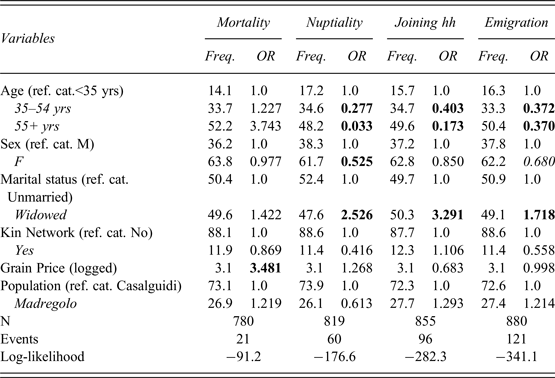
Table 5 shows the results of competing risk models. The mortality risk factors for people living on their own are limited to grain price, whose increment determines significant increases (p < 0.010) in the mortality risk. The low number of observed deaths could explain the general lack of statistical significance of the variables included in this model. However, a model limited to the population of Casalguidi (results not shown), and including Family Tax as a covariate, also suggests the existence of a strong effect of socioeconomic status on mortality, clearly indicating the significantly higher risk of death among the poorest, namely indigent people exempt from taxation. As for the determinants of the three events causing the exit from solitariness (marriage, joining another household, emigration), the resulting pattern is quite similar, more likely involving male, young, and widowed solitaries. In all three models, in fact, the older the solitary, the lower the odds of escaping that condition, which highlights the difficulties of elderly solitaries in either finding a (new) spouse (−97 per cent), being physically able to move elsewhere (−83 per cent), or finding a family to harbour him/her (−73 per cent) compared to people younger than 35 years.
Competing risk models of exit from solitude: logistic regression (odds ratios). Casalguidi, 1819–1859; Madregolo, 1800–1883 a

a Freq. = % of observations in each category; OR = Odds Ratio. In bold p < 0.05, in Italics p < 0.10. The population at risk includes all the individuals aged 10+ years for mortality and emigration. For nuptiality, it includes all the individuals 15+ years who are unmarried or widowed. In bold p < 0.05, in Italics p < 0.10
Similarly, females living alone had significantly lower chances of escaping solitariness compared to males, especially by getting married (−47 per cent) or emigrating (−32 per cent). On the other hand, widowed solitaries were definitely more likely to break out from solitariness than unmarried ones were. In particular, they had more than three-times higher chances of joining another household and about two times higher chances of getting married or emigrating. A further model involving also an interaction between age and marital status (data not shown) allowed to highlight that the positive effects of widowhood on the odds of escaping a solitary condition were common in all age groups (with the exception of nuptiality), and particularly between 35 and 54 years. If we hypothesise that even emigration could be associated with having relatives living elsewhere, these findings are probably the result of the likely higher number of kin on whom widowed solitaries could rely for hospitality (children, grandchildren, parents-in-law, etc.). The existence of a web of relatives able to provide hospitality to solitaries could also explain the possible link between moving out (or joining another household) and the kin network. The fact that marital status and kin network are variables somehow correlated one to another could explain the lack of statistical significance regarding the kin network in both the joining and emigration models. In fact, when the models do not allow for marital status (results not shown) the role of the local kin network becomes statistically significant and negatively associated with emigration and positively with joining a local household.
In the end, the specific demographic profile associated with escaping from solitude, namely being male, young, and widowed, outlines individual characteristics that were somehow associated with good local connections, social inclusion, and social position as well as with working attitudes suitable for the local economic and productive system. Men, especially if widowed, were, in fact, likely to be embedded in larger local networks of kin and connections in comparison with females because of the patrilocal system of living arrangement after marriage. In addition, widowers were also usually more likely to remarry than widows were due to social norms and the traditional Catholic practice of nineteenth-century Italy.Footnote 54 On the other hand, whatever the marital status, young solitaries had good chances to marry as well as to be incorporated into a household for their physical contribution to the family working force. The demographic profile above described, however, does not support some of our initial ideas concerning the emigration of solitaries. First, elderly people appear less involved in emigration flows, which makes the hypothesis of the search for help and assistance in urban institutions less probable. Second, the minor role of female solitaries in such movements induces us to reconsider the relevance of domestic service as one of the major causes of emigration.
6. CONCLUSIONS
People living alone have seldom been studied in historical demographic studies, especially those living in rural populations. Various reasons can explain this lack of interest and what we know comes mainly from studies of family historians concerning the household structure of past societies, but, also in those cases, the analyses have been usually limited to simple percentages of one-person households. In this article, we have used reconstructed life-histories of the inhabitants of two nineteenth-century Italian rural communities to shed some light on the causes of solitariness as well as on the strategies to escape it.
What has emerged in this study is that the solitaries of the sharecropping areas of mid-nineteenth-century central Italy, who lived in an economic and social context extremely unfavourable for people living alone, hardly managed to find a way out from this condition. They tried every possible strategy, either joining another household, creating a household on their own through marriage or moving elsewhere, which shaped a specific pattern of demographic behaviours characterised by higher intensity with respect to the rest of the population. The primary consequence of this urgency is that only a few people died in solitude in the rural villages studied. The second finding is that many of the individual characteristics that increased availability and quality of social connections seem to have played a key role in breaking out from solitariness, especially through marriage or incorporation into another household. As for emigration, which was the preferred option among solitaries, it is impossible to say whether it may have resulted in a change of the former condition of solitary or not. However, we also found strong evidence that the largest urban-rural differential in the incidence of one-person households occurred precisely in the regions of Italy dominated by a sharecropping form of land tenure and by family-based production. These findings could provide indirect evidence that many of the solitaries who left the rural sharecropping villages still lived on their own once they arrived in town. What is clear is that the demographic profile of the solitaries who out-migrated (male, young, and widowed) does not appear to support the hypothesis of elderly people moving to the city to find care and assistance in charitable institutions as well as that of women finding employment as a servant in some wealthy family, but rather that of men moving out in search of working opportunities. Whether they moved to cities, to other rural communities, or abroad, and whether or not they found better working opportunities is still a matter of discussion.Footnote 55
These findings should, therefore, encourage further studies of solitaries in rural populations not only to improve our knowledge of the characteristics of such a neglected social group but also to deepen our understanding of their role in the demographic and social dynamics that made the countryside and the city strictly interdependent during the preindustrial and industrial period.