In an effort to improve the postoperative haemodynamic state of neonates with hypoplastic left heart syndrome undergoing a Norwood procedure, a number of institutions have revisited the use of a shunt placed directly from the right ventricle to the pulmonary arteries for provision of the flow of blood to the lungs.1–4 The advantage of this type of shunt is elimination of diastolic run off, and elevated aortic diastolic blood pressure, which may result in improved coronary arterial perfusion.5–8 This leads to the theoretical advantage of balanced systemic, pulmonary and coronary arterial circulations, with an improved resistance to physiologic insults, such as survival following cardiac arrest.9 Favourable early outcomes have been reported for such patients undergoing a Norwood procedure when compared to those with a modified Blalock-Taussig shunt.10–14 Concerns remain, however, regarding the necessary ventriculotomy, and its effects on long-term ventricular and tricuspid valvar function, as well as growth of the pulmonary arteries and outcomes following future staged palliation.
The purpose of our study, therefore, was to compare the effect of these two approaches on morbidity, mortality, qualitative echocardiographic assessment of right ventricular function and tricuspid regurgitation, pulmonary arterial growth, and candidacy for and outcomes following the second stage of palliation.
Methods
Patients studied
From January, 2000, to April, 2005, Norwood procedures were performed in 88 consecutive patients. Diagnoses were aortic and mitral atresia or stenosis with left ventricular hypoplasia in 70, right ventricle dominant unbalanced atrioventricular septal defect with hypolasia of the aortic arch in 10, and dominant left ventricle in the setting of functionally univentricular heart with obstruction to the systemic outflow tract in 8. To provide more homogeneous groups for comparison, we excluded the 8 patients with a functionally single left ventricle from the study. In addition, we excluded 4 patients who were converted from a shunt placed from the right ventricle to the pulmonary arteries to a modified Blalock-Taussig shunt from all analyses except the need for conversion or revision of the shunt due to concerns regarding the potentially confounding effects of both modified Blalock-Taussig shunt and ventriculotomy in a single patient. Among the 76 patients remaining for analysis, a modified Blalock-Taussig shunt had been constructed in 35 patients, and a shunt had been placed from the right ventricle to the pulmonary arteries in 41 patients as part of the initial Norwood procedure. All patients with a shunt between the right ventricle and the pulmonary arteries, and three patients with a modified Blalock-Taussig shunt, had undergone surgery after May, 2002. Collection of data was approved by, and performed following the guidelines of, the Institutional Review Board.
Courses of patients
We reviewed the progress of all patients retrospectively, comparing those in the 2 groups for morbidity, in terms of revision of the shunt, need for post-operative extracorporeal membrane oxygenation, and listing for cardiac transplantation, and mortality following the Norwood procedure. We also compared inter-stage mortality, gain of weight, pharmacotherapy utilized, and candidacy for and outcomes following the second stage of palliation. Cardiac catheterizations were performed in all patients prior to the second stage of palliation.
Echocardiography
Transthoracic cross-sectional, Doppler, and colour Doppler echocardiography was obtained on all patients at the time of catheterization prior to the second stage. For those patients who had died prior to this stage, we used the most recent complete study. Right ventricular systolic function was qualitatively graded in 5 planes, specifically the subcostal long axis, subcostal short axis, apical, parasternal long axis and parasternal short axis planes, using a scale from 1, representing normal, to 4 for those with severely depressed function. The severity of tricuspid regurgitation was also graded from 1, for no regurgitation, to 4 for those with severe valvar incompetence. From each imaging plane, observations that were considered to be in between two grades were graded as the average of those two grades. We also calculated the ratio of the diameter of the jet of tricuspid regurgitation to that of the annulus of the tricuspid valve.
A single experienced observer, who was blinded to the outcomes and type of shunt, retrospectively reviewed all echocardiograms (G.S.S.). All echocardiograms were digitally acquired and stored. An independent reviewer marked the areas of interest in a manner that did not reveal the type of shunt, date of study, or the identity of the patient. The blinded observer then reviewed only the areas of interest for the purposes of grading and measurements. Intra-observer variability was assessed by means of blinded review of echocardiograms on 10 patients by the same observer 1 month after initial review.
Statistical analyses
Data was described as median and range or mean plus or minus standard deviation as appropriate. Groups were compared using the Fisher exact test, chi square analysis, Mann-Whitney rank sum test or the unpaired Student's t-test assuming unequal variance, as appropriate. Data reproducibility, and intra-observer variability, were expressed by the correlation coefficient. Statistical significance was defined as a p less than 0.05.
Results
Courses
Hospital morbidity and mortality following the Norwood procedure did not differ between the groups (Fig. 1). Nor were the requirements for post-operative extracorporeal membrane oxygenation different, at 2 of 35 (6%) for those having a modified Blalock-Taussig shunt versus 1 of 41 (2%) of those with a shunt from the right ventricle to the pulmonary arteries (p equal to 0.59). No patient in either group needed evaluation for cardiac transplantation.

Figure 1. Postoperative and interstage mortality following the Norwood procedure.*p = 0.75, [dagger]p = 0.13 of hospital survivors, [Dagger]34 of 41 patients (83%) who underwent a right ventricular to pulmonary arterial shunt survived to the second stage of palliation, compared to 23 of 35 patients (66%) who underwent a modified Blalock-Taussig shunt (p = 0.14). Abbreviations: mBT: modified Blalock-Taussig shunt. RV-PA: right ventricular to pulmonary arterial shunt.
Shunt conversions or revisions occurred in 9% of patients in both groups, 3 of 35 of those with modified Blalock-Taussig shunts versus 4 of 45 of those having shunts from the right ventricle to the pulmonary arteries (p equal to 1.0). Of the 4 patients converted from a ventricular to a modified Blalock-Taussig shunt, 3 had undergone surgery during the initial 14 months of performing the ventricular shunt. One was an infant of a diabetic mother, in whom thickened myocardium may have caused obstruction at the proximal end of the shunt, necessitating conversion on the second post-operative day. The other 2 had hypoxaemia that persisted after conversion to the modified Blalock-Taussig shunt. Of these, one had been converted in the operating room during the Norwood procedure, and the other on the second postoperative day. Both infants responded to nitric oxide. The fourth conversion was made on the 22nd postoperative day, secondary to endocarditis, with obstructive vegetations found within the shunt placed from the right ventricle to the pulmonary arteries. Of these four patients needing conversions to a modified Blalock-Taussig shunt, two died prior to the second stage of palliation, namely the patient with endocarditis and the infant of the diabetic mother. The other 2 patients survived the second stage of palliation. Of the 3 patients requiring revision of their modified Blalock-Taussig shunts, one died during initial hospitalization, while the other 2 survived through the second stage of palliation.
Echocardiography
The mean age at the time of echocardiography was not significantly different between the 2 groups, at 4.8 months plus or minus 2.7 months for those with modified Blalock-Taussig shunts versus 4.5 months plus or minus 1.8 months for those with shunts from the right ventricle to the pulmonary arteries (p equal to 0.59). Qualitative assessment of right ventricular systolic function and tricuspid regurgitation also did not differ between groups, the specific findings being shown in Table 1. The correlation coefficients for intra-observer variability of qualitative assessment of right ventricular function, and the severity of tricuspid regurgitation, were 0.92 and 0.98, respectively.
Table 1. Echocardiography data; median (range)/mean.

We then compared these same echocardiographic measures of right ventricular function and severity of tricuspid regurgitation between all patients who died and all living patients, regardless of the type of surgical shunt constructed. A significant difference was found between groups for worse tricuspid regurgitation in patients dying, with a median of 1.5 for those who survived versus 2.5 for those who died (p equal to 0.017). Right ventricular function, however, did not differ between these groups, median values being 1.2 for those surviving and 1.3 for those who died (p equal to 0.29).
Interstage course
Although improved interstage survival was seen for those with a shunt placed from the right ventricle to the pulmonary arteries, the difference was not significant (Fig. 1). There was no difference between groups in the median weight gain per day from the time of initial hospital discharge to admission for the second stage of palliation, at 16 grams per day, with a range from 9 to 26 grams per day, for those with modified Blalock-Taussig shunts versus 19 grams per day, with a range from 2 to 33 grams per day for those with shunts from the right ventricle to the pulmonary arteries (p equal to 0.11).
Given that the assessment of ventricular function is load dependent, and may be altered by systemic afterload, we compared the utilization of several medications that may affect the assessment of ventricular function, such as digoxin, inhibitors of angiotensin converting enzyme, antiarrhythmic agents, and furosemide. There was no difference between the groups for the medications used, with the exception of digoxin, which was used in 40% of those with modified Blalock-Taussig shunts as opposed to 9% of those with shunts from the right ventricle to the pulmonary arteries (p equal to 0.01). For the other agents, inhibitors of angiotensin converting enzyme had been given in 8% of those with modified Blalock-Taussig shunts versus 20% of those with ventricular shunts (p equal to 0.42), antiarrhythmics in 8% versus 3% (p equal to 0.58), and furosemide in 76% versus 75% (p equal to 0.82) of the respective groups.
Cardiac catheterization
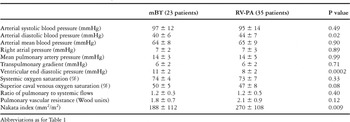
The group with ventricular shunts was catheterized at a younger age, specifically a mean of 4.6 months plus or minus 0.8 months, versus 5.4 months plus or minus 1.2 months for those receiving modified Blalock-Taussig shunts (p equal to 0.01). Findings at catheterization are shown in Table 2. A single patient had a myocardial muscle bundle causing proximal obstruction to a shunt placed from the right ventricle. No aneurysms were seen at the site of ventriculotomy in any patient.
Table 2. Cardiac catheterization data (mean plus or minus standard deviation).

Progress to the second stage
As a group, patients with shunts placed from the right ventricle underwent the second stage of palliation at an earlier age, a mean of 5.9 months plus or minus 1.4 months compared to 6.7 months plus or minus 1.2 months for those undergoing the modified Blalock-Taussig shunt (p equal to 0.02). There was no significant difference between the groups in median duration of mechanical ventilation, at 1 day with a range from 1 to 10 days for those with the modified Blalock-Taussig shunt versus 1 day with a range from 1 to 46 days for those with ventricular shunts (p equal to 0.51), the duration of stay in the intensive care unit, at 3 days with a range from 2 to 12 days versus 3 days with a range from 2 to 46 days (p equal to 0.52), and length of stay in hospital, at 8 days, with a range from 4 to 20 days versus 6 days with a range from 4 to 80 days (p equal to 0.46), respectively. In addition there was no difference between groups in the need for pulmonary arterial augmentation at the time of second stage palliation, at 39% for those with modified Blalock-Taussig shunts versus 47% for those with ventricular shunts (p equal to 0.77).
In one patient with a shunt from the right ventricle to the pulmonary arteries, who never left the hospital following initial Norwood palliation, death occurred 1.5 months after the second stage of palliation due to severe atrioventricular valvar regurgitation. There was no other mortality at the surgery for the second stage. From initial Norwood palliation through the second stage of hospitalization, 33 of 41 patients (80%) who underwent construction of a shunt from the right ventricle to the pulmonary arteries survived compared to 23 of 35 patients (66%) of those undergoing construction of a modified Blalock-Taussig shunt (p equal to 0.23).
Additional analysis
Hypoplasia of the left ventricle in the setting of a common atrioventricular junction is frequently considered as a variant of hypoplastic left heart syndrome. We further analyzed all data in those with the classical variant of the syndrome, excluding the 10 patients with a common atrioventricular valve, namely 2 patients with a modified Blalock-Taussig shunt and 8 patients with a shunt from the right ventricle to the pulmonary arteries. There was no change in any outcome variable with the exception of interstage death, at 22% for those with modified Blalock-Taussig shunts versus 3% for those with ventricular shunts (p equal to 0.05).
Further analyses were then performed based on the intention to treat. The 4 patients that underwent conversion from a ventricular to a modified Blalock-Taussig shunt were included and the data was reanalyzed. There was no change in the results.
Discussion
Several institutions have revisited the use of a shunt placed from the right ventricle to the pulmonary arteries to improve postoperative haemodynamics in patients undergoing the Norwood procedure for hypoplastic left heart syndrome. Despite favourable early findings, concerns remain about a ventriculotomy, and its effects on long-term function of the right ventricle and tricuspid valve. Although no method for quantifying right ventricular function has uniformly been accepted, a prior study has shown qualitative assessment of systolic function to be the best predictor of survival.15 The current literature shows conflicting results regarding right ventricular function following construction of a shunt from the right ventricle.16, 17 As far as we know, ours is the first study to use a blinded approach to the qualitative assessment of right ventricle function and tricuspid regurgitation in this population. Right ventricular function was not different between groups in any of the echocardiographic planes used for assessment, nor when the qualitative assessments of all views were averaged, suggesting no global deleterious effects of the ventriculotomy on systolic function. Indeed, early evidence from strain Doppler echocardiography has revealed improved systolic function in the first 2 months postoperatively in patients undergoing the Norwood procedure with a ventricular shunt.16 These observations of systolic function, along with our findings of significantly lower ventricular end diastolic pressure, militate against a detrimental effect of the ventriculotomy on ventricular function.
There was no difference between groups regarding tricuspid regurgitation. Among our patients, those who died prior to the second stage of palliation had significantly worse qualitative tricuspid regurgitation when compared to patients who survived, regardless of the type of shunt received. We have recently shown that atrioventricular valvar regurgitation, and the need for atrioventricular valvoplasty at the second stage of palliation, is associated with death, transplantation or failure to progress through complete Fontan procedure.18 Interestingly, right ventricular systolic function did not differ between the patients who survived as opposed to those who died. This may be a reflection of the qualitative methodology that was used to assess right ventricular function. It is also likely that right ventricular systolic dysfunction is masked in the presence of significant tricuspid regurgitation.
Growth of the pulmonary arteries has been a concern due to the unique pattern of flow associated with the nonvalved ventricular shunt, and possible obstruction secondary to myocardial muscle bundles. We found that pulmonary arterial size, as judged using the Nakata index, is in fact larger prior to assessment for the second stage in those with a shunt originating from the right ventricle, suggesting no deleterious affects, and possibly improved pulmonary arterial growth. Our findings are in agreement with recent studies showing a higher ratio of pulmonary arterial to aortic diameters, and improved pulmonary arterial growth, following the construction of shunts between the right ventricle and the pulmonary arteries.10, 19 Additionally, the need for pulmonary arterial augmentation at the time of second stage palliation was not different between our two groups of patients. Obstruction of ventricular shunts secondary to myocardial muscle bundles has been implicated in causing increased cyanosis requiring earlier palliation for the second stage. Among our patients, both catheterization and the second stage of palliation were performed earlier in those with shunts originating from the right ventricle. We opine that this reflects an institutional bias, with improved follow up and a more proactive scheduling of procedures, rather than reacting to increased cyanosis, given similar saturations of oxygen and ratios of pulmonary to systemic flow at catheterization.
As in other studies, we found increased systemic arterial diastolic blood pressure in those with shunts originating from the right ventricle, probably due to elimination of diastolic runoff from the aorta.5–8 It has been speculated that the elimination of such diastolic runoff results in an increase in coronary arterial perfusion, and more stable coronary blood flow, with a resultant decrease in the incidence of interstage mortality and resilience to cardiopulmonary resuscitation.9, 14 We propose this leads to the trend found towards improved survival to the second stage of palliation in neonates receiving a shunt originating from the right ventricle, especially in those with “classic” hypoplastic left heart syndrome.
We recognize that our study is limited by its retrospective, nonrandomized design, the small size of our sample, the relatively short duration of follow up, and the fact that the majority of the patients did not undergo contemporaneous operations. Results in those receiving a shunt originating from the right ventricle may have been influenced by our Institutional learning curve. In addition, the cause of interstage death was frequently not available, so the improved survival seen in those with shunts taking origin from the right ventricle may also be due to improved follow up, or better care, rather than the morphology of the shunt itself. A larger number of patients, as well as longer follow up, may reveal clinically important differences between the two approaches. A randomized prospective multi-centered trial is underway to address these issues.