1. Background
Most quantitative analyses can be categorized into two main types: variable-centred and person-centred (see Bergman & Magnusson, Reference Bergman and Magnusson1997). The former is used to examine associations between variables, whereas the latter is used to identify groups of individuals with similar values across variables. To illustrate this using the main topic of the present study as an example, a variable-centred analysis would investigate whether providing different types of glossary information is associated with second language (L2) vocabulary learning, whereas a person-centred analysis would explore whether there exist different learner types when various types of glossary information are provided.
The use of person-centred analysis in the field of L2 research dates back to the early 1980s. It has been adopted to identify hidden patterns or groups among L2 learners in terms of L2 aptitude (e.g. Hummel & French, Reference Hummel and French2016; Skehan, Reference Skehan1986), L2 motivation (e.g. Csizér & Dörnyei, Reference Csizér and Dörnyei2005; Papi & Teimouri, Reference Papi and Teimouri2014), and L2 learning approaches or strategies (e.g. Yamamori, Isoda, Hiromori & Oxford, Reference Yamamori, Isoda, Hiromori and Oxford2003). By using a battery of language tests and questionnaires, these studies have revealed that it is possible to identify different affective, cognitive, and achievement profiles of L2 learners.
The primary goal of the present study is to unearth hidden groups of learners in a corpus-based L2 vocabulary learning experiment using a data-mining technique that is frequently used in the field of computer science. To this end, we employed a model-based clustering technique, which uses statistical criteria to determine an optimum number of groups. This feature distinguishes itself from traditional clustering methods used thus far in the field of L2 research (e.g. hierarchical clustering or partitioning clustering; Csizér & Dörnyei, Reference Csizér and Dörnyei2005; Skehan, Reference Skehan1986). Although these traditional clustering methods have the potential to exert strong power in identifying similar groups of learners “based on strength of and relationships among several [outcome] variables” (Papi & Teimouri, Reference Papi and Teimouri2014: 495), they are considered heuristic because they are not based on formal models, thus requiring researchers to make a subjective decision on the optimal number of clusters (see Meilă & Heckerman, Reference Meilă and Heckerman2001; Witten, Frank, Hall & Pal, Reference Witten, Frank, Hall and Pal2016). Adopting more advanced techniques from a cutting-edge data-mining approach might help us unearth hidden groups or patterns from a data set in a more reliable and precise way.
Moreover, scant attempts have been made in L2 and computer-assisted language learning (CALL) research to understand possible hidden groups or patterns from data obtained from experimental designs aimed to compare the effects of different types of treatment. To address this paucity, we used data obtained from a previous experiment in an instructed L2 context, in which concordance lines excerpted from corpora were provided as glossary information in CALL reading environments (Lee, Warschauer & Lee, Reference Lee, Warschauer and Lee2017). On the assumption that learners would make meaning inferences of target vocabulary by exploring the concordance lines provided (so-called “data-driven learning,” or DDL; Johns, Reference Johns1991), their lexical inferences via the multiple contextual examples excerpted from corpora can be more accurate when additional confirmation opportunities via dictionary definitions of target vocabulary are provided. A previous variable-centred analysis revealed that, on average, DDL was effective but that providing an additional definition glossary led to even more L2 vocabulary gains (Lee et al., Reference Lee, Warschauer and Lee2017). Given that clustering groups of similar individuals in terms of the aforementioned variables (i.e. L2 aptitude, motivation, and strategy use) has provided a new angle on the problem, adopting data-mining techniques for experimental data could reveal information that is equally important, if not more so. For example, when there are significant differences between treatment and control groups in terms of outcome variables, it is possible that “there is considerable variation within these groups” (Staples & Biber, Reference Staples and Biber2015: 243). A close examination of this variation could thus reveal some interesting findings about the effect of a target treatment on certain groups of learners.
Overall, we believe that adopting a data-mining approach makes a significant contribution in that we can glean information about how individuals behave in each learning condition, subsequently allowing us to provide personalized instruction. As the present study is about CALL reading environments equipped with glossary information with one type of this information being corpus-based input (i.e. concordance lines), in the following sections we review the literature on different learner types in L2 vocabulary learning with different glossary types and corpus-based L2 vocabulary learning. We then present a description of methods, our findings, and implications.
1.1 Different learner types in L2 vocabulary learning with different glossary types
There have been continuous empirical efforts in the L2 vocabulary learning and CALL literatures to examine the impact of different glossary types, such as L1 and L2 glosses (e.g. Yoshii, Reference Yoshii2006), multimedia glosses (e.g. Lomicka, Reference Lomicka1998; Yanguas, Reference Yanguas2009), glosses in different positions on screen (e.g. AbuSeileek, Reference AbuSeileek2011; Chen & Yen, Reference Chen and Yen2013; Lee & Lee, Reference Lee and Lee2013, Reference Lee and Lee2015), and concordance-based glosses (e.g. Lee et al., Reference Lee, Warschauer and Lee2017; Poole, Reference Poole2012). However, only limited attempts have been made to understand different learner types in L2 vocabulary learning with different glossary types (e.g. Chun, Reference Chun2001; Plass, Chun, Mayer & Leutner, Reference Plass, Chun, Mayer and Leutner1998).
In one example, Plass et al. (Reference Plass, Chun, Mayer and Leutner1998) developed a computer program called CyberBush to improve L2 reading comprehension by offering different types of glossary. Participants in their study were German learners who read a story that consisted of 762 German words. Participants could click on verbal information (i.e. text translated into their first language) and/or multimedia cues (i.e. picture or video clips in their first language) on 24 target lexical items. Based on log-file data of learners’ choices of glossary types, the results revealed that on average students achieved better vocabulary gains when they selected both glossary types rather than selecting one or none. Further, Plass et al. found different learner types who showed diverse preferences towards glossary types to maximize their reading comprehension.
In another example, Chun (Reference Chun2001) developed a web program called netLearn to investigate L2 learners’ preferences between instructor-created glosses (internal glossary) and electronic dictionaries (external glossary). In addition to log-file data of learners’ clicks on websites, a small number of participants were asked to conduct think-aloud protocols as they read. Post-intervention interviews were then conducted with a few selected students. The results from both the quantitative and qualitative data revealed that on average participants showed better reading comprehension when they were provided access to both internal and external glossaries than when provided access only to an external glossary. Further, Chun identified different learner types who had varied beliefs in which glossary type was more helpful and showed contrasting strategies for L2 vocabulary learning during their activities.
Overall, only a few studies in the field of L2 vocabulary learning have examined different learner types in CALL experiments, and researchers have emphasized that more research is needed to tackle this issue. With similar purpose, a data-mining technique that can provide a statistical basis for similarity-based aggregating (Witten et al., Reference Witten, Frank, Hall and Pal2016) could be used to identify different learner types based on data obtained from an experiment.
1.2 Positive impact of corpus-based glossary information and different learner types
Inferring meanings of unfamiliar L2 vocabulary, also known as L2 lexical inferencing, is considered a successful vocabulary learning strategy (e.g. Fraser, Reference Fraser1999; Nassaji, Reference Nassaji2003; Schmitt, Reference Schmitt2000). For this reason, it is believed that corpus use can promote self-driven L2 vocabulary learning by allowing learners to explore authentic language data on their own or with some level of guided induction (e.g. Cobb, Reference Cobb1999; Johns, Reference Johns1991; Lee et al., Reference Lee, Warschauer and Lee2017). Learners can discover linguistic features of target vocabulary such as its contextual meanings and collocation patterns as they are induced by multiple contextual examples excerpted from corpora (DDL; Johns, Reference Johns1991). Recent meta-analysis studies (e.g. Boulton & Cobb, Reference Boulton and Cobb2017; Lee, Warschauer & Lee, Reference Lee, Warschauer and Lee2018) have confirmed the overall positive effect of corpus use on L2 vocabulary learning, although they did not distinguish the studies focusing on the effects of independent lexical inferencing and those on the effects of guided induction in DDL.
However, to the best of our knowledge, little has been studied about how learners may differentially benefit from corpus-based glossary information (Boulton, Reference Boulton2009; Flowerdew, Reference Flowerdew2008; Lee et al., Reference Lee, Warschauer and Lee2017). For example, in our previous study (Lee et al., Reference Lee, Warschauer and Lee2017), we found four emerging patterns of vocabulary learning from the participants’ interactions with e-glosses. However, the results were not about learner types but about vocabulary types, such that vocabulary items may need different glossary types for them to be learned most effectively. Furthermore, although recent meta-analyses (Boulton & Cobb, Reference Boulton and Cobb2017; Lee et al., Reference Lee, Warschauer and Lee2018) included a moderator analysis to identify factors related to learner types in corpus-based L2 learning, these studies failed to identify such factors because of limited data and incomplete reporting of the included studies. Nevertheless, we believe that corpus-based glossary information may not be appropriate for all types of learners. For example, there could be different learner types, considering that language data excerpted from corpora could be beyond some learners’ comprehension levels (Lee et al., Reference Lee, Warschauer and Lee2018) or could impose different amounts of cognitive load (Lee & Lee, Reference Lee and Lee2015). Thus, the present study aimed to unearth different learner types in a corpus-based L2 vocabulary learning experiment via a data-mining approach.
2. Present study
Data mining is generally categorized into two types: (1) supervised and (2) unsupervised (Witten et al., Reference Witten, Frank, Hall and Pal2016). A distinguishing factor of these two types is whether data mining is being implemented with or without a response variable (i.e. predefined labels or classifications of observations). For example, supervised data mining is mainly used to predict or classify observations from a new data set based on the algorithm computed from pre-classified observations in an original data set. Conversely, unsupervised data mining is mainly used to analyse a given data set without predefined labels or classifications and identify hidden structures of the data set. In the present study, we focused on unsupervised data mining because our goal was to unearth possible different learner types from experimental data. As part of this approach, we also hypothesized that using a model-based clustering technique based on statistical distributions and probabilities in identifying clusters (see Fraley & Raftery, Reference Fraley and Raftery2002) would expand our perspective and advance CALL research.
Based on the suggestions of researchers (e.g. Chun, Reference Chun2001; Lee et al., Reference Lee, Warschauer and Lee2017; Plass et al., Reference Plass, Chun, Mayer and Leutner1998) and limited empirical evidence on learner types (e.g. Boulton & Cobb, Reference Boulton and Cobb2017; Lee et al., Reference Lee, Warschauer and Lee2017, Reference Lee, Warschauer and Lee2018), we conjecture that there may be different learner types who show different learning patterns to maximize their L2 vocabulary learning. Such differential learning patterns would deviate from previous variable-centred findings on the correlation between the amount of glossary information provided and L2 vocabulary knowledge gains at the group level (Lee et al., Reference Lee, Warschauer and Lee2017). We believe that this study provides a clearer picture on how to explore different learner types when a data-mining approach (as part of person-centred analysis) is accompanied by variable-centred analysis. We address the following three guiding research questions:
1. Are there hidden groups of learners in a corpus-based L2 vocabulary learning experiment?
2. If so, how similar or different are they from each other in terms of maximizing their L2 vocabulary learning?
3. What is the role of L2 proficiency in relation to different learner types?
3. Methods
In this study, we used experimental data published by Lee et al. (Reference Lee, Warschauer and Lee2017) that addressed effects of different glossary types on L2 vocabulary learning: (1) concordance lines and definitions, (2) concordance lines only, and (3) no glossary–all of which were equipped with English reading tasks in CALL reading environments. In this section, we describe the methodological aspects involved in comparing these three conditions as well as the details of our data analysis plan.
3.1 Participants
A total of 132 L2 undergraduate students with a wide range of academic majors in Republic of Korea participated in this study. They were convenience samples from six intact EFL classes. We adopted a repeated-measures design to have each participant experience all three reading tasks in a random order. To determine students’ L2 (English) proficiency, we collected their scores on the Test of English for International Communication (TOEIC) developed by the Educational Testing Service (2016). The average TOEIC score of these participants was 732, indicating that they were at an intermediate level of English proficiency (CEFR B1; TOEIC scores between 550 and 785). According to a post hoc power analysis, the sample size was large enough to yield sufficient statistical power for the study design.Footnote 1
3.2 Materials
We extracted three reading texts, each consisting of approximately 500 words, from newspaper articles on social issues from an English textbook (Cunningham, Moor & Carr, Reference Cunningham, Moor and Carr2003). Through a pilot study using students with similar characteristics to our participants, we determined key features of glossary information (e.g. a preferred and manageable number of sample sentences for students’ L2 vocabulary learning) and 30 unfamiliar lexical items from the reading texts, including nouns (e.g. endowments, fib), verbs (e.g. traipse, tuck), adjectives (e.g. mucky, dodgy), and multi-lexical items (e.g. be beset with, in the vicinity of). Each reading text included 10 of the target lexical items evenly distributed throughout the text.Footnote 2
The reading texts were made compatible with three conditions of glossary information.Footnote 3 For the concordance lines and dictionary definitions condition (CODI), each target vocabulary item was hyperlinked to a pop-up window showing three preselected concordance lines via a customized tool. After consulting these concordance lines, learners could confirm the inferred meaning through dictionary definition of the target vocabulary item.Footnote 4 For the concordance lines only condition (CONC), target vocabulary items were hyperlinked to a pop-up window for concordance lines. For the no glossary or control condition (CTRL), target vocabulary items were underlined without providing lexical information.
3.3 Study design and previous findings
To prevent possible order effects, we computed six order types to distribute the three tasks: (1) task 1–task 2–task 3, (2) task 1–task 3–task 2, (3) task 2–task 1–task 3, (4) task 2–task 3–task 1, (5) task 3–task 1–task 2, and (6) task 3–task 2–task 1. Participants within condition were then randomly assigned to these order types. After a pre-test of target lexical items, the participants completed the three reading tasks in an ordinary classroom with their own laptops, followed immediately by post-tests of target lexical items (e.g. task 1–post-test 1–task 2–post-test 2–task 3–post-test 3). The pre-test and each post-test took five minutes, and each reading task took 15 minutes. Scheduling considerations did not allow us to include a definition-only condition.
In the post-tests, the participants were required to write the meaning of each target lexical item in either the L1 (Korean) or the L2 (English). Their answers were given a zero point for inaccurate meaning, one point for partially correct meaning, or two points for completely correct meaning.
In our previous study (Lee et al., Reference Lee, Warschauer and Lee2017), we found that on average the participants achieved higher post-test scores than their pre-test scores and that their gains were statistically significant (p < .001) within each of the different conditions. When compared between the conditions, we found that the participants under the CODI condition achieved the highest post-test scores on average, followed by those under the CONC condition and then those under the CTRL condition. The achievement differences between the conditions were statistically significant (p < .05). It was also found that there was no order effect and that having different sets of target lexical items in each reading task did not affect participants’ overall vocabulary gains (see Lee et al., Reference Lee, Warschauer and Lee2017, for more details).
3.4 Data analysis plan
To answer the first research question, as part of our data-mining approach, we used a model-based clustering technique with R 3.4.2 for Windows along with the mclust package version 5.3 (entitled “Gaussian mixture modelling for model-based clustering”; Fraley, Raftery, Scrucca, Murphy & Fop, Reference Fraley, Raftery, Scrucca, Murphy and Fop2017; Scrucca, Fop, Murphy & Raftery, Reference Scrucca, Fop, Murphy and Raftery2016). The mclust package identifies clusters in given data based on pre-defined Gaussian mixture models (GMMs; see Fraley & Raftery, Reference Fraley and Raftery2002; Jung, Kang & Heo, Reference Jung, Kang and Heo2014). Provided that any given data can be multi-dimensional, models can be distinguished from each other in terms of their distributions, volumes, shapes, and orientations (see this article’s supplementary materials for detailed information about predefined GMMs included in the mclust package).Footnote 5
In general, any statistical technique works best with normally distributed data. Although model-based clustering has been reported to be robust for non-normal data sets (Mun, von Eye, Bates & Vaschillo, Reference Mun, von Eye, Bates and Vaschillo2008; Yeung, Fraley, Murua, Raftery & Ruzzo, Reference Yeung, Fraley, Murua, Raftery and Ruzzo2001), the method assumes that identified clusters are “concentrated locally about linear subspaces” by using pre-defined normally distributed models to statistically unearth hidden groups of cases (Fraley & Raftery, Reference Fraley and Raftery1998: 586). This indicates that it would also work best with data that are normally distributed, or Gaussian.
For this reason, we checked the normality of students’ performance data, such as pre- and post-test scores, by using univariate and multivariate normality tests after applying each of four commonly used data transformations: logarithm, square root, reciprocal, and reverse score (see Field, Reference Field2009; Pires & Branco, Reference Pires and Branco2010, for data transformations). First, we used a skewness and kurtosis test for each variable (i.e. the Improved D’Agostino Test suggested by Royston, Reference Royston1991). This test compares the symmetry and flatness of the distribution of a variable to the normal distribution. Second, we used two widely used tests for multivariate skewness and kurtosis (i.e. the Henze–Zirkler [Henze & Zirkler, Reference Henze and Zirkler1990] and the Doornik–Hansen [Doornik & Hansen, Reference Doornik and Hansen2008] tests). These tests examine “whether the marginal distributions and linear combinations of x-variables are normal and whether observations of pairs of x-variables show the elliptical appearance of the equal-density contours” (Tacq, Reference Tacq2010: 338; see this reference for more information about the multivariate normal distribution).
The results indicated that the square root transformation satisfied the Gaussian mixture assumption for the post-test scores according to the normality tests at the 1% significance level. Although the pre-test scores were important indicators of students’ achievement, we found that the data values, which measured participants’ unfamiliarity with target vocabulary items, could not be normally distributed, as both the mean and standard deviation were very close to zero. It was further found that gain scores, which can be calculated by subtracting pre-test scores from post-test scores, failed the normality tests under all the data transformations.Footnote 6 As a result, we used the post-test scores for the model-based clustering, and included the pre-test scores as covariates in the following data analysis to take account of the baseline differences.
To answer the remaining research questions, we conducted logistic regression and multiple regression analyses. With pre-test scores and gender as covariates, L2 proficiency scores were analysed to (1) check how participants of different cluster memberships were similar to or different from each other, and (2) understand the role of L2 proficiency in relation to different learner types in different learning conditions. To ensure consistency, all data analyses followed by the model-based clustering used the square roots of the vocabulary test scores.
4. Results
4.1 RQ #1. Hidden groups in a corpus-based L2 vocabulary learning experiment
The results of the data-mining technique indicated that there were two clusters across different glossary types for maximizing L2 vocabulary learning potentials. Specifically, we found the best fit at the two-cluster solution according to the lowest Bayesian information criterion (BIC) value (BIC=−511.92; see supplementary materials for detailed information about how the optimal model can be determined by BIC via the mclust package). This result indicated that there were different groups of learners in terms of the square roots of their post-test scores in three conditions.
4.2 RQ #2. Similarities and differences in L2 vocabulary learning between hidden groups
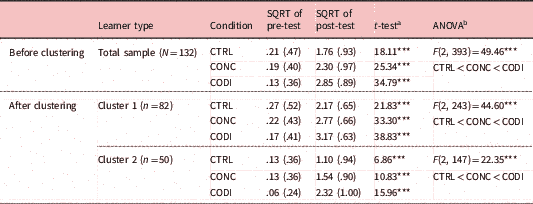
Table 1 presents the descriptive statistics of vocabulary test scores for the two different learner types, as well as the total sample. Corresponding to the overall finding that all participants, on average, gained a statistically significant amount of L2 vocabulary knowledge within each of the three conditions, both the two learner types achieved higher vocabulary post-test scores than pre-test scores in all conditions and the differences were statistically significant (p<.001).
Descriptive statistics of vocabulary test scores

Note. Standard deviations are in parentheses. SQRT=square root.
***p<.001.
a t-tests examined whether the square roots of post-test scores were different from the square roots of pre-test scores.
b ANOVA results compared the square roots of post-test scores between the conditions.
To further analyse how the two groups of learners were similar to or different from each other across the different glossary types, we conducted an ANOVA by using the square roots of the post-test scores, which were used for the model-based clustering technique. Roughly speaking, the two learner types appeared to exhibit L2 vocabulary learning patterns largely corresponding to our previous finding at the group level (i.e. CTRL<CONC<CODI; see Total sample row in Table 1) but with different magnitudes of gains (i.e. higher or lower gains according to the size of t-values from t-tests).
Predicted values of vocabulary post-test scores from multiple regression analysis

Note. Values came from multiple regression analysis with the square roots of the vocabulary post-test scores as the dependent variable and vocabulary pre-test scores, gender, and L2 proficiency scores as independent variables or covariates. See supplementary materials for the complete results of the analysis. Standard errors are in parentheses.
First, the finding that the participants performed well under the CONC and CODI conditions, when compared to CTRL, indicates that both the two learner types might have harnessed corpus-based language input as a source of their vocabulary learning, supporting researchers’ advocacy for providing concordance lines as glossary information for L2 vocabulary learning (e.g. Frankenberg-Garcia, Reference Frankenberg-Garcia2012, Reference Frankenberg-Garcia2014; Lee et al., Reference Lee, Warschauer and Lee2018; Poole, Reference Poole2012).
Second, participants’ higher scores under the CODI condition compared to the CONC condition indicated that providing definitions of target lexical items in addition to concordance lines had a positive impact on L2 vocabulary learning. This condition likely enabled learners to confirm their inferred meaning of target lexical items (e.g. Cobb, Greaves & Horst, Reference Cobb, Greaves and Horst2001; Fraser, Reference Fraser1999). This finding also corresponds to Godwin-Jones’s (Reference Godwin-Jones2001) idea that learners’ inaccurate inferences from inductive learning would be minimized if their meaning inferences can later be confirmed through definition of target lexical items.
However, results from the multiple regression analysis with the square roots of the vocabulary post-test scores as the dependent variable and the square roots of the vocabulary pre-test scores, gender, and L2 proficiency scores as independent variables or covariates reported a slightly different picture.
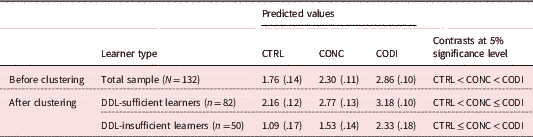
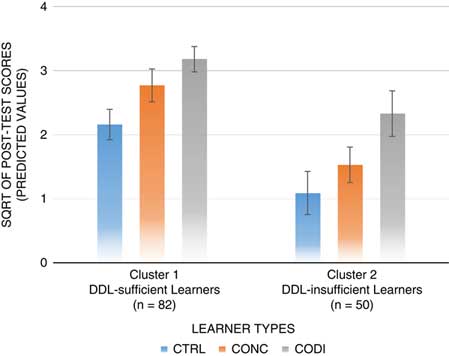
We obtained bar graphs (see Figure 1) by using the predicted values of the dependent variable (i.e. the square roots of the post-test scores across three different conditions) from the multiple regression analysis (see Table 2). Although the bars largely correspond to the overall finding (i.e. CTRL<CONC<CODI), examination of error bars suggested that some of the differences between the conditions could be statistically insignificant (i.e. overlapping error bars). In brief, the vocabulary gains of Cluster 1 in CONC and CODI conditions and the gains of Cluster 2 in CTRL and CONC were not statistically different, respectively (see Table 2). We named these two clusters as follows: (1) “DDL-sufficient learners,” and (2) “DDL-insufficient learners.”
Two clusters (learner types) and their L2 vocabulary learning patterns Note. Values are from Table 2. Error bars represent 95% confidence intervals.
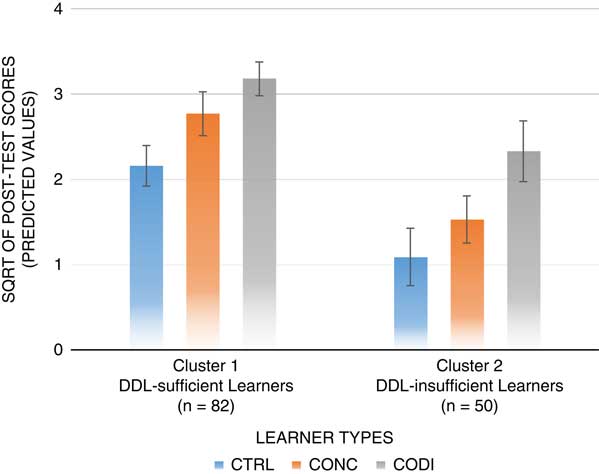
First, we named Cluster 1 DDL-sufficient learners (n=82) to refer to those who achieved the highest post-test scores when they performed DDL under CONC and CODI conditions (no statistically significant difference between these two conditions; t=2.04, p=.08). This learning pattern indicated that receiving concordance lines as glossary information was sufficient for these learners to be successfully induced to discover the meaning of target lexical items by independently exploring concordance lines. Further, given that this learner type has higher English proficiency (TOEIC scores: M=759.04, SD=81.07) than the average L2 proficiency level of the DDL-insufficient learners (M=688.50, SD=86.39), we can speculate that DDL can be more effective for learners with higher L2 proficiency (Boulton, Reference Boulton2009; Flowerdew, Reference Flowerdew2015; Leńko-Szymańska & Boulton, Reference Leńko-Szymańska and Boulton2015).
Second, we named Cluster 2 DDL-insufficient learners (n=50) because they were unlikely to achieve significantly higher scores when they received concordance lines only as glossary information compared to under the CTRL condition where no glossary was provided (no difference between these two conditions; t=1.52, p=.17). In other words, DDL was not an effective way of learning L2 vocabulary for this learner type compared to DDL-sufficient learners. As suggested by previous researchers (e.g. Huang, Reference Huang2011; Lee & Lee, Reference Lee and Lee2015), students of this learner type may find that the concordance lines provided are incomprehensible or unsuitable in accordance with their relatively low L2 proficiency level (M=688.50, SD=86.39). This assumption, as well as findings of a study by Chun (Reference Chun2001) that participants generally prefer glossary information that requires a lower cognitive load, enabled us to suggest that DDL-insufficient learners probably learned target lexical items by leveraging dictionary definitions under the CODI condition (Cobb et al., Reference Cobb, Greaves and Horst2001; Fraser, Reference Fraser1999) without benefiting much from DDL activities.
4.3 RQ #3. Role of L2 proficiency in relation to different learner types
Finally, we used the English proficiency (TOEIC) variable to check if it was related to cluster membership. In addition to the simple comparison between DDL-sufficient learners and DDL-insufficient learners in terms of L2 proficiency level, we conducted a logistic regression analysis to predict probabilities of a participant falling into specific learner types. The results revealed that there was a statistically significant odds ratio of 1.01, χ2(5)=77.69, SE=.002, p<.001, for DDL-sufficient learners, indicating that the odds for being this learner type increase about 1% for every one point increase in TOEIC score, and that students with higher L2 proficiency levels were more likely to fall in this learner type (see supplementary materials for the complete results of the analysis). On the other hand, the odds for being the other learner type (DDL-insufficient learners) increase about 1% for every one-point decrease in TOEIC score; thus, those with lower L2 proficiency levels were more likely to fall into the DDL-insufficient learner type.
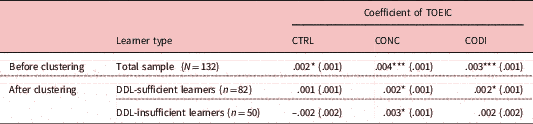
To further investigate the role of L2 proficiency, we conducted a multiple regression analysis with L2 proficiency as an independent variable for each treatment condition. As shown in Table 3, the results indicated that L2 proficiency had positive associations with vocabulary post-test scores for DDL-sufficient learners in the CONC (b=.002, SE=.001, p<.05) and CODI (b=.002, SE=.001, p<.05) conditions, and for DDL-insufficient learners in the CONC (b=.003, SE=.001, p<.05) condition. Given that L2 proficiency was significantly associated with L2 vocabulary learning across all three conditions including CTRL in the full sample, the null impact of L2 proficiency under CTRL for the two learner types indicated an exclusive role of L2 proficiency in determining the success of DDL tasks. Along these lines, the null impact of L2 proficiency under CODI for DDL-insufficient learners partly corroborated one of our speculations about possible absence of DDL efforts of this learner type in CODI. Overall, although the practical magnitude of the impact was not large enough to draw a meaningful interpretation (i.e. small coefficients of the L2 proficiency variable), we found that L2 proficiency played a significant role in influencing successful DDL.
Role of L2 proficiency identified from multiple regression analysis

Note. Values came from multiple regression analysis with the square roots of the vocabulary post-test scores as the dependent variable and vocabulary pre-test scores, gender, and L2 proficiency scores as independent variables or covariates. See supplementary materials for the complete results of the analysis. Standard errors are in parentheses.
*p<.05. ***p<.001.
5. Discussion
In this study, we adopted a data-mining approach to unearth hidden groups of learners in an instructed L2 vocabulary-learning context using a model-based clustering technique. In doing so, we were able to extend our previous finding that more glossary information led to better overall learning outcomes (Lee et al., Reference Lee, Warschauer and Lee2017), suggesting that identified learner types from the clustering technique may not exactly follow the overall learning pattern. We found that participants exposed to all three learning conditions through a repeated-measures design could be divided into two learner types: (1) DDL-sufficient learners, whose ability to make use of concordance lines made them suitable for DDL (cf. Johns, Reference Johns1991), but who did not benefit as much from additional dictionary information as had been expected (e.g. Godwin-Jones, Reference Godwin-Jones2001; Lee et al., Reference Lee, Warschauer and Lee2017); and (2) DDL-insufficient learners, who did not benefit much from only receiving concordance lines as glossary information. That is, by using data mining, this study shed light on unidentified learner types overshadowed by the average obtained through data analysis at the group level. The two learner types had distinctively different learning patterns, so combining them produced a poorly defined “one-size-fits-all” conclusion. We thus offered support to what Staples and Biber (Reference Staples and Biber2015: 243) asserted, that clustering techniques can “provide a bottom-up way to identify new groups that are better defined with respect to target variables.”
In this way, we were able to identify the complex role of learners’ L2 proficiency level in this CALL intervention. The model-based clustering technique we employed here is designed to identify statistically more similar and homogeneous groups of learners, and this led us to recognize a strong predictive power of L2 proficiency not only between but also within the identified learner types. Between the two learner types, we found that students with higher L2 proficiency were more likely to be DDL-sufficient learners, and those with lower L2 proficiency were more likely to be DDL-insufficient learners. Within each learner type, data mining helped us find that learners’ high levels of L2 proficiency were especially crucial for successful DDL activities, unlike the previous finding at the group level, where students’ overall L2 proficiency level is expected to influence the magnitude of L2 vocabulary gains equally across all conditions. That is, we found more direct statistical evidence that DDL can be beneficial to vocabulary learning for L2 learners in general, but the impact can be greater for those with higher L2 proficiency (e.g. Boulton, Reference Boulton2009; Flowerdew, Reference Flowerdew2015; Leńko-Szymańska & Boulton, Reference Leńko-Szymańska and Boulton2015). This may bring us one step closer to understanding “the types of learners who take most readily to DDL or extract most benefit from it” (Boulton, Reference Boulton2009: 87), corroborating the significant role of L2 proficiency in DDL highlighted by recent meta-analyses (Boulton & Cobb, Reference Boulton and Cobb2017; Lee et al., Reference Lee, Warschauer and Lee2018).
Given that corpus use for L2 vocabulary learning is “an active, creative, and socially interactive process” (Rüschoff & Ritter, Reference Rüschoff and Ritter2001: 223), more research is required to understand which learner factors could affect successful DDL activities, such as motivation (e.g. Gass, Behney & Plonsky, Reference Gass, Behney and Plonsky2013), strategy use (e.g. Tseng & Schmitt, Reference Tseng and Schmitt2008), use of knowledge sources (e.g. Nassaji, Reference Nassaji2003), learning styles (e.g. Flowerdew, Reference Flowerdew2008), and working memory capacities (e.g. Martin & Ellis, Reference Martin and Ellis2012). Again, findings of the present study highlight that results from aggregating individuals (as in the case of data analysis at the group level) should be interpreted cautiously as providing only a partial perspective on L2 vocabulary learning.
6. Implications and limitations
Our study has several implications for future research on L2 learning. It is expected that the use of data-mining techniques in analysing experimental data sets will expand research paradigms in several possible ways. First, we recommend the use of data-mining techniques in addition to variable-centred statistical analysis. Such an implementation could either produce similar results across different analyses (and thus enhance the validity of the overall result), or present a conflicting finding that could provide useful information about hidden groups of learners with different profiles. Second, researchers may administer a series of pre-tests and questionnaires on individual differences and use data-mining techniques to examine if their participants can be clustered in meaningful ways prior to an intervention (see Staples & Biber, Reference Staples and Biber2015, for similar suggestions). Researchers could then further examine possible interaction effects between each cluster and target intervention(s), which could provide valuable findings regarding personalized instruction.
The limitation of the present study is that we could not fully harness our data set by excluding the vocabulary pre-test scores in the model-based clustering technique. We used these scores to interpret the results of clustering in a statistically robust way, and yet we wonder how results might have differed if the pre-test score variable had been normally distributed, in which case it would have been possible to include it in the data mining. According to our clustering simulation with the six variables (i.e. square roots of pre-test and post-test scores for CTRL, CONC, and CODI), we found six clusters with uneven sizes (large differences between the size of the clusters; i.e. 9, 12, 12, 13, 35, and 51, respectively), which could be a convincing sign of bias (see Firooz, Reference Firooz2015, for a discussion). Moreover, the small sample size of the data set could be another limitation in this case, because the number of variables (i.e. degree of data dimensionality) generally requires a corresponding sample size. Although there is no rule of thumb about the sample size necessary for clustering techniques, one suggests using 5×2k (k=number of variables) as the minimum sample size (see Dolnicar, Reference Dolnicar2002, for a review), which would be a minimum of 320 samples for this case. Overall, it is complex and difficult to evaluate findings of unsupervised data mining due to an absence of true labels or classifications. For this reason, future studies on this topic with larger samples are warranted to understand how individual learners gain their L2 vocabulary knowledge in diverse ways.
7. Conclusion
Using a data-mining technique at the individual level, our results indicated that there were different learner types who exhibited learning patterns that differed slightly from our previous finding at the group level–a positive association between the amount of glossary information provided and post-test scores of L2 vocabulary knowledge. As a result, we identified that individual learners might require different accommodations to maximize their L2 vocabulary learning potentials. For example, for the DDL-sufficient learner type, receiving concordance lines was enough for successful L2 vocabulary learning, while the process of confirming inferred meaning did not substantially contribute to L2 vocabulary learning. The vocabulary post-test scores of DDL-insufficient learners also corresponded to a concern that DDL may not be as effective for some learners (Schmitt, Reference Schmitt2008). Therefore, closer attention to individual types of learners is required (e.g. Boulton, Reference Boulton2009; Flowerdew, Reference Flowerdew2015; Lee & Lee, Reference Lee and Lee2015; Leńko-Szymańska & Boulton, Reference Leńko-Szymańska and Boulton2015). If L2 researchers can implement similar approaches in their future studies, this could contribute to a better understanding of CALL environments equipped with different learning accommodations and the development of more personalized instruction.
Supplementary materials
For supplementary materials referred to in this article, please visit https://doi.org/10.1017/S0958344018000162
Acknowledgements
The authors would like to thank Jamal Abedi, Dorothy M. Chun, Joshua Lawrence, Robin C. Scarcella, and Julio R. Torres for their helpful comments on an earlier version of the manuscript; Kameryn Denaro, Jacquelynne S. Eccles, Alexander Ihler, and Steve Peck for statistical guidance and support; and the editor and three anonymous reviewers for their thoughtful feedback and suggestions.
Ethical statement
The present study uses data from a previously published study (Lee et al., Reference Lee, Warschauer and Lee2017). In Lee et al. (Reference Lee, Warschauer and Lee2017) and the present study, effort was made to ensure the participants’ anonymity. We also declare that there is no conflict of interests.
Author ORCIDs
Author ORCiD. Hansol Lee, http://orcid.org/0000-0002-6912-7128
Author ORCiD. Mark Warschauer, http://orcid.org/0000-0002-6817-4416
Author ORCiD. Jang Ho Lee, http://orcid.org/0000-0003-2767-3881
About the author
Hansol Lee is a PhD candidate in the School of Education at the University of California, Irvine. As an applied linguist with a wide range of research interests and methodologies, his recent work has been published in Applied Linguistics, Language Learning & Technology, and ReCALL, among others.
Mark Warschauer is a professor of Education and Informatics at the University of California, Irvine, where he directs the Digital Learning Lab and the Teaching and Learning Research Center, and the editor of AERA Open journal. His research focuses on digital media and learning.
Jang Ho Lee received his DPhil in education from the University of Oxford. He is presently an associate professor in the Department of English Education at Chung-Ang University. His work has been published in Applied Linguistics, Language Teaching Research, The Modern Language Journal, TESOL Quarterly, System, Language Awareness, and so on. All correspondence regarding this publication should be addressed to him.