Introduction
One of the main features of the Ubaid period is its ceramics. Ubaid pottery was initially identified during the excavations at Tell al-Ubaid in southern Mesopotamia during the early 1900s. The colors of the painted decoration on Ubaid pottery vary from black to brown, purple and dark green, while the fabric shades from buff to reddish brown and greenish brown (Carter and Philip Reference Carter, Philip, Carter and Philip2010: 2). The painted decorations are monochrome, but contrasts are achieved deliberately by different thicknesses and density of applied paint (Adams and Nissen Reference Adams and Nissen1972: 98). This pottery style was developed in an extensive geographical area and found throughout Mesopotamia and in southeastern Turkey, northern Syria, western Iran and along the Persian Gulf littoral (Carter and Philip Reference Carter, Philip, Carter and Philip2010: 2). Currently, the internal chronology of the Ubaid period is divided into successive phases from Ubaid 0 (Oueili) to Ubaid 5 (Terminal Ubaid) (Carter and Philip Reference Carter, Philip, Carter and Philip2010: 2; Crawford Reference Crawford, Carter and Philip2010: 163–164).
In an archaeological survey during the winter of 2016, an Ubaid site known as Kall Karim was identified in the Chavar district, at the northwestern part of the Posht-i Kuh (West Iran). All of the ceramic materials of Kall Karim belong to the Ubaid period. Posht-i Kuh (literally “over the mountain”) is located between the Iraqi border and the Kabir Kuh Mountains. Kabir Kuh is the westernmost major ridge of the Zagros mountain chain in western Iran, which separates the Mesopotamian lowlands from the highland valleys of western Iran. In modern administrative divisions, Kabir Kuh is now located in the Ilam Province, and the Posht-i Kuh region is south, west and northwest of it. The purpose of this paper is to examine the discoveries made during the survey of Kall Karim, as well as presenting a chronological framework for this site based on the decorative styles and shapes of the ceramics recovered.
Survey area and Kall Karim
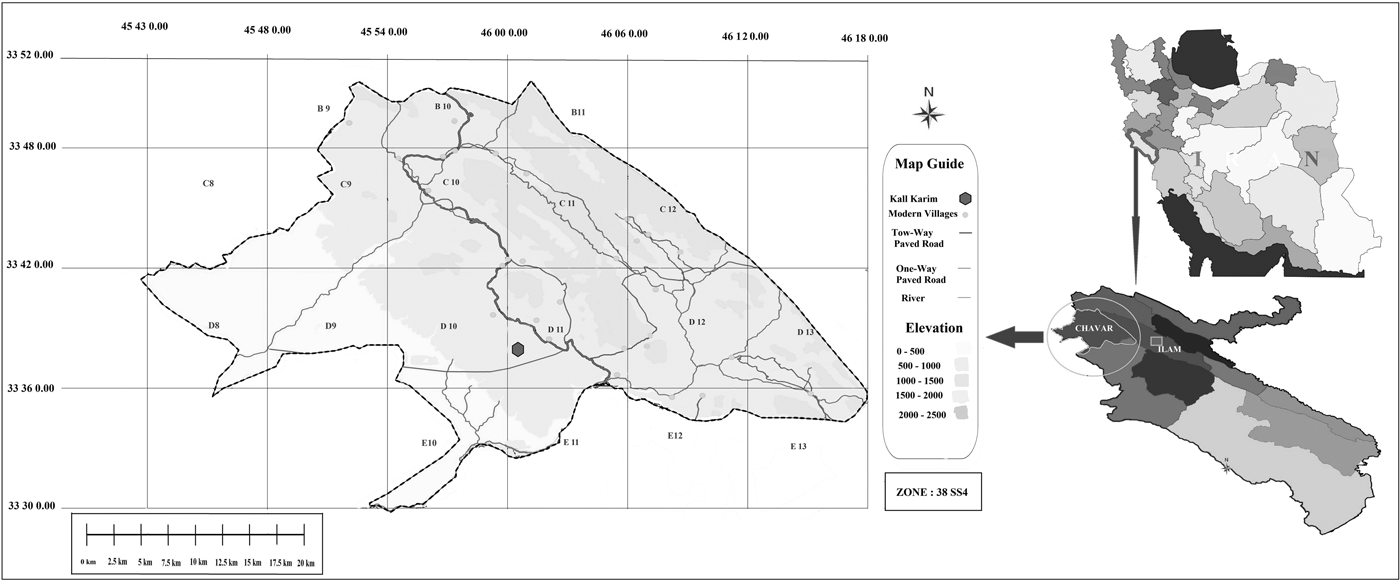
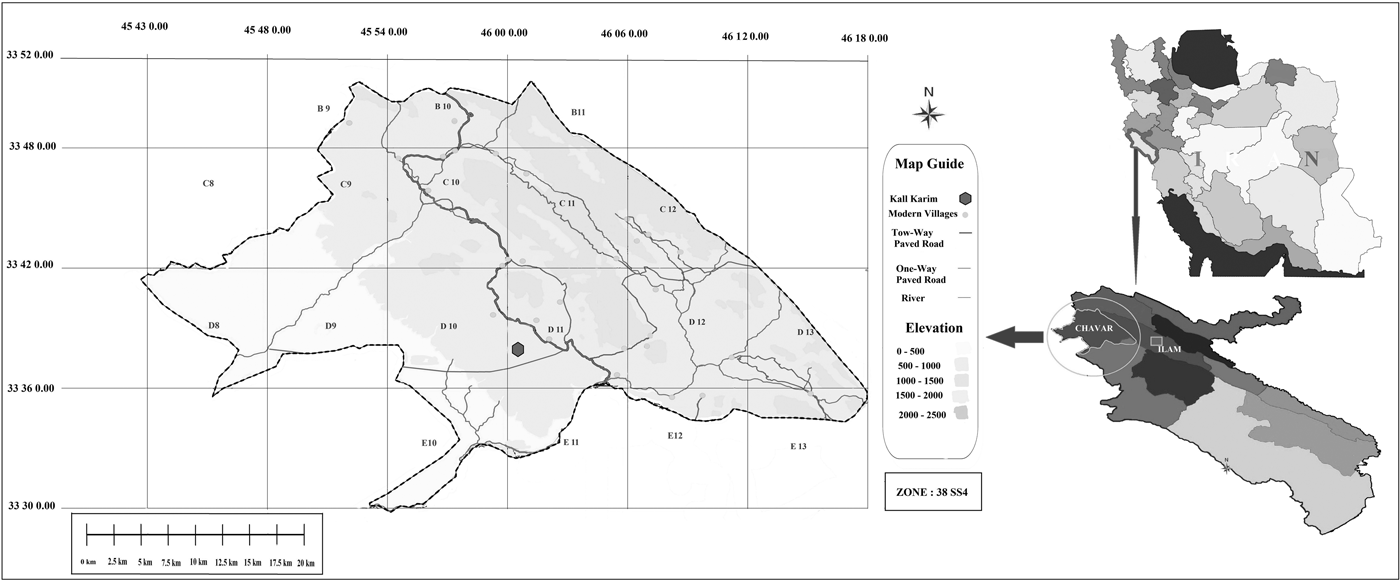
The surveyed region covers an area of 250 square kilometres (Fig. 1). This area is located in the Chavar district, in the northwest of Ilam Province (west Iran) and adjacent to the Diyala region in Iraq. Indeed, the survey area is a significant part of the northwestern area of the Posht-i Kuh. This area is formed of valley systems, which open up in the direction of the Diyala region in Mesopotamia. The painted ceramics from the Early Bronze Age cemeteries of this region indicate close relations with Mesopotamia (Haerinck and Overlaet Reference Haerinck and Overlaet2002: 170–71). The Chavar district is divided into three different geographical zones, comprising Meimak, Bawlly and Arkawazi, respectively from west to east. Meimak is the most western region, starting from the Iran-Iraq border and Meimak Mountain to the Gach and Seh Kurvand mountains. The Bawlly region is between Gach and Seh Kurvand mountains on the west and Kach, Garesar, Cheqal Zard Sia and Shamrareh Mountains on the east. Finally, Arkawazi is the most eastern region of the Chavar district.
Map of Iran with survey area and location of Kall Karim at the northwest of Posht-i Kuh.
The surveyed region contains numerous valleys, mountains and canyons, which provide diverse climate conditions from very hot on the west and southwest to colder in the eastern and northeastern areas. The rainfall rate in this area also varies, reducing from east and northeast toward the west and southwest, while the temperature increases. The east and northeastern areas are mountainous and contain significant heights, while the western and southwestern areas comprise mainly lowlands. The highlands are covered by dense vegetation, usually oak trees. The majority of the region is rugged and rocky and unsuitable for farming, therefore agricultural activities are very limited; however, the rich pastures and warm climate make this area a suitable place as the winter camp for modern nomadic pastoralists. Indeed this area is a warm, low-lying area or Garmsir, which forms the winter pastures of the local tribes.
The Belgian Archaeological Expedition obtained comprehensive information about the Bronze and Iron Ages in the Arkawazi region, through excavation in cemeteries such as Kalleh Nisar, Bani Surmah and Chamahzi Mumah (Haerinck and Overlaet Reference Haerinck and Overlaet1998, Reference Haerinck and Overlaet2002). In 2012, an Iranian team conducted archeological surveys in the Meimak region (Darabi et al. Reference Darabi, Niazi, Feizi and Javanmardzadeh2012). However, the Bawlly region was still unknown until a survey in 2016. As the result of these surveys, eighty sites were identified in Meimak, Bawlly and the western half of the Arkawazi region, of which Kall Karim is one of the most important. All the surface ceramics of Kall Karim belong to the Ubaid culture. Beyond Kall Karim, Ubaid pottery was recognized only at one additional site, which has only few Ubaid ceramics on its surface.
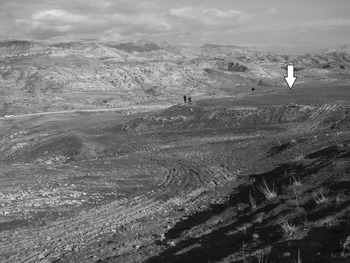
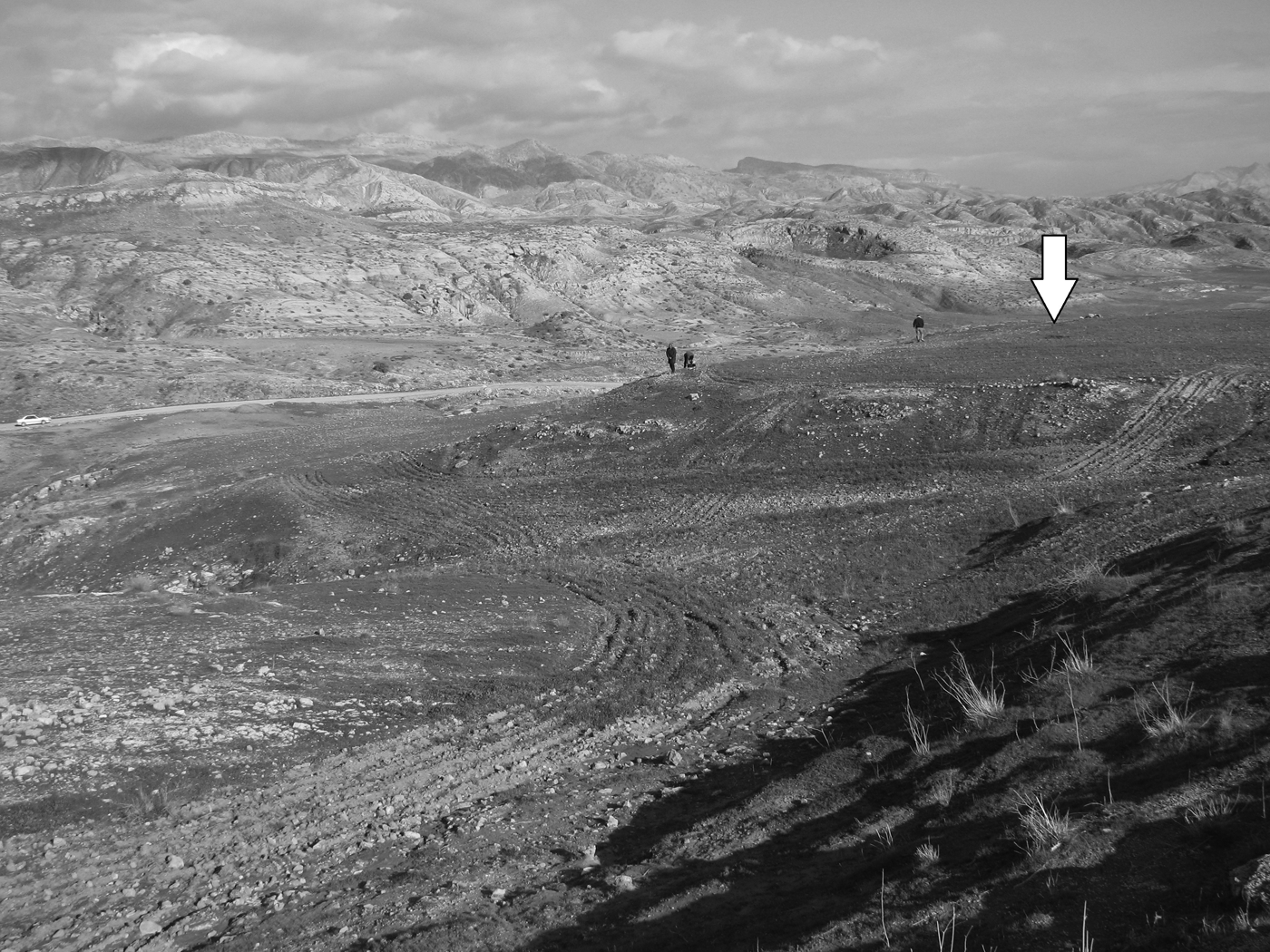
Kall Karim was identified for the first time in archaeological survey during 2016. It lies at 33037′58″ latitude north, 46000′38″ longitude east and at a height of 661 metres above sea level. It is 2700 metres south of the modern village of Pa Ghalleh in the Bawlly region. This region is connected to the Mesopotamian plain through the Bina and Bijar valleys. The site is located in a public area known as ‘Chakar-e Bawlly’; the Chakar-e Bawlly pool is located 800 metres to the northeast of it. The surrounding landscape is covered with plants and bushes. Kall Karim is far away from the residential centers and is set on the northern slopes of Seh Kurvand Mountain. Its surface is very rough, but it is plowed and cultivated by modern farmers. It slopes in a northern-eastern direction, and its southern edge joins to chalk hills. Kall Karim is not a normal site with evidence of occupation sediments. Indeed, the rugged and mountainous landscape of this area is unsuitable for the formation of settlement sites, and this region is only fit as winter camp for contemporary semi–nomadic populations. The whole of the area is rugged and composed of rising grounds, chalk mountains and several floodways (Fig. 2). The surface soil of the site is mostly sedimentary-alluvial and seems to have very limited thickness. Its substructure is chalk. Some parts of site are heavily eroded, and much of its chalk substructure has been revealed. Moreover, modern agricultural activities have disturbed the surface and accelerated the erosion process, so that in some cases there are no remaining ancient deposits, and in some parts of the site, the natural virgin soil is evident. The slope of the site has also contributed to this process.
Kall Karim site, western view.
Evidence of pottery production activities
The field surveys and surface evidence indicate that all the ancient deposits of Kall Karim are industrial deposits related to pottery production activities. The majority of dispersed surface materials are wasters from the pottery firing process, and the number of usual surface sherds is very limited. We collected important fragments related to firing cycles as slags, squashed and warped sherds. The surface sherds and other materials were scattered across an area of four hectares. It is only on the northeastern side of the site that the concentration of surface findings is clear. In this part of the site, abundant and dense waster sherds have accumulated in an area of 1600 square metres. Of course it should be noted that Kall Karim is badly disturbed by strong erosion and agricultural activities, and its deposits had been heavily eroded.
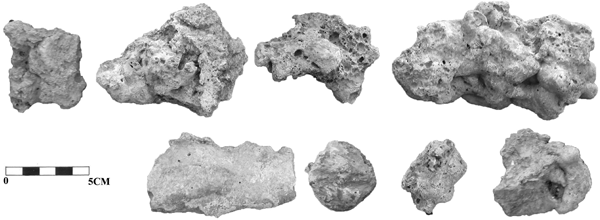
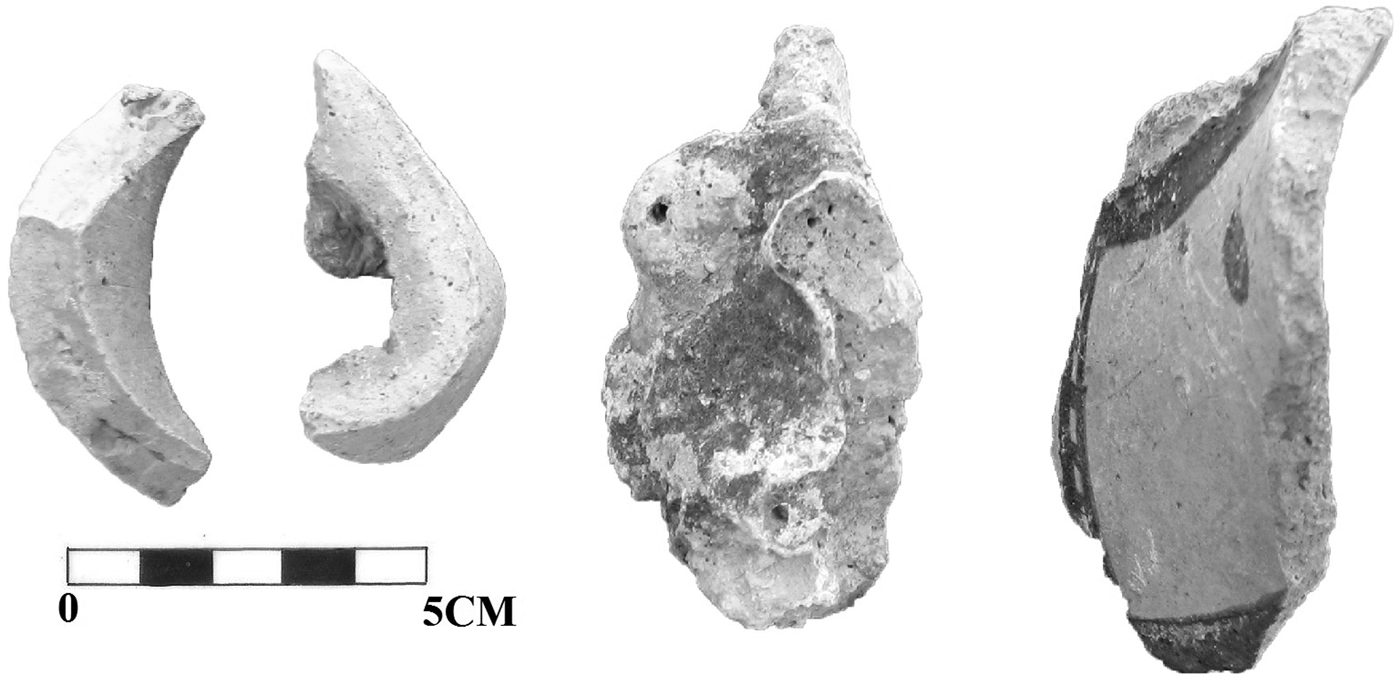
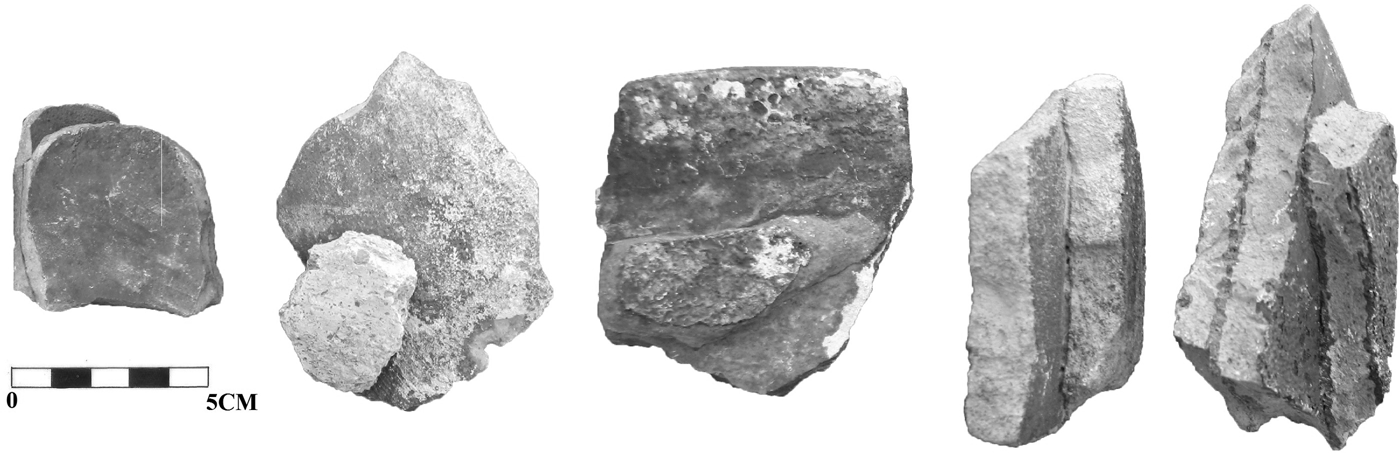
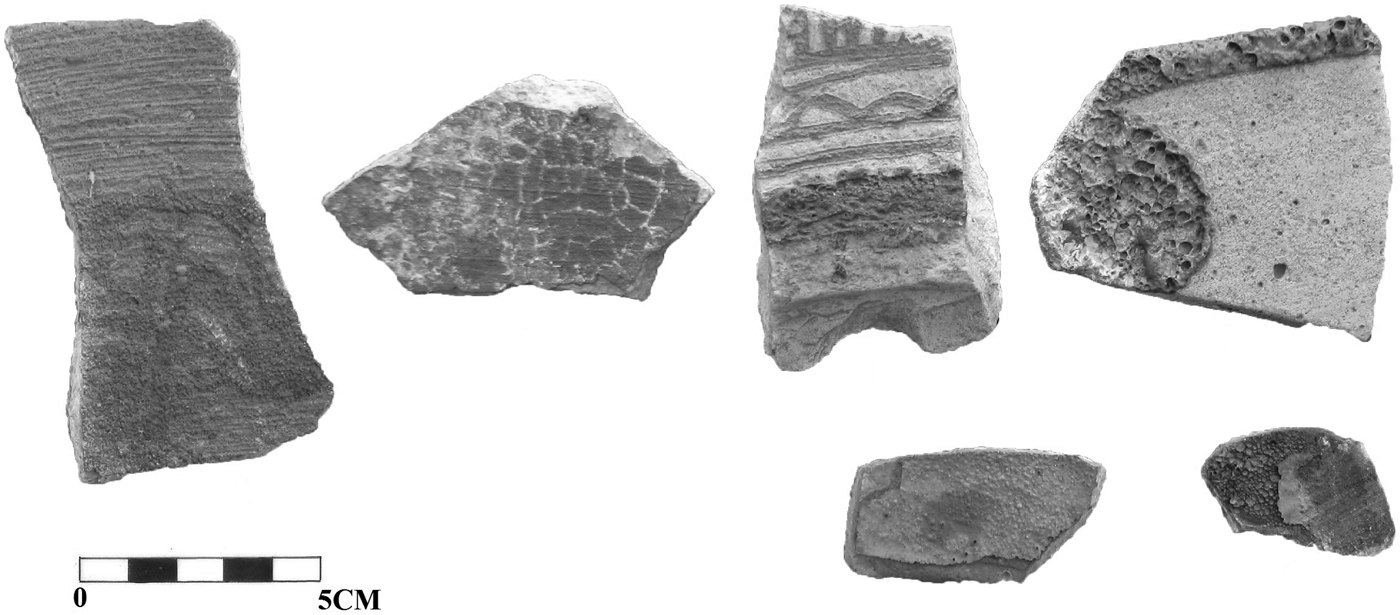
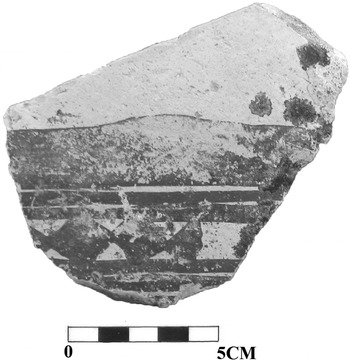
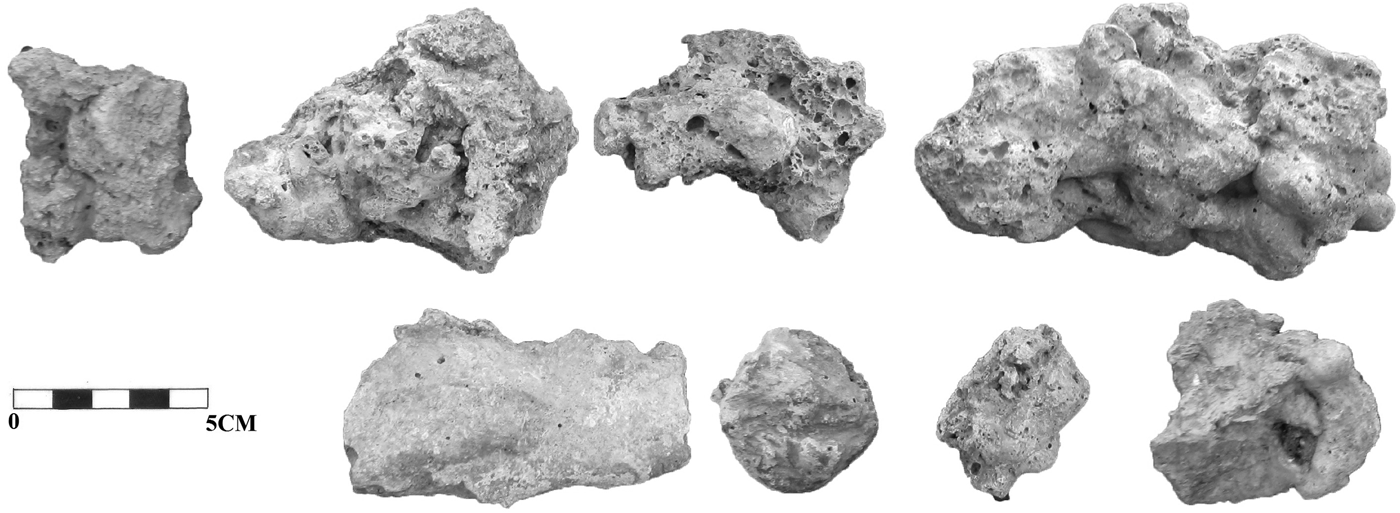
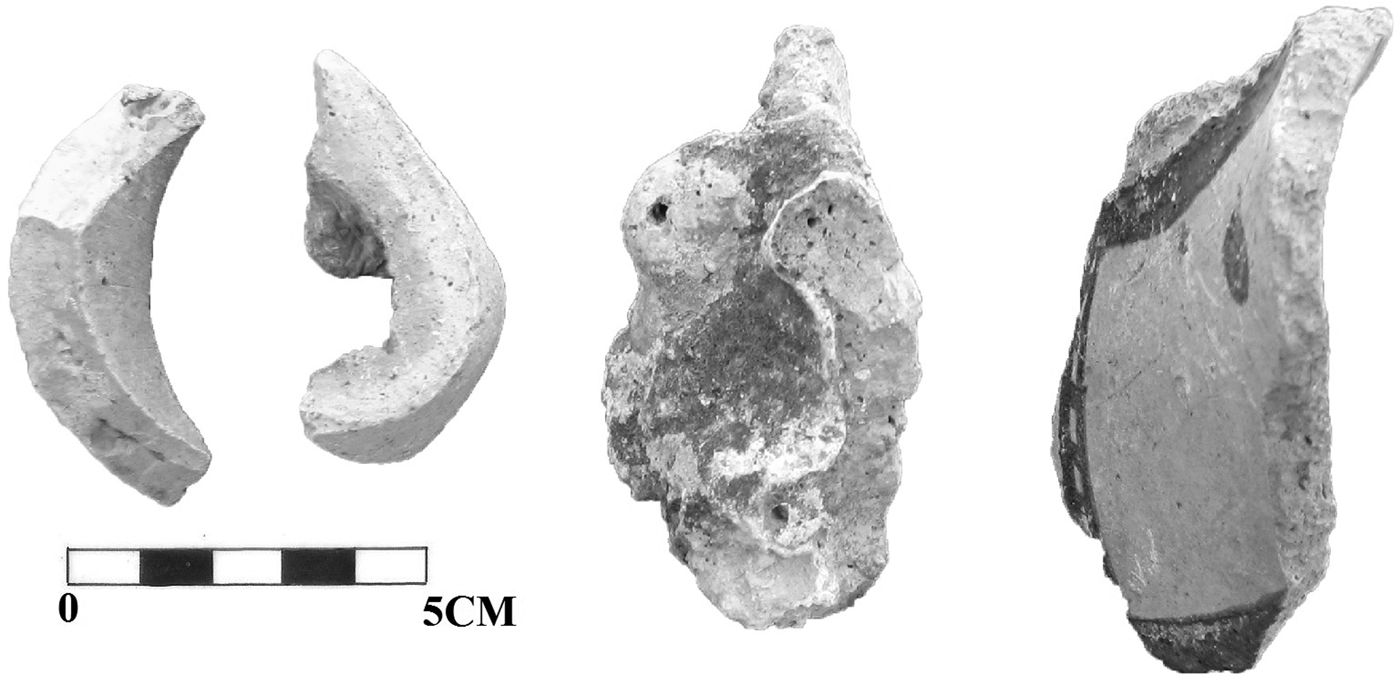
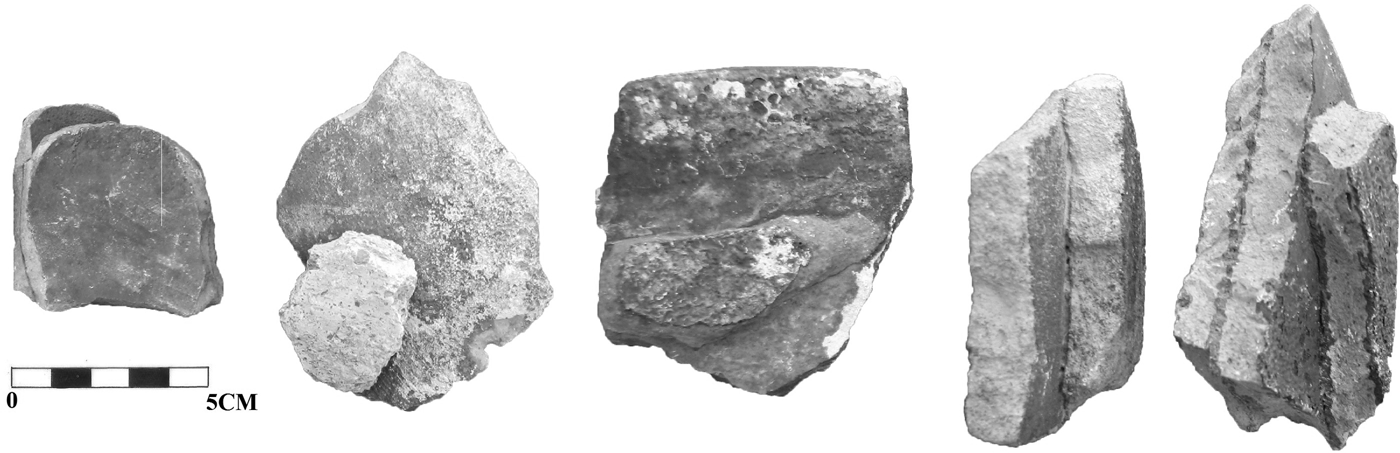
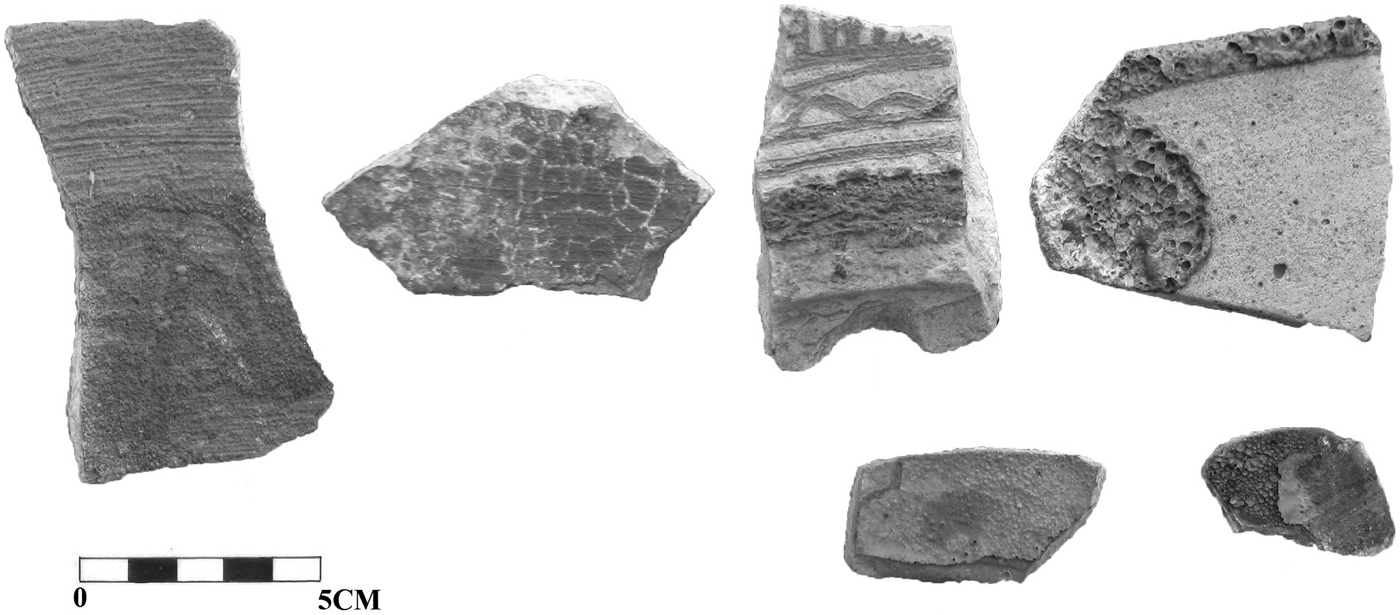
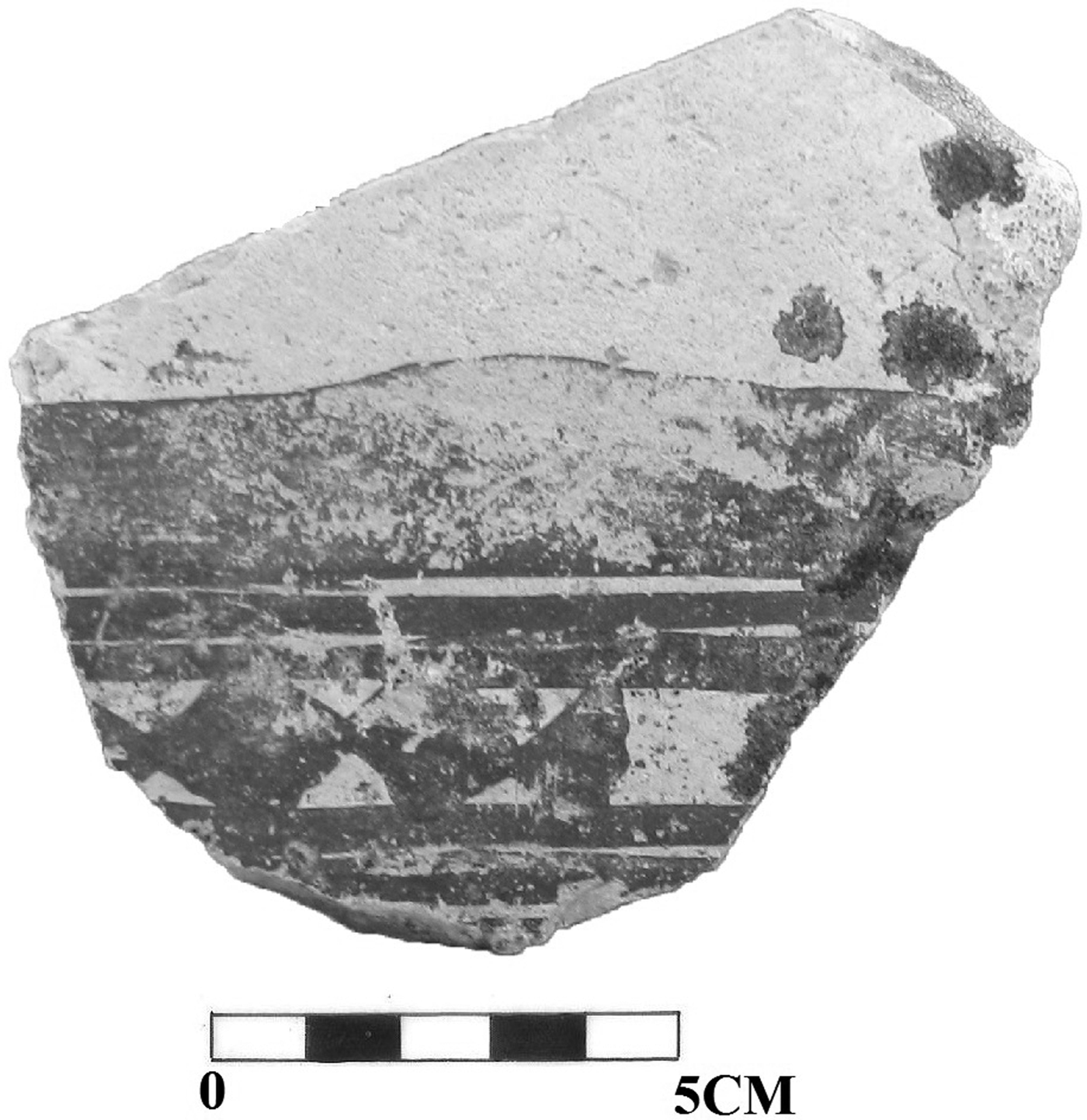
Many pieces of slag were seen all over the site, representing industrial activities related to kilns (Fig. 3). Slags are the result of the melting of minerals at high temperatures, and after cooling these take on the distinctive appearance of porous rocks; they may be formed through melting of ceramics during firing or from the melting of the rim or inner surfaces of kilns themselves. Most wasters from the pottery production process are formed when the temperature inside the kilns is higher than needed. The kiln's high temperature deforms the ceramics’ shapes and they gradually at first become squashed and warped; if the temperature continues to increase, ceramics melt or turn into slag. Most of the scattered surface sherds at Kall Karim are melted or squashed (Fig. 4), or melted and stuck together (Fig. 5). Indeed, wasters form a major part of the surface material, and we can infer the presence of kilns at the site because wasters do not have any uses and are usually discarded in place near where they were produced. Apparently the lack of proper control of the temperature and the overall high temperature of the kilns caused the gray colour of some of the ceramics’ fabric. The density or thickness of the paint is also greater than normal in many of decorated ceramics. As a result of high temperatures, the paint either melted and infiltrated into the ceramic body or its stabilization has been poor and only a trace of the paint is remaining (Fig. 6). The number of pieces of this type of waster is high among the surface materials. Given these findings, there is no doubt that Kall Karim included workshops for firing pottery, although we did not see any traces of firing structures or indeed any other structures during the surface survey. No evidence was found during survey of the early steps in production of pottery or the pre-firing cycle; for example, we did not find potters’ tools such as scrapers. It is probable that the process of shaping and decorating of ceramics was carried out elsewhere. It seems that this site was a specialized workshop for firing vessels, without domestic activities.
Pieces of slag from the surface of Kall Karim.
Melted sherds from the surface of Kall Karim.
Sherds from different vessels that have been welded together, from the surface of Kall Karim.
Painted sherds with evidence of overfiring, from the surface of Kall Karim.
In the Hamrin region, from Level III at Tell Abada and Level IV at Songor B, evidence suggests the presence of pottery workshops among the houses (Oates Reference Oates, Young, Smith and Mortensen1983: 252–53; Crawford Reference Crawford, Carter and Philip2010: 165). There is also evidence related to pottery production activities at Tell al-Abr in northeastern Syria, again within the occupation levels (Yamazaki Reference Yamazaki, Carter and Philip2010: 314). Firing structures were also excavated among residential deposits at Logardan in northern Mesopotamia (Baldi and Naccaro Reference Baldi, Naccaro and Vallet2015: 57). However, as mentioned above, there is no evidence of occupation sediments at Kall Karim. In addition, we did not identify any Ubaid settlement in adjacent areas during the archaeological surveys of 2016. It seems that this specialized workshop was established far from any residential centre.
This situation invites many questions, such as: why, unlike many Ubaid pottery workshops that have been excavated so far, was Kall Karim far from residential centers? Why is it not located adjacent to a settlement or settlements? And further, where were the ceramics of this production centre used? Answering such questions is difficult without excavations. In addition, laboratory and geological studies are required in order to identify sources and possible transport routes, and such studies should include not only ceramic samples from Kall Karim but also samples from other sites both in Iran and in the Diyala region of Iraq. Further, it is necessary to identify and study the surrounding resources and clay quarries. Unfortunately, limited data have been discovered about the likelihood of nomadic populations of the Ubaid period using pottery products from Kall Karim. Only a few painted black on buff sherds were found in Area C at Kalleh Nisar. This site is an ancient cemetery used by nomads that is located at the northwestern of the Posht-i Kuh, near Chavar city (Haerinck and Overlaet Reference Haerinck and Overlaet2008: 64). This cemetery is located 45 kilometres to the east of Kall Karim. During archaeological surveys by an Iranian team in the surrounding area, two sites with residential deposits of Ubaid 2–4 date were identified. These sites, known as Golem Zard and Garr-e Chega, are located 20 kilometres to the south of Kall Karim. Limited findings have been gathered during the survey of these sites (Darabi et al. Reference Darabi, Niazi, Feizi and Javanmardzadeh2012: 53). Numerous Ubaid sites were identified along the eastern frontier of Iraq, in the Diyala region and around Mandali city, during survey in 1966. Choga Mami is the most famous of these (Oates Reference Oates, Young, Smith and Mortensen1983: 259). Mandali is located about 50 km west of Kall Karim. The Ubaid Period deposits of Choga Mami belong to Ubaid 1–3 (ibid.: 256). Today, it is nearly half a century since archaeological studies have been carried out in this area, therefore we have very limited information on the Ubaid settlement pattern and sites, especially on the border areas with Iran. So at the moment, the closest known sites to Kall Karim are Golem Zard and Garr-e Chega.
Since raw materials for the production of pottery are available almost everywhere, it seems that the ease of access to and abundance of fuel required for firing is one of the main factors to have caused the formation of Kall Karim in this area. Above it was explained that the vegetation of the area is currently rangeland, and it is possible that the bushes that are seen in the area today were potentially a past natural resource, supplying fuel used in the firing cycles. Canebrake that surrounds the Chakar-e Bawlly pool, which appears to have been expanding in the past, could also have been used for this purpose. On the other hand, due to the fact that this area is used as a winter pasture for nomadic populations, it may be that animal dung was one of the potential sources of the fuel required.
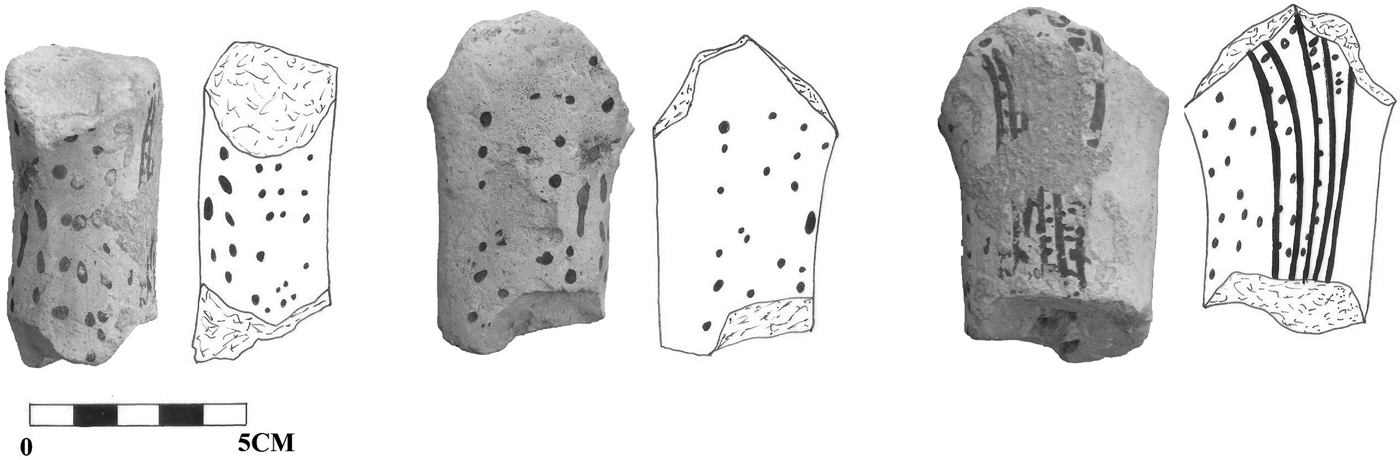
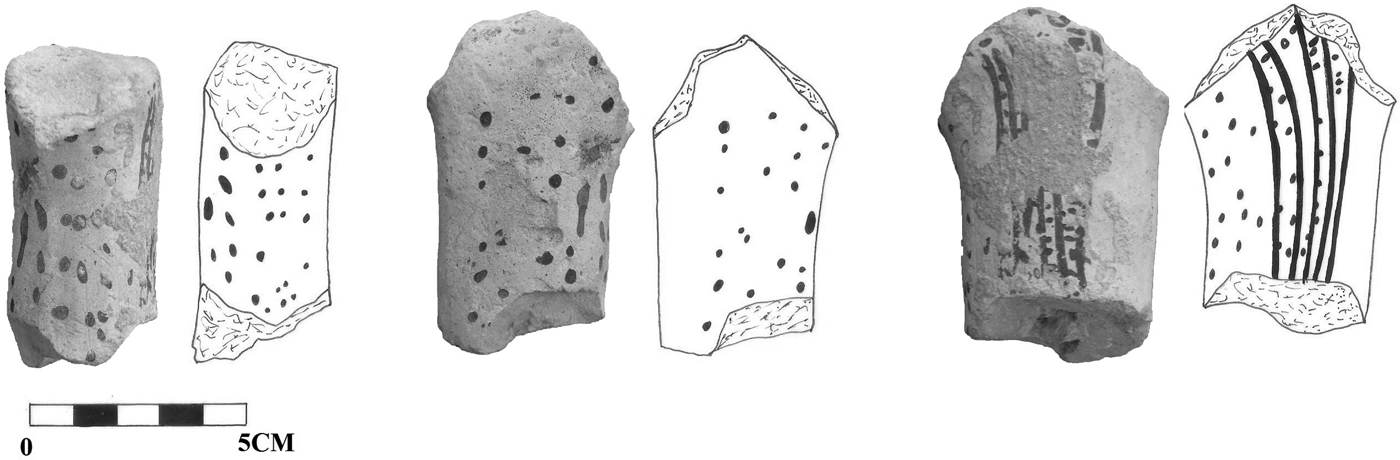
The establishment of firing structures adjacent to fuel resources is sensible, because the transportation of fuel incurs costs and takes time. In addition, the placement of firing structures far from residential centers means that environmental contaminations arising from firing (such as ash and smoke) were kept far away from settlements. Despite the abundance of ceramics, other cultural materials were observed only to a limited extent. Two grinding stones, a few lithic artifacts, part of a clay statuette with simple geometric motifs (Fig. 7), and part of a clay whorl were identified during survey. However, no evidence of the production of such objects was found in the area.
Different aspects of a clay figurine from the surface of Kall Karim.
Ceramics
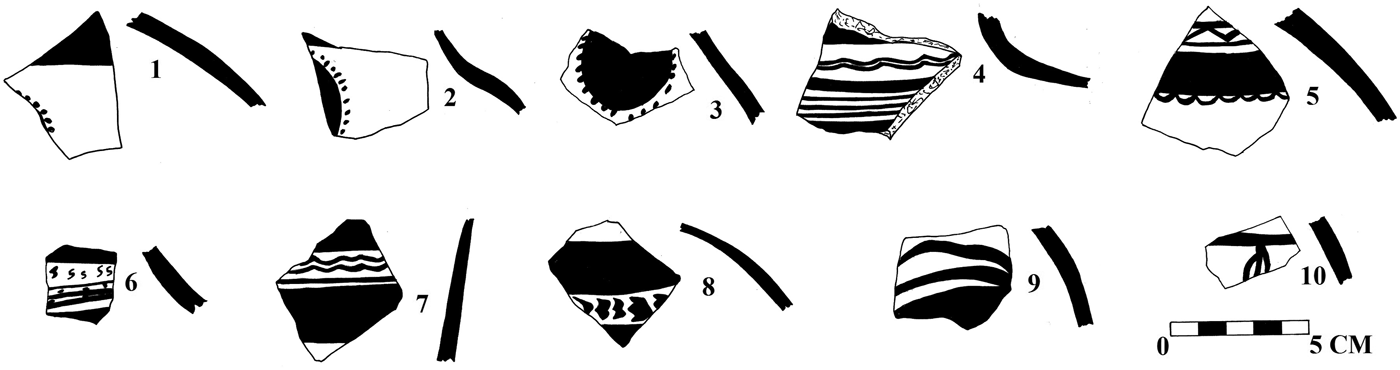
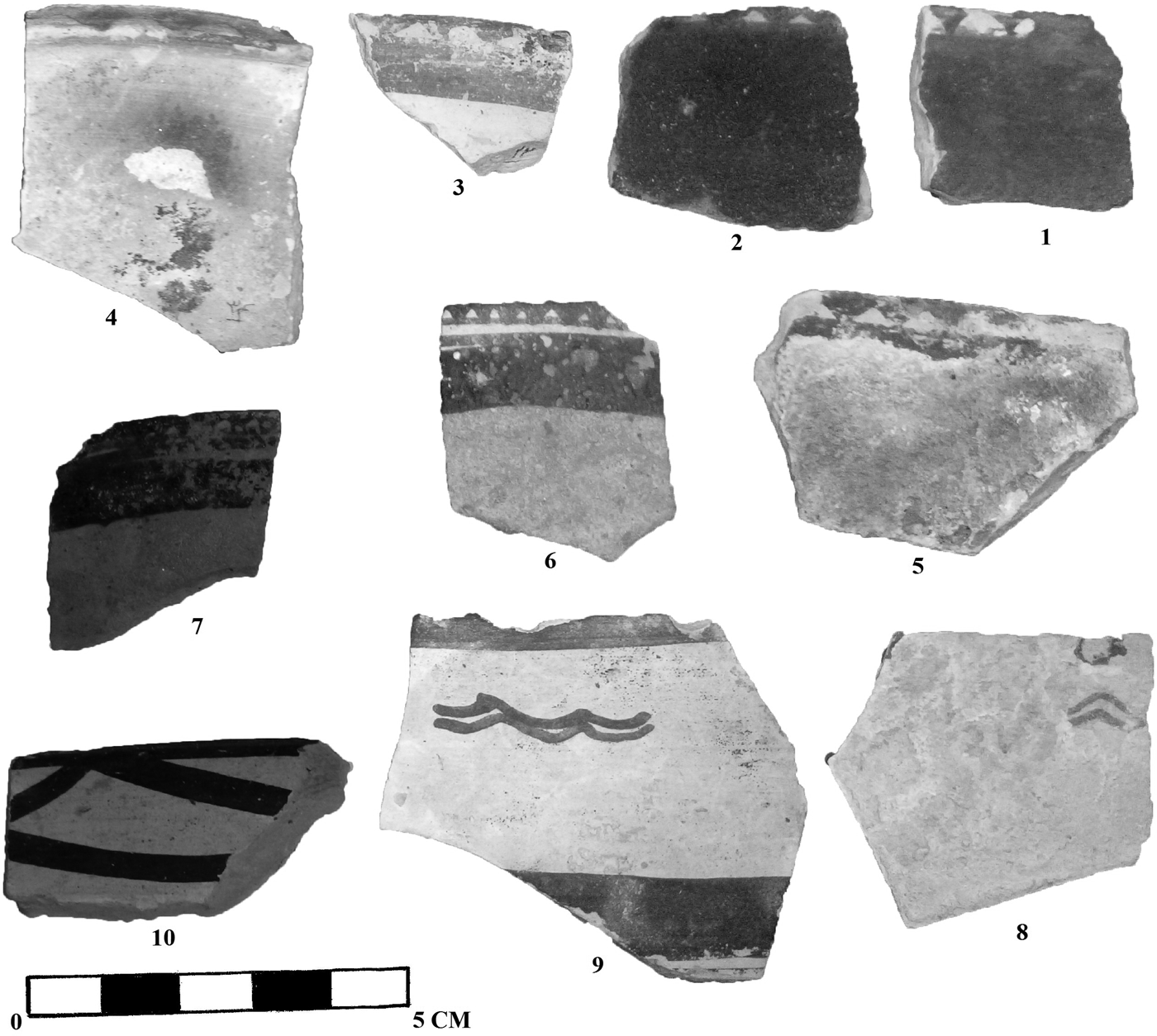
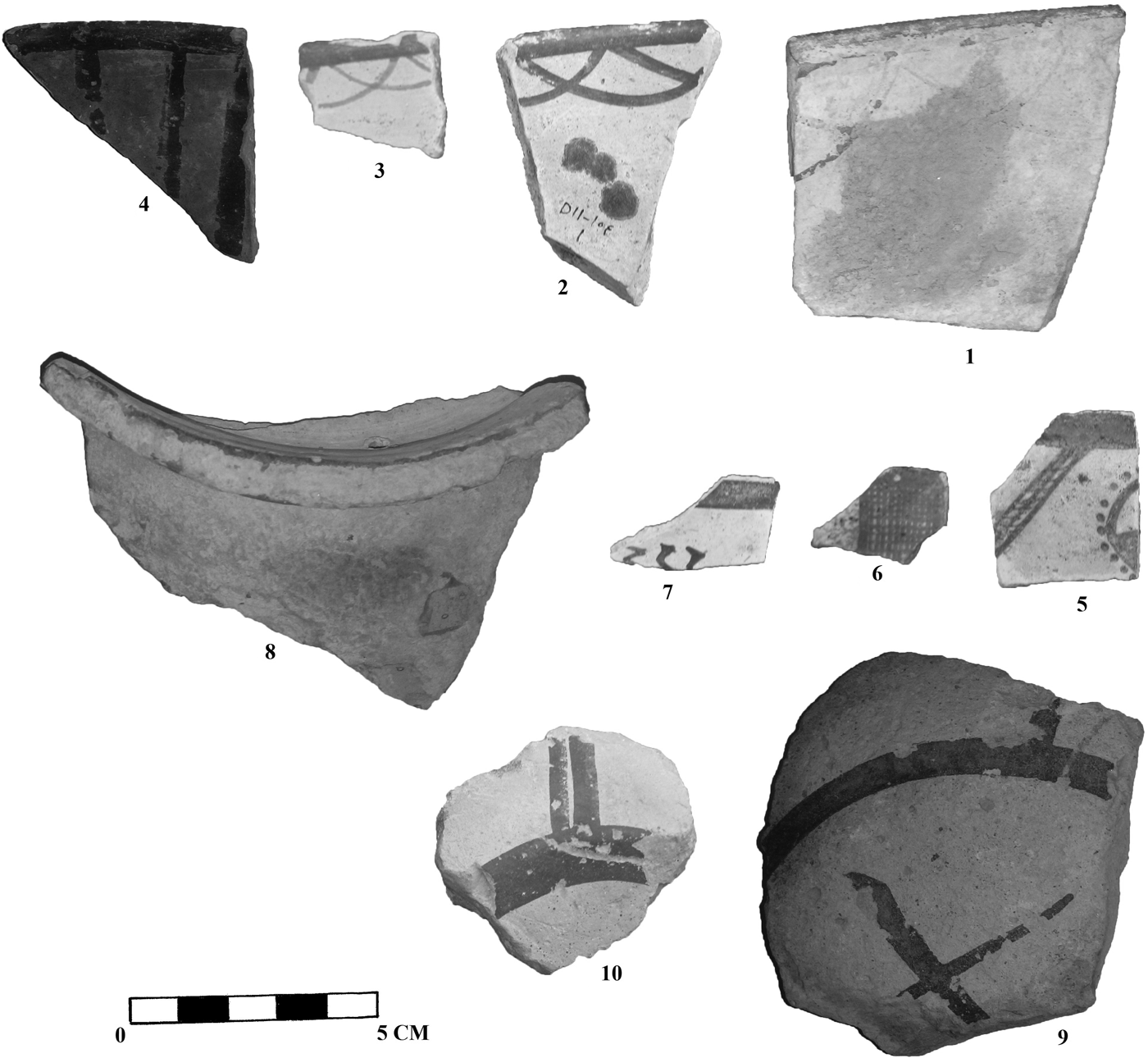
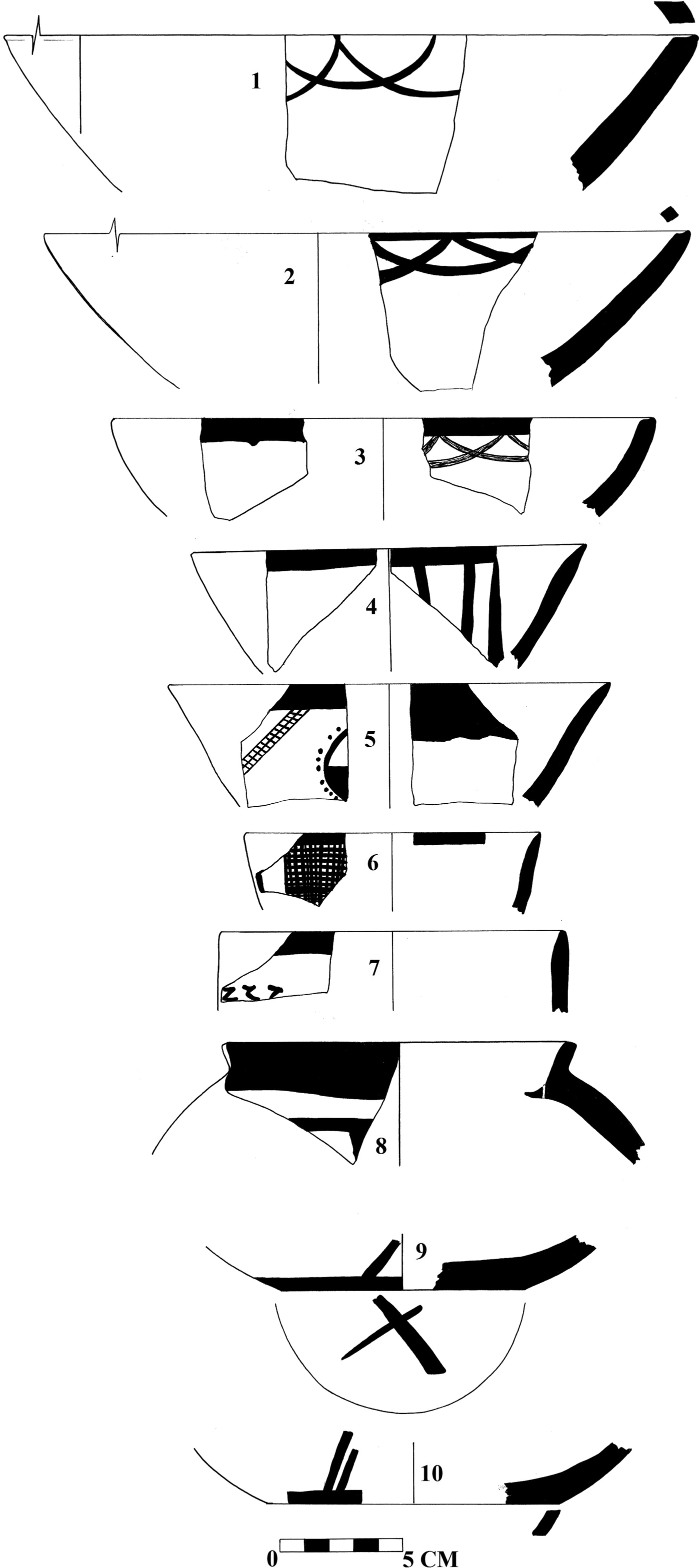
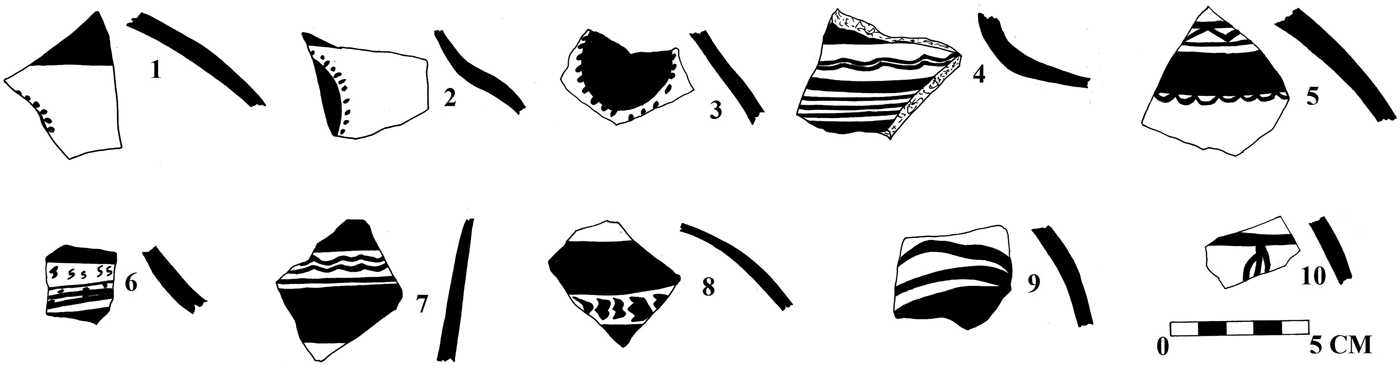
Most of the surface sherds are wasters, and the number of normal sherds is very low. Furthermore, the sherds are damaged because of modern agricultural activities. We collected only diagnostic sherds in the survey, to use for classificatory and chronological analysis. Sixty sherds were collected during the survey of Kall Karim, among which thirty samples were chosen for closer study; these include eighteen rim sherds, two parts of bases, and ten body sherds. All of them are painted sherds (Figs. 8–10); indeed most of the surface sherds are painted. The fabric colour of most of the sherds is different shades of buff, especially green buff; however, the fabric of two is red and of another two is gray. The fabric of the sherds was well kneaded and in most cases is tempered with fine grit. Their quality puts most of them into the category of fine ware ceramics. All are handmade and fired at adequate and high temperatures. Their texture is sturdy and hard with smooth surfaces. There are adhering sediments and concretions on the surface of some sherds, which covered some of the motifs. And white particles were occasionally seen on the surface of sherds. Most of the sherds were coated with a thin or thick slip of buff colour.
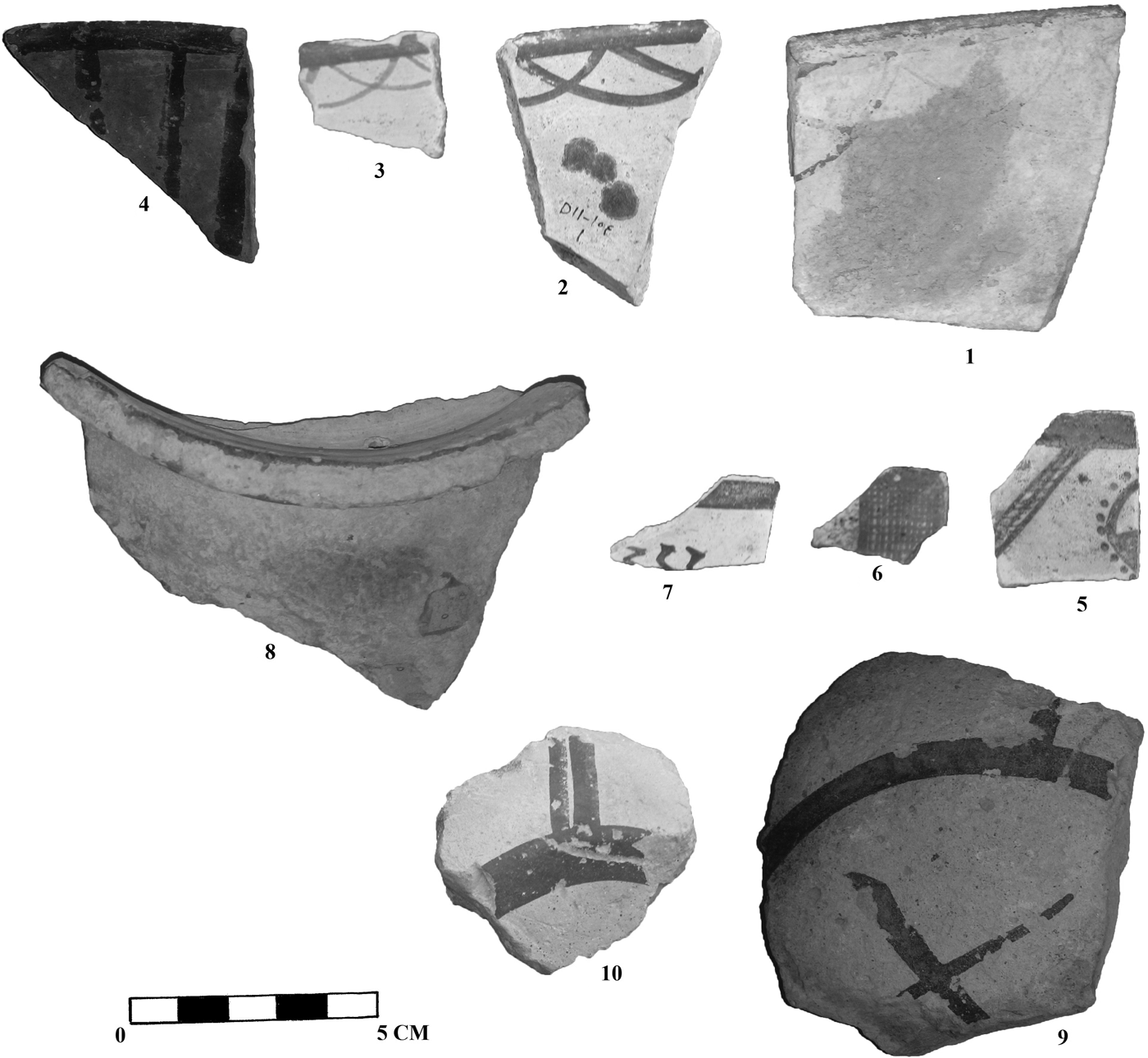
Selection of Kall Karim painted sherds.
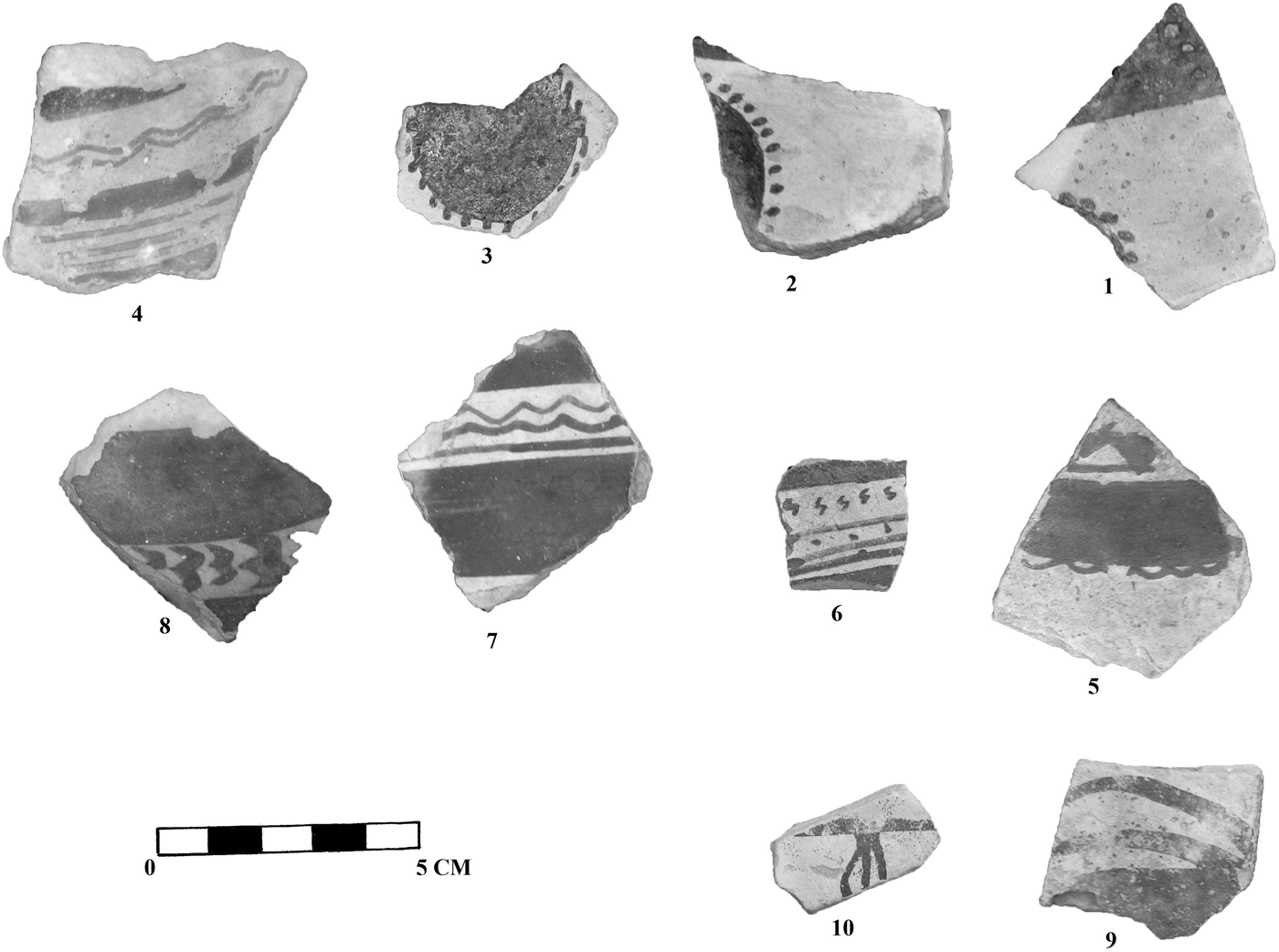
Selection of Kall Karim painted sherds.
Selection of Kall Karim painted sherds.
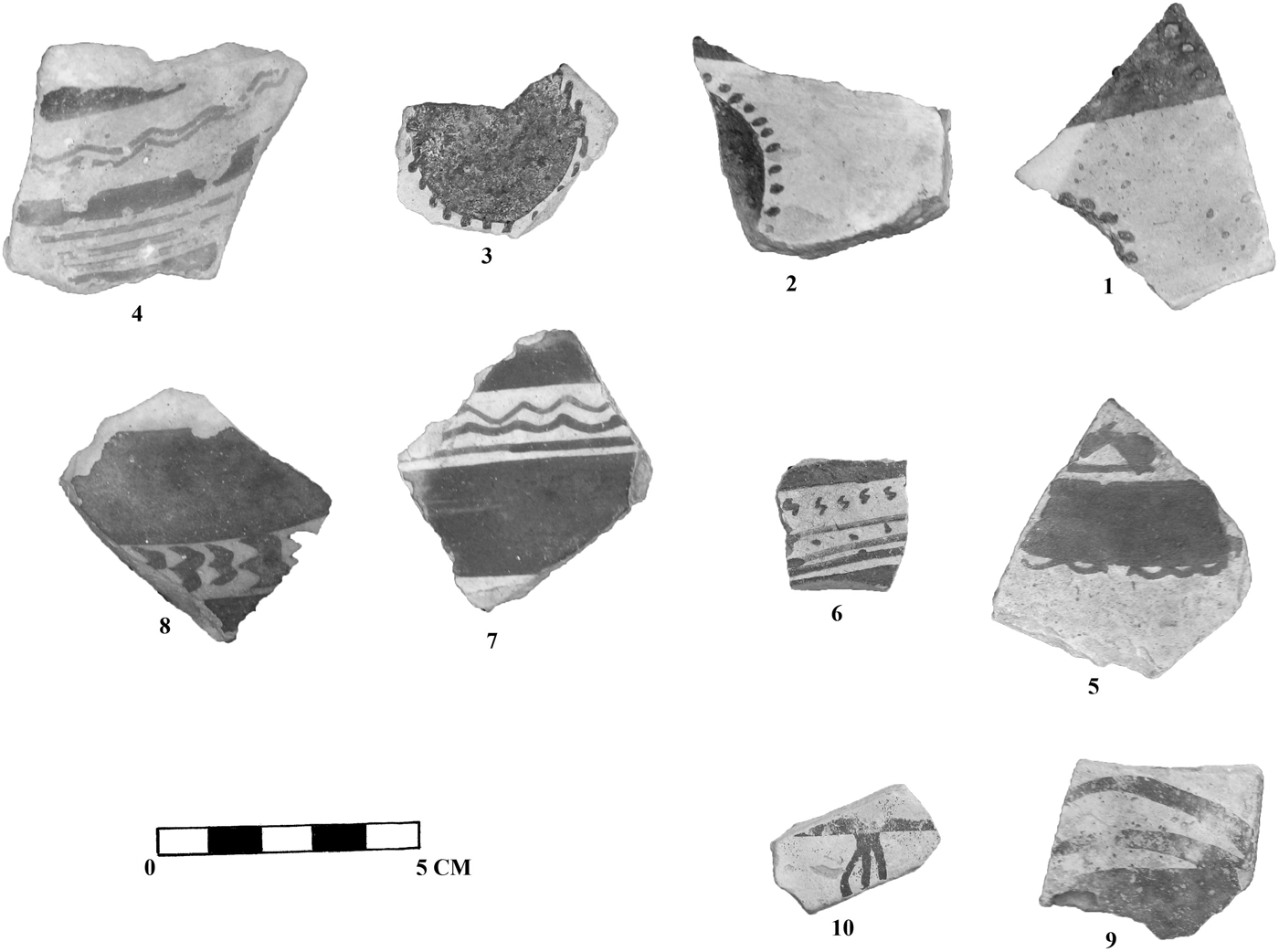
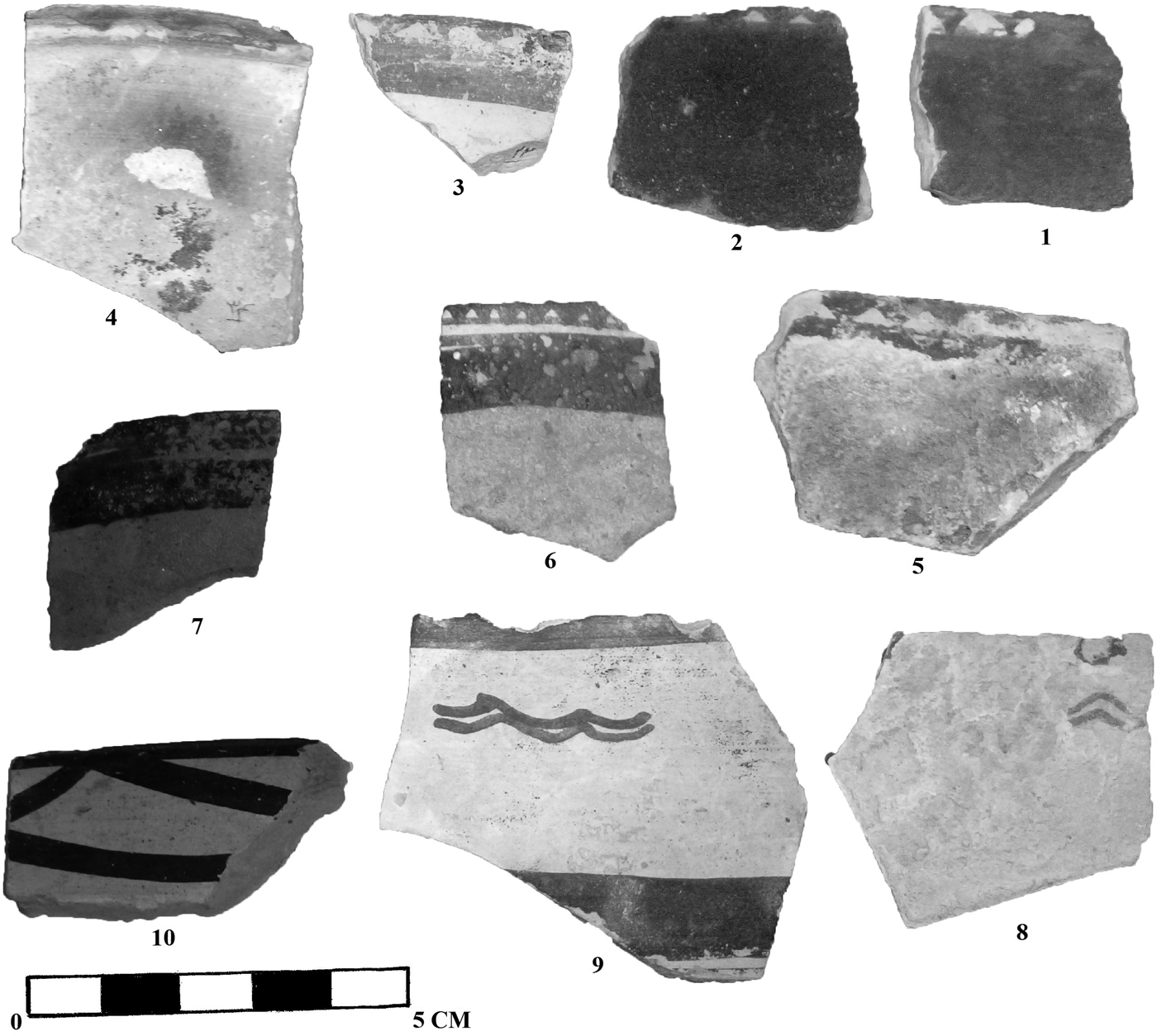
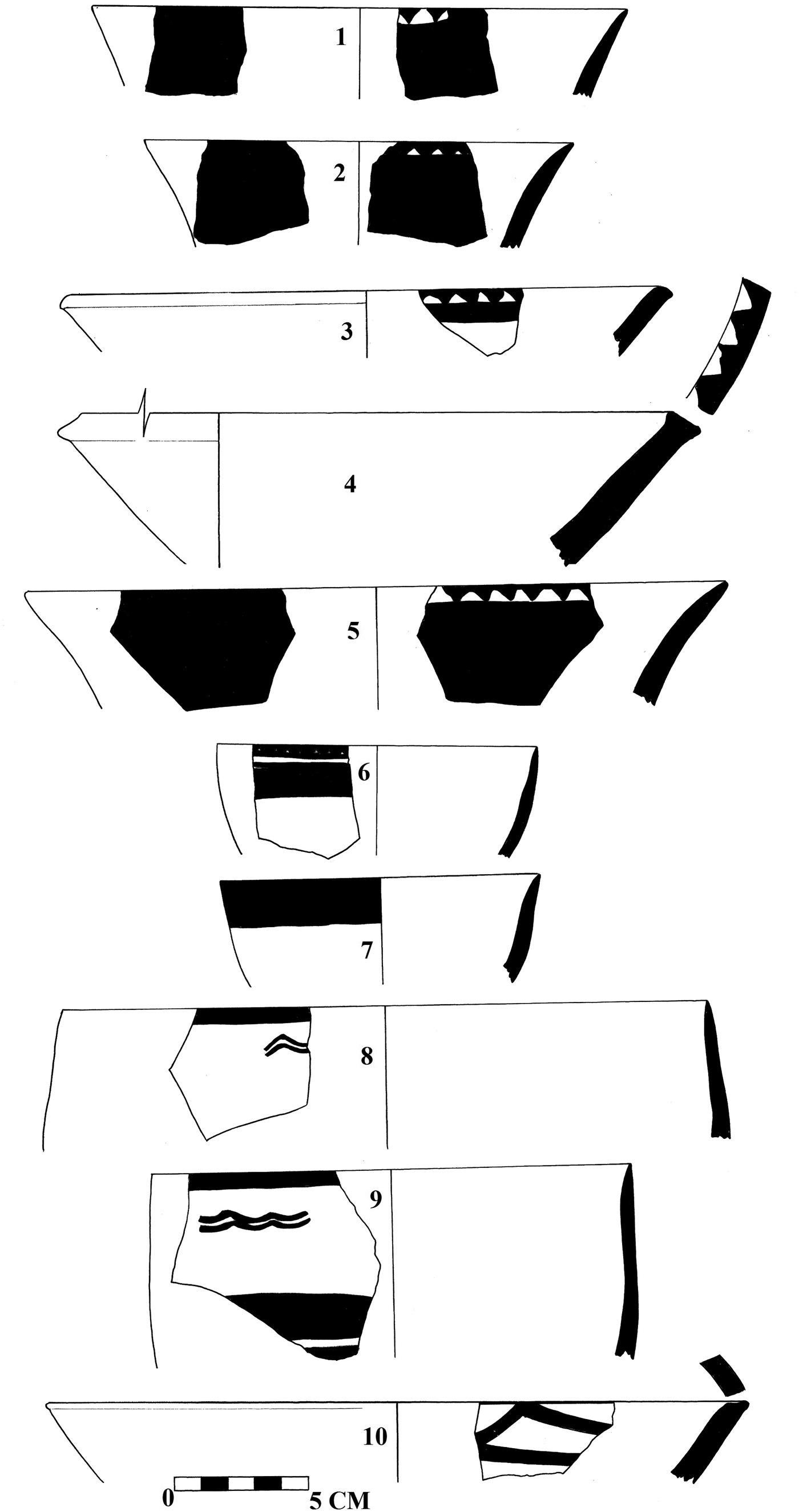
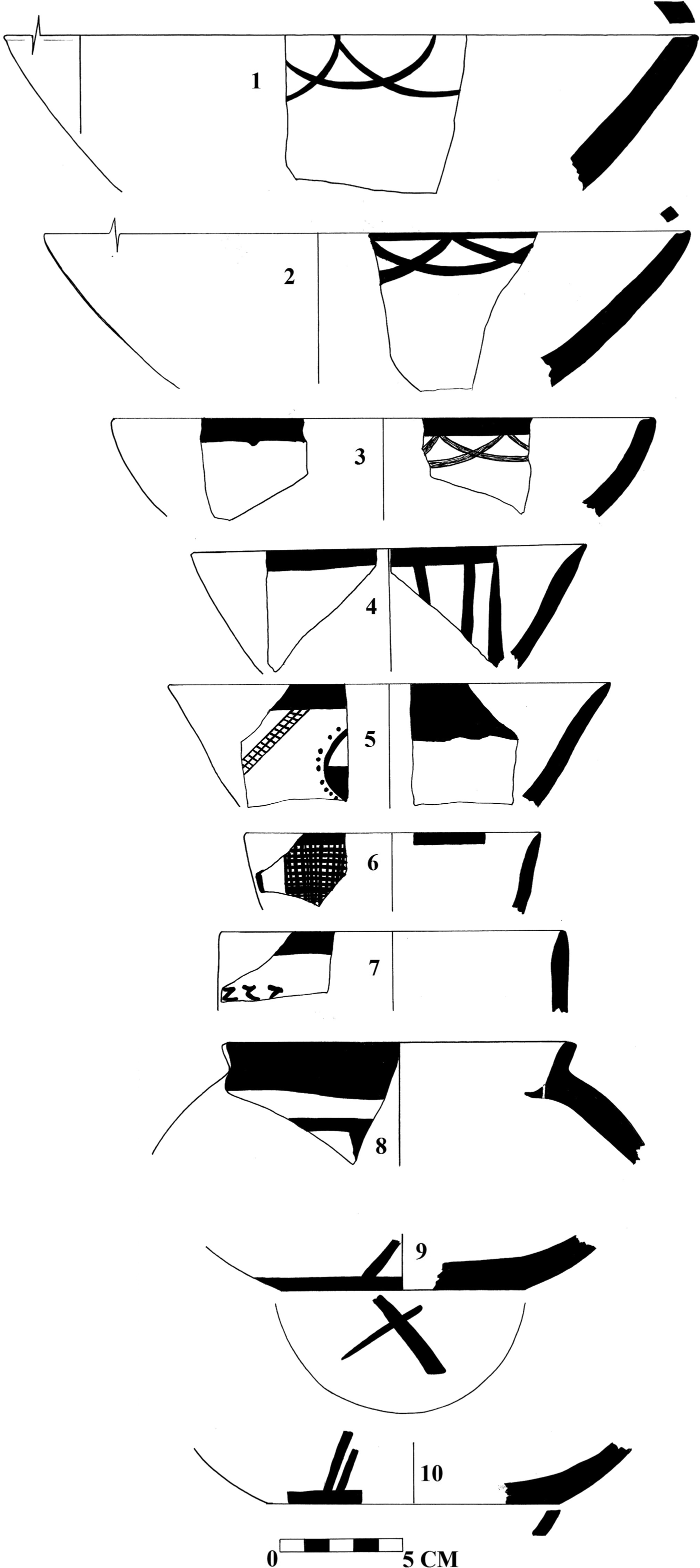
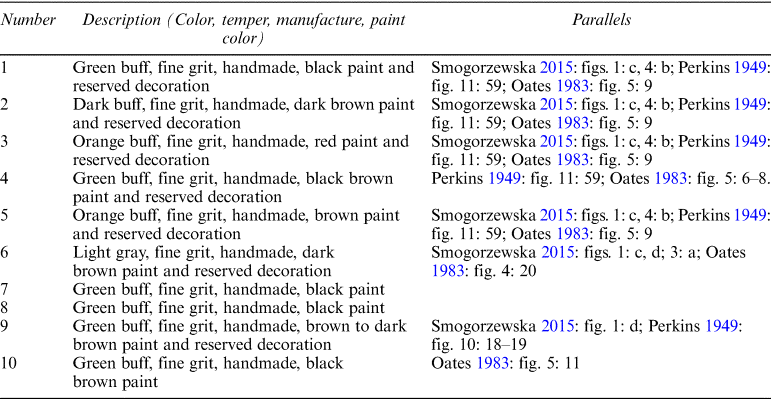
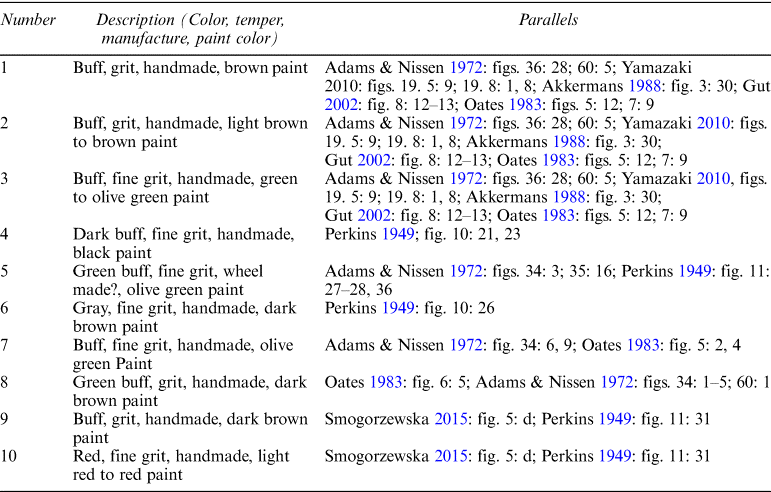
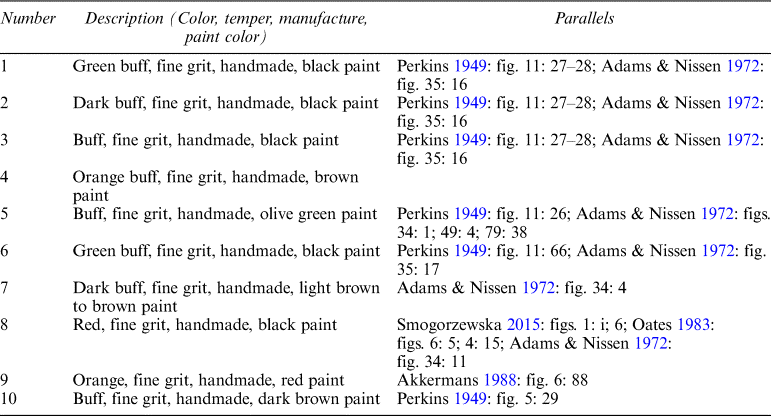
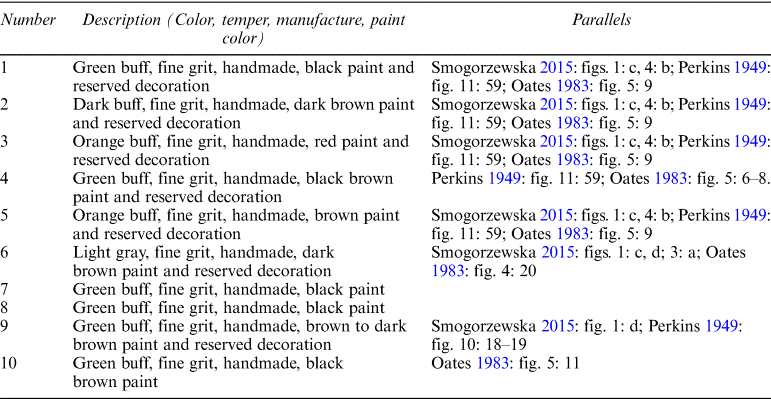
Most of the rims are related to open forms such as flaring bowls (Table 1 and Fig. 11: 1–2; Table 2 and Fig. 12: 5), hemispherical bowls (Fig. 11: 6), oval-shaped bowls (Fig. 12: 1–3), conical bowls (Fig. 11: 3–4; Fig. 12: 4), deep bowls with vertical bodies (Fig. 11: 8–9), and goblets (Fig. 12: 6–7). Also, part of a double-mouthed jar with a hole in its inner rim was found (Fig. 12: 8). All of the sherds have monochrome decoration; painting is the only technique of decoration used. Painted motifs appear on both interior and exterior of the sherds and sometimes even on the exterior of the base (Fig 12: 9–10). Various paint colours, including black, red, brown, dark brown or olive green, were used. The thickness and density of the paint layer varies, and it seems the potters were not particularly careful in drawing the motifs (for example, Fig. 12: 3; Table 3 and Fig. 13: 6). Some of the painted motifs appear to have been incompletely drawn (Fig. 14). The motifs are not usually regular, and there are examples where the paint seems to have been inadvertently spilled on the ceramics during the decoration process. In some cases, the thickness of the paint layer is not uniform; the variation between thick and diluted paint contributes to the diverse range of colour.
Sherd from Kall Karim.
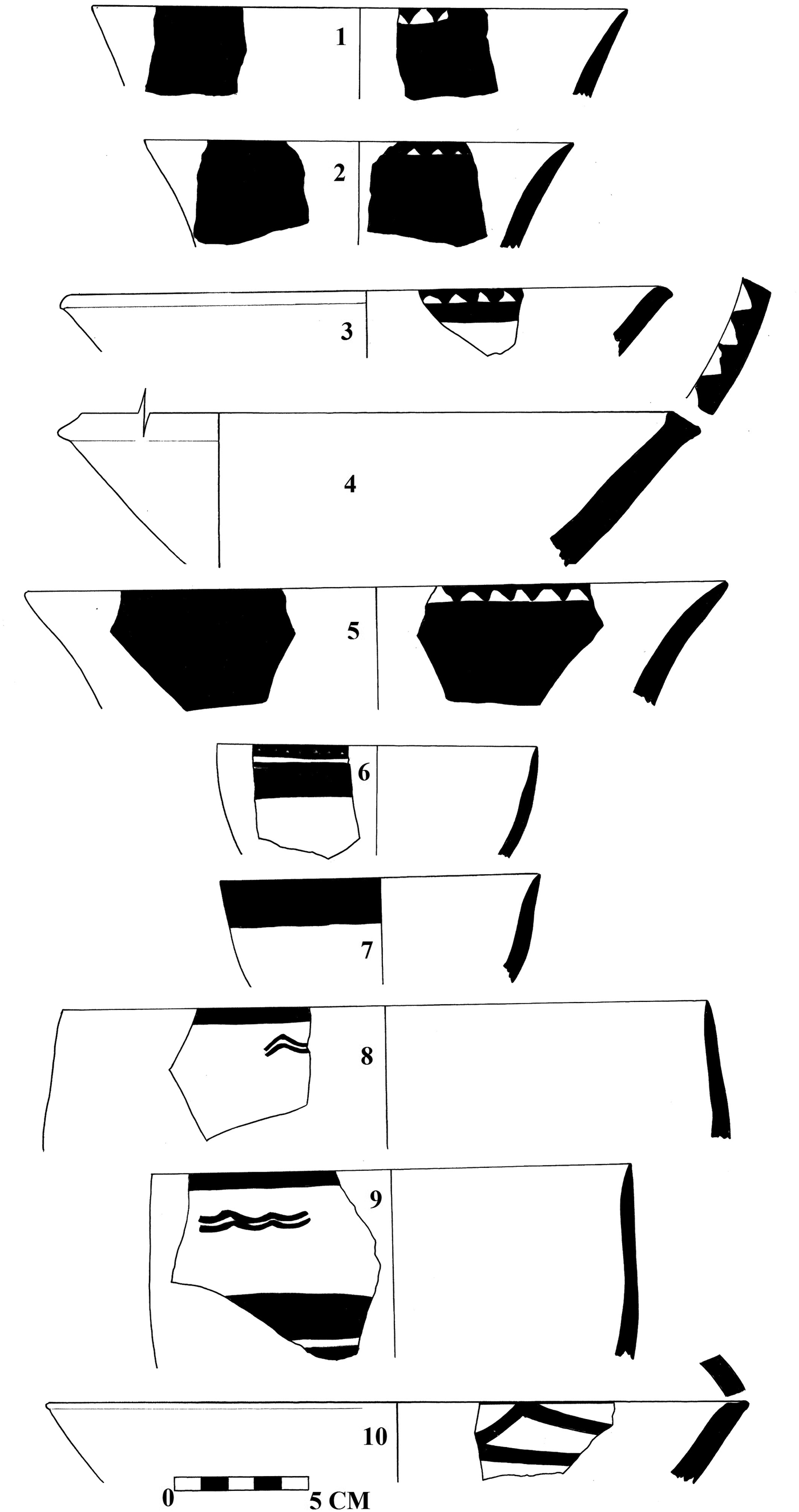
Sherds from Kall Karim.
Sherds from Kall Karim.
Sherd with incomplete and irregular decoration.
Pottery Catalogue for Fig. 11
Pottery Catalogue for Fig. 12
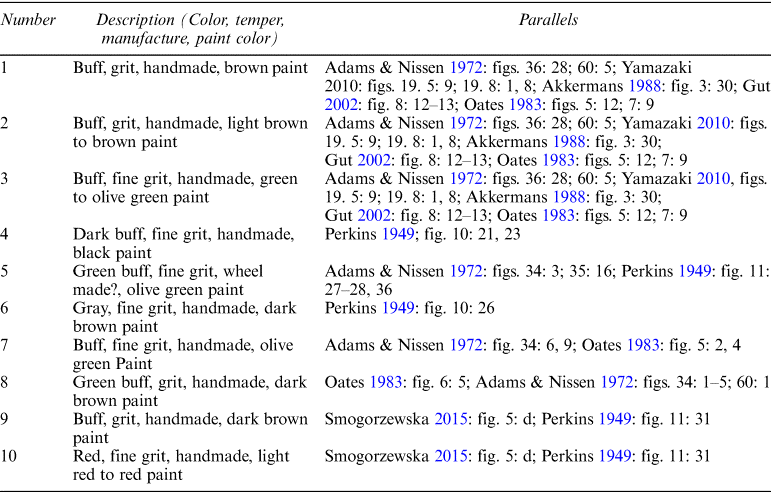
Pottery Catalogue for Fig. 13
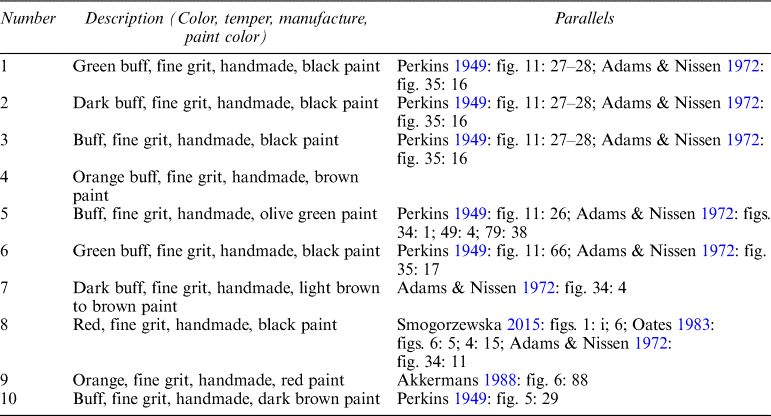
Several ceramics have reserved decoration (or decoration in negative) that was obtained by covering almost the entire surface of a vessel or part of it with a thick layer of black, dark brown, brown or red paint, so that the unpainted parts, which retained the colour of the body or slip, formed the desired decorative motifs (Smogorzewska Reference Smogorzewska2015: 143). Negative motifs include rows of small triangles beneath the rims on the interior (Fig. 11: 1–3 and 5) and exterior of the sherds (Fig. 11: 6), or along the top of the rim (Fig. 11: 4), or reserve lines on the exterior surface of sherds (Fig. 11: 6 and 9). There is a variety of geometric painted motifs, including pendant loops beneath the rims (Fig. 11: 10; Fig 12: 1–3), diagonal lines (Fig. 12: 9–10), multiple zigzags (Fig. 13: 8), ladder motif (Fig. 12: 5), dotted circles (Fig. 12: 5; Fig. 13: 1–3), interrupted wavy lines (Fig. 11: 8, 9), continuous wavy lines between parallel lines (Fig. 13: 4, 7), vertical lines (Fig. 12: 4), rows of dots between parallel lines (Fig. 13: 6), and horizontal lines upon or beneath the rims or above the bases (Fig. 11: 7–10; Fig. 12: 9–10). An animal motif appeared on one sherd (Fig. 13: 9).
Chronology and comparisons
Due to the proximity of the study area to the Diyala area, as well as the close similarities between the pottery of Kall Karim and published data from Mesopotamia, the Mesopotamian ceramic material and sequencing, especially that from the Diyala region, will be used here for comparison and dating. The classificatory analysis of the sherds shows that the material from Kall Karim belongs to one chrono-cultural horizon. Typological studies, comparison of motifs, and the shape of the ceramics have revealed that certain shapes and motifs may have long life-spans. A row of pendant loops beneath the rim is the most distinctive decorative pattern found on the Ubaid ceramics at Choga Mami. Identical examples as well as variations of this pattern occur at Hajji Muhammad, Ras al-Amiya and Eridu Levels XIII-XI (Oates Reference Oates, Young, Smith and Mortensen1983: 258, fig. 5: 12; fig. 7: 9). This motif lasted until the Ubaid 5 and is seen on bowls discovered from the Terminal Ubaid phase at Nineveh and Tepe Gawra in northern Mesopotamia (Gut Reference Gut and Postgate2002: fig. 8: 12–13; pl. 3a). It is also seen on the ceramics from Ubaid 3–5 in northeast Syria (Yamazaki Reference Yamazaki, Carter and Philip2010: figs. 19. 5: 9; 19. 8: 1, 8; Akkermans Reference Akkermans1988: fig. 3: 30). The diagonal lines motif, although it is seemingly typical for the Hajji Muhammad phase, has a longer life-span; it can be encountered also in the Ubaid 1, 3 and 5 phases (Smogorzewska Reference Smogorzewska2015: 148). The dotted circles motif probably has a longer life-span too; it appears on ceramics discovered from Ur's Ubaid 1 phase in southern Mesopotamia and later Ubaid levels at sites in northern Mesopotamia (Perkins Reference Perkins1949: figs. 5: 33; 11: 27–28).
The double-mouthed jar can be observed throughout the Ubaid period and even in Uruk contexts (Oates Reference Oates, Young, Smith and Mortensen1983: 253, 258). The best examples of this type were discovered at Hajji Muhammad and Ras al-Amiya (Adams and Nissen Reference Adams and Nissen1972: 110). A double-mouthed jar with a hole in its inner rim similar to the Kall Karim example was discovered at Hajji Muhammad (ibid., fig. 60: 1). The decoration of the early Ubaid (Ubaid 1–2) tradition is usually associated with open forms and appears on the inside of vessels, while Ubaid 3–5 decorative motifs are more commonly encountered on the outside walls of vessels (Smogorzewska Reference Smogorzewska2015: 143). Painted decorations appear on both sides and sometimes below the base of Kall Karim ceramics. Comparable samples with motifs of pendant loops beneath the rims, the ladder motif, dotted circles motifs, rows of dots between parallel lines, diagonal lines and reserve triangles have been observed on the Ur Ubaid 1 ceramics (Perkins Reference Perkins1949: fig. 11). Triangles in reserve, lines in reserve, diagonal lines and multiple zigzags are traits characteristic of Hajji Muhammad style decoration (Smogorzewska Reference Smogorzewska2015: 154). Reserve lines are associated with various types of Hajji Muhammad ceramics (ibid.: 148), but many Hajji Muhammad characteristic ceramics have longer life-spans than the Ubaid 2 phase (Crawford Reference Crawford, Carter and Philip2010: 163). Bowls with reserve decoration belong to Ubaid 2–3 phases. An Ubaid 2/3 phase, where pottery types characteristic of both Ubaid 2 and Ubaid 3 co-occur, was recognized at many Ubaid sites (Smogorzewska Reference Smogorzewska2015: 154, 155). Small triangles in reserve along the top of the rim are found at Choga Mami, Levels XIII-XI at Eridu and at Hajji Muhammad. At Choga Mami, such ornament is often found on deep oval dishes (Oates Reference Oates, Young, Smith and Mortensen1983: 258). Many similarities were identified between the motifs of Kall Karim ceramics and those of Choga Mami, especially in reserve decoration and pendant loops beneath the rims. Reconstruction of an absolute chronology of Kall Karim ceramics based on internal chronology of Ubaid phases is thus not possible, because most of the motifs and certain shapes have long life-spans. In addition the Kall Karim finds were obtained from surface survey and not in a controlled excavation of stratified layers. However, according to typological studies and comparison of motifs and the shape of ceramics we assume that the use of Kall Karim belongs to Ubaid 2–3. Comparisons with Choga Mami ceramics confirm this comparative chronology.
Conclusion
The formation, archaeological materials and position of Kall Karim, the underlying geological structure of the site, and its surrounding environment all suggest that Kall Karim was a specialized workshop for the firing of ceramics, without domestic activities and established at a distance from residential centres. The landscape of the surrounding environment is only favourable for exploitation by nomadic pastoralists. Indeed this site provides unexpected information about the possible specialization within the pottery production process, especially firing. Classificatory analysis of the sherds shows that the use of Kall Karim belongs to one chrono-cultural horizon. According to typological studies and comparison of motifs and the shape of ceramics, we propose that Kall Karim belongs to the Ubaid 2–3 period.
It can be argued that the abundance and ease of access to fuel needed for firing is one of the main factors in the establishment of Kall Karim in this area. In this situation, environmental pollution from the activity of the kilns is kept away from settlements as well. Although Kall Karim is badly disturbed by severe erosion and agricultural activities, it nonetheless holds important information about the ceramics of the Ubaid period. Future excavations can provide us with interesting and more precise information about the production of Ubaid pottery in this region.