Introduction
Xenia is defined as the direct effect of pollen genotype on the development and characteristics of the seed and fruit (including embryo, endosperm and maternal tissues) in the period that spans from fertilization to seed germination (Rieger et al., Reference Rieger, Michaelis and Green1968; Denney, Reference Denney1992). As a consequence of xenia effects, some variations in the phenotypic characteristics of the seeds or fruit from the same maternal parent are the result of fertilization by different pollen sources, but they are not inherited to the progeny. This effect is of great agronomic importance for the production of fruits and seeds, having applications in plant breeding, and in the research to increase grain yield and/or the size and quality of the fruit (Denney, Reference Denney1992; Bullant and Gallais, Reference Bullant and Gallais1998; Dogterom et al., Reference Dogterom, Winston and Mukai2000; Kaczmarek et al., Reference Kaczmarek, Bujak, Kadłubiec, Grochowski and Galek2001; Weingartner et al., Reference Weingartner, Kaeser, Long and Stamp2002; Liu, Reference Liu2008; Liu, Reference Liu2018).
The xenia effect has been demonstrated in crops such as alfalfa (Medicago sativa L.), where pods of larger size and greater number of seeds were obtained after cross-fertilization (Bullant and Gallais, Reference Bullant and Gallais1998). The results were similar in rye (Secale cereale L.). In this species the comparison of the size and weight of 1000 grains of an inbred line and the same line crossed with a tester, rendered the highest levels of the variable for the cross-pollinated plants. In addition, it was shown that the smaller the seed resulting from an inbred line, the higher the effect of the pollen exerted in cross-pollination (Kaczmarek et al., Reference Kaczmarek, Bujak, Kadłubiec, Grochowski and Galek2001). In blueberry (Vaccinium corymbosum L.), xenia increased the number of seeds and also the mass and quality of fruits (Dogterom et al., Reference Dogterom, Winston and Mukai2000). Xenia was demonstrated in tomato (Solanum galapagense S. and Solanum lycopersicum L.), where a wild male parent increased the density of trichomes of the fruit and decreased the size of the seeds when it was crossed with cultivated genotypes (Piotto et al., Reference Piotto, Batagin-Piotto, de Almeida and Oliveira2013). Most studies about xenia have been made in maize (Zea mays L.), due to its pollination mode. It was demonstrated that the xenia effect in this crop contributed an increase of 35% in grain yield due to increments of the levels of zeins proteins. This increase in protein accumulation was attributed to the elongation of the effective filling period of grain (Bullant and Gallais, Reference Bullant and Gallais1998). It was also shown that the highest grain yield for this crop was obtained by combining male sterility with xenia. In addition, it has been proposed that the effects of pollen are greater when more genetic distance exists between the female and male parent (Weingartner et al., Reference Weingartner, Kaeser, Long and Stamp2002).
Although xenia remains a poorly understood biological process at the molecular level, many authors have proposed a mechanism for this effect, and elaborated different hypotheses to explain its occurrence. Many of them point to molecules that diffuse through the maternal tissues whose synthesis depends on the pollen genotype that fertilizes the embryo sac. These molecules were called gemmules by Darwin (Reference Darwin1868), or hormones by Swingle (Reference Swingle1928) and Dag and Mizrahi (Reference Dag and Mizrahi2005), but Denney (Reference Denney1992) proposed that the cause of xenia may be the mRNAs as mediators hypothesis. Evidence suggested that these molecules would be represented by mRNAs and microRNAs (miRNAs) (Kim et al., Reference Kim, Canio, Kessler and Sinha2001; Kudo and Harada, Reference Kudo and Harada2007). The RNA molecule can act within the cell where it was generated or as a signal molecule, moving between cells and regulating gene expression of other tissues. Hence they are able to cause phenotypic effects in the development of the target tissue (Kim et al., Reference Kim, Canio, Kessler and Sinha2001; Kudo and Harada, Reference Kudo and Harada2007; Piotto et al., Reference Piotto, Batagin-Piotto, de Almeida and Oliveira2013). During fertilization, pollen would release mRNA molecules, which would diffuse into the tissues of the mother plant causing changes in colour, size and chemical composition of seeds and fruits. These changes depend on the particular male parental (Liu, Reference Liu2008; Liu, Reference Liu2018).
Endosperm results from fertilization of the central cell by one sperm cell, and this tissue is an important source of energy and proteins for humans and animals (Brown and Lemmon, Reference Brown and Lemmon2007). The value of cereals, such as maize and wheat, are largely determined by the endosperm. Parental imprinting affects endosperm development and thereby seed size and chemical composition (Sabelli and Larkins, Reference Sabelli and Larkins2009). In addition, this tissue has been central throughout the evolution of the concept of xenia. In consequence, studies on endosperm development with different pollen donors are fundamental for understanding the xenia effect (Denney, Reference Denney1992). Therefore, Paspalum notatum Flüggé (bahiagrass) is the species used in this study to analyse the xenia effect at the molecular level in the hybrid endosperm. This species is used as a model in studies of plant reproductive genetics. Paspalum notatum is multiploid, including a diploid cytotype and several polyploids, of which 98% are tetraploid (Tischler and Burson, Reference Tischler and Burson1995; Pozzobon and Valls, Reference Pozzobon and Valls1997). The apomixis in the polyploid cytotypes is gametophytic and includes apospory (nucellar cells develop unreduced embryo sacs), parthenogenesis (embryo development without fertilization of the egg cell), and pseudogamy (endosperm formation following fertilization of the polar nuclei) (Martínez et al., Reference Martínez, Esteban Hopp, Stein, Ortiz and Quarin2003; Depetris et al., Reference Depetris, Acuña, Pozzi, Quarin and Felitti2018). Therefore, in apomictic individuals, fertilization of the egg cell is not required, although fertilization of polar nuclei (pseudogamy) is necessary for endosperm development (Burton, Reference Burton1948, Quarin, Reference Quarin1999). Thus, the contribution of the direct effect of pollen genotype (xenia effect) on the hybrid endosperm could be evaluated in this species by analysing crosses in which apomictic plants are used as female parents. In our approach, the use of such pseudogamous aposporic species to study xenia effects is necessary because of technical difficulties to separate the embryo from other seed tissues to obtain RNA samples. As the embryo originates directly from maternal cells, heritable to progeny pollen effects are avoided and only pollen genotype effects on endosperm and other seed tissues (i.e. xenia effects) can be assessed at the molecular level by means of the plant materials employed in this experiment.
Due to the importance of the xenia effect in plant breeding of species of agronomic interest, the absence of information on its mechanism of action at the molecular level, and the importance of the endosperm in seed production, the aims of this work were: (1) to perform an initial screening of a xenia effect in hybrid endosperm development at the molecular level by studying the differential gene expression in crosses among the same pseudogamous aposporic maternal plant with two different paternal genotypes; (2) to evaluate if the differentially expressed genes detected exert functions during the development of the seed; and (3) to explore the metabolic processes and the signalling molecule(s) that mediate the xenia effect in the endosperm in this species.
Materials and methods
Plant material and crosses
Experimental crosses from P. notatum were made to obtain fertilized embryo sacs with two different pollen genotypes: Q4117xH398 (4x pseudogamous aposporic × 2x sexual) and Q4117xQ3775 (4x pseudogamous aposporic × 4x apomictic). In addition, an emasculated and unpollinated mother plant (genotype Q4117, 4x apomictic) was used as the control (Table 1). The crosses were carried out at the Instituto de Botánica de Noreste (IBONE – CONICET), Corrientes.
Crosses and unpollinated control mother plant genotypes

aC1, cross1; C2, cross2; T, unpollinated mother plant (control). bParental genotypes were classified according to ploidy level (2x = diploid, 4x = tetraploid) and reproduction mode (S = sexual, A = apomictic).
Female plants were emasculated by eliminating the anthers immediately after anthesis in a humid chamber (Burton, Reference Burton1948). Pollen from the plants used as the male parent was collected at anthesis by introducing the inflorescences into an envelope. Finally, this pollen was used to pollinate the previously emasculated inflorescence.
In order to detect the xenia effect at endosperm level during the formation of P. notatum seeds, ovaries were isolated from the flowers with dissecting forceps under a stereo microscope, 3 h after pollination. At this stage, the fertilization of the polar nuclei has already occurred (Burson, Reference Burson1987). A minimum of 20 ovaries from each cross were harvested and frozen in liquid nitrogen (Felitti et al., Reference Felitti, Acuña, Ortiz and Quarin2015).
RNA isolation, cDNA synthesis and cDNA-AFLP analysis
The cDNA-AFLP (DNA copy-Amplified Fragment Length Polymorphism) profiles were obtained from the mRNA retrotranscription of the Q4117 (T), Q4117xH398 (C1) and Q4117xQ3775 (C2) samples, according to the protocol described by Vuylsteke et al. (Reference Vuylsteke, Peleman and van Eijk2007) and Xiao et al. (Reference Xiao, Li and Tang2009). The combination of restriction enzymes used was CviAII/TaqI, selected through the AFLPinSilico program (Stölting et al., Reference Stölting, Gort, Wüst and Wilson2009). The combinations of the primer pairs were used for pre-selective and selective PCR programs (see supplemental table S1) (Vuylsteke et al., Reference Vuylsteke, Peleman and van Eijk2007). Each cDNA sample was pre-amplified and then used as template in a second selective amplification using 16 primer combinations. Pre-amplified samples were diluted 1/3 and used as templates in reactions of selective amplification. The reaction conditions were as follows: 95°C for 5 min; 12 cycles of 94°C for 30 s; 65°C (decrease of 0.7°C each cycle) for 30 s; 72°C for 1 min, and 24 cycles of 94°C for 30 s; 55°C for 30 s; 72°C for 1 min; followed by a final extension step (72°C for 10 min) as indicated by Felitti et al. (Reference Felitti, Acuña, Ortiz and Quarin2015). Loading buffer (98% m v−1 formamide, 10 mM EDTA, pH 8.0, bromophenol blue and xylene cyanol) was added and the samples were denatured at 94°C for 5 min and loaded in 6% m v−1 denaturing polyacrylamide gels. In order to estimate the molecular weights of the bands of DETDFs (differentially expressed TDFs [transcript-derived fragments]), a molecular weight marker (100 to 1500 b.p.; New England Biolabs, Ipswich, MA, USA) was loaded into the polyacrylamide gels. Electrophoresis was conducted for approximately 3 h at 60 W using 0.5× TBE (100 mM Tris-HCl, 90 mM boric acid, 1 mM EDTA, pH 8.0) in the upper tank and 1× TBE and lower tank, both buffers with pH 8.0. The DNA Silver Staining System (Promega, Madison, WI, USA) was used to stain gels. Technical replicates were performed to determine the reproducibility of the technique (data not shown). Biological replicates of samples and validation of the technique by real-time PCR were reported by Felitti et al. (Reference Felitti, Acuña, Ortiz and Quarin2015): total RNA was obtained using SV Total RNA isolation system (Promega). Two biological replicates (different RNA extractions from two experimental crosses) were used in real-time PCR experiments. One of the RNA samples was the same as that used in the cDNA-AFLP analysis, and the second RNA sample was obtained from ovaries of a replicated cross of P. notatum genotypes. cDNA was synthesized, DETDF-specific primer sequences were designed with Primer3 v 0.4.0 software (http://primer3.sourceforge.net). Real-time PCR analysis was performed using the Rotor-Gene Q (Qiagen, Hilden, Germany) thermal cycler. Reactions were performed on two biological replicates (different RNA extractions from two experimental crosses), using six technical replicates. Quantification cycle (Cq) and efficiency (E) for each amplicon were obtained from the Comparative Quantitation software supplied by Corbett Research for Rotor Gene. β-Tubulin was selected as a suitable reference gene to analyse gene expression levels in P. notatum ovaries (Pfaffl et al., Reference Pfaffl, Tichopad, Prgomet and Neuvians2004). Normalized expression value for each gene was calculated based on amplification efficiency (E) and Cq in comparison with the reference gene according to Simon's formula (Simon, Reference Simon2003). Data were tested for statistical significance using the Kruskal–Wallis test. Statistical analyses were performed using agricolae package of R software (http://www.r-project.org/) (Felitti et al., Reference Felitti, Acuña, Ortiz and Quarin2015).
In apomictic P. notatum, embryo develops by parthenogenesis (clonal embryo) but endosperm develops following fertilization of the polar nuclei (hybrid endosperm) (Martínez et al., Reference Martínez, Esteban Hopp, Stein, Ortiz and Quarin2003). Therefore, for the analysis of the differential expression of genes in respect to xenia, the TDFs simultaneously present in T, C1 and C2 were considered as maternal origin. TDFs present in both C1 and C2 were then analysed as an effect of the interaction between the clonal embryo and the hybrid endosperm and just those TDFs differentially present in C1 or C2 were assigned to pollen genotype effect (xenia) at endosperm or other seed tissues level. TDFs were considered differentially expressed (DETDFs) when they differed in either presence/absence or intensity along the different crosses (C1 and C2) and the control mother plant (T).
Isolation, sequencing of DETDFs and bioinformatic analysis
DETDFs considered as a paternal (or xenia) effect were isolated, the bands present and showing higher intensity in at least one cross compared with the other crosses in the same gel were hydrated with a drop of distilled water and excised from the polyacrylamide gel, crushed with a micropipette tip and incubated in 30 µl of elution buffer (0.5 M NH4Ac, 1 mM EDTA, pH 8.0) with occasional vortexing for 4 h at 37°C. A re-amplification reaction was conducted using 1 µl of the eluted sample as a template and the same conditions described for the selective amplification reactions. Agarose gels 2% (m v−1) were conducted to check the resulting PCR products as described by Sambrook and Russell (Reference Sambrook and Russell2001). Those bands presenting the correct size and quality were sent for sequencing analysis to Macrogen Inc. (Korea). The sequences and chromatograms provided by Macrogen Inc. were analysed. The corresponding specific primer sequences were detected and eliminated using CleanBSequences package of R software (http://www.r-project.org/). The sequences shorter than 41 b.p. were not included. Unique sequences of high quality were analysed using parameters of best similarity to infer protein functions. The similarity analysis was performed using the BLAST 2.2.25 NCBI site program (http://blast.ncbi.nlm.nih.gov/Blast.cgi). Searches were confined to plant species (plants taxid: 3193) and examination of the following databases: Expressed Sequence Tags (ESTs), BLASTn (blasted on the non-human, non-mouse expressed sequence tag) and then, the best ESTs were blasted on non-redundant protein sequences (nr) BLASTx. The similarity search with the genome of Arabidopsis thaliana was conducted using the tool BLASTp 2.2.8 of the TAIR Arabidopsis Information Resource Site (http://www.arabidopsis.org/Blast/).
Xenia effect observations
In order to characterize xenia effect in seeds of P. notatum at phenotypic level, seeds of genotypes Q4064 and Q4294 (4x pseudogamous aposporic) were collected after self- and open-pollination to compare seed set, and to measure the length and width of the seed. The measurements were made using ImageJ2 software (Rueden et al., Reference Rueden, Schindelin, Hiner, DeZonia, Walter, Arena and Eliceiri2017). Data were tested for statistical significance using Student's t-test. Three replications were made for each treatment.
Results
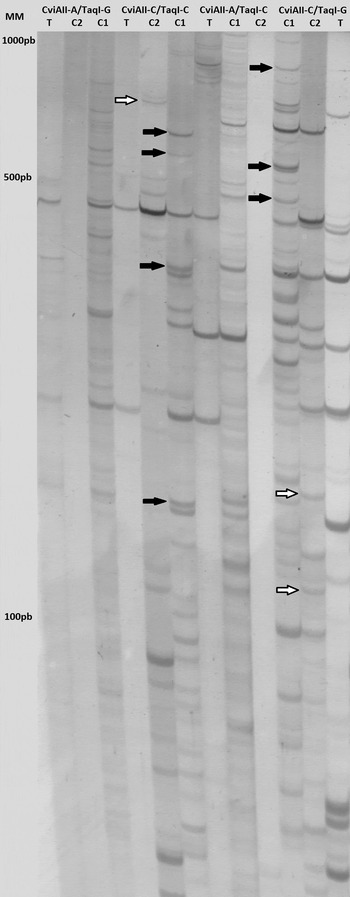
In order to characterize xenia effect at endosperm level by studying the differential gene expression between crosses involving different paternal genotypes using cDNA-AFLP analysis, two genotypes of P. notatum were used as pollen donors. On average, patterns of approximately 60 fragments had been produced by each primer combination, with molecular weights ranging from 100 to 800 b.p. Figure 1 shows a section of a typical cDNA-AFLP polyacrylamide gel.
Polyacrylamide gel with typical band pattern using the cDNA-AFLP methodology. Transcript-derived fragments resulting from selective amplification used the next four combinations of primers (CviAII/TaqI): A/G, C/C, A/C and C/G (indicated at the top of the figure). Rows correspond to unpollinated mother plant (T): Q4117 (4x A) and two crosses: Cross 1 (C1): Q4117 (4x A) × H398 (2x S) and Cross2 (C2): Q4117 (4x A) × Q3775 (4x A). A/G and A/C primers combinations did not show amplification products in sample C2 (removed from the analysis). In C/C and C/G primer combinations, black arrows indicate examples of some of DETDFs that were only present in C1 cross, and white arrows indicate examples of some of DETDFs that were only present in C2 cross.

Differential gene expression for study of xenia effect
Based on the analysis of 16 primer combinations, 11 of them showed amplification products. Combinations CviAII/TaqI: A/C, A/G and G/T were removed from the analysis because they did not show amplification products in sample C2 (Fig. 1). Of the total TDFs detected, 39 were considered as maternal origin, 10 were considered as interaction between the clonal embryo and the hybrid endosperm effect, and 33 (28 corresponding to C1 and five corresponding to C2) were considered as xenia effect at endosperm level and were isolated from the gel. Twenty-four of the 33 DETDFs (23 to C1 and one to C2) were successfully re-amplified, sequenced and classified by function (Table 2).
Transcript classes and sequence search results of clones with significant homologies

_, no hit; n, similarity below the threshold used (e-value less than 1); Cross, grouping of DETDFs based on cross analysed (C1 and C2). DETDFs: CC, CG, GA and TG were indicated selective primer combinations.
Sequence analysis
The 24 DETDFs obtained were expressed only in one or another analysed cross and not in the control, therefore they were considered as related to xenia effect in P. notatum (Table 2). The sequences CG7, GG5, GA1 and TG2 were characterized in Arabidopsis thaliana and it was determined that they were related to pollen effect in the metabolic processes during germination and development of the pollen tube and pollen–pistil interaction. The sequences CG5, GA4, GA6, GG5, CG3, TG2 and CC1 were related to the number and size of seeds (Wang et al., Reference Wang, Boavida, Ron and McCormick2008a; Hajduch et al., Reference Hajduch, Hearne, Miernyk, Casteel, Joshi, Agrawal, Song, Zhou, Xu and Thelen2010; Bourdenx et al., Reference Bourdenx, Bernard, Domergue, Pascal, Léger, Roby, Pervent, Vile, Haslam, Napier, Lessire and Joubès2011; Missbach et al., Reference Missbach, Weis, Martin, Simm and Bohnsack2013; Voiniciuc et al., Reference Voiniciuc, Günl, Schmidt and Usadel2015; Salas-Muñoz et al., Reference Salas-Muñoz, Rodríguez-Hernández, Ortega-Amaro, Salazar-Badillo and Jiménez-Bremont2016). The sequences CC3, GA4, GA6 and GA2 were associated with A. thaliana loci encoding mobile mRNAs that can be moved cell to cell in the same tissue, or to nearby or distant tissues via phloem (Thieme et al., Reference Thieme, Rojas-Triana, Stecyk, Schudoma, Zhang, Yang, Miñambres, Walther, Schulze and Paz-Ares2015). The expression patterns of some DETDFs were analysed by real-time PCR and published in Felitti et al. (Reference Felitti, Acuña, Ortiz and Quarin2015). The expression profiles were confirmed for four out of the five DETDFs selected.
Xenia effect at phenotypic level in P. notatum
The comparisons of self- and open-pollinated seeds within genotypes Q4064 and Q4294 in P. notatum are presented in Table 3. The results showed that the higher values for percentage seed set, length and width of seeds were obtained from open-pollinated plants, although the differences in percentage of full seeds between self- and open-pollinated seeds were not significant. In the Q4064 genotype, the mean value of the number of full seeds was 41 and 123 in self- and open-pollinated types, respectively. In the Q4294 genotype, the mean value of the number of full seeds was 50 and 151 in self- and open-pollinated types, respectively (Fig. 2).
Seed set obtained from self- and open-pollinated Q4064 and Q4294 plants. SP, self-pollinated; OP, open-pollinated.

Analysis of xenia effect in self- and open-pollinated seeds

SP, self-pollinated; OP, open-pollinated. *Significant at α = 0.05.
Discussion
Numerous studies have reported xenia effects on seed and fruit characteristics in species of agronomic interest. These studies showed the importance of the effect of pollen on grain yield, size, colour and chemical characteristics, and their implications for breeding and seed production (Bullant and Gallais, Reference Bullant and Gallais1998; Dogterom et al., Reference Dogterom, Winston and Mukai2000; Kaczmarek et al., Reference Kaczmarek, Bujak, Kadłubiec, Grochowski and Galek2001; Weingartner et al., Reference Weingartner, Kaeser, Long and Stamp2002; Piotto et al., Reference Piotto, Batagin-Piotto, de Almeida and Oliveira2013; Wang et al., Reference Wang, Huang, Huang, Zhang and Zheng2013).
However, only one study of xenia at the molecular level in an apomictic species has been reported (Wang et al., Reference Wang, Huang, Huang, Zhang and Zheng2013). There appeared to be great phenotypic variability (length, diameter and weight) in seeds and fruits of hickory depending on the pollen used. The authors found that the progeny showed substantial differences when compared with the male progenitor. However, when they analysed the offspring with random amplified polymorphic DNA (RAPD) and AFLP markers they did not find so many differences compared with the female progenitor. It is essential to provide more molecular information on xenia in order to generate new tools to assist plant breeding in the search for higher grain yield and better fruit quality. Thus, in the present work, biological function was assigned to DETDFs obtained for each cross used when compared with each other and with an unpollinated control. Different pollen pools generated different patterns of gene expression. It was determined that some DETDFs were associated with reproductive mechanisms, specifically identifying genes associated with double fertilization and development of the seed per se. In addition, xenia effects at endosperm level began at very early stages of development of the P. notatum seed, as this effect was already detected after 3 h of pollination.
Pollen effects in the metabolic processes during germination and development of the pollen tube and pollen–pistil interaction
The sequences CG7, GG5, GA1 and TG2 were related to A. thaliana loci associated with germination, pollen tube growth and pollen–pistil interaction. CG7 showed high similarity (e−122 BLASTp) to the AT3G45100 locus (alternative name: SETH2) that encoded glycosylphosphatidylinositol anchor (GPI anchor), a protein involved in pollen grain germination and pollen tube growth (Lalanne et al., Reference Lalanne, Honys, Johnson, Borner, Lilley, Dupree, Grossniklaus and Twell2004). SETH2 mutation blocked male transmission and pollen function, associated with abnormal callose deposition, suggesting the important role of GIP in the formation and metabolism of the pollen tube (Lalanne et al., Reference Lalanne, Honys, Johnson, Borner, Lilley, Dupree, Grossniklaus and Twell2004). GG5 showed high similarity (0.0 BLASTp) to AT4G24190 locus. Constant gene expression levels of these loci were shown during the period between the desiccated mature pollen grains to developed pollen tubes (Wang et al., Reference Wang, Zhang, Song, Zou, Su and Wu2008b). GA1 sequence showed high similarity (5e−39 BLASTp) to AT5G59720 locus, which encoded a low molecular weight heat shock protein 18.2 (HSP18.2). Gene expression of this locus was demonstrated during pollen grain germination and pollen tube growth (Wang et al., Reference Wang, Zhang, Song, Zou, Su and Wu2008b). In addition, it was shown that gene expression levels increased from the mature pollen condition desiccated to the hydrated mature pollen condition, where the transcript levels were maintained at a constant maximum level until pollen development (Wang et al., Reference Wang, Zhang, Song, Zou, Su and Wu2008b). Finally, TG2 presented high similarity (0.0 BLASTp) to AT1G02205 locus (alternative name: CER1), which was important in the pollen–pistil interaction, and was associated with the structure and composition of the pollen wax, which in turn, was involved in the development and fertility of the pollen grain (Preuss et al., Reference Preuss, Lemieux, Yen and Davis1993). In mutants where the pollen wax layer was removed, it was found that the stigma placed in contact with this pollen did not expose callose and did not carry out the fertilization (the pollen did not germinate), and thus interrupted the pollen–pistil interaction. These results demonstrated that wax was necessary for fertilization (Aarts et al., Reference Aarts, Keijzer, Stiekema and Pereira1995).
Pollen effects in metabolic processes during seed development and production (xenia effect)
The sequences CG5, GA4, GA6, GG5, CG3, TG2 and CC1 were related to loci of A. thaliana associated with seed development and production. CG5 showed similarity (1e−02 BLASTp) to AT1G15440 a locus that encoded a protein acting as cofactor in the biogenesis of the 40S subunit of the ribosome (alternative name: PWP2) (Missbach et al., Reference Missbach, Weis, Martin, Simm and Bohnsack2013). In studies with heterozygous mutants in A. thaliana (PWP2 +/–) it was observed that the siliques reduced its size by 25% and the seeds were very small or had aborted early, so the number of seeds was reduced by 50% (Missbach et al., Reference Missbach, Weis, Martin, Simm and Bohnsack2013). In a transcriptome analysis that included different organs and developmental moments, the highest expression of PWP2 was found in reproductive and strongly dividing tissues (such as flowers, seeds and siliques) (Missbach et al., Reference Missbach, Weis, Martin, Simm and Bohnsack2013). The CG3 sequence showed high similarity (e−160 BLASTp) to AT3G44110 locus (alternative name: ATJ3). Loss of ATJ3 function was associated with small seed production. Studies in mutant seeds showed a reduction of 24% in size and weight of 500 seeds, compared with the wild-type (Salas-Muñoz et al., Reference Salas-Muñoz, Rodríguez-Hernández, Ortega-Amaro, Salazar-Badillo and Jiménez-Bremont2016). In addition, it was observed that the lack of transcription of the gene altered the columella form of the seeds. The ATJ3 gene could be an important factor in seed development (Salas-Muñoz et al., Reference Salas-Muñoz, Rodríguez-Hernández, Ortega-Amaro, Salazar-Badillo and Jiménez-Bremont2016). On the other hand, the CC1 sequence showed high similarity (2e−60 BLASTp) to AT5G67230 (alternative name: IR14-L) locus. IR14-L encoded a member of the family glycosyltransferases43 (GT43) protein family and was essential for the synthesis of highly branched xylan in seed coat epidermal cells and was more abundant in the mucilage of the A. thaliana seed and required to maintain its architecture (Voiniciuc et al., Reference Voiniciuc, Günl, Schmidt and Usadel2015). These unique branches appeared to be necessary for the attachment of pectin to the seed surface, while the xylan backbone maintains the cellulose distribution. The expression for this locus was demonstrated at different moments and tissues of the seed development (Voiniciuc et al., Reference Voiniciuc, Günl, Schmidt and Usadel2015).
The GA4 and GA6 sequences were highly similar (5e−52 BLASTp) to AT2G47470 locus, which encoded a protein disulfide isomerase 2-1 (PDIL2-1) that is involved in the maturation of plasma membrane and secreted proteins (Wang et al., Reference Wang, Boavida, Ron and McCormick2008a). Mutant phenotypes of this locus of A. thaliana showed reduced seed production, small siliques and reduced seed numbers. In addition, it was shown that in these mutants there is an interruption in the funicular and micropylar pollen tube guidance, altering the orientation of the pollen tube (Wang et al., Reference Wang, Boavida, Ron and McCormick2008a). Although previous studies had attributed the role of correct pollen tube growth to PDIL2-1 (Wang et al., Reference Wang, Boavida, Ron and McCormick2008a; Boavida et al., Reference Boavida, Shuai, Yu, Pagnussat, Sundaresan and McCormick2009), gene expression studies during A. thaliana seed development had shown that the maximum expression level of this gene was at 5 days after flowering (DAF) and then the expression levels decreased (Hajduch et al., Reference Hajduch, Hearne, Miernyk, Casteel, Joshi, Agrawal, Song, Zhou, Xu and Thelen2010). The results suggested that this gene played an additional role besides the guidance of the pollen tube to the micropyle of the ovule. Taking into account that fertilization of A. thaliana occurs 3 h after flowering (Mansfield and Briarty, Reference Mansfield and Briarty1991) and that the period of greater storage of oils and protein, synthesis and deposition in A. thaliana seeds is between 5 and 13 DAF (Hajduch et al., Reference Hajduch, Hearne, Miernyk, Casteel, Joshi, Agrawal, Song, Zhou, Xu and Thelen2010), it is probable that this gene plays an important role during the development of A. thaliana seed.
Similar to GA4 and GA6 sequences, whose functions are exerted at moments prior to fertilization (development of the pollen tube) and during seed development, the GG5 sequence seemed to behave in the same way in A. thaliana (Hajduch et al., Reference Hajduch, Hearne, Miernyk, Casteel, Joshi, Agrawal, Song, Zhou, Xu and Thelen2010). A similar behaviour to GA4, GA6 and GG5 was shown by the TG2 sequence which, in addition to fulfilling an important function in the pollen–pistil interaction (Preuss et al., Reference Preuss, Lemieux, Yen and Davis1993; Aarts et al., Reference Aarts, Keijzer, Stiekema and Pereira1995), also performed functions during the development of seed and fruit (Bourdenx et al., Reference Bourdenx, Bernard, Domergue, Pascal, Léger, Roby, Pervent, Vile, Haslam, Napier, Lessire and Joubès2011). Previous studies had shown that waxes are not only implicated in dehiscence processes but also that the relative abundance of transcripts for CER1 showed the highest levels of expression in flowers and siliques, in addition to CER1 being involved in the biosynthesis of flower waxes and fruits (Bourdenx et al., Reference Bourdenx, Bernard, Domergue, Pascal, Léger, Roby, Pervent, Vile, Haslam, Napier, Lessire and Joubès2011).
Molecules related to the xenia effect
Liu (Reference Liu2008) suggested two hypotheses for the mechanism of xenia, the first of which was that the effect would be mediated by hormones that are secreted by the embryo and/or endosperm and that these hormones would depend on the male parent. The second hypothesis was that the molecules mediating xenia would be mobile mRNAs, which would be released during fertilization from the pollen tube and diffuse out into maternal tissues of the seed and fruit, producing phenotypic variations. It has been shown that mRNAs can move long distances via phloem or plasmodesmata and are also involved in signaling between the male and female parent, which would affect the characteristics of the seed and/or fruit, causing phenotypic changes of the tissues in development (Kim et al., Reference Kim, Canio, Kessler and Sinha2001; Kudo and Harada, Reference Kudo and Harada2007; Liu, Reference Liu2008; Wang et al., Reference Wang, Boavida, Ron and McCormick2008a; Piotto et al., Reference Piotto, Batagin-Piotto, de Almeida and Oliveira2013; Thieme et al., Reference Thieme, Rojas-Triana, Stecyk, Schudoma, Zhang, Yang, Miñambres, Walther, Schulze and Paz-Ares2015). Piotto et al. (Reference Piotto, Batagin-Piotto, de Almeida and Oliveira2013) supported the hypothesis of mRNA as a signalling molecule, as its diffusion could explain the transmission of the signal within the tomato fruit and, therefore, could be involved in the observed expression of xenia. Wang et al. (Reference Wang, Huang, Huang, Zhang and Zheng2013) found that genetic differences (by analyses using AFLP and RAPD markers) exist between the female progenitor and F1progeny, but not between F1 individuals and the male parent. Therefore, they concluded that the effect of pollen is not genetic (supporting either hormone-mediated or another type of mechanism).
In the present work, four DETDFs (CC3, GA4, GA6 and GA2) were detected for the pollen grain genotype used in A. thaliana to be encoded for mobile mRNAs. Of these, CC3 sequence was highly similar (0.0 BLASTp) to AT1G17745 locus that encoded D-3-phosphoglycerate dehydrogenase (PGDH2), a member of the PGDH isoenzyme family. PGDHs are components of the glycolytic phosphoserine (PS) pathway and phosphorylation pathway of serine biosynthesis (PPSB), playing important roles in plant development and metabolism. PPSB play an essential role in actively diving cells such as embryos and anthers (Toujani et al., Reference Toujani, Muñoz-Bertomeu, Flores-Tornero, Rosa-Téllez, Djoro Anoman and Ros2013). In addition, an alteration of the PGDH family gene expression affected the primary metabolism of A. thaliana, so that mobile mRNA might be involved in seed development and primary metabolism of the seed (Benstein et al., Reference Benstein, Ludewig, Wulfert, Wittek, Gigolashvili, Frerigmann, Gierth, Flügge and Krueger2013). GA4 and GA6 were associated with an A. thaliana locus (AT2G47470) involved in protein synthesis. Mutants for this locus showed interference in signalling between the pollen tube and the micropyle of the ovule during fertilization (Wang et al., Reference Wang, Boavida, Ron and McCormick2008a). These results were consistent with the second hypothesis proposed by Liu (Reference Liu2008) and could be added to the results obtained by Piotto et al. (Reference Piotto, Batagin-Piotto, de Almeida and Oliveira2013) supporting the hypothesis that mobile mRNAs would be involved in the mechanism of xenia functioning as a signal between the male and female parents.
Xenia effects in seeds obtained from self- and open-pollinated plants
The values for seed set, length and width of seeds obtained from self- and open-pollinated plants of Q4064 and Q4294 genotypes demonstrated the effects of the pollen genotype (xenia) at phenotypic level. The results of xenia in seeds obtained from self- and open-pollinated P. notatum plants were consistent with the observations reported in crops such as alfalfa, rye (Kaczmarek et al., Reference Kaczmarek, Bujak, Kadłubiec, Grochowski and Galek2001) and maize (Bullant and Gallais, Reference Bullant and Gallais1998; Weingartner et al., Reference Weingartner, Kaeser, Long and Stamp2002). The different genotypes of the pollen source resulted in measurable changes during the development of the seed, such as in the filling and grain size (length and width). Also, the results obtained in the present work show a connection between the genes (CG5, GA4, GA6, GG5, CG3, TG2 and CC1) predicted to be involved in xenia effect and the phenotypic differences in seed set and seed size in P. notatum.
Conclusions
In conclusion, the results of the initial screening of xenia effect showed evidence of the pollen genotype effect in the hybrid endosperm at molecular level in P. notatum. Additionally, the effect of pollen genotype in P. notatum could be one of the factors that determine differential expression of genes related to number, size and weight of seed. Therefore, this effect of pollen genotype may be associated with grain yield. In addition, four out of 24 DETDFs were particularly interesting, as they are mobile mRNAs that mediate signalling pathways between maternal and paternal tissues. The results present evidence that these mobile mRNAs could be the signals involved in the xenia effect at endosperm level in the species. Given the implication of the genotype of the pollen grain on plant genetic improvement in species of agronomic interest such as maize, alfalfa, rye, tomato and blueberry, we consider that the results obtained in this work are among the first contributions to the description of xenia in the endosperm at the molecular level. In addition, xenia effects were demonstrated at the phenotypic level in P. notatum seeds.
Supplementary material
The supplementary material for this article can be found at https://doi.org/10.1017/S0960258518000375.
Acknowledgements
We thank Dr Alex Zilli (Universidad Nacional del Nordeste) for kindly providing the caryopses of P. notatum included in this study. We thank Dr Ana C. Ochogavía, researcher of the Consejo Nacional de Investigaciones Científicas y Técnicas (CONICET), for her valuable advice regarding image analysis. We also thank Dr Elsa L. Camadro, researcher of CONICET and Instituto Nacional de Tecnología Agropecuaria, for her useful advice and discussions.
Financial support
This work was supported by the Consejo Nacional de Investigaciones Científicas y Técnicas (CONICET) grants PIP-11220090100613 and PUE 0043, the Agencia Nacional de Promoción Científica y Tecnológica (ANPCyT) grant PICT-2012-1321, and the Secretaría de Ciencia y Técnica and Universidad Nacional de Rosario (UNR) grant AGR161.