INTRODUCTION
Spartan inscriptions constitute some of the most important evidence for the investigation of ancient Sparta, but, with rare exceptions, the extant inscribed objects are left idle in storerooms, while modern scholars rely upon dated publications of their texts. Old epigraphical publications, which sometimes are not entirely accurate, focus mainly only on the text, while the physical objects bearing inscriptions themselves are often treated summarily. Yet study of the objects bearing inscribed texts together with the inscriptions themselves yields information that challenges what we suppose we know about ancient Sparta.
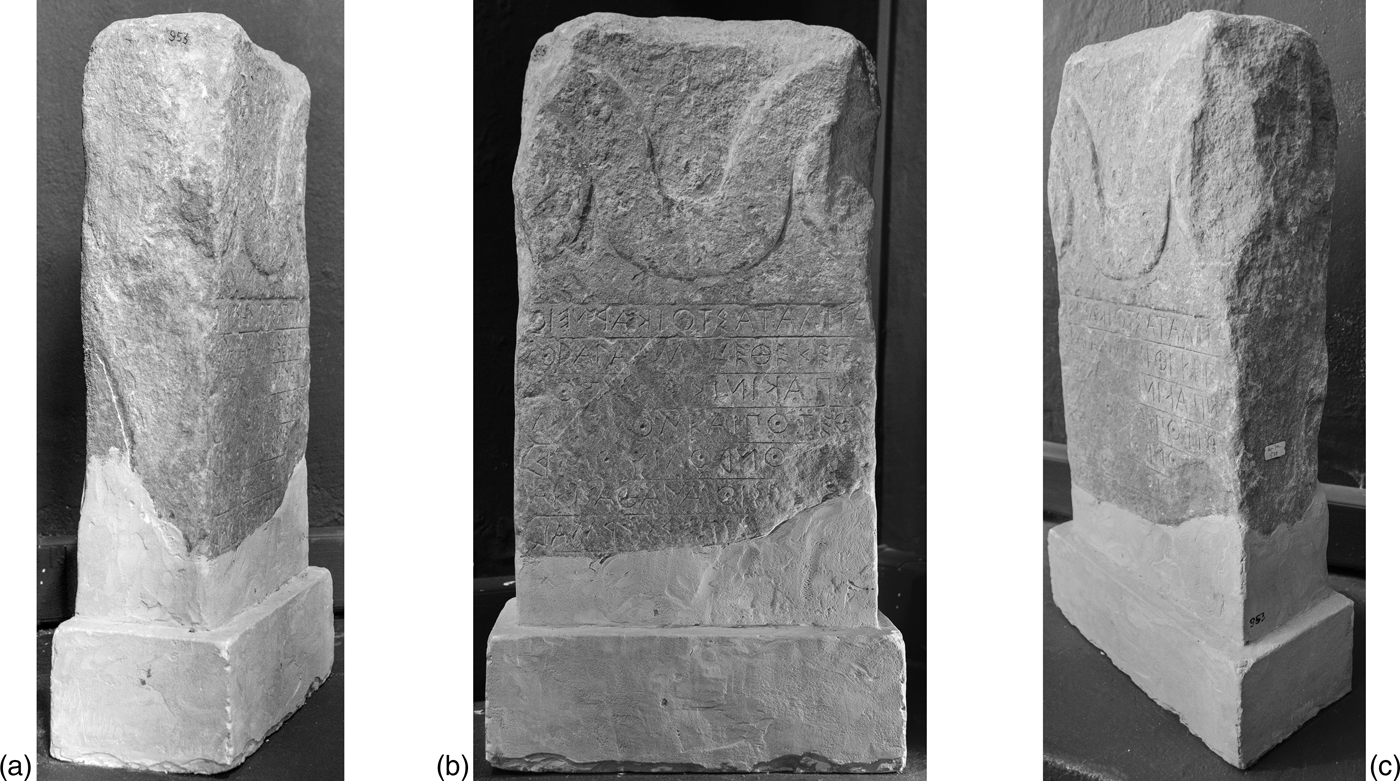
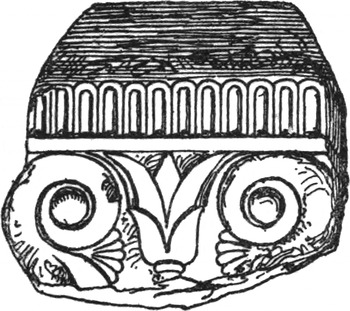
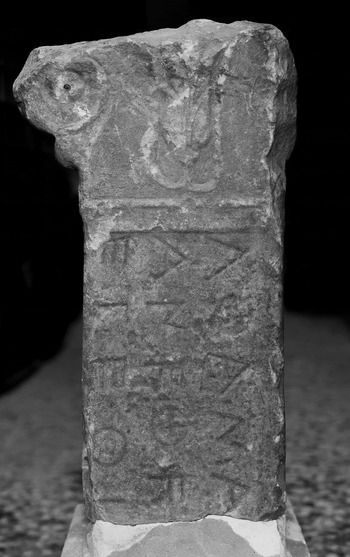
This article analyses a Late Archaic inscribed stele (IG V.1 222), now on display in the Archaeological Museum of Sparta (from now on referred to as SM; Inv. 953), bearing an inscribed dedication to Karneios by a certain Aiglatas for his athletic victories (Figs 1a, 1b, 1c, 1d, 1e, 1f, 2a, 2b and 2c). The present study combines re-examination of the stone and close comparisons with parallel documents, which will also be analysed in detail. I propose a new reading of the inscription and interpretation of Aiglatas’ dedication. Aiglatas’ stele has been used as evidence for two scholarly claims concerning Apollo Karneios and the Karneia festival: that athletic competitions were performed at the Karneia, and that Apollo Karneios in the Mediterranean was represented as having a ram's horns. As we will see, these claims are without foundation.Footnote 1
Aiglatas’ stele, from Sparta (SM 953, IG V.1 222), 500 bc: (a) left section; (b) top; (c) right section; (d) left; (e) front; (f) right. Author's drawing.

Aiglatas’ stele: (a) left view; (b) front view; (c) right view. Author's photos.

THE STONE
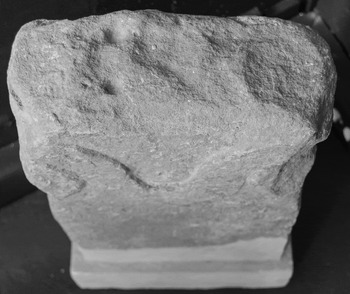
The stele of greyish marble is complete on all sides except the bottom edge (Figs 1d, 1e, 1f, 2a, 2b and 2c), and the sides and surface are damaged in several places (size: h. 47.85 cm; w. 32.90 cm; th. 13 cm).Footnote 2 The upper sides of the stone were originally broader than they are now, and clearly have been cut down and made even with the lower portion of the sides, probably to give to the stele a new shape, perhaps for reuse in the Late Roman wall where it was found.Footnote 3 On the top horizontal surface of the stone, one can see two holes (Figs 1a, 1b, 1c and 3), the bottom of a rectangular cut (c.4.90 by 4.50 cm), and two shallow circular hollows (diam. c.8 cm).Footnote 4 The nature of the two hollows is unclear because their uneven shape and blurred profiles do not allow certain reconstruction: they could be the result of the remodelling of the stone for its reuse in Late Roman architecture, or could have belonged to the original monument; in the latter case, the poor state of preservation does not allow us to establish their function.
Aiglatas’ stele: top view. Author's photo.

Although the stone is altered by probable later reuse as building material, some characteristics of the original shape did not disappear completely: the central rectangular cut and the two holes, which measure c.0.80 cm in depth (Figs 1a and 1c), originally were deeper than they are now, because the irregular surface of the top of the stele suggests that the top portion of the monument was levelled off, perhaps when the stone was reused. Therefore, the two holes were originally deep enough to host dowels, while the rectangular cut, with its clear shape and its location in the middle of the top surface, looks like a bedding belonging to the original monument.
We will return to the possible function of the rectangular bedding and the dowel holes, but for the moment let us point to a detail that is relevant to our analysis of the monument. If we look at the stele from the left-hand side profile (Figs 1a, 1d and 2a), we can notice that the thickness of the stone is uneven, that its upper portion broadens at the top.
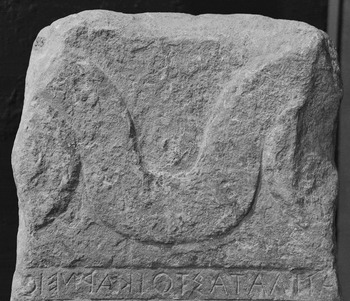
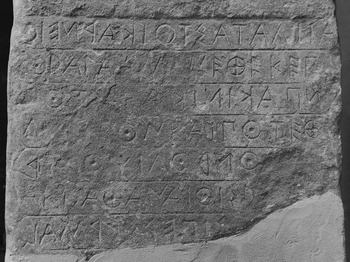
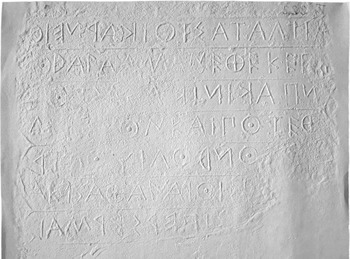
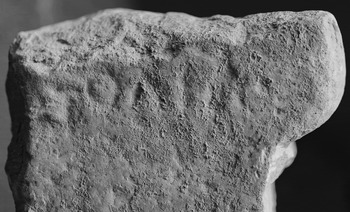
The front vertical face is divided into two areas: on the upper (Fig. 4) is carved a U-shaped form that terminates in two volutes. The space around the edge of the design is flat but an anomalous circular concentration of cement is positioned above the central curve of the relief (Figs 1e and 4). Below the spiral motif, on an even lower and carefully polished flat surface, is an inscription. The text (Figs 5 and 6) is a hexametric epigram in seven lines of true boustrophedon ⇋; the last letter of every line is skewed in the direction of the following line; thin straight guidelines, curving at the edge of the stele, are incised between the lines of text. The lettering (h. 2 cm) shows a consistent cutting throughout the whole inscription and is rendered in Archaic Laconian script.
Aiglatas’ stele: upper portion front view. Author's photo.

Aiglatas’ stele: the inscription. Author's drawing.

Aiglatas’ stele: the inscription. Author's photo.

THE INSCRIPTION
Editions
Kapsalis Reference Kapsalis1909, 275–82 photo 276, based on the stone; Woodward Reference Woodward1909, 81–5 with drawing at 82, based on squeeze (Hoffmann in GDI IV 1, 688 no. 27; Aupert Reference Aupert1980, 311 with photo at 310 fig. 1); Kolbe in IG V.1 222 with add. et corr. 302, based on drawing (Schwyzer 9; Friedländer 50; iAgon 9); Jeffery, LSAG 192, 199 no. 22, text 407, based on drawing pl. 36 no. 22 reworked from Woodward Reference Woodward1909, 82 (Lazzarini, Formule 299 no. 849); Hansen in CEG 374 is based on the drawing by Woodward Reference Woodward1909, 82 (Bowie Reference Bowie, Baumbach, Petrovic and Petrovic2010, 343; Day Reference Day2010, 206 photo 56 fig. 6:1, credit O. Palagia, with drawing at 56 fig. 6:2 from CEG archives).
Cf. Peek Reference Peek1974, image only, pl. 5:2.
Text
Αἰγλάτας το̑ι Καρνείο[ι]
[τ]όδ’ ἄγαλμ’ ἀνέθεκε, / πε-
νπάκι νικάσας τὸν̣
μα̣κρ̣όν, καὶ ποτέθε-
5 [κε, / τ]ὸν δόλιχον τρι-
άκις Ἀθαναίοις δ[ιαθε-
ύσας, / h]ᾶ̣ιπερ συρμαία
[---]
Epigram
Αἰγλάτας το̑ι Καρνείο[ι|τ]όδ’ ἄγαλμ’ ἀνέθεκε,
πε|νπάκι νικάσας τὸν|μ[ακ]ρόν, καὶ ποτέθε|[κε],
3 [τ]ὸν δόλιχον τρι|άκις Ἀθαναίοις δ[ιαθε|ύσας],
[h]ᾶιπερ συρμαία [---]
Translation
Aiglatas set up this agalma to Karneios,
having won the makros five times, and added [something to the dedication],
having run the dolichos three times at the Athanaia,
where the syrmaia […]
Commentary
Restorations: l. 1: Friedländer 50, τῶι Καρνείω[ι] ‖ ll. 2–3: Kapsalis Reference Kapsalis1909, 278, ανεθεκεπ(ε)-νπακι ‖ l. 4: Kapsalis Reference Kapsalis1909, 278, ποτε θ ‖ ll. 4–5: Hoffmann in GDI IV 1, 688 no. 27, Kolbe in IG V.1 222 add. et corr., Friedländer 50 and Moretti in iAgon 9, ποτέθ(ρ)-[εξε |] ‖ l. 6: Kapsalis Reference Kapsalis1909, 278, Αθαναιοις (σ) – – –; Woodward Reference Woodward1909, 82, Friedländer 50, Moretti in iAgon 9, and Aupert Reference Aupert1980, 311, Ἀθαναίοις δ…; Kolbe in IG V.1 222 and Schwyzer 9, Ἀθαναίοις δ[ὲ ․ ․ ․] ‖ ll. 6–7: Jeffery, LSAG 199 no. 22, Αθαναιοις ε[ν αγο̄-σιν?, |]; Lazzarini, Formule 849, Αθαναιοις ἐ[ν ἀγο̑-σι ?]; Hansen in CEG 374, Ἀθαναίοις ἐ̣[ν ἀέθ-λοις|] ‖ ll. 7–8: Bowie Reference Bowie, Baumbach, Petrovic and Petrovic2010, 344 n. 59, συρμαία[ς χάριν] (?) ‖ l. 8: Woodward Reference Woodward1909, 82, [. Τ̣- - - - - -]; Aupert Reference Aupert1980, 311, ․ ․ ․ τ̣ ․ ․ ․ .; Hansen in CEG 374, either ζ, h, π, or τ; the stroke is now partially covered by the modern plaster of the display base.
The circles, ο = ⨀ and θ = ⨁, were engraved with a cutting compass, as is visible from the central dot, which is missing in the o of το̑ι in l. 1, and faint in the o of Καρνείο[ι] (l. 1), probably because of the erosion of the surface.Footnote 5 Woodward (Reference Woodward1909, 81 n. 1) suggests that the ○ probably marks the ω, while the ⨀ is its short counterpart ο: the opposite occurs in an inscription from Thera (cf. Roehl Reference Roehl1882, 121 no. 451ab; and Guarducci Reference Guarducci1967, 352 no. 5ab). σ can be composed of four strokes  (l. 1 only) or three strokes
 , which, in l. 6, can face right (
 ) or left (
 ). ν (
 ) alters its slope constantly. α has the typical Laconian form with the horizontal middle stroke
 . μ also has the typical Laconian form
 with the fourth stroke as long as the first.
The date is controversial: on the basis of palaeography, some scholars assign the inscription to 530 bc or to the late sixth century bc, while others date it later (from the early fifth century to 480 bc), but a reasonable date would be 500 bc, if we consider that some Spartan materials – including inscriptions – have been lowered in date in the light of the work of J. Boardman, who down-dated the deposits excavated at the sanctuary of Artemis Orthia.Footnote 6
THE TEXT
The text is easily legible or restorable until the end of l. 6; after Ἀθαναίοις, it becomes less legible. As summarised in the commentary, Jeffery and Hansen place an epsilon after Ἀθαναίοις, and restore the missing text with ε[ν αγο̄-σιν] and ἐ̣[ν ἀέθ-λοις], respectively. This would yield this reading:
Aiglatas set up this agalma for Karneios having won the makros five times, and [he] added the dolichos three times [at] the Athanaia contests, where the prize …
Jeffery and Hansen favour an ε because Woodward's drawing (Fig. 7) indicates that the letter after Ἀθαναίοις is incomplete, and is compatible with an ε or a δ (cf. Fig. 8).Footnote 7 However, the letter after Ἀθαναίοις is not an ε but a δ, as it is possible to discern from pictures previously published, and as autopsy confirms (Figs 1e, 2b, 5 and 6).Footnote 8 The identification of this letter affects the reading of the text: those scholars who adopt the δ often propose a restoration with the particle δέ (l. 6), which implies a strong editorial break after τριάκις (ll. 5–6), and yields the following:
Aiglatas dedicated this agalma to Karneios having won the makros five times, and [he] added the dolichos three times. Then, at the Athanaia [Aiglatas did something else].
Aiglatas’ stele: the inscription. Drawing after Woodward Reference Woodward1909, 82. Courtesy of the British School at Athens.

Aiglatas’ stele: the inscription. Squeeze. Photo by D. Summa. Courtesy of Inscriptiones Graecae, Berlin.

This reading separates the Athanaia from the two athletic competitions, and does not state explicitly in which festival Aiglatas obtained his victories in the makros and the dolichos. Scholars who propose this reading associate the two competitions with the festival in honour of the dedicatee, implying that Aiglatas ran both the makros and the dolichos at the Karneia. Yet this is not the only possible reading.
It is evident that the epigram has a formulaic construction: the dedication in verse 1 is expressed by the aorist ἀνέθεκε, followed by an accusative (τόδ’ ἄγαλμα) and the participle νικάσας (v. 2), which governs the accusative τὸν μακρόν (v. 2). After the conjunction καί is ποτέθε[κε] (v. 2), the Dorian form of προσέθηκε. The two verbs – ἀνέθεκε and ποτέθεκε – are similar to each other: they are composite forms of τίθημι and aorists, and both are located at the end of their respective verses. Thus, after καί we would expect the same structure as verses 1–2, namely an aorist (ποτέθεκε, v. 2), an accusative, a participle after Ἀθαναίοις (v. 3), and another accusative (τὸν δόλιχον, v. 3) in order to have two verses with a consistent syntactical construction based on the pattern aorist–governing–participle–governing–accusative repeated twice.Footnote 9 An accusative governed by ποτέθεκε (v. 2) is not explicitly expressed in the text, but it could be τόδ’ ἄγαλμα, shared with ἀνέθεκε (v. 1), or, as we will argue in the next section, may have been an object now lost.Footnote 10 As for a participle after Ἀθαναίοις (v. 3), I propose δ[ιαθε|ύσας], the aorist participle of διαθέω, to fill the eight letters’ gap after Ἀθαναίοις, where the letter δ is clearly visible.Footnote 11
With this restoration, the text of the inscription yields the translation reported in the commentary above. From the use of the verbs we can infer that ἀνέθεκε (v. 1) and ποτέθε[κε] (v. 2) allude to two separate actions of dedication. Even if these actions could have happened simultaneously, they are related to two distinct deeds expressed by as many participles, namely νικάσας (v. 2) and, possibly, διαθεύσας.Footnote 12 So structured, the two sentences are independent of each other, and separated by καὶ in line 4 (v. 2), implying that the complement of place, Ἀθαναίοις (v. 3), relates to the restored participle διαθεύσας, which itself governs the accusative τὸν δόλιχον (v. 3). Thus, the sentence ποτέθεκε τὸν δόλιχον τριάκις Ἀθαναίοις [διαθεύσας] is distinct from the preceding clauses, and suggests that Aiglatas ran only the dolichos, and not the makros, at the Athanaia.
THE FESTIVALS
The Athanaia festival in Sparta honoured Athena Poliouchos, the ‘Protectress of the City’, who had a temple richly decorated in bronze on the Spartan acropolis (Pausanias 3.17.2–3). Because of the decorations, according to Pausanias (3.17.2), the goddess was also called Chalkioikos, ‘of the bronze house’. Although her temple and part of the sanctuary have been excavated, we do not know much about this deity, nor are we adequately informed about the Athanaia, for which we have only a few inscriptions and a literary account by Polybius (4.35.2–3). The latter mentions a parade of youths in armour who attended a sacrifice conducted by the ephors at the temple of Athena Chalkioikos, but the association of these events with the Athanaia is hypothetical.Footnote 13
Despite the lack of information about the festival, it is unlikely that it was held more than once a year, but athletic events did not necessarily take place annually: as M. Nafissi argues on the basis of epigraphical evidence, athletic contests at the Athanaia were held trieterically.Footnote 14 If so, we can conjecture that Aiglatas obtained his victories in the dolichos within, at least, a time span of five years, which corresponds to the times he won the makros, presumably an annual race.Footnote 15 We cannot be sure that the five years were consecutive, but choosing the shortest period of time possible and counting the ratio of his victories to both the makros and the dolichos, we obtain a calculation that can be summarised in Table 1.
Possible summary of Aiglatas’ victories.

If this calculation is correct, one may argue that Aiglatas set up the agalma at least five years after his first victories; that is, not immediately after each success. The practice of making a dedication some time after – but not immediately after – the victories is attested by an inscribed stele dated to the end of the fifth century bc from Sparta.Footnote 16 The inscription (IG V.1 213) commemorates the successes of Damonon and his son Enymakratidas in horse racing and athletic events at several local festivals, such as the Athanaia, in Laconia. The text includes events related to different years: one section lists Damonon's accomplishments as a pais, another names competitions that he won as an adult. Damonon's inscription, therefore, commemorates events that took place over some 30 years. Something similar might be argued for Aiglatas, who, at least five years after his earliest victory, dedicated a single agalma commemorating eight significant successes of his athletic career.Footnote 17
The structure of the epigram informs the reader why Aiglatas dedicated the thanksgiving. If the text after καὶ (v. 2) explains what Aiglatas did at the Athanaia, that before καὶ explains why our Spartan runner decided to dedicate the agalma, as the use of ἀνέθεκε (v. 1) attests. The aorist ἀνέθεκε is the main verb of dedication, and the only one of the epigram governing both an accusative (τόδ’ ἄγαλμα, v. 1) and a dative (το̑ι Καρνείοι, v. 1). These three elements plus the subject, Αἰγλάτας, form the main clause, which occupies verse 1, and which, enunciating a standard dedicatory formula, expresses the dedicator's action of setting up the votive. The ensuing subordinate clause (v. 2) explains the reason for the dedication, delivered by the participle νικάσας, which governs the accusative τὸν μακρόν. Thus, πενπάκι νικάσας τὸν μακρόν (v. 2), being the subordinate clause of Αἰγλάτας το̑ι Καρνείοι τόδ’ ἄγαλμ’ ἀνέθεκε (v. 1), suggests that the main reason for setting up the votive is Aiglatas’ five victories in the makros, and not his triple victory in the dolichos at the Athanaia.Footnote 18
To summarise the argument thus far: Aiglatas dedicated the agalma to Karneios chiefly because of his victories in the makros, and added something to the votive because he ran the dolichos at the Athanaia. So far, we have interpreted the two aorists ἀνέθεκε and ποτέθηκε as differing from each other and related to two separate actions of dedication. However, these two verbs are kindred: first, they both refer to two actions that probably happened at the same time, because extant evidence – such as a consistent letter cutting throughout the whole inscription – suggests that the votive did not have additions after it was set up. Second, the verbs ἀνέθεκε and ποτέθηκε have semantic similarities because they both refer to the same practice of setting up a votive: ἀνέθεκε – the actual verb of dedication – is a composite form of τίθημι, which indicates the action of setting. While with prefix ἀνα- the verb acquires the meaning of setting up, the prefix προσ- added to τίθημι gives the sense of adding something to an object.Footnote 19 We have seen that ἀνέθεκε (v. 1) governs the accusative τόδ’ ἄγαλμα (v. 1), and because προστίθημι functions as the counterpart of ἀνατίθημι in the epigram, we can assume that ποτέθηκε governs an object, now lost, which was part of the votive and extended the dedication of the agalma.Footnote 20 Since the agalma is dedicated to Karneios for the victories in the makros, one might conclude a connection between the makros and the deity, and assume that probably Aiglatas won the makros at a celebration in honour of Apollo Karneios. Although the epigram does not specify what this celebration was, Aiglatas could have won this race at any festival where Apollo Karneios was honoured, even outside Sparta. As we will see, defining the makros restricts the options.
THE RACES
As the name itself suggests, the makros was probably a long run, and ancient literary and epigraphical texts suggest that it often is associated with the lampadedromia, the torch race. Modern scholarship has tentatively proposed an association between the makros dromos and the lampadedromia with regard to Aiglatas’ inscription.Footnote 21 But the relevant evidence is geographically and chronologically scattered: with the exception of Aiglatas’ inscription, extant evidence concerning the makros dromos is Hellenistic and Roman and derives from a wide geographical region from Athens to Asia Minor. Although these testimonies do not come from Peloponnesian poleis, and date later than Aiglatas’ stele, we have to take into account this later evidence if we want to attempt a definition of the makros mentioned in IG V.1 222.
Let us start from literary sources that inform us about the race in Athens. From Plutarch (Solon 1.4) we know that ephebes, running the lampadedromia during the Panathenaia, lit their torches near the statue of Eros that Peisistratos erected at the Academy, where, according to Pausanias (1.30.1), Charmos – the tyrant's eromenos – dedicated an altar for the god. According to Hermias (Phaedrus 231e), before the race began the ephebes lit their torches at the altar of Eros from which the long race (ὁ δρόμος γε ὁ μακρός) started. Therefore, Hermias’ text suggests that the makros dromos was run from the same starting point as the Panathenaic lampadedromia mentioned by Plutarch.Footnote 22 The difference in dates between the three authors – Plutarch (first century ad), Pausanias (mid-second century ad) and Hermias (fourth century ad) – is considerable, but the information that they provide about the makros dromos does not conflict.
Literary sources are not the only evidence available for the Athenian makros dromos, which is also attested epigraphically. An inscription (IG II2 3149 = 3877) of the early second century bc reports a dedication by a woman for her son, who won the makros dromos at the Panathenaia (l. 3). In view of the literary sources presented so far, the long race of IG II2 3149 = 3877 may refer to a victory in the lampadedromia.Footnote 23 Yet in Athens the makros dromos took place outside the framework of the Panathenaia as well: a decree (IG II2 1011) honouring ephebes, dated 106/105 bc, mentions a makros dromos (l. 17) performed by Athenian youths against the Salaminians during the Aianteia festival, and from IG II3.1 1166, l. 19, dated 213/212 bc, we know that the competition run by the Athenian ephebes during the same festival was a torch race.Footnote 24 Therefore, we might hypothesise that the makros dromos was also a lampadedromia at the Athenian Aianteia.Footnote 25
Outside of Athens, evidence for the makros dromos also comes from Dorian poleis of the east Aegean islands. A group of inscriptions mentions the makros dromos in conjunction with torch races. An inscribed stele (SEG XLV 1065; cf. Kontorini Reference Kontorini1975, 97–117) dated to the third century bc from Rhodes reports a victory list related to the Great Erethimia. Lines 20–30 of Face B are devoted to victories in the torch races, among which is mentioned a makros dromos (l. 20). Both the makros and lampadedromia can be found coupled in two inscriptions from Kos. The first (IG XII.4 298 = NSRC 145), of the early second century bc, reports the regulation for the sales of the priesthood of Hermes Enagonios. The law prescribes (ll. 51–3) that a makros dromos followed by a lampadedromia and a procession should take place on the second day of the month Hyakinthos. Another Koan inscription (IG XII.4 328 = NSRC 215A), dated to the first century bc, reports a regulation for the sales of the priesthood of Zeus Alseios. According to this law, the purchaser of the priesthood has to crown the winners (l. 13) of the makros dromos and those of the lampadedromiai (the preliminary one and the actual lampas race, l. 14), all run at the Alseia festival (l. 15).
Evidence associating the makros dromos and the lampadedromia also derives from Macedonia. From Beroea comes a stele reporting a gymnasiarchal law (Gauthier-Hatzopoulos, Beroia 1) dated 200–130 bc. Among other regulations, the law includes a section (Face B) dedicated to the organisation of the Hermaia festival, during which both a makros dromos and a lampadedromia took place (l. 85; cf. Gauthier and Hatzopoulos Reference Gauthier and Hatzopoulos1993, 97–110). The inscription mentions the two competitions together, as they are implicitly analogous because they are coupled in opposition to a generic ‘the other contests’ (l. 86), which may refer to the εὐεξία, the εὐταξία, and the φιλοπονία of l. 47.Footnote 26 Since the inscription (ll. 59, 82–4) mentions two torch races, one (ll. 82–3) for boys (παῖδες), and the other (ll. 83–4) for youths (νεανίσκοι), one might hypothesise that the makros dromos (l. 85) corresponds to the long torch race held for the youths. The prizes for both contests were weapons (ὅπλα, ll. 46–7, 60).Footnote 27
The same prizes (ὅπλα) and contests (εὐεξία, εὐταξία, φιλοπονία, and makros dromos) occur in an inscription (ISestos 1 = OGI 339.83) of 130–120 bc, from Sestos, in the Thracian Chersonese. The document reports a decree by the Sestian Boule and Demos (l. 2) granting honours for their co-citizen Menas, who offered weapons (ὅπλα) as prizes for the makros dromos (l. 83), the εὐταξία, the φιλοπονία and εὐεξία. The extant text of the decree does not name torch races, but the other contests mentioned in ISestos 1, including the makros dromos, are the same as those held in Beroea, and both inscriptions, that from Sestos and that from Beroea, also mention arms as rewards for the competitions.Footnote 28 Given these analogies between the two inscriptions, it is not certain, but likely, that the makros in Sestos also could have had something to do with the lampadedromia.
The group of documents summarised above is the only extant evidence that can help us to define the makros dromos: only rarely is this race not explicitly associated with the lampadedromia, while sometimes it appears as the same competition for different age classes. Other times the two races are conflated, as in the case of Hermias (Phaedrus 231e), indicating that they are not just closely connected, but also that they are treated as the same kind of competition. An inscribed decree of lampadistai from Patmos (SIG 3 1068.9) suggests that the makros dromos is a type of lampadedromia: according to the inscription, dated to the second century bc, the Patmian lampadistai honoured Hegemandros, son of Menekrates, who became a priest of Hermes by promising to perform sacrifices to this deity for the rest of his life at his own expense (ll. 15–18). Not only was Hegemandros priest, but he also served as gymnasiarch for the seventh time, treasurer (chrysonomos, l. 11) of the torch race runners (lampadistai, l. 11), team leader and sponsor (lelampadarchekos, l. 8), and winner (nenikekos, l. 9) of the makros dromos. In SIG 3 1068, the connection between the makros dromos and torch races is remarkable: mentioning the costly offices that Hegemandros held, the decree emphasises his prominent role in the college of the torch race runners and stresses the link between the honorand and those activities relevant for the lampadistai, namely the lampadedromia. In particular, Hegemandros’ victory in this competition occurs immediately after his role of torch race official, as if the former is closely related to the latter. In such a context, we might expect that the makros dromos won by Hegemandros is nothing other than a lampadedromia.Footnote 29
Hegemandros’ victory in the makros dromos is individual, like that mentioned in IG II2 3149 = 3877, but modern scholarship generally considers the lampadedromia as a relay torch race, and, as such, run by teams formed from civic tribes.Footnote 30 However, Gauthier interprets the two inscriptions from Kos as referring to individual races run before the torch races.Footnote 31 In addition, he argues that the λαμπάδι ἀπὸ πράτας of the Rhodian inscription mentioned above refers to a torch race among individuals.Footnote 32 Individuals also receive victories for team torch races in Athens (Pausanias 1.30.2). According to his account, the winner does not correspond to the fastest runner, but to the first who arrives at the destination with the torch still lit. Therefore, team competitions do not necessarily imply team victories, but individual winners are also possible. We know that individuals who ran the lampadedromia received a hydria as a prize, as the inscription IG II2 2311, ll. 76–7 of the first half of the fourth century bc attests.Footnote 33
If the makros dromos can be a lampadedromia, and the torch races could have had both team and individual runners and winners, let us consider how these conditions could affect the interpretation of Aiglatas’ dedication IG V.1 222. The inscription states that Aiglatas won the makros five times, and the verb used is the singular participle (νικάσας, l. 3). The number of the verb implies that our Spartan runner accomplished his five victories by himself, and if we are right in considering the makros as a type of lampadedromia, then Aiglatas obtained individual victories in torch races. As argued above, the composition of the epigram suggests that Aiglatas dedicated the agalma because of his victories in the makros. Since the agalma is dedicated to Karneios, we might surmise that the race and the deity are strongly connected. If the makros is a lampadedromia, then Apollo Karneios may have received sacrifices after a torch race that renewed the fire of his altar.
Because there is no evidence concerning sacrifices for Apollo Karneios in Sparta, nor any attestation of lampadedromiai in the city, one might argue that Aiglatas could have won the torch races outside Sparta, in any of the festivals – and places – where the makros is attested. However, the lampadedromia, unlike other races performed in Panhellenic or interregional festivals, was generally restricted either to tribal teams, or – as inscriptions attest – to individuals selected from citizens and trainees of the same gymnasium.Footnote 34 Prizes won locally in lampadedromiai often remained in their communities: evidence attests to winners who had to dedicate their prizes, sometimes even by law, shortly after their victory. This is the case, for instance, for two inscriptions mentioned above. According to ll. 67–8 of the gymnasiarchal law from Beroea (Gauthier-Hatzopoulos, Beroia 1), winners of the competitions at the Hermaia festival, which also includes both the lampadedromia (ll. 59–60) and the makros dromos, were compelled to dedicate their prizes within a given time after the victory, or pay a fine of 100 drachmas. The other inscription is IG XII.4 298 = NSRC 145 from Kos; ll. 34–7 states that ‘the lampadarch who is the winner […] should sacrifice to Hermes an adult animal worth 30 drachmas from the prize of victory […] on the day after the torch-race’.Footnote 35
If we move away from Kos and Macedonia of the third and second century bc, respectively, and focus on Athenian dedicatory practices during the same time, evidence attests that victories in the makros dromos were dedicated to the same deity for whom the race was run. The stone of IG II2 3149 = 3877 dated to the early second century bc was found on the Athenian Acropolis; the inscription attests to a votive set up by Thaleia after her son's victory in the makros dromos at the Panathenaia.Footnote 36
For the stele of Aiglatas there is no evidence pointing to regulations on how, or to whom, our Spartan winner had to dedicate his votive, but the Laconian character of the dedication suggests that the makros of IG V.1 222 was run in Sparta.Footnote 37 Apollo Karneios had his own annual festival in Sparta, the Karneia, which was probably the most suitable occasion to run a lampadedromia – which, according to the interpretation argued here, corresponds to the makros dromos – for this god.Footnote 38 Yet even if the makros of Aiglatas’ votive refers to a torch race to Karneios’ altar, Aiglatas’ dedication does not necessarily attest to a set of athletic contests during the Karneia. In contrast to the makros dromos, which ancient evidence seems either to associate or conflate with the lampadedromia, the dolichos is the only competition mentioned in Aiglatas’ inscription that is widely attested during athletic programmes.Footnote 39 Therefore, IG V.1 222 attests to athletic competitions only at the Athanaia, where he ran the dolichos. It does not clearly refer to the Karneia, where perhaps Aiglatas ran a lampadedromia, a competition that can occur singly or in combination with other events. The Panathenaia, for example, included both torch races and athletic events, but other celebrations did not: the Olympic games had races with no lampades, while the Athenian Hephaisteia hosted a lampadedromia and music competitions, but not a set gymnic agones.Footnote 40 Thus, evidence for a torch race in Aiglatas’ inscription does not imply a whole athletic programme of events at the Karneia.Footnote 41
THE OBJECT MOUNTED UPON THE STELE
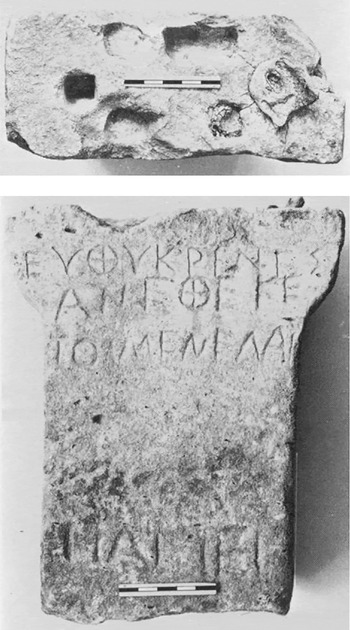
Thus far, we have proposed that Aiglatas won a makros race, a torch race in honour of Apollo Karneios, five times, and that these five victories explain why Aiglatas set up the agalma. In the structure of the epigram, agalma is the object of ἀνέθεκε (l. 2, v. 1), the first of the two verbs of dedication. But what about the object of ποτέθεκε (ll. 4–5, v. 2), the other verb of dedication? I suggest that even if omitted in the epigram, the object would have been clear to an ancient observer who viewed the stele in its original context because I think that the verb referred to something physically added to the top of the stele. The two dowel holes and the rectangular bedding mentioned earlier (Figs 1b and 3), may have received lead soldering or tenons to support attachments of bronze or stone. One could argue that the holes and the bedding look too shallow for this purpose, but, as noted earlier, the top surface does not seem to stand to its original height, so we are seeing the ‘bottoms’ of the cuttings, not their full height (Figs 1a and 1c). It is not possible to know what kind of objects were placed on the stele, but the two dowel holes are suitable to accommodate a small animal figure, either imaginary or real, such as a sphinx, a lion or a horse, while the rectangular cutting is a convenient bedding for a base of a small human figurine.Footnote 42 Alternatively, the dowel holes and the rectangular bedding may have supported a single object. Despite the lack of details, I think that the verb ποτέθεκε refers to one or more of these objects attached on top of the stele.Footnote 43
Although we can only hypothesise as to what object(s) topped the stele, the epigram may offer a clue as to why Aiglatas made the addition. Aiglatas ποτέθεκε (ll. 4–5, v. 2), namely ‘added’, something to the agalma because he ran (διαθεύσας, restored in ll. 6–7, v. 3) the dolichos thrice (τριάκις, ll. 6–7, v. 3) at the Athanaia (Ἀθαναίοις, l. 6, v. 3). The inscription informs us that Aiglatas not only ran, but also won the dolichos three times, because the relative pronoun [h]α˜ιπερ connects the dolichos with syrmaia (l. 7), an ephemeral prize made of suet and honey, as Hesychius (Σ.2782) explains.Footnote 44 In view of ποτέθεκε and of the syntax and structure of the epigram, it is likely that the object or objects on the stele were a thank offering for Aiglatas’ victories in the dolichos.
THE VOLUTES
The stone was shaped to create a surface large enough to accommodate the attachment(s) (Figs 2a and 2c). In its original state, Aiglatas’ stele might have been similar to that of SEG XXVI 459, a votive stele of the early fifth century bc from the Spartan Menelaion (Fig. 9), which records a dedication to Menelaos. Carved beddings with traces of the metal (bronze and lead) attachments are still visible on the top surface (Catling Reference Catling1976, 37 figs 28 and 29). While the front side of SEG XXVI 459 is flat, that of Aiglatas’ stele is decorated with the relief with whorls. Whorls that originate vertically from the bottom, often adorned with a palmette placed between the volutes, are characteristic of Aeolic capitals.Footnote 45 Perhaps the relief may be a stylised representation of volutes belonging to a capital, which worked as both a crown for the inscribed body of the stele and a pedestal for the attachments.Footnote 46
Votive dedication, from the Spartan Menelaion (SEG XXVI 459); early 5th century bc: top and front view. Photos from Catling Reference Catling1976, 37 figs 28 and 29. Courtesy of the British School at Athens.

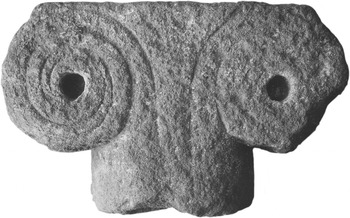
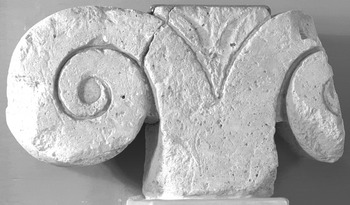
Aeolic capitals topped Archaic votive columns in the sixth and fifth centuries bc from Delos (Fig. 10), Paros (Fig. 11) and Athens (Fig. 12), and served as supports for statues.Footnote 47 Although these comparanda have volutes that do not connect at their bottoms, Aeolic-style capitals from architecture offer good comparisons for the volutes on Aiglatas’ stele. The volutes carved on a capital of the sixth century bc from Eressos on Lesbos (Fig. 13), spring from a single stem, then divide.Footnote 48 An even closer parallel is a capital of 550 bc from a building in Larissa on the Hermos (Fig. 14). The volutes of this capital rise from the central point at the bottom of the stone, and in the centre of each whorl is a dowel hole for metal attachments.Footnote 49 Not only volutes, but also metal attachments on the front of the capitals are relevant for our analysis of Aiglatas’ stele.
Capital from an Aeolic votive column, from Delos (Archaeological Museum of Delos, inv. unknown); second half of the 6th century bc. Drawing after Perrot and Chipiez Reference Perrot and Chipiez1894 pl. 53:1–2.

Parian marble capital from a votive column used for statuary, from Paros (Archaeological Museum of Paros, inv. 737); late 6th – early 5th century bc. Drawing after Orlandos Reference Orlandos1961, 193 fig. 199. Courtesy of Η εν Αθη´ναις Αρχαιολογικη´ Εταιρει´α.

Parian marble capital of votive column, from the Athenian Acropolis (Inv. 3794); c.550–500 bc. Courtesy of DAI Athen, negative no. Akropolis-0158.

Capital of grey granite from Eressos, Lesbos (Ministry of Culture and Sport, Ephorate of Antiquities of Lesbos, Archaeological Museum of Mytilene, inv. unknown); no earlier than the 6th century bc. Image after Condis Reference Condis1950, 26–7 figs 1–2. Courtesy of the Scuola Archeologica Italiana di Atene.

Architectural Aeolic capital of tufa, from Larissa on the Hermos (Archaeological Museum of Istanbul, inv. 1925); c.550 bc. Photo after W. Schiele. DAI Istanbul, negative no. D-DAI-IST-R6157.

We return now to the mortar-filled circle above the central curve of the relief (Figs 1e and 4), which was mentioned at the start of this study. A few black dots, perhaps traces of metal, appear within the cement, which protrudes from the surface of the stone. Both the circular shape of the cement and the black metal dots suggest the presence of a hole for some sort of metal attachment, now lost. This hole – if it exists – is still covered by the cement, perhaps belonging to the Late Roman wall where the inscription was found immured.Footnote 50 Considering that Aeolic capitals often have palmettes in the centre of the capital, I would suggest that a decorative device, such as a disc or, more likely, a metal palmette, may have accompanied the carved volutes above Aiglatas’ inscription.
Aiglatas’ stele would not be the only Spartan votive bearing a capital: for instance, a capital of bluish marble (Fig. 15), from the Late Archaic period, bears a motif similar to those of Aeolic style: a pomegranate flower ornaments the centre of the capital, and is flanked by two tendrils that curl from the outside towards the centres of the whorls.Footnote 51 Another example is a stele of Laconian marble (SM 4630), which has the shape of a narrow quadrangular pillar, widening and terminating at the top as an Aeolic capital (Figs 16a, 16b, 16c and 17). Between the volutes is a flower, from which sprout two tendrils that curve upwards sinuously, and rise vertically before curling into two whorls (Fig. 16a). The volute on the right-hand side is not extant, but that on the left, although damaged, is preserved (Fig. 16b). Traces of bronze from a metal attachment are still visible in the eye of the volute (Figs 16a and 17). A considerable portion of the top of the capital is missing, so we cannot speculate about its appearance. On the front vertical face (Figs 16a and 17) is the following stoichedon inscription (SEG XI 653):
Base of bluish marble, from Sparta (SM 737); Archaic period. Drawing after Tod and Wace Reference Tod and Wace1906, 207 fig. 75.

Eteoitas’ stele, from Sparta (SM 4630, SEG XI 653), c.500 bc: (a) front; (b) left side; (c) back. Author's drawing.

Eteoitas’ stele: front view. Author's photo.

Eteoitas’ stele: back view, inscribed letters. Author's photo.

Ἀθανα[ίαι] | ἀνέθε[κεν] | Ἐτεοί[τας (?)]. Eteoitas set up [this/me] to Athena.
Based on the form of the letters, Woodward (Reference Woodward1925, 251) suggests a date earlier than 480 bc, while Jeffery, LSAG (193, 200 no. 30) raised it to 510–500 bc. Although the stone was reused in a Late Roman wall, the dedication to Athena suggests that Eteoitas set up the stele in the precinct of Athena Chalkioikos, located north of the cavea of the Spartan theatre (see Dawkins et al. Reference Dawkins, Wace, Droop, Dickins, Tillyard, Woodward and Tod1906, 137–54). The context of the dedication might explain the presence of six letters, π̣τολια, not mentioned by Woodward or Jeffery, cut on the back side of the capital (Figs 16c and 18), suggesting that the letter cutter chiselled the text once the stone had already been shaped. My autopsy revealed that the back of the stone had been polished, and except for the six letters, there is no trace of strokes on the rest of the extant surface. However, the stone above and to the left (as viewed) of the five letters is not preserved; the shape of the fracture suggests that more letters (two to three) accompanied the extant five. Considering the evidence, I propose the following restoration:
[τοι] Π˙τολιά[|χο̄ι] To [Athena] Ptoliachos.
This second, presumed dedication accompanies the one on the front, and specifies that the offer was to Athena Poliouchos, elsewhere called Chalkioikos in Sparta.Footnote 52 This stele demonstrates that elements reproducing Aeolic-style capitals could be used in Spartan votives of the late sixth and early fifth centuries bc.
Another inscribed votive stele is worth mentioning as a comparison to the capital posited on Aiglatas’ stele: it is a block of grey marble bearing four lines of fragmentary text in true and false boustrophedon of c.500 bc. The text reads as follows:Footnote 53
[- - - νι]κ̣άσας) τ[ά] | πέντε [- - - |- - - δ]ύ̣ō) τόν | δόλιχ̣[ον - - - ]
Woodward (Reference Woodward1925, 249) and Jeffery, LSAG (193, 199 no. 28) noted a hole for a dowel on one of the sides of this stele. Because Woodward interprets the stone as a base, he thinks that the hole was used to attach another stone bearing the missing part of the inscription; Jeffery, on the other hand, interprets the stone as an inscribed shaft and suggests that the hole was used to attach a capital, now lost. I find Jeffery's suggestion convincing because the inscription occupies the whole space between two finished sides, which are parallel to the lettering, and because the letters of the first line of text are inverted, suggesting that the stone was positioned vertically, and not horizontally, as Woodward's interpretation implies. According to Jeffery's reconstruction, we can imagine that this stele resembled that of Eteoitas: the quadrangular pillars of both stelai are inscribed vertically on the front side with a capital on top, and like Aiglatas’ stele, the inscribed shaft of the grey marble stele also has lightly scored guide lines dividing lines of text.Footnote 54
To sum up, Aiglatas’ stele mentions victories in different competitions (dolichos and makros) that took place in different festivals (Athanaia and perhaps the Karneia, respectively), possibly in a time span of at least five years. As we have seen, the votive was probably set up some time after the victories, and the inscription, showing consistent letter cutting, seems to have been carved at one moment. Thus, possible additions to the stele – the object of ποτέθηκε – were probably part of the original design of the monument, and the choice of using two verbs of dedication perhaps reflects a desire to place the focus on the main reason for erecting the votive, namely Aiglatas’ five victories in the makros. The thanksgiving, the agalma, including the capital, the dedication with its attractive lettering, as well as the attachments ‘added’ on top, may once have featured a metal attachment between the volutes.
THE DEITY
The proposal made here is not obvious: from 1909 on, scholars interpreted the volutes on Aiglatas’ inscription as a ram's horns, an attribute that modern scholarship unanimously ascribes to Apollo Karneios.Footnote 55 The reasoning behind this supposition is easy: the dedication is addressed to Apollo Karneios, thus the stele is ornamented with his symbol, the ram's horns, but this becomes a syllogism. Because ‘the ram's horns’ are carved on a dedication to Karneios, the horns symbolise the deity.Footnote 56 This circular reasoning, as well as the relations between Apollo Karneios, rams and horns, should be questioned.
The identification of Apollo Karneios with the ram also is based on literary sources describing the origins of the cult, and in particular on the stories of two seers of Apollo, Karnos and Krios. Karnos was killed by the Herakleidai when they captured the Peloponnese, and as compensation, the Herakleidai were required to establish a cult for Karnos.Footnote 57 The second story recounts that Karneios received cult in the Spartan dwelling of Krios, a seer of Apollo.Footnote 58 Karnos and Krios both can mean ‘ram’, and from this ancient ‘Volksetymologie’, modern philologists interpret Karneios as Apollo ‘the ram’ and concluded that he was represented with the ram's horns.
On the basis of etymological studies, the ram's horns are an attribute of Apollo Karneios, who was identified by modern scholars as a gehörnter (horned) deity. The definition is based on an alleged derivation of the god's epiclesis from the ancient Greek word κέρας, ‘horn’, which corresponds to the Latin cornus, and to the Hebrew קרן (keren).Footnote 59 Other etymologies are common in ancient authors and in modern scholars: Demetrius of Scepsis (FGrHist Part V, 2013 F2 = Scholia in Theocritum 5.83) and Pausanias (3.13.5) derive, respectively, the word Karneios from the verb κραίνω, which means ‘to accomplish’, and from κράνειᾰ, the cornel trees. Moreover, even Hesychius’ definitions provide several meanings to the word κάρνος, one of which is, for instance, ‘big locust’.Footnote 60 The only certain iconographical reference to Karneios in visual imagery appears on a South Italian red-figure krater, known as ‘The Karneian Krater’, of the late fifth – early fourth century bc. The painted scene on side A has been interpreted unanimously as a Dionysiac thiasos.Footnote 61 Side B is divided into two registers: the upper shows Perseus brandishing Medusa's head to a group of frightened satyrs, who flee in fear, perhaps a representation of a satyr play or a fight between Perseus and Dionysus, according to which the Argive hero killed Dionysus and threw him in the Lerna marshes.Footnote 62 The lower register of side B shows youths who play the double flute, dance and prepare for the dance, wearing large elaborate hats. At the right is a pillar with the dipinto “ΚΑΡΝΕΙΟΣ”.Footnote 63 There is no indication of rams, or indeed, any animals in this scene.
Considering the extant evidence, both literary and material, there is no reason to assert that Apollo Karneios was depicted with horns of a ram or any other animal.Footnote 64 The removal of horns from the deity's head, and of rams out of his peculiar sphere of influence, opens new possibilities for reconsidering the deity and his religious value within the Spartan pantheon.
CONCLUSIONS
This study of the stele of Aiglatas, known since the early twentieth century and extensively cited by scholars, demonstrates that new data are available from old evidence if we adopt a holistic methodology. Previous scholars focused only on single aspects of the stele: epigraphers paid attention to the inscribed text; students of images directed their eyes towards the volutes; topographers looked at where the stele was found to establish the cult-spot of the deity; and scholars interested in ancient athletics concentrated only on the inscribed words that refer to games and festivals. For Aiglatas’ stele we have seen that marrying physical materials (the stone, its sculpted decoration, and its attachments) to text (the inscription) enables a better understanding of the object and its cultural value. Adopting this approach, we have shown that the inscribed text refers to objects that were attached to the stele, and that interpreting the inscription according to the physical characteristics of the votive yields a reading that does not confirm the presence of athletic games during the Karneia, as earlier scholars claimed. The possible absence of athletics from the celebrations does not diminish the importance of the festival; other competitions and activities took place that can be considered as important as gymnic contests, such as communal banquets, agones of music and poetry, and torch races that possibly occurred prior to sacrifices.Footnote 65
By looking at other instances of the term makros dromos, we could conjecture that Aiglatas won a torch race five times, and by analysing the structure of the inscribed epigram we suggested that the torch race renewed the fire of Apollo Karneios’ altar. While earlier scholars regarded the decoration on the stele as the ram's horns symbolic of Apollo Karneios on the basis of ancient literary texts, an interpretation of the ornament in another way may be justified, since we can observe Aeolic capitals on votive stelai and/or columns in and outside Sparta. Cuttings still visible on the top face of Aigalatas’ stone suggest attachments, as is usually the case for votive columns topped by capitals.
Finally, we might note that the capitals adduced as comparanda here attest that the use of volutes on votive columns is not limited to Sparta, but was widespread in many Greek poleis of the Archaic and Early Classical periods. We know that contacts between Spartans and Lydians were particularly intense in the second half of the sixth century bc (Herodotus 1.56–70), and these contacts are also reflected in mutual influences in architecture between Laconia and Asia Minor, whence Aeolic capitals developed (cf. Lippolis, Livadiotti and Rocco Reference Lippolis, Livadiotti and Rocco2007, 248–53). While Laconian-style roof tiles were often used in mid-sixth-century bc Lydia, literary sources report that architects who worked in Asia Minor were employed for Spartan buildings in the Archaic period: Pausanias (3.12.10) recounts that the Skias, a building located at the edges of the Spartan agora, was built by Theodoros of Samos (mid-sixth century bc), who was said to have worked for the famed Lydian king Croesus (Herodotus 1.51.2–3). Another account by Pausanias (3.18.9) relates that Bathykles of Magnesia (probably that in the Meander), who lived at the end of the sixth century bc, was appointed to remodel the throne of Apollo at Amyklai, a building prolific in volutes, as attested by the use of monumental composite capitals.Footnote 66 These and other Spartan contacts with the East, as well as the use of volutes similar to those of other Greek poleis of the Mediterranean, militate against the conventional modern view of Sparta as a city isolated, closed and self-referential.
ACKNOWLEDGEMENTS
I wish to thank the 5th Ephorate of Prehistoric and Classical Antiquities for permission to examine and document the materials at the Sparta Museum, particularly Ms Hara Yannakaki, whose help made my research at the Museum not only productive, but also pleasant; Mrs Tania Gerousi (BSA), who helped me to get the permission; and the British School at Athens, where the collegiality, facilities and library created the ideal environment for my research. I am also grateful to the Baldwin Brown Travelling Scholarship from the University of Edinburgh, which generously supported my research in Greece. I had the opportunity to present part of this paper at the Aigeiros Lecture Series at the Deutsches Archäologisches Institut in Athens, where my arguments benefited greatly from the stimulating discussion that took place afterwards. I thank the organisers, Torben Kessler and Dr Dimitris Grigoropoulos; the respondent, Dr Jenny Wallensten (Swedish Institute in Athens); and the audience. My warmest thanks go also to Prof. Georg Petzl and Prof. Roberta Fabiani for their careful reading, and to Prof. Massimo Nafissi, Prof. Joseph Day and Prof. Paul Christesen, whose suggestions helped to improve my arguments. I wish to extend my thanks to the anonymous readers of the Annual of the BSA, who deserve a special mention for their constructive feedback. Last but not least, my greatest and sincerest gratitude goes to my adviser Prof. Judy Barringer, from whom I received constant counsel, support and unconditional encouragement. I take responsibility for any misconceptions or mistakes remaining.