1. Introduction
The label of the ‘museum’ can be applied to a broad range of artistic spaces, which has been shown by the Belgian conceptual artist Marcel Broodthaers who used the term in reference to his studio, where he engaged with fellow artists and theoreticians in discussions about the consequences of the civil unrests that happened in May 1968. Broodthaers wanted to express the idea that the events that are most relevant for the development of the arts no longer happen in museums, but outside the gallery space.
Documenta 13 – one of the world's most prominent exhibitions of modern and contemporary art that is held every five years in the provincial German town Kassel – provides a more recent example. Documenta 13 expanded to venues in Alexandria, Banff, Cairo and Kabul. The motive of this expansion was to foster a broader discourse rather than limiting the exchange of artistic ideas to the exhibition areas in Kassel.
These examples signify a change in our perception of the art museum. Do we need a new concept of museum that includes them? What ought such a museum be like? Can this new museum prove the performance artist Allan Kaprow wrong when he claims that museums have come to ‘look like mausolea’ and are irrelevant to current and future art?Footnote 1
My aim is to introduce the participatory art museum as a novel type of museum. I will explore the challenges this novel museum raises for philosophical aesthetics. The need for the participatory museum results from a shift in art engagement and aesthetic appreciation that is linked with the emergence of participatory art practice. Participatory art requires active participant-spectators rather than viewers who passively admire artworks hanging on museum walls.Footnote 2 The participatory art museum will be introduced as the space that facilitates this novel type of aesthetic appreciation that responds to the needs of the participant-spectator, which the emergence of novel art forms such as participatory art has brought about.
The strategy I will pursue is as follows: Christoph Schlingensief's participatory art centre The Opera Village Africa will be utilised as an example that allows us to explore the distinctive nature of participatory art. I shall begin with an introduction of The Opera Village Africa, which leads to an analysis of its twofold nature. Understanding the twofold nature of participatory art will allow me critically to explore two current models for the evaluation of participatory art that are brought forward by Claire Bishop and Grant Kester, and examine how they feed back into models of aesthetic appreciation in general. Having identified problems in the current models for the evaluation of participatory art, I will propose an alternative model for the evaluation of participatory art practice, one which is rooted in virtue aesthetics. This model, I shall argue, elaborates on Bishop's and Kester's theories, since it takes the twofold nature of participatory art seriously. Finally, I will make some suggestions for the participatory art museum that take the central role of the audience as participant-spectator seriously.
2. Participatory Art
Participatory art may preliminarily be defined as a type of art that requires the active collaboration of the audience in order to realise its aesthetic value. Whilst Claire Bishop has pointed out that there are different names for this audience-based art such as ‘socially engaged art, community-based art, experimental communities, dialogic art, littoral art, interventionist art, participatory art, collaborative art, contextual art and (most recently) social practice’, the most inclusive of all terms is, in my view, ‘participatory art’ since it does not specify whether the responsibility for the construction of an artwork lies with the artist or the audience, or whether they take a symmetrical responsibility within the creative process.Footnote 3 It is an emerging art form, which developed out of theatre, performative art practice and installation art, and has gained increasing importance since the 1960s.Footnote 4 Tino Sehgal's These Associations (2012) provides a good example of a participatory artwork. These Associations does not possess an aesthetic object. Rather it consists of encounters between a group of collaborators being trained by Sehgal and the audience. Sehgal's collaborators walk in unforeseeable movements through the Turbine Hall at Tate Modern, they circle around the visitors, suddenly form a group that starts running, and then approach individual spectators to tell them intimate stories of their childhood. Key themes of this work are questions about forming a community, intimacy and understanding the other.
The above mentioned, as well as other well-known examples of participatory artworks, such as Jeremy Deller's Battle of Orgreave (2001) and Stephen Willat's The West London Social Resource Project (1972–3), indicate strong links between participatory art and theatre, where the tradition of audience participation goes back much further. Although participatory art is now an essential part of museological programming, an aesthetic account of participatory art is still missing.Footnote 5 This is surprising since much could be gained from exploring participatory art, which raises fundamental challenges to our understanding of issues in aesthetics, such as the nature of aesthetic experience, the value of art, and the role of the spectator.
The shift towards participatory art forms in contemporary artistic practice goes along with the need to adapt the environment in such a way as to guarantee an excellent aesthetic appreciation of this novel type of art. Whilst the modernist white cube gallery space provides a suspended realm that separates us from our day-to-day concerns and thereby offers a space in which we can fully dedicate ourselves to aesthetic appreciation, participatory art no longer allows this.Footnote 6 Rather, encounters with participatory art tend to be integrated within the realm of the everyday reality of the audience. The following example of Christoph Schlingensief's Opera Village Africa underlines the blurring of boundaries between art and life that occur in the spaces in which participatory art takes place.Footnote 7
2.1 The Opera Village Africa
Christoph Schlingensief's Opera Village Africa is an actual village developed by Schlingensief in collaboration with Diébédo Francis Kéré – a Burkinabé architect who lives in Berlin and was awarded the Aga Khan Award for Architecture in 2004 for his innovative construction of a primary school in Gando. The Opera Village is inspired by the vision to provide a platform for the nourishment of creativity and the intercultural exchange of artistic ideas. Founded in February 2010 – just several month before Schlingensief's premature death at the age of 49 – the Opera Village has already become a vibrant artistic centre. The village, on a 12 hectare site in Laongo located 30 km east of Burkina Faso's capital Ouagadougou, will eventually include a festival theatre in its centre, surrounded by a school, an infirmary, workshops, a couple of guest houses and a sports field. Whilst the construction of the festival theatre is incomplete at the time of writing, the school and infirmary are already in use. The school associated with the Opera Village opened in October 2011, and is already rated as one of Burkina's best schools.
Until the village has its own opera house, for which Schlingensief's widow Aino Laberenz is still raising funds, artistic endeavours – such as Ildevert Meda March's theatre play Demain il fera jour, traditional African dance, as well as film and photography workshops – happen in the village square. The art events are motivated by Schlingensief's wish to learn from the colourful and spirited African culture rather than exporting his Western background to Burkina.Footnote 8
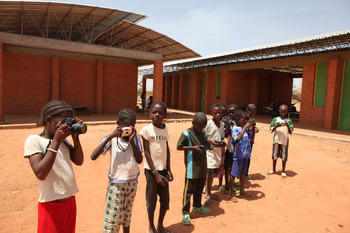
The roots for the idea to build an Opera Village in Burkina Faso can be traced back to Schlingensief's Parsifal production for the Bayreuth Festival in 2004, during which he became disillusioned about the elitism and exclusivity surrounding contemporary opera reception. Schlingensief rightly identified that this non-inclusive approach to opera was entirely opposed to Richard Wagner's ideal of the Gesamtkunstwerk that is accessible to everyone. Yet, the village must not be understood as an attempt to bring Wagnerian opera culture to Burkina Faso. In contrast to Wagner's Bayreuth Festspielhaus, the Opera Village is not a venue for the performance of actual opera. The children who perform there are not taught how to sing Wagnerian arias, but how to be creative in a way that suits their individual skills. A recent example is the photo workshop Mach dir ein Bild (2013), during which the children in the Opera Village and the German photographer Marie Köhler explored the life of the village in more than 15,000 photos. The school in the Opera Village, in which the children are taught according to the Burkinabé curriculum without having to pay any school fees, offers the children an opportunity on a day-to-day basis to realize their potential and to cultivate their individual skills.Footnote 9
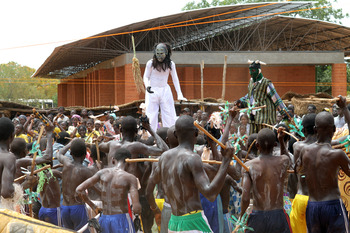
Ceremony in the Opera Village on the Inauguration of the School, 8 October 2011. (Photo: Michael Bogar).

During his time in Bayreuth, Schlingensief realized that opera had become increasingly separated from everyday life and was no longer accessible to everyone.Footnote 10 His attempt was to reverse this development and to bring opera back to its roots. A narrow understanding of Schlingensief's claim to bring opera back to its roots is problematic since opera actually originates in Renaissance court culture, which was probably even more elitist than contemporary opera. In a broader understanding, however, one might view opera as rooted in ritual and performance. Opera came into being as an attempt to revive Ancient Greek drama and possesses links to medieval mystery plays. Schlingensief most probably refers to ritualistic performances, which were integrated within the life of communities, when he asserts his aim to bridge the gap between art and life and to reconcile opera with its roots. Schlingensief's unusually broad definition of ‘opera’ becomes obvious when he describes the scream of a child as the most beautiful opera:
And when the first visitors join us, they will perhaps already be able to spend the night at the opera village and eat here; perhaps they will be looking for an opera singer who sings most wonderfully, but perhaps they will then hear the primal scream of a new-born baby that has just come into the world at our little clinic here in the opera village. What wonderful song! The first scream of a child. By far better than opera, and truer by far than anything we can otherwise present on our stages.Footnote 11
Schlingensief's expanded definition of opera, that is, his unusually broad understanding of what counts as opera, safeguards him from post-colonialists’ attacks, which are mostly based on a misconception of what an ‘opera village’ is.Footnote 12 The paradoxical name is often taken to suggest that Schlingensief attempted to bring European high culture to Burkina Faso and to stage Wagnerian opera in a village nearby the Burkinabé capital Ouagadougou. This is very much at odds with Schlingensief's mission to create a platform for empowering Burkinabés to the full appreciation and creative development of their own rich culture. By focusing on opera's roots in ritual and performance, Schlingensief introduces a counter-model to a type of elitist opera that no longer has anything to do with real life. The Opera Village cannot function without the participation of its audience. The mission of the Opera Village is to create a place where creativity is nurtured and stimulated in a way that leads to a new form of art; a form of art that draws no distinction between art and life. Schlingensief intended to realize Joseph Beuys’ idea of social sculpture – art as a form of ‘an activist aesthetic practice’ – that allows everyone to participate as an artist in the construction of an aesthetic reality that becomes an integral part of the participants’ lives.
Photoworkshop in the Opera Village, 2013. (Photo: Marie Köhler).

If one compares the Opera Village with traditional artworks, such as a painting that might be appreciated in a white cube gallery space, one becomes aware that it is not merely valuable as an aesthetic object. Rather, its aesthetic value is embedded and interlinked with other types of value. This suggests that participatory art has a twofold nature.
3. The Twofold Nature of Participatory Art
The mission of the Opera Village to create a space where art and life become inextricable distinguishes participatory art from traditional artworks. It is not only an artwork, but is integrated within the ethical reality of its audience. The twofold nature of a participatory artwork is that it possesses (i) a genuinely aesthetic aspect in which reality is suspended, as well as (ii) a genuinely ethical aspect in which it has an impact on the participant's life that surpasses the purely aesthetic realm. ‘Ethical value’ will be used very broadly to refer to the social-ethical consequences the artwork has on the well-being of the viewer.Footnote 13
The claim that the value of an artwork is not necessarily purely aesthetic is not novel. In fact, it has recently been broadly discussed in interactionist debates, which explore to what extent the presence of one value affects the occurrence of another.Footnote 14 Robert Stecker, for example, has argued for the interaction between aesthetic and ethical value in an artwork, but he does not seem to consider the aesthetic and ethical values as essentially connected. Rather he conceives of them as two distinctive types of value that may contingently affect each other. In addition, he views the aesthetic and ethical values as rooted in the artwork. The artwork possesses certain properties that may or may not elicit a deep aesthetic engagement or a moral response. A participatory artwork, by contrast, does not possess these properties independently of the collaborators that take part in its construction.
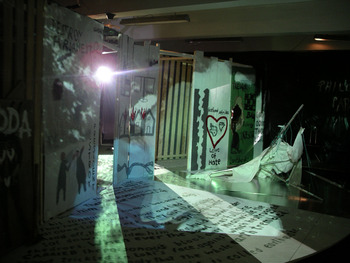
Let us explore the interaction of values by scrutinising the aesthetic and ethical nature of the participatory art project of the Opera Village. The aesthetic nature of the Opera Village is linked with its character as a distinctive type of aesthetic object, namely being Schlingensief's last animatograph. Schlingensief described the animatograph as a constantly rotating tool for transformation (‘ein sich permanent fortbewegender Transformationkörper’), a platform on which the spectator becomes part of the artwork.Footnote 15 The rotating stage in Bayreuth is often described as Schlingensief's first animatograph. Schlingensief very unconventionally translates ‘animatograph’ as ‘soulwriter’, stemming from the Latin term for soul ‘anima’, with the Greek verb for writing ‘graphein’.Footnote 16 The whole idea is closely linked with the rotating stage and the film projections Schlingensief introduced with his Parsifal production to the Bayreuth Festival. His original thought was to utilize multiple projections on screen to represent with an overflow of images the phenomenon by which every scene from one's life passes before one's eyes at the moment of death. A rotating stage would serve to make the flow of images possible. As shown in the illustration, below, the animatograph develops the idea by presenting a number of images, around and among which the audience is compelled to walk. The key aspect is that participation is integral to the experience, which is in each case particular to the individual. The visitor is literally surrounded by the work, with the screens projecting a series of scenarios that are less part of a comprehensible story than a series of recollections or associations that the viewer must assemble and organize. Schlingensief toured the animatograph around countries including Iceland and Namibia, where he constructed his rotating stage in the slums of the former German colony of Lüderitz, and intended to shoot a film merging questions of colonial guilt with the 9/11 terrorist attacks. The African Twin Towers (2005–2009) is a record of this chaotic shoot. The final animatograph is the Opera Village, which will eventually incorporate a rotating stage in its festival theatre.
It is a key characteristic for the animatograph that it requires the active engagement of the audience in order to be activated. The Opera Village as a type of fully developed animatograph provides the stage for creatively engaging the audience. Only through active participants is the participatory artwork of the Opera Village bestowed with value. The ethical nature of the Opera Village becomes obvious if one considers the far reaching impact this participatory art project has on the life and flourishing of its participants. It is unquestionable, for example, that the education the children experience in the school of the Opera Village will be advantageous for their further development and their future chances for flourishing.Footnote 17
In what follows, I explore the significant role the participant takes in the construction of value, and investigate the dissolution of the gap between art and life that happens in participatory art. This will help us to understand the twofold nature of participatory art better and allow us to explain what distinguishes my account of the inextricability of aesthetic and ethical values in participatory art from interactionist theories about traditional artworks.
Christoph Schlingensief, Animatograph in Rotation. Reykjavik, 2005. (Photo: Aino Laberenz).

3.1 The Construction of Value
In contrast to traditional artworks, which possess a certain type of value prior to being exposed to an audience, the value of participatory art only comes into being through the active engagement of the audience. This becomes clear if one compares Gerhard Richter's Youth Portrait of Ulrike Meinhof (1988) with Christoph Schlingensief's Opera Village Africa.Footnote 18
Richter's portrait of the young Ulrike Meinhof, which alludes through the gentleness of depiction to a portrait of a saint, possesses aesthetic value as well as ethical value. Whilst its aesthetic value consists, among other things, in the way in which Richter's painting blurs the original photograph, his distinctive use of light and the imaginative way in which he depicts the dreamy look of Ulrike Meinhof that is opposed to her look in the photograph – one which resembles a kind of fanatic determination – the ethical value of the painting can be found in the way in which Richter depicts the idealist and almost romantic beliefs of the co-founder of the Red Army Faction (RAF) and his indirect questioning of the brutality with which the state responded to such ‘saints’. The ethical and aesthetic values of Richter's painting exist independently of the spectator.
By contrast, the value of Schlingensief's Opera Village Africa is constructed through the spectators who become ‘participants’ in the project. The value of a participatory artwork is not rooted in the content of the artwork or the response we have to this content, but is constructed through an active engagement of the participant-spectators. Through this it becomes clear that the participant has a much more fundamental role in the construction of value than the appreciator of a traditional artwork has. This fundamental role the participant has in the construction of the aesthetic and ethical values of a participatory artwork has to be taken into account when developing a model for the evaluation of a participatory artwork that does justice to its twofold nature.
3.2 Disrupting the boundaries between art and life
As we have seen, above, the mission of participatory art to disrupt the boundaries between art and life – between the aesthetic and ethical realms of human life – suggests that the link between the aesthetic and the ethical values of a participatory artwork is inextricable. Yet, since the aesthetic and ethical values of a participatory artwork are partly constructed by the participant's engagement with the work rather than possessed by the work as its independent content, it becomes difficult to distinguish between an aesthetic value of a participatory artwork and its ethical value. Is the film session in which the school children in the Opera Village learn how to use modern technologies to capture their day-to-day environment an activity that possesses purely aesthetic value? Rather, the way in which the children collaborate when making a film possesses relevance for their ethical development, too, since it requires them to work as a team, be patient with others who might need more time, and not to feel jealous of those who might come up with more creative ideas for images. In contrast to the suspended aesthetic realm in which Richter's paintings are appreciated, Schlingensief's interventions become part of our reality and reach far deeper into our life. Participation reveals much more about the distinctive kind of person we are since it engages us in a social environment that is part of our reality. In order to understand the twofold nature of a participatory artwork, we need to know much more about the participants and how the work that engages them is ingrained within the context of their life.
In what follows, I argue that a model for the evaluation of participatory art needs to take the firm link between aesthetic and ethical value in participatory art seriously.
4. Existing Models for the Evaluation of Participatory Art
The two rival accounts of participatory art that have dominated the discussion to date have been proposed, respectively, by the art historians Claire Bishop and Grant Kester. As we shall see, the problem with both their theories is that they focus too strongly on either the aesthetic or the ethical aspects of participatory art, while ignoring the way in which the aesthetic and the ethical are interlinked.
Bishop's account is characterized by her claim to take the ‘aesthetic’ element of participatory art practice seriously. According to her argument – fundamentally inspired by the French philosopher Jacques Rancière – an ethical assessment of participatory art is flawed because of its didacticism and its incapacity to conceive of art as an autonomous aesthetic realm. Rather than conceiving of participatory art as a form that aims to establish a harmonious equilibrium between the individual collaborators, Bishop favours a Lacanian account of desire according to which the artist aspires to use the social relations between participants in order to ‘explore and disentangle a more complex knot of social concerns about political engagement, affect, inequality, narcissism, class and behavioural protocols’.Footnote 19
Bishop's rejection of the ethical does not appear very convincing, which might partially be due to the fact that her account lacks the philosophical clarity to be persuasive. A major problem is that Bishop confuses the ethical with the didactic. Also, her emphasis on autonomy, which she links back to the German Romantics and Rancière, is unconvincing if one considers that many participatory artworks such as Schlingensief's Opera Village Africa aim to tear down the boundaries between the aesthetic as a purportedly autonomous realm distinct from the ethical.Footnote 20
Bishop seems to be mostly concerned about the ethical as a realm of static norms and conventions that prevents participatory art from realising its disruptive function within the aesthetic realm. She fails to see that there might be a conception of the ethical that succeeds in assessing participatory art as something genuinely aesthetic, that is specifically successful in allowing the individual to discover a way in which he or she can fully realize his or her potential, including their desires.
In contrast to Bishop's, Kester's account shifts into the other extreme since his explanation of participatory art as an aesthetic phenomenon employs a purely ethical model. Kester introduces an account of dialogical aesthetics in order to explain the value of participatory art.Footnote 21 His explanation raises the question of how one can distinguish participation as an aesthetic engagement from other forms of participation, such as the participation in the building of a house, that do not normally possess an aesthetic element.
Kester's model of dialogical aesthetics is rooted in Jürgen Habermas’ theory of discursive ethics.Footnote 22 Kester argues that participation establishes a dialogue among the participants, which allows the subjects to view themselves from the perspectives of others. This contributes to self-reflection and a critical refinement of each individual's identity.Footnote 23 Kester locates the value of participatory art practice in the dialogical collaboration with others that fosters a bond between communities. His standard for evaluating participatory artworks depends on whether or not a participatory artwork succeeds in eliciting such a dialogical collaboration through which the agency of each individual is strengthened.
There are two fundamental problems that Kester's approach has to face. Firstly, it is questionable whether dialogical collaboration as such is ethically warranted. One might think of a group of Nazis collaborating on building Germania. The dialogue in which they engage might allow them to empathize with each other. Yet, hardly anyone would claim that this dialogue is ethically warranted. So if whether or not an artwork succeeds in eliciting a dialogical collaboration is to be viewed as the criterion for the evaluation of participatory art, Kester faces the challenge of having to provide a standard that guarantees that the dialogue is warranted. Secondly, Kester fails to distinguish participatory art as a form of aesthetic engagement from other types of collaboration that involve dialogue. If dialogical collaboration is the criterion for the success of a participatory artwork, one might wonder what distinguishes this form of collaboration from the way in which we collaborate when, for example, participating in building a house.
Both Bishop's and Kester's accounts are problematic, then, because they are focusing too strongly on either the aesthetic or the ethical aspect of participatory art whilst ignoring what makes participatory artworks so unique: their inextricable link between the ethical and the aesthetic – the crossing of boundaries.
In what follows, I introduce a virtue account of participatory art that by taking the inextricability of the ethical and the aesthetic realms, as well as the distinctive role of the spectator into the account, guides us towards a better understanding of participatory art.
5. A Virtue Account of Participatory Art
Why will a virtue account yield a better understanding of participatory art than those accounts already considered? This might become obvious if one recapitulates how the construction of aesthetic value within a participatory artwork differs from value construction in traditional artworks. At most, the aesthetic value of a traditional piece is bestowed on it by facts of its construction, along with general sociological and psychological facts. Once it is finished, its value and meaning cannot be changed; it is complete. A participatory artwork, by contrast, requires engaged viewers to acquire aesthetic value. The aesthetic value of the participatory work is constructed within the process of participation, and does not exist prior to its exposition to the audience. The aesthetic value of the Opera Village, for example, is established through creative and imaginative participation. Similarly to installation art, the meaning of participatory art is ‘constitutively open’.Footnote 24 Whilst a painting, for example, gives the spectator, qua its content, a starting point that elicits a process of interpretation in order to arrive at the meaning of the work, the ‘structural openness’ we experience when entering the participatory situation requires an active construction of meaning.Footnote 25 This meaning is an expression of the way in which we, as a distinctive kind of subject, respond to the cultural and social conditions the participatory situation brings to our mind.
Given that the meaning of a participatory artwork is constructed through the imagination and creativity of the audience, its meaning changes, and grows or shrinks, depending on who the participants are. Whether or not the participants succeed in constructing meaning might depend on the skills they exercise within the process of constructing value. This is where virtue theory becomes relevant. Virtues, according to the philosopher Julia Annas, are states of character that ‘enable us to respond in creative and imaginative ways to new challenges’.Footnote 26 These challenges can occur in the moral, or in the aesthetic (or other) realms. Virtues are those excellent skills that enable us to overcome these novel challenges. If one assumes that virtues are required to respond to the challenge of shaping the open meaning of a participatory artwork, there is reason to suspect that a successful production of novel meaning depends on the way in which we activate and employ our virtues. Approaching the value of a participatory artwork from a virtue perspective will thereby allow us to take the important role the audience has in the construction of the value of a participatory artwork into account. Moreover, this virtue perspective will contribute to the development of an explanatory model that can account for the twofold nature of participatory art. The connection between the aesthetic and the ethical realms, the blurring of boundaries between its aesthetic and ethical values, can similarly be illuminated by attending to the virtues involved in this art form.
Even though it is important to acknowledge a conceptual distinction between virtues that have a stronger relation to the moral realm, such as temperance, courage and honesty, and virtues that seem to belong to the aesthetic realm, for example, creativity, having good taste and being a fine observer, there might be cases in which the moral and aesthetic virtues resemble each other.Footnote 27 The link between moral and aesthetic virtues will become clearer if we examine Matthew Kieran's account of creativity as a virtue of character.Footnote 28 Creativity requires that we employ our aesthetic virtues in different and new situations, that is, we have to respond in an imaginative way to different situations and circumstances. In order to be morally virtuous, it is similarly necessary to adopt virtues such as courage to new and unexpected situations. If we practise creative responses to new and unexpected situations in the aesthetic realm, this might improve our ability to respond creatively to new situations in the moral realm. So creativity may enable us to react reliably across different moral and aesthetic situations.Footnote 29
This example from virtue theory allows us to understand how closely the ethical and aesthetic realms are interlinked. In some cases, it might even be impossible to differentiate between a certain virtue as aesthetic or ethical. One might ask, for example, whether it counts as an ethical or an aesthetic achievement that the children in the Opera Village foster their creativity when taking photos of each other. Whilst it is an aesthetic experience to the extent that photography requires the ability to capture objects in a distinctively visually appealing way, it similarly requires the empathy to understand the other's personality in order to capture it appropriately. As argued above, the way in which the interaction in a participatory artwork fosters the ethical and aesthetic virtues seems to link them both in an inextricable way.
A virtue approach towards participatory art successfully describes the distinctive value of participatory art since it takes the inextricability between the aesthetic and the ethical realm – the crossing of boundaries between art and life – seriously. Moreover, a virtue account does justice to the significant role the participant plays in the construction of the value of such artworks. This brings us back to our initial question about the normative understanding of the participatory art museum. How can the participatory museum serve as a platform that allows the audience to exercise those skills which are needed to construct the value of the participatory artwork?
6. The Participatory Art Museum
The participatory art museum needs to pay sufficient consideration to the unique nature of participatory art.Footnote 30 What distinguishes participatory art from other art forms, as it has been shown, are (i) its twofold nature, that is, the way in which the aesthetic and the ethical realms are interlinked, and (ii) the way in which it requires the participant to actively construct its value. The ideal participatory art museum needs to offer a platform on which boundaries between the ethical and the aesthetic realms are overcome, which implies that it must differ from the suspended aesthetic realm of the white cube gallery space and provide a space in which the visitor can exercise and cultivate their virtues in order to bestow the participatory artwork with value. Given that this value is constructed in collaborative interaction and exchange, the role of the museum is, as Bernadette Lynch remarks, ‘to help people develop the skills necessary for such an exchange’.Footnote 31 How can this happen?
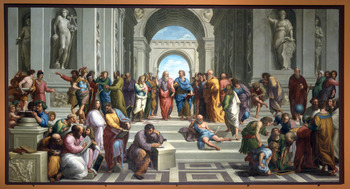
Looking back into antiquity, to a particular conception of space that is famously associated with the development of the human virtues, brings us to the Athenian agora – the public place where Socrates interrogated his interlocutors and thereby challenged them to critically refine their virtues. The Athenian agora provided the platform for a critical exploration of day-to-day reality within the playful medium of the dialogue. The Socratic dialogue contains fictive and aesthetic elements that challenge us to view our daily life from a different perspective. The praxis of dialegesthai (that is, critically engaging in a dialogue with others) provides the opportunity to cultivate and refine the virtues within an aesthetic sphere that similarly possesses ethical potency. Can the ancient agora serve as a model, and provide inspiration for, the participatory museum?
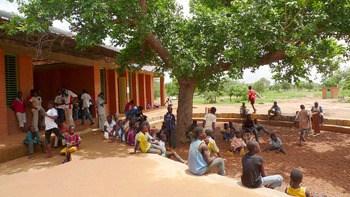
Christoph Schlingensief, The Opera Village Africa. Vacances Artistiques, 2012. (Photo: Aino Laberenz).

We can imagine the participatory art museum as a contemporary agora. The act of participation in artistic creation resembles Socratic dialogue, in so far as we gain a deeper understanding of our own distinctive potential, which we can realize through exercising our virtues. Whereas Socrates elicits a refinement of the virtues through the rational activity of critical thinking, the artist prepares a platform for the refinement of the virtues through aesthetic engagement. This aesthetic engagement does not happen in a suspended aesthetic realm, but within our life.
A view towards theatre praxis might further inform our understanding of the participatory museum. The Brazilian theatre director Augusto Boal, inventor of the Theatre of the Oppressed, argued that the members of the theatre audience are oppressed due to their lack of the possibility to express themselves during the theatre performance.Footnote 32 He demanded that the spectators become ‘spect-actors’, people who express themselves as part of the theatre performance.Footnote 33 Boal presupposes an active audience that critically explores its day-to-day reality within an aesthetic realm. In this way, the theatre provides an aesthetic realm in which we can transform our reality.Footnote 34 The participatory museum, such as the Opera Village Africa, might possess similarities to the aesthetic realm of the theatre in which reality can be transformed. One could imagine the participatory museum as a theatrical agora in which the art takes the role of a provocative Socrates that elicits us to critically scrutinize our day-to-day reality.
Anton Raphael Mengs, The School of Athens (after Raphael), 1752–1755. (Photo: Victoria & Albert Museum).

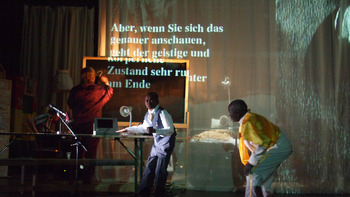
The Opera Village provides a platform in which collaboration on art projects, such as the series of photographs the school children took of their daily life, enables the participants to develop their potential through self-expression. Via Intolleranza II, Schlingensief's first tangible piece of the Opera Village project, points us further towards what the participatory museum might be like.
Inspired by Luigi Nono's opera Intolleranza 1960, which radically criticized racism, intolerance and state power, Schlingensief staged a searing inquiry into why we want to help Africa while we are increasingly unable to help ourselves. Schlingensief brought actors from Africa and Europe together in order to explore whether intolerance and indifference might lie at the heart of this paradox.
Christoph Schlingensief, Via Intolleranza II. Uraufführung, Kunstenfestivaldesarts, Brüssel 15th May, 2010 (Photo: Aino Laberenz).

In conclusion, the participatory art museum might be viewed as a theatrical Socratic agora. It enables the viewer to act within a sphere that links art and life, and provides the ideal environment for the exercise of the virtues – those skills that enable the participant to construct the value of a participatory artwork and realize its full meaning.Footnote 35