1. Introduction
Rising concerns about income and wealth inequality in liberal democracies have fueled a steadily growing stream of research on the topic as indicated by the increased share of top journal articles on the topic (Horpedahl and Kling, Reference Horpedahl and Kling2020). This research can be divided into two categories. The first is the literature that attempts to properly measure inequality (see notably Auten and Splinter, Reference Auten and Splinter2018, Reference Auten and Splinter2019, Reference Auten, Splinter and Furchtgott-Roth2021; Burkhauser et al., Reference Burkhauser, Feng, Jenkins and Larrimore2012; Geloso et al., Reference Geloso, Magness, Moore and Schlosser2021; Geloso and Magness, Reference Geloso and Magness2020; Kopczuk et al., Reference Kopczuk, Saez and Song2010; Larrimore et al., Reference Larrimore, Burkhauser, Auten and Armour2021; Mechling et al., Reference Mechling, Miller and Konecny2017; Piketty et al., Reference Piketty, Saez and Zucman2018; Piketty and Saez, Reference Piketty and Saez2003). The second is the literature that attempts to connect inequality to socio-economic outcomes (see notably Bowles, Reference Bowles2012; Corak, Reference Corak2013; Deaton, Reference Deaton2003; Ferreira et al., Reference Ferreira, Lakner, Lugo and Özler2018; Pickett and Wilkinson, Reference Pickett and Wilkinson2010).
Articles and books in the second category share one key assumption: that inequality is socially problematic if it is associated with persistent social stratification. To measure this stratification, the tendency is to rely on longitudinal income mobility variables such as income gains for different centiles (or deciles) of the income distribution or income gains of children relative to their parents. If these measures suggest that people near the bottom of the distribution enjoy smaller gains than those at the top or if they tend to inherit their parents' income levels, then there is greater persistence. Inequality fuels stratification by making one's initial conditions play a stronger role while their own hard work play ‘a commensurately weaker role’ (Corak, Reference Corak2013: 79). This negative association between inequality and upward income mobility is something that the empirical literature has clearly documented when data about wealth and income mobility are available (see Narayan et al., Reference Narayan, Van der Weide, Cojocaru, Lakner, Redaelli, Mahler and Thewissen2018).
There is, however, one important shortcoming in this literature: it is decidedly monocausal. The assumption is that, all else being equal, high inequality implies a stronger constraint on upward income mobility for those at the bottom of income ladder. However, the constraints on upward mobility are also institutional. ‘Bad’ institutions (e.g. high barriers to entrepreneurial entry, regressive taxes and transfers, insecure property rights, etc.) can limit the chances for upward mobility in multiple ways. For example, insecure property rights mean that individuals will have more difficulty realizing the fruits of their efforts (see De Soto, Reference De Soto2000; Kerekes and Williamson, Reference Kerekes and Williamson2008). These efforts are therefore reduced. In countries where incumbent firms are granted monopolies protected by the state, higher prices are paid by the poor (which accentuate constraints) while also deterring entrepreneurial efforts that may increase economic growth. Where ‘citizens are free to engage in commerce with others’ and ‘do not fear their property will be stolen from them’, we should expect greater upward social mobility (Boudreaux, Reference Boudreaux2014: 234).
In other words, there are two constraints: the inequality constraint and the institutional constraint. Only the former of the two constraints has been subjected to intense inquiry. The latter has been mostly ignored – with some key exceptions (Boudreaux, Reference Boudreaux2014).Footnote 1 Our paper seeks to remedy this situation in two ways. First (in section 2), we point out the crucial but nuanced role that high levels of economic freedom – our measure of institutional quality – can play in determining upward mobility. Economic freedom indexes comprise multiple components: size of government, level of regulation, soundness of money, trade openness, and security of property rights.Footnote 2 We argue that there are strong reasons to connect higher scores in each of these components with stimulation of upward mobility, albeit one of them, the size of government, probably has more ambiguous effects (and could be positive).
Second (in sections 3 and 4), we amass evidence on income mobility in Canadian provinces between 1982 and 2017 to test the role of economic freedom as measured by the Fraser Institute's Economic Freedom of North America (EFNA) index (Stansel et al., Reference Stansel, Torra and McMahon2020). This index is narrower than others as it includes only components for government spending, tax levels, and labor market regulation. Because the index applies to subnational levels of government, there are no significant variations in property rights, trade policy, and monetary policy. As such, the downside of our analysis is that our results are focused on only a few aspects of economic freedom. There are, however, two upsides. First, we provide the first effort that employs a sample of more than 100 observations connecting economic freedom to income mobility. Second, the components of the index of economic freedom for North America permit circumvention of the potentially ambiguous issue of government size. Whereas other indexes of economic freedom tend to use government spending alone as a proxy for government size, the index we use here has separate components for taxes and spending. Just as social transfers (captured by the spending component) may increase income mobility, the taxes (captured by the tax component) that fund those transfers may decrease mobility. Thus, having the two components separate avoids the ambiguity inherent in the cruder measure of government size.Footnote 3
We also provide the first work connecting institutions to multiple dimensions of longitudinal income mobility. Using the Canadian Longitudinal Administrative Databank (LAD), Statistics Canada followed cohorts of individuals in recurring 5-year windows from 1982 (e.g. 1982–1987, 1983–1988, etc.). This has yielded a rich array of longitudinal income mobility data in both absolute and relative terms: (i) the average income change (an absolute measure); (ii) the percentage of individuals with rising or falling income (there are also breakdowns available by magnitude of rise or fall); (iii) a per capita decile mobility index (i.e. how many deciles does a person rise in the overall income distribution). By using the provincial-level aggregations of the LAD provided by Statistics Canada, we can assess the effects of economic freedom and its components on income mobility for the cohorts as a whole, and for people in the lowest income decile.
We find that the aggregated EFNA index has a significant and positive effect on the proportion of individuals with rising incomes and on income decile mobility. The aggregated index has no effect on the magnitude of income changes. The taxation and spending components do not reveal a consistent pattern and tend not to be statistically significant. The same findings apply for mobility of people in the lowest income decile. Our results hold when we exclude the province of Quebec from our sample; it is plausible that its unique linguistic features may be driving results.
The labor market component of the index yields the most surprising results. While it is consistently significant in all specifications, it is only positively associated with greater mobility for the proportion of rising income and relative income changes. It is significantly and negatively (though weakly) associated with absolute income mobility for the whole population. However, it is significantly, strongly, and positively associated with absolute income mobility for people in the lowest decile – thus suggesting that freer labor markets matter more for the very poor (and that unfree markets probably redistribute income regressively).
We argue that these findings are important, as the Canadian evidence was used because it offered the highest quality data that could be reliably matched with institutional measures. However, the EFNA index measures economic freedom within one of the freest economies in the world and it does not include the security of property rights, trade openness, and monetary policy (which are taken as being shared equally across the Canadian provinces). Taking an international perspective including more variance by considering low economic freedom countries and the role of property rights would likely strengthen our results. Thus, we modestly suggest that our results constitute the ‘lower bound’ case for the potential of economic freedom to increase upward income mobility within countries.
2. Economic freedom and income mobility
2.1 Connecting economic freedom to income mobility
The connection between upward mobility and inequality has often been illustrated through microcosms which are particularly useful because they reduce the number of factors to consider. These microcosms include the famous Whitehall study (Fuller et al., Reference Fuller, Shipley, Rose, Jarrett and Keen1980; Marmot et al., Reference Marmot, Stansfeld, Patel, North, Head, White, Brunner, Freeney and Smith1991), the life expectancy of Academy Awards winners and nominees (Redelmeier and Singh, Reference Redelmeier and Singh2001), the labor market for guard labor (Jayadev and Bowles, Reference Jayadev and Bowles2006), and the Olympic games (Berdahl et al., Reference Berdahl, Uhlmann and Bai2015; Kufenko and Geloso, Reference Kufenko and Geloso2021). In all these cases, inequality is tied to outcomes through a mechanism that limits the chances of those at the bottom to rise. The Olympics case is probably the most illustrative. As talent is innate, it is randomly distributed. However, the cost necessary to develop those talents is the same for everyone. All else being equal, the talented poor in more unequal societies will find it harder to pay the cost of training for Olympic competition. Thus, more unequal societies win fewer medals. If one takes the ability to win medals as a sign of upward mobility, then the case is made. This microcosm powerfully illustrates the admonition made by Finis Welch in his presidential address to the American Economic Association in 1999: ‘Inequality is destructive whenever the low-wage citizenry views society as unfair, when it views effort as not worthwhile, when upward mobility is viewed as impossible or as so unlikely that its pursuit is not worthwhile’ (1999: p. 2).
However, while inequality may reduce chances at upward mobility, institutions that secure the gains produced by individual effort determine whether that effort is worthwhile or possible. Consider again the microcosm of the Olympics. Kufenko and Geloso (Reference Kufenko and Geloso2021) pointed to a literature demonstrating that countries with high levels of economic freedom also won more medals (see Campbell et al., Reference Campbell, Mixon and Sawyer2005; Pierdzioch and Emrich, Reference Pierdzioch and Emrich2013). From this they argued that economic freedom must incentivize the deployment of efforts by allowing innately talented athletes to secure and increase any gains arising from them. Kufenko and Geloso (Reference Kufenko and Geloso2021) found that inequality only had a negative effect in low economic freedom countries, whereas countries with higher levels of economic freedom suffered no penalty due to inequality and enjoyed a net premium on their performance given the strength of the effects of economic freedom. Thus, the microcosm of the Olympics militates for an offsetting effect of economic freedom.
However, is there evidence, beyond this microcosm, to connect economic freedom to upward mobility? The main direct evidence is provided by Boudreaux (Reference Boudreaux2014). Using the same dataset of intergenerational income mobility as Corak (Reference Corak2013), Boudreaux (Reference Boudreaux2014) found that a one-point increase in the rule of law (an index that approximates property rights security and is measured from −2.5 to 2.5 where 2.5 is best) leads to a decrease of 0.09 in the intergenerational persistence measure. Boudreaux found similar results using the Economic Freedom of the World (EFW) index. To explain his result, Boudreaux proposed that secure property rights incentivize entrepreneurial efforts and allow new firms to flourish. These entrepreneurial activities lead in turn to greater upward mobility.
There is also a great deal of indirect evidence that speak to how economic freedom can increase upward mobility. The most interesting is provided by Wiseman (Reference Wiseman2017) who used the EFNA (the same dataset used in this paper) to investigate how economic freedom differently impacted income changes across the income distribution. Wiseman found that increases in overall freedom between 1979 and 2011 were associated with larger income growth rates for income earners in the bottom 90% relative to the top 10%. Income changes across the income distribution are not perfectly synonymous with any form of longitudinal income mobility. Indeed, Wiseman's result speaks to income inequality rather than income mobility.Footnote 4 However, there are overlaps sufficiently large to argue that Wiseman's results indirectly speak to the connection between economic freedom and income mobility. Most importantly, as the EFNA speaks to US state-level data, there is no variation in property rights protection so that all differences in economic freedom are driven either by labor market regulation, taxes or government spending. Ergo, his results suggest that economic freedom has an effect even within the group of countries with highly secure property rights.
The role of the non-property rights components of economic freedom indexes can also be best gleaned by considering the role of labor market regulations. Consider the example of occupational licensing which speaks indirectly to the labor market regulation component of the EFNA data that we will use in the empirical portion of the present article. Occupational licensing imposes important entry costs into certain professions that would offer important income gains for people in the lower income deciles of the population (Carpenter et al., Reference Carpenter, Knepper, Sweetland and McDonald2018). In addition to limiting access to certain professions, the resources expended to clear the hurdles of the licensing process reduce the net returns from joining the profession. It is thus unsurprising that occupational licensing is tied to slower income growth for the poor (see Kleiner and Vorotnikov, Reference Kleiner and Vorotnikov2017; Zhang and Gunderson, Reference Zhang and Gunderson2020).Footnote 5 As way of another example, consider the role of union density (which is part of the EFNA) and right to work laws (RTW) which prohibit making union membership a prerequisite for employment in American states with such laws. The literature is unable to find a clear effect of such laws on inequality within states (Gondhalekar and Kessler, Reference Gondhalekar and Kessler2021). For example, using a synthetic control method, Jordan et al. (Reference Jordan, Mathur, Munasib and Roy2021) found that RTW laws (which prohibit making union membership a prerequisite for employment) had no effect on income inequality within states. As reviews of the empirical effects of RTW laws also show that they tend to be associated faster income growth (Hicks et al., Reference Hicks, LaFaive and Devaraj2016; Reed, Reference Reed2003) and greater worker in-migration (Hicks et al., Reference Hicks, LaFaive and Devaraj2016), this suggests that labor market freedom in the form of RTW increases upward mobility. This is because the findings are at the state-level and cannot account for the fact that people move. As they move to RTW states with faster income growth, upward income mobility nation-wide should increase (even if state-level measures would not capture this). Thus, labor market regulations in the form of occupational licensing and pro-union legislation can reduce upward mobility for those near or at the bottom of the distribution.
Other regulations may also tend to limit the choices of the poor more than those of the rich so that the poor must make more effort than necessary to reach new and higher levels of income. Chambers et al. (Reference Chambers, McLaughlin and Stanley2019) found that product regulation had an uneven effect across the income distribution. The price increases induced by regulatory burdens on different industries were more significant for goods and services that featured heavily in the consumer expenditures of the poor. This effect can be conceptualized as a tighter budget constraint being imposed on the poor which, in turn, means that they are forced to choose from a smaller set of options for advancement than would have been available absent regulation. This is echoed by Bailey et al. (Reference Bailey, Thomas and Anderson2019) who, for their part, found that regulatory costs disproportionately slowed wage growth for lower-wage workers – a finding that suggests that regulations reduce upward mobility.
These examples above speak to the role of economic freedom in determining upward mobility. However, we are not the first to notice this relationship. Many other components of economic freedom (e.g. freedom of trade, sound money) can also be tied to upward mobility.Footnote 6 This is why many libertarian-leaning scholars have attempted to connect economic freedom to upward mobility (see Friedman, Reference Friedman2016; Grubel, Reference Grubel2016; Holcombe, Reference Holcombe2018). However, even non-libertarian scholars such as Stiglitz (Reference Stiglitz2012), Welch (Reference Welch1999) and Deaton (Reference Deaton2017) accept this link.Footnote 7 As such, the following statement appears to be accepted by many: increasing economic freedom, all else being equal, leads to greater mobility.
2.2 Problems regarding the proposed connection between economic freedom and income mobility
There are, however, two problems with this statement. The first is that the literature offers few attempts to empirically measure the strength of economic freedom's effects on upward mobility. When the case is made, it follows a roundabout route.Footnote 8 As we indicated above, there are very few studies that have directly measured an empirical link between economic freedom and upward mobility, whereas there are many studies that do measure the link between inequality and mobility. The main exception is that of Boudreaux (Reference Boudreaux2014) who was constrained to using a cross-section of 25 countries. This is not for lack of income mobility data – there are multiple datasets of income mobility (Chetty et al., Reference Chetty, Grusky, Hell, Hendren, Manduca and Narang2017; Narayan et al., Reference Narayan, Van der Weide, Cojocaru, Lakner, Redaelli, Mahler and Thewissen2018). The issue is that these datasets are difficult to match with institutional data at the country level for more than one unit of time.Footnote 9 As such, the statement is mostly accepted without being quantified.Footnote 10
The second problem is that there is one component of the economic freedom indexes that is ambiguous: the size of government. With the exception of EFNA, economic freedom indexes generally take government spending as their proxy for government size.Footnote 11 Numerous countries (e.g. Sweden, Denmark, Finland, Norway) have high levels of government spending but score so high on other components of economic freedom that their overall grades compare quite favorably (Bergh, Reference Bergh2015, Reference Bergh2020; Murphy, Reference Murphy2019). These countries also exhibit relatively high levels of social mobility (Corak, Reference Corak2013). Why should that be the case?
Here, the works of Bergh (Reference Bergh2020) and Lindert (Reference Lindert2004a, Reference Lindert2004b, Reference Lindert2021) are particularly useful for conceptualizing the ambiguous relationship. Both works speak to how welfare states may be fiscally quite large without slowing down growth. To make this point, Bergh divides ‘large states’ into two categories. The first category is composed of states that use taxes that minimize distortion of economic activity (e.g. consumption taxes) to fund non-discriminatory transfers to the poorest. The second category includes states that use more distortionary forms of taxation (e.g. capital and income taxes) to finance expenditures that go to interventionist measures (e.g. subsidizing a particular industry). The second category impedes growth, while the first is only weakly connected (Heckelman and Stroup, Reference Heckelman and Stroup2000; Ott, Reference Ott2018).
In fact, the first category of large states might even be growth-enhancing under certain conditions (Lindert, Reference Lindert2004a, Reference Lindert2004b, Reference Lindert2021). Take the example of human capital formation, a key feature of which is that its marginal returns decrease mostly as a function of an individual's initial levels. In other words, each additional unit of human capital provides greater marginal returns to the poor uneducated worker than to the rich educated worker. In this case, transfers of wealth from the rich to the poor may induce the formation of human capital that adds more to output. This effect will be even stronger if the rich person had the choice to invest either in more human capital or more physical capital (whose marginal returns are a function of the overall stock of physical capital) where the returns on human capital are greater than on physical capital (Galor and Zeira, Reference Galor and Zeira1993). While this illustration applies to economic growth in the aggregate, it also implies the provision of greater upward mobility to lower income households. Indeed, such transfers ease budget constraints in ways that allow forms of capital accumulation that allow growth to benefit the poorest preferentially.Footnote 12
The problem is that the size of government may not always cut in the direction of greater mobility as the illustration above suggests. For example, a decision to acquire human capital involves certain risks (e.g. failure to graduate) and significant costs (i.e. foregone income) regardless of social transfers. In the presence of risk-averse individuals, higher income taxation may reduce the returns to education sufficiently to create a net reduction in human capital formation (after accounting for the effects of the transfer mentioned above), a possibility that is consistent with the connection between economic freedom and human capital formation (Feldmann, Reference Feldmann2017).Footnote 13 Sometimes, the effect may be due to varying degrees of bargaining power across the income distribution. Workers with strong exit options from a high-tax district may require higher gross pay to match the net pay they could have obtained elsewhere. To adjust, employers may delay wage increases (or even reduce wages) for less mobile workers. If there is a positive correlation between the number of exit options available and income, the pre-taxation distribution of income could be more unequal than it would have been absent the taxes (Gordon, Reference Gordon2016).Footnote 14 As such, higher taxes to fund social transfers might end up reducing the resources available to lower-income households for investment in the human capital required to climb the income ladder successfully.
In the next section, we provide a remedy to these two problems. We rely on income mobility from Canadian provinces from 1982 to 2018 to assess the influence of economic freedom. As we will be using the Fraser Institute's EFNA index, we will also be able to circumvent the potential ambiguity regarding the effects of the size of government.
3. Data and methodology
To test the relationship between economic freedom and income mobility, we rely on two key datasets. The first dataset is the Fraser Institute's EFNA (EFNA) (Stansel et al., Reference Stansel, Torra and McMahon2020). The goal of this index is to measure economic freedom at the subnational level in Canada, the United States, and Mexico. The data is continuous on an annual basis since 1980.Footnote 15 The index has three components: (i) government spending; (ii) taxes; and (iii) labor market freedom.Footnote 16 The advantage of these components is that we can disaggregate the overall effect of economic freedom. More importantly, the spending and tax components allow us to circumvent the ambiguous nature of the effect of government size on mobility. Given the examples we provided above, we should expect taxation and spending to yield different effects on mobility. Examining them separately allows us to disentangle their opposite effects.
The second dataset is Statistics Canada's database of income mobility derived from the Longitudinal Administrative Database (LAD) (Zhang et al., Reference Zhang, Saani and Chung2016).Footnote 17 The LAD was designed to track individuals using the income tax package (known as T1FF) using roughly 20% of available units. Because of the information contained in the LAD, Statistics Canada was able to create multiple distributional measures of incomeFootnote 18 which can be broken down by gender, age, and immigrant status. Each of these measures can also be broken down at the provincial level.Footnote 19 For our purposes, we are interested in market incomeFootnote 20 as it pertains to market outcomes rather than government policy.Footnote 21 To evaluate mobility, they created rolling 5-year panels tracking tax filers over time. For example, a first cohort is followed from 1982 to 1987, a second is followed from 1983 to 1988, etc. All the income measures are reported in nominal terms and require adjustment for inflation.
From this dataset, we will extract three measures of income mobility: two measures of absolute mobility and one measure of relative mobility. The first is the per capita dollar mobility measure defined as the average of the absolute changes in income in natural logarithm between the first and the last year of each period.Footnote 22 Because the change in each individual's income in the LAD is expressed in natural logarithm, this can be interpreted as the average percentage change in income. However, this measure is provided in nominal terms by Statistics Canada and we must make an adjustment for the price level.Footnote 23 However, that first measure is imperfect because it averages individual downward and upward movements. Thus, it is mathematically possible that a single large increase (with no upward boundaries in terms of percentage) may outweigh many small decreases (with a downward boundary as incomes cannot fall below zero). Fortunately, Statistics Canada also computes the proportion of tax filers with rising income over each 5-year period.Footnote 24 This will be our second measure of absolute income mobility. Neither measure speaks to relative income mobility, as they do not tell us whether individuals had greater income gains than their peers. To provide information about relative mobility, Statistics Canada produced the measure of per capita decile mobility which is defined as is the average number of deciles changed, including both the upward and the downward moves among all tax filers.
With these two datasets, we construct a panel regression approach according to this general specification

Where M is each of the three mobility measures for each of the 10 provinces i over the cohorts t from 1982–1987 to 2012–2017: the proportion of people with rising income; the average decile increase; the average absolute real income change. These mobility measures apply to all deciles combined. The variable EFNA is either the aggregate index or each of its three components. We also add province-fixed effects and year-fixed effects captured denoted by V i and V t. We will cluster our standard errors by province. The vector x contains the relevant control variables that we use: unemployment rate, urbanization, the investment rate, economic growth during each time window, and recession-year dummies. These control variables require some elaboration on our part. The inclusion of the unemployment rate is meant to capture variations in the business cycle – something that Statistics Canada's flagship publication on income mobility also did (Zhang et al., Reference Zhang, Saani and Chung2016: 8). The inclusion of urbanization is to reflect the thickness of labor markets which would offer more chances at upward mobility. The investment rate is included to reflect labor demand. The rate of economic growth is added to address the overall condition of the economy. As for recession year dummies, this is necessary because of the way the changes are defined. As Statistics Canada defined mobility as the changes in income between the first and last year of a specified window, mobility may be affected. In other words, if the first (last) year was a recession year, the income growth during the period will be overstated (understated).
We make two alterations to this specification. First, using mobility measures for all deciles may yield confusing results. This is mainly because economic freedom might have uneven effects across the distribution. Take the aforementioned example of occupational licensing. By restricting entry, licensing may make it harder for people at the bottom of the distribution to enjoy growth in income. However, the higher prices that licensing allows may allow people higher up in the distribution to enjoy greater income. In this case, economic freedom may yield a negative effect on absolute income mobility for a higher decile while yielding a positive effect in lower deciles (in ways that, in aggregate, permit more relative mobility). As such, we run the same specifications using only the first income decile as specified below where M1 refers to mobility measures (i.e. proportion of people with rising income; average decile change; average change in real income) for people who were in the first decile in the first year of each cohort.

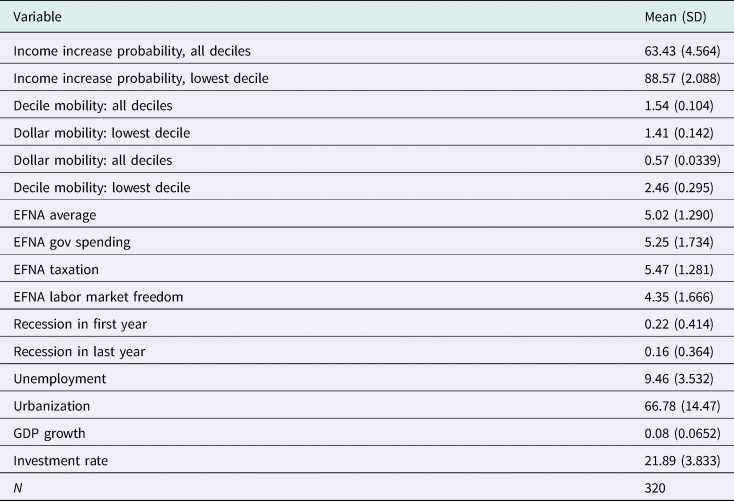
Second, we will then replicate each of these two specifications without the province of Quebec. Removing Quebec from the sample could help improve the results because of the province's unique linguistic setting. Being home to the majority of Canada's French-speaking population, and because a large fraction of that population is unilingual, it is sometimes argued that Quebec's labor markets are segmented on the basis of language, which suggests some unique features. Obviously, the province-fixed effect will capture some of this, but there were variations in bilingualism rates during the period such that the effects of ‘being Quebec’ probably shift over time, thus violating some of the assumptions for this type of fixed effect. Removing Quebec is a way to assess robustness (Table 1).
Descriptive statistics

4. Results
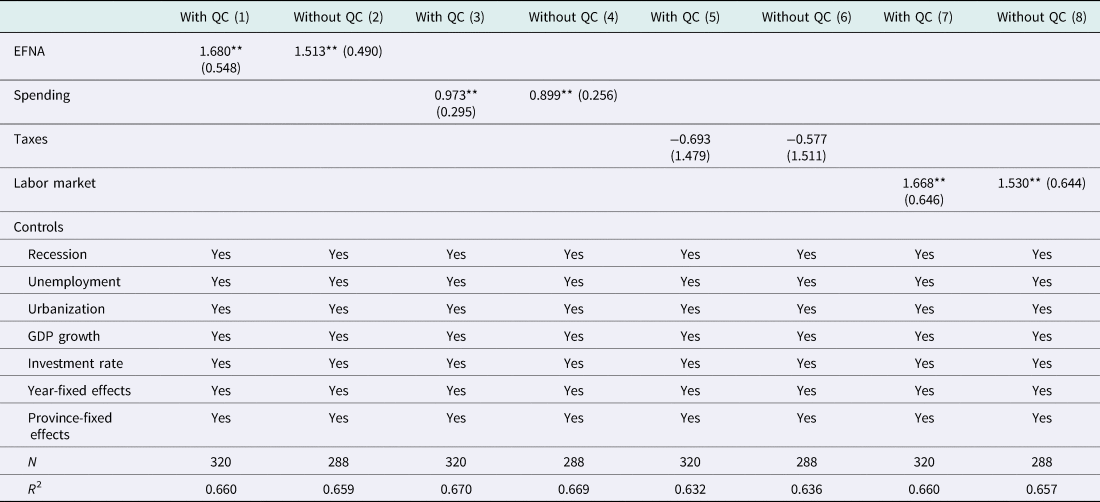
Results for each regression can be found in Tables 2–7. Across all regressions, a common theme emerges: greater economic freedom yields significantly higher income mobility. We first see this by looking at the proportion of filers whose income rose over the period without excluding the province of Quebec (see Table 2, columns 1, 3, 5, 7). On average, 63% of people in our time-windows enjoyed income gains. One additional point of overall economic freedom increases that proportion by 1.7 percentage points. We take this examination further by splitting the EFNA score into its three components (spending, taxes, and labor market freedom) to examine which component drives the results most strongly. When examined through this lens, improved government spending (i.e. a rising score means a lower level of spending) and greater levels of labor market freedom increase the likelihood of incomes increasing for all deciles, while taxes do not have a significant effect. Results are robust to the exclusion of Quebec (columns 2, 4, 6, 8).
Income increase probability, all deciles

Robust standard errors in parentheses.
***p < 0.01, **p < 0.05, *p < 0.1.
Income increase probability, lowest decile

Robust standard errors in parentheses.
***p < 0.01, **p < 0.05, *p < 0.1.
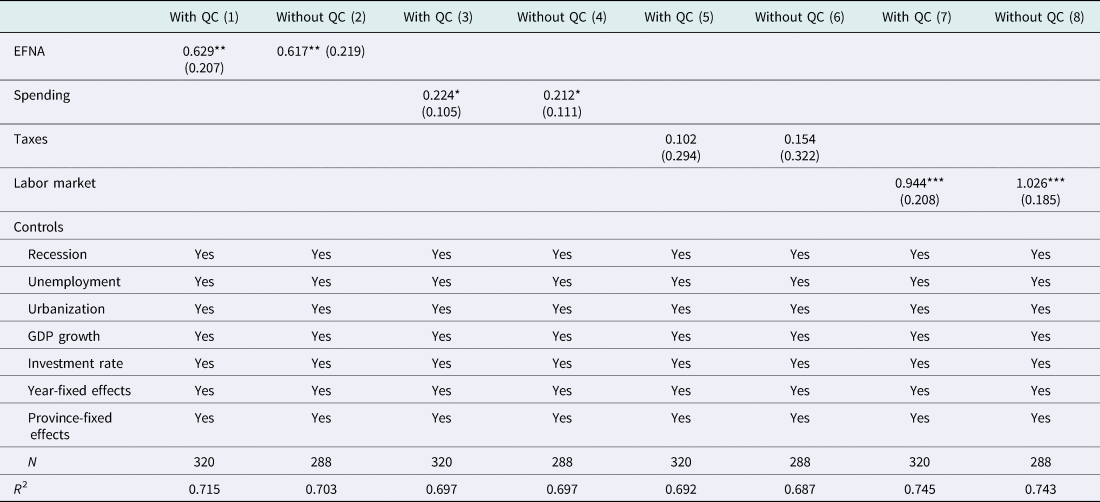
Decile mobility: all deciles

Robust standard errors in parentheses.
***p < 0.01, **p < 0.05, *p < 0.1.
Decile mobility: lowest decile

Robust standard errors in parentheses.
***p < 0.01, **p < 0.05, *p < 0.1.
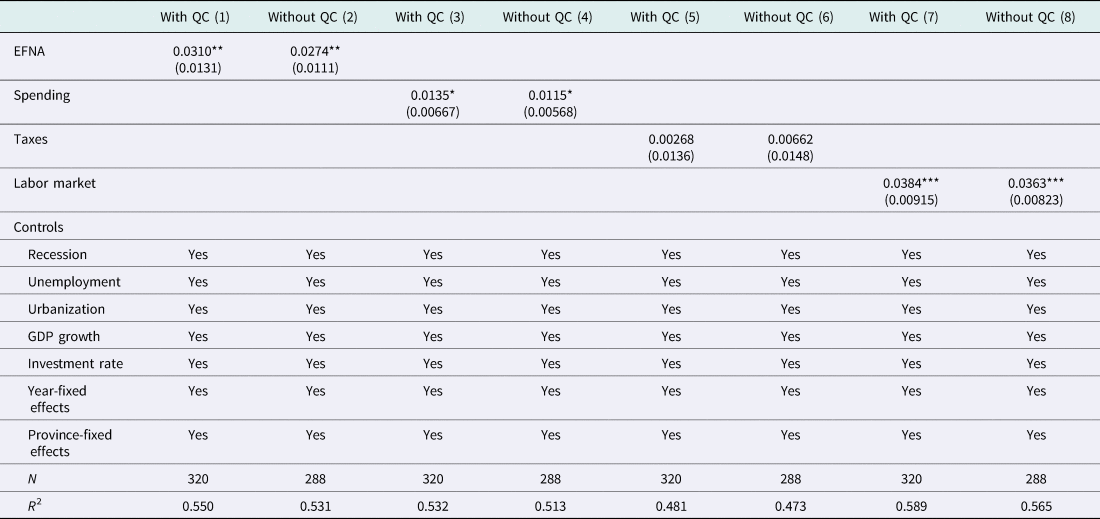
Dollar mobility: all mobility

Robust standard errors in parentheses.
***p < 0.01, **p < 0.05, *p < 0.1.
Dollar mobility: lowest decile

Robust standard errors in parentheses.
***p < 0.01, **p < 0.05, *p < 0.1.
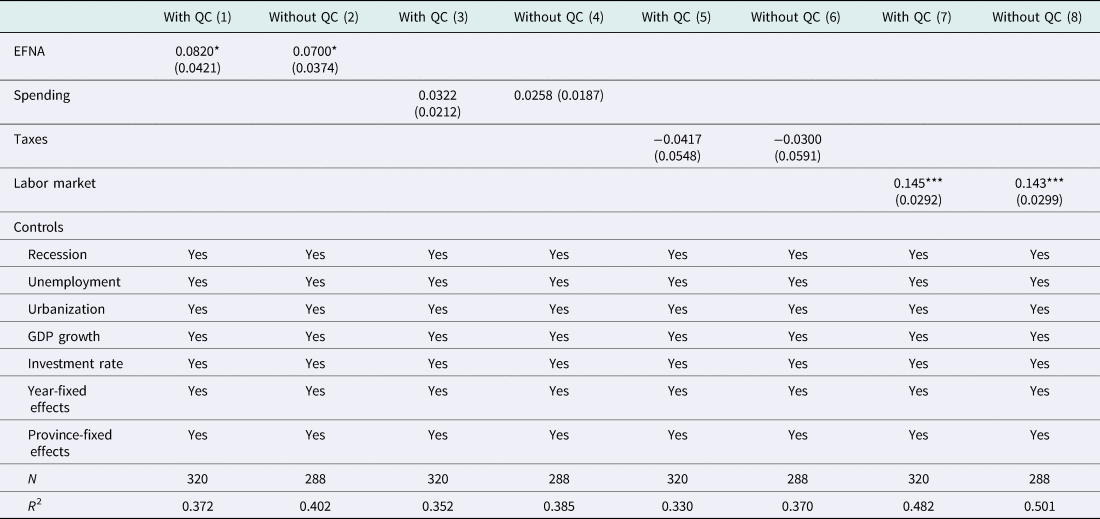
Some would argue that, while greater economic freedom does increase incomes, these gains tend to be concentrated higher in the income distribution, leading to greater inequality. To examine this, we turn our focus on the bottom decile (see Table 3). Here, we find that prosperity from greater levels of economic freedom is shared widely throughout the distribution. On average, 89% of people in the bottom decile enjoyed income gains. An additional point of economic freedom increased that proportion by 0.6 percentage points. That may seem smaller than for the overall population, but one should bear in mind that our dependent variable has an upper bound of 100%. There is little room between the observed proportion of rising income and the maximum potential proportion. As such, finding an effect at such a high range is testimony to the effect of economic freedom. In addition, the result for the lowest income decile seems to be driven by greater labor market freedom. This result seems quite intuitive given how the EFNA score is constructed, as lower-income citizens will be more sensitive to labor market regulations than to taxes or government spending.
Next, we turn our examination to relative mobility by looking at a province's decile mobility, or the average number of deciles jumps over the period (see Table 4). We see largely similar results to those presented above, as greater economic freedom significantly increases a person's relative income mobility. An additional point of economic freedom allows a filer to move an additional 0.03 deciles, on average throughout the distribution. To put this number into perspective, one can consider the range of economic freedom values across the samples. The lowest economic freedom unit tends to be Quebec (2.78 on 10 for the 2013–2018 window) while the high economic freedom unit tends to be Alberta (7.44 on 10 for the 2013–2018 window). The economic freedom difference amounts to greater mobility in Alberta by 0.14 deciles on average. Interestingly, this result also seems to be driven most strongly by greater labor market freedom while spending and taxation play significantly smaller roles.
When focusing on the bottom decile's average decile mobility (see Table 5), we must note this variable only measures upward decile mobility, as those in the poorest decile cannot move down a decile and the upper decile can only move down or stay put. As a result, the effect of economic freedom is likely somewhat understated because of these mathematical boundaries. Nevertheless, we see that greater economic freedom increases the lowest decile's upward decile mobility. In essence, higher amounts of economic freedom improve the relative gains of those at the bottom of the distribution, allowing them to move to higher deciles. Here, again, we see that the labor market freedom component is key for the nation's poorest, such that an additional point of labor market freedom allows those beginning in the poorest decile to move up an additional 0.145 deciles (see column 7). These results are also robust to the exclusion of Quebec (see column 8). To put that number into perspective, using the differences in economic freedom between Quebec and Alberta (i.e. the lowest and highest economic freedom units in our data) is again useful. The greater labor market freedom of Alberta entails that the poorest Albertans have 0.44 extra deciles of mobility on average than the poorest Quebeckers. Another way to picture the importance of labor market freedom on upward decile mobility is to consider the level of upward decile mobility for the bottom decile which stood at 2.51 deciles for 2013–2018 (on average for all provinces). The effect of the average level labor market freedom during the same period is 0.69 deciles – which means that 28% of the level of upward mobility for the poorest is due to labor market freedom. This is a substantial effect suggesting that lowering the barriers to entry for workers, through fewer regulations on the labor market, allows those toward the bottom of the distribution to work their way to higher deciles.
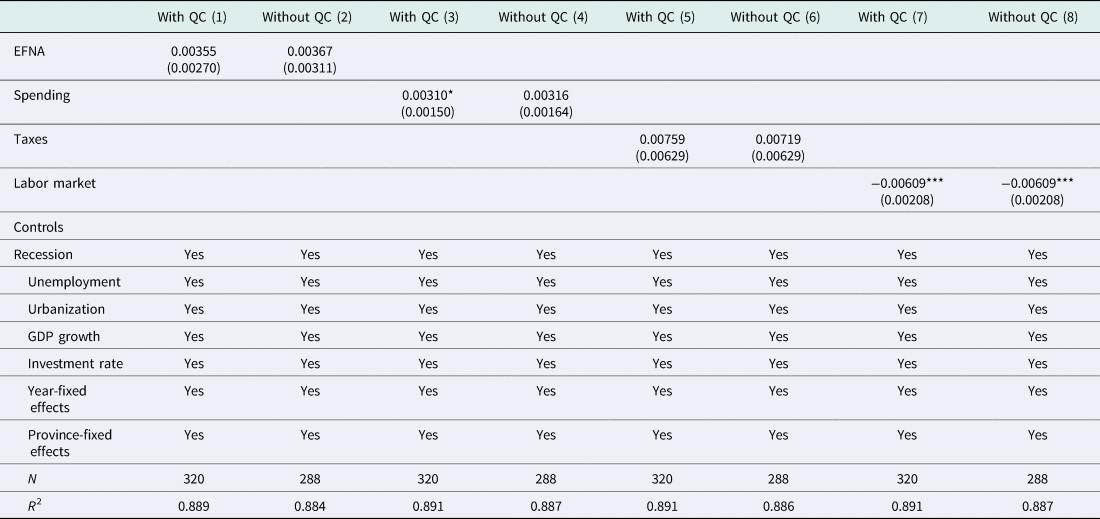
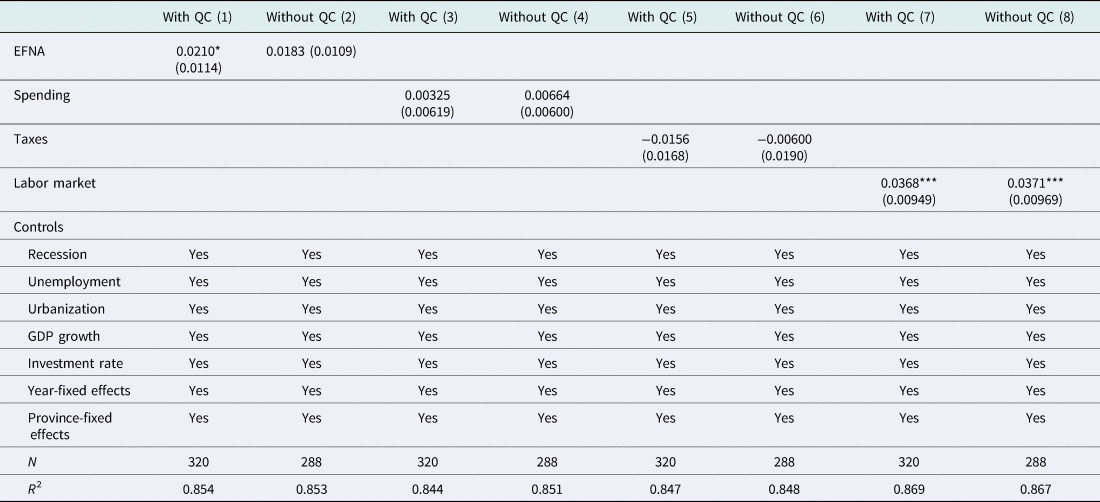
Finally, we examine a person's dollar mobility (see Tables 6 and 7), or the average percentage increase in income over the period. Here, we see somewhat weaker results, as a higher EFNA score does not significantly increase dollar mobility throughout the sample. Additionally, the labor market component yields a significant and negative effect on absolute income mobility: a one-point increase in economic freedom in that component reduces absolute gains by 0.6% for all deciles. This result likely reflects the nature of labor market regulations which aim at protecting certain workers – those higher up in the distribution – from competition. For people in the lowest income decile, an extra point of labor market freedom increases absolute gains by 3.7%. This is consistent with our finding that labor market freedom is strongly associated with greater upward relative mobility for both the poorest and the aggregate population. It also speaks to our point that labor market regulations, by restricting entry, may prop up the income of higher-income groups at the expense of the mobility of lower-income groups.
The results with regards to labor market freedom are probably the most interesting. Of all the components of the EFNA, it is the one that showed the largest improvement. On average, the values of each of the components in 1982–1987 were 5.2, 6.23 and 2.31 for government spending, taxation and labor market, respectively. By 2012–2017, these values stood at 4.66, 5.1 and 5.15. The overall index increased from 4.59 to 4.97 over this period. As such, the benefits of economic freedom were driven largely by the labor market component. Moreover, all the subcomponents of labor market freedom increased importantly (and values converged across provinces).Footnote 25 This suggests that comprehensive reforms to liberalize labor markets may yield very potent effects on income mobility.Footnote 26
5. Conclusion
Few scholars dispute that, in the aggregate, economic freedom is tied to income mobility. However, there are empirical blind spots. First, there are very few studies that connect income mobility with economic freedom, and those that do tend to rely on relatively small samples. Second, there are good reasons to expect empirical ambiguity as some components of economic freedom indexes – such as the size of government – can be inversely associated with income mobility. In this paper, we attempted to deal with these blind spots by using Canadian data regarding income mobility since 1982 in conjunction with the Fraser Institute's EFNA index. We have thus produced the first effort to test this connection with more than a cross-section of data applying to a few countries.
On the whole, our results suggest that economic freedom index values are associated with greater mobility levels across a range of relative and absolute measures. However, the components for the size of government and for taxation levels do not yield strong and consistent effects. This implies that labor market freedom is the most important driver of income mobility. Policy-makers in rich countries with secure property rights regimes could collect important low-hanging fruits from labor market reforms.
Our findings, we should point out, are probably a lower bound estimate that should motivate future research. First, Canada is a high economic freedom country. The marginal effect of economic freedom within Canada at such a high level is unlikely to be as large as it would be for less free countries. Second, we elided the potentially crucial role of property rights protections in achieving greater income mobility. This was because the provincial economic freedom index we used did not include any property rights component – understandable given that there is little variation in such rights at the subnational level. Yet, the limited empirical literature on income mobility suggests that this component is not negligible. There is, therefore, a good case to be made that we are presenting a lower-bound assessment of the effects of economic freedom. Future research that remedied the limitations imposed by available data would, we believe, produce results showing even stronger effects than we have found here. We hope that this constitutes a sufficient call for further efforts in the future.
Acknowledgements
We wish to acknowledge the helpful comments of Joshua Hall. Vincent Geloso also thanks Ginger Ale and Tanqueray Gin for the inspirational support.