


Introduction
High-latitude areas, such as the Antarctic continental margin, are amongst the most sensitive to climate changes because of their extreme environmental conditions. in the Antarctic marine environment, biogeochemical (luxes supply a significant part of the sedimentary material. The delivery of organic carbon and biogenic silica to the bottom mostly depends on primary productivity and preservation efficiency (DeMaster and others, 1996), which are a funution of sea-ice extent and, therefore, of climate. in turn, changes in biogeochemical processes affecting the carbon balance in the upper water column of this region could significantly modify the level of atmospheric CO2 and potentially influence global climate. The record of past environmental changes, and their effects on oceanic biogeochemistry, is preserved in marine sediments (Reference DomackDomack and others, 1993; Frank, 1996; Frank and others, 1996) and can be used to reconstruct the response of the northwestern Ross Sea to natural global climate changes during the late Quaternary (Anderson and others, 1992; DeMaster and others, 1996; Licht and others, 1996; Reference Brambati, Barker and CooperBrambati and others, 1997; Ceccaroni and others, in press). Our interest was mainly directed towards understanding sediment accumulation during the late Pleistocene and Holocene and to determining fluxes of organic carbon and biogenic silica and their variability as a function of environmental conditions. We addressed also the relative importance of vertical and lateral transport in the basins, and tried to estimate paleoproductivity using 10Be and biogenic Ba, respectively.
Study area and sampling sites in the northwestern Ross Sea. Gores from the deepest areas of the basins are 14,19,28,29 and 30. Cores 15,25, and 27 were retrieved from the flanks of Mawson and Crary banks.

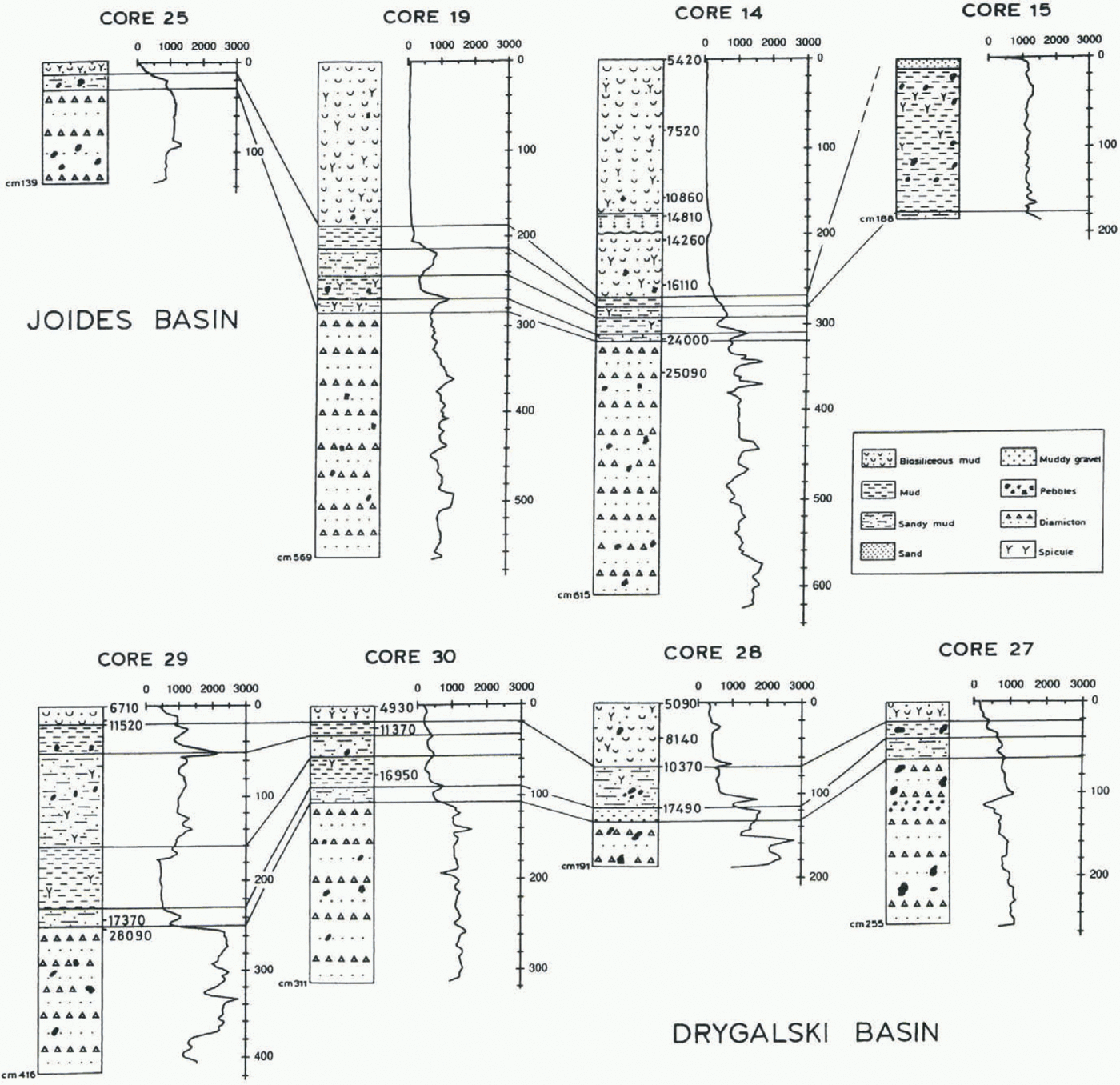
Lithological composition, magnetic-susceptibility-depth profiles, and core correlation. Conventional14Cages (Reference Stuiver and PolachStuiver and Pollach, 1977) are reported.
Materials and Methods
In December 1990 and February 1991, eight sediment gravity cores were collected from the Joides and Drygalski basins in the northwestern Ross Sea. Core locations (Fig. 1) were selected in order to study sedimentary sequences in the two shelf basins and their margins. A comparison between gravity cores and box cores (Reference Labbrozzi, Langone, Frignani and RavaioliLabbrozzi and others, in press) showed that gravity coring could cause the loss of 0-5 cm of top sediment. All cores were X-radiographed, scanned for magnetic susceptibility, opened and described. Samples were taken at selected depths, dried at 60°C and analysed for: (1) total organic carbon (TOC) and total nitrogen (N), using a CHN analyser after hydrochloric acid treatment; (2) biogenic silica, by the progressive-dissolution method (De-Master, 1981); (3) Fe, Al, Ba and Mn by AAS after melting with Li metaborate and dissolution with 8N HCl (Frank, 1996); (4) uranium and thorium isotopes, from alpha counting after radiochemical separation and eleclrodeposition on stainless-steel disks (Frank, 1996); and (5) 10Be by AMS, carried out at the Institute Paul Scherrer, Zürich. Nineteen AMS radiocarbon dates, relative to different levels in four cores (14,28,29 and 30), were determined from bulk organic matter. Most analyses were carried out at the Antares Mass Spectrometry, Australian Nuclear Science & Technology Organisation ( ANSTO), whereas 14C dates for core 30 were obtained from Brambati and others (1997). Porosities and dry bulk densities were calculated from the percentage water content (Reference BernerBerner, 1971) assuming a sediment density of 2.55 g cm−3 . Biogenic-barium concentrations were calculated from the empirical formula suggested by Dymond and others (1992): Biogenic Ba = Total Ba - (0.0075 AI), where AI is the aluminium concentration in the sample.
Concentration-depth profiles of porosity, total N, biogenic Ba, Al, Mn and Fe relative to core 19.

Results
Core lithologics and depth profiles of magnetic susceptibilities are shown in Figure 2. The sedimentary sequence consists of three principal lithological units. The deeper one, massive and overconsolidated, is a diamicton (Cooper and Davey, 1987), which might represent basal till or glacialmarine sediment. This facies is characterised by high magnetic susceptibility and null, or low, content of biogenic components. Above the diamicton there are glacial-marine sediments, composed of muddy sand interbedded with mud and characterised by an upward increase of the biogenic components and a corresponding decrease of magnetic susceptibility. The uppermost unit is a biosiliceous mud, with a relatively high content of biogenic silica and TOC. in core 15, from the flank of Mawson bank, this lithology is replaced by a sandy layer, which is a residual lag of previously deposited glacial-marine sediment. Pebbles are found throughout the sediment column at all sites and represent the coarsest fraction of the continental input. According to the patterns shown in Figure 2, magnetic susceptibility is high in sediments with an important detrital component, and low where a significant fraction of the sediment is biogenic. in most cases magnetic-susceptibility profiles clearly show a variation from high values at depth to low values in the upper part of the core, marking the shift in sediment input during the retreat of the ice sheet. An exception is represented by core 15.
Concentration-depth profiles and fluxes of organic carbon and biogenic silica. in most cases the distribution of total nitrogen(not shown) parallels that of organic carbon.

Figure 3 shows concentration-depth profiles relative to core 19, as an example of the results obtained in this study. Concentrations of biogenic Ba, Al, Fe, and Mn were measured only in samples from cores 19, 28 and 30. The depth distribution of AI and Fe concentrations are related to the abundance of the detritic component and show a correlation with magnetic susceptibility. Mn mostly behaves like AI and Fe.
Figure 4 shows concentration-depth profiles of organic carbon and biogenic silica. in general, biogenic silica, organic carbon and total nitrogen content increase in recent times. The cores from the joides basin show TOC, biogenic Si and biogenic Ba concentrations from 0.1 to 1.3%, 0 to 35% and 18 to 520 μg g−1, respectively. in the Drygalski basin, closer to the land, values are lower: 0.2 to 0.9%, 2 to 25% and 0 to 224 μg g−1, respectively.
Discussion
Sediment lithology and core correlation
Based on lithologes, magnetic-susceptibility depth profiles and porosities, a core correlation is suggested which provides the chronostraligraphic framework (Fig. 2). The oldest units are diamictons, probably formed during the Last glacial Maximum by the grounding ice sheet. Overconsolidation, absence of fossils and stratification, bad sorting and presence of reworked pebbles suggest a glacial origin as basal till (Reference Kellogg, Truesdale and OstermanKellogg and others, 1979; Anderson and others, 1980, 1984; Dunbar and others, 1985). However, the retrieval of well-preserved fossils at depths consistent with their age in core 19(19 00014C years BP according to Brambati and others, 1996), suggests that the diamicton contains glacial marine sediment. This sediment was deposited and then overconsolidated during phases of retreat and readvance of the grounding line during an overall phase of retreat. A similar pattern was proposed for another area of the Antarctic continental shelf by Reference Gingele, Kuhn, Maus, Melles and SchoneGingele and others (1997). Above these sediments, a transitional unit corresponds to decoupling of the grounded ice (Kellogg and others, 1979). in this situation the glacial input is still present, but the sediment is enriched in marine-biogenic components. We have assumed that the most significant increase of biogenic silica and TOC content, with the deposition of biogenic mud and ooze, marks the onset of present conditions of a seasonally open sea. Low values of magnetic susceptibility are the result of lessened continental inputs. This facies is best represented by cores from the deepest zones of the basins, whereas present glacial-marine sediments closer to the coast are dominated by ice-rafted debris (>20%) and terrigenous material (Dunbar and others, 1985).
A one year time series of current velocities was obtained for the northern part of Mawson Bank in 1995. The average current speed, measured by the bottom meter, was 30 cm s−1 with peaks of 55 cm s−1 (PiccO and others, in press). These high currents winnow sediments previously deposited and prevent accumulation of newly formed biosiliceous mud. Core 15 represents this situation.
Radiocarbon dates from the northwestern Ross Sea sediments. Errors are referred to lσ.(*) from Brambati and others (1997)

14C chronology and accumulation rates
Conventional 14Cages (Stuiver and Pollach, 1977) are reported in Table 1 and Figure 2. The 14C ages for the core top samples are 6710-4930 14C years BP. Such high values are not uncommon for Antarctic marine environments (Domack and others, 1989; Domack., 1992; DeMaster and others, 1996; Licht and others, 1996). in particular, the surface age of the organic carbon in Ross Sea sediments is typically 3000-2000 14C years BP, with older ages (10000-5000 14C years BP) in slowly accumulating slope deposits (DeMastcr and others, 1996). Old surface ages may arise from several factors: (1) plankton growth in 14C-dcpleled waters; (2) loss of the core top during collection; (3) surficial sediment mixing; and (4) supply of reworked carbon (Domack and others, 1995). Because of uncertainties in the Antarctic reservoir effect and the difficulty in assessing the varying influence of the factors listed above, we chose not to correct our dates. Sediment accumulation rates were calculated assuming constant sedimentation between dated levels and the correlations shown in Figure 2 were used to obtain estimates for cores without 14C data. When surface 14 C ages were lacking, rates were calculated using the surficial value of the closest core. The results are reported in Table 2. Accumulation rales reported by Kellogg and others (1979), Reference HilfingerHilfinger (1995) and Franceschini (1995) for sediments of the southwestern Ross Sea and the Joides basin vary from 3-10 cm ka−1. According to DcMastcrand others (1996), sediments in this area accumulate at rates of 0-250 cm ka−1, with an average value of 7.4cm ka−1. Our values agree with those reported by other authors, and confirm high heterogeneity of sedimentation processes on the shelf in relation to location and topography.
Sediment accumulation rates calculated on the basis of 14C ages and core correlation

In the Joides basin, sediment accumulation rates vary from <1 to 38 cm ka−1. The highest values characterise modern sediment in the deepest part of the basin and decrease down-core, with the exception of the interval between 270 and 320 cm at site 14. On the other hand, modern sediment accumulation is slow (core 25) or null (core 15) along the southeastern flanks of Mawson bank and Crary bank. Although sediment accumulation at site 25 was also limited under glacial-marine conditions, at site 15 the glacial-marine unit appears relatively expanded (Fig. 2) and the accumulation rate could have been very high.This would he consistent with the seismic records, which indicate that thick packages of material were deposited on the sides of the troughs during the deglaciation (Reference Shipp and AndersonShipp and Anderson, 1994).
In core 14, between 205 and 175 cm depth, a turbiditic event is recorded. This layer consists of graded sand and is characterised by an erosive contact at the base and by a faint lamination in the upper part. The hypothesis that it represents a turbidite is also supported by the Features shown in most profiles and by the inversion of the 14C age at 181-184 cm depth.
In the Drygalski basin, sediment accumulation rates range from 4 to 38 cm ka−1. Here the most recent accumulation rates are low compared with those calculated for the Joides basin and high rates characterise the deposition of glacial-marine sediments in cores 29 and 30. On the other hand, sediments at depth in cores 27 and 28 were deposiied very slowly. in this basin, the patterns show two different trends: (1) in the northern area (core 28) accumulation rates increased with time, starling with the beginning of marine biogenic sedimentation; (2) at sites 29 and 30. close to the Drygalski Ice Tingue, glacial-marine sediments accumulated at high rates. This is probably the result of the high input of sediment from the melting of basal ice of the retreating ice tongue. Core 27, from the northwestern bank of the Crary bank, shows low sediment-accumulation rates and minor variations with time.
Biogenic fluxes
Dry hulk densities were used to calculate sediment accumulation rates, which were combined with concentrations of TOC and biogenic silica to obta in the burial fluxes of the biogenic components. The temporal changes of the duxes, which are mainly related to the patterns of accumulation rates, is shown in Figure 4. The highest present-day (luxes occur in the deepest parts of the basins (TOC, 0.05-0.2 g cm −2 ka−1; biogenic silica. 1.5-5 gcm−2 ka−1), whereas topographic highs show the lowest values (TOC, 0.01—0.1 g cm−2 ka−1; biogenic silica, 0.1 1.1 gcm−2 ka−1). in most cases, fluxes change dramatically with the establishment of open marine sedimentation. This change occurred at different times in the two basins, fust in thejoides and then, after a delay of about 6000 years, in the Drygalski (figs 2 and 4). With eight dated levels, we achieved the most detailed chronology and flux history for core 14 (Joides basin). Here, a trend is clearly observed in that both TOC and biogcnic-silica fluxes increase during the Holocene, though slightly differently. For example, in the uppermost 80 cm (7520 ± 50 uncorrected 14C years BP) opal concentration and flux increase more than organic-carbon ones (fig. 4.)
Vertical and lateral components of fluxes
Recently, Reference Jaeger, Nittrouer, DeMaster, Kelehner and DunbarJaeger and others (1996) addressed the influence of the lateral advection of particles in decoupling the processes in surface waters from the underlying sea bed. François and others (1995) and Reference KumarKumar (1994) showed that the lateral component of sedimentation can be as much as ten times greater than the vertical contribution. in certain cases, it is possible to estimate the contribution of lateral advection with respect to vertical deposition using 230Th inventories (Frank and others, 1996). However, this method is difficult to apply in these conditions since the generally low water-column depth provides low excess 230Th to the sedi-ments. Furthermore, a process of authigenic-ttraniuin enrichment is indicated by the ratios of 230Th/234U and 230U/230Th. The former is low and the latter, which should be close to 0.25 in marine sediment (unpublished data from A. Mangini), is well above this value in core 19 in most cases, ranging between 0.4 and 0.7 down to 180cm depth.
In an effort to evaluate the relationship between productivity and sedimentary fluxes, the natural isotope l0Be was determined. It is known that biogeochemical processes in the water column play a major role in the transfer to the sediments of 10Be produced in the atmosphere by cosmic radiation. Because of its relatively long residence time in the water, an efficient transfer occurs in areas of high productivity or particle input (Rutsch and others, 1995). Fluxes of l0Be at station 19 vary between 5 x 10⁹ and 12 X 109 atoms cm−2a−1 from late Pleistocene to Holocene. Assuming that the system is in a steady state, the atmospheric production(1.21 ±0.26 x 10⁹ atoms cm −2 a−1) should equal the downward flux. Measured fluxes largely exceed (even by 8 times) the expected ones. The enrichment of 10Be in these sediments relative to the atmospheric input can be explained by a significant contribution of sediment from nearby areas due to lateral advection and focusing. 210Pb inventories and fluxes can be used in the same way. Although previous data suggested that rain rates account for most of the material accumulating in the deepest part of ihc basins (Langone and others, in press), other evidence now confirms that sediment focusing can be a very important sedimentary process for basin areas (Labbrozzi and others, in press).
While minimum values of TOC and biogenic-silica fluxes are similar in the two areas, the highest fluxes characterise the Joides basin. These differences are difficult to explain on the basis of present knowledge and could be an artefact due to a different incidence of sediment focusing.
Productivity and paleoproductivity
Burial rates of TOC and biogenic silica depend on the amount of material produced in the euphoric / one and that transported laterally. Our results show these rates are particularly high in the Joides basin. A tentative estimate of export paleoproductivity was carried out according to François and others (1995) and Reference Nürnberg, Bohrmann, Schlüter and FrankNürnberg and others (1997): biogenic Ba concentrations and fluxes were calculated for cores 19 and 28. Fluxes vary from 5 to 60gCm−2 a−1, and are higher in the Drygalski than the Joides basin. These values are in agreement with the integrated shclf-wide export productivity of 16gCm −2a−1 estimated by Reference Nelson, DeMaster, Dunbar and SmithNelson and others (1996) for the Ross Sea. According to uranium and Mn data, however, these cores could be anoxic or sub-oxic and calculated biogenic Ba may not be a suitable paleoproductivity proxy, due to possible diagenetic re-mobilisation (Dymond and others, 1992). Because of this, barium-derived biogenic fluxes are likely underestimated. On the other hand, the increase of biogenic Ba flux in core 19 at the onset of the open marine sedimentation, which parallels the increase of the 10Be flux, might reflect increased focusing rather than simply an increase of bio-genie production in overlying waters.
Conclusions
-
(1) The sediment sequence in cores from thejoides and Drygalski basins consists of three principal lithological units. From past to present they are: basal tills, glacial marine sediments and biogenic mud and ooze.
-
(2) Maximum concentrations of biogenic components (organic carbon >1% and biogenic silica >30%) were found in the deepest zones of the basins, whereas the lowest contents were found in cores from topographic highs.
-
(3) Maximum accumulation rates during the Holocene vary between 38 cm ka−1 in the central pari of thejoides basin and 1.4cmka−1 on the banks. Burial fluxes of biogenic components follow the same pattern: basins accumulate faster (TOC, 0.05-0.2 gcm −2 ka−1; biogenic silica, 1.5-5 g cm−2 ka−1) than banks (TOC, 0.01-0.1 g cm−2 ka−1; bio-genic silica, 0.1-1.4 g cm−2 ka−1).
-
(4) Depth profiles of both physical properties and fluxes record a dramatic change corresponding to the establishment of conditions of seasonally open marine sedimentation. This change occurred first in the Joides basin and then, with a delay of ca. 6000 years, in the Drygalski basin.
-
(5) l0Bc was used to estimate the relative importance oflal-eral transport and vertical sinking. Results from cores 19 and 28 show the flux is up to eight times that expected, suggesting that focusing is a very significant processes in basin areas. Also, biogenic Ba fluxes seem dominated by lateral advection.
-
(6) A different incidence of lateral transport may account for the different accumulation of biogenic material in the two basins.
Acknowledgements
This research was carried out with in the framework of the projects “Ecology and Biogeochemistry of the Southern Ocean” and “glacialogy and Paleoclimatology” of the Italian Programma Nazionale di Ricerche in Antartide, and supported financially by the Ente Nazionale Energia e Ambiente. The authors wish to thank L. Labbrozzi, E. Lipparini, G. Rovatti, G. Marozzi, and V. Palumbo who helped in the sampling operation and/or carried out analytical work. Special thanks are extended to P. Sedwick who reviewed the paper and provided invaluable comments and suggestions. The drawings were provided by G. Zini. This is contribution No. 1128 from the Istituto di Geologia Marina, Consiglio Nazionale delle Ricerche, Bologna.



